Showing posts with label Irwin Allen Binge. Show all posts

Wednesday, June 10, 2020

Irwin Allen Binge: The Return of Captain Nemo (1978)


"I am Captain Nemo. I have been asleep for 100 years aboard my submarine, Nautilus. I would probably still be left encapsulated had it not been for two intrepid agents of American Naval Intelligence...who quite by chance came upon my ship trapped by seismic underwater quakes..."

-Opening voice-over narration to The Return of Captain Nemo (1978)

On March 8, 1978, CBS began airing in prime-time the latest science fiction TV series from the master of disaster Irwin Allen (The Towering Inferno, The Swarm, etc.)

In essence, this new venture -- which represented Allen's final attempt at series work -- was an unholy hodgepodge of Voyage to the Bottom of the Sea (1964-1968) mixed with a little Jules Verne, and with a huge helping of Star Wars, which was still playing in theaters and had become nothing less than a national craze. 


The extremely short-lived series was called The Return of Captain Nemo, though some viewers may remember it by its foreign, theatrical title, The Amazing Captain Nemo.

Only three hour-long episodes of The Return of Captain Nemo ("Deadly Black Mail," "Duel in The Deep" and "Atlantis Dead Ahead") were produced and aired, and the obscure, extremely rare series has mostly been seen since in an abbreviated compilation movie format. 


This strange broadcast and distribution history has resulted in some apparent confusion about whether or not the original production was a mini-series, a made-for-TV movie or simply a series. All the evidence suggests the latter, since the three 45-minute segments feature individual titles and writer/director/guest star credits. 

The series aired in prime time, drew terrible ratings, was unceremoniously canceled, and then exhumed from its watery grave as the theatrical or TV-movie that many nostalgic folk of my generation remember.

The first episode of The Return of Captain Nemo, "Deadly Blackmail" commences as a diabolical mad scientist, Dr. Waldo Cunningham (Burgess Meredith) blackmails Washington D.C. for the princely sum of one billion dollars from his perch in the command center of his highly-advanced submarine, the Raven.

Unless the President pays up in one week's time, Cunningham will fire a nuclear "doomsday" missile at the city. To prove his intent is serious, Cunningham destroys a nearby island with a laser called "a delta ray." 


The creature in charge of firing this weapon is a frog-faced golden robot in a silver suit and gloves. Every time the delta ray is fired (over the three episodes...), we cut back to identical footage of this strange frog robot activating the deadly device.

This introductory scene sets the breathless tone and pace for much of the brief series, proving immediately and distinctly reminiscent of George Lucas's Star Wars. Specifically, Cunningham's right-hand man in the command center is a giant, baritone-voiced robot/man called "Tor." This villain -- when not speaking directly into a communications device that resembles a high-tech bong -- looks and sounds like the cheapest Darth Vader knock-off you can imagine, right down to the rip-off James Earl Jones voice.

Tor even boasts psychic abilities not unlike the power of the Force. When intruders steal aboard the Raven, for instance, Tor can psychically senses their presence there; just as Vader could sense the presence of Obi-Wan aboard the Death Star. Yes, I know Darth Vader isn't actually a robot and his power wasn't actually psychic, but this is the kind of distinction that escaped the creators of The Return of Captain Nemo.


And speaking of The Death Star, Cunningham -- who essentially plays Governor Tarkin to Tor's Lord Vader -- the submarine Raven's deadly delta ray looks an awful lot like the primary weapon of that destructive imperial space station. 

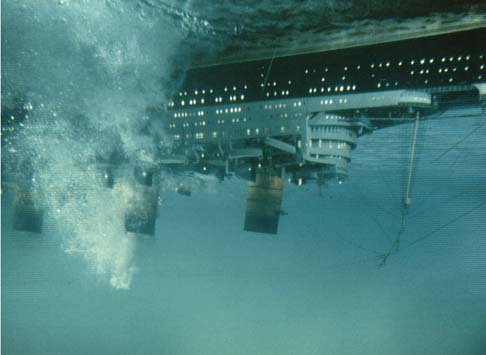
Much more troubling for this fan, however, is the fact that the Raven, Cunningham's powerful submarine, is actually a just barely re-dressed Space:1999 eagle spaceship, replete with the four rear-mounted rocket engines, the dorsal lattice-work spine, the modular body, and the front, bottle nose capsule. 

Yep, it's all there


Many of the underwater sequences in The Return of Captain Nemo are incredibly murky and feature superimposed bubbles and dust in the foreground (probably to hide how bad the miniatures look...), but I've attempted to post a few photographs of the Raven here, so you can see for yourself that Cunningham's ship is an underwater Moonbase Alpha eagle transporter.

Anyway, while Washington D.C. puzzles over the nefarious threat of Professor Waldo Cunningham, two Navy frogmen, Commander Tom Franklin (Tom Hallick) and Lt. Jim Porter (Burr De Benning) happen upon an ancient submarine trapped on an undersea reef. From an exterior port hole, they detect a figure trapped inside a smoke-filled glass tube. They board the ship and find that this figure is actually the legendary Captain Nemo...in cryogenic freeze! 


The two men immediately free Captain Nemo (Jose Ferrer) from hibernation and he steps out heroically, wearing a cape and ready for action (after exclaiming "my experiment worked!")

Turns out Nemo has been asleep for one hundred years, and it is now April 9th, 1978. The spry captain reveals to Tom and Jim that Jules Verne was no mere novelist, but actually his biographer...and that all his adventures are true. 


Furthermore, Nemo wants to resume his search for the lost continent of Atlantis immediately. Jim and Tom, meanwhile, are astounded to see that the 127-year old Nautilus is a nuclear-powered submarine, one equipped with all the latest technology...including radar scopes. Interestingly, it is not just any radar device Captain Nemo has invented (along with cryogenic suspension and nuclear-powered submarines...), but rather radar devices that are identical in shape, mode and design to ones we have now on board our state-of-the-art ships

Incredible coincidence, no?

Jim and Tom help free the Nautilus from its perch and convince Captain Nemo to return to their headquarters in San Francisco. There, they all report to the leader of an Elite Navy Group commanded by a man named Miller (Walter Stevens). Miller promptly recruits Nemo as a secret agent for the government, and in return the Nautilus gets a refit (though it clearly doesn't really need one...) and a full Navy crew.

At this point in the story, I must admit, I nearly lost my lunch. 


The independent, head-strong, world-weary Captain Nemo of Jules Verne is -- without much argument or debate -- transformed into a dedicated agent for the U.S. government?! After a history of decrying war? After a history of sinking warships? After exiling himself to the "liberating" world under the sea? After leaving the world of man permanently behind? 

This man of science just becomes...a tool of one particular government?

Methinks Irwin Allen (along with Franklin, Porter and Miller) never actually read any Jules Verne.

Instead, Allen must have been secretly screening recent episodes of Lynda Carter's Wonder Woman Man from Atlantis (1977), since the series premise (fish-out-of-water individual becomes government agent) of The Return of Captain Nemo shares more in common with those seventies superhero TV series than it does the literary work of Jules Verne, or any previous screen incarnations of Captain Nemo, for that matter.

Regardless, here we are presented with the most bizarre film interpretation of Captain Nemo imaginable: as genius creator of suspended animation (!), and as dashing, adventurous secret agent (!) for the United States Navy. This iteration of Nemo boasts not a whit, not a scent, not even an iota of a dark or even melancholy side. 


Instead, this Nemo is an exuberant man of action.

In fairness to Ferrer, he's quite charismatic and physically capable in this leading role, even if the writing (and the entire scenario...) is ridiculous to the point of inanity. One wonders what Ferrer might have accomplished playing the character in a more faithful incarnation of Captain Nemo's world. 


This Nemo gets to voice some flowery language ("We must stroll through this orchard without bruising the fruit," he notes metaphorically of an undersea waste dump, in the second episode), and this Nemo does seem "above" worldly concerns (like Star Trek's Spock), but Nemo almost never asks Tom and Jim any questions about the new world he has arrived in. 

He shows no curiosity about the 20th century or its customs, which seems odd. Wouldn't Nemo the scientist wish to see what man has accomplished? Or does he just assume he's already accomplished more?

Captain Nemo's first assignment as a government agent is to prevent Waldo Cunningham from firing his doomsday nuclear missile at Washington D.C. 


The Nautilus hunts the Raven at the bottom of the sea, and Nautilus evades destruction by delta beam when Nemo activates the Nautilus's protective electric force field. 

Deciding he needs to understand his nemesis better, Nemo boldly boards the Raven and is promptly taken hostage by Tor and Cunningham. Together, Nemo and Franklin escape custody and run down an advanced corridor that also appears to have been lifted directly from the Death Star construction blueprints. 


Captain Nemo -- now equipped with a hand-laser, destroys a bevy of Cunningham's storm-trooper-type robot goons in this very corridor, and the music actually sounds remarkably like a sped-up Star Wars theme. Again, I kid you not. The imitation is just...brazen.

Eventually, Nemo destroys Cunningham's nuclear missile by firing a laser beam weapon he invented(!), and the Raven slinks away under the sea to fight another day. In case you don't detect the pattern here, the writers left themselves an easy out. 


Whenever threatened with destruction, Captain Nemo has a new invention up his sleeve that saves the day. A suspended animation device, a radar, an electric force field, now a ship-mounted laser beam. Not only is Nemo a genius, I guess, he's a super duper uber genius. There's nothing this guy didn't invent a hundred years ago. Nothing.

Because Star Wars is ripped-off so dramatically in the opening episode of The Return of Captain Nemo, the series changes tactics in its second episode ("Duel in the Deep") and rips off the premise of Space:1999 instead. Here, Waldo Cunningham (again!) threatens the safety of the world when the Raven begins ripping up (with grappling hooks...) the radioactive nuclear waste containers at the bottom of the sea, 35,000 feet down, at the Mindanao Trench near the Philippines. 


Just think the dark side of the moon, the atomic waste dumps, and the inaugural 1999 episode "Breakaway."

The Nautilus and Captain Nemo are assigned to repair the breaches in the nuclear waste dumping ground before a wave of radioactivity leaks to the surface, destroying all life there. Two nuclear physicists come aboard to help out, the beautiful Kate (Lynda Day George) and the duplicitous agent, Cook (Mel Ferrer). If you've ever seen any episode of Voyage to the Bottom of the Sea, you know that Irwin Allen really loves his submarine saboteurs (secret spies show up in every other episode during the early seasons of that series...) and here the Nautilus is drawn off course by undersea magnets, surrounded by sea mines, and Nemo's bathosphere is also sabotaged. 


Fortunately, Kate helps Nemo save the day, defeat Cook, and joins the Nautilus crew, becoming a regular on the series. At the end of the day, Cunningham escapes again and the breach in the nuclear waste dumps is repaired by a lucky rock fall.

The third -- and mercifully -- final episode of Return of Captain Nemo boasts the name of Robert Bloch as one of its writers, but one has to assume he was heavily re-written, or had little to do with the show's development. 


"Atlantis Dead Ahead" also features Horst Bucholz as Atlantis's King Tibor and a very young Anthony Geary (General Hospital's Luke of "Luke and Laura" fame) as an Atlantean retainer named...Bork. In this adventure, Captain Nemo easily locates Atlantis (did I mention he's a super duper, uber genius?) but finds that Waldo Cunningham has already beaten him to the lost continent and enslaved the underwater people there with dastardly mind-control head-bands.

Cunningham captures Nemo and Tom Franklin and paralyzes the crew of the Nautilus (including Kate) with a "z-ray" that freezes the unlucky crew "in time," whatever the hell that means. Tom is fitted with his own individual brain-washing head-band (which makes him look like he's ready to participate in a Jane Fonda aerobics video...) and forced to torture Nemo.

Nemo himself is attached to a brain-sucking device that will reveal to Cunningham all of his one-hundred-year old secrets, including the formula for Nautilus's laser ray. Since Cunningham already has a death ray, why he needs Nemo's death ray is a bit of a mystery. 


Anyway, Nemo outsmarts Cunningham by re-playing in his mind (and broadcasting his thoughts on the view screen...), information about the Navy and U.S. government that re-activates Tom's sense of patriotic loyalty. They escape together and there's yet another shoot-out between Cunningham's robot storm troopers and our heroes in the very same Death Star corridor. Still, Cunningham proves more dangerous than ever because he posses twenty pellets of a poisonous element called "Crosar" which he plans to release in 20 world cities.

After an undersea battle between Nautilus and Raven -- in which the Raven is apparently destroyed-- Captain Nemo decides to leave the freed Atlantis behind, "untouched by our progress." King Tibor thanks him and then jumps into the water, never to be seen again.

Then, apparently with nothing left to accomplish, Nemo turns to Kate (a possible love interest...) and suggests they head back to San Francisco and have a meeting with Mr. Miller, so the boss can give the Nautilus new orders. Yep, the inventive and brilliant captain Nemo can think of nothing else to do with Nautilus, and just wants a new assignment from a government bureaucrat. 


A sad end for a sad re-vamp.

I was nine years old when Return of Captain Nemo first aired on CBS, and I have to confess...I loved it at that age. It had lasers, submarines, evil robots, Captain Nemo, underwater adventure...everything a young, imaginative mind could ask for. 


As an innocent, impressionable youngster I had no inkling just how nonsensical, how ridiculous, how vapid, how inane and how derivative the Allen series was. Seeing the program today, I'm amazed but just how craven it remains: how desperate and frenzied it is to latch on to the latest trend in the pop culture (Star Wars) and artlessly exploit it.

I've blogged many, many TV movies and series here -- and if you read my blog often, you know I endeavor to highlight the positive -- but off the top of my head, I can't recall another TV series so regularly, so routinely, dreadful. The Return of Captain Nemo is so bad, so confused about itself, that it's actually baffling at points.


Tor, for instance, is not only a robot sidekick with psychic powers (why? why?), but also a xenophobic bigot! For some reason, he is constantly seen railing against "aliens." 


Only problem, there are no aliens on the show. Tor keeps blaming aliens for everything...and there aren't any aliens around.

Why would Cunningham program a robot with this weirdo tic? If Tor is not a robot, what the hell is he, and why is he working for Cunningham in the first place? 


He can't be an alien and hate aliens, can he? 

It's clear the character was just thrown in to the mix, apparently at random, to appeal to the demographic that thought Darth Vader was super cool. But no real thought was ever given to Tor as a character. No thought was given to his background, his creation, his very nature.

Tor's not alone, either. The two Navy officers, Tom and Jim, continually play second fiddle to Nemo and have absolutely nothing of interest to do but issue orders from the bridge of Nautilus in Nemo's absence. In Voyage to the Bottom of the Sea, Captain Crane suffered from some of the same issues (always proving far less interesting than his boss, Admiral Nelson), but Tom and Jim are approximately a million times more uninteresting even then Crane.

And for Cunningham to act as the primary villain of all three episodes, escaping and returning, forever escaping and returning, makes the series seem repetitive and dull. And that's being polite. 


Imagine if The Master were the only villain the Doctor ever encountered, and you'll understand what I mean. Some essential sense of jeopardy is lost because you just know here that Waldo is always going to get beaten, always escape, always return, always gets beaten and always escape, ad infinitum, ad nauseum. Burgess Meredith is a good actor, of course, but at times (particularly in one view screen exchange with Nemo...) you can see the veteran glancing down out of shot and then back...apparently to read the off-screen lines.

A talented writer could probably tell a Captain Nemo story with a flavor of Star Wars thrown in and get away with it if he or she had an airtight narrative, interesting characters and some sense of style. But The Return of Captain Nemo is bereft of all those ingredients. It is poorly-written and seems dashed off from the Irwin Allen assembly line in order to exploit Star Wars before the craze wore off.

Again, you have to feel sorry for Jose Ferrer. He's got the gusto, the presence, the intelligence, the wit, the attitude, and the physicality to make an excellent Captain Nemo, but the scripts here require him to speedily race from one crisis to another, saving the day like a campy superhero, and the result is that he never seems like a fully-developed human being.

Many genre fans of my generation have -- like me -- spent an inordinate amount of time seeking out The Return of Captain Nemo. It's an item of nostalgic remembrance, something that appeared on a major network (and remember, in those days of the disco decade there were only three networks...) and then disappeared, never to be heard from again. 


The pull of such a production is tantalizing. Did I really see that? Did it really exist? Have I lost my mind? Was I dreaming? Was it any good? 

Indeed, this is the very journey I undertook.

Unfortunately, in the case of The Return of Captain Nemo, this is but a dismal voyage to the bottom of the barrel. 

Go ahead and watch it if you dare, but sometimes old memories -- like Captain Nemo himself -- are best left in stasis. 

I'll always cherish my memory of watching (and loving) the show as a nine year old kid, but I dare not re-visit this series again as an adult. Not trying to be mean here. Believe me, I'm being as charitable as possible. The great Captain Nemo deserves so much better than this travesty.

Tuesday, June 09, 2020

Irwin Allen Binge: The Towering Inferno (1974)


The Towering Inferno (1974) is the towering accomplishment of the 1970s cinema of disaster.  

This Irwin Allen film was directed by John Guillermin (King Kong [1976]), nominated for eight Academy Awards including Best Picture, and it took home awards for best cinematography, best editing, and even best song .  

As one might expect from a list of kudos like that, The Towering Inferno is dazzling in terms of visual presentation, and more than that, the film is highly suspenseful. Some scenes, especially those involving the fate of Robert Wagner’s character, are also harrowing, and quite frightening. The fire effects are, for the most part, legitimately terrifying too.  


Yet The Towering Inferno holds up best today -- more than forty years later -- due to its carefully constructed social commentary.                                           

I noted in my review of Irwin Allen’s The Poseidon Adventure (1972) last week how that disaster film transmitted a specific philosophy: a brand of muscular Christianity that states, essentially, God helps those who help themselves. Gene Hackman’s character, the reverend, was a spiritual leader, rallying the ship’s survivors to survive one crisis after the other.

The Towering Inferno doesn’t present a spiritual story-line to go with its chaotic tale of an out-of-control fire, but instead transmits a strong message about one very real pitfall of unfettered capitalism.  

Essentially, the film suggests that if the contest for a business is between turning a profit, or insuring the safety of its customers….the bottom line is going to win out, and people aren’t.

As we discover early in the film, shortcuts have been taken on the fiery building’s electrical wiring by a morally bankrupt subcontractor, Simmons (Richard Chamberlain). 

Simmons wasn’t exactly acting alone, either. Jim Duncan (William Holden), the head of the construction company, was going perilously over-budget on the project, and needed Simmons to save two-million dollars...somewhere.

Well, Simmons found the place where he could save that money. And in the end, though two million dollars were saved, at least before the disaster, roughly two-hundred people also lost their lives because of his actions.

This idea of a high-rise building being a dangerous fiasco or scam, essentially (especially considering the company’s abundantly ironic motto: “we build for life,”) is dynamically reflected in one of the film’s intimate subplots or "B" stories. 

A con-man named Claiborne (Best Supporting Actor nominee Fred Astaire), attempts to bilk a party-goer, doomed Lisolette (Jennifer Jones) out of her money. He too values money more than he does people.

Even the very structure underlining the film's character conflicts -- with corporate big-wigs like Duncan and Simmons on one side, and heroic, municipal firefighters like O'Halloran on the other -- adds to the leitmotif about the pitfalls of avarice and greed. A businessman is a person out to line his or her pockets. A municipal fire worker, by comparison, is someone who has dedicated his or her life to helping others.

There's clearly a conflict between those goals, and The Towering Inferno diagrams those conflicts beautifully.

Because it includes this social commentary about our society, The Towering Inferno isn’t mere escapism or disaster porn, as it has been accused of being by some critics.

Instead, this film from Irwin Allen proves a riveting and suspenseful experience that warns its audience that in their rush to make money, some people will cut corners…at the expense of the rest of us.


“We have an equipment problem.”

On the day of a gala party celebrating its opening, the architect behind the 138 story (and 135 floor…) Glass Tower, Doug Roberts flies into San Francisco by helicopter.  

He is greeted at the tower by his romantic partner, Susan Franklin (Faye Dunaway), who informs him that she wants to stay in the city and take an important new media job rather than leave the city with Doug.

Following this meeting, Doug is alarmed to  learn that safety-back-ups are not yet installed in the building, and there are indications of a fire somewhere in the skyscraper. He discovers that some wiring is too hot, and realizes that the electrical sub-contractor, Simmons (Chamberlain), did not follow specs. Instead, he used cheap wiring with no conduit covers.

Doug is worried the situation could escalate to a full-fledged disaster, but the construction company’s boss, Jim Duncan (William Holden) refuses to cancel the impending party, in part because a Senator (Robert Vaughn) and the Mayor are slated to attend.

Soon, a fuse box blows out on Floor 81, and starts a raging, ever-growing fire.  This conflagration begins to burn out of control, and Doug calls the S.F. Fire Department after a co-worker, Geddings (Norman Burton) dies from burns.  

Fireman Mike O’Halloran (Steve McQueen) arrives on the scene with a team of dedicated fire-men, but he informs Doug that if the fire is above the seventh floor, there is no good way for his men to combat it. 

The fire is on the 81st floor..and moving up.

This situation goes from bad to worse as the fire spreads, killing the passengers on an express elevator, and endangering all the party goers on the top floor, in the Promenade Room.


“I want both, and I can’t have both, can I?”

I noted above that The Towering Inferno -- based on the books The Tower and The Glass Inferno -- is actually a social critique of unregulated capitalism. 

A construction company in bed with political elites (the aforementioned senator and mayor) has cut corners to make its budget and get the construction permits that it needs. 

The budget is ultimately satisfied, but human decency is not.  

This leviathan of a skyscraper may be beautiful to look at, but is demonstrably unsafe. 

Built for life,” in this case, means built for a day. The building does not survive its inaugural celebration.


Simmons is the obvious bad guy here. He installs wiring without conduit covers, and as a result, the wires get too hot. They overheat. They start a fire.

It’s easy to blame Simmons for the entire crisis since he was the hands-on fellow who changed Doug’s specs. 

But there is plenty of responsibility to go around, as Simmons points out. Duncan, of course, wanted to save money, and that became his most urgent concern.  Even if he didn’t specifically tell Simmons to authorize faulty wiring, he created the environment wherein Simmons felt it was permissible to do so. 

 In The Towering Inferno’s climax, Duncan is contrite because he knows fully the role he played in the deaths of 200 people. “All I can do now is pray to God I can stop this from happening again,” he notes.

For some, that may be too little too late.


Similarly, Doug bears some responsibility too. True, he absolutely designed a building he believed would be safe. But Doug never ran his ideas past by an expert who might know something about skyscrapers, fires, and safety issues; a man like O’Halloran. 

O’Halloran calls him out in the film over this particular oversight, noting that Doug is fully aware that buildings as tall as the Glass Tower can’t be protected from fire, and yet Doug keeps designing such buildings.  

At movie’s end, Doug sees the error of his ways, and says that the ruined building ought to be left standing as a “shrine to all the bullshit in the world.” 

This was, actually, a building erected on the shaky foundations of bullshit. It had better marketing --- built for life? -- than it did actual safety precautions. It is a reminder of what happens when greed is made more important than human lives.

Poor old Mr. Claiborne is not a bad person, but he too lives by scamming money from people. He pretends to be rich, but can’t even afford taxi fare, as we see in the film’s first act.  He place a greater value on money than on people, and when he loses poor Lisolette, he sees the error of his ways.  He has lost a person he loves, and nothing can make that loss better for him. It was a person, not a “mark” in a con game that ultimately matters most to him. Claiborne's punishment is that he shall be left alone -- with only Lisolette's cat, Elke -- when he could have had the companionship and love of a dear woman.

The film's leitmotif about runaway capitalism and avarice is even mirrored, to some degree, in Susan’s story.  She’s been waiting for five years to get a promotion to story editor at her job, and now the opportunity lands in her lap. She expresses her desire, openly, to have it all, both her job and the man she loves. “I want both, and I can’t have both,” she complains. We can see here the seeds of conspicuous consumption, and the idea that we can have everything we want, when we want it, all the time.

The party-goers in the Promenade are not exactly sterling characters, either, for the most part. 

They panic, they push, and they sow disorder through their ill-considered actions. We want them to survive, but cannot escape the notion, either, that they are in danger in the first place because of their wealth (their money, again), and their power.  

Again, and again, these rich people put themselves first. Two women run onto the roof, for instance, for a rescue helicopter, even though Doug warns them not to go. These women interfere, and the copter crashes and burns. People die because they didn't obey the rules.  Just as Duncan and Simmons didn't obey the rules.

At another point, the party-goers flood the express elevator, even though they have been told not to do so; that the express elevator is dangerous.  They are killed.

The message here seems to be that these people want everything, right now, and nothing -- not even safety concerns -- is going to stop them from getting what they want.

But just try negotiating with a fire...


And of course, attempting to restore order in this chaotic situation we find heroic O’Halloran. He is not a fire-fighter for the money, the power, or the prestige. He is a municipal worker: a civic worker reporting to a public hierarchy.  

And even though the powerful don’t listen to him, O'Halloran rushes in to rescue them when they are endangered. They could not care less about his life, but he puts his neck on the line again and again for the civilians at risk.  

At the end of the movie, O'Halloran has been through the wringer, and yet one feels he would do it again in a heart-beat.  In one great shot, O'Halloran takes in the scene on the ground floor.  He scans the wreckage. His men are in body bags. Their equipment is strewn across the floor.  

This is the cost of staying on a budget; of making a profit  At least for O'Halloran.

O'Halloran serves as the living, breathing mirror of those he saves. He’s not interested in money or power. He’s interested in putting safety, not profit, first.  

By contrast, Doug is the character in the film who starts on one side (that of the corporate interests), and changes allegiances as the truth about the building is revealed.  In the end, he is left humbled by this experience, and will not make the same mistake again.  The film’s closing lines involve his desire to seek out O’Halloran the next time that he designs a building. 

He knows where to find him. That's where he's been all along.

The Towering Inferno's tragedy of greed is played out against an amazing and spectacular cinematic background.  

One scene that remains awesome and terrifying involves Robert Wagner’s character, Don Bigelow.  He dons a wet towel, and runs out into a room on fire, convinced he can safely reach an exit.  

He is consumed in fire in seconds. It devours him.


It goes without saying that this horrifying moment is not faked with digital special effects. A stunt man accomplished this run, and it was edited for maximum impact in slow-motion photography so the terror is extended. The moment is stunning and horrifying, and impossible to look away from. It captures the beauty and destructive power of fire in visceral terms.

Other scenes will cause your belly to drop, or flop. 

Late in the film, one nail-biting rescue attempt involves sending a lone person in a chair across a dangling line connecting two buildings  Although some of the process work has aged a bit -- the rear projection, specifically -- this moment still looks great in high-definition. A poor soul sits in that chair (belted in), and is moves slowly in mid-air between burning building and distant sanctuary.

I would not want to take that ride.


Before the film is done, we also see water tanks explode and flood the fire -- buffeting the survivors in the Promenade Room -- and a scenic elevator come off its track and dangle dangerously 110 floors from terra firma

These moments are executed with an eye towards maximum suspense and realism.


What surprised me, watching the film today, is that every minute seems genuinely suspenseful, rather than histrionic, and I actually cared about what happens to the characters, especially those played by Newman, McQueen, Dunaway, Astaire, and Jones.  

They don’t all make it out alive.

I felt very enthusiastic on my re-watch of The Poseidon Adventure last week, and assumed that The Towering Inferno might not compare favorably. The Poseidon Adventure was short, to the point, and right on target with its commentary about mankind making his own way in the world.

On the contrary, however, The Towering Inferno may just be the zenith of the seventies disaster format.  

The actors are not just good, but fully engaged, the danger is palpable, the threat is not merely pervasive, but in a way, beautiful, and there’s an undercurrent of social critique underlining all the action. The story means something, in the final analysis.

And that’s how you made blockbusters in the mid-1970s.

Monday, June 08, 2020

Irwin Allen Binge: The Poseidon Adventure (1972)


Based on Paul Gallico’s 1969 novel of the same name, Irwin Allen’s The Poseidon Adventure (1972) is one of those disaster movies from the seventies that even today proves nearly impossible to resist.  

It’s not just human curiosity that makes this film appealing, with audiences inevitably wondering how, in the same situation, they might fare.

On the contrary, there’s actually a strong spiritual component at work in this thriller directed by Ronald Neame. 

Indeed, the movie offers a full-throated, abundantly muscular version of Christian faith that many viewers will find appealing now, in 2016, and must have proven highly appealing at the time of the film's original release, in the aftermath of Time Magazine’s “Is God Dead?” cover story.

The filmmakers knew what they were onto, I believe, and so the film’s promotional materials read, pointedly. “Hell, Upside Down!” 


That tag-line very nicely sums up the movie’s thematic through-line. 

Specifically, a widely-disdained man-of god -- a Moses or Jesus figure -- played by Gene Hackman leads a group of would-be survivors through an industrial Hell on Earth: the capsized ocean-liner S.S. Poseidon.  

The path to safety and indeed, salvation, is veritably Dante-sque in its grueling, horrific dimensions, consisting of floods, fires, and other challenges for the faithful to overcome. Again and again, Reverend Scott’s tenets of faith are asserted, challenged, and vindicated as he rallies the spirits and courage of his wayward flock.

This approach is quite different, for certain, from the specifics of the novel.

In the literary version of this tale, Scott possesses some rough edges, and takes his own life. Additionally, the character played by Pamela Sue Martin in the film is, in the book, raped by a fellow survivor. The filmmakers have removed this controversial material so that Scott and his “flock” are easier to identify with and root for, perhaps.

And that’s the thing worth lauding about The Poseidon Adventure (1972). 

In the final analysis, it doesn’t matter how much Ernest Borgnine over-acts, or if the special effects have aged poorly (and mostly, they haven’t).  

Despite any such superficial drawbacks, the film enthralls the viewer because we desire to see the characters live up to their leader’s words. We hope to see them take responsibility for their own lives; for their own survival. 

When they do so, their victory is not merely one of physical endurance. It is one of spiritual strength.


“Resolve to fight for yourself and others.”

At sea, the ocean liner S.S. Poseidon is struck by a tsunami, and it cap-sizes. The captain (Leslie Nielsen) and bridge officers are killed instantly, leaving survivors of the disaster to fend for themselves.

In the ship’s main hall, a ballroom where a New Year’s Eve party was in full swing, the Reverend Scott (Gene Hackman) attempts to convince the others that they must leave the hall and head for the upside-down vessel’s aft propeller section. There the metal hull is at its thinnest, and rescue is therefore possible.

Many don’t heed his message, but some do. 

Climbing a Christmas tree and escaping the ballroom with the reverend are a young woman, Susan Shelby (Pamela Sue Martin) and her little brother, Robin (Eric Shea), and an older Jewish couple, the Rosens (Shelley Winters, Jack Albertson). 

Also going with Scott’s group are an argumentative police officer, Rogo (Ernest Borgnine) and his wife, Linda (Stella Stevens), as well as a single man, Mr. Martin (Red Bttons) and a traumatized singer, Nonnie (Carol Lynley).

The group escapes the hall just as water floods it, killing those who stayed behind. 

But the survivors can’t look back, and must soon navigate a passageway called “Broadway,” a kitchen riddled with fire, a submerged compartment, and the obstacles of a burning engine room.


“Nobody’s gonna help us except ourselves.”

Early in The Poseidon Adventure, Gene Hackman’s outsider reverend (who is bound for exile in the third world for his non-dogmatic views of Christianity) delivers a powerful sermon on the ship's deck.  

He declares that God cares about humanity, but sees humanity on a different scale than we can understand. God is looking at man over the generations, over a huge span of time, and can’t worry about each one of us, says Scott.

Instead, Scott informs his flock -- and the audience -- when we “pray to God” we should “pray to that part of God within” all of us. 

God wants winners, not quitters,” he says. Scott then suggests that his listeners “resolve to fight” for themselves and "for others."


Scott’s philosophy comes in handy during the crisis, but on a much more significant level, also informs the rest of the film.  It is not actually in Scripture that “God helps those who help themselves,” but The Poseidon Adventure puts forward that philosophy, on steroids, as a guide-post for the faithful in harrowing and uncertain times.

Again, one must consider historical and cultural context when thinking about a film’s meaning. In the early 1970s, the pop culture was agonizing over the issue of God and faith. The 1966 Time Magazine with the “Is God Dead?” cover appeared in Rosemary’s Baby (1968), for example. 

The Poseidon Adventure’s response to such questioning, is, essentially, to say, stop being a crybaby about God and go pull your own weight. 

God’s got other things to do besides saving your scared ass. He made you in his image, so find that part of God inside you...and survive.  Quit being a victim.

Now, I am not advocating any viewpoint or belief system here (least of all regarding belief in God), merely noting that The Poseidon Adventure reflects its time, and accordingly puts forward a philosophy or way of commenting on that epoch.

Think about that time just a little more: December, 1972. American pillars like faith in government were beginning to fall, in part because of the Watergate Scandal. The first convictions in that crime came just weeks after The Poseidon Adventure’s theatrical release. 

Also, America was sharply divided by issues such as the Vietnam War, which it appeared to be losing...badly. The old ways of seeing and living just weren’t working anymore. In short, We all seemed to be trapped on a capsized ship, one that was sinking fast.  

The Poseidon Adventure’s answer  to that dilemma was simple but ultimately empowering on a personal level: When things are falling apart, look to yourself. Summon the best part of yourself to respond.

In the film, Scott’s superior in the Church, also on the Poseidon, laments that Scott “speaks only for the strong,” but I think he’s off-base in that assertion. I believe that the message of Scott’s sermon is that we all  carry the spark of the divine within us, and can access it when we try.  We are all strong, and we must summon that strength if we wish to survive. Again, I’m not advocating for or against anything, including religious belief, merely noting what I saw and heard consistently expressed in this movie.

The entire film can be read, at least metaphorically, as a religious journey. Scott states his philosophy, and some follow it...while others (to their detriment) don't. 

He leads them out of the hall or ballroom, specifically by climbing up a Christmas tree. Certainly, that is a symbolically-important choice.  In 2004, for example Pope John Paul noted that the Christmas tree exalts “the value of life” and related it to Scripture, and the tree of life in Genesis 2:9.  

Note that a key aspect of Scott’s philosophy, as repeated, in hushed tones throughout The Poseidon Adventure is that “life matters very much.”  Life, specifically, involves climbing that Christmas tree and escaping the hall. It is literally a tree of life for those who choose to see it as such.


Moreover, the Christmas tree in the film is topped by a star of sorts, if memory serves, and symbolically speaking, such a Christmas star is supposed to represent the one viewed by the Three Wise Men at the time of Jesus’s birth. Likewise in the film, above and beyond the star is, literally, salvation: an escape from the hell of the bowels of the ship.

Scott’s belief system, that “nobody’s going to save us except ourselves,” is transmitted to the others, including Belle Rosen (Winters). She gives up her life fighting to survive. Had she not chosen to swim into a submerged compartment, Scott would have died then and there, pinned under a sheet of metal, and the others would not have escaped the ship.  Belle Rosen -- whose name means beautiful flower -- "blooms" as a person, and puts into practice the belief of her spiritual leader.  She fights for "others," like her husband, Manny. She has resolved to fight for them, no matter the cost.


Next, of course, in this spiritual reading of the film, we must consider Scott himself. He is either a Moses figure, leading the survivors out of Hell to a promised land, or a Christ figure.  

I tend to prefer the Christ analogy, because -- spoiler alert -- he dies living his principles.  

Above the burning ruins of Poseidon’s Engine Room -- literally a lake of fire in spots -- Scott gives up his life so that others might live. He dies, essentially, for our sins, as Jesus did. Burning steam is being voided into the chamber, and Scott hangs precariously from the valve to close it, and make the way passable.

Although we don’t explicitly get a traditional crucifixion pose here, it is important to note that visually, Scott hangs isolated before the others, dying before their eyes, as he makes his sacrifice.

He dies living out his philosophy, fighting every inch of the way to survive, to fight not just for himself, but “for others.”


The Poseidon Adventure's final scene is particularly Dante-sque, as it sees the survivors escape the Hell of the Engine Room and step out onto the surface, into sunlight and safety.  This moment represents a catharsis, a cleansing. True, it’s not Easter Sunday when these individuals escape (like it was for Dante and Virgil in The Divine Comedy), but it is a day of renewal and re-birth nonetheless: New Year’s Day. 

As readers are aware, I admire tremendously those movies that work on two tracks of meaning simultaneously. 

One can absolutely enjoy The Poseidon Adventure as a straight-up disaster film with some remarkable stunts.


But one can also view the film as a statement of philosophy; as a meaningful comment on spirituality and what it means at this particular junction in history.  Although the film is often criticized for over-acting and some cheesy dialogue, it also manages to craft some beautiful and unforgettable compositions.

For instance, there’s the moment early in The Poseidon Adventure when the hall is flooded, and those without faith in Scott's leadership panic and drown. There is nothing Scott can do to help them once the sea rushes in. 

Downcast, he closes the doors to the hall -- which the doomed will never reach -- his visage disappearing into shadow and darkness. The others have been locked out of Heaven, in a sense, because of their inability to believe in Scott’s philosophy of muscular faith. Visually, this shot  makes us understand how Scott must “close the doors” on those who can’t help themselves, and continue his trek for freedom (and the salvation it brings).


Another moment that lingers in the memory involves Mrs. Rogo’s death. She’s a former prostitute and a crass sort of gal.  She dies just moments before salvation, by falling into the lake of fire. 

This occurs, I believe, because she never came to believe in Scott’s dogma of looking out for herself and others.  She only got to the first part of that equation. In one especially ugly moment, she comments on Mrs. Rosen’s “fat ass,” and getting stuck behind it.  

Her punishment for abandoning her fellow survivors is death by fire. It’s true Mrs. Rosen dies too, but she dies at a moment of courage and nobility, saving others instead of deriding them. I suppose the important question involves how one meets his or her fate, right?

On the surface, The Poseidon Adventure is about a disaster at sea, of course, and those who do and don’t survive that disaster.  That’s to be expected.  

The rewarding quality about this film is that it talks about survival not merely as an end, but, finally, a statement of philosophy and faith.  

There are a lot of good disaster movies out there, but I don't know of many that are as coherent and consistent as The Poseidon Adventure is in terms of messaging and symbolism.


Hell, Upside Down,” is the challenge you face, and if you desire to escape it, you have to do it standing on your own two feet.  

CULT TV FLASHBACK: Dead of Night (1994-1997)

This year, Dead of Night: The Complete Series , was released on Blu-Ray by Vinegar Syndrome , and I just had the pleasure of falling into i...