Saturday, December 11, 2021

Blackstar: "The Overlord's Big Spell"


The Overlord conjures an evil and powerful spell, one which draws all the magic from all locations and beings on Sagar to his location, in the ice palace.  

This spell has an unfortunate effect on Mara, whose life force is sustained by magic. She starts to vanish, a little at a time, becoming intangible.

Blackstar understands the risk if The Overlord is successful: “evil things will run wild” on Sagar, and there will be no chance left to stop the Overlord. Mara will die.

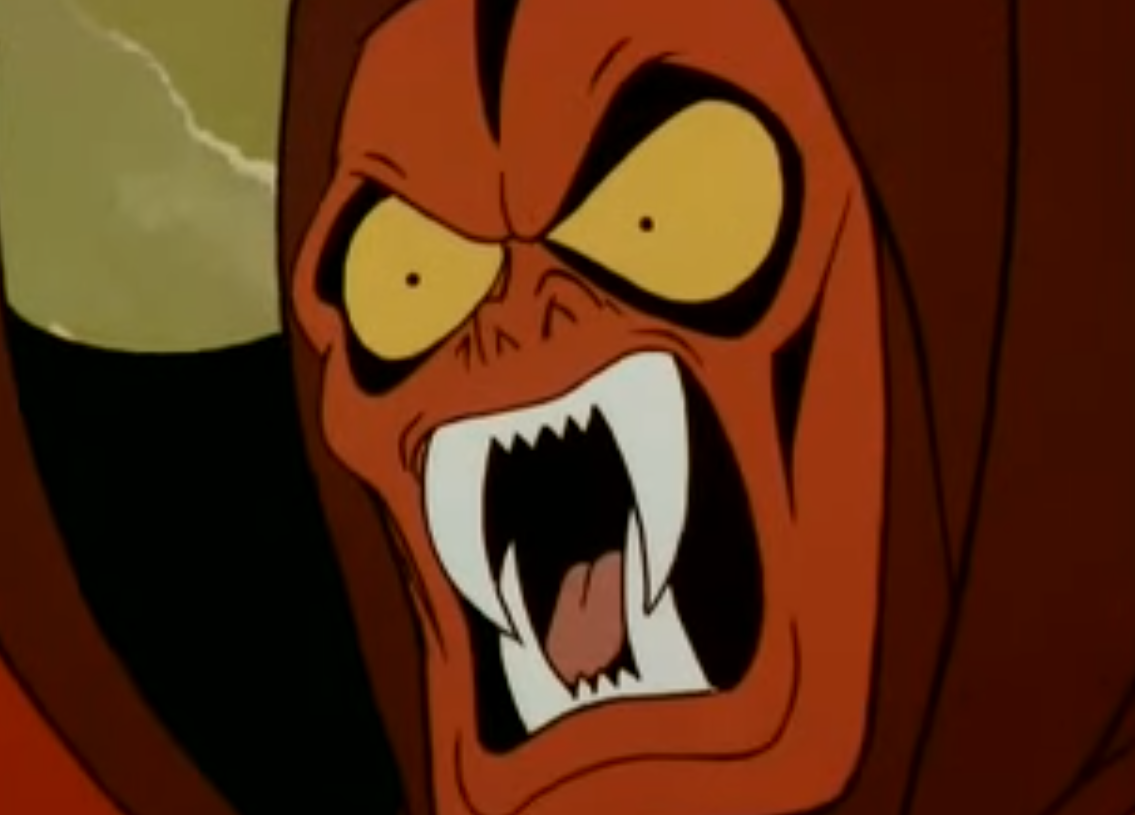
Meanwhile, the ever-more-powerful Overlord summons a new minion, a devil creature called Brilerand.  The demon is so evil, even Overlord cannot control him.

Because of this development, Blackstar and Overlord agree to a temporary truce.


“The Overlord’s Big Spell” is another “my enemy, my ally” story in which sworn enemies must put aside their differences so as to vanquish a dangerous and immediate threat.  

Here, the Overlord’s magic-sucking spell allows him to summon a big, red, gargoyle-like monster that refuses to accept his dominion.  In one funny scene, the Overlord demands that Brilerand obey him, and Brilerand replies by shooting laser beams at him, repetitively.


Blackstar and the Overlord join forces, though for different reasons. Blackstar wants to save Mara before she vanishes all-together, and Overlord knows that he cannot defeat the demon alone.  As soon as Brilerand is vanquished, the Overlord is back to his old tricks and the truce is definitively off.

This is a good episode of Blackstar, even though it follows the series formula rigorously since it features yet another evil spell. Mara’s predicament adds an emotional appeal to the story, and it is rich indeed to see the Overlord forced to work with his nemeses.  “Helping trobbits…it pains me!” he croaks.

Monday, December 06, 2021

30 Years Ago Today: Star Trek VI: The Undiscovered Country (1991)


Star Trek II: The Wrath of Khan (1982) is widely championed as the finest of the Star Trek films featuring the original TV series cast, and for a multitude of good reasons.  

Yet, in many substantial ways, 1991's Star Trek VI: The Undiscovered Country, also directed by Nicholas Meyer, actively competes for that title too.  

The sturdy foundations of Star Trek II: The Wrath of Khan are many.  First and foremost, the film features a strong literary bent that adds a new and even poetic sense of realism to Gene Roddenberry's far-flung, Utopian future.  Revolving around death and re-birth both personal and cosmic (vis-a-vis the Genesis Device), The Wrath of Khan never fails to prove deeply affecting.  And, of course, the film is endlessly exciting, a tense technological space duel between two evenly-matched opponents and starships.

While never a shallow copy of Khan (like 2002's Nemesis...) Star Trek VI: The Undiscovered Country attempts a similarly ambitious alchemy.  This sixth film in the franchise grounds its tale of interstellar rapprochement in the Western literary canon (this time the oeuvre of William Shakespeare), as well as in current 1990s-world affairs, namely glasnost. Or as Leonard Nimoy called it, "the Wall coming down in space."   

The Undiscovered Country -- now 30 years old -- also reveals beloved Star Trek characters grappling with old age, and more specifically a hardening of their perceptions and sensibilities about the universe, a kind of metaphorical "death." These aren't the idealistic, energetic young space adventurers we first met in 1966.  They have grown jaded, and more than a little cynical over the long decades.  As Captain Kirk notes to Spock in the movie, "I'm really tired," and you can detect that exhaustion in his carriage and in his gait.

But also -- with Star Trek's trademark sense of optimism about the future-- this sixth Trek film sends these aging  icons out to pasture in glorious, heroic, even transcendent terms. They fly off into the proverbial sunset both literally and metaphorically.

Notably, Star Trek VI: Undiscovered Country also obsesses on issues such as prejudice, death and "change," all while preparing franchise fans for the inevitable fact that "all things end."  These issues are woven into the very fabric of the film through the literate screenplay, the darker-than-usual, Gustav Holst-inspired musical score by Cliff Eidelman, and director of photography Hiro Narita's autumnal -- and then wintry -- visuals.  

Such qualities make the sixth Star Trek film a very good movie, but the film also functions ably as great Star Trek, re-visiting core (and sometimes very funny) concepts of the franchise one last time, and even bridging the gap between Trek Classic and The Next Generation.

An important factor in terms of critical appreciation for this final Trek movie also involves visual flourish.  On this front, The Undiscovered Country is undeniably the most confidently realized of all the Trek films, reveling in dramatic camera spins, suspense-heightening cross-cutting, and other tools of a formalist's quiver.  

In colorful, pulse-pounding fashion, the film emerges not just as a glorified TV episode then, but as a proper cinematic farewell to the most beloved and charming space heroes of a generation.

"Guess who's coming to dinner."

While cataloguing gaseous anomalies in Beta Quadrant, the U.S.S. Excelsior under Captain Hikaru Sulu (George Takei) encounters a "subspace shock wave" of dramatic proportions.  

It originates from Praxis, a Klingon moon that serves as the Empire's "key energy production facility."

This event quickly reverberates in galactic politics.  The accident at Praxis, caused by "over mining and insufficient safety precautions," inspires the Gorkon Initiative, a move by the Chancellor of the High Council (David Warner) to seek peace with the Federation.  This peace, incidentally, will involve the dismantling of Starfleet star bases and outposts along the Klingon/Federation "Neutral Zone."

Captain Spock (Leonard Nimoy) volunteers Captain Kirk (William Shatner) and the U.S.S. Enterprise as the peace initiative's "first olive branch."  Just three months shy of "standing down," Kirk is to escort Gorkon's vessel through Federation space to Earth, for a summit with the President of the United Federation of Planets.  

The idea of peace with the Klingons does not sit well, however, with several Starfleet officers, including Admiral Cartwright (Brock Peters) and Kirk himself.  While Cartwright terms Klingons the "alien trash" of the galaxy, Kirk -- still bitter over the Klingons' murder of his son, David Marcus -- believes that Klingons can't be trusted.  He knows that there is an historic opportunity for peace, but wonders "how on Earth" history can get past people like him.

After an awkward state dinner between the Klingon delegation and the Enterprise staff, the peace process goes awry when it appears that Kirk's starship opens fire on the Klingon battle cruiser.  

The alien ship loses gravity, and in the ensuing chaos Chancellor Gorkon is assassinated by two helmeted hit men wearing Starfleet uniforms and gravity boots.  While attempting to ascertain what has occurred, Kirk and Dr. McCoy (DeForest Kelley) are arrested by Gorkon's chief of staff, General Chang (Christopher Plummer) and held for trial.

Aboard the Enterprise, Spock and his Vulcan protege, Lt. Valeris (Kim Cattrall) attempt to clear Kirk's name and solve the mystery of Gorkon's assassination, even as Kirk and McCoy are found guilty of conspiracy and transported to Rura Penthe, a dilithium mine and penal facility deep inside the Klingon frontier, often referred to as "the alien's graveyard."

Kirk and McCoy contend with an alien "chameloid," Martia (Iman) on Rura Penthe as Spock and the Enterprise crew determine that a new Klingon weapon -- a Klingon Bird of Prey that can fire while cloaked -- was utilized to frame Kirk and the Enterprise.  It seems Klingons, Romulans and Starfleet officers are conspiring together to destroy the peace process, and maintain the current political status quo.

With the help of Captain Sulu and the Excelsior, Kirk and the Enterprise crew set out one last, grave mission: to stop the next assassination attempt, this one directed at the UFP President.

Unfortunately, there's a traitor in their midst...

"So...this is goodbye"
Star Trek VI: The Undiscovered Country virtually obsesses on the idea of things ending; on the notion of inevitable change and the various human responses to such change.

This leitmotif is encoded right there in the film's sub-title: The Undiscovered Country.  

In Meyer's film, Gorkon defines Shakespeare's descriptor (Hamlet, Act III, Scene I) as being a reference to "the future."   

In fact, as we remember from Hamlet, "the Undiscovered Country" is a direct reference to death.  

I first saw this film while attending university, and my Shakespeare professor had fits over what he detected as the film's grievous mistake regarding this famous passage.  But it isn't actually a mistake, I submit.  Rather, the debate about "the Undiscovered Country" is part of the film's tapestry about two diverse cultures coming together without sacrificing each's sense of identity.  In "the original Klingon" version of Shakespeare, as the film makes plain, "the Undiscovered Country" may very well be the future.

So Star Trek projects an "Undiscovered Country" that is both death and the future.  In Star Trek VI: The Undiscovered Country, the main characters -- good and bad -- battle over the direction of a future that few of them will actually live to experience (Spock is an exception, of course, given his extended Vulcan life-span).

In other words, this is a film which is both an "end" (a metaphorical death) for the beloved dramatis personae of Star Trek, and a bridge to a distant future as it is projected in the TV series, Star Trek: The Next Generation, set decades beyond Kirk's time.  Both realms, both destinations, are a mystery.

Given this backdrop, allusions to death, endings, and time's passage dominate Star Trek VI: The Undiscovered Country.  For instance, Chang quotes from Henry IV when he leaves the Enterprise:  "Have we not heard the chimes at midnight?"  

Again this quote re-contextualizes Shakespeare in terms well outside the Bard's original meaning.  Here, Chang is noting the lateness of the hour.  He departs the starship after a long night of drinking Romulan ale, but the hour is also late for Gorkon, and for peace.  In just moments, an assassination attempt which Chang orchestrates will be launched.  Chang is "marking" this anticipatory time with his quip to Kirk, and again, it portends death, change and endings.

In a scene set in Spock's quarters early in the film, Lt. Valeris studies a painting: a representation of the Biblical "expulsion from Paradise."  When Valeris asks Spock why he keeps this work of art in his quarters, he replies that the painting serves as "a reminder" to him "that all things end."   

Coming so early in the film -- one widely advertised as the final voyage of the starship Enterprise -- this discussion is of great significance too.  Here is Spock -- a character many of us grew up with -- accepting, his own mortality and the change of the status quo.  He soon tells Valeris that this journey represents his final voyage aboard the Enterprise as a member of his crew.  

The universe shall unfold as it should.  All things live and all things die.  All things end

 Even Star Trek.

Spock's acceptance and "faith" in a universe of change is contrasted strongly in the film with Kirk's stubborn refusal to brace change.  The good Captain admits in the film that he is "terrified" of change, of a world with "no neutral zone," where the Klingons are allies. It is almost easier, like Chang, to believe in the concept of "no peace in our time" than to accept the possibility of something new...and unknown.

Importantly, Gorkon is also an example of Spock's approach.  He begs Kirk, on his death bed, not to let matters "end this way."  Again, it's clear from the screenplay's obsessive language about endings that a chapter of history is closing and the future is up for grabs.

When such "death" or "ending" centric dialogue is coupled with visuals such as a doppelganger of Kirk being disintegrated (on Rura Penthe), one begins to detect how deeply this Star Trek movie treads into the territory of "the future."  Spock even asks, at one point, if both he and Kirk have grown "so old, so inflexible" that they have "outlived their usefulness."

His comment is a wonderfully wry one, reminding us that these beloved characters are people, not flawless Demi-Gods.  They make mistakes, they stumble, and they don't always do the right thing.  It's the most human portrayal -- apologies to Mr. Spock -- of the characters in any of the feature films.

And that humanity even extends to expressions of prejudice, as The Undiscovered Country ably notes. 

In addition to Cartwright's description of the Klingons as alien trash, Kirk terms them "animals," and admonishes Spock to "let them die."  Chekov quips "Guess who's coming to dinner," a direct reference to director Stanley Kramer's 1967 film about race relations in America.  

In the same vein, Scotty argues that Klingons "don't place the same value on life as we do," creating a separate category for his enemies.  

These are repellent remarks, and yet they make a powerful point. Even heroic characters such as Kirk, Chekov and Scotty boast a blind spot when it comes to their opinion of "an enemy. " Can you truly begrudge Kirk his prejudice towards the Klingons, given his personal loss?  

We might not like or laud Kirk's attitude, but nor can we deny that it certainly makes sense from his perspective, and knowing his history.  The crew of the Enterprise has spent a lifetime battling the Klingons tooth-and-nail (and phasers and photons) and now, in a heartbeat, that life is over, and the Klingons are supposed to be friends and allies.  What does that sudden change do to their life's work, to their legacy?

As Kirk notes disapprovingly of his own behavior near film's end, he "got used to" the idea of hating Klingons.  It's easy to fall into a bad pattern like that, especially when you're unhappy.  And that, in some way, is how prejudice is born.

And this is one reason why I so much admire the original Star Trek, and this particular film.  The filmmakers have permitted the beloved franchise characters their own individual, politically incorrect viewpoints.  Why?  So Kirk and the others can learn through experience that their perceptions are dead wrong.  The Klingons are proud and can continue "being proud."  And they can do so without being the villains or "alien trash" of the galaxy.  

Later Star Treks, particularly The Next Generation took a different and far less dramatic, far less chancy tack.  There, the Enterprise crew became above such human flaws as prejudice, and so would meet and endlessly lecture less-advanced aliens about how they must live up to Federation ideals of equality, etc.  

The difference here involves how a storyteller chooses to construct a tale.  Either with the characters stagnant and therefore dull, having already learned everything they need to know, or with the characters in a constant state of flux and growth, learning and making mistakes as they go. 

As Kirk once noted, "we learn by doing," and that expression is reflected in the storytelling of the original series and, occasionally, in the feature films.  It's more realistic, and more true to life, I submit, than TNG's direction.

I much prefer the Undiscovered Country approach, which permits the Star Trek characters both their foibles and an opportunity -- when confronted with a mirror -- to outgrow those foibles.   

My only wish on this front is that the makers of the Undiscovered Country had been able to more fully realize their original vision.  For instance, they wanted Saavik to be the traitor in the film.  The late Gene Roddenberry scuttled that idea, hence the creation of Valeris. This substitution robs the final Star Trek film of what could have been one of the most powerful moments in franchise history.  It would have been a genuine shock to learn Saavik was a conspirator and that jaw-dropping moment would have electrified the movie.  

Ostensibly, Saavik would have hated the Klingons for the same reason that Kirk did: she was there on the Genesis Planet when they murdered his son.  She saw it.  She witnessed it all.  Kirk and Saavik both lost David, but only one of them would grow and come to take away a lesson about prejudice.  That would have a been a powerful side-by-side comparison, and the ultimate lesson about bigotry. If Kirk could past his resentment, why then, could not Saavik?  This is a missed opportunity on a cosmic scale.

As it stands, The Undiscovered Country never exactly makes a case for why Valeris should fear peace with the Klingons. Kim Cattrall is engaging as the character, but there's no audience connection, no history to Valeris, and so it isn't a surprise that the "guest star" in this film is a bad apple.

It' a shame that in this case, some of Star Trek's greatest defenders and advocates couldn't see the larger picture.  That prejudice is universal...affecting even the most enlightened of us.  And also, optimistically, that prejudice can be overcome by facing change and the future head on.  

And if you don't think this is still a very big issue in America right now, you haven't been paying attention to the national discourse.

"There is an old Vulcan proverb: Only Nixon could go to China."

Star Trek VI: The Undiscovered Country is great Star Trek for so many reasons.  

First, it lives up to Star Trek's history in that it serves primarily, as a morality play.  It tells the story of a Captain Kirk who first stands in the way of history, and then, ultimately nudges it in the right direction by overcoming his own prejudice and personal shortcomings.

Secondly Star Trek uses a timely metaphor to dramatize that tale, namely the ending of the Cold War.  In the film, doomed Praxis, the key energy production facility, tracks as Chernobyl, the nuclear power plant that suffered a terrifying meltdown.  Gorkon tracks as Gorbachev, a man who took a chance on peace to save his people.  And Kirk is very much the conservative hawk (the Reagan or Nixon) who, in the end, unexpectedly finds himself the greatest warrior for peace.  

Now, regular readers of this blog are well aware that I am no Reagan fan. But I also deeply admire the fact that the man grappled with reality, changed his mind, and grew.  Reagan began his tenure as President calling Russia "The Evil Empire," joked that "bombing begins in five minutes" on an open mic and erroneously claimed that a sub's nuclear missiles could be recalled after launch.  But by the end of his second term, he was Gorbachev's committed partner for world peace. Reagan walked back from the precipice and from his own, hawkish views of "winnable" nuclear war, as well.  It wasn't easy for him, and it wasn't painless.  His right flank savaged him, accusing him of giving up the nuclear store.  But Reagan fought for peace anyway, because he believed in the cause. If that's not something to compliment one of my least favorite modern Presidents on, I don't know what is.

Going further, Star Trek VI: The Undiscovered Country also refers to another Reagan era issue: the Iran-Contra Scandal.  Here, a rogue Colonel named West -- think of Colonel Oliver North -- conspires with intergalactic (international) enemies for an illegal policy.   Even Valeris's denial of involvement, "I do not remember," harks back to North's frequent invocation before Congress that he could "not recall" details of the alleged wrongdoing.

In addition to being timely, Star Trek VI: The Undiscovered Country also ably serves the larger franchise (which at the time only included TNG and the movies) by providing the connective tissue between generations.  

In this film, we meet Lt. Worf's ancestor, Kirk's lawyer, also played by Michael Dorn.  And the writers of the film knowingly set the peace conference at Khitomer, a planet referred to in such TNG episodes as "Heart of Glory."  Beyond those small continuity touches, the film finally shows us the ambitious  last "piece" of Kirk's era: the turbulent story of how the Klingons and the Federation learned to begin trusting one another.

On a much more amusing note, Star Trek VI seems hell bent on recycling one last time many beloved tropes of the classic series.  Kirk gets to kiss a  very sexy (but weird) alien woman, Iman's Martia.  He is forced into hand-to-hand combat with an alien twice his size on Rura Penthe.  And, of course, James Tiberius even gets to face off against a doppelganger, as he did in series segments such as "Whom Gods Destroy" and "The Enemy Within."  

Then there are the submarine movie cliches the movie adopts for its final battle, as the equivalent of a German U boat (an invisible Bird of Prey) repeatedly strikes a surface vessel, the Enterprise.  We saw this idea originally in "Balance of Terror," but The Undiscovered Country outdoes even that remarkable episode in terms of spectacular effects and suspense.

And suspense is important, especially when we talk of a movie concerned with endings.  Star Trek IV: The Voyage Home and Star Trek V: The Final Frontier certainly had their moments, but overall they were also jokey, almost flabby affairs.   There wasn't much tension in those stories.

Star Trek VI: The Undiscovered Country corrects that deficit in spades.  It jauntily plays with the very idea that this is Kirk's last mission, and so every event, every battle, takes on a new importance.  These characters aren't coming back for another movie, so we wonder throughout the film...are they going to die?  

Have these characters "outlived their usefulness" not just to the Federation, but to the entertainment franchise itself?  This uncertainty, when combined with Meyers' dynamic cross-cutting, the mad pans, and the dazzling camera spins, makes for a highly suspenseful adventure, perfectly pitched.

"Second star to the right, and straight on till morning...

Everything comes together in Star Trek VI: The Undiscovered Country's valedictory scene.  

Bones reminds the crew that it isn't against the law "to have feelings," and Spock expresses his feelings of disdain for Starfleet rather strongly:

 "If I were human, my response would be...go to hell.  If I were human," he says, at news of the Enterprise's de-commissioning.

And then Kirk gives his final order from the center seat.  "Second star to the right, and straight on till morning," an allusion from Peter Pan that concerns not death, or ending...but perpetual youth and immortality.  

The inference is that in overcoming his prejudice regarding the Klingons, Kirk has restored his own soul, his own youth and his own innocence.

And more so, that the Enterprise crew --- especially to those who love her -- shall remain forever young in our hearts, even as it sails into retirement and the history books.  That sense of youth is evident in the crew's ability here to change, grow, and surprise us even after twenty five years of going "where no man...where no one...has gone before."

"Second star to the right, and straight on till morning," is the perfect way to bid farewell to these characters.  As they contemplate the end of their journeys (a Never Never Land of its own), they do so not with cynicism and prejudice, but with hope, vigor and indeed, a charming, even awe-inspiring innocence.

So as you experience that final, lump-in-your-throat goodbye -- as the original starship Enterprise flies off into the sunset and our cherished  memories -- I challenge you to deny that, indeed, the franchise saved the best movie for last.

Saturday, November 27, 2021

Blackstar: "The Air Whales of Anchar"


Blackstar’s star-sword is damaged beyond conventional repair during an attack by vampire men.

The only thing in the universe that can fix the damaged weapon is the song of an air-whale. 

Mara and Blackstar proceed to search out the air-whales of Anchar, only to learn that a villain called Neolis has captured a calf and is enslaving it.

Blackstar boards Neolis’s airship, but is captured and forced to work in the ship’s bowels. 

If he can only convince Neolis’s daughter, Lila, to help him, he has a chance of freeing the air whale and repairing his sword...


“The Air Whales of Anchar” is an amusing Blackstar story, and one that combines a lot of intriguing elements.  

We get some information about the nature of the star-sword, for instance, and meet a Captain Ahab of the air: Neolis. He is missing one hand, instead of a leg, but the comparison to Melville's antagonist is clear.


Also, viewers meet the air whales, inoffensive creatures who apparently inhabit the skies of Sagar.

The only disappointing aspect of the episode is its reliance on the love story subplot. This story was used a lot in Filmation’s Flash Gordon (1979-1981) as well.  Basically, a hero from another planet gains the trust of a beautiful woman, and she helps him overthrow the villain.  

Here, Lila helps Blackstar engineer a slave rebellion on the air ship, in defiance of her father. The story relies on some pretty far-fetched ideas, like a woman falling so helplessly in love with a strange man that she would choose him over her ostensibly beloved family.  It’s 1970s (or 80s…) sexist, as Joss Whedon might aptly note at this juncture.

Still, it is nice that Blackstar goes a little off-formula in this episode. For a change, Blackstar isn’t battling an evil spell from the Overlord.  Instead, the quest is to repair his damaged star-sword.  Of course, even that plot element defies logic.


If Blackstar’s star-sword explodes, he will lose it; it’s true. 

But it will also be lost to the Overlord, and thus he will have no opportunity to become the all-powerful ruler of Sagar. So, from a certain viewpoint, it would make more sense for Blackstar to allow the sword to be destroyed.  It would put an end to all he Overlord’s plans…permanently.

Wednesday, November 24, 2021

John, Space:1999, and The Bloody Pit!

I recently had the great pleasure of appearing as a guest on Rodney Barnett's podcast, The Bloody Pit, to discuss Space:1999 (1975 - 1977).  Our wide-ranging discussion also includes the Powys Space:1999 novel line, and Blake's 7 (1978-1981)!

You can listen in to the conversation here.

Monday, November 22, 2021

25 Years Ago: Star Trek: First Contact (1996)


Star Trek: First Contact
 (1996) is likely the finest of The Next Generation feature films.  In part, this is so because the film combines an extremely popular villain, the Borg, with an extremely popular idea in the franchise: time travel.  

In part, First Contact also thrives because the film is more action-oriented and visceral than some of the other entries in the canon. The screenplay, by Brannon Braga and Ronald Moore also goes through fewer contortions than Generations did to fashion its compelling tale.  Where Generations seemed confusing and contrived, First Contact feels stream-lined and sleek. 

Perhaps most importantly, Star Trek: First Contact – while occasionally gory and quite violent – remembers that the core of Star Trek’s appeal does not rest in warfare and hatred, but rather in the exploration of the “human adventure.”  

By ending on the high note of humanity’s first contact with the Vulcans, First Contact honors Star Trek’s important legacy of hope and promise.  This vision of a better tomorrow (and of a better humanity, to boot), differentiates the franchise from virtually all other space adventures, and makes the film a pleasure to watch, even fifteen years after its theatrical release.  An average Star Trek movie can excite you with space battles, certainly, but only a very good one can tap into the inspirational nature of Gene Roddenberry’s celebrated creation.

Accordingly, film critics approved of and admired the film, and First Contact remains one of the best-reviewed Star Trek films in the saga’s history.  Variety wrote: “Star Trek: First Contact" is a smashingly exciting sci-fi adventure that ranks among the very best in the long-running Paramount franchise. Better still, this is one TV spinoff that does not require ticket buyers to come equipped with an intimate knowledge of the small-screen original. Fans and non-fans alike will line up for this wild ride, and many will be repeat customers.”

Lloyd Rose at The Washington Post praised Jonathan Frakes’ direction, and opined “There are moments of visionary beauty in this film that rank with "Metropolis," with Josh Meador's interior vistas in "Forbidden Planet" and Irvin Kershner's and Ralph Quarrie's work in "The Empire Strikes Back" -- that is to say, with the best fantasy films ever made.”

As a reviewer and unapologetic Trek fan, I boast deeper reservations about First Contact than Rose apparently did, and feel that while the film is indeed the best of the Next Generation cinematic efforts, it still falls short of the cinematic majesty and scope of The Motion Picture (1979), or the sheer emotionality and humanity of The Wrath of Khan (1982).  

Part of the reason that Star Trek: First Contact doesn’t work on the same rarefied level as those aforementioned titles is that many of the earthbound scenes involving James Cromwell’s recalcitrant Zefram Cochrane boast no effective foil for the mischievous inventor of warp speed technology.  Riker, Troi and Geordi are beloved characters to be certain, but they are never really established effectively in the script as larger-than-life personalities with the heft to match Cochrane note-for-note and blow-for-blow.  As a result, the film’s pace lags badly every time First Contact returns to Earth and the Borg are shunted off-screen.

By contrast, the Borg themselves (itself?) are incredibly effective in design, concept and execution.  They are visually-inspired, dynamic villains, and First Contact benefits strongly from their presence, even if aspects of their culture (namely the Borg Queen) now seem contradictory and unnecessarily muddled.   As a longtime Star Trek fan, I was also disappointed with some of the shoddy continuity in the film, especially because in most cases the flaws were unnecessary and could have been easily rectified in post-production.

But such quibbles aside, Star Trek: First Contact remains a fun and involving science fiction adventure.  It’s an eminently sturdy entry in the long-lived franchise, and comes close to recapturing successfully the character chemistry that made Star Trek: the Next Generation so beloved an endeavor. 


“A group of cybernetic creatures from the future have traveled back through time to enslave the human race... and you're here to stop them?”


In the 24th Century, the cybernetic Borg attempt a second invasion of Sector 001, the home of the human race.  Instead of warping to planet Earth to join the battle, however, Captain Jean-Luc Picard (Patrick Stewart) and the U.S.S Enterprise-E are ordered to stay away.  Starfleet fears that Picard’s traumatic experience being assimilated by the Borg could make him an “unstable element” in the critical defense of Earth.

With his crew’s support, Captain Picard ignores Starfleet’s orders and assumes control of the fleet battling the Borg Cube.  Able to hear the Borg’s thoughts, Captain Picard pinpoints the cube’s weakness and destroys it, but not before a Borg escape craft opens a temporal anomaly and travels into Earth’s past.

Caught in the energetic wake of the escaping Borg sphere, the Enterprise crew can only watch as Earth of the past is assimilated by the cybernetic organisms.  The starship follows the Borg to the past, to April of 2063 in an effort to prevent the change.  There, they learn that the diabolical aliens plan to scuttle Earth’s “first contact” with alien life forms following the successful test flight of Zefram Cochrane’s (James Cromwell’s) experimental warp ship.  

Picard realizes he must preserve the timeline, or the human race will become…Borg.

Before long, the Enterprise herself is infested with Borg invaders.  Lt. Commander Data (Brent Spiner) is captured by the Borg Queen (Alice Krige), who requires the information stored in his android brain if she wishes to access the ship’s computer and stop Cochrane’s historic flight.  

Meanwhile, on Earth’s surface below, Commander Riker (Jonathan Frakes) must convince Cochrane to make his historic flight…

“I am the beginning. The end. The one who is many. I am the Borg.”


The Borg are really no-brainers as movie antagonists.  The most beloved episode of Star Trek: The Next Generation remains the two-parter “The Best of Both Worlds,” concerning a Borg incursion into Federation space. The Borg are such popular villains because they promise a fate much worse than death.  

It’s one thing to be killed by drooling, murderous aliens; it’s another thing entirely to have your individuality wiped away and your intelligence sublimated into the Borg Collective.  In that state, your memories belong to the Borg.  Your physicality belongs to the Borg.  Your very soul…is theirs.  

Somewhere inside, you may want to struggle against the Collective or Hive, but you can’t succeed.  You must stand by and watch in a kind of living Hell as the Borg exploit your knowledge and exploit your body, perhaps even condemning your very loved ones to the nightmare of being “one” with the collective. It’s a horrid fate to imagine, let alone endure.  

The Borg threat also works remarkably well in the context of The Next Generation, a series that -- through the inclusion of half-Betazaoids, Klingons, androids, the blind and other colorful characters -- champions diversity as a worthwhile human ideal.

The Borg destroy diversity, making all life-forms conform to their vision of perfection, thus making them a perfect adversary for our colorful and very individual 24th century heroes.

Assimilation into the Borg group consciousness is such a powerful, frightening notion that it would be nearly impossible to ruin the threat of the Borg in a two-hour motion picture.  And yet, First Contact almost achieves the impossible by giving the Borg a heretofore unseen new ruler, a single individual called the Borg Queen.  

Now, let me be plain: Alice Krige is remarkable as the Borg Queen here.  She gives a performance simultaneously terrifying and sensual.  Similarly, her appearance is both frightening and incredibly sexy.  And yet the very idea of a Borg Queen represents a terrible undermining of the original notion of the Borg: a collective life form. 

Now, suddenly – after several years of Next Generation episodes – we learn that that the Borg are ruled by an individual leader?  By the equivalent of a Queen Bee?  And worse, this Queen Bee is apparently seeking a human mate?  Here, it is plain she seeks not to make drones of protagonists Captain Picard or Data, but to make them her lovers and companions, co-rulers of the lower Borg caste. 

In one fell swoop, then, the terror and anonymity of assimilation is largely undone.  For one thing, the Borg can maintain individuality after assimilation, as the presence and personality of the Borg Queen prove.  For another, our heroes don’t face total erasure of individuality.  Instead, they get to hob-knob it with the sensual, if sadistic, Borg Queen.  There are some humans who may not consider that arrangement so terrible, frankly, given her overt sensuality… 

I understand the (flawed) thinking that individuals make a “better” enemy in a movie than a group of bad guys, but the popularity of the Borg as a collective in the Next Generation TV series proves the fallacy of such thinking.  First Contact invents a new character in the Borg Queen that -- while beautiful and menacing -- totally undercuts the terror of the Borg equation.

Her presence raises important questions too.  How does the Queen exist in multiple dimensions at once, since First Contact suggests that she was present on the Borg ship with Locutus, although though we never saw her there in “Best of Both Worlds?” 

Secondly, and perhaps more importantly, how do the Borg survive (into episodes of Voyager) if their multi-dimensional Queen keeps getting destroyed?  How many Queens are there?  How does she die?  Does Star Trek now possess an un-killable character?   Also, because she can apparently be in more than one dimension at a time, why does the Queen have to bother with sending a message to the Borg of her time by sensor dish?  Why not just transition from one place to another, one time to another?

Another serious problem in First Contact again comes down to how writers Ronald Moore and Brannon Braga choose to highlight crew interaction.  Specifically, superficial “movie thinking” undercuts what could have been incredible scenes of conflict and drama between Enterprise team members.  

Here, Patrick Stewart delivers an incredibly well-written Moby Dick speech about the Borg, explaining in detail why he won’t fall back again, why he won’t let the Borg win.  Stewart does a terrific job with the material.  It’s the monologue of an obsessed, driven man, and it works quite effectively in terms of the character we love, even if it seems logical that he would have exorcised these Borg demons already, given the span of time between “Family” and First Contact.


But forget all that. Picard gets called on the carpet and called out for his obsession with Borg… by Lily (Alfre Woodard), a one-time guest star in the franchise.  She goes toe-to-toe with Picard and points out how his pursuit of the Borg doesn’t make sense.  She’s known him for maybe a few hours, when she makes the speech.

I’ll be blunt: this confrontation should have occurred between Captain Picard and Dr. Crusher (Gates McFadden).  She has known Captain Picard longer than anyone else aboard ship, she can speak from experience -- not hear say --  that his orders usually make sense, and she boasts the standing as chief medical officer of the Enterprise to stop Picard in his tracks if he is acting in a manner that is dangerous to the well-being of the starship’s crew.  

If this were an original cast Star Trek movie, do you have any doubt that it would have been McCoy calling Kirk on the carpet over his behavior, as he did, explicitly in Star Trek: The Motion Picture (1979), Star Trek II: The Wrath of Khan (1982) and Star Trek V: The Final Frontier (1989), to name just three incidents?  McCoy could do it because he was Kirk’s confidante, and because he had that standing as CMO to question a captain’s behavior.

Again, Crusher – who shares breakfast with Picard every day as we know from the series – is that person in The Next Generation universe.  Yes, Stewart and Woodard are powerful in the confrontation scene together, but it doesn’t resonate deeply in terms of Star Trek history, because Picard doesn’t get checked by one of his own, by one of his crew. These movies are supposed to be about how starship crews work together to resolve problems, right?  Shouldn't the person who actually knows Picard be the one to question him?  You may recall, I had a similar problem with how Generations used Crusher.  She should have been Picard's "Nexus" ideal, given their relationship there. And she should do her duty as CMO here, in First Contact. It's not that I have a thing for Crusher (though I like her just fine).  It's that as a member of the team, when there is an opportunity to use her character appropriately...she should be thus used.  And she never is.  In any Star Trek movie.  Even Chekov, Sulu and Uhura had moments in the sun in the original Star Trek films when there was opportunity.

I’ve always believed this a major flaw in the Next Generation movies: they give the supporting cast members little to do, and farm out the dramatic work to guest stars inside of established characters.  The Moby Dick scene would have been infinitely more powerful if Gates McFadden – whom we know and love as Crusher – had been given the opportunity to stand up to Captain Picard.  I wrote above how Riker, Geordi and Troi don’t seem equal to the task of countering Cochrane here.  The same is true of Crusher in First Contact: she’s written like a doormat.  She remains on the bridge, without questioning orders, while Lily enthusiastically performs her job as chief medical officer. 

This reveals -- as we see time and time again – that there’s definitely a pecking order in the Star Trek: The Next Generation movies:  the men get better roles than the women do, and Picard, Riker, Worf and Data get the lion’s share of the drama, while the rest of the characters are afforded only brief moments that play as the equivalent of shtick.  Troi gets to play drunk, for example.  In First Contact, Crusher not only shirks her duty to hold Picard’s feet to the fire over a bad decision, she actually loses a patient (Lily again…) who is under her protection.  That’s the best the writers could come up with for a character who raised a son, overcame the tragic death of her husband, commanded the Enterprise from time-to-time and even headed Starfleet Medical?

In short, for First Contact, the writers decided to go out and invent a woman tough enough to challenge Picard, when a woman already in the Next Generation stable could have done it just as well, and it would have resonated far more with the Trek fan base.  All they needed to do was to write Gates McFadden a decent part.

In the introduction to this piece, I wrote about some careless errors in the film.  Let me name just a few.  At one point, Picard tells Lily the Enterprise consists of 24 decks. Later, Worf’s security chief replacement reports that the Borg control "deck 26."  If we’re to believe Picard, that deck doesn’t exist.  By looping “24” over the “26” dialogue, this would error would not have occurred.  I just can’t believe that nobody was checking continuity on a major studio’s tent-pole franchise.

Other matters of concern include the origin of Zefram Cochrane.  He is a character from the original series episode “Metamorphosis,” and one with an entirely different look and origin (in terms of home planets, apparently) than what this movie establishes. But First Contact feels no obligation to explain the discrepancies in Cochrane’s biography.  

Also, since when can Captain Picard hear the voices of the Borg?  Is this a common side effect of those who have been separated from the Collective?  If so, did Hugh, the Borg refugees of “Descent” and Seven of Nine also hear Borg voices in their heads whenever they encountered them?


In spite of such problems, Star Trek: First Contact is a highly entertaining movie with many dramatic and visually-appealing high points.  


Prime among these is the zero-gravity sequence in which Picard, Worf and Hunt must battle the Borg on the exterior of the Enterprise hull, on the main deflector dish.  This scene is splendidly-directed, buttressed by incredible special effects, and it features an undercurrent of anxiety throughout, as the Borg – slowly becoming aware of Picard’s interference – begin to menace the crew as the team works to stop them.  

I remember, circa 1994 or so, I was deeply disenchanted with the Star Trek universe and consequently looking back at Space: 1999 (1975 -1977) with much appreciation, because I felt that the world of the Enterprise had become too safe and predictable.  Space adventuring was no longer dangerous.   Now it consisted of vacations on holodecks, endless resources and material wealth, courtesy of replicators, and even families living on the saucer section while exploring the final frontier.  I lamented the fact that not once in Star Trek: The Next Generation or Deep Space Nine up to that point, had any main character been seen in a space suit, actually reckoning with the actual environment of space.  The crew members of Starfleet seemed to me too insulated from danger.

So I was delighted that Star Trek: First Contact included this zero-g sequence and put my qualms to rest, at least momentarily.  The zero-gravity action scene in Star Trek: First Contact reminds us that these men and women are in a dangerous profession, and that even with all the comforts of “technology unchained” in the 24th century, they must still sometimes go out into space with precious few resources to fight enemies, or attempt to repair their ship.   The zero-gravity fight scene is actually my favorite in the film because it is so tense, and because it features so many nice character touches, from Picard’s unconventional cleverness (blasting a Borg into space by shooting the deck of the ship…) to Worf’s “always be prepared” mentality, bringing a blade out into space with him.  It’s terrific stuff.

I also enjoy the climax of Star Trek: First Contact tremendously because it remembers that Star Trek isn’t always supposed to be about battling hostile aliens.  This is one of the reasons why I’m not all that impressed with Star Trek Online. It’s a game about going out to other worlds and fighting aliens, about firing phasers and engaging in battle. 

For me, that’s but one small aspect of Star Trek, and not, for me, the one with the most appeal.  Star Trek: First Contact features great battle sequences, but more than that, ends on the high note of first contact.  It shows us an important and inspiring scene in human history, our first, peaceful meeting with extra-terrestrials.  In this case, the humans who broach that contact are fatigued from war, and not “perfect” (like our 24th century protagonists).  And yet they lead with trust and peace, and a wonderful, new era is opened up because of their willingness to go out on a limb.  Frankly, I find the final scenes of First Contact absolutely inspiring, reminding us of the better angels of our nature.  We can greet the unknown not with fear, paranoia and suspicion, but with hope and peace and trust. 


In ending the film on this high note, rather than the (admittedly-satisfying) defeat of the villainous Borg, First Contact remembers and honors the highest aspirations of Gene Roddenberry and the Star Trek saga.  Remember “the human adventure is just beginning?” the tag-line of Star Trek: The Motion Picture?  First Contact literalizes that motto, and shows us the wondrous beginnings of man’s odyssey to the stars, beginning with the first moments of brotherhood with another race.  It’s a fantastic and inspiring story-point.

I also appreciate the creativity involved in Data’s subplot in First Contact. I didn’t care for how Data was utilized in Generations…as a veritable bi-polar psychotic. Here, he seems more...balanced.  He faces temptation as the Borg perform an assimilation in reverse.  Usually, the Borg apply mechanical prosthetics to biological skin.  Here, they apply biological skin to a mechanical apparatus.  It’s an interesting idea, especially since Data suggests early on that he can’t be assimilated by the Borg.  The Queen proves him wrong, and in a diabolical fashion that tempts Data.  We never really believe he has turned to the dark side...but as Data suggests, a few seconds can feel like eternity when we're uncertain of his exact motivations. 

I understand that Star Trek fans are divided on the subject of Frakes as a director.  He gets good performances from the cast here, and manages several action scenes nicely.  Judging by First Contact, he certainly seems up to the center seat...the director's chair. 

Between the zero-g action, the up-lifting last moments of first contact, and Data’s unique experience being Borgified, it’s largely futile to resist First Contact, a high-point for the Next Generation cast at the movies

Have a Monster-ous Holiday, 1970's Style


When I was growing up in the New Jersey burbs during the seventies and early eighties there was a great Thanksgiving Day tradition that I’d like to share on the eve of the holiday.  

Every year, WOR Channel 9 would broadcast King Kong (1933), Son of Kong (1933) and Mighty Joe Young (1949) on Turkey Day.

Then, on Friday, the same station would host a Godzilla marathon consisting of such films as King Kong vs. Godzilla (1962), Godzilla vs. The Smog Monster (1971) and many others.  Some years, if memory serves, War of the Gargantuas (1968) also played.

I remember showering and dressing early on those Thanksgiving Days, so I could be lodged near the TV when the Kong movies started. Meanwhile, my Mom and Dad would be busy in the kitchen preparing a great meal of turkey, stuffing, baked carrots with cinnamon, and home-made biscuits.  The house would fill with the delectable aromas of the feast, and even downstairs -- while glued to WOR-TV -- I could feel my appetite for dinner building.

Our guests, usually my grandparents and aunts and uncles, would arrive sometime in the early afternoon, around 1:00 pm and I would socialize with them, and then sneak back to the family room for more King Kong.  Sometimes my uncle Larry, a horror fan after a fashion, would join me.

Then the meal and dessert -- a chocolate cream pie and a pumpkin pie -- would be served, and we’d all enjoy each other’s company over the delicious food.  After an appropriate interval of visiting and socializing, I’d high-tail it once more back down the stairs to watch more of the movies. 

I’m certain my description of Thanksgiving makes it sound weird and anti-social, but you must remember that in the seventies, there were no VCRs (let alone DVRs or movie streaming), which meant that if you wanted to see a movie like King Kong, you had to seize your moment, or else wait for another year. 

I believe it took me the better part of four Thanksgivings to see all of King Kong, and then not even in chronological order.  I actually saw the entirety of Son of Kong first, perhaps because it was often scheduled between our early afternoon dinner and dessert course.

This tradition of King Kong Thanksgiving and Godzilla Black Friday continued over a long period at my house -- the better part of a decade -- so much so that I still irrevocably associate the Holiday season with WOR Channel 9 and its monster movie broadcasts.  

I still remember, a bit guiltily, forcing my parents to watch the 1970s Godzilla movies on Fridays, while we ate Thanksgiving leftovers in the family room.  My folks liked the King Kong movies, but when it came to Japanese monster movies, they weren’t exactly big fans.

Happy Turkey Day!

50 Years Ago on WPIX: Space:1999: "The Metamorph" (September 26, 1976)

'In “The Metamorph,” Moonbase Alpha emerges from its second encounter with a space warp, six light years from its previous position. The...