Wednesday, March 27, 2013

Pop Art: Dune Cover Edition


Collectible of the Week: Tobor the Telesonic Robot (Schaper; 1978)


No, this toy doesn't have anything to do with the awesome space-age robot that appeared in Tobor the Great (1954), although it does share his name.  

Instead, this Tobor was advertised during The Star Wars Holiday Special (1978) and thus was promptly added to every child's Christmas wish-list that year.


Tobor, the toy's box reminds us, is "robot spelled backwards."  

Using "u-drive it" technology, Tobor "the telesonic robot" is "under your control."  You can use a "telesonic commander" -- really a conventional wireless remote control device -- to make the robot circle, move forward, circle again, and even "pick up" the robot's "support module."


Tobor the Telesonic Robot runs on three wheels, and is a pretty nifty hunk of black plastic, at least if you grew up in the 1970s and remember the toy. I no longer have mine, alas, and even so, prefer the complexity of something like Milton Bradley's Big Trak.  That toy could be programmed with a keypad to go forward, fire laser blasts, or circle. It could also pull a trailer behind it.  By contrast, Tobor is a kind of glorified remote control car.  But if you collect vintage robots -- which Joel and I do -- he's an absolute must from the disco decade and the age of the Star Wars Craze.

Below, a Tobor TV commercial...

Model Kit of the Week #21: Godzilla


Tuesday, March 26, 2013

Movie Trailer: Sinister (2012)

Theme Song of the Week: Seven Days

Monday, March 25, 2013

Ask JKM a Question: Sci-Fi TV Endings?


A reader named David asks:

“As a lifelong fan of SF-TV, I was thinking if there were any final episodes you would do all over again.  And if so, how would you change them for the better?”

“In short, what are your favorite and least favorite program endings?”

David, that’s a great question.  Ending a long-running (or even a short-running) TV series is a difficult endeavor, and many times creators aren’t even able to properly finish a series at all, because programs are often canceled without warning.

In terms of endings I like, I think that Buffy the Vampire Slayer, Blake’s 7, The X-Files, Smallville, Sapphire and Steel, Star Trek: The Next Generation and The Prisoner are all pretty satisfactory. I can also live with the Twin Peaks and Millennium finales. I did a blog post about series endings a few years back, here.

As far as the “endings” that rubbed me the wrong way, there have certainly been some, and based on my answers a few weeks back about overrated TV programming, you may be able to guess which ones.


I feel very strongly that the re-imagined Battlestar Galactica and Lost both ended disastrously.  The writers on those series strung everyone along week-after-week, year-after-year with tantalizing bread crumbs and clues, and then couldn’t be bothered to create a final chapter that resolved the narratives in a way that made simple, logical sense. 

This is disturbing because, in both cases, series writers had plenty of time -- on the order of two years, I believe -- to plan and execute for an appropriate ending.

I know people say I pick on Battlestar Galactica too much.  Yet, as I like to remind those folks, if you claim to have a plan on screen every week, and build a story as a serial with escalating clues, you damn well better deliver a knock-out final chapter.  Yet as I’ve noted before, BSG essentially ended with an insulting “God moves in mysterious ways” conceit, while simultaneously hoping for audiences to believe that a technologically-advanced race would live in a society without indoor plumbing, air-conditioning, or refrigeration.  The final episode didn’t pass the smell test, and it didn’t seem true to what had come before.


I also didn’t care for Star Trek: Voyager’s finale, "Endgame."  The series ended with a deadly encounter involving the Borg, and the Voyager making it hope to Earth and Starfleet Headquarters…to be met by fireworks. 

Had I been writing that series, I would have brought Voyager home at the end of season six, and spent the last season telling stories about how the crew could not adjust to Earth; how once you learn and change, you simply “can’t go home again.” 

To wit, the EMH’s rights would not have been assured in Federation space.  Separate assignments would have split Paul and B’Elanna and their new family up.  Chakotay would have been viewed suspiciously, and if accepted back into Starfleet at all, only at a reduced rank.  Seven of Nine would have been treated as an enemy, given the lingering prejudices about the Borg in the Federation. 

So -- all season long --- I would have had Admiral Janeway coming to the slow-dawning conclusion that she had to get her crew back together, steal Voyager, and return to the Delta Quadrant…to explore where none had gone before.  The crew would have realized that Voyager, not Earth, was home.


I supposed I should mention Star Trek: Enterprise and its generally-disliked final episode, "These are the Voyages."   

I’ll be honest, I’ve tried to watch the series again and again, and every episode I watch -- even in the ballyhooed fourth season -- is just god-awful.  I mean unwatchable, god-awful.  I have viewed the final episode -- just to see what the fuss is about -- and I can’t honestly say it was worse than any other episode of the series I sat through.  

And from a certain perspective, the ending made practical sense.  The writers and producers of the series were not just ending Enterprise, after all, they were ending eighteen years of continuous Star Trek on television.  They had a responsibility, I think, to genuflect to the franchise, and its history and legacy as a whole.   I’m not sure the balance between Enterprise/Star Trek was perfect in the last episode, but I’m not debauched by the final episode the way some folks are.

I will soon be watching Fringe from start to finish, and I understand it featured quite a satisfactory ending.  But I’m sparing myself the details, so -- please -- no one provide me any! I already know too much!

Don't forget to ask me your questions at Muirbusiness@yahoo.com.  I'm almost caught up!

Cult-TV Theme Watch: Horses


First domesticated by man thousands of years ago, the horse is a fast, balanced, noble animal utilized by our species in battle, in difficult labor, and, notably, for friendship or companionship.  

The presence of a horse in a work of art could symbolize innocence, nobility or freedom.  The Greeks associated horses with war, and some Buddhists with the law itself. In many Native American mythological traditions, the horse is a messenger.

The horse has appeared frequently throughout cult television history.  Most notably, the white horse – symbolizing vitality, resurrection or freedom -- has appeared prominently in the genre.

The most famous cult-television horse (outside the loquacious Mr. Ed)  is likely Silver, the white stallion of the Lone Ranger (1949 – 1957).  In one episode of the series, we learn that Silver was rescued by the Lone Ranger, and in gratitude for its life, became his loyal steed.

One of the franchise’s key catchphrases involves this horse: “Hi-yo, Silver, away.”  In terms of symbolism, a white horse, as I noted above, can represent resurrection.  The Lone Ranger was initially left for dead, before being “resurrected” as a figure for justice in the Old West.  Silver symbolizes that character’s re-birth.

In V: The Final Battle (1984), Mike Donovan (Marc Singer) rode a white horse into battle with a Visitor air-ship.  In this case, the white steed perhaps represents freedom, or the harnessing of nature against technology.

In the first season episode of Millennium (1996 – 1999), “Broken World,” Frank Black (Lance Henriksen) investigates a case in which a serial killer has murdered twenty horses, and is graduating to human beings.  In this case, the horses represent innocence, and the story is an interesting variation on Equus.


The revived Doctor Who (2005 - ) featured a white horse in the Hugo Award and Nebula Award winning episode “The Girl in the Fireplace.”  Here, the white horse represents purity and love. Since the episode involves the Doctor’s romantic relationship with Madame De Pompadour (Sophie Myles), the horse is a reminder that even a 900 year old Time Lord who has seen it all can still love, can still be pure-at-heart.  He walks the horse around (a spaceship) as though he is dragging his own romantic heart around.


Horses of other hues have also appeared in cult-television programming.  In the pilot episode of Star Trek, “The Cage,” Captain Pike (Jeffery Hunter) experiences a fantasy/hallucination in which he is back at home on Earth, attending a picnic in a park with his wife (Susan Oliver) and beloved horse, Tango.  In this case, Pike is suffering fatigue and guilt over a failed mission, and is tired of the responsibilities of starship command.  The horse represents a desire for simpler pleasures, for a more innocent life.

An episode of Shazam! (1974 – 1977) called “Thou Shalt Not Kill” involves Billy Batson (Michael Gray) and Mentor (Les Tremayne) attempting to save a horse, Beckett, from unwarranted execution.  Again, the horse represents a brand of innocence.  He is a pawn in man’s world, and is guilty of no crime   Fortunately, Captain Marvel (Jackson Bostwick) saves the day.

The Cult-TV Faces of: Horses

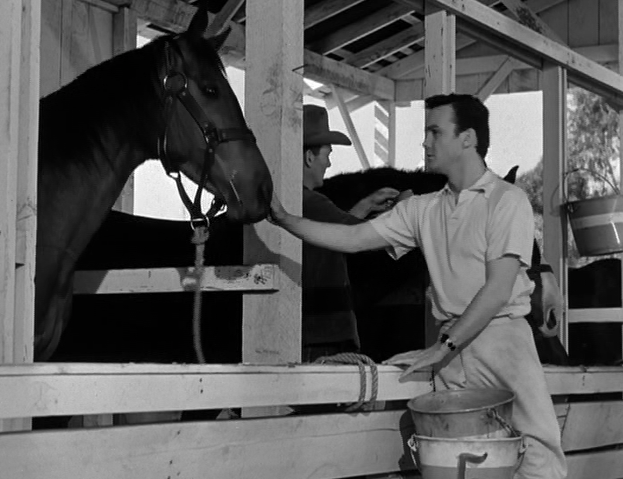
Identified by Hugh: Silver in The Lone Ranger (1949).

Identified by Hugh, Mr. Ed.

Not Identified: One Step Beyond: "Front Runner."

Identified by Joanna: Twilight Zone: "Spur of the Moment."

Identified by Hugh: Tango in Star Trek: "The Cage."

Identified by SGB: UFO: "The Sound of Silence."


Identified by SGB: Kim Darby in Circle of Fear: "Dark Vengeance."

Identified by SGB: Beckett in Shazam! "Thou Shalt Not Kill."

Identified by Chris G: Planet of the Apes: "The Horse Race."

Identified by Terri Wilson: Buck Rogers in the 25th Century: "Planet of the Amazon Women."

Identified by Terri Wilson: V: The Series (opening credits).

Identified by Hugh: Star Trek: The Next Generation: "Pen Pals."

Identified by Terri Wilson: Millennium: "Broken World."

Identified by Hugh: Doctor Who (new): "The Girl in the Fireplace."

Television and Cinema Verities #63


"Work with Gregory Peck? Yes, please. What was so good about that picture was that there was no blood in it, really. It's not a gorefest. Strange things happen, but it's got the mood and the music and everything. So, of its type, of its kind, I think it's quite a superior film. But, either way, you don't say no if you're asked to work with Gregory Peck. And he was wonderful, by the way."

- David Warner reflects on The Omen (1976).

Sunday, March 24, 2013

Monument(al) Destruction #2: Superman II (1981)


Cult-TV Blogging: Star Blazers (1979) Episode #4


In this episode of Star Blazers (1979), the great ship Argo tests its wave motion engine for the first time. 

In the Central Strategy Room, Captain Avatar and his top crew strategize for space warp, described aptly in the dialogue as a “giant step across space.”  The problem, as everyone realizes is that if calculations are wrong by even a degree, the Argo could become lost forever in the corridors of the “fourth dimension.”

The region selected for the Argo’s first jump is “Area 14,” a span of territory between the Moon and Mars.  Alas, a Gamilon carrier approaches the Argo as it nears those coordinates, and Derek Wildstar launches a squadron of Argo’s small fighters to intercept it.  One ship -- Conroy’s – nearly doesn’t make it back in time to join the Argo.

The Argo succeeds on the jump, and reaches Mars in a matter of seconds.  Unfortunately, the ship is badly damaged in the jump, and the crew must undertake repairs before the Gamilons can locate the battleship and resume their bombardment.

Only 362 days remain until Earth will be destroyed…


Between this episode and the next, The Argo is getting a shakedown of sorts.  The engine is tested here at space warp capacity, and the follow-up episode involves the first deployment of the wave motion gun.  

Much of this episode consists of building tension in terms of the first space warp jump.  Mark Venture is understandably concerned and anxious, since he is Argo’s navigator, plotting the vessel’s trajectory through space/ time.  More suspense arises when Conroy is almost left behind as the countdown to space warp ticks down.  My friend SGB has written before in the comments about the “emotional component” of Star Blazers, and this scene certainly fits the bill.  Once again, as viewers we are asked to contemplate the notions of duty and sacrifice in the service of a greater good.  Captain Avatar is prepared to leave a man behind because the consequences of mission failure are, literally, global.

All these moments work well, and the moment of space warp doesn’t disappoint, either.  The episode cuts to a trippy montage of the ship crossing planes of existence, it seems.  Images of the ship in flight double and triple, and the Argo even seems to travel through the corridors of time…where it briefly meets itself.  It’s a pseudo-2001 visual “trip,” and as such, awesomely psychedelic. 


Less satisfactory, however, are the exact details of the space warp.  It is reported in the dialogue that “thousands of light years” are traversed in a matter of moments, but the Argo bafflingly emerges near (a snowy) planet Mars.  On average – because both it and the Earth move -- Mars is some 225 million kilometers distant from our world.  A light year is approximately 9.4605284 x 10¹² kilometers in distance, so the Argo hardly jumped at all. 

In fact, it didn’t even jump one light year, let alone thousands, if Mars was its destination.

Now, I am not at all a person who believes that science fiction programs must be entirely scientifically accurate to be enjoyable.  In some sense, a focus on scientific accuracy over drama can take the fun and imagination out of certain narratives.  But, there should be some surface attention paid to scientific accuracy.  In other words -- just on a general level – I know that Mars is not a light year distant, let alone thousands of light years distant.

I wonder if the original Japanese series made this error in science, or if it was an error in translation to English. In other words, I wonder if in the Japanese original, the planet the Argo jumps to is not actually Mars, but rather one much more distant and far outside the solar system.

Regardless, this is a jarring mistake that raises many distracting questions.  And that, generally speaking, is my threshold of tolerance.  I’m willing to let pass a lot in the name of entertainment and imagination -- I’m a die-hard Space: 1999 fan, after all -- but what does appear on screen generally shouldn’t be so amiss that it actually distracts from the narrative.

What makes the mistake worse is that in the follow-up episode, Argo travels from Mars to Jupiter in a matter of minutes without using the wave motion star drive.  The distance from Mars to Jupiter is approximately 3.18 AU or 419 million kilometers, which is greater than the distance between Earth and Mars. 

So basically the Argo space warps to travel a shorter distance (Earth to Mars) and conventional engines to traverse a longer one (Mars to Jupiter). Again, I ain’t a science expert, but I know enough about space to be distracted by all this.

Despite the goof, I still have “faith” in what Star Blazers is “doing,” to borrow a line from Derek Wildstar.  In particular, I’m enjoying the series as momentum builds, and the Argo passes one crucial test after the next as it begins its long journey.  

Sneak Preview of Abnormal Fixation Season 3