Posts
Posts


At
the risk of embarrassing some readers, I will nonetheless write the following
statement regarding Clive Barker’s Hellraiser (1987).
It’s
all about sex.
If
that description is too debauching, just consider for a moment how much of our great literature
actually concerns sex.
What
started the Trojan War, and led to the events of Homer’s Iliad?
Sexual
desire (for Helen).
Or
consider, Lysistrata.
Or
Othello.
At
the center of all those tales is the human sex drive, or perhaps put more aptly,
the mysteries of the human sex drive.
How it can be manipulated. How it
can be used. How it can be sated.

An
extremely gory horror film from 1987, Hellraiser is very much in the same
camp as the aforementioned works of literature. The film involves, specifically,
one “uptight and frigid” woman’s
desire to experience, again, the best sex of her life.
That
sex (with Frank Cotton) is so amazing that Julia (Clare Higgins) -- as we see in
the film -- would do literally anything to experience it again, even commit murder…repeatedly.
Family ties fall by the wayside as Julia single-mindedly pursues a resurrection
of not only her lover, but her slumbering passion.
The
later Hellraiser films -- as horror sequels often do -- adopt a much
more literal, straightforward stance.
Those films are about, simply, people opening the gates to Hell and
their adventures with Cenobites such as Pinhead (Doug Bradley).
But Barker’s inaugural film is about sexual frustration in Julia, and sexual awakening, after a fashion, in Kirsty Cotton (Ashley Laurence).
Barker
explores these notions about human sexuality -- about the flesh -- through repeated instances of remarkable (and either sensual or horrific) visual symbolism.
I
have read, over the decades, negative reviews of Hellraiser that don’t
understand why people like so much a movie concerning an “evil box.”
In
some cases, those critics have failed to understand the central idea that
built the franchise; the idea that Hellraiser isn’t about opening an
evil box, but rather mastering and
unlocking the puzzle-box of human sexuality.
The
Hellraiser movies go from brilliant to terrible in short order, and I’ll
review at least the first four in the next few weeks here on the blog, but the first film
remains a masterpiece of the macabre primarily for its deep exploration into these ideas about sex and desire.

“Some
things have to be endured, and that’s what makes the pleasures so sweet.”
Julia
(Clare Higgins) and Larry Cotton (Andrew Robinson) move into the family house formerly
occupied by Larry’s loner brother Frank (Sean Chapman). Julia and Frank once
had an affair, and she covets the memory of it.
But
now, bizarrely, a chance arises for Julia to have a second chance with
Frank. He died in the house at the hands
of demonic beings called Cenobites. In particular, he opened a puzzle -- the
Lament Configuration -- that opened a door between Earth and Hell.
Somehow,
Frank escaped the tortures of the Cenobites, and was left for dead. His consciousness and bones still survive,
but for him to be whole once more, he must have Julia bring him the blood of the
living to devour.
She does so, bringing back strange men to the house with a promise of
sex, and then bludgeoning them to death with a hammer.
Kirsty
(Ashley Laurence), Larry's daughter, grows increasingly concerned for her father, and is troubled by bad dreams. One day, she goes to the house and learns what Frank and Julia
are up to. She also gets her hands on
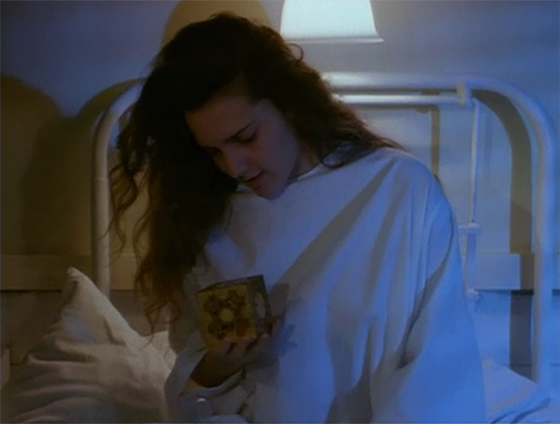
the Lament Configuration Puzzle, summoning the Cenobites as Frank once did.
Now
Kirsty must make a deal with Pinhead (Doug Bradley), the leader of the
Cenobites, to turn over Frank, lest they tear her soul apart. instead...

“Like
love…only real.”
I
first saw Hellraiser (1987) in movie theaters in 1987. I was seventeen,
and had never seen such a bloody film. And
yet, I could detect on repeat viewings (especially after I was in my twenties), how
all the blood and violence in the film served a dramatic purpose. The cold, empty Julia would do anything to feel her
blood pumping again, to feel the heights of passion, even it meant spilling the blood of someone
else, someone she didn't care about.
Julia’s
passion for Frank and blood-letting are first connected by Barker in a remarkable (and
remarkably disgusting...) bit of cross-cutting early on.
Julia is in the attic, remembering
the first time Frank made love to her (over her wedding gown, actually…).
Meanwhile, downstairs, Larry is attempting,
with several movers, to get a mattress up a narrow staircase. The mattress
becomes stuck, and Larry must pull at it. He tugs at it repeatedly, even as we see Frank thrusting atop Julia.


Unfortunately for Larry, he drags his hand across a
rusty nail. Blood fountains from his hand.
The
symbolism is unmistakable. As Julia has intercourse with Frank and achieves orgasm (in her flashback), that fevered motion is mirrored
by Larry’s hand, dragging the mattress. Both moments end with, presumably, the release of fluids.
But in this case, Julia’s driving memory of
sex with Frank is linked to explicitly to injury, to blood and death.
Indeed, that’s what her
passion will ultimately bring to Larry, his family, and anyone else that gets
into her orbit. Her love for Frank is a death sentence to everyone else.

That’s
not the only time that visual symbolism comes into play.
Consider specifically how the puzzle box, the
Lament Configuration, is opened. The demons are released
after the user runs a finger across a small circle of gold filigree.

This small circle (by a roaming finger...) across a surface is mirrored by Julia and
Frank’s sign of affection for one another. Several times in the film, they run their fingers across each other’s lips in a circle…even when
fingers and lips are drenched in spilled blood.


The little circle that opens the box -- and this sensuous touch of the soft lips -- is also, apparently, a metaphor or stand-in for clitoral
stimulation. That stimulation suggests another kind of gateway, one to passion and
sexual satisfaction. Frank is a kind of hyper-sexualized figure, an explorer in the realms of pleasure and pain, and he is
adept, apparently, at opening the puzzle -- or unlocking a woman’s desire. Julia is
ultimately undone by Frank (at least in this movie), because he uses these skills
to get his life back, but doesn’t truly love her. He betrays her, instead.
I have always considered Julia's journey to be the emotional and thematic core of Hellraiser. The family house where virtually all the action occurs even seems to be a metaphor for the character of Julia. It is an empty place that, nonetheless, houses inside a monstrous or terrible desire.
The house hides Frank, a dormant figure waiting to be re-activated. And Julia holds him inside her sealed-off heart, wishing him back.

Consider,
in comparison, Kirsty’s journey.
A young woman, she is permanently infantilized as "Daddy’s
little girl." Kirsty is solicitous of her dad’s attention, and constantly
worrying/tending to him. She runs to him whenever she has a problem.

Kirsty is also beautiful, and “ripe” as Frank describes her. She is totally unaware of her own (dawning) sexual power. Kirsty's beauty arouses the movers in the house, and then Kirsty goes to a kitchen sink, which explodes with water, unexpectedly, in her face.

Kirsty is surprised by this explosion, because
she is unaware of the power she wields.
To put it another way, Kirsty has not realized the power to unlock the puzzle box of her sexual power. But where Julia’s passion was associated explicitly with
spilled blood, Kirsty’s is not.
Instead, her desire is pure, and visualized by
the water. Life hasn't twisted Kirsty yet, hasn't transformed her into something sick and co-dependent.
Later, Kirsty has sex with her boyfriend, Steve, and in general seems to have a much healthier
attitude about passion than do either Frank or Julia.
So when she gets her hands on the Lament Configuration what does Kirsty do?
First, she teases Frank with the promise of controlling it. She does this not as a flirt, not out of desire, but so as to save her own life.
Kirsty has realized, suddenly, that she possesses something he very much wants. She can bargain with it, and hold him at bay. Kirsty now has an awareness of the power she yields, and again, that's a metaphor for sexual awakening.


Then, Kirsty uses the box for another purpose. She sends back the demons; destroying the sickness that Frank
and Julia created. She wields the box for an end that saves her life, and saves others.
Kirsty escapes the out-sized pull her father has on her life (exemplified by Frank’s gross come-on line, “Come to
Daddy,”) and demonstrates responsible control over the Lament Configuration. She can use the box to
destroy her demons, not summon them, not wallow in them. She governs her passions. She doesn't let them govern her, the way that Julia does.
This fact seems plain in the imagery that connects the two women. For a moment, each woman has a hand on the box. But Julia has destroyed herself playing with it. Kirsty takes it for purposes of escape.

What
is presented in Hellraiser then, uniquely, is a story of two very different
women. One lives in the memory of the past,
and covets a sick relationship that gave her pleasure. The other woman is able to grow up, move beyond her family unit, and
demonstrate an ability to conquer the threats that she encounters.
I
admire Hellraiser so much not for the goopy special effects, the
downright bloody horror, or even the spectacular and immortal Cenobite designs,
but because the film focuses so clearly on Julia and Kirsty, and their encounters
interacting with the “puzzle” of flesh, skin, and desire.
The imagery -- whether revealed in cross-cutting,
or related to the mastery of the Lament Configuration, enhance the film’s
themes beautifully.
For
me, no other Hellraiser film so perfectly captures the drive and illogic of
human behavior. The sequels move into the realm of mythology. I like Hellbound very much, but it’s such a different
animal.
In short, Hellraiser is all a
about a woman bringing unsuspecting men back to a filthy room and beating them
to death with claw hammers…so she can have the best sex of her life again. These particular scenes -- three of them -- are
played to perfection by Higgins. Julia is both anxious and excited as
she lures her would-be lovers to their doom. On
that first encounter, she’s thinking about committing murder. Her mark is thinking
about having sex. The line “there’s a first time for everything,” captures the
moment perfectly. It is true of both murder and sex.
Once the Hellraiser movies beyond both Julia and Kirsty, they seem a whole lot less intriguing.

Hellraiser also concerns tactile pleasures in a way that explores the Zeitgeist of its time. We experience the world through our
flesh, through our skin. We want to do -- at least sometimes -- what feels good, not what
it is actually right.
That equation seems like a
perfect metaphor for the excess of the 1980s, and so Hellraiser speaks to its
time in a remarkably powerful way.
In a decade of “greed is good,” how far do
you take greed? In this case, greed
transmits, pretty much, as sexual avarice. A merchant asks -- in the film’s
book-end questions: “what’s your pleasure?”
That’s the question, isn’t it? How far would somebody go to feel
good? As far as Julia goes? Or Frank?
Today
we remember Hellraiser as our introduction to Pinhead, Chatterer, Butterball, and the Female. But these Cenobites -- if I recall correctly from Paul Kane’s
brilliant book about the series, The
Hellraiser Films and Their Legacy -- only appear on screen for seven
minutes. These “explorers in the further
realm of experience” carry such incredible impact, even today, because they are
well-performed, and carefully-designed. But also because we don't see them too often, or get to know them too well.
Pinhead
radiates a kind of noble or regal brand of evil. He’s a monster, and yet, in some way,
he can be approached with reason and logic. At
least if you have something to bargain with.
The others are frightfully monstrous, and
they make you wonder how they can be seen as “angels to some” instead of as “demons.”
This
first Hellraiser film also features some blind alleys that were never adequately
explored in the sequels. After this film, for instance, we never again saw The Engineer, or the bone demon
that takes the box from the fire during the denouement. Those seem fascinating elements of the
mythology that ought to be developed at some point.

But
more troubling, I feel, is the fact that post-Hellbound films don’t’ really deal
convincingly or well with human foibles.
Pinhead and his buddies should function as ruthless exploiters of human
vice, and each film in the franchise, conceivably, could concern the downward
spiral of someone like Frank, or Julia. And in Hellbound, Pinhead notes that “hands don’t” summon him, only “desire”
does. That edict is dropped like a hot potato by the third film, and Pinhead,
Angelique and other Cenobites torture anyone who haphazardly opens the box and
toys with it.
That paradigm takes away much of the power of the franchise and
robs Hellraiser of its galvanizing factor; the opening up of the complex puzzle of human desire.