


Subscribe To JKM

 Posts
All Comments
Wednesday, December 09, 2015
Trading Card Close-up: Babylon 5 (Rittenhouse)

 award-winning creator of the web series Abnormal Fixation (2024), the audio drama Enter the House Between (2023) and author of 35 books including Horror Films FAQ (2013), Horror Films of the 1990s (2011), Horror Films of the 1980s (2007), TV Year (2007), The Rock and Roll Film Encyclopedia (2007), Mercy in Her Eyes: The Films of Mira Nair (2006),, Best in Show: The Films of Christopher Guest and Company (2004), The Unseen Force: The Films of Sam Raimi (2004), An Askew View: The Films of Kevin Smith (2002), The Encyclopedia of Superheroes on Film & Television (2004), Exploring Space:1999 (1997), An Analytical Guide to TV's Battlestar Galactica (1998), Terror Television (2001), Space:1999 - The Forsaken (2003) and Horror Films of the 1970s (2002).
Model Kit of the Week: Babylon 5 (Revell Edition)
 award-winning creator of the web series Abnormal Fixation (2024), the audio drama Enter the House Between (2023) and author of 35 books including Horror Films FAQ (2013), Horror Films of the 1990s (2011), Horror Films of the 1980s (2007), TV Year (2007), The Rock and Roll Film Encyclopedia (2007), Mercy in Her Eyes: The Films of Mira Nair (2006),, Best in Show: The Films of Christopher Guest and Company (2004), The Unseen Force: The Films of Sam Raimi (2004), An Askew View: The Films of Kevin Smith (2002), The Encyclopedia of Superheroes on Film & Television (2004), Exploring Space:1999 (1997), An Analytical Guide to TV's Battlestar Galactica (1998), Terror Television (2001), Space:1999 - The Forsaken (2003) and Horror Films of the 1970s (2002).
Theme Song of the Week: Babylon 5 (1993)
award-winning creator of the web series Abnormal Fixation (2024), the audio drama Enter the House Between (2023) and author of 35 books including Horror Films FAQ (2013), Horror Films of the 1990s (2011), Horror Films of the 1980s (2007), TV Year (2007), The Rock and Roll Film Encyclopedia (2007), Mercy in Her Eyes: The Films of Mira Nair (2006),, Best in Show: The Films of Christopher Guest and Company (2004), The Unseen Force: The Films of Sam Raimi (2004), An Askew View: The Films of Kevin Smith (2002), The Encyclopedia of Superheroes on Film & Television (2004), Exploring Space:1999 (1997), An Analytical Guide to TV's Battlestar Galactica (1998), Terror Television (2001), Space:1999 - The Forsaken (2003) and Horror Films of the 1970s (2002).
Tuesday, December 08, 2015
Lost in Space 50th Anniversary Blogging: The Girl from the Green Dimension" (January 4, 1967)

In
“The Girl in the Green Dimension,” the space siren who once attempted to lure
Dr. Smith (Jonathan Harris) to the stars (in “Wild Adventure”) returns. This
time, Athena (Vitina Marcus) is in love with Smith and believes him to be a
handsome warrior.
Smith
realizes that Athena, from the “green dimension,” has the ability to see the
future, and decides she is worth having around.
At least, that is, until a suitor shows up for her: the green-skinned space
Viking named Urso (Harry Raybould).
Because
Smith refuses to fight Urso for Athena’s hand, the alien turns Will (Bill Mumy)
green too.

It’s
not easy being green. It’s also not easy
reviewing this spell of Lost in Space’s (1965-1968) second
season. It would be difficult to name a sillier, more inconsequential title
than this week’s installment, “The Girl in the Green Dimension.” It’s sub-Gilligan’s Island fare.
The
absurdities pile up pretty past, but I’ll enumerate some of them here to give
you a taste. The first involves the fact
that Athena is apparently in love with Smith and considers him a brave
warrior. He is hardly suitable courtship
material. She is gorgeous and exotic…he’s
a middle-aged pear. So why the
attraction?
Secondly,
Will gets turned green – and then back to normal – by means that can only be
termed magic. Apparently, only Urso, not
Athena, can change the molecular structure of people by touch. Does this mean
all green men of the Green dimension have this power?


Thirdly,
we are asked to believe that the Robinsons would hold a funeral for a piece of
Jupiter 2’s equipment. The family
members literally bury the equipment, gather around the mound, and then say
kind words about it; they eulogize it.
This occurs, naturally, so Smith can see a vision of the “future” and
think that it is his funeral the family has witnessed. After witnessing this vision of his death, he
walks around the planet surface carrying his own half-carved tombstone.
“Wild
Adventure” is one of the absolute worst episodes of the second season, so it’s
a baffling choice to pick up that story line in “The Girl from the Green
Dimension.” Worse, nothing about this
story makes the slightest bit of sense, from the telescope that can show the
future to Athena’s affection for Smith as a brave, handsome warrior. It all seems to take place in some bizarre universe
where up is down, black is white, and green is, well, green.
Some
folks have seen “The Girl from the Green Dimension” as a commentary on racial
differences and belonging, because of Will’s tribulations as a green boy. He is afraid to show his face to his family,
after turning green, fearful that his siblings will reject him because he is “different.”

Indeed, that could have been the point of the
episode, but it isn’t. Instead, it’s the
only bearable subplot the episode has to offer.
A better episode would have featured Will’s change as the main point,
and challenged his family’s thinking on what is ‘normal,’ and the importance of
skin color. “The Girl from the Green
Dimension” barely touches on those notions, and certainly not enough to merit a
positive review.
In two weeks: "The Questing Beast."
award-winning creator of the web series Abnormal Fixation (2024), the audio drama Enter the House Between (2023) and author of 35 books including Horror Films FAQ (2013), Horror Films of the 1990s (2011), Horror Films of the 1980s (2007), TV Year (2007), The Rock and Roll Film Encyclopedia (2007), Mercy in Her Eyes: The Films of Mira Nair (2006),, Best in Show: The Films of Christopher Guest and Company (2004), The Unseen Force: The Films of Sam Raimi (2004), An Askew View: The Films of Kevin Smith (2002), The Encyclopedia of Superheroes on Film & Television (2004), Exploring Space:1999 (1997), An Analytical Guide to TV's Battlestar Galactica (1998), Terror Television (2001), Space:1999 - The Forsaken (2003) and Horror Films of the 1970s (2002).
Monday, December 07, 2015
Ask JKM a Question: Too Much Star Wars Hype?

A regular reader, Sean, writes:
"As we near the release of Star Wars Episode Seven, I share your confusion and ambivalence about the title Force Awakens. and I feel Star Wars Mania gripping the nation.
I recently stopped by my local Target and realized I couldn't look in ANY department without spying Star Wars Force Awakens merchandise there. I don't mean just Shirts and Toys, but plates, groceries, stationary, and well everything!
I was too young to properly notice or appreciate this Tour de Force when Episode 1 was released back in 1999, but now I find it at the same time both exciting and a little disheartening. The child in me is just excited to see the magic happening again, the adult in me eager to step back into that magical place the movies took me on my first time around.
But there is a third part of myself that has already grown to detest that bright Red and Black logo, who flinches and rolls his eyes at the sheer pointlessness of a Vader shower head, and is somehow offended by the sheer garishness of it all.
But there is a third part of myself that has already grown to detest that bright Red and Black logo, who flinches and rolls his eyes at the sheer pointlessness of a Vader shower head, and is somehow offended by the sheer garishness of it all.
I was wondering what your opinion was on the current Star Wars mania and is it coloring or influencing your anticipation for the film?
Also, is there a way an honest fan can enter the coming film with the correct amount of anticipation?

Sean, those are some amazing observations and questions.
I am very much looking forward to The Force Awakens, and hoping it will be great.
I do have my expectations firmly in check, however, because over the years I've realized that, well, I'm just not a little kid any more.
No film can ever make me feel exactly the way I felt when I first saw Star Wars.
Why? I was 7 years old.
That doesn't mean there is no joy or wonder to be had at the movies anymore. I came out of Mad Max: Fury Road (2015) invigorated by its presentation, and the possibilities of its world, for example.
But even that was an adult reckoning.
Going in with the expectation that a film made today -- in this corporate, homogenized movie environment -- will somehow transform my life, at 46 years old, is a certain path to the Dark Side.
I have seen Star Wars fans turn angrily on George Lucas because, somehow, he couldn't re-create for them that amazing, cherished experience they had in youth.
They don't understand the truth: it's not Star Wars that really changed. It's them. They grew up.
So I'm not certain why the same fans would suddenly believe that J.J. Abrams can accomplish what George Lucas did not. I guess because Abrams is promising the mother-of-all-nostalgia trips. "Chewie, we're home..."

What do I want and desire from the film?
I hope the movie is coherent, joyful (in J.J. Abram's words), and exciting.
I hope it has something to tell us about the world we live in today, while also transporting us to one of the most fascinating fantasy worlds of all time.
I hope The Force Awakens meaningfully reacquaints us with characters we love, and introduces us to new ones who are love-worthy and can carry the torch forward.
That's it. That's all the movie has to do.
I don't anticipate, expect, or need the film to be The Second Coming.
My recommendation would be for other fans to take that stance too. Enjoy the moment, enjoy the return of Star Wars, but leave behind your personal, sacrosanct memory from 1977.
My honest opinion about the mania and merchandising jibes with your own. It is garish; distasteful.
I can't watch any medium (even YouTube) without seeing Star Wars Walmart commercials, or Star Wars HP commercials all the bloody time. I can't surf the net without seeing a new theory, a new tidbit, a new promotional clip, a new night-show appearance every day, every hour, every minute.
I just don't need that much Star Wars. Nobody does, frankly.
It's a turn off, frankly. It makes me less inclined, not more inclined, to buy into the mania. It turns the magic into marketing.
Part of the thrill of the original Star Wars, again, back in 1977, was the feeling of discovery behind it; the feeling that you had stumbled upon something amazing that even the studio itself didn't realize was so great.
Yes, I loved (and continue to love) the toys too...they were incredible. Today, many of them have spots of honor in my home office.
But in 2015, Star Wars seems to be less about the movie -- or even toys -- than it is about selling audiences a fully-branded, never-ending "lifestyle" experience. This means we get spoon-fed the teasers, trailers, and clips. This means we get teased the next chapter, and the next standalone movie too. This means we get Star Wars Day at merchant sites and stores.
If the movie ends with a post-credits scene, I know it means, too, that this Star Wars -- whatever its merits -- is also a corporate sell-out; that the actual movie is not nearly so important as dangling the carrot of what comes next.
So I guess there is one more thing I want from The Force Awakens.
I want it to be a movie first; a vehicle for selling Darth Vader shower heads second.
I guess that's an expectation I carry with me.
The presence of a post-credits scene will be a good test, won't it?
If this work of art ends by trying to queue us up for excitement over the next installment, then, finally, the mania matters more than the movie. I'll be sad and disappointed if that's the case.
Don't forget to ask me your questions at Muirbusiness@yahoo.com
award-winning creator of the web series Abnormal Fixation (2024), the audio drama Enter the House Between (2023) and author of 35 books including Horror Films FAQ (2013), Horror Films of the 1990s (2011), Horror Films of the 1980s (2007), TV Year (2007), The Rock and Roll Film Encyclopedia (2007), Mercy in Her Eyes: The Films of Mira Nair (2006),, Best in Show: The Films of Christopher Guest and Company (2004), The Unseen Force: The Films of Sam Raimi (2004), An Askew View: The Films of Kevin Smith (2002), The Encyclopedia of Superheroes on Film & Television (2004), Exploring Space:1999 (1997), An Analytical Guide to TV's Battlestar Galactica (1998), Terror Television (2001), Space:1999 - The Forsaken (2003) and Horror Films of the 1970s (2002).
Cult-TV Theme Watch: Swords

A
sword is a blade weapon used for feints, thrusts, cutting, and stabbing.
And
swords have been a near constant presence in cult-television across the
decades.

In
“The Challenge,” an episode of Lost in Space’s (1965-1968) first
season, Professor Robinson (Guy Williams) battles an alien leader (Michael
Ansara) with a sword. The trick is that
the sword carries an electrical charge. Of
course, this battle itself is an homage, of sorts, to Guy William’s most famous
TV role: as sword-master Zorro.

In
the Star
Trek (1966 – 1969) third season episode, “The Day of the Dove,”
Klingons and Kirk’s crew battle for possession of the U.S.S. Enterprise when a
life-form that feeds on hate transforms all phaser weapons into
old-fashioned swords. Scotty finds a
Scottish blade -- a claymore -- that he fancies.
The
Buck Rogers in the 25th Century (1979-1981) episode “Escape from
Wedded Bliss” sees Buck (Gil Gerard) battle Tigerman in an arena,for the hand
of Princess Ardala (Pamela Hensley). One
of the weapons used is, predictably, a sword.
The
eighties brought several genre cartoon characters armed with swords, including
He-Man and the robot Voltron. Other
fantasy TV series, such as Wizards and Warriors (1983) made
frequent use of swords, and often featured sword battles.

The
last episode of V: The Series (1985), sees Mike Donovan (Marc Singer) and
Philip (Frank Ashmore) engage in a friendly sword duel with uncharged nuclear
swords. They are unaware that Diana
(Jane Badler) has secretly had them charged, so that they will kill each other.
The
1990s brought another sword master, Xena:
Warrior Princess (Lucy Lawless), and an episode of Star Trek: The Next
Generation in 1991, “Q-Pid”) saw Captain Picard (Patrick Stewart) playing Robin
Hood and defeating the Sheriff of Nottingham with a sword. The series Highlander features swords all the time, in virtually every episode.

In
the year 2000 episode of The X-Files (1993 – 2002), “First
Person Shooter,” a video game avatar, Maitreya, kills male players in a virtual
reality game with a deadly blade. She
decapitates them with it. Later, she captures Mulder, and Scully must enter the
game space to save him.
And
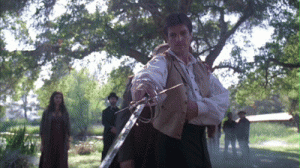
in the Firefly (2002) episode “Shindig,” the hapless Mal Reynolds
(Nathan Fillion) challenges a deft swordsman to a duel, for the honor of Inara
(Morena Baccarin). He is badly wounded,
but wins the duel only because he cheats.

Recently,
of course, Game of Thrones (2011 - ) has featured swords on a regular
basis. Arya Stark (Maisie Williams) has a sword – needle – with which she
trains to become a warrior. Later, she
plans to use it for purposes of revenge against those who have wronged her
family. We have also learned that the wicked Lannisters prefer their swords be forged from Valyrian Steel.
award-winning creator of the web series Abnormal Fixation (2024), the audio drama Enter the House Between (2023) and author of 35 books including Horror Films FAQ (2013), Horror Films of the 1990s (2011), Horror Films of the 1980s (2007), TV Year (2007), The Rock and Roll Film Encyclopedia (2007), Mercy in Her Eyes: The Films of Mira Nair (2006),, Best in Show: The Films of Christopher Guest and Company (2004), The Unseen Force: The Films of Sam Raimi (2004), An Askew View: The Films of Kevin Smith (2002), The Encyclopedia of Superheroes on Film & Television (2004), Exploring Space:1999 (1997), An Analytical Guide to TV's Battlestar Galactica (1998), Terror Television (2001), Space:1999 - The Forsaken (2003) and Horror Films of the 1970s (2002).
The Cult-TV Faces of: Swords
 |
| Identified by Hugh: Lost in Space: The Challenge. |
 |
| Identified by Hugh: Star Trek: "Day of the Dove." |
 |
| Identified by Hugh: Doctor Who: "The Deadly Assassin." |
 |
| Identified by Hugh: Buck Rogers: "Escape from Wedded Bliss." |
 |
| Identified by Hugh: Voltron. |
 |
| Identified by Hugh: He-Man and the Masters of the Universe. |
 |
| Identified by Hugh: Wizards and Warriors. |
 |
| Identified by Hugh: V: The Series: "The Return." |
 |
| Identified by Hugh: ST-TNG: "Q-Pid." |
 |
| Identified by Hugh: Highlander. |
 |
| Identified by Hugh: Xena: Warrior Princess |
 |
| Identified by SGB: Farscape: "Crackers don't Matter" |
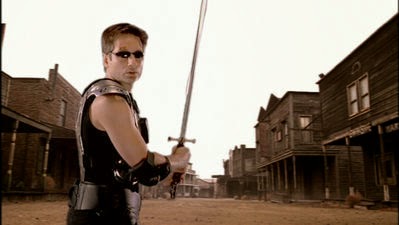 |
| Identified by Hugh: The X-Files: "First Person Shooter." |
 |
| Identified by Hugh: Firefly: "Shindig". |
 |
| Identified by Hugh: Doctor Who: "The Christmas Invasion." |
 |
| Identified by Hugh: Doctor Who. |
 |
| Identified by Hugh: Game of Thrones |
 |
| Identified by Hugh: The Clone Wars. |
award-winning creator of the web series Abnormal Fixation (2024), the audio drama Enter the House Between (2023) and author of 35 books including Horror Films FAQ (2013), Horror Films of the 1990s (2011), Horror Films of the 1980s (2007), TV Year (2007), The Rock and Roll Film Encyclopedia (2007), Mercy in Her Eyes: The Films of Mira Nair (2006),, Best in Show: The Films of Christopher Guest and Company (2004), The Unseen Force: The Films of Sam Raimi (2004), An Askew View: The Films of Kevin Smith (2002), The Encyclopedia of Superheroes on Film & Television (2004), Exploring Space:1999 (1997), An Analytical Guide to TV's Battlestar Galactica (1998), Terror Television (2001), Space:1999 - The Forsaken (2003) and Horror Films of the 1970s (2002).
Sunday, December 06, 2015
At Flashbak: The Computer Masters of Metropolis

This week at Flashbak, I also remembered the (strange) occasion in the early 1980s when DC Comics and Radio Shack joined up to promote the TRS-80 computer!
"The Computer Masters of Metropolis" is a story about superheroes, super-villains, and computer-savvy middle-schoolers.
Here's a snippet and the url: (http://flashbak.com/superman-wonder-woman-radio-shackstrs-80-47551/)

"Way back in 1982, Radio Shack -- "the
biggest name in little computers" -- and DC Comics combined forces to
promote home computing, and in particular, the home computer called TRS-80.
Superman and Wonder Woman headline "The Computer Masters of Metropolis," a comic penned by Paul Kupperberg and featuring art by Curt Swan and Frank Chiaramonte.
The tale commences with middle-schoolers
Alec and Shanna – “the computer whiz kids”
-- happily tapping away on their TRS 80s in class, when Wonder Woman arrives
and promises to escort the students to the World’s Fair, being held this year
in Metropolis. The theme of the Fair: science and technological improvements in
the 1980s.
Unfortunately, the evil Lex Luthor will destroy the World’s Fair unless he is paid a billion dollars. And he has incapacitated Superman with dangerous red solar energy! But Alex, Shanna, and the TRS-180 are available to save the day, thereby making the students the “computer masters of Metropolis.”
One of the most interesting aspects of
this promotional comic for Radio Shack and its product is Wonder Woman’s informative
classroom lesson on computers.
“Computers had their beginning in the
United States, when the world's first all-electronic unit was
completed in the fall of 1945,” she explains. Wonder Woman then makes a powerful
prediction: that one day computers will share "everything from
national weather reports to up-to-the-minute news reports from a major wire
services."
People will even be able to "play
games...with people thousands of miles away," and consumers can “can
go shopping through a computerized catalog."
So, absolutely, Wonder Woman predicted the
nature of the Internet!"
award-winning creator of the web series Abnormal Fixation (2024), the audio drama Enter the House Between (2023) and author of 35 books including Horror Films FAQ (2013), Horror Films of the 1990s (2011), Horror Films of the 1980s (2007), TV Year (2007), The Rock and Roll Film Encyclopedia (2007), Mercy in Her Eyes: The Films of Mira Nair (2006),, Best in Show: The Films of Christopher Guest and Company (2004), The Unseen Force: The Films of Sam Raimi (2004), An Askew View: The Films of Kevin Smith (2002), The Encyclopedia of Superheroes on Film & Television (2004), Exploring Space:1999 (1997), An Analytical Guide to TV's Battlestar Galactica (1998), Terror Television (2001), Space:1999 - The Forsaken (2003) and Horror Films of the 1970s (2002).
At Flashbak: The Wonder Computer of the 1980s! (The Commodore VIC-20)

This week at Flashbak, I remembered the Commodore VIC-202, the so-called "wonder computer" of the 1980s.
Here's a snippet, and the url (http://flashbak.com/remembering-wonder-computer-1980s-commodore-vic-20-47427/ )

"The
first home computer to sell a million units was the Commodore VIC-20, an 8-bit
unit hawked by Star Trek star William Shatner and released on the market in
1981.
Sold
at a very reasonable $299.99, the Commodore VIC-20 was the best-selling
computer of the 1982, and described as “revolutionary.”
Or,
as the ads trumpeted: “a computer like
this would have been science fiction a few years ago. Now it’s reality.”
Shatner’s
TV commercials were effective, in part because the marketing technique involved
positioning the VIC-20 against Atari 2600 and Intellivision game systems.
“Why buy just a video
game?” Shatner
queried, when “the whole family can learn
to compute!” A key selling point was, accordingly, that this machine had a
keyboard, not just joysticks."
award-winning creator of the web series Abnormal Fixation (2024), the audio drama Enter the House Between (2023) and author of 35 books including Horror Films FAQ (2013), Horror Films of the 1990s (2011), Horror Films of the 1980s (2007), TV Year (2007), The Rock and Roll Film Encyclopedia (2007), Mercy in Her Eyes: The Films of Mira Nair (2006),, Best in Show: The Films of Christopher Guest and Company (2004), The Unseen Force: The Films of Sam Raimi (2004), An Askew View: The Films of Kevin Smith (2002), The Encyclopedia of Superheroes on Film & Television (2004), Exploring Space:1999 (1997), An Analytical Guide to TV's Battlestar Galactica (1998), Terror Television (2001), Space:1999 - The Forsaken (2003) and Horror Films of the 1970s (2002).
Saturday, December 05, 2015
Saturday Morning Cult-TV Blogging: Jason of Star Command: "Chapter 10: "The Disappearing Man"

In
Jason
of Star Command (1978-1980), Chapter Ten, “The Disappearing Man,” a
Seeker suddenly appears near Star Command, and then vanishes. It re-appears in
the hanger bay.
While
investigating, Jason (Craig Littler), Nicole (Susan O’Hanlon), Parsafoot
(Charie Dell) and Commander Canarvin (James Doohan), find a high-speed
recording on the ship. Lt. Matt Prentiss
(John Berwick), who disappeared from Space Academy a year earlier), claims to
be a victim of Dragos’ (Sid Haig) evil.
Dragos
has experimented on him and accelerated his metabolism to one thousand times
the equivalent of human normal speed.
This is part of Dragos’ plot to develop an “ultimate weapon,”
invisibility.
Professor
Parsafoot (Charlie Dell) creates a device that can speed up Jason’s metabolism,
and allow him to locate Matt. But he
only has 90 seconds to use it, before he too becomes trapped – permanently – at
that accelerated rate of existence.
Jason
is successful bringing back Matt, and the grateful man informs him of another
secret. Peepo – who is still missing –
is under Dragos’ control.


“The
Disappearing Man” is a knock-off of a classic third season Star Trek episode: “Wink
of An Eye.”
In that narrative, as you
may recall, the Enterprise visited a planet called Scalos wherein a
civilization was dying. Its few survivors,
including Queen Deela, had been affected by strange factors in their
water.
The result was that their
metabolism accelerated to an unbelievable rate, making them impossible to see
at our speed or our level of vision.
The
story saw Captain Kirk accelerated in similar fashion (thanks to a drop of
water in his coffee cup), and the neat visuals depicted him moving at normal
speed through a world -- the corridors of the Enterprise -- frozen, as if in
amber.
“The
Disappearing Man” features the same sort of personal acceleration, vis-à-vis
the missing cadet, Matt Prentiss, and also shows the “real world” in the same
fashion; as so slow that movement is undetectable.

In “Wink of an Eye,” the Scalosians could
communicate, but their words were so fast, they sounded like insects buzzing
about. “The Disappearing Man” retains
that concept as well. I wonder how James Doohan felt acting in an episode with such an obvious Trekkie antecedent?
Even
casting aside these similarities, “The Disappearing Man” has some logical
problems. For example, Jason only has
ninety seconds or he will be lost, accelerated.
The machine that can bring him back, however, is broken at the last
second, leaving Dr. Parsafoot to attempt something else. The question is: why is this a crisis? Why not just repair the machine and send
somebody else (Nicole, perhaps…) after Jason, just the way he went after the
accelerated Prentiss?
“The
Disappearing Man” plays a lot like a budget/time-saver. Although there is a
guest star, John Berwick, all the action occurs on standing sets, not new
planet sets with alien creatures, and there are no new significant outer space
visuals, either, just some footage of a Seeker from Space Academy (1977).
Even
the plot is thrifty, having been imported directly from Star Trek.
Next
week: “Chapter 11: The Haunted Planet”
award-winning creator of the web series Abnormal Fixation (2024), the audio drama Enter the House Between (2023) and author of 35 books including Horror Films FAQ (2013), Horror Films of the 1990s (2011), Horror Films of the 1980s (2007), TV Year (2007), The Rock and Roll Film Encyclopedia (2007), Mercy in Her Eyes: The Films of Mira Nair (2006),, Best in Show: The Films of Christopher Guest and Company (2004), The Unseen Force: The Films of Sam Raimi (2004), An Askew View: The Films of Kevin Smith (2002), The Encyclopedia of Superheroes on Film & Television (2004), Exploring Space:1999 (1997), An Analytical Guide to TV's Battlestar Galactica (1998), Terror Television (2001), Space:1999 - The Forsaken (2003) and Horror Films of the 1970s (2002).
Saturday Morning Cult-TV Blogging: Space Academy: "Life Begins at 300" (November 12, 1977)

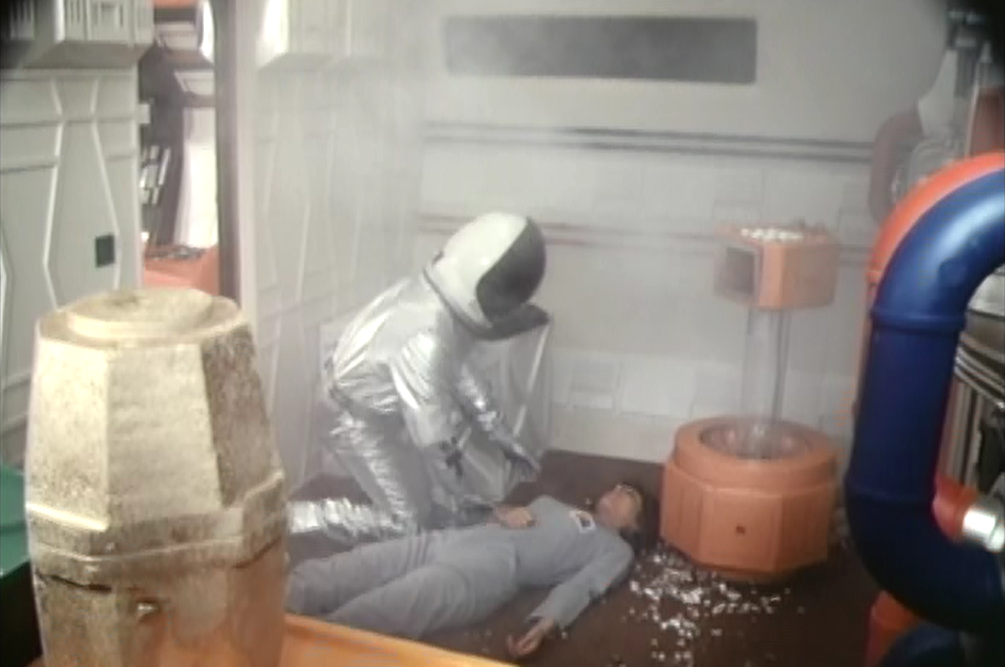
In "Life Begins at 300," another segment of Space Academy (written by Jack Paritz), a haughty cadet from Yellow Squad, Gina Corey (actress Paula Wagner) warns Commander Gampu (Jonathan Harris) that he should abort a Seeker mission to collect the mineral Zolium from a distant planet.
She thoughtfully quotes "Stanley Crane's paper on Zolium Distribution," but Gampu doesn't consider the mission particularly dangerous.
Unfortunately, he's proven wrong, and Paul's life support badge malfunctions while he's collecting the Zolium on the planet surface.
Worse, Peepo malfunctions in the atmosphere when sent out to save the cadet (with, of all things, an inflatable raft...).
Though Paul is finally saved, Gampu now has serious questions about his own leadership. Was Gina right? Did he underestimate the danger?
"There's a very old saying: you can't teach old dogs new tricks," he bemoans. Then, Gampu tenders his resignation from the Academy and orders Gentry to transmit it to Earth.
But Gina, who has constructed a device called "an extractor" to collect Zolium, also fails her mission, and it's up to Gampu -- with his 300 year old wisdom and experience -- to save her. He does so, and his faith in himself and his capabilities is restored.
"We all need the experience of age, which I have, and the exuberance of youth, which you have," he tells the thankful Gina.


The most interesting aspect of "Life Begins at 300" is that it's the first episode thus far to include Jonathan Harris (Gampu) in more than a supporting role. He does well in the role. I like that he can be both stern and gentle, and that he is alwys driving the cadets to be better. Gampu is a far cry from Dr. Smith on Lost in Space. He is a great elder spokesman for the human race and its values, and I like that Harris was given an opportunity to reveal another side of his persona.


I also just have to note how "Life Begins at 300" fits into that wonderful sci-fi TV convention: the mineral hunt.
In so many science fiction TV series of the 1960s and 1970s, the hunt for a rare mineral resource was the plot of the day. Dilithium was in short supply in Star Trek ("Mudd's Women,") along with Ritalin ("Requiem for Methuselah.") On Space:1999, the moonbase desperately needed titanium ("The Metamorph") and tiranium ("Catacombs of the Moon.") On Battlestar Galactica, it was the valuable substance "tylium" that had to be mined by the Ovions in "Saga of a Space World." Here, on Space Academy, Zolium is used to "regenerate life support badges." That's an intriguing background note that helps us understand how the seemingly miraculous future world exists.
I suppose it makes abundant sense that sci-fi TV series would focus on this aspect of outer space: ideally, we hope it's a realm brimming with the resources we require to sustain ourselves. But that remains to be seen. So when do we start mining the asteroid belt (and move into Outland territory?) I hope it happens soon.
Next week: "The Cheat."
award-winning creator of the web series Abnormal Fixation (2024), the audio drama Enter the House Between (2023) and author of 35 books including Horror Films FAQ (2013), Horror Films of the 1990s (2011), Horror Films of the 1980s (2007), TV Year (2007), The Rock and Roll Film Encyclopedia (2007), Mercy in Her Eyes: The Films of Mira Nair (2006),, Best in Show: The Films of Christopher Guest and Company (2004), The Unseen Force: The Films of Sam Raimi (2004), An Askew View: The Films of Kevin Smith (2002), The Encyclopedia of Superheroes on Film & Television (2004), Exploring Space:1999 (1997), An Analytical Guide to TV's Battlestar Galactica (1998), Terror Television (2001), Space:1999 - The Forsaken (2003) and Horror Films of the 1970s (2002).
Subscribe to:
Posts (Atom)

-
 Director Ridley Scott has already given the science fiction cinema two of its greatest and most cherished films: Alien (1979) and Blade...
-
 "Other Worlds lie outside our seeing; beyond the beyond; on the edge of within. The Great Pyramids: erected by the Ancient Ones as a ba...