Monday, November 11, 2013

Reader Top Ten: The Ten Greatest Science Fiction Films of the 1970s?


This month, for the Reader Top Ten, I want to return to the science fiction genre, and visit a beloved age of filmmaking: the 1970s.

In particular, I want to know the answer to one question.  What are your selections for the ten best science fiction films of the 1970s?

Personally, I love this decade of science fiction films, in part because of the overwhelming schizophrenia.  Half of the decade is downer dystopian-ism, and the other half is Star Wars swashbuckling.  Which trend wins out?

Send me your lists at Muirbusiness@yahoo.com, and I will post them throughout the week, before presenting the final tally on Sunday. I’ll accept reader lists through Friday night.

Again, number one choices are weighted three points, and number two choices are weighted two points, so make your lists accordingly!

In total honesty, I’m returning to the 1970s for two reasons.  First, it’s my favorite era in terms of science fiction film, as I suggested above.  And secondly, I happen to have a book out on the subject that I’d like to draw your attention to.

So -- in addition to compiling your own list -- please think about supporting my work in print.  My books are the very things that make this blog -- and daily posting -- possible.  So if you enjoy the blog and are a regular visitor, please think about supporting the book, in either print or even cheaper e-book.

Sorry for the hard sell, but every now and then, it’s a part of the job!

Now, here are my choices for the top ten greatest science fiction films of the 1970s, and my explanations for why they made the cut:''


10.       No Blade of Grass (1970)

This is an absolutely brutal and blunt apocalypse movie of the 1970s. The film confronts what a world-wide famine would mean to cities, families, and individuals, and descends into bloody violence and sexual degradation.  The film periodically flashes forward -- in bloody red color -- to scenes of life getting worse and worse for the desperate survivors.  Also, to my delight, the movie boasts absolutely no tact whatsoever. The director vividly cross-cuts images of children starving in Asia with satisfied restaurant diners gorging themselves on gourmet food in London.  In some ways, this film is even more hardcore than 1979’s Mad Max.


09.       Star Trek: The Motion Picture (1979)

There were a lot “computers go crazy” movies in the 1970s, including Colossus: The Forbin Project (1970), Westworld (1973) and Demon Seed (1977), but Star Trek: The Motion Picture gazed at the future of machines and imagined not only fear and domination, but the possibility of human/machine unions.  Derided in its time as slow and derivative, the film from Robert Wise is actually a full-throated exploration of the in-vogue theory of Singularity; of the total joining of machine and man.  This idea plays out in not only the main plot-line, but in terms of character arcs.  Kirk is in love with a machine (the Enterprise), Spock wants to be a machine, and then realizes that without human emotions he would face only “emptiness,” and finally, V’Ger -- the ultimate machine -- requires humanity to “imagine” an after-life beyond the universe.  Forget that you’re watching a Star Trek movie here, and simply experience a “human adventure” about a possible future where man and machine might co-mingle, to the benefit of all, and you start to see how The Motion Picture is one of the decade’s most forward-looking and visually spectacular films.


08.       Soylent Green (1973)

This dark, despairing dystopian effort revolves around a world in which global warming and over-population combine to create Hell on Earth.  A detective, Thorn (Charlton Heston) becomes involved in a murder investigation that threatens to uncover a dark secret about the Soylent Corporation.   From the opening montage -- which increases speed and intensity until it suggests the idea of humankind spreading across the surface of Earth like a virus -- to a touching scene of an old man selecting death over a life in Hell, Soylent Green is visually daring, and thematically prophetic.  In many ways, this underrated film stands as a clear noir predecessor to Blade Runner, and one – surprisingly – of roughly equal quality.


07.       Silent Running (1972)

This landmark environmental science fiction film about a man who kills his fellow man to save the Earth’s last forest proposes two ideas that we assume contradict each other, but don't, actually.  These are, A: that the last forest should be saved, and the film’s hero, Lowell (Bruce Dern) is right to save it.  And B:  that it is wrong for Lowell to kill his crew mates to save the forest.   Both A and B are true, and exist side-by-side in the film.   Lowell accomplishes a good...very badly, in other words.  Life is often this complex, but movies rarely are. Douglas Trumball’s Silent Running asks viewers to countenance the story of a  man commits a “good,” but at too a high a personal and moral price to live with.  In a sense, this is one of the most moral science fiction films ever made.  Lowell Freeman tries to balance nature, but unbalances his own life in the process…


06.       Invasion of the Body Snatchers (1978)

The 1970s remake of Invasion of the Body Snatchers by director Philip Kaufman primarily concerns shape and form, and the myriad ways that human beings misperceive shape and form, and thus make unwarranted assumptions that fit pre-conceived notions about those qualities. The film itself depicts an invasion of alien “pod people” -- essentially sentient plants -- who secretly replace human beings while they sleep in a vast 1970s liberal metropolis, San Francisco.  But unlike its 1950s predecessor, which was either an indictment of communism or an indictment of McCarthyism depending on your personal Rorschach, the remake plays meaningfully against the unmistakable backdrop of an increasing divorce rate in the United States and the ascent of the so-called “Me Generation.”  This film is witty, terrifying, and vetted with stunning visuals.  The casting of Leonard Nimoy as an emotionless alien is a brilliant joke, and once that creates a real tension with his familiar role as Mr. Spock.


05.       The Andromeda Strain (1971)

Mankind enters the “future age” of ascendant science in director Robert Wise’s impressive techno-thriller The Andromeda Strain, and the film ultimately proves that technology and scientific know-how can battle a deadly space “bug” to a stand-still.  Accordingly, Wise and his film itself -- an adaptation of a Michael Crichton best-selling book -- seem to worship at the feet of machinery, medicine, and science, not to-mention provide a reverent near-religious litany of techno-talk.  In this world, ordering up a computer test is more like quoting Scripture.  The film’s assessment of mankind, however, may seem less gracious. Here, mankind’s failings get in the way of progress, slow-down the process of stopping Andromeda, and nearly destroy the entire world.  The film’s final message, diagrammed in a computerized “601 Error” is that machines are ultimately only as good as their users.  Serious-minded, suspenseful, and presented with an almost kitchen-sink/documentary feel, The Andromeda Strain is an incredibly impressive film, to this day.


04.       Solaris (1972)

On the surface, the open-ended, Russian science fiction epic Solaris concerns mankind’s reckoning with an alien world, and its coruscating, planet wide ocean.  Scrape the surface, however, and the Tarkovsky film revolves around humanity’s total inability to meaningfully reckon with something truly alien, something truly unlike us.  Humanity’s steadfast inability to understand something “different’ is a result of a peculiar brand of selfishness, Solaris suggests.  When mankind gazes upon any object or person, people see only echoes of themselves and their own lives, their own experiences.  Thus, human beings are intrinsically self-centric beings. This notion is expressed in a line of dialogue in the film which suggests “We don’t need other worlds. We need a mirror.”   So where many science fiction films concern first contact with alien life forms, Solaris concerns, intriguingly, our through un-readiness for such a meeting.


03.       Superman: The Movie (1978)

Although blockbuster superhero films have come and gone since Superman: The Movie in 1978, the Richard Donner film remains the best film of its type yet produced.  This grand assertion is due in part to the film’s layered visual symbolism, which intentionally and methodically equates the life-time journey of Kal-El/Superman with that of a messiah, or Christ figure. Also, the 1978 Superman speaks meaningfully about its historical context: the Post-Watergate Age of the mid-1970s. Specifically Superman is offered up to audiences as a positive role model, a kind of wish-fulfillment alternative for a country that appeared mired in partisanship, bickering, and corruption.  Superman’s promise that he would “never lie” to Lois Lane (and to us) reflects this deep, burning national desire during the mid-1970s for a restoration of belief and trust in our elected leaders. In terms of structure, Superman: The Movie, is similarly unsurpassed because of the film’s remarkable and epic three act, biographical structure, which actually permits for intense focus on the hero rather than the villain, an absolute rarity in a genre which has distinguished itself largely, by spotlighting ever-kinkier, ever-more perverse antagonists. 


02.       Alien (1979)

I have come to believe that Ridley Scott’s Alien (1979) better represents the “vibe” of the 1970s than just about any other science fiction film of the decade (well, save for one…).  If the crew in Alien is recognizable as truckers in space or blue collar workers in the final frontier, then the alien is utterly unrecognizable -- even incomprehensible -- on first reckoning.  A great deal tension arises in the film from the conflict between these two poles: of total recognition, and total lack of recognition. The alien’s constant shifting, its universal state of flux, seems to reflect the anxieties of a decade that witnessed three presidents in ten years, and upheavals in Vietnam, Iran, and on the home-front.  An overwhelming fear in the 1970s was that we didn’t know what,-- or from where, --something else was going to hit the country as it was trying to get back up on its feet again.  Would it be another oil crisis or “shock”? Stagflation? Another political upheaval? A nuclear reactor meltdown?  Alien pitted the average Joe -- the everyday American -- against a multi-headed hydra, a threat that was always in transition.


01.       Star Wars (1977)

I suppose this selection is a predictable one, but the hell with it.  Star Wars is a phenomenon, and a cultural touchstone, but the important thing is that it is also a great movie.  The  tremendous joy of Star Wars, even today, after all the imitations and knock-offs, originates from George Lucas’s incredible ability to ground his otherworldly “space opera” world in a reality that is immediately recognizable to all of us.  For instance, underneath the flashy lasers and colored light sabers, or the strange aliens and robots, the film boasts this driving, human feeling of yearning, of almost anticipatory anxiety. Star Wars’ lead character, Luke Skywalker (Mark Hamill) gazes up at the night sky of Tatooine, and he wonders what awaits him.  Where will he go next?  When does his life really begin? When does he finally get to grow up and chart his own destiny?  What is he supposed to believe in? Lucas grounds the viewer in Luke’s personal “coming of age” story, yet that’s far from the only grounding the director accomplishes here.  Without explaining in significant terms a layered or complex back-story, Lucas crafts in Star Wars a lived-in world which nonetheless points to previous adventures, and to a larger universe beyond the main narrative.  It’s such a big (and yet consistent…) place, in fact, that it almost can’t all fit within the boundaries of the movie frame.  Thus at times, it almost seems as if Lucas didn’t make up his universe at all, or build it all from scratch.  Rather, it’s as though he took a camera in-hand and actually traveled to a galaxy far, far away, filmed what he witnessed there, and brought that footage back for the rest of us to enjoy.

My choices for runners-up (and which might have even made the list on another day…) are: Conquest of the Planet of the Apes (1972), Logan’s Run (1976), Mad Max (1979) and Stalker (1979).
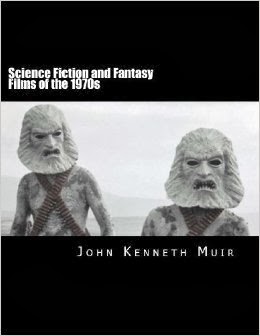

Available at Amazon.com


Cult-TV Theme Watch: Skeletons


A skeleton is an organism’s super-structure, and an adult human skeleton showcases 206 bones including the vertebral column, the rib cage, and the skull.

The skeleton features a kind of fearsome or monstrous visage, too, and it is for that reason -- fear -- that skeletons often appear throughout cult-television history. 

Skeletons represent a great mystery, perhaps, when discovered by cult-TV protagonists. 

What happened to the dead?  How did they die? Who were they? Where did they come from and what did they face?

A skeleton -- a human form without, necessarily, individual human identity -- raises all such questions.


Three Quaker-like innocents, Devon (Keir Dullea), Garth (Robin Ward) and Rachel (Gay Rowan), discovered they were living on a spaceship, not on a planet in “Voyage of Discovery,” the first episode of The Starlost (1973 – 1974). But what they found on the bridge of that ship was even more terrifying: the skeletons of the dead crew, victims of some long-forgotten but catastrophic disaster.


Similarly, in Space: 1999’s (1975 – 1977) “Testament of Arkadia,” the Alphans discover a cave of humanoid skeletons on the distant world of Arkadia.   These skeletons seem to pre-date man, and the mystery surrounding their lives -- and deaths --- grows and grows.

An away team from the Enterprise-D discovers the skeleton of a human astronaut inside a strange casino on another world in Star Trek: The Next Generation’s (1987 – 1994) “The Royale,” and wonders what led him to his grim fate.  Worse, when they can’t escape the casino, they wonder if they will share his lonely fate.


A pair of skeletons is discovered in North Carolina in The X-Files (1993 – 2002) episode “Field Trip,” and is positioned strangely…as if resting together on a bed.  Again, the skeletons confirm the what -- death -- but not the how or why.  That’s Mulder and Scully’s job, to get those answers.

Skeletons have also made fearsome and spooky villains in many series.  In Doctor Who’s (2005 - ) two-parter “Silence in the Library”/”Forests of the Dead,” the Doctor grapples with the “piranhas of the air,” the Vashta Nerada.  These microscopic aliens devour flesh, leaving only bone, and then, grotesquely, can animate the skeletons of the dead. An unforgettable vision presented by this installment of the series is that of an ambulatory skeleton in a spacesuit.


Skeleton soldiers and sword-fighters -- deliberate echoes of the work of Ray Harryhausen in Jason in the Argonauts -- have likewise appeared in such series as Buffy the Vampire Slayer (“Tabula Rasa”) and Merlin.

The Cult-TV Faces of: Skeletons

Identified by David Colohan: The Starlost: "Voyage of Discovery"

2
Identified by SGB (and Brent Fox on Facebook): Space:1999: "Testament of Arkadia.'
Identified by David Colohan: Skeletor of He-Man and the Masters of the Universe


Identified by Sirrus: Star Trek: The Next Generation: "The Royale."

Identified by Kentucky Packrat: Star Trek: The Next Generation: "Loud as a Whisper."

Identified by David Colohan: The Simpsons

Identified by Sirrus: Star Trek Voyager: "Life Signs."

Identified by David Colohan: The X-Files: "Field Trip."

Identified by Brian: Farscape: "Home on the Remains."
Identified by Erik Johnson, Illustrator (and on Facebook: Ed Erdelac):  Buffy the Vampire Slayer: "Tabula Rasa."


Identified by Erik Johnson, Illustrator: Smallville: "X-Ray."

Identified by David Colohan: Lost.

Identified by David Colohan: Doctor Who: "Silence in the Library."/"Forest of the Dead" (Vashta Nerada).


Identified by Kentucky Packrat: Merlin.

Television and Cinema Verities #95


"When I did the picture, we had a script that did not have the last few pages. The script at the end said... I forget now how it was worded, but it made it clear that there was an ending that they were going to keep secret until they shot it. My assumption was, "Oh, boy, this is going to be a good ending. This is Disney, these guys know what they're doing, they're really gonna put something great out there." And when I saw the picture, I was really confused about what that ending was all about. So, with the exception of the ending, I liked the picture a lot..."

- Robert Forster describes the making of The Black Hole (1979), in a year 2000 interview with Keith Phipps at A.V. Club.

(And to read my review of The Black Hole, don't forget to check out my book, Science Fiction and Fantasy Films of the 1970s).

Sunday, November 10, 2013

Cult-TV Blogging: Firefly: "Jaynestown" (November 1, 2002)


In “Jaynestown” Serenity makes a stop at the “mudder” settlement on poverty-stricken Canton. 
There, Mal (Nathan Fillion) and Jayne (Adam Baldwin) attempt to recover a long-lost loot, only to discover that since his last visit there, Jayne has been deified as “the Hero of Canton.”  On his last visit, years earlier, Jayne dropped his cargo -- money – on the mudder town, and so now boasts a reputation as a kind of modern Robin Hood.
While Shepherd Book (Ron Glass) cares for River (Summer Glau) and introduces her to the Bible, and Inara (Morena Baccarin) sees the son of a wealthy client, Jayne comes to reckon with what it really means to be a “hero.”


“Jaynestown” concerns the Hero of Canton, Jayne Cobb (Adam Baldwin), and he even gets his own theme song here. 

I’ll be honest: Jayne -- Serenity’s muscle -- is one of my favorite characters on Firefly, and episodes such as “Jaynestown” and “Ariel” (coming up in a few weeks), establish why.  Jayne is most definitely not a hero.  
He’s not even a good man, at least most of the time.  He’s an opportunist and a man who is interested in his own survival, first, second, and last.  “Out of Gas” reveals how Jayne joined Serenity’s crew in the first place, switching to the highest bidder during a confrontation.  And “Ariel” explores how he is willing to sell his shipmates out for a big pay-day.

But Jayne is also funny as hell, and, most significantly, he does possess a conscience, even if he doesn’t always choose to listen to it.  In “Ariel,” after Mal learns of his sell-out, Jayne accepts his own death, but pointedly asks the captain not to tell the crew about his mis-deeds.  He doesn’t want to be remembered that way….as a rat.  That fact suggests that Jayne knows that he did wrong.  A real monster, a real bad man, wouldn’t have understood the error of his ways.

Likewise, in “Jaynestown,” Jayne is bowled over by the fact that someone else would die for him, as a young mudder does in the climactic battle. 

Would Jayne have died for that boy?  Not bloody likely. 


Jayne realizes this fact, and so the episode ends with him confused, and downright contemplative; the most thoughtful we’ve ever seen Jayne, in fact.  He can’t understand why his life would matter to someone else, because most of the time the lives of others don’t really mean much to Jayne.  He is shamed by the fact that someone better than he is died for him.

“Jaynestown” is a strong episode of Firefly because it asks the viewer to accept multiple and seemingly contradictory truths about Jayne, and what he did on Canton. 
On one hand, we know that Jayne dumped the cash in the haste of a failed escaped, and didn’t intend to do good at all. 
On the other hand, Jayne did (inadvertently) do good, in the final analysis. He made a difference in the mudders’ lives, and now they veritably worship him as a Robin Hood figure.  

In this situation, are Jayne’s intentions (or lack of intentions) important?

Or are his deeds what truly matter?

In studying that question, the episode examines how we can’t really know a “hero” by his or her actions, and furthermore, explains that heroism is a matter of a perception.  As Mal says in the episode’s coda: “It isn’t about you…It’s about what they need.” 

In other words, the mudders find a purpose, unity, and even a meaningful life “story” in Jayne’s actions, and that “myth” becomes infinitely more important to them than the reality of Jayne’s intentions in one moment of time. 

At first, we want to laugh at the colonists for building this huge heroic mythology around Jayne, a dunce and a scoundrel.  But then we see how the “Hero of Canton” has made their lives better; has rallied them.  That Jayne is a dunce and a scoundrel matters not a whit, really.


This theme finds an interesting and meaningful reflection in Shepherd Book and River’s sub-plot.  There, Book introduces River to the Bible, and she proceeds to tear it up.  River starts scribbling in the book, and tearing out pages.  She says she can “fix it” and that the Holy Book is “broken.”  Sherpherd Book tells her that you “don’t fix the Bible!” with a bit of righteous indignation.

But in this scenario, the Bible is, essentially, serving the same purpose as Jayne does.  It is a well-spring from which many people have drawn inspiration, faith, and the strength to continue facing the difficulties of life.  The Bible may not be “perfect” in some ways -- as Jayne isn’t perfect or even heroic -- but so many people draw strength from its words and lessons.  It has become more than a mere book, and an integral part of a whole culture’s “life.” Yes, there are some aspects of the Bible which might (arguably) be termed archaic today, as there are some elements of Jayne that aren’t so great. 

But Jayne and the Bible have managed -- each in their own, very different ways -- to bring hope to the hopeless, and faith to the faithless.  What “Jaynestown” seems to state most clearly is that sometimes the messenger may be flawed or imperfect, but the message can still be fruitful, and worth hearing.

Next week, one of Firefly’s greatest episodes: “Out of Gas”

Saturday, November 09, 2013

Saturday Morning Cult-TV Blogging: Return to the Planet of the Apes (1975): "Terror on Ice Mountain" (November 22, 1975)


In the Return to the Planet of the Apes (1975) episode “Terror on Ice Mountain,” Cornelius unearths a dangerous book at his latest archaeological dig in the Forbidden Zone.  The book is so dangerous because it was created pre-catastrophe by intelligent humans, and titled A Day at the Zoo.  Inside the book, pictures depict intelligent humans looking at primitive apes in cages…

Zira and Cornelius realize that if Urko should find this book, he would possess just the evidence he needs to wipe out the planet’s humanoids.  

Even as Urko petitions the council to search the chimpanzees’ laboratory for signs they are collaborating with the humanoids, Zira and Cornelius reach out to Jeff and Bill for help disposing of the offending text.

Cornelius tells the human astronauts that he has also discovered the blueprints to a hot air balloon, and needs their help constructing and flying the device.  He plans to take the book A Day at the Zoo to the peak of Mount Gar, where it will be buried and thus hidden until such time as Ape City is wise enough to receive the truth about the planet's history.

Bill and Cornelius launch the hot air balloon, but run afoul of a deadly storm, and the great creature “Kigor,” “God of the Mountain Apes…”


I’m not actually certain why, but “Terror on Ice Mountain” is the episode of Return to the Planet of the Apes that I most clearly remember from my own childhood.  I must have been five-years old when I saw it during its first broadcast, but elements of the episode still stand-out, particularly the hot-air balloon and the giant ape.  In fact, I suspect that the giant ape is what really caught my eye, since at that age I was a crazy King Kong fan, and obsessed with everything Kong-related.

Without the warm-glow of nostalgia shining upon it, however, “Terror on Ice Mountain” isn’t one of the more dynamic episodes of this animated series, at least so far.  The episode starts strong with the discovery of the dangerous book (and the idea that, in some societies, knowledge is dangerous.).  

But then, once the hot-air balloon takes off the audience is treated to endless minutes of the craft being buffeted in the storm.  It’s almost as if the episode ran short, and needed padding to round out the half-hour.  The blizzard seems to go on forever.


At episode’s end, Cornelius and Bill encounter not just a giant ape, but those who worship it...beings who are rather like the Tibetan Monks of the Planet of the Apes.  Thus, a second ape society is introduced to the series, and one less hostile to the idea of intelligent man (and the truth).  This aspect of "Terror on Ice Mountain" makes me wonder if there are other ape cities or cultures throughout this world, and if they are all as paranoid and hostile as the one where Zira and Cornelius dwell.

Next week: “River of Flames.”

Saturday Morning Cult-TV Blogging: "Wild Thing" (October 12, 1991)


In “Wild Thing,” the sixth episode of the 1991-1992 Land of the Lost remake, the baby dinosaur Tasha begins to unwittingly make trouble for the Porters.  

She is loud at night, and keeps waking up the family.  Then, Tasha accidentally knocks over the shower stall that Mr. Porter has laboriously constructed.

Feeling that he has little choice, Porter orders Annie to send Tasha away to live in the wild.  

“No matter how sweet she is, she’s still an animal,” he notes.

Meanwhile, however, Shung and the Sleestak are looking for a way to gain possession of the Porters’ chariot, and set a trap in the woods for the now-on-her-own Tasha. 

 Fortunately, a brontosaurus Tasha has befriended comes to her aid…


In the original Land of the Lost (1974 – 1977), patriarch Rick Marshall had the presence of mind, foresight, and flat-out good sense to tell his daughter Holly that she could not keep the baby brontosaur Dopey as a pet.  It was hard to let the dinosaur go, but Marshall spared Holly a lot of pain by laying down the law early.  By refusing to let her take the dinosaur as a pet, Marshall prevented a world of problems.

Mr. Porter in the remake of Land of the Lost could learn a lot from Rick.

Here -- several episodes after Annie and the family have “adopted” Tasha -- he decides that she would be better off living in a pen, and then, finally, that she should live in the wild.  In the end, however, he must bring the young dinosaur home again, to Annie, Tasha (and the audience’s) relief.    But what lesson does he teach his child?  That parents can be capricious, cruel, and foolish?


In other words, the whole episode represents an unnecessary exercise.  Porter puts his daughter and Tasha through an emotional nightmare just to end with the original status quo.

It’s weird, but Mr. Porter is uncharacteristically mean and short-sighted in “Wild Thing,” and he also waffles a lot.  First, he tries to get rid of Tasha, but then -- when he sees she could get hurt in the wild -- welcomes her back.  Certainly, if Mr. Porter was advocating for releasing the dinosaur into the jungle, he must have realized that she might get hurt.  How could he have not considered that fact in the first place?

I know I’m not being particularly nice about this episode of Land of the Lost, but the whole story bothered me.  You don’t get rid of a pet -- let alone a family member -- just because keeping them around becomes inconvenient. 

In my house right now, we have three geriatric cats that we love, and one of them is having a problem urinating on carpets.  But she’s part of the family and has been since 1999.  We’re working to solve the problem…but we would never dream of getting rid of her.  Alas, there are many people who do treat pets the way Mr. Porter does in "Wild Thing."  Pets are wonderful...until they do something people don’t like.  I used to know someone who, when they didn’t like a cat, would drive the animal to “the farm.”  The “farm” was actually a euphemism for dropping off the animal alone in the country.

Anyway, “Wild Thing” smacks of that kind of thinking to me.  It doesn’t seem realistic or true to what we know of Mr. Porter’s character that he would suddenly decide to get rid of Tasha, especially given the fact that Scarface is nearby (and in fact, murdered Tasha’s mother and the rest of her litter). 

Secondly, it’s abundantly clear from the get-go that getting rid of Tasha is wrong, so the whole episode feels like an unnecessary exercise in futility, as we wait for Mr. Porter to come to the pre-ordained conclusion that he was wrong in the first place.  Again, he only makes Annie and Tasha suffer here, and does no real good.

Once again, this episode seems like another situation where the writing and characterization on the original Land of the Lost is a lot stronger than it is on the 1990s follow-up.

Next week: “Day for Knight.”

Friday, November 08, 2013

Cult-Movie Review: Southern Comfort (1981)


“Instead of raising the tragic possibility that a subculture might disappear, Southern Comfort explores our anxiety that the dominant culture itself may be divided and destroyed.  [It] seems to suggest that destruction is the price of the desire to use -- rather than understand – another culture.”

-          Jeffrey H. Mahan, The Christian Century, December 16, 1981, page 1322.

“Southern Comfort” is not only a liqueur (a New Orleans original, so-to-speak…), but a turn of phrase that links a storied American region with ideas like relaxation, hospitality, and succor. 

Walter Hill’s 1981 film Southern Comfort plays ironically on the meaning of the term, and forges the director’s second effort -- after The Warriors (1979) -- that involves outnumbered soldiers trapped in harsh enemy territory and forced to fight every step of the way home.

But Southern Comfort is rather steadfastly not the urban fantasy of The Warriors. 

Instead, it’s a blistering social critique as well as a violent action film.  By setting his film in the year 1973 and featuring as his protagonists soldiers from the Louisiana National Guard, Hill crafts a film that, according to Michael Sragow in Rolling Stone, is a “parody of the military sensibility,” “a metaphor for the Vietnam War” and a “study of gracelessness under fire.”

Southern Comfort gazes at the idea of a nation knowingly unloosing aggression and violence on a mass scale, often times by soldiers who are not educated about the nature of the enemy, are insensitive to cultural differences, and who – finally – crack under pressure. 

Can war ever be a moral “right?”  And if so, does it matter who, specifically, a nation sends to war, and how those men wage that war?

These are not easy questions to answer.  And these were not small issues in the days of Vietnam, a war that severely tested American beliefs about its own national might and moral rectitude.  Southern Comfort suggests a home-grown Vietnam culture-clash right here, inside our regional borders, and a so-called “primitive” culture dwelling side-by-side with the more “advanced,” dominant one.    

By making this sustained cinematic battle an intra-American one, so-to-speak -- American National Guard vs. American Cajuns -- Walter Hill allows viewers to see concepts not always readily apparent in the case of foreign wars, where patriotism can overwhelm reason and balance.  In America we cherish and protect our right and responsibility to defend our homes and even our right just to be left alone, the very concepts that the Cajuns wage bloody guerrilla war over in the film.  But when we’re the aggressors intruding in the territory of others, our values seem to change.  This film holds up a mirror to that paradox. It is a non-romantic, non-idealized view of war and soldiers.  

Notice that I didn’t say negative view.  

The approach here is even-handed, revealing how soldiers can be smart and heroic, as well as misguided and out-of-control.  The trenchant idea seems to be that of the Pandora’s Box.  If you release men with guns into an untamed environment, where danger is everywhere, each will respond in his own way.  Some will find and adhere to a strong moral compass.  Others will degenerate into sadistic violence.

Furthermore, Southern Comfort suggests, as the quote from Jeffrey Mahan above observes, that a dominant culture out to “use” a weaker culture is actually the one in danger of being “divided and destroyed.”  

That destruction comes about from a moral failure, the failure to contextualize “the enemy” as human, and understand the enemy on human terms.  Specifically, if we use our might just to take resources from others, or to argue for the assertion of our ideology in someone else’s land, we are in violation of our own cherished beliefs and values.  We say “don’t tread on me,” but if someone else has what we want, we tread on them with the greatest military machine in history.

This cerebral argument doesn’t make Walter Hill’s film any less tense or violent, but rather adds a layer of commentary to the savagery.  As critic Diane Hust wrote in “Heavy Symbolism Ravels Film’s Good Yarn” (The Daily Oklahoman, November 12, 1981): “These ‘civilized’ but allegedly trained soldiers fall apart in a blue-green otherworld, and even the likable heroes...have brutal and vulnerable sides that emerge during the ordeal.” 

The idea here is that all soldiers are not created equal, and until the crucible of combat occurs, it’s almost impossible to determine who will thrive, and who will succumb to cowardice, or animalistic brutality.  The film walks a delicate balance, but not everyone agrees it succeeds.  Vincent Canby at The New York Times noted that Walter Hill is “the best stager of action in practice,” but found the film to be “more an exercise in masochism than suspense.”  Yes, in some way, the same argument could be made of every entry in the Savage Cinema genre.

Time Magazine noted (derisively) that in Southern Comfort “everything is a metaphor for something else,” but that’s okay with me too.  When vetting extreme violence, I prefer that movies boast and reflect an intellectual point-of-view about that violence.  In other words, the violence becomes palatable and meaningful because we sense it is being applied to convey a point of intellectual merit.

In this case, Southern Comfort reminds us that once war is uncorked, and men are encouraged to rely on instinctive, violent impulses, all bets are off concerning outcomes. It also reminds us how people with guns can, in a moment of impulse spark a conflagration that can’t be controlled.

“Comes a time when you have to abandon principles and do what's right.”

In 1973, the Louisiana National Guard’s “Bravo Team” practices maneuvers in the bayou, tromping through nearly forty kilometers of treacherous and dangerous natural terrain.

Soon, the squad becomes lost and realizes it must procure transportation to traverse a river.  Accordingly, Sgt. Pool (Peter Coyote) orders the men to appropriate three Cajun canoes.  Worse, one of the soldiers, Stuckey (Lewis Smith) playfully opens fire on the Cajun owners. 

They don’t realize his weapon is loaded with blanks, and respond with sustained lethal force.  In the first attack, Sgt. Pool is shot down, and the Cajuns begin hunting down “Bravo Team.”

Inexperienced and scared, the reservists make a bad situation worse when they seek shelter at the home of a French-speaking trapper (Brion James), and blow up his house using dynamite.

As the reservists die in the swamp, one by one, the level-headed Spencer (Keith Carradine) and a transfer from Texas, Hardin (Powers Boothe) try to hold their own and maintain some sense of order and control.

They eventually escape the treacherous bayou, but end up in a remote Cajun village in the middle of nowhere…

“Well, you know how it is, down here in Louisiana, we don't carry guns, we carry ropes, RC colas and moon pies, we're not too smart, but we have a real good time.” 

Set in “the great primordial swamp,” Hill’s hard-driving polemic, Southern Comfort shreds typical bromides about “supporting the troops” and gazes instead, in rather even-handed (if gory...) fashion at soldiers who are ill-prepared emotionally, intellectually and even physically in some cases.

Powers Boothe portrays Hardin, one of Southern Comfort’s main protagonists.  He’s a chemical engineer who recently transferred from Texas, and he immediately understands the brand of man he’s now training with.  He calls them “the same dumb rednecks” he’s been around his “whole life.” 

In short order, this descriptor proves tragically accurate. His fellow “soldiers” steal private property (canoes), and open fire – as a dumb joke! -- on unaware American citizens, the local Cajuns. 

The same “dumb rednecks,” meanwhile, deride the Cajuns as “dumb asses” or primitives.  It’s true that director Hill has on occasion rejected the Vietnam metaphor encoded in his film, but it’s apparent that these soldiers view the Cajuns precisely as some Americans viewed “Charlie:” inferiors who couldn’t possibly pose a threat to modern, technologically-superior Americans.

Again, cementing this Vietnam allegory, the Cajuns in the film boast a strategic advantage because they are familiar with the harsh landscape of their “homeland.” 

Also, they resort to guerrilla tactics, deploying deadly booby traps and other hazards against the lost soldiers.  Like the Viet Cong, then, the Cajuns have been underestimated, and prove more resourceful and cunning than the forces of the more technologically-advanced culture. 

This is very much the same dynamic we see in another film Walter Hill produced, 1986’s Aliens.  There, the titular xenomorphs with their underground (sub-level) tunnels (hive) were grossly under-estimated by soldiers packing high-tech weaponry.  They were derided as “animals,” but they executed brilliant battle strategy.  The idea in both instances is the arrogance of military might, and the misapplication of military power.

Much of Southern Comfort finds the Guardsmen lost, confused, and running in circles as the Cajun hunters pick them off one at a time. Making the plight of the Guardsmen even more dangerous and harrowing, they lose their leader early on, in the equivalent of a decapitation strike.  

Also, and again repeating aspects of the Vietnam War dynamic, the Guardsmen are absolutely unable to distinguish allies from enemies, “good” Cajuns from “bad” ones.  They think (literally) that all the enemies look alike and capture and torture one Cajun man they are convinced must be the one that shot the sergeant.   In short, in “alien” territory, the members of Bravo Team are completely clueless-ness about the nature of things. Yet this doesn’t stop them from acting aggressively, impulsively and violently.

Roger Ebert writes persuasively about this metaphor, though notes the fact that it is plain early on: “From the moment we discover that the guardsmen are firing blanks in their rifles, we somehow know that the movie’s going to be about their impotence in a land where they do not belong.  And as the weekend soldiers are relentlessly hunted down…we think of the useless of American technology against the Viet Cong.”

Tremendous tension is generated throughout Southern Comfort not merely by the presence of the almost invisible, omnipresent enemy, but in the exploitation of another brilliantly-expressed (and, yes… politically incorrect) fear.  This is, simply, the fear that your comrade-in-arms is a redneck idiot who could do something stupid at any time. 

For the most part, and excepting one or two important characters, the members of Bravo Team prove that they are not trustworthy, capable or smart.  It’s a two-front war: battling the enemy, and battling “self.”  This again seems like a metaphor for The Vietnam War, where incidents including the My-Lai Massacre raised questions and concerns about the military’s behavior.

The ineptitude of the Guardsmen is also apparent in the team’s misuse of their resources. They continually waste their limited bullets, so that in the end they can’t even rely on their superior equipment.  Ironically the group is termed Bravo Team according to protocol right up until the very end, yet this group has never been a team, and one senses that this is why things go badly.  There is no camaraderie, no respect, and no trust.  These men are thrown together and have little in common.  Unlike the Cajuns, who work in silent tandem and strike without warning, the Guardsmen blunder and fail except for a few – namely Hardin and Spencer -- who evidence common sense at least.

Southern Comfort shares core thematic elements with John Boorman’s Deliverance (1972), though, as I’ve noted above, in a far more militaristic setting. Both films are set in treacherous, difficult landscapes.  Both films involve a diverse group of men who, individually, see things very differently.  And both films pit the “visitors” (or invaders) against another culture with superior knowledge of the landscape.

Southern Comfort adds to the Deliverance equation the dangerous and unpredictable factor of guns, and indeed, lots of them.   This addition changes the central dynamic a bit.  In Deliverance, the “invaders” on the river never actually did anything violent to the inbred mountain folk that attacked them.  Sure, they were insulting “city folks” who thought they knew better.  They didn’t belong on that river, and were rude to everyone they met.  But they didn’t strike back and wage war until their lives were on the line.  Their posture, in terms of violence, was largely self-defense.

In Southern Comfort, by contrast, Bravo Team steals property and opens fire on the Cajuns.  The Cajuns don’t have the luxury of “knowing” the attack occurred with blanks.  All they know is that they are suddenly under siege, on their own land.  The posture is different.  In this case, the Cajuns believe war is being waged against them.  And foolishly, Bravo Team has started that war.

The last thirty minutes of Southern Comfort are hair-raising and terrifying, as Hardin and Spencer survive the deadly traps and gun battles only to reach a Cajun village.  Hill provides a trenchant image of the soldiers’ plight here. They sit on the back of a Cajun transport, the truck carrying them to ostensible freedom. But placed nearby, in a key visualization, are two pigs trapped in cages.  The Guardsmen don’t realize it yet, but they are in as much imminent danger as the trapped animals. 

When the men reach the village and the increasingly fast, increasingly intense Cajun music becomes a near constant on the film’s soundtrack, the locals ominously ready two nooses in the center of town…either for Spencer and Hardin, or for the pigs.  This portion of the film, fostering ambivalence and paranoia, is almost unbearably suspenseful in my opinion.

Again, the soldiers (and the viewers too) have difficulty understanding this “foreign” enemy and discerning its motives.  In that “fog,” we begin to understand why people react fearfully and impulsively when in danger.  In essence, Hill makes us understand how terrifying it is to be in a place far from home, observing customs you can’t understand, and having to make “calls” that could result in your death.  This ability to place us in Hardin and Spencer’s shoes is one reason why the film doesn’t indict all soldiers.  It makes us “feel” their plight, and understand why mistakes happen.  Again, I count the film as pretty even-handed and judicious.  We see both really bad soldiers, and some really good ones.

Finally, the film ends in a frenetic, almost insane flurry of dancing, spinning and slow-motion, graphic violence as the Guardsmen are drawn into more battle, this time of a much bloodier, personal dimension.  The first time I watched this finale, I was literally up on my feet because it’s so damn intense, and because I felt so invested in the outcome.  Again, viewers wouldn’t feel that way if Hill were indicting all soldiers or making an anti-American film.

There’s no comfort at all in Southern Comfort, and that, finally, is the point.  The film effectively captures the “domino effect” that can occur once groups of armed men -- without leaders and without any real common sense, either -- start letting bullets fly.  Gunfire is a threshold that, once traversed, is difficult to come back from. “Survival is a mental outlook,” one character in the film insists.  Indeed, but survival is made exponentially more difficult when the guy in the fox hole next to you is a moron, or you don’t understand local customs, or you’re lost, or you’re out of bullets. 

This is the very crux of Savage Cinema ideas.  In the absence of safety and security, violence is, perhaps, inevitable. But in that situation I certainly hope there are level-headed guys like Spencer and Hardin around.  They fight to survive, but also never lose sight of the concept of civilization.