Subscribe To JKM


 Posts
All Comments
Friday, November 08, 2013
Movie Trailer: Southern Comfort (1981)

 award-winning creator of the web series Abnormal Fixation (2024), the audio drama Enter the House Between (2023) and author of 35 books including Horror Films FAQ (2013), Horror Films of the 1990s (2011), Horror Films of the 1980s (2007), TV Year (2007), The Rock and Roll Film Encyclopedia (2007), Mercy in Her Eyes: The Films of Mira Nair (2006),, Best in Show: The Films of Christopher Guest and Company (2004), The Unseen Force: The Films of Sam Raimi (2004), An Askew View: The Films of Kevin Smith (2002), The Encyclopedia of Superheroes on Film & Television (2004), Exploring Space:1999 (1997), An Analytical Guide to TV's Battlestar Galactica (1998), Terror Television (2001), Space:1999 - The Forsaken (2003) and Horror Films of the 1970s (2002).
Thursday, November 07, 2013
The X-Files 20th Anniversary Blogging: "Bad Blood" (February 22, 1998)

A
couple of weeks ago, in my review of the thriller Surveillance (2008), I
discussed Akira Kurosawa’s Rashoman (1950), a landmark cinematic
effort that involved a murder, and four differing witness accounts of that
moral and legal transgression.
Those
who remembered the crime in the film included a bandit, a wife, a woodcutter,
and a samurai (whose viewpoint was recounted from the “Other side” by a medium.)
As
the movie established, no definitive account of the crime could be produced
because everyone had seen the same events, but interpreted them differently. The Japanese film thus suggested that there is no such thing as objective
truth.
Rather,
there are multiple, subjective
truths, and all of them are based, in some sense, upon personal “self-interest” according to Kurosawa’s
work of art.
Vince
Gilligan’s “Bad Blood” is one of the ten finest X-Files episodes
produced, and a deliberate -- and humorous
-- variation on Rashoman and its thematic approach.
To
wit, in this story, Scully and Mulder each present their personal version of an
investigation in Texas that went awry, and proceed to find very little in terms
of meaningful common ground.
Yet
the episode reaches a surprising and positive conclusion as well.
Even
though they see the world (and each other…) very differently, Mulder and Scully’s
viewpoints also prove valuable in parsing clues, and understanding the nature
of a crime/killer.
Delightfully,
in “Bad Blood,” Mulder and Scully reveal not only how they view their sparring
partner, but how they view themselves as
well. As “outside” (objective?) viewers,
it is left to us -- the audience -- to determine whose version of reality is
closer to the canon characters we experience each week.
Regardless
of where you may land regarding that answer (and my wife steadfastly insists
Scully’s viewpoint is closer to reality than Mulder’s is…), “Bad Blood” emerges
as a valuable tale because it explores the little myths that we all construct
around our lives.

After
botching an investigation and fatally staking a suspect in the heart, Mulder
(David Duchovny), learns that he, Scully (Gillian Anderson), and the F.B.I. are
being sued for 446 million dollars in a wrongful death suit.
Preparing
to go before Skinner (Mitch Pileggi) to make their final, grim reports on the
matter, Scully and Mulder go over their respective stories, and find much to
differ about.
The
truth about what happened in Cheney, Texas is not easy to discern, and the
agents describe vastly different experiences there.
Mulder
suspects that a local a pizza delivery boy was a vampire, and the perpetrator
of at least two murders.
Scully,
meanwhile, maintains that cultists may have been involved.
As
the agents quarrel regarding their differing interpretations, they learn that
the pizza deliver boy’s body has disappeared from the morgue, and they return
to Cheney to investigate…

“Bad
Blood’s” Rashoman template has been employed on genre television before
-- and to notably weak effect in Star Trek: The Next Generation’s third
season entry, “A Matter of Perspective” -- but the principle of presenting multiple,
subjective “accounts” of an adventure works brilliantly on The X-Files because of
the series very structure.
After
all, The
X-Files is designed as an exploration of the unknown as seen through two lenses --
skepticism and belief -- and thus an episode that explores the personalities and
frissons behind those belief systems is entirely fitting, and within the
parameters of the format.
In its humorous efforts
to explain “essentially, exactly, the way
it happened” in Cheney Texas, “Bad Blood” provides funny and sharp insight
into the characters of Mulder and Scully.
Throughout the series,
we have witnessed these two very different investigators work together, debate
matters of science and superstition, and cleave to one another in times of
crisis and trauma. But “Bad Blood”
explores how these characters see each other on a day-to-day basis, and the results
are funny and even revelatory.
To wit, Scully views
Mulder as “characteristically exuberant”
over the discovery of things that seem to reinforce his world view (things like
cattle mutilations). Mulder, meanwhile,
sees himself as knowledgeable and deferential.
In Scully’s version of
reality, Mulder steam-rolls over her in a rush to get to Texas. In his version, he tiptoes around her, and
provides the necessary keys to solving the case.
And how does Mulder see
Scully?
In his version of the
events, she is caustic, snippy, and perpetually out-of-sorts, complaining about
going to Texas, and refusing to entertain the possibility that vampires exist. She
is reluctant to do an autopsy, and condescending regarding his belief in
vampires.
In Scully’s version,
however, she is agreeable, put-upon and down-trodden. She doesn’t get to enjoy her pizza or her
motel bed’s “magic” fingers, and without complaint performs the autopsy tasks
at hand.
Essentially, then,
Mulder and Scully each possess exaggerated views of themselves and each other.
When Mulder learns that
Scully believes the local sheriff is attractive (and called her “Dana…”), he
amends his tale to play up the sheriff’s southern-bumpkin-ism. Mulder’s vision of a buck-tooth, dim-witted
sheriff results in some of the episode’s funniest moments, in my opinion. They seem borne out of Mulder’s jealousy, and
upset that Scully doesn’t remember things the way he does.


So in short, Mulder and
Scully each see the other one as kind of…bossy,
while viewing themselves as paragons of restraint and equanimity.
This is not an alien
equation to longtime partners -- in marriage or on the job -- I hasten to add.
Yet “Bad Blood” doesn’t
just tear down Scully and Mulder. It
reveals their core intelligence and knowledge.
Mulder’s oddball notion about vampires and obsessive compulsive
disorders, for instance, proves spot-on, and Scully successfully determines the
identity of the killer through her two autopsies, and an understanding of the
corpses’ stomach contents.
What the viewer takes
away, then, is that though Scully and Mulder are flawed human beings, they are
also, importantly, clever, curious, knowledgeable investigators.

I
also enjoy this episode very much because it is another story (like “3”) that
de-romanticizes vampires, and comes up with a new way to “parse” these old-fashioned
monsters. Specifically, The
X-Files and “Bad Blood” -- as early as 1998 -- seem to recognize the
next iteration of the vampire myth on television.
The
undead of Cheney, Texas report themselves to be good, hard-working American
citizens. “We pay taxes. We’re good neighbors,” the sheriff (Luke Wilson)
insists, and indeed, this is the template we have come to see in the last
decade, in programming such as True Blood (2008 – 2014) and The
Vampire Diaries (2009 - ).
In all these stories, the vampires are not
monsters (“It’s not who we are, anymore…”),
but rather a social minority attempting to assimilate into mainstream American
culture, but having trouble, occasionally, policing their own.
In
some ways, “Bad Blood” feels like an episode of The X-Files that was
absolutely destined to be made, because it puts us in the shoes of each
protagonist, and asks us to consider their judgment and vision. The episode is so damned funny because it
holds nothing precious, nothing sacred.
Scully and Mulder’s flaws are on full display here and fully recognized
by the storyteller. The flip side is
that their virtues also come to the forefront quite powerfully. Where most X-Files episodes boast a
kind of clinical distance from the subject matter as Scully and Mulder walk us
through evidence, science, and theory, “Bad Blood” is heightened, exaggerated,
silly, and therefore, in some sense, intimate.
For one glorious hour, we get to see
Mulder and Scully through Mulder’s eyes, and through Scully’s eyes.
It’s
a perspective I wouldn’t have missed for the world.
Next
week: another fantastic season five episode - “Folie a Deux.”
award-winning creator of the web series Abnormal Fixation (2024), the audio drama Enter the House Between (2023) and author of 35 books including Horror Films FAQ (2013), Horror Films of the 1990s (2011), Horror Films of the 1980s (2007), TV Year (2007), The Rock and Roll Film Encyclopedia (2007), Mercy in Her Eyes: The Films of Mira Nair (2006),, Best in Show: The Films of Christopher Guest and Company (2004), The Unseen Force: The Films of Sam Raimi (2004), An Askew View: The Films of Kevin Smith (2002), The Encyclopedia of Superheroes on Film & Television (2004), Exploring Space:1999 (1997), An Analytical Guide to TV's Battlestar Galactica (1998), Terror Television (2001), Space:1999 - The Forsaken (2003) and Horror Films of the 1970s (2002).
The X-Files promo: "Bad Blood"
award-winning creator of the web series Abnormal Fixation (2024), the audio drama Enter the House Between (2023) and author of 35 books including Horror Films FAQ (2013), Horror Films of the 1990s (2011), Horror Films of the 1980s (2007), TV Year (2007), The Rock and Roll Film Encyclopedia (2007), Mercy in Her Eyes: The Films of Mira Nair (2006),, Best in Show: The Films of Christopher Guest and Company (2004), The Unseen Force: The Films of Sam Raimi (2004), An Askew View: The Films of Kevin Smith (2002), The Encyclopedia of Superheroes on Film & Television (2004), Exploring Space:1999 (1997), An Analytical Guide to TV's Battlestar Galactica (1998), Terror Television (2001), Space:1999 - The Forsaken (2003) and Horror Films of the 1970s (2002).
Wednesday, November 06, 2013
Lunchbox of the Week: Indiana Jones and the Temple of Doom

 award-winning creator of the web series Abnormal Fixation (2024), the audio drama Enter the House Between (2023) and author of 35 books including Horror Films FAQ (2013), Horror Films of the 1990s (2011), Horror Films of the 1980s (2007), TV Year (2007), The Rock and Roll Film Encyclopedia (2007), Mercy in Her Eyes: The Films of Mira Nair (2006),, Best in Show: The Films of Christopher Guest and Company (2004), The Unseen Force: The Films of Sam Raimi (2004), An Askew View: The Films of Kevin Smith (2002), The Encyclopedia of Superheroes on Film & Television (2004), Exploring Space:1999 (1997), An Analytical Guide to TV's Battlestar Galactica (1998), Terror Television (2001), Space:1999 - The Forsaken (2003) and Horror Films of the 1970s (2002).
Collectibles of the Week: The Indiana Jones Raiders of the Lost Ark Collection (Kenner; 1982)

One toy collection that I never owned -- but which I sure as hell wished I did -- was the Kenner Indiana Jones collection released in 1982 and 1983, after Raiders of the Lost Ark (1981), but before the release of Indiana Jones and the Temple of Doom (1984).
Anyway, Kenner -- the company responsible for the great 3.34 Star Wars line of the time -- released two amazing series of Indiana Jones-related action figures and play sets.
For some reason, I don't even really remember seeing these toys much in stores, perhaps because, at age 12, I was becoming ever-more self-conscious about my love of toys, and moving away from them. I ultimately regressed, thankfully, and accepted wholly my enduring love of toys, but the years 1982 - 1985 were lost to me, alas, save for a few precious items.


In the first Indiana Jones set, from 1982, Kenner released several small action figures with accouterments, including Indiana Jones, Marion Ravenwood, the villainous Toht and the Cairo Swordsman.
The last figure, the Swordsman, is kind of a lame choice for an action figure, I readily acknowledge. He was the butt of the movie's best joke, and not exactly a great or menacing villain. Also, Belloq "in Ceremonial Robes" was offered at this time as a mail-away prize. He was included in the second series as well.
The playsets from Series One were amazing, and I'd love to have these today. They were "The Well of Souls" ("The Hiding Place of the Ancient Ark!") and "the Map-Room."


In 1983, more action figures came along, including Sallah, Indiana Jones in German uniform (another odd choice, I admit...), the German Mechanic (who got pulped by the Flying Wing)..., Belloq, and Indy's "Arabian Horse."
The playsets in this case were very cool as well: "Desert Convoy Truck" and "the Streets of Cairo." I'm most interested in the Streets of Cairo set. I've never seen it anywhere, and if I'm not mistaken it comes complete with Marion's treacherous monkey pet.
Again, how could I have been unaware of these toys?

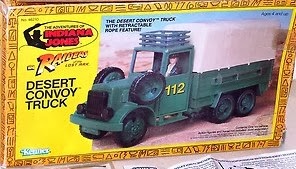
Below, a commercial for Kenner's Indiana Jones line of toys. If you're like me, you can watch it and dream of being a kid again. If Adventure has a name...
award-winning creator of the web series Abnormal Fixation (2024), the audio drama Enter the House Between (2023) and author of 35 books including Horror Films FAQ (2013), Horror Films of the 1990s (2011), Horror Films of the 1980s (2007), TV Year (2007), The Rock and Roll Film Encyclopedia (2007), Mercy in Her Eyes: The Films of Mira Nair (2006),, Best in Show: The Films of Christopher Guest and Company (2004), The Unseen Force: The Films of Sam Raimi (2004), An Askew View: The Films of Kevin Smith (2002), The Encyclopedia of Superheroes on Film & Television (2004), Exploring Space:1999 (1997), An Analytical Guide to TV's Battlestar Galactica (1998), Terror Television (2001), Space:1999 - The Forsaken (2003) and Horror Films of the 1970s (2002).
Model Kit of the Week: Raiders of the Lost Ark Desert Chase Action Scene (MPC)
 award-winning creator of the web series Abnormal Fixation (2024), the audio drama Enter the House Between (2023) and author of 35 books including Horror Films FAQ (2013), Horror Films of the 1990s (2011), Horror Films of the 1980s (2007), TV Year (2007), The Rock and Roll Film Encyclopedia (2007), Mercy in Her Eyes: The Films of Mira Nair (2006),, Best in Show: The Films of Christopher Guest and Company (2004), The Unseen Force: The Films of Sam Raimi (2004), An Askew View: The Films of Kevin Smith (2002), The Encyclopedia of Superheroes on Film & Television (2004), Exploring Space:1999 (1997), An Analytical Guide to TV's Battlestar Galactica (1998), Terror Television (2001), Space:1999 - The Forsaken (2003) and Horror Films of the 1970s (2002).
Board Game of the Week: Raiders of the Lost Ark (Parker Brothers; 1981)

 award-winning creator of the web series Abnormal Fixation (2024), the audio drama Enter the House Between (2023) and author of 35 books including Horror Films FAQ (2013), Horror Films of the 1990s (2011), Horror Films of the 1980s (2007), TV Year (2007), The Rock and Roll Film Encyclopedia (2007), Mercy in Her Eyes: The Films of Mira Nair (2006),, Best in Show: The Films of Christopher Guest and Company (2004), The Unseen Force: The Films of Sam Raimi (2004), An Askew View: The Films of Kevin Smith (2002), The Encyclopedia of Superheroes on Film & Television (2004), Exploring Space:1999 (1997), An Analytical Guide to TV's Battlestar Galactica (1998), Terror Television (2001), Space:1999 - The Forsaken (2003) and Horror Films of the 1970s (2002).
Tuesday, November 05, 2013
What I'm Reading Now - Back in Time: The Unauthorized Back to the Future Chronology

November 5th is an important day in Back to the Future (1985) lore so today seems like an appropriate time to call your attention to the book I'm reading right now.
Back in Time: The Unauthorized Back to the Future Chronology by Greg Mitchell and Rich Handley is the latest master-work from Hasslein Books, an imprint fast developing a reputation for intricate, comprehensive, exhaustively-detailed texts about beloved genre franchises.
I already own Handley's Planet of the Apes Chronology, and Planet of the Apes Lexicon (for which I submitted a preface...), and the quality of this work rivals both of those impressive texts. This Back in Time book is filled with beautiful illustrations, flow-charts, and family trees, and is appealing simply on the basis of the dynamic visual lay-out.
In terms of content, Back in Time consists of a meticulous time-line broken down into 15 segments ranging from "prehistory" to "2015 and beyond."
The book also includes five appendices, which gaze at the history of Hill Valley, and even the ubiquitous Courthouse Square (where the clock tower plays an important role).
I also loved the appendix which traces the various "family trees" of generations of Tannens, McFlys, Browns, Stricklands, Parkers and so forth. This seems a crucial element of the Back to the Future mythos, as the "series" concerns a core group of families that keep reliving a similar series of events (in the same places),.
The first thing that may strike the reader about the book beyond the attractive graphic design and artwork from Pat Carbajal is the fact that the Back to the Future "universe" (and franchise) is a hell of a lot more expansive than it might appear at first blush.
The chronology thus includes not merely the three feature films (circa 1985 - 1991), but an animated series, three comic book series, Happy Meal Boxes (!), commercials, music videos, and a card game. I frankly had no notion that half of this material even existed.
Delightfully, the book provides all the details necessary to finding a story, and understanding where and how it fits in the overall time-line. An added bonus is that the authors add scientific "notes" to many entries, such as those involving the Jurassic and Cenozoic Period, to sort of "accuracy check" the franchise.
The approach -- as that level of detail suggests -- is one of respect and complete-ism, if there is such a word.
Again, I'm bowled over by the level of detail found in the text, and must credit, at least partially, Rich Handley, the co-author. He is a great writer for this sort of material because he approaches franchises like Apes or BTTF like some obsessed archaeologist reconstructing an ancient culture from diverse, seemingly unconnected clues.. He is constantly organizing and re-organizing chunks of data so that a new, "big" picture of the overall story emerges.
I (clearly...) don't know Back to the Future as well as Planet of the Apes, but for fans of the series, this chronology is absolutely a must-have if you seek be a student in that archaeology class, and desire to put all the pieces together so as to glean a sense of the "story" from the distance of an objective observer, in accordance, perhaps with Hasslein (Books?) theory of Infinite Regression.
Back in Time: The Unauthorized Back to the Future Chronology is available at Hasslein Books and at Amazon.com.
award-winning creator of the web series Abnormal Fixation (2024), the audio drama Enter the House Between (2023) and author of 35 books including Horror Films FAQ (2013), Horror Films of the 1990s (2011), Horror Films of the 1980s (2007), TV Year (2007), The Rock and Roll Film Encyclopedia (2007), Mercy in Her Eyes: The Films of Mira Nair (2006),, Best in Show: The Films of Christopher Guest and Company (2004), The Unseen Force: The Films of Sam Raimi (2004), An Askew View: The Films of Kevin Smith (2002), The Encyclopedia of Superheroes on Film & Television (2004), Exploring Space:1999 (1997), An Analytical Guide to TV's Battlestar Galactica (1998), Terror Television (2001), Space:1999 - The Forsaken (2003) and Horror Films of the 1970s (2002).
Movie Trailer: Resolution (2012)
award-winning creator of the web series Abnormal Fixation (2024), the audio drama Enter the House Between (2023) and author of 35 books including Horror Films FAQ (2013), Horror Films of the 1990s (2011), Horror Films of the 1980s (2007), TV Year (2007), The Rock and Roll Film Encyclopedia (2007), Mercy in Her Eyes: The Films of Mira Nair (2006),, Best in Show: The Films of Christopher Guest and Company (2004), The Unseen Force: The Films of Sam Raimi (2004), An Askew View: The Films of Kevin Smith (2002), The Encyclopedia of Superheroes on Film & Television (2004), Exploring Space:1999 (1997), An Analytical Guide to TV's Battlestar Galactica (1998), Terror Television (2001), Space:1999 - The Forsaken (2003) and Horror Films of the 1970s (2002).
Monday, November 04, 2013
Ask JKM a Question: What kind of horror film would I like to see come back from the dead?

A
regular reader named Jason writes:
"I read your Horror Films FAQ book and your
descriptions of all the different types of horror movies. My question to you
is: what form of horror film would you like to see revive or rebound today?”
Jason,
that’s a terrific question about the horror genre and its current direction.
My answer is simple: I’d love to see a revival
of the rubber reality horror film.
I’m
talking about films like Phantasm (1979), Altered
States (1980), A Nightmare on Elm Street (1984), Hellraiser
(1987), or Candyman (1992), specifically.

In
horror films of this type, the villain is able to rewrite reality as we
understand it, and the barriers between realities seem to fall all around us. I love this type of horror film when it is
done well, and I think all the above-listed films manage that feat. Even Wishmaster (1997) was entertaining
as hell.
In particular, I enjoy the imaginative nature
of the rubber reality films (and productions such as Craven’s The Serpent and the
Rainbow (1988) and Shocker (1989), because I think they
capitalize on the link between horror films and dreams/nightmares. Phantasm, after all, plays as an
adolescent boy’s dream about death.
Altered States is like a drug trip gone wrong, and so forth.
Unfortunately,
I don’t believe that rubber reality as a horror sub-genre is going to make a
comeback anytime soon, and that’s because -- as I’ve written before -- the general
movement of film history is from the theatrical or artificial to the realistic
or natural.
You can detect that trend in
the kind of horror films made today, mostly of the found-footage genre. I happen to love and adore the found-footage
horror film, and think that it has a lot of life in it (particularly in films
such as The Bay, or REC, Lovely Molly, or BWP).
But
because horror movies are trending more realistic, a step in the opposite
direction -- back towards “rubber reality” -- doesn’t necessarily make a lot of
sense. Rubber reality isn’t really “where we are” in
terms of the Zeitgeist.
Some
clever writer out there would need to “re-imagine” the rubber reality film for
our era today in a fashion that resonates the way Wes Craven’s Elm
Street resonated in 1984. I’m
not sure I see that happening…and believe me, I’ve tried!
For example, I
wrote a rubber-reality script some years back called The Dead Side of The Street, and it
had some (little) interest from agents and producers, but ultimately nothing
happened with it. And I think that has
to do with: a.) my own failures as a writer, but also b.) the fact that nobody
is making rubber reality films anymore, especially ones that boast the kind of jaunty humor we see in the Elm Street sequels, or Phantasm
sequels.
So,
I would really love to see more of the rubber reality I loved as a teenager and
college student, but, frankly, I don’t see how it would fit in with today’s
culture.
My only take on the material now would be to consider how nobody sees facts or "truth" anymore, but rather facts and truth through the prism of a pre-existing world view. In other words, many Americans tend not to believe facts if they come from a political person/party they don't agree with. Hence, many of us live in very different realities from our neighbors. A good rubber reality horror movie might find a genre-specific way to take into account that uncomfortable premise of modern life, and twist it into something truly terrifying.
What we need, frankly, is for someone to
do for rubber reality what Kevin Williamson did for slashers in the mid-1990s. The whole approach needs to be re-imagined
for the 21st century in a way that we all “get” immediately.
I think it’s do-able, but again, not terribly likely.
award-winning creator of the web series Abnormal Fixation (2024), the audio drama Enter the House Between (2023) and author of 35 books including Horror Films FAQ (2013), Horror Films of the 1990s (2011), Horror Films of the 1980s (2007), TV Year (2007), The Rock and Roll Film Encyclopedia (2007), Mercy in Her Eyes: The Films of Mira Nair (2006),, Best in Show: The Films of Christopher Guest and Company (2004), The Unseen Force: The Films of Sam Raimi (2004), An Askew View: The Films of Kevin Smith (2002), The Encyclopedia of Superheroes on Film & Television (2004), Exploring Space:1999 (1997), An Analytical Guide to TV's Battlestar Galactica (1998), Terror Television (2001), Space:1999 - The Forsaken (2003) and Horror Films of the 1970s (2002).
Cult-TV Theme Watch: The Bible and Other Holy Texts

A Bible is a holy book, or a
collection of canonical writings considered sacred. Throughout cult-television history, both
fictional bibles and the authentic Christian Bible have appeared frequently in
many notable productions
Fictional Bibles have often
appeared primarily on programming involving alien cultures on other
worlds.
For instance, in the original Star
Trek (1966 – 1969), Kirk and Spock twice encountered planets where the
culture’s Bible or “holy words” were familiar to denizens of Earth.

In “A Piece of the Action,”
Captain Kirk (William Shatner) had to correct the damage done after a previous
starship had left behind on an impressionable planet the book titled “Chicago
Mobs of the Twenties.” The humanoid
inhabitants of the planet took the book seriously, and modeled their entire
culture on 20th century gangsters and the material in the monograph.
In other words, they mistakenly took the book literally. “A Piece of the Action” is a funny episode,
but also a social critique of religion, and the danger of relying too heavily on any
single book or set of ideas from that book.
In “The Omega Glory,” Kirk and Spock
happened upon a planet that paralleled Earth’s development, and met a group of
primitives called “Yangs” who worshiped a duplicate of the United States’
Constitution. Dramatically, Kirk read the Constitution’s preamble to the Yangs,
who had mangled the language and lost the meaning of the words over time.
In Star Trek: Deep Space Nine
(1993 – 1999), the Ferengi Bible was introduced, a Holy book about unfettered
capitalism called “The Rules of Acquisition.”
More recent TV series have also
introduced fictional Bibles.
The remade Battlestar Galactica
(2003 – 2008) featured “The book of Pythia,” for instance.
And on True Blood (2008 – 2014), the
Vampire Bible is revealed, as well as its deity: the blood-thirsty Lilith. The book plays like a wicked inversion of the
Christian Bible, at least based on the passages audiences have been privy to
thus far.

Many science fiction series have
also featured quotations from Scripture, or references to the authentic Christian
Bible. Chris Carter series such as The
X-Files (1993 – 2002) and Millennium (1996 – 1999) are rife
with Scriptural allusions, for instance.
In The X-Files episode, “3,” for instance, a vampire references
John 52:54. And in Millennium’s “The Curse
of Frank Black,” Frank (Lance Henriksen) suddenly comes to understand the
importance – and relevance in his life -- of Acts: 26:8.

The Bible also played a vital
role in V: The Final Battle (1984).
There, a Catholic Priest presented the alien Diana (Jane Badler) with a
copy of the Bible to help foster brotherhood between humans and Visitors. Diana was so moved by the writings in the Bible
that she murdered the priest and incinerated the Holy Book with her laser gun. Diana didn’t like that the Bible made her
feel so-called “weak” emotions such as love and fellowship. So she destroyed that which she felt
compromised her mission, even while acknowledging the power of the Bible’s
message.
In Firefly’s “Jaynestown,”
River Tam (Summer Glau) borrows Shepherd Book’s (Ron Glass) Bible and begins to
write notes in its margins and even rip out pages. She does so, she says, because the text is “broken”
and she can fix it. Book reminds her
with irritation that “you don’t fix The
Bible.”

In season three of The
Walking Dead, the kindly physician and elder, Hershel Greene (Scott
Wilson) is seen on several occasions to draw strength from reading his
Bible. In the final episodes of the
year, he leaves behind his Bible at the prison for the Governor to find, along
with a pertinent passage highlighted John: 5:29.
award-winning creator of the web series Abnormal Fixation (2024), the audio drama Enter the House Between (2023) and author of 35 books including Horror Films FAQ (2013), Horror Films of the 1990s (2011), Horror Films of the 1980s (2007), TV Year (2007), The Rock and Roll Film Encyclopedia (2007), Mercy in Her Eyes: The Films of Mira Nair (2006),, Best in Show: The Films of Christopher Guest and Company (2004), The Unseen Force: The Films of Sam Raimi (2004), An Askew View: The Films of Kevin Smith (2002), The Encyclopedia of Superheroes on Film & Television (2004), Exploring Space:1999 (1997), An Analytical Guide to TV's Battlestar Galactica (1998), Terror Television (2001), Space:1999 - The Forsaken (2003) and Horror Films of the 1970s (2002).
Subscribe to:
Posts (Atom)
-
 Director Ridley Scott has already given the science fiction cinema two of its greatest and most cherished films: Alien (1979) and Blade...
-
 "Other Worlds lie outside our seeing; beyond the beyond; on the edge of within. The Great Pyramids: erected by the Ancient Ones as a ba...