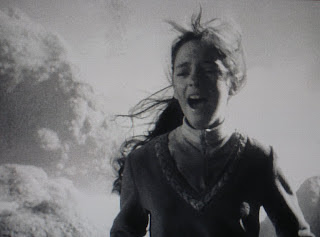
Tuesday, September 03, 2013

Cult-Movie Review: Cloud Atlas (2012)


All boundaries are conventions waiting to be transcended. One may transcend any convention, if only can first conceive of doing so.”

-          Cloud Atlas (2012)


The 2012 Wachowski/Tom Tykwer science fiction film Cloud Atlas is a sprawling, three hour epic, and a dedicated adaptation of David Mitchell’s award-winning novel of the same name, first published in 2004.   The novel tells six stories (or a sextet, if you prefer), set in six different time periods, ranging from centuries ago to centuries in the future.   

It is necessary to describe these six stories briefly, so you have a full sense of them, before I continue to review the film.


“We cross and re-cross our old paths like figure-skaters.”

First, there’s “The Pacific Journal of Adam Ewing,” set in the South Pacific in 1849. Adam Ewing (Jim Sturgess) is the son-in-law of a slave-trader (Hugo Weaving).  Adam falls grievously ill on his return home to England, but is deliberately made sicker by a con-man, Dr. Goose (Tom Hanks), who wishes to steal his wealth.  Fortunately, Adam has befriended a black slave and stowaway on the ship, one who is grateful for Adam’s kindnesses, and comes to watch over him.

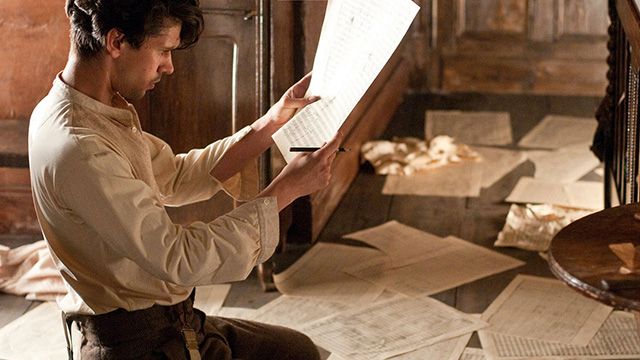
The second story, “Letters from Frobisher” is set in 1936 Scotland, and involves a brilliant young musician, Frobisher (Ben Whislaw) who creates a sextet called the Cloud Atlas while mentoring with one of the world’s greatest composers, Vyvian Ayrs (Jim Broadbent). When Ayrs recognizes his talent, however, he uses Frobisher’s homosexuality to extort him and imprisons the young man in his home until he hands over the Cloud Atlas.  Frobisher’s lover, Rufus Sixsmith (James D’Arcy) tries to save Frobisher, but fate rips them apart.

The third tale, “Half-Lives: The First Luisa Rey Mystery” is set in San Francisco in 1973, and features a dedicated reporter, Luisa (Halle Berry) who learns a dangerous secret about a nuclear plant that will soon go into operation.  She attempts to report the truth, but the head of the plant, Lloyd Hooks (Hugh Grant) orders her assassinated.

The fourth tale is “The Ghastly Ordeal of Timothy Cavendish.” Set in London in 2012, this tale finds a fly-by-night book agent Cavendish (Broadbent) unexpectedly incarcerated at a diabolical nursing home.  With the other exploited old folks in the home, Cavendish engineers an escape from custody, and sells the movie rights to his story.

The fifth story, “An Orison of Somni-451” is set in New Seoul in 2144 AD, as old Seoul succumbs to the ravages of global warming. There, a female “fabricant,” Somni-451 (Doona Bae) regularly endures slavery and exploitation but nonetheless honors the First Catechism: “Honor They Consumer.”  Soon, she experiences an awakening about the fabricants’ plight, and the connections between human beings.  She conveys these thoughts to the world at large after being rescued by the people’s union.  Through this orison or prayer on viral video, Somni, in later generations is worshiped as a prophet.

In Cloud Atlas’s sixth and final story, set in the post-apocalyptic Hawaii of 2346 AD, a grizzled old storyteller, Zachry (Hanks) recounts by campfire the tale of how his tribe ended up in a new home, starting a new life.  His story involves a gang of fearsome cannibals called the Kona (led by Hugh Grant in terrifying war-paint…) and his fateful decision to help a “prescient,” Meronym (Berry) on a long and dangerous trek to a mountain summit.  There, she believes, an answer regarding mankind’s future may exist.  But Zachry’s got a devil on his back, one insistent on causing Meronym’s mission to fail…


“Fear, belief, love…phenomena that determined the course of our lives. These forces begin long before we are born and continue after we perish…”

The movie version of Cloud Atlas adapts all six stories highlighted in the book, but takes the unusual step of doing so -- as the descriptions above indicate -- with the same eight or ten actors appearing in all segments, namely Tom Hanks, Halle Berry, Jim Broadbent, Hugh Grant, Susan Sarandon, Hugo Weaving, Doona Bae, Ben Whishaw, Jim D’Arcy, and Jim Sturgess. 

Now, just to be crystal clear, these actors are not playing the same character in each story; but rather entirely different individuals, a fact made abundantly plain by the creative and jaw-dropping make-up effects featured on-screen. 

So Halle Berry plays both a black woman of the year 2346 and a white, Jewish woman of the year 1936.

Likewise, Tom Hanks plays a murderous English thug for the story set in 2012, a movie star in the year 2144 AD, and the post-apocalyptic story-teller, Zachry, in the post-apocalyptic finale.

The question regarding this particular approach is: why? 

Why vet these six very different stories in such a way that the same repertory actors perform all the parts? 

The answer ultimately comes down to the film’s application of Buddhist philosophy, or what the dialogue terms “Eternal Recurrence.” 

Buddhists will immediately recognize this concept as something akin to the Samsara, which Wikipedia describes thusly: “

“…Samsara is defined as the continual repetitive cycle of birth and death that arises from ordinary beings' grasping and fixating on a self and experiences. Specifically, samsara refers to the process of cycling through one rebirth after another within the six realms of existence, where each realm can be understood as a physical realm or a psychological state characterized by a particular type of suffering. Samsara arises out of avidya (ignorance) and is characterized by dukkha (suffering, anxiety, dis-satisfaction). In the Buddhist view, liberation from samsara is possible by following the Buddhist path.”

You may notice something important encoded in that definition above.  The Samsara is said to have six realms of existence, and Cloud Atlas likewise consists of six story-lines set in six time periods.

Thus the movie’s epic tapestry serves as a deliberate re-creation of the Samsara, and the actors each portray multiple individuals or characters.  But the argument could be made, I suppose that they are playing…only one soul moving through the six realms, from past to future (and in one fascinating case of prescience, future to past…).

This fact means that the Tom Hanks character in the first, third and sixth story are different people/individuals but are perhaps the same soul, experiencing avidya and dukkha in a different state of existence, or level of the Samsara. 

Another way to describe Cloud Atlas’s thematic conceit: each main character in the film is re-born into one of the six realms and based on his “kindnesses” or “crimes” writes his soul’s very future going forward.

Again, what’s the benefit of structuring the story this way?  Well, the directors are more easily able to examine the ripple effects of moral or immoral decision-making over a long period of time or history, for one thing.

For instance, the soul portrayed by Jim Broadbent in the tale set in 1936 Scotland does something terrible to another person and his soul eventually suffers for it.  Specifically, Vyvian Ayrs, a famous composer, imprisons Frobisher -- a young man of great talent -- in an attempt to steal his work. 

But then, in the 2012 story, “The Ghastly Ordeal of Timothy Cavendish,” the same soul (for which actor Broadbent is the visual avatar) receives his karmic comeuppance: Cavendish is imprisoned in a nursing home of the damned. 

His soul’s evil acts in 1936 were paid forward to the next realm of the Samsara and thus the next iteration of his soul, Timothy, suffers grievously.  And the manner of the punishment is equal to the crime.  The soul goes from victimizer to victim, from jailer to jailed.

In one life: a jailer and exploiter.

In the next life: jailed and exploited.
Similarly, the soul symbolized by Hugh Grant undergoes his karmic comeuppance across two stories and two epochs.  As Lloyd Hooks, a nuclear plant manager in 1973, this soul willfully plans to murder thousands of people in a meltdown…all because he is being paid by the oil industry to sow mistrust of nuclear power. 

By the time this corrupt soul reaches 2346 Hawaii, however, he is a half savage beast and a cannibal, the Kona Chief.  His actions in life have made his journey through the Samsara all the more horrible.  By his sixth go-round he has not evolved or transcended, but actually devolved into something barely human, something very nearly animal.

In one life a killer by proxy.

In the next, a killer by hand...and teeth.
To fully understand and appreciate Cloud Atlas it is necessary to understand the Buddhist underpinnings, the concept of Samsara (or “eternal recurrence” in the film’s lingo), and even karma.  The viewer must realize he or she is witnessing the march of souls from 1849 to 2346 and that each stop or each story along the way is an opportunity for those souls to deliver kindnesses to others and evolve to the next step, or deliver a crime, and continue in a realm of suffering going forward.

As you are no doubt tired of reading here on the blog, my highest aesthetic or critical criterion is that form must echo content in film, and that visuals must reflect the story. 

Cloud Atlas is so brilliant and worthwhile a science fiction initiative, I submit, because it asks us -- through its casting and re-casting of the same actors as souls in various incarnations -- to understand one possible aspect or force of universal, constant human existence. 

Perhaps the there is no sphere of the afterlife at all.  Perhaps our souls ride the wheel of the Samsara, hopefully achieving wisdom as that wheel turns.  And what we do here, now, affects where our soul lands when we return to this plane of existence.

Had different actors played all the important parts in Cloud Atlas, viewers would have no visual signifiers by which to recognize the same soul in different stories and different eras, and therefore we’d be unable to track their moral progress on the Samsara, in the “eternal recurrence” of human life. 

The film thus suggests, by casting the same actor as different individuals over a long span of time, that our lives stretch beyond this moment of now.  They go on.  The flesh is mortal, but the soul is not.  We keep repeating the same mistakes, surrounded by the same souls, until we learn to change our behaviors, or until we reach the outcome we desire and need.

None of this philosophy would be evident, however, without Cloud Atlas’s complex structure.  The film reflexively notes its own complexity in an early voice-over narration by Cavendish (Broadbent): “While my extensive experience as an editor has led me to disdain for flashbacks and flash forwards and all such tricksy gimmicks, I believe that if you, dear reader, can extend your patience for just a moment, you will find that there is a method to this tale of madness.”

That line of dialogue -- that explicit request for patience and understanding -- is at the heart of Cloud Atlas’s ambitious strategy to chart the full human experience.  Since “we’re all connected,” the film requires the audience to engage with its creative strategy.  This task of engagement and attention is richly rewarded however.  Audiences that meet the film half-way will feel part of a process of discovery…and then experience joy and awe as that discovery unfolds, and layer after layer of meaning blossoms.


“I knew someone who had a birthmark similar to that…”

Much of the challenge and joy that arises from an engaged viewing of Cloud Atlas involves noting and cataloging the little touches or grace notes that connect souls from one story (or level of the Samsara) to the next. 

For instance, a comet-shaped birth mark appears on one character in each of the six tales, and then the film ends with a shooting star -- a comet of sorts -- as its valedictory composition.  Is this comet-shaped birth mark ticking off the levels of the Samsara, ending with a valediction in the cosmos, in Eternity itself?  Is it a signifier of the same soul, moving through various levels of the Samsara?  Again, the film opens itself to various stimulating and challenging interpretations.

Similarly, a jeweled button that appears in “The Pacific Journal of Patrick Ewing” re-appears again and again throughout history (or the future), owned by different individuals.

And all six levels of the Samsara are connected by a work of art featured prominently in the previous level of existence.

Frobisher in Story #2 reads Ewing’s diary from Story #1 

Luisa Rey in Story #3 listens to Frobisher’s musical composition, Cloud Atlas, from Story #2, and so on. 

Not only does music play a crucial role in the film, but a movie version of Cavendish’s tale appears in the fifth story, and a viral video from the fifth story plays a role in the sixth and final vignette. 

In toto, therefore, Cloud Atlas seems to note that art -- whether literature, music, film, or even a web video -- is the thing ties humans together on the Samsara from one life or level to the next. 

In other words, our art is as immortal as we are, and it carries our stories and histories into the unbound future. 

We can learn from that art if we heed it, and we ignore it at our own peril. This notion of art outliving individuals and proving of great value to future generations is transmitted beautifully in a line of dialogue: “My life extends far beyond the limits of me.” 

That extension of life may be in the soul itself, or it may be in the thoughts transcribed in a book, or the musical notes of a composition. It may be in a movie that speaks to the future, though it was made in the past.


What is an ocean but a multitude of drops?

The interconnections between the six stories in the film stretch even further. In all six tales featured in Cloud Atlas, a crime is committed based on craven selfishness and thirst for power.  This selfishness or power-thirst is tellingly described in at least three different stories as being part and parcel of “The Natural Order.”  
Consider:

The Natural Order permits for the slave-trader, Haskell, to do his exploitative work. 

The Natural Order permits for the murder of whistle-blowers and the furtherance of avaricious corporate goals in 1973 San Francisco.

The Natural Order allows the State to abuse and cannibalize its Fabricants in New Seoul, and so forth (a fact foretold, uniquely, by a joke about Soylent Green [1973] in the previous story, set in 2012).  

Virtually every conflict in every story featured in Cloud Atlas lands a pair of soul-mates up against proponents of some Natural Order.  And the Natural Order always seems to possess the superior hand.

As Haskell, the slave trader notes in the first story: “There is a natural order to this world, and those who try to upend it do not fare well. This movement will never survive; if you join them, you and your entire family will be shunned. At best, you will exist a pariah to be spat at and beaten-at worst, to be lynched or crucified. And for what? For what? No matter what you do it will never amount to anything more than a single drop in a limitless ocean.”

This plot-line represents the film’s embedded social critique of “Natural Order” and the so-called “Natural Order’s” vehicle on this mortal coil: anarcho-capitalism for lack of a better term.

An out-of-control and merciless capitalist buys and sells human flesh in “The Pacific Journal of Adam Ewing.” 

The importance of status -- or “reputation” -- in a capitalist class-system is what drives blackmail and exploitation in “Letters from Frobisher.” 

The desire to control energy resources (at the height of the Energy Crisis in 1973, no less) is what drives Lloyd Hooks to contemplate the murder of thousands of innocent people in “Half-Lives…” 

Timothy Cavenish ends up at the nursing home while running away from a $60,000 dollar debt in “Ordeal.” 

The economic system of New Seoul mass produces people to be slaves to hedonist  “consumers,” and then cannibalizes those man-made people when they can no longer work, in “An Orison of Sonmi-451.”

And finally, the battle to control food and other resources dominates the final story, with the Kona Clan operating as the ultimate corporate raiders/cannibals. 

More than once in the film, we hear the mantra of Natural Order spoken aloud, and with hungry salaciousness: “The weak are meat, and the strong must eat.’

The point to all this is simply that when the goal of humanity is to control power or own supreme wealth rather than better oneself (and find true love…), crimes are born instead of kindnesses…and karma’s a bitch. 

In at least three of the stories (“Letters from Frobisher,” “Half-Lives” and “Orison…”) the meeting of souls together in true love is brutally curtailed by the forces of the so-called “Natural Order.”  In other stories, however (Ewing’s, Cavendish’s and Zachry’s), true love is victorious over the Natural Order because kindnesses, not crimes, carry the day.

Soul-mates threatened by the "natural order."

The same soul-mates, in another place and time.
The answer to the question posed by one character in the film – “why do we keep making the same mistakes?” – is simply that Natural Order, aligned with the levers of power, often seizes the day over the better angels of man’s nature.  But it’s a constant battle, and for that reason, our souls “cross and re-cross our own/old paths,” trying to achieve justice…and happiness.

“This world spins from the same unseen forces that twist our hearts…”

In the second story, Frobisher composes “The Cloud Atlas,” a sextet, and from this work the film derives its title and its structure. 

But today, I gaze at a science fiction film of such scope, ambition, and convention-shattering that I can’t help but think of “cloud” computing too.  With cloud computing, a program can run on multiple computers at the same time, networked together. 

That technological term therefore seems like a good analogy for our “interconnected” souls.  We’re all here on this planet together, right now, and according to Cloud Atlas “the gulf between us” is but an “illusion.”  In how we treat each other, we create a map -- or atlas -- a network of bonds, of loves and hates, stretching outward and into the future, and reverberating through the very corridors of existence.

In the end, like Frobisher suggests, perhaps we all become, art or music. 

And if that is the case, wouldn’t you rather your eternal song be one of harmony, not dissonance? 

Movie Trailer: Cloud Atlas (2012)

Monday, September 02, 2013

Ask JKM a Question: Cloud Atlas?


A regular reader, Chris, writes:

"We've chatted a bit in the past before. I love your books, blog, and the genre-praising and reinforcing tone of your writings (cult, horror, sci-fi, and more). 

For months now, I've been tempting, pushing myself to sit myself down and watch Cloud Atlas. Due to my usual temptations, beforehand, I glanced at a select few genre-fansite reviews, and... I was halted by the reach of what I was reading. 

What these few reviewers were hinting at, was that this Cloud Atlas turns out to be the most 'evolved' and far-reachingingly complex sci-film ever attempted by the human race. In fact, so much so, there's no mere mortal who could come close to possibly grasping or understanding it all, especially not in one or even two sittings. To me, reading that was not just intimidating, but almost a turn off. I mean come on, really? Certainly on the audacious side. Being a technology and computer geek, I've always been a fan of the filmmakers' Matrix trilogy. I found it to be just the right amount of befuddlement, as those films toyed with my various layers of reality-mortality-philosophy. 

But, they're making Cloud Atlas sound like "2001" to the "Inception" power (with maybe a little Tree of Life/Melancholia flavoring thrown in. Name your philosophical poison...). For me, Inception was far too much like calculus. I was never good at math. Inception was frankly too much thinking and too little touching. The best movies not only entertain, but connect on a magically personal level. The Matrix films actually connected with me on many personal levels. Nothing too terribly complicated. Sort of the same thing that has Morgan Freeman exploring the universe with his "Through the Wormhole" series. A celebration of relatively tangible (albeit technically never-to-be-literally-answered) questions. Gets you thinking, absolutely, but... not to the point of a headache. 

Anywhooo, I searched your blog for a Cloud Atlas review. My hope (and I do this often) was that, if I were to watch Cloud Atlas, and it were to leave me in a perpetually eye-glazed, brain-unraveling state, I could quickly dive into your analysis ---- and find my way back down to Earth. Your analyses very often work that way for me. They explain, teach, celebrate, but also explain, and direct the flow of mental-traffic to a grasp-able thesis. 

And so, I'd like to see how you parse this 'genre-breaker' of a film called Cloud Atlas!  Maybe I'm worried for no reason at all.  I realize this one may take some work. Hopefully, not too much, though! I'll be scanning the Muir blog-waves! 


Chris, I want to thank you for that extraordinary vote of confidence in my skills as a film critic.  I appreciate your words tremendously, and will endeavor to live up to them. At your behest, I did watch Cloud Atlas about two weeks ago, and fell in love with the film.  I will definitely explain why, so look for my review of Cloud Atlas tomorrow morning at 6:00 am sharp!  We'll see how I do!  

Don't forget to ask me your questions at Muirbusiness@yahoo.com

Cult-TV Theme Watch: The Zoo


A zoo is an institution or facility where animals are kept in cages or other separated enclosures, and displayed for the benefit of a curious public. The word zoology (and hence zoo...) comes from two Greek terms meaning "animal" and "study."  The first zoo in the world opened for the public in the mid 1800s.
In cult-TV history, the zoo has proven an irresistible location for many science fiction and horror programs. 
Indeed, many famous sci-fi series feature an intriguing inversion of the "zoo" principle which might be called "the people zoo."  In stories of this type, intelligent humans find themselves housed in extra-terrestrial zoos, gawked at by curious (but unsympathetic) alien beings.


Perhaps the most famous of such tales is The Twilight Zone's (1959 - 1964) first season entry, "People Are Alike All Over," which stars the late, great Roddy McDowall as an astronaut who fears his upcoming journey to Mars.  He is assured by a friend that people -- even Martians -- are really alike everywhere, and hence there is nothing to fear.  
The episode's final, unforgettable twist puts a spin on that observation.  People are alike all over, all right, and people everywhere enjoy seeing primitive creatures in the zoo...

The Twilight Zone revival on CBS (1985 - 1988) returned to the concept of people zoos with the short segment called "Children's Zoo."  Here, an unhappy girl has the opportunity to put her misbehaving parents in a "children's zoo," while she picks out new, presumably more satisfactory custodians.
The third season Lost in Space (1965 - 1968) episode "A Day at the Zoo" featured a story line in which Penny Robinson (Angela Cartwright) is captured by an alien showman, Farnum B, for display in his galactic zoo.  The Robinsons must come to her rescue.
Over the years, the Star Trek franchise has also explored the "people zoo" trope as well.  The first Trek pilot, "The Cage" (later re-purposed as "The Menagerie") finds Captain Christopher Pike (Jeffrey Hunter) trapped in a subterranean zoo on Talos IV.  As a sturdy specimen in this Talosian zoo, he is also expected to breed and produce a race of slaves.

In the Star Trek: The Animated Series (1973 - 1974) episode "Eye of the Beholder," Kirk, Spock and McCoy are captured on distant Lactra VII and held in an elaborate zoo by giant intelligent slugs.  The giant creatures judge the humans (and half-Vulcan) to be hideous and primitive, but eventually a conversation between species is begun, and the zoo-keepers tell the Starfleet officers that they will be welcome back on the planet in twenty or thirty centuries.
In the 1990s, The X-Files (1993 - 2002) also spotlighted a story of aliens and zoos called "Fearful Symmetry."  In this case, aliens are found to be abducting animals from the Fairfield Zoo, and then returning them to Earth...but invisible.  
Stories about zoos have also appeared on Buffy the Vampire Slayer ("The Pack") and Primeval (2006 - 2011).  In the former case, malevolent hyena spirits possess Xander (Nicholas Brendan) and several Sunnydale High Students after a field trip to the zoo...

The Cult-TV Faces of: Zoos

Identified by Lonestarr 357: The Twilight Zone: "People Are Alike All Over."

Identified by SGB: Star Trek: "The Cage"/"The Menagerie"

3 
Identified by SGB: Star Trek: The Animated Series: "Eye of the Beholder"

Identified by Lonestarr 357: The Twilight Zone (1985): "Children's Zoo"

6

Identified by Hugh: The Springfield Zoo, on The Simpsons.

8

Identified by SGB:  Buffy the Vampire Slayer: "The Pack"

Identified by Hugh: Lost

Identified by Lonestarr 357: Futurama.

12


Television and Cinema Verities #84


 "My Friend, Mr. Nobody" was my favorite episode. I love the black-and-white film noir feel to it. I loved the message it had...though I remember it was challenging to talk to "no one"through the whole episode."

- Angela Cartwright discusses playing Penny Robinson in one of Lost in Space's all-time best episodes,  the outer space fairy tale, "My Friend, Mr. Nobody," at the blog Classic Film and TV Cafe (May 15, 2013).


Sunday, September 01, 2013

Reader Results: The Top Ten Greatest Science Fiction Movies circa 2000 - 2013


Well, we have now come to the end our fourth Reader Top Ten series, and I suspect this exercise has been the most difficult yet for many of us.  Certainly, after reading all of your fine top ten catalogs, I realized I wish I had twenty slots to play with.

There are many more great films from this recent time period, I think, than I had remembered or reckoned on when I composed my list at the beginning of this enterprise.

Great job to everyone who passionately argued their cases, and especially those who turned me on to new titles that I can watch and then review here on the blog...

So without any further delay, here are is our Reader's List of Top Ten Greatest Science Fiction Movies of the Era 2000 - 2013.


Tied at numbers 9, 10, 11, 12, 13, 14 and 15 are:


Pitch Black (2000)
Ghosts of Mars (2001)
Sunshine (2007)
Cloverfield (2008)
Rise of the Planet of the Apes (2011)
Cabin in the Woods (2012)
Pacific Rim (2013)

At number #8 is:


Star Trek (2009)


At number #7 is:


Children of Men (2006)


At Number #6 is:


Minority Report (2002)


At Number #5 is:


Wall-E (2008)

At number #4 is:


Prometheus (2012)


At number #3 is:


Serenity (2005)


In second place is...


Moon (2009)

And the number one ranked movie by readers for 2000 - 2013 is:


District 9 (2009) 

Well, what do you think?

Despite all the ties, I'm satisfied with the list.  There are only five titles here that ultimately overlapped with my own tally (Ghosts of Mars, Minority Report, Prometheus, Wall-E and District 9).  That's my lowest average so far on these lists!

I suppose this result could suggest that there is less consensus about recent films than there is about vintage films, a point that I believe Simon Pegg made recently.  Newer films, perhaps, we haven't had as much time to absorb and process.

Other top contenders -- just 1 vote each outside the tally -- were Dredd (2012), A.I. (2001) and Primer (2004).

It might be fun to revisit this topic in five years and see how the list holds up.  In the meantime, be sure to come back next month, late September, for the next Reader Top Ten!

Reader Top Ten Greatest Science Fiction Films Circa 2000 - 2013: Josh McCormack


Friend and reader Josh McCormack closes out this round of The Reader Top Ten with his list.

Josh writes:

"10. Pacific Rim: Guillermo Del Toro's recent giant robot vs giant monster flick may not be terribly original, but it's the most fun I've had seeing a movie this year. Also, the choreography for the fight scenes are fantastic and I can see what's going on. That was a breath of fresh air, after I saw the seizure-inducing final battle at the end of "Man of Steel".
9.Star Trek (2009): I love this film, lens flares and all. Though a true Trekkie could point out a few missteps, I find it a welcome return to the original Starship Enterprise crew...even if they are played by new actors. Spock's story arc is what REALLY intrigues me about this flick. More than any of the previous movies, it really asks the question: Is Spock meant to live among the humans or the Vulcans? The sequel is a lot of fun as well, but lacks the, somewhat, genius storytelling of this one. Now don't mess up "Star Wars" for me, Abrams.
8.Cloverfield: In the midst of more and more, lackluster, found footage films, there lies this 2008 Matt Reeves/ J.J Abrams gem. Like all found footage movies, you have to suspend disbelief, just a little bit, so that you can genuinely believe a person could still hold the camera during all the mayhem surrounding him. Once you've got that out of the way, you can sit back and enjoy the movie. The reason I love this film is because it starts out like a coming of age, indie film (a good one, too), therefore you get to relate and care for the characters. So by the time that all Hell breaks loose, it's THAT much more intense. Also, the two main characters' "testimonial" to the camera, in the film's final moments, are tragic and extremely chilling.
7.Dredd: After the 1995 release of "Judge Dredd" destroyed non-comic book readers' view of the character, Lionsgate said it was about time for a reboot. This time, Dredd remains true to his comic book counter part. He never takes his helmet off, he's a man of few words, and he has that terrifying scowl. This movie reminds of the low budget action movies of the 70's and early 80's. As a matter of fact, it looks like the kind of movie John Carpenter should be making at this point in his career. Karl Urban also owns it as Dredd. He knows how to balance the character's dark persona with a nice dose of dead pan humor. Ultra-stylized, ultra-violent, ultra-fun!
6. Looper/ The Hunger Games: I know I'm cheating, but I honestly can't decide, they're both fantastic films, each with an interesting view on a dystopian future.
5. The Avengers: Man, 2012 was a good year for sci-fi. But I think within all of these films, I have to go with the best super hero film of the twenty first century. This movie is like a concert. Seeing all these epic heroes get together to mow down some alien scum makes the audience cheer...me included.
4. Battle Royale: The movie that people wrongly accuse "The Hunger Games" of ripping off. It's also the movie that was banned in several countries for its use of violence towards young teens. Now, I've never been a fan of violence towards children in films, many directors use it as a cheap trick to get a reaction. But director Kinji Fukasaku uses the violence in a very meaningful way. It starts out as being tragic, but by the end we have grown used to it, much like the characters in the movie. It's very eerie if you think about it.
3. The World's End: I know it only came out a little over a week ago, but I REALLY love this film. I second this only to "Shaun of the Dead" in Edgar Wright's "Cornetto" trilogy. It is insanely funny, but much like Wright's previous films, it treats the threat (this time, alien robots) with utter seriousness. It also had a real heart to it. Its final act may have leak a few tears as well.
2.District 9: A sci fi movie with a true message. Director Neill Blomkamp takes the idea of racism and separation, then displays them in such a wild form. It also has a nice dose of dark humor, much like "Robocop" or "Total Recall" before it. Another thing worth mentioning is that the CG effects are top-notch, and look better than any big budget Hollywood film. Blomkamp once again showed his fantastic use of visual effects in the very entertaining, yet inferior, "Elysium".

1. Wall-E: If I were to list the ten best of the decade for any genre, a Pixar film would almost always be on top. They completely deserve it, though. Within all of the Pixar films, Wall-E has to be one of the best. Its vision of an over polluted Earth is so well realized, that you can't help but think that's where the human race is headed. But the thing that makes this film so special is the love story between the two very different robots: Wall-E and Eve. Their relationship consists of only a few words, yet every time they interact, it's like poetry. Wall-E made any other romance look robotic (forgive the pun) in comparison. Fun, honest, and heartfelt. That's what makes Wall-E so special."

Hi Josh: Great list.  Glad to see Wall-E placed so highly, as well as District 9.  I have not seen The World's End yet, but am looking forward to it.
Results to post at 4:00 pm TODAY! Don't miss the results!

Reader Top Ten Greatest Science Fiction Films, Circa 2000 - 2013: Ed Erdelac


            My friend and reader Ed Erdelac contributes his top ten list next in our continuing reader poll. He writes:

         "1. Prometheus  - As decisive as it is, I think it’s the Blade Runner of our time, easily dismissed as flawed in its characterizations, but undeniably provocative in its craft and the depths of its hidden themes.

2. Moon – Fantastic one man performance by Rockwell, engrossing in its ethical concerns.

3. Real Steel – A criminally overlooked fusion of science fiction and sports drama inspired by Richard Matheson’s short, STEEL, where both of the major spectacle draws take a backseat to a pair of great characters. At its heart, a tried and true father and son story that had the theater literally cheering when I saw it, even with a surprisingly less than happy ending.

4. Wall-E – Heartwarming romance and comedy groundbreaking in its nonspeaking principals and bitingly satirical in the scope of its environmental message.

5. Attack The Block - An utterly original and unique perspective on the old alien invasion story, with inner city London youth culture as the protagonists, bolstered by a strike of lightning cast. My favorite movie of 2011.

6. Cloverfield – One of the few found footage movies that consistently makes sense, a harrowing on the spot depiction of a giant monster attack that lives up to its Godzilla inspirations, and what will no doubt be seen as a time capsule of post 9/11 paranoia.

7. Cloud Atlas – A masterfully interwoven look at the recycling of souls throughout time.

8. Iron Man – One of the finest comic book movies ever made, not just the story of a guy in a powered suit, but a supremely idealistic, metaphorical tale about an industrialist who has a literal change of heart and becomes a hero.

9. Europa Report – A harrowingly realistic look at deep space travel, the lengths to which the pioneers of humanity will go for knowledge, and with a dash of Lovecraft.

10. Rise Of The Planet Of The Apes – Surprisingly great reboot of the classic series, with a compelling environmental message.

Honorable Mentions:

Pacific Rim
Godzilla: Giant Monsters All Out Attack
The Hitchhiker’s Guide To The Galaxy
Star Wars Episode III: Revenge Of The Sith
X-Men
John Carter
District 9."

Ed: I enjoyed reading this list tremendously, and was glad to see you agree with my assessment and also high ranking of Prometheus.  I'm also gratified to see the high-placement of Cloud Atlas, a film also on my list, and which I will talk about more next week.  I have not seen Real Steel, but should...

Reader Top Ten Greatest Science Fiction Films Circa 2000 - 2013: David Read


Reader David Read provides us a list for Sunday morning, and the first day of September:

He writes: "So.... sci-fi films - 2000 to 2013, that got me thinking... In no particular order.

1. Moon. 

I really enjoyed this (much more than source code which essentially dealt with the same subject).  People often think it would be great to be born again... But what we want is for us reborn, memories and all, so we can carry on...

 2. Super 8

 What a great film, I enjoyed it on so many retro levels, but the anamorphic lens flares sold it to me! It was like a 2-hr homage to Dean Cundey!

3. War of the Worlds.  

Shame it had Tom Cruise in it, as his version of a tortured soul just looks angry, and this always lessens sympathy with him, which can be a good thing, but not this time. I think in many ways it is quite critical of America, and despite the ending, not a feel good film. I did enjoy Minority Report, but the fact half way through it came to resemble any other Tom Cruise actioner left me a foul taste in my mouth

4. The Mist

A strange film, which does stay in the mind.. If only for the ending.  I say strange, because you realise that the whole film is like a huge evil joke leading to a punch line.  And upon looking back on the film, that really seems to overshadow all readings of the film.

5. Pitch Black.

Yes it introduced Riddick, for which we are truly sad, but the original was a lean mean machine and the perfect Saturday night after a beer movie.

6. Eternal Sunshine of the Spotless Mind

A SciFi chick flick? No! I really enjoyed this meditation on memories and love lost and found.  Carey was just terrific, and it is well worth re watching!

7.  Vikaren

Ole Bornedal has a lot of talent. The original Nightwatch is terrific.  I really enjoyed this, it has a vibe akin to Super 8, and the kids performances are top notch, as Is Paprika Steen.

8. Doomsday

I guess it should have been better than this, but I couldn't help enjoying this Carpenter / Miller mash up from Neil Marshall. Plus it will probably end up being better than any EFNY remake...

9. Slither.

Horror, comedy and Nathan Fillion, what's not to like.  Hardly a classic, but a difficult film not to enjoy.

10. The Mothman Prophecies

What I like best about the film is its rhythm, the story and plot are very thin, and it should pay like a bad episode of the Outer Limits, but it doesn't, it unnerves, and that is a great compliment.

Serenity would be in, but Firefly exists and I'd rather watch that.  How come no one has mentioned Battlefield Earth or Jason X.   ;-)"


David: I really enjoyed reading your list, and it looks like you have added more titles for me to see (Doomsday, Vikaren…).

Reader results to follow soon!

Star Blazers Episode #24


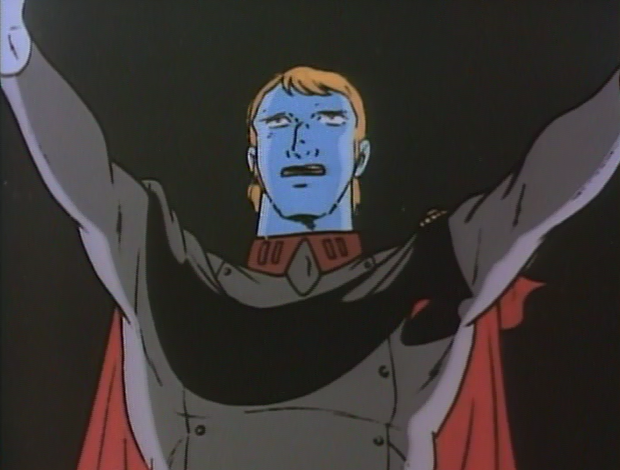
In this installment of the first season of Star Blazers (1979), the Argo escapes from a trap in Gamilon’s “sulfuric acid” ocean, as Desslok activates the Sulfuric Acid Storm Machine in an effort to melt the ship.

Facing missiles, acid, and other hazards, Deputy Captain Derek Wildstar takes Nova’s advice and seeks guidance from the bed-confined Captain Avatar. 

The good captain recommends total submersion of the Argo in the acid sea for ten minutes, so the ship can get a good shot (with the wave-motion gun) at the unstable volcanoes devastating Gamilon.  This could be the advantage the Star Force so desperately desires...


Wildstar accepts this risky recommendation, and even as Desslok orders the Argo “erased from the skies forever,” the great ship survives the final battle and devastates the planet Gamilon.  

One of Desslok’s panicked underlings notes that they “have been fighting a force” they “don’t understand" since the day the Argo left Earth.

After the fierce battle, Nova and Wildstar share a quiet moment atop the hull of the Argo, now twisted and nearly melted by the Gamilon oceans.  Nova expresses her fatigue with constant war and strife, and Derek assures her: "I think this was the last battle..."


Whether that observation is true or not remains to be seen, as two episodes of Star Blazers remain.  

Still, this episode makes a satisfying conclusion to the long-standing chess game between the Gamilons and the humans from Earth. For episode after episode, we've witnessed the Star Force defeating the plans of Gamilon underlings such as Lysis and Volgar.  

Here, Desslok himself is in charge, and there's no one else to blame for his failure.  During some moments of this episode, he seems to go mad at the prospect of defeat.  Oddly, there is not as much joy in seeing Desslok's defeat as one might expect.  We know now that Desslok is trying to save his own planet.  That knowledge adds a melancholy feeling to the episode.  Earth and its people may be saved, but Gamilon still, will die. 


Once Desslok and Gamilon are firmly in the rear-view mirror, Star Blazers features a great visual composition. Near the end of the episode, we witness the Argo rising triumphantly over the planetary curve of Gamilon.   Then, the planet recedes out of view as another planet appears directly ahead: Iscandar.  

The danger is passed, and the destination is in sight!

Only 161 days left!