Saturday, July 23, 2022

Millennium (1996 - 1999) -- Join the Tweet-a-Thon!


Why the hell isn't Chris Carter's Millennium available on a streaming service yet?

Help me celebrate the series today, 12:00 to 2:00 pm, for the Millennium tweet-a-thon. (And if you tweet about the series, be sure to use the hashtag #StreamMillennium.)

Twenty-five years beyond its first broadcast, Chris Carter's brilliant and underrated crime/horror program, Millennium (1996-1999) remains the gold standard in terms of the genre “procedural.” 

Man popular series, historic and current -- such as Bones, Criminal Minds, CSI, Medium and even Hannibal -- owe the series a tremendous artistic debt.

Like those series, Millennium focuses on forensic pathology, oddball criminals, and crafty, perverted serial killers, but the series achieved something else beyond that description too.  

More importantly, Millennium also charts the impact of such dark, difficult investigations upon the investigator, and even more so, his family.

Catching society’s “monsters” has an impact on the psyche of the investigator, as Millennium episodes such as “Dead Letters” and “The Beginning and the End” aptly note.

In terms of its origin or inspiration, Millennium takes as a leaping-off point two relatively early episodes of The X-Files (1993-2002). One is the second season story, “Irresistible” which involves a horrible serial killer who operates in plain sight, seemingly normal, but really harboring sinister and monstrous urges.

The second is the third season narrative “Grotesque,” which involves the real danger to the investigator in entering the thoughts/worlds of the serial killer. Here, Mulder nearly loses himself, following in the footsteps of the episode’s copycat killer: an FBI investigator who has lost himself in the quest to find the original killer’s motives.

Millennium ran for three glorious and all too brief seasons on FOX TV in the late nineties, in total broadcasting sixty-six episodes.


Millennium starred the incredibly versatile and charismatic Lance Henriksen in the role of his career: ex-F.B.I. profiler Frank Black, a quiet, haunted man who has suffered two mental breakdowns in his life because of his capacity to "see inside" the minds of killers. 

As the series begins, he's just moved to a beautiful yellow house in Seattle with his wife, a therapist named Catherine (Megan Gallagher) and his young, gifted daughter, Jordan (Britanny Tiplady). 

Frank helps the Seattle PD solve difficult crimes from time-to-time, and consults for the mysterious Millennium Group, an organization of ex-F.B.I. professionals (based on the real like Academy Group) dedicated to understanding and apprehending criminals...and also, perhaps, cultivating The End Times.

Frank's friend, and later -- nemesis -- is his sponsor in the Millennium Group, Peter Watts (Terry O'Quinn). 

After a series of catastrophic events in the second season, Frank loses confidence in the secretive Group and returns to the F.B.I. Academy at Quantico, teaming up with a young, intelligent agent, Emma Hollis (Klea Scott) to bring it down. 

Most of his cases there involve the mysterious and odd misdeeds of The Millennium Group. As fans of The X-Files remember, a closing episode of that show, titled -- appropriately -- "Millennium," brought some sense of closure (though not enough for fans…) to the series.

According to Variety at the time of Millennium’s premiere near Halloween in '96, Millennium "makes Twin Peaks look like a morning in Romper Room," and the magazine called the series "literate, well-acted and blessed with an irresistible hook...the best new show of the season."(Jeremy Gerard, Variety, October 21-27, 1996, page 212.) 

John J. O'Connor, writing for The New York Times suggests that creator "Carter pushes all the right apocalyptic buttons...The production values darkly mirror the text."(The New York Times: "The Evil That Lurks All Around," October 25, 1996, page B16). 

In 1999, after the program finally and sadly left the air, X-Pose Magazine insightfully commented that "Millennium surpassed itself in cultivating relationships between its principal cast" and called the show "a clear artistic success, making sense out of an often chaotic, disturbing world with consummate intelligence and powerful emotions."(X-Pose # 35, "Inner Demons," June 1999, pages 49-51.)

As these notices suggest, Millennium was constructed artfully, with symbols and ideas that continue to resonate deeply in today’s world.  Back in 1999, I wrote a book called Terror Television, and opined of Millennium that it was "far better, far smarter, than just about any program on any of the American networks." 

I could easily (and happily) make the same statement today.

As part of Millennium's twentieth anniversary, I'll celebrate this week with some posts about the series, some of which you've seen before, and others which you have not.  But here, now, to start off, I want to break down some of the particulars of the series' artistry as I judge them.


Context and Literary Allusion

Many episodes of Millennium -- especially during the first season -- open with a white-lettered quotation from a literary or religious source.  In short order, the episodes then depict a tale that echoes, contrasts, or mirrors that opening selection. 

Yeats ("Pilot"), Dostoevsky ("Dead Letters"), Melville ("The Judge"), Jean-Paul Sartre ("522666"), Robert Louis Stevenson ("The Well Worn Lock"), Cicero ("Walkabout"), Nietzsche ("Broken World"), William Rose Benet ("The Paper Dove") and even Shakespeare ("Monster") represent just some of the literary giants and thinkers Millennium routinely referenced.  The Bible is often mined for pertinent quotations as well.

These opening quotes have not been included to be pretentious, but to provoke thought and to connect the viewer to the fact that the series concerns our history, our very nature.  

It's an invigorating purpose, frankly, and one that reminds authors that there is a direct link between past and present: a universality of the human condition.  The situations that criminal profiler Frank Black (Lance Henriksen) encounters are situations that Shakespeare or Cicero contemplated or thought about, and so these opening quotes -- too easily dismissed as affectation by by some -- remind us of our literary and historical past.  

And since Millennium is, in some ways, about the passage of a thousand years, it's entirely appropriate, and even inspired, to focus on the link to our shared past.

In other words, these opening quotations help us contextualize the stories; but also contextualize Frank's journey in terms of human (or at least literary) history.  He's not just "a guy" trying to catch a serial killer, he's part of the ebb and flow of human history, doing battle at a vital juncture in such history.


The Yellow House

I find it endlessly rewarding to consider how Millennium was devised on artistic terms, from its opening quotations to its very unique application of symbols and imagery.  The oft-mentioned yellow house on Ezekiel Drive, for instance, is perhaps the program's most important and familiar symbol. Viewers associate yellow with brightness, and with bright, happy light, like that of the sun. 

Of course, the yellow house also represents Frank Black's only bright place away from the darkness and away from the horror that he witnesses on the job, and even within the recesses of his own mind.  Millennium utilizes the recurring symbol of the yellow house in a plethora of stimulating ways.  It doesn't always mean the same thing.

In the series' first season, for instance, the house is seen as a place of safety for the Blacks, a sanctuary away from the darkness of the world.  That safety is violated (alarmingly) in one of the best episodes of the series: “Lamentation.”

In the second season, the yellow house becomes a representation of paradise lost and the object of the heroic quest, when Frank is, literally, banished from it. His purpose in life becomes reclaiming the yellow house and what it once represented (the wholeness of his family.) He spends this season separated from Catherine, and from his daughter.  He also loses the gift of insight in this season, so the yellow house, in season two, is something to be found again, metaphorically, or to be reclaimed.


In the third and final season, Frank's yellow house is but a sad memory, yet one which remains intact inside the recesses of his mind.  He visits his former home in the episode "The Sound of Snow," and it has been painted white.  

Still, the ever perceptive Frank envisions his Camelot, his yellow home in Seattle.  Frank's house is now an ideal, not a real place, one representative of a specific time and feeling.  The ideal can continue to exist, beyond the latest coat of paint, beyond the brick and mortar construct of the house itself.  As Frank grapples with the loss of Catherine this season, and the requirement to raise Jordan alone, he must come to understand that the yellow house is a state of mind.

One might suggest that the yellow house of Millennium represents an escape from evil, "the painting away of the darkness" as Chris Carter has beautifully described it, and yet it is also the very reason why Frank faces the heart of human darkness every day.  

By facing the dark inside and out, Frank preserves the yellow, inside and out. The two are interconnected in some significant way.  The house is Frank's yin and yang.

The yellow house could also symbolize, on a more basic level, small town America circa 1996.  Frank must rescue it from the encroaching evil.  Thus the yellow home is not merely beautiful in an architectural sense, it is a brilliant symbol because it shares with viewers an insight into Frank's personality and cause.  

It represents his interior architecture, if you will.

It is the reason Frank fights; and what he fights for, since the yellow represents the sanctuary for his family, for his wife and daughter.

And yes, I painted my first home yellow (a Dutch Colonial built in 1912), in honor of Millennium's yellow house.  

We all have a "yellow house" in our minds; whether in our adulthood or as a remembrance of childhood.  It is a place of safety, nostalgia, hope and dreams.   

In Millennium, the yellow house is the center of gravity, the center of Frank's universe.


The Time is Near

 The specter informing so many episodes of Millennium is the end of the world itself: doomsday

This is a powerful and universal fear because many people suspect that the end will come one day...and perhaps soon.  Dinosaurs preceded us here and now they are extinct.  The Roman Empire came and went, a brief candle.  The expansive Native American culture which once existed on this land we now inhabit is but a memory too. 

Time passes, cultures die, and life is transitory and on some subconscious level, all humankind is aware of this fact, of the inevitable changing of the guard.  On a personal, individual note, we all must reckon with our personal appointed doomsday, or appointed apocalypse.  We will each die, and for us, that cessation represents, certainly, the end of the world.

Throughout Millennium's canon, the series writers obsessed on the universal human inquietude about our impending ends.  

Could our demise arrive in a second great flood ("Force Majeure?")  

Could it involve religion prophecy ("Forcing the End,") and, specifically the Anti-Christ ("Marantha?" “Antipas?”)  

Would our end come from deliberate, blind tinkering with our science, or our genetic make-up ("Walkabout," "Sense and Antisense," “Bardo Thodol”)?  

The series also gazed at ethnic doomsdays ("A Single Blade of Grass), Y2K fears ("Teotwawki), and one of the best, "Jose Chung's Doomsday Defense,” boasted the audacity to suggest what we've actually seen since Millennium was canceled, with the advent of so many damned movie remakes: a creative apocalypse.  

Written by Darin Morgan, this installment of the series implied that all humans can look forward to for the next thousand years is "the same old crap."


Who Cares?

It probably seems strange to praise Millennium as an inherently optimistic series, considering how obsessively it wonders about the end of the world, or the fall of man.

Yet, Millennium boasts another recurring and potent symbol worth mentioning. That symbol is, of course, the child.  Segment after segment on Millennium explicitly involves children, and youth in general, because our offspring represent the future. In our children, in our next generation, we see hope and fear, and Millennium shares this viewpoint.  

For instance, in one of the best hours written for any genre show in history, Millennium explores a very real "evil" of modern American society: the way in which our culture encourages children to be the same, to conform to expectations, and be "ordinary." 

The episode I refer to is titled "A Room with No View," and it concerns a demonic force, Lucy Butler (Sarah Jane Redmond) who captures promising kids.  These abducted teenagers have all been voted "most likely to succeed," and are well loved by classmates and parents.  There is something almost intangibly special, something attractive, charismatic and magnetic about each of them. They all have spirit, for lack of a better term. 

But in "A Room with No View," our future leaders are captured and tortured until they succumb to the urge to become ordinary, invisible, and corrupt.  In this case, Millennium views an apocalypse not in some outside force, such as a flood, but in our inability to inspire and support our children; to let them be who they choose to be. Instead, we wish to fit them into pre-designed boxes, whether they fit or not.

Other episodes also very much involve children.  Chris Carter's "The Well Worn Lock" gazes at the terrifying problem of child abuse and how it intersects with politics, while "Monster" gazes at a child who -- for inexplicable reasons -- is purely and simply evil. 

The inspiring story "Luminary" involves a young man who forsakes the material "culture of desire" we've made here in the United States, and gives up all his belongings and money.  He goes to Alaska alone to seek wisdom.  When the boy disappears, Frank must find him.  But the very idea of renouncing things, of renouncing wealth, is a potent idea in Millennium (inspired by the story Into the Wild), and significantly, it finds purchase in the symbol for our future; in the next generation.

Throughout the series, the writers also followed the development and growth of Frank's daughter, Jordan (Brittany Tiplady).  


But importantly, we also witnessed, dynamically, Frank's viewpoint as a parent regarding his daughter, and regarding children in general.  In the aforementioned "Monster," he delivers an impassioned, heart-wrenching speech about what the arrival of Jordan meant to his life; and how it changed him. 

Specifically, Jordan's birth reminded Frank that he did not "manufacture" himself as a grown-up; that he too had been a child once.  And now he strives to see the child -- the potential -- in all of us, even the men he hunts.  If the serial killers are dark potential realized, then Millennium views children as exactly the opposite, as a source for hope.

The importance of the child (of our tomorrows, essentially) is signified in Millennium even in its opening credits, impressively.  As you can see in the photo above, there's an image of a young girl walking across a bridge, awkwardly, in danger of a fall.  That's the bridge to the future (the 21st century) and she will either make the journey intact...or plummet to her doom.


The Fall of Rome?

 Millennium is an abundantly introspective series.  Back before Y2K, before 9/11, before Katrina, the series set up a very specific analogy that America was like something akin to Rome...an empire on the verge of collapse

And the cause of the collapse came from within; from a perversion or "weeds" growing up inside our borders, and personified by the serial killers of the 1990s. The series brilliantly and quite originally suggested "pathology is part of the grotesque master plan" (Alyssa Katz, The Nation: Millennium," November 24, 1996, page 35), and constantly raised the specter that, as a nation, America was rotting from within; from a kind of inbred decadence. 

I have written about this before, but I believe that writers such as Chris Carter and Frank Spotnitz carefully used the concept of the "serial killer of the week," much like Star Trek used the concept of "the civilization of the week."

In each new encounter and each new episode, Frank would learn something valuable about himself, and something about the values of his country from the case of a twisted serial killer.  

We saw this paradigm in "Weeds," "Blood Relatives," "Loin like a Hunting Flame" and "Wide Open," among others.  

The idea was that madness had sprouted up in the land, a very specific madness born from "who we are."   The series suggested this madness would ultimately be America's downfall.  Unless men like Frank could stop it.


The Ouroboros

The Ouroboros is the symbol of a cycle. And Millennium is about such cycles.  In the Ouroboros symbol, a serpent swallows its tail. It eats itself.  It devours itself, and yet it still exists. This is a metaphor for human life.

And it is important regarding Millennium’s historical context, both in-world, and outside it. The Millennium Group speaks often of the last millennium (the year one thousand) and the one approaching. The implication is clear. We survived the test of the last Millennium, but we may not survive the test of this one.  

But we have gone through it all before.

Also, consider that in America we have seen these cycles again and again. We have war, then peace, then war, then peace again.  In the 1980s, we were locked in a Cold War, and in the 1990s, America was suddenly the last superpower standing.  Then came the 2000s and the asymmetric contests of the War on Terror.  Millennium -- falling in the age between wars -- evidenced anticipatory anxiety; fear that the cycle of “peace” and “prosperity” would soon come to an end.

Of course, the series was quite correct.


Lance Henriksen
  
It would be impossible to write of Millennium without considering the depth that Lance Henriksen brought to the role of Frank Black.  Even in a narrative that doesn't necessarily work on all thrusters, Henriksen completely invested himself in the role of Black. 

The scene I described above, in "Monster," is a perfect example.  The episode, as a whole, is pretty good, but boasts some pretty obvious deficiencies in the writing.  For instance, Lara Means (Kristen Cloke) is introduced in this episode as a semi-regular, and in the first twenty-three minutes, she quips "here's my thing" four times.  The viewer is practically bludgeoned with the catchphrase, and it's...well, lacking in nuance. 

But then, in the third act, amidst the dross, Henriksen delivers that speech; the one about childhood, about the importance of children; about the impact of his child's birth upon his life, and his performance is absolutely riveting.  

Suddenly, you're not watching a conventional tale of an evil child; you're watching the story of a human being, of a committed father facing the loss of all that he cares for.  The scene is emotional and beautifully performed (and written), and Henriksen accomplished miracles like this on a regular basis.


We're all shepherds

For me, Millennium was always at its best when it addressed our human fears (about apocalypse, about our culture, about violence) and made us look in the mirror.  In the opening credits the first year, the question "who cares?" would pop up in almost accusing fashion.

That was an important matter. 

Who cared enough about the world to make it a safer place?  By the third season, the series had formulated carefully it's answer to the question "who cares." 

The answer came, not surprisingly, from Jordan, from a child.  She said "we're all shepherds," meaning it is incumbent on each of us to care how the world turns out, apocalypse or no apocalypse.

For three years, despite format shifts, Millennium reminded us, "this is who we are," and in the process gave television one of its legitimate artistic masterpieces. 

The series awaits rediscovery.  Let's see Millennium come to Hulu, or Disney!

Monday, July 18, 2022

My Home Office: July 2022


Saturday, July 16, 2022

40 Years Ago Today: The Secret of NIMH (1982)


Mainstream animated films, though often designed for children, don't universally shy away from real life problems.  

Many of us, of a certain generation, in particular, remember being traumatized by the death of Bambi's mother in the Walt Disney film, Bambi (1942).

But Don Bluth's 1982 animated feature The Secret of NIMH is perhaps a bit darker and more intense than the average animated fare.  On several occasions, the film showcases spilled blood, and it deals with, in straight-forward, open-eyed fashion, our very mortality.  Also, the movie features a message about the way that humans treat animals...and how animals, in fact, might feel about it.

As you may recall if you followed this riveting story in the early 1980's, Don Bluth and his team (including John Pomeroy and Gary Goldman) left Walt Disney Studios during production of The Fox and the Hound (1981) because the artists felt that too many creative shortcuts were being taken in terms of the animation.  

And Disney, in fact, had already dismissed the NIMH property as too overtly dark.  They already had a mouse in their stable, named Mickey, and saw little need for more.  Therefore, Bluth went rogue and produced the film under his own auspices at his Don Bluth Studios.  In creating The Secret of NIMH, Bluth hoped to usher in a "second age" of quality movie animation, following the passing of Mr. Disney.

Made on a small budget of seven million dollars and created in the exceedingly short time frame of roughly two years, The Secret of NIMH is based on an award-winning 1971 novel by Robert C.O. Brien entitled Mrs. Frisby and the Rats of NIMH.  

NIMH, by the way, stands for National Institute of Mental Health, an American organization devoted to basic and clinical research into the issue of mental health.  In particular, O'Brien based the core idea of his novel -- intelligent rats -- on the work of ecologist John B. Calhoun, who studied rodents in the late 1960s, and in 1968 created a "mouse universe" for one separated population of mice to inhabit.  

There, he observed that in the absence of predators, other dangers, and day-to-day survival pursuits, the mouse society procreated and reproduced for a long time, but then began to break down.  Rodent society collapsed without the struggle for survival...and headed for extinction.  Reproduction stopped.  Social interaction ceased.  Calhoun thus concluded that the same thing could happen to man in an overpopulated, impersonal world, and his experiments caught the eye even of Pope Paul VI.

In keeping with the wisdom gleaned from that "mouse universe," Don Bluth's 1982 film doesn't shy away from contending with life's dark or disturbing qualities.  In the film, there are discussions of mortality, death and mourning, even, as they regard to a cute-as-buttons mouse family.  The film's central character, a widower named Mrs. Brisby, also learns, however, that she can cope with these abundant difficulties...and she emerges stronger.   Thus, for all the admittedly dark moments in the film, Secret of NIMH concerns the idea that we are all more resilient and resourceful than we believe, and we can cope with a sometimes scary world.  

It helps, of course, to possess a pure heart...

The Secret of NIMH  proved a moderately successful competitor at the summer box office of 1982, a real accomplishment given the competition, which included E.T. and Annie. By-and-large critics also appreciated the film, especially Bluth's dedicated efforts to resurrect an age of animation that was more lush, more fully-realized, and, perhaps, more reflective of life's ambiguity.   

Writing for The New York Times, Vincent Canby regarded NIMH as "something of a technical and stylistic triumph. The anthropomorphic animal characters are, for the most part, charming to look at....The backgrounds, the colors, the perspectives, the soft differences in shades of light are extraordinarily lovely." 

Similarly, Variety opined of NIMH that it was "certainly an homage to the best of an age ago. Every character moves fluidly and imaginatively against an extravaganza of detailed background and dazzling effects, all emboldened by fascinating colored textures."

The only complaint some critics had of this 1982 film was that there was no strong "anchor" for the film (in terms of their being a Dumbo or a Bambi, for example, as the central hero). Today this seems like a strange and off-the-mark criticism, since Mrs. Brisby -- a heroic Mom -- functions more than ably in this regard, at least speaking from the perspective of a parent.

Although perhaps not ideally suited for the very youngest of children, Secret of NIMH remains a stunning and deeper-than-normal animated achievement, one buttressed by abundantly gorgeous visuals and an affecting story that doesn't surrender to schmaltzy sentimentality or easy and safe platitudes.

"Courage of the heart is very rare."


The Secret of NIMH
 takes place on a small family farm in rural Pennsylvania, where a family of mice faces impending tragedy.  It's almost harvest time, and the Brisby house is going to be destroyed by tractor tilling. 

But Mother Brisby (Elizabeth Hartman), a recent widow, can't relocate her family because her youngest son, Timothy (Ian Fried) is ill with pneumonia and requires several weeks of bed rest.

Mrs. Brisby seeks help -- with the help of a clumsy crow named Jeremy (Dom Deluise) --  of a local scientist rat named Mr. Ages (Arthur Malet). He provides medicine for the ailing child, but suggests that Mrs. Brisby seek the counsel of a Great Owl (John Carradine) in saving her family.  After a visit to the fearsome Great Owl, Mrs. Brisby earns the admiration of the rats of NIMH, who have escaped from captivity after being experimented upon; their very intelligence altered and augmented.  The rats of NIMH think fondly of Mrs. Brisby because her late husband helped free them from captivity in the lab, and wish to help, even as they commence "The Plan," a strategy to move their own home, in a rose bush.

The aged leader of the rats, Nicodemus (Derek Jacobi) agrees to help Mrs. Brisby move her house, but a rat rebellion brews when Jenner (Paul Shenar) sees a way to kill thisleader and gain power for himself.   With the help of a heroic rat, Justin (Paul Strauss), Mrs. Brisby fights to save her sick boy, and keep the super-intelligent rats safe when the forces of NIMH threaten to return and capture them.  

In the end, Mrs. Brisby is aided by a magical amulet, one that recognizes her courage of the heart.

"You can unlock any door, if you only have the key."


Perhaps the most wondrous quality of film is the medium's almost unlimited capacity to transport audiences to new and different worlds.  The more detailed, the more credible, the more affecting that world, the greater our sense of "belief" and engagement. 
  
On these terms, The Secret of NIMH is a remarkable success.  
  
Accompanied by an evocative score from Jerry Goldsmith, the imagery of NIMH is meticulously detailed and almost unbelievably rich.  
  
This is a world of spectacular golden hues and also of dark, moody blackness.  This world is created from a mouse's perspective, so that objects that we take for granted -- a fallen log, for instance -- take on a new luster and dimension.  More than that, perhaps, they take on exquisite texture, and as viewers, we feel that we are seeing this world for the first time.  The film pays remarkable attention to how the world might appear from the perspective of a mouse, or a rat, or a crow. 
  

It's clear that no short-cuts were taken when crafting the film's special effects and seemingly impossible backgrounds.  
  
Just as impressively, the characters are also remarkably crafted, especially -- in my opinion -- Nicodemus and the Great Owl.  These are characters of tremendous individuality who radiate dignity, and even, at times, some sense of fear.  Gorgeous creations all around.   Also, John Carradine gives a great performance as the Great Owl.  His aged but still strong voice is pitch perfect for the character. 
  
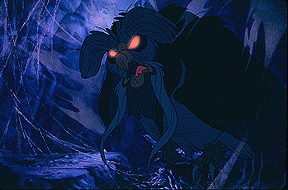
Nicodemus and the Great Owl, plus a villainous cat featured in an early scene, in conjunction with some of NIMH's dark imagery (finely detailed spider webs, craggy trees, and so forth), create the impression of a world that is not only real...but fearsome.  
  
This visual approach fits in well with the film's thesis about the challenges of a difficult world.  Early in the film, we are told at least twice that a child mouse may die from pneumonia. We learn of the father mouse's recent, untimely death.  We see a monstrous tractor threaten to smash the family homestead.  We learn of cruel animal experimentation (with long hypodermic needles, no less...) in a laboratory setting.  We see the family home sink into the mud -- disappearing below the surface -- with three mouse children trapped inside...drowning.  We see the good leader mouse, Nicodemus, destroyed by an evil strategy.  When the good rats and Jenner clash, we see the bloody wounds and cuts on their bodies.  It's not all hugs and puppies.  
  
But through it all -- driven by her love for her children -- Mrs. Brisby never surrenders.  No matter the setback, no matter the challenge (like meeting the Great Owl), she keeps fighting.  In the end, when she takes the mystical amulet and it amplifies her "heart," it's a wondrous special effects moment, but also a moment of terrific emotional impact.  As parents, we love our children and would do anything for them.  Sometimes it feels like our very hearts could pound out of her chest to help them and keep them safe from life's darkness.  The amulet amplifies Mrs. Brisby's strength and love...and you just how she feels
  
The Secrets of NIMH attempts an awful lot in 82 minutes. It is ambitious. The plot line is very complicated.  And yet, the movie is also rewarding because it doesn't spoon-feed you platitudes, or talk down to children.  It imagines a beautiful (if dark) universe, and reveals how an individual of courage, endurance and love can master it.  If Mrs. Brisby's odyssey were an easy or simple one, the story would lose much meaning. 
  
Also, NIMH clearly boasts a sort of animal-rights message. I don't want to get on a soapbox about this, but it's all too easy to assume that people or animals who look different from us have no feelings, no souls.  I challenge anyone who has looked into the eyes of a beloved pet dog or beloved pet cat to believe that is actually so.  Animals, though of a different order of intelligence, deserve dignity. I always remember Spock's line from Star Trek IV: The Voyage Home (1986) about the whales. He says that if the Enterprise crew "assumes" that the whales are "theirs" to "do with" as they please, they are as guilty as those who caused their extinction.  I'm not saying we shouldn't observe animals, study them, and attempt to learn more about life on our planet from them, but it seems a moral imperative that we always do so with...humanity and even respect.  
  
I love the "growing pains" of the intelligent rats as they are presented in The Secret of NIMH.  These animals have come to realize that "to be rats" is no longer sufficient given their brain boost.  Their super-intelligence requires a new way of living...a new set of laws and responsibilities.  Just as our intelligence means we have certain responsibilities too.  But of course, it's not always easy to accept that responsibility.  The law of the jungle is difficult to eradicate, even amongst the most civilized of us, and that's the quality I believe Jenner represents in the film. 
  
The Secret of NIMH may not have spawned that glorious second age in quality animation that Don Bluth hoped for, but it is certainly a film of wondrous imagination and execution. It's a high-point for the genre during an age when the trend was towards cheaper, quicker, and less morally complex.  

The "secret of" NIMH, perhaps, is that mice and people aren't that different at heart.

Saturday, July 09, 2022

40 Years Ago Today: Tron (1982)

Steven Lisberger's Tron arrived in American theaters during the magical, unmatched summer of 1982.

This was the golden season that gifted to cineplexes Ridley Scott's Blade Runner, John Carpenter's The Thing, Tobe Hooper's Poltergeist, Steven Spielberg's E.T., Nick Meyer's Star Trek II: The Wrath of Khan and Clint Eastwood's Firefox.

And much like Blade Runner and The Thing, Walt Disney's Tron received largely negative reviews from film critics. They judged that the film -- while a technological wonder -- failed utterly to connect on some basic human level. This was an easy conclusion to draw since Tron involved, predominantly, computers and computer programs.

Writing for The New York Times, critic Janet Maslin opined that Tron's "technological wizardry isn't accompanied by any of the old-fashioned virtues - plot, drama, clarity and emotion - for which other Disney movies, or other films of any kind, are best remembered. It is beautiful - spectacularly so, at times - but dumb. Computer fans may very well love it, because ''Tron'' is a nonstop parade of stunning computer graphics, accompanied by a barrage of scientific-sounding jargon. Though it's certainly very impressive, it may not be the film for you if you haven't played Atari today."

Well, Maslin was half-right...

The visuals of Tron are indeed utterly spectacular...and trail-blazing. 

But there also exists encoded here a powerful human dimension. Specifically, Lisberger's narrative carries an undeniable subtext concerning the devouring nature of 1980's corporate America. It was a corporate America, in fact, unleashed (and virtually unregulated...) by the laissez-faire policies of the new American President, Ronald Reagan.

Impressively, Tron even seems to position itself as a critique of the "new" Walt Disney Company...post-Walt Disney. It thus bites the hand that made it, so-to-speak. For Disney is a company, the film indicates, where the computers and the bean-counters have seized control.

Contrarily, one might also cogently argue an opposite point with some validity; that Tron is actually a jingoistic Cold War statement against Communism; one depicting a battle for personal freedom against a "Red"-hued assimilating enemy, the Master Computer Program.

Beyond these intriguing and debatable sub-texts, Tron continues to fascinate new generations of viewers on the basis of the intricate, visually-complex fantasy computer world it creates with such aplomb. This is a dazzling alternate universe where all the main characters of the human world -- in the spirit of The Wizard of Oz -- boast an identity "double," -- a computer program doppelganger. Given the contemporary  popularity of MMORPG games, Tron's notion of electronic counterparts or computer avatars acting as our alternate identities in a man-made photoelectric landscape remains timely four decades after the film's release.

Greetings, Programs!


Tron depicts the story of a rogue computer programmer named Flynn (Jeff Bridges) who was fired from his job at the mighty corporation ENCOM when a fellow programmer and now executive-senior-vice president, Dillinger (David Warner) stole his design for several blockbuster video games, including the popular Space Paranoids.

Dillinger has also all-but-ousted the company's original president, the gentle and elderly Walt (Barnard Hughes) -- who created ENCOM in his garage.

Dillinger has turned Walt's creation into a devouring machine bent on the acquisition of smaller corporations and companies so as to seize a bigger market share. Assisting him in this dedicated raiding effort to control all commerce (international and domestic) is the monstrous MCP -- Master Control Program.

Flynn is zapped by a matter-transformer controlled by the MCP and "digitized." He thus enters the world of the MCP and other computer programs. There, he attempts to re-claim his cstolen reations and destroy Dillinger's machine servant. Flynn is assisted in this matter by a regulatory program, Tron, created by another information-seeking ENCOM programmer, Alan Bradley (Bruce Boxleitner). The MCP attempts to destroy Flynn -- a man the other programs revere as a god-being called a "User" -- using his right-hand man, the villainous Sark (also David Warner), to do it.

I Programmed You To Want Too Much: Big Business Unfettered in Tron

An excavation of the context underlining Tron is important to any understanding of this unique fantasy film.

The first significant trend to discuss here is technological advance: the evolution of arcade video games into home based game systems (like the Atari 2600) in the late 1970s; and then the lightning-fast, subsequent replacement of those game systems with home computing devices like the Commodore VIC-20 in the early 1980s.

Forget a chicken in every pot, by the mid-1980s there was a PC in every American house. 

Accordingly, terms such as BASIC, DOS, RAM, "user friendly" "disk drive," "program" and "memory" (not to mention "crash...") entered our lexicon as we accommodated a new and useful device into our daily lives.

Tron expresses, in fascinating terms, the sense of uneasiness some Americans felt with the rapid growth of this new technology. On one hand, humans were still at the top of the food chain in Tron: "Users" sending "programs" to do their bidding in an invisible (to our eyes...) electronic universe.

However, on the other hand, the electronic world of our helpful programs had been (secretly) co-opted by a hungry, assimilating devourer that put the food-pellet-gobbling Pac Man to shame: the MCP. This fear of insidious technology in our homes finds voice in much of Tron's dialogue. "The computers will start thinking and people will stop," warns Walt Dumont (Hughes) in one critical scene.

Prophetic?

At other points, however, Tron expresses the desire for a "free system" in which Man and Program ally in beneficial unison. And the film's brilliant climax is not entirely unlike that depicted in Star Trek: The Motion Picture (1979) a sort of religious communion/fusion between Man and machine. As in that cinematic case, man here is the deity, shepherding his sense of traditional human values to the "cold," "intellectual" machine. In Tron, Flynn dives into the MCP (in a Godly beam of blinding light...) and briefly joins with it. His decency -- his humanity -- transforms the outward shade of evil (a crimson, coruscating red) into the film's shade of rebellion and liberty; blue.

The second important element of Tron's context involves the Walt Disney Company and the policies of Ronald Reagan (though in fairness to Mr. Reagan, his predecessor in the office, Jimmy Carter, had begun the process of deregulation well before he took office...).

However, Reagan was important because it was he who oversaw the de-regulation of the financial industry on his watch. He not only made regulation far less less stringent (which eventually led to a housing bubble.), but also expanded the powers of Savings and Loans to diversify -- 
with a keen eye directed towards profits. This move essentially eliminated the distinctions between commercial and saving banks. As a result, interest rates rose, and so did rampant real estate speculation.  Merging companies in the 1980s became titans...monopolies. And they soon grew...too big to fail (thus requiring financial bail-out from tax-payers).

Now consider the troubled history of the Walt Disney Company during this same time period; the time period leading up to Tron. 
Walt Disney had passed away in 1966, and the company floundered through the 1970s. Walt's nephew, Ray Disney, left the company in 1977 after vocally disagreeing with the company's creative direction. In 1979, Don Bluth, Gary Goldman, and John Pomeroy -- the creative brain trust of the Disney animation family -- also walked away. The general feeling at the time was that Disney had lost its way creatively. The answer, according to some business-minded voices, was assimilation. 

Now consider that in the years since Tron, Disney has assimilated independent characters and franchises such as the Muppets and Winnie the Pooh. (And more recently, Star Wars and Marvel). In MCP-like fashion, it has also "acquired" TV networks such ABC, Fox Family, Capital Cities, and production companies including Saban Entertainment and Pixar. It owns 20th Century Fox.

Tron arrives in the very early days of this new and aggressive corporate policy. Corporate raider Dillinger has "acquired" (illegally...) a variety of video games from Flynn, while his alter ego in the computer world, The MCP acquires (legally, but through force), every computer program he comes in contact with, making him a more formidable opponent.

Daringly, the film even provides us a Walt Disney surrogate in the person of the amusingly named "Walt Dumont," a flannel-shirted, avuncular-type with a heart of gold. Uncle Walt was with ENCOM when the company's motives were not purely commercial; when it tended first to people, to customers -- to "user requests."

By explicit contrast, Dillinger -- a surrogate for the Reagan-Era, laissez-faire CEO -- states that "doing business is what computers are for," and tells Walt that "the company you started in your garage doesn't exist anymore." In other words, Walt Disney was rolling in his grave and the company he created just didn't care.

In focusing on the bottom-line of profits (and the pirate-like acquisition of more businesses/programs), however, Dillinger makes a mistake. He neglects the human spirit. Thus the computer world as run by the MCP is cold and harsh...and a rebellion and a religion are born there.

The old school contingent, led by Walt Dumont and his avatar, the Guardian, believe that "our spirit remains in every program we design for this computer." But the MCP isn't interested in personality or individuality, and in the film's climax, we register him attempting to absorb all the "individual" rogue programs he has captured; in the film's lingo, "snapping them up."

Merging, acquiring and re-purposing the landscape for raw material and (thus wealth), the MCP is thus the Reagonomics financial model set loose in the computer world.

Tron's coda even suggests further particulars of the Walt Disney Company. After Dillinger's ouster, the family-friendly, old-school Flynn becomes CEO -- flown in a helicopter to his corporate office. In real life, this sort of restoration happened in 1982 (Tron's release year). Walt Disney's son-in-law, Ron W. Miller became CEO, at least before big business won out again and Michael Eisner took over.

So, in telling fashion, Tron comments directly on the corporate raiders of the early 1980s and warns about what might come next if these 1980s laissez-faire economic policies were to continue unabated. It even predicted a move by big corporations "beyond operations" into...world domination. The film's video-game titles highlighted in Flynn's arcade -- and brightly lit in neon, -- seem to warn of an impending disaster, with names such as "ZERO HOUR," "THE END" and "INTRUDER."

In 2022, we must wonder the MCP has reached finally achieved his dream of conquest: reaching "inside" the Pentagon...and deciding national policy.  Corporations are people, right?


Red, White and Blue:  Communism vs. Capitalism in Tron


For all the visual bells and whistles, Tron is a fairly deep, fairly substantial genre film. In fact, you can interpret Tron in an entirely different fashion than I've enumerated above. 

Specifically, in a Pro-Reagan way, for my conservative friends.

The MCP -- quashing religious freedom, assimilating businesses, and lording it over innocent programs -- may be an allegory not for big business amok; but for the Soviet Union.

The MCP's color of choice/identification is scarlet red (think red scare...). And as far back as Invasion of the Body Snatchers in the 1950s, communists have been associated with non-human evil; either alien or machine. The MCP -- the emotionless computer -- fits perfectly the bill of Cold War Era jingoism. Especially under the President who joked that he had "outlawed Russia" and planned to "begin bombing in five minutes..."

If you study the arguments of the aggrieved programs in Tron, that "the high and mighty master control" has: restricted movement of programs on "the micro-circuits," (think interstate travel between Eastern Bloc countries), conscripted a vast army, and assimilated control of all individual programs (essentially nationalizing them), then the Cold War metaphor holds as strongly, perhaps, as does the film's anti-corporate streak. 

The desire for a "free system" is the American desire for the CCCP to adopt freedom and liberty overy tyranny. And the key to the MCP's destruction is getting in behind his force field, a protective, impenetrable wall. Tron "tears down that wall," and brings down the MCP in the process.

On the Other Side of the Screen, It All Looks So Easy

Tron illuminates late 20th century issues of technology, humanity, contemporary politics, perhaps even foreign affairs, in the setting of an amazing, richly-visualized fantasy world. The film's major set pieces are gorgeous, and remain amazing to behold. It is for this reason, indeed, that the film entertains so mightily.  

There's the Game Grid, where Flynn is forced to engage in a life-and-death game of electronic jai lai. There's the light-cycle race and break-out, an adrenalin-inducing action sequence and visual trademark for the film itself. There's a recognizer tank out-of control...disassembling itself a layer at a time as it crashes into the staggered technological landscape. And, perhaps most impressively, there's the digital beam transport -- a butterfly-like light ship, crossing "unprogrammed space," a kind of computer world wilderness.wasteland. The MCP itself is a great villain: a computerized Devil, part Wizard of Oz and part Darth Vader. Both heir to Forbin's Colossus and antecedent to War Games' WOPR.

I hasten to add that all these amazing and imaginative visuals and characters serve an important purpose in Tron. Because the computer world is a twisted reflection of ours; the landscapes tell us something about ourselves, and about our world. How we shunt aside the old and obsolete seemingly without thinking (Walt/Guardian). How we seek purpose through a belief in the divine. And how we all create God in our own image (the "Users" of the programs are...us.).

And finally, the gorgeous, artistic last shot of Tron punctuates the film's carefully-crafted connection between the computer world and the world of the human Users (the builders of that computer world).

It's a simple, long-view shot of a contemporary American city; of a skyline.

But as day slides irrevocably into night, something unusual happens. The substance of this brick and mortar metropolis changes. All the roads, the buildings, and the moving cars seem to transform into the very raw, blinking "data" we have come to associate with Tron's glowing computer world. 

Beacons in the dark; searching for meaning...leading us into the technological future and limitless possibility.

It is an image that connects man's natural world and his technological one, and reminds us, visually, that we inhabit both. 

To our detriment or to our glorification.

End of Line.

60 Years Ago: Star Trek: "The Man Trap" (September 8, 1966)

Stardate: 1513.1 The U.S.S. Enterprise visits planet M-113 to check in on archaeologist Dr. Robert Crater (Alfred Ryder) and his wife, Nancy...