Tuesday, July 04, 2017

July 4th Blogging: Star Trek: "The Omega Glory"


Stardate: Unknown

The U.S.S Enterprise discovers the missing starship Exeter in orbit of remote planet Omega IV. A landing party beams over to the vessel and finds that the crew has died as a result of a mysterious illness, ostensibly exposure to contaminants on the planet.

A recorded message from the ship’s chief medical officer reports that anyone boarding the ship will also become infected, and that the only antidote rests on the planet.

Captain Kirk (William Shatner) and his landing party leave the Exeter and beam to the surface, hoping to buy survival time from the infection.  Kirk and the others find that Exeter’s Captain Ron Tracey (Morgan Woodward) is alive, and has, quite possibly, violated the Prime Directive in order to save the planet’s peaceful humanoid villagers, Kohms, from the wild hordes nearby, known as Yangs.

Tracey has taken this action because he believes that the Kohms have discovered the secret of eternal life, or the Fountain of Youth.  As Dr. McCoy (De Forest Kelley) investigates this possibility, Kirk weighs his responsibilities, vis-à-vis Tracey’s violation of General Order One. Meanwhile, Tracey wants the Enterprise to beam down more phasers, and more phaser packs to help him in his quest to defeat the Yangs.

When the Yangs invade the Kohm village, however, retaking lands they held long ago, Kirk realizes that a kind of parallel to Earth’s history is playing out. 

The Kohms were once “communists.”  The Yangs were…Yankees….


“The Omega Glory,” is a strange, strange episode of Star Trek, though a perfect one to revisit on July 4th, or Independence Day.

The narrative begins with a strange disease killing a starship crew, moves into a meditation on the Prime Directive, and ends with Kirk nodding, knowingly and approvingly at a (parallel) version of Old Glory, our American flag.  Our Stars and Stripes will not only live on in the memory of the greatest starship captain of the 23rd century, "The Omega Glory" tells us, but will restore freedom on a parallel planet.

Despite the wide-ranging subjects covered by "The Omega Glory," the episode is never less than “fascinating,” to echo Mr. Spock’s famous exclamation.  In part, this is because the scenarios are memorably realized in visual terms, and buttressed by a soundtrack that underscores the weird, and discomforting nature of the tale.

I have long found “The Omega Glory” to be a pleasure to watch because of the imagery.  The episode begins with pure eeriness, as Kirk’s landing party discovers Exeter’s dead crew.  There are no traditional corpses, however.  Only uniforms and chunks of white chemical compound are left behind.  This is a remarkable and original visualization, and one that is terrifying.  Basically, the crew decomposed to these chunks of chemical residue.  The uniforms -- and the remnants -- are draped over stations, positioned in chairs, suggesting a truly alien condition, and a terrifying danger in the final frontier.


Later, the episode focuses on intense close-ups of Spock’s magnetic, slightly devilish eyes, and cuts to literary images of a Vulcan-like interpretation of the devil making quite explicit the comparison between Spock’s nature and the Devil’s. If Kirk is “The Evil One,” as the Yangs believe, Spock is his dark minion. The views we get of Spock in this episode -- especially as he hypnotizes Sirrah – support this notion visually.

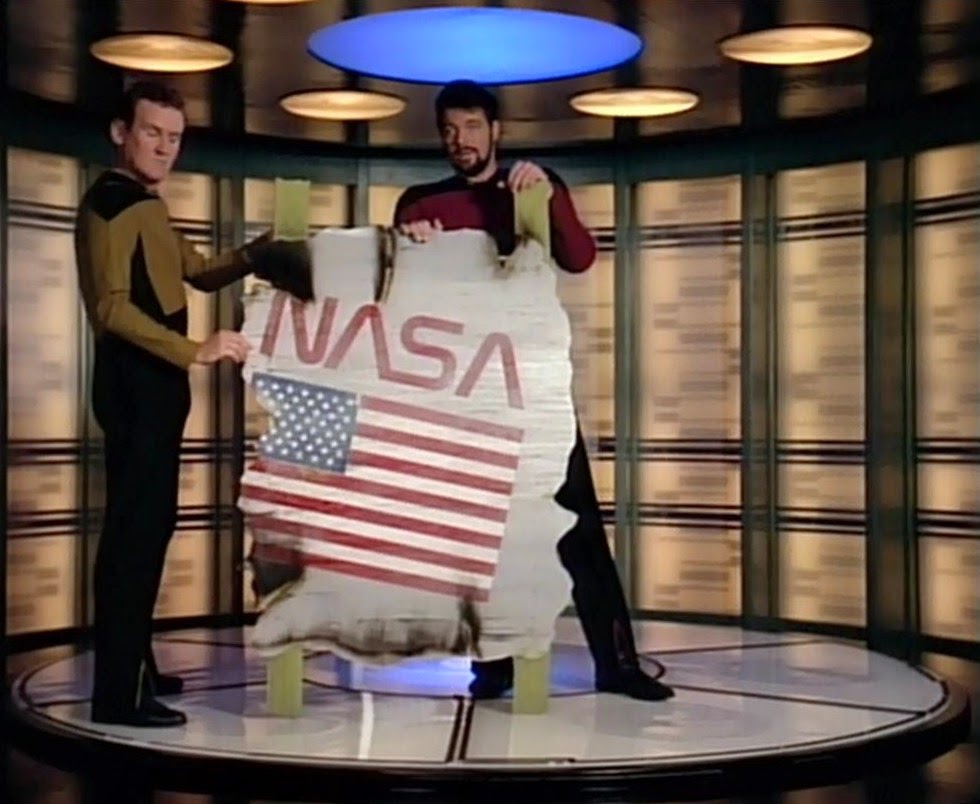
By the time we get to the image of a ratty, torn relic of American flag -- introduced with a dissonant, creepy, alternate version of The Star Spangled Banner -- the episode has demonstrated a visual and aural ingenuity that sets “The Omega Glory” apart.


Another key strength of the episode is Morgan Woodward’s performance as Ron Tracey. Woodward is a charismatic personality, one who projects physical strength and mental toughness.  Indeed, if you look at the original series “captains” -- Kirk, Decker, and Tracey, specifically -- one detects some commonalities.  These are all men of uncommon will and constitution.  Decker is undone by a tragedy not his fault.  Tracey too deals with tragedy (though in a way we may not approve of) but both men represents lessons, in a way, for Kirk to learn from.


Of course, however, “The Omega Glory’s” plot of a parallel Earth is often criticized by fans and scholars. When Spock notes that the parallel of Yangs/Yanks and Kohms/Communists is almost “too close” to be believed, there are many who will agree with his assessment. 

And yet, let us remember that the key analogy between Star Trek and our reality of the late 1960s is undoubtedly the Cold War.  In most cases, Klingons sub for the Soviets, and the UFP stands in for the USA.  Here, Kirk and company stumble across a world that fought a World War over the ideologies of these two forces, and destroyed themselves. 

So, at least in a sense, “The Omega Glory” remains true to the underlying conceits of the Roddenberry series, even if in this case, the comparison may be very “on the nose.”  Also, it’s clear, given Kirk’s reverence for the United States flag and the U.S. Constitution that this episode revels in national patriotism.

Kirk’s argument that the worship words of the Constitution are for all the people, Yangs and Kohms is rousing, indeed, and meaningful, in this context.  The words must apply to all people, he says, or they are rendered meaningless.  The underlying idea here is that words, over time, and through crises, can lose their meaning, if not read closely; if not read carefully; if not remembered.  The Yangs want their country back, but have lost the meaning of the words they supposedly revere. Kirk puts meaning back in those ideals with his dramatic reading of the worship words.


Of course, a key problem here is that it takes two to tango, and though the episode advises mercy for the Kohms (the words of worship are for everyone!), no commentary is given to the fact that if two ideological forces go beyond the brink, to nuclear war, both ideologies and both nations bear the responsibility. The “glory” of “Errand of Mercy,” for instance, was Kirk’s realization, forced by the Organians, that he was part of the problem too; hungering for a conflict with the (admittedly aggressive) Klingons.  There’s no such even-handedness here.

As a Prime Directive episode, “The Omega Glory” is also highly intriguing.  Tracey loses his whole crew, and then sees peaceful people being massacred by wild men, and so intervenes to protect them. It is not at all impossible to see Kirk doing the same thing in the same situation. Would you stand by and let the last apparent refuge of civilization fall on Omega IV?

But Tracey goes further, believing that he can somehow redeem himself and his actions by bringing a (mythical) Fountain of Youth to the Federation. He goes from interfering to save lives, for interfering to acquire something for his own people.  I would argue that this is his great violation of the Prime Directive, his vainglorious desire to be seen, perhaps, as a savior to his own people; an act which would mitigate the loss of his ship and his crew.

Some fans have judged “The Omega Glory” corny, both for the reverence to the American flag in a 23rd century context, and for Shatner’s impassioned reading of the “worship words.”  I understand that, and yet feel the episode remains visually fascinating, and conceptually unusual.  One thing is for certain: the episode is never less than entertaining.

And, on July 4th, it is never a bad thing to remember that the Constitution applies to all the people of America, not just some people.

July 4th Blogging: Independence Day: Resurgence (2016)


So, it took twenty long years for filmmakers Roland Emmerich and Dean Devlin to give audiences…this movie.

I won’t mince words about it: Independence Day: Resurgence (2016) is a terrible, awful, no good movie.

I’ll go further. This is quite possibly the worst big budget studio release in a generation, or at least since I’ve been reviewing movies. 

Big, would-be emotional moments in Emmerich’s Independence Day: Resurgence fail utterly, and even the supposedly spectacular action scenes are flat and lifeless. Beloved characters and actors return to the franchise, and have almost no impact whatsoever.

Now, I know there are readers out there who hate Independence Day (1996) with a passion, but I don’t feel that way. 

For all its inherent, generic, goofiness, ID4 remains a nineties pop-culture touchstone. The scene of the alien flying saucer destroying the White House is absolutely iconic. 

And the dramatic material, while schmaltzy, nonetheless carries authentic emotional impact. President Whitmore’s (Bill Pullman) final, inspirational speech in the film, about the human race joined as one, finally, in opposition to an outside threat, is remarkably delivered.  It also captures an idea often spoken, by the likes of President Reagan and others: that the human race will only truly be united in opposition to an alien attack.  

If the Earth is at stake we will come together as one.

For whatever flaws the 1996 film possesses -- namely and most importantly, the relentless pandering to a wide audience -- ID4 still feels like a huge pop culture event; one with grand, carefully orchestrated special effects, and an ominous sense of build-up and tension as the alien attack on Earth commences.

The new film, Resurgence feels utterly slapdash in comparison. It looks like a cash grab that should have been released in 1998, two years after the original film premiered so as to capitalize on some of the good will generated by the original film.

But this is twenty years later -- not two years -- later, and Independence Day: Resurgence is a disaster of epic proportions. It’s shocking, actually, to watch the whole enterprise go up in smoke before your eyes.


Twenty years after an alien invasion nearly destroyed humanity, the human race is once again thriving. 

Utilizing technology reverse-engineered from captured and shot-down alien ships, the Earth Space Defense, sponsored by the UN, has established based on the Moon, and operates from an HQ at Area 51.

As the twenty year mark nears, however, a mission to the Congo -- consisting of scientist David Levinson (Jeff Goldblum), Dr. Marceaux (Charlotte Gainesbourg) and the warlord Umbutu (Deobia Oparei) -- discovers that a crashed alien ship has been transmitting a distress signal to deep space.

Similarly, those who were once telepathically-linked to the aliens -- including ex-President Whitmore (Pullman) and Dr. Okun (Brent Spiner) -- begin receiving mental impressions again.

Meanwhile, at Earth’s Moonbase, where hot-dog pilot Jake Morrison (Liam Hemsworth) is stationed, a small spherical ship approaches. It is shot down immediately, but is not actually part of the invasion. Instead it harbors the secret to defeating the aliens, known as “Harvesters.”

Soon, a 3,000 mile-in-diameter Harvester vessel approaches and destroys Earth’s defenses. It begins to drill into the Earth in an attempt to remove Earth’s core, killing the planet.

Levinson, however, believes, that there is a way to stop the procedure. The aliens possess a hive mind, and killing the Queen will stop the drilling operation.


There is a good (and very Japanese-ish/kaiju or Gerry Anderson-ish) idea embedded in Independence Day: Resurgence, but that’s about it. 

Specifically, the movie features the idea of a unified Earth developing a multi-national defense force against external threats.  It's a pseudo SHADO.  

All the Earth planes and ship designs featured in the film are futuristic in design, powered by the alien’ anti-gravity technology.  There isn’t a lot of dialogue about this upgrade in the film, which actually works in the movie’s favor.  It is a brand new world we encounter here, twenty years after the invasion, and a lot of the technological progress is (rightly) un-commented upon.  Rather, it is merely accepted as being a fact of life.

Beyond that idea, there’s not much here to recommend Resurgence to thoughtful audiences. The movie features three creative specific failures worth describing in detail. One involves the actual invasion, the second involves the new characters, created for the sequel, and last regards the handling of the characters who return from the original.

Let’s take each issue in turn.

In Independence Day, there was a slow-burn build up to the attack, and accordingly, a sense of suspense and mounting anxiety.  The aliens didn’t just arrive and start smashing landmarks. A signal was detected, suggesting a coordinated attack around the globe, and then a mysterious countdown.  That countdown was detected too late, and an evacuation of government sites began, only half-successfully.

I understand that the mystery is gone now about the alien intent. We know they are hostile. So the same card can't be played a second time.  

However, the whole premise of this movie seems to be, simply, that bigger is better. That’s it: shock and awe, CG style.  

Accordingly, we get a huge spaceship arrive, latch on to the planet, and pretty much wipe through Europe in one over-the-top scene. The ship is huge, the destruction is huge too, but it is over in a few short moments. There’s no sense of a pitched battle, no sense of the people who live in the affected city (London).  It’s a digital cartoon, without human scale, and therefore, without human impact.


The second such scene, with Julius Levinson’s boat escaping the giant space ship, is played more for laughs than horror, and it feels impossible. We know he is going to survive, even as every other ship in the sea is pulped. Why, because he's the movie's indestructible comic relief.

The special effects are lacking in human impact, perhaps, because the new human characters are conceived and performed in the most generic way imaginable. 

Liam Hemsworth, Jessie Usher, and Maika Monroe are utterly forgettable as this “next generation” of characters, and the audience doesn’t ever come to truly care about them. They never leave a footprint on your mind, let alone on your heart.  Jake (Hemsworth) and Hiller (Usher) are given some back-story conflict that goes nowhere and means nothing. It's just a way to waste time, and make you feel that there is a "history" to these cardboard creation.


But you know the movie is failing on a catastrophic level when it looks, for a minute, that the young heroes have died in an escape from an alien saucer, and you find you just don’t care.  The movie’s soundtrack rises to a crescendo, and you realize that you are supposed to be concerned, engaged.  You are supposed to care.

You don’t. 

I can’t remember, offhand, another blockbuster movie where the crowd-pleasing moments, the big victories, the prospective failures, fall so utterly, horribly flat.  The young, underwear-model cast is never able to generate any real or genuine interest on the part of the audience.


The returning characters don’t fare all that much better.  Bill Pullman registers strongly as President Whitmore at first, but then the character is sacrificed for what is, finally, a meaningless death. He gives another speech that is supposed to register as inspiring and stirring, but plays as a pale shadow of the original ID4 oratory.  His death, again, doesn't reach the emotional heights the movie aims for.


Judd Hirsch continues to be over-the-top as the senior Levinson, while Jeff Goldblum feels oddly disconnected from the material, simply walking through the part. By contrast, Vivica A. Fox gets what should be a powerful death scene, but again…the moment carries almost no emotional weight. She's been given so little screen time here, that there is no chance to reconnect with her.

Of all the original characters, Dr. Okun is the only one who comes off well. Brent Spiner steals practically every scene he is in, but even he can only do so much heavy lifting.  He gets the last lines of the film, which should be a rallying cry for the sequel, but feels more like a slapdash joke.


At his best, director Roland Emmerich can rouse audiences with efforts such as Stargate (1994) or Independence Day (1996), and at his worst, he provides audiences empty thrills and brain-dead narratives like 10,000 BC (2008) and 2012 (2009). His Godzilla (1998), widely-derided, falls somewhere in the middle of the pack.

Independence Day: Resurgence is a new career low, as it leaves out even the emptiest of thrills. The whole movie flies on automatic pilot, with no apparent creative investment. It's all just a formula, without heart, without emotional connection or creative distinction. We have no idea, from this film, why we should love these characters, or invest in their world.

The title of this sequel was once proposed as Independence Day: Forever.

How about Independence Day: Forget It.

July 4th Blogging: Independence Day (1996)


"In less than an hour, aircraft from here will join others from around the world. And you will be launching the largest aerial battle in the history of mankind. "Mankind." That word should have new meaning for all of us today. We can't be consumed by our petty differences anymore. We will be united in our common interests. Perhaps it's fate that today is the Fourth of July, and you will once again be fighting for our freedom. Not from tyranny, oppression, or persecution, but from annihilation. We are fighting for our right to live. To exist. And should we win the day, the Fourth of July will no longer be known as an American holiday, but as the day the world declared in one voice: "We will not go quietly into the night!" We will not vanish without a fight! We're going to live on! We're going to survive! Today we celebrate our Independence Day! "

- President Whitmore (Bill Pullman) delivers an historic address in Independence Day (1996).


Independence Day (1996) remains one of the big “event” movies of the 1990s, a sci-fi blockbuster of monumental, almost unimaginable proportions.  The crowd-pleasing film successfully tapped into the decade’s unending fascination with aliens and UFOs (The X-Files, for example) and significantly augmented that interest too, resulting in a slew of further alien films and TV programs from Dark Skies (1996) to Men in Black (1997).

As an inside-the-industry cautionary tale, Independence Day also represented the (unfortunate) cementing of the Emmerich/Devlin blockbuster “formula” -- a revival of 1970s disaster film tropes.  This format would meet its Waterloo in 1998’s Godzilla, but nonetheless continues right into this decade with films such as the dreadful 2012 (2010).

Of all the Emmerich genre fare, I’m most fond of 1994’s Stargate, as it seems to strike the right balance between spectacle and intelligence.  After that film’s release, the scales in further efforts kept tipping towards spectacle and away from brains, and so the ensuing films suffer mightily for the imbalance. 

That established, I was certainly part of the enthusiastic audience for Independence Day upon its summer release, and I still remember how great the film looked on the big screen.  A recent re-watch confirms how terrific the miniature effects remain.  The scenes of awesome alien saucers lumbering to position over major world cities -- though obviously reminiscent of Kenneth Johnson’s V (1984) -- remain downright staggering.

What ages Independence Day most significantly, instead, is the pervasive shtick and the schmaltzy, sentimentality-drenched characters. At every step of the way during its narrative, Independence Day punctures its end-of-the-world majesty and gravitas with low humor and over-the-top sentimentality, qualities which today render the whole affair close to camp. 

Science fiction fans, of course, experienced conniption fits over Independence Day’s unlikely finale: a third act which sees an Earth-produced computer virus successfully uploaded to an alien computer aboard a mother-ship, thus giving humans the opportunity to strike back…on July 4th, no less. 

The movie doesn’t pay even lip service to the idea that aliens from another solar system might have developed anti-virus software (!), let alone computer systems totally incompatible with our 20th century Earth technology. 

Given how badly things go for Earth in the first hour of Independence Day, it’s difficult to countenance the film’s final veer into outright fantasy as every heroic campaign – with split-second timing – comes together perfectly.

Despite my misgivings about the film’s humor, sentimentality, and narrative resolution, however, I still find the grave, apocalyptic, anxiety-provoking tone of Independence Day’s first hour worthwhile, especially the President’s grim choice to deploy nuclear weapons in an American city to drive off the aliens.   

It would be absolutely foolish to deny, too, that some of Independence Day’s imagery has become iconic in the annals of cinema history.  We all remember that portentous shot of hovering saucer pulping the White House for instance.  Thus -- even while criticizing this over-sized beast -- I've got to give the Devil his due for getting matters right on a visual terms

In terms of theme, Independence Day works overtime to remind all of us that although we are separated by oceans and other Earthly partitions, we are all nonetheless citizens of the same planet. It’s a laudable message in an age of hyper-partisanship to be certain, even if delivered with little nuance or subtlety.  This through-line in the film is consistently and well-conveyed, both in terms of incident and in the make-up of the diverse dramatis personae.  Who would have imagined our precious Earth could be saved by a war veteran, a drunk crop-duster, a Jewish cable repairman and an African-American fighter pilot?

Movie critics were understandably divided on Independence Day.  At The New York Times, Janet Maslin wrote: “Guess what: "Independence Day" lives up to expectations in a rush of gleeful, audience-friendly exhilaration, with inspiring notions of bravery that depart nicely from the macho cynicism of this movie season. Its innocence and enthusiasm are so welcome that this new spin on "Star Wars" is likely to wreak worldwide box-office havoc, the kind that will make the space aliens' onscreen antics look like small change.”

Writing for The Washington Post, Rita Kempley opined: “"Independence Day" is primarily a $70 million kid's toy, a star-spangled excess of Roman candles and commando games designed to draw repeat business from 9- to 12-year-old boys. Little girls won't find any role models among the barnstormers, though a plucky exotic dancer is featured among the heroines. Even with the end of the world in sight, she shakes her booty. It's for her kid. No, really.  Maybe the moviemakers' mission was to boldly go where everyone in Hollywood has gone before: the bank.”

Honestly, I can see both sides of the critical equation in this case. Independence Day is such dumb fun, and yet fun nonetheless.

“A toast...to the end of the world.”


The people of planet Earth watch with anxiety and wonder as three-dozen alien saucers descend from orbital space to take up positions over cities around the globe.  President Whitmore (Bill Pullman), a former jet pilot in Desert Storm, advises calm, but new information from genius cable repair man David Levinson (Jeff Goldblum) suggests the alien ships have initiated a countdown and are preparing a coordinated attack.

As the countdown ends, Levinson’s suspicions are confirmed, and the alien ships destroy Los Angeles, Washington D.C., New York and other population hubs. President Whitmore survives the attack on the Oval Office and escapes by Air Force One.  He promptly orders a retaliatory strike.  Pilot, top-gun, and would-be astronaut Steven Hiller (Will Smith) downs an alien ship during battle, and captures one of the fearsome aliens for study.  The rest of the fight, however, is a rout, and the U.S. jets are unable to penetrate alien shields.  Humanity stands upon the edge of extinction.

The President visits the secret military base at Area 51, and learns there that scientists there have been experimenting with an alien ship for close to fifty years.  When Hiller arrives, the President attempts to communicate with Hiller's captured alien, but finds the being implacably hostile.  The aliens, he soon learns, are like locusts.  They travel from solar system to solar system using up planetary systems and then moving on…leaving only carnage and waste in their wake.

After nuclear weapons prove ineffective against the aliens, President Whitmore is at a loss how to save the planet, or the human race.  But David comes through again.  He believes he can take the captured alien ship at Area 51 to the mother-ship and upload a computer virus there, thus bringing down alien shields…at least for a few minutes.  When Steven volunteers to fly that risky mission, it’s up to the President himself to coordinate and lead a huge aerial attack against the alien saucers, both in America, and world-wide…

“It's a fine line between standing behind a principle and hiding behind one. You can tolerate a little compromise, if you're actually managing to get something accomplished.”


For a film about such a terrifying topic – an alien invasion – Independence Day frequently plays thing...light.  At least a half-dozen major supporting characters in the film are defined by their shtick. Judd Hirsch plays a nagging Jewish Dad, Julius Levinson, and his lines and delivery are pure Borscht Belt ham-bone.   Harvey Fierstein plays another kitschy character, Marty, who hams it up and makes jokes about his therapist and his (presumably overbearing...) mother.  Harry Connick Jr. portrays a cocksure pilot who provides the film at least one dopey gay joke.

But the worst character is likely Randy Quaid’s Russell Casse, a drunken crop-duster (and alien abductee) who joins the air battle against the aliens during the film's denouement.  Quaid’s dialogue is so incredibly dreadful that it has become the stuff of legend and MST3K fodder.  “I picked the wrong day to stop drinking,” springs immediately to mind. 

Among all these actors hamming it up and stealing time, Brent Spiner likely fares the best as aging ex-hippie and scientist Dr. Okun. Spiner comes off as weird and eccentric, but not so dreadfully hammy that you want to turn away from the screen in shame for watching.  His last scene -- played with alien tentacles pressing against his larynx -- is also genuinely unsettling.

Why do I have a problem with the film's pervasive moments of low humor?  Well, Independence Day already boasts Jeff Goldblum and Will Smith continually cracking wise in leading roles.  Their dialogue is dreadful too, from "Welcome to Earth" to "Now that's what I call a close encounter!"  Given all this material from our leads, do we really need Judd Hirsch, Harvey Fierstein, Harry Connick Jr., Randy Quaid and even Brent Spiner dishing out lame one liners too?  The ubiquitous nature of these characters makes Independence Day, at times, resemble an overblown sitcom.  Maybe if the material were stronger, these characters would not seem so objectionable. I guess what I'm saying, is that these moments are rarely actually funny.

Another weak character is Secretary of Defense Nimzicki (James Rebhorn), a man who in one scene advises the full scale nuking of many American cities, but in a later scene argues against a “risky” maneuver to attack the alien mother-ship and upload the virus.  His objections to the (ultimately) successful plan make no sense, and aren’t consistent with the “war hawk” image he projects in the film all along; a guy who advises going to Def-Con 2 before the President has made his final decision.  Instead, Nimzicki is contradictory simply so the audience can boo at him, and the President can dress him down…thus appearing tough and resolute. 


While I have real disdain for much of the writing and characterization in Independence Day, I do feel that the film's visuals often still shock, and often still carry real emotional resonance.  One shot, set on July 3rd, reveals the Statue of Liberty toppled, face down in the harbor...a massive saucer hovering low in the sky.  Colored in autumnal browns,  this is a terrifying composition of American culture annihilated.  

It’s tough indeed to compete with the amazing Statue of Liberty imagery of Planet of the Apes, yet this moment in Independence Day remains quite upsetting.    The film is also anxiety-provoking in the way it reveals American military might crushed before a more technologically-advanced enemy.  The battle sequences, the nuclear option, and other heavy moments are all deeply scary because one realizes that if America can’t save the world…the world ain’t getting saved.  Indeed, Independence Day plays up the alien threat so successfully in terms of spectacular visuals and special effects that there’s almost no way the scripted, climactic victory can ring true.  It’s like we’ve slipped into an alternate movie or something.


The first half of Independence Day is undeniably the strongest, as alien saucers push through storm and cloud fronts, and emerge over our cities, casting dark shadows upon bewildered and amazed populations.  These moments continue to impress, and pack an almost visceral gut punch.  We’ve all wondered if, one day, we’ll wake up to something like this imagery…a new dawn in which we learn definitively we are no longer alone.   As much as I deride Independence Day’s silly humor and bad dialogue, I have no quibbles whatsoever with the way that these scenes of “arrival” are vetted.  As I said in my introduction, many of these scenes still carry a staggering punch.

From its first shots to its final ones, Independence Day also makes an interesting point about mankind being unified by a threat from the outside.  The film opens with imagery of a plaque on the moon which reads “We came in peace for all mankind.”  That’s a wonderful thought, the movie seems to suggest, but then the filmmakers set up a paradigm by which that hopeful expression of common cause is tested.  Suddenly, all mankind must work together to defeat the alien threat, putting competition and petty differences aside.  This idea is expressed through scenes set in Iraq, the location of America’s most recent war (Gulf War I).  There, in the desert, British and Iraqi soldiers join the battle against the mother ships.  The implication of such scenes is that mankind is indeed capable of working together.


The same idea is presented in the film in the (positive) character of President Whitmore.  Before the alien crisis, he is viewed not as a warrior, but as a “wimp.”  He can’t even get his Crime Bill passed by a hostile Congress.  Whitmore laments that “it’s just not simple, anymore” and that people don’t seem to understand that compromise is the only path towards moving everyone ahead, together.  He then works with the nations of the world to defeat the aliens, and in the process transforms an American holiday into an Earth holiday.   Again, the message implicit in Independence Day is that we can apply ourselves to solve big problems, not just alien invasions.  Why can’t we all band together to keep our neighbors and our neighbors' children from starving?  Or to eliminate poverty?  Once we acknowledge our common humanity, petty partisan differences shouldn’t really matter, should they?

In this sense, Independence Day -- set in part on July 4th -- acknowledges a new, evolved brand of patriotism.  It is a patriotism not merely to party or to one nation, but to all of humanity.  As a fan of Star Trek and a person who believes we can achieve great things if we sometimes accept compromise, I appreciate the film’s ultimate message of hope about human nature.  This consistently-applied theme almost mollifies my concerns about the film’s ridiculous and ill-conceived conclusion, and the surfeit of characters who spew cliché after cliché, bad joke after bad joke.  Almost, but not quite.    Still, I know I'm spitting in the wind against an 800 million dollar blockbuster, a veritable entertainment machine.

So am I a hopeless sentimental for recognizing Independence Day’s entertainment and social value, even amidst so many stupid groaners and moments of cynical, calculated humor?  

Or, like Randy Quaid's character...did I just pick the wrong day to stop drinking?

Monday, July 03, 2017

The Cult-TV Faces of: The Stars and Stripes

1

2

3

4

5

6

7

8
9

10

11

12

13

Sunday, July 02, 2017

Advert Artwork: U.S. Mail


Saturday, July 01, 2017

Saturday Morning Cult-TV Blogging: Ark II: "The Balloon" (December 4, 1976)


In this episode of the Filmation Saturday morning series Ark II, the crew runs smack into a society that, as a whole, suffers from xenophobia, a fear of outsiders or “foreigners.”  

Captain Jonah’s (Terry Lester) initial log entry describes people who “refuse to have contact with the outside world.”

But from somewhere deep inside the isolationist village, someone is sending out distress messages tied to floating balloons…written in Greek.  After deciphering one message, the Ark II crew comes to understand that the very people who have so calculatingly cut themselves off from the rest of humanity are suffering from a terrible plague, one they can’t cure on their own.

The Ark II team finds the messenger -- an old man working a printing press near “the place of the Iron Birds,” a destroyed air-field -- and learns that this is indeed the case.  The messenger says: “We have a new enemy now…disease.”


While Ruth returns to the Ark II via hot air balloon to work on a cure for the new disease, Jonah attempts to convince the village’s leaders to “open” their hearts and minds to others.  Unfortunately, he and a young boy fall prey to the disease, and only reinforce the fear of strangers.  Now outsiders are disease carriers.

Meanwhile, Ruth and Samuel must clear a path to get the Ark II inside the village, and deliver inoculations to all the sick people.

Like its predecessors, “The Balloon” is a message-heavy installment of this Saturday morning series.  In “The Tank,” we met people who shunned machines because they believe machines caused war.  Here, we meet characters who refuse to deal with outsiders, because they fear attack from them.   In both cases, people have responded to a terrifying situation irrationally, by a blanket rule about the things they perceive caused them harm.


In real life, of course, America has witnessed periods of intense xenophobia over the last two centuries, not the least of which has been in the decade following the 9/11 terror attacks.  Yet the rampant fear associated with xenophobia is ultimately counter-productive, as this episode of a 70's kid show rightly points out.  If you close yourself off, you also close yourself down to certain options, to new solutions, and to improvements your life.  When you come from a closed place, everything -- even learning -- can come to a stop.  It’s not a healthy response to fear, even if it is, on some level, understandable. 

It’s very interesting that Ark II chooses to tell this particular story, about a place that has sealed itself off from the world and in its insularity faces extinction.  “By talking instead of fighting,” says Jonah “we can move forward.”


In terms of Ark II continuity and lore, this episode reveals that the Ark II can fire a focused beam from its fore section, but the beam is still defined as “a force field,” keeping in tune with the idea of self-defense and no aggressive weaponry.  Intriguingly, the force field is also quite a limited device.  In trying to move heavy stones from the vehicle’s path, the force field’s power grid short circuits…

Although “The Balloon” carries a laudable message, it plays, at this point, as fairly routine.  

The series is in something of a rut, with tiny villages constantly being shown the error of their primitive ways by the Ark II team.  The civilizations of the week -- battling superstition (“The Slaves”), xenophobia (“The Balloon”), cruelty to the weak (“The Rule”) and technophobia (“The Tank”) -- are a bit too predictable and one-note at this point.  But the series is about to mix it up with some infusions of more science-fictional elements, from robots and suspended animation to telepathy, and that’s a good thing.

Next Week: “The Mind Group”

Saturday Morning Cult-TV Blogging: Lidsville: "Mommy Hoodoo"


In “Mommy Hoo-Doo,” Hoo-Doo’s mother (Muriel Landers) shows up in Lidsville, worried that her boy is no longer rotten.  

Dealing with disappointment and sadness, the Bad Hats, the Good Hats, and Mark (Butch Patrick) attempt to convince the mourning matriarch that her son is just as terrible as ever.


Well, what a long, strange journey it has been.  

We have arrived, at last, at the final installment of the trippy Sid and Marty Krofft live-action 1970’s series, Lidsville only to find…a clip’s show!

Yes, that’s right, this seventeenth and last segment is nothing but a collection of clips wrapped in a flimsy “new” story. 

Specifically, Mommy Hoo-Doo arrives, and must be convinced that her son has not turned to the light. Regular characters in the show (Bad Hats, Good Hats, Mark) provide testimony to prove his terrible-ness, and clips of those stories (for example “Show Me the Way to Go Home,”) are offered as evidence.


Sadly, the clip-heavy nature of this story means that Butch Patrick, Billie Hayes and Charles Nelson Reilly appear only infrequently appear in new material in this final story. CNR gets one final chance to chew the scenery, and in fairness, he makes the most of it.

Before taking on this retrospective, I had not seen any episodes of Lidsville in years, if not decades. Some episodes I found diverting, and others were just plain silly. I wouldn’t place the series at the bottom of the ladder of Saturday morning live action material, but nor is it close to being at the top rung (Land of the Lost).  Despite the performances of CNR, I'm not certain that the series ever truly escapes the orbit of H.R. Pufnstuf, its chronological and spiritual predecessor.

So for now, let’s bid adieu to Horatio HooDoo, and leave behind the world of hats.