Tuesday, April 04, 2017

The Films of 2016: Arrival


[Spoilers abound. Swim at your own risk.]

The 2016 science fiction movie Arrival concerns many fascinating ideas, but two, in particular, stand-out as being particularly intriguing or noteworthy, especially given our current national and historical context. 

The first such notion involves a cornerstone of communication studies: The Sapir-Whorf Theory.

Broadly-speaking, there are two readings of this particular hypothesis, but Professor Betty Byrne explains the hypothesis best in an interview at Slate with Melissa Martinelli, from November of 2016:
There are two ways of thinking about the Sapir-Whorf hypothesis, and scholars have argued over which of these two Sapir and/or Whorf actually intended.
The weaker version is linguistic relativity, which is the notion that there’s a correlation between language and worldview. “Different language communities experience reality differently.”
The stronger view is called linguistic determinism, and that’s the view that language actually determines the way you see reality, the way you perceive it.
What is being discussed here, specifically?
No less than the idea that the code (language) that we use to express our philosophy of the universe actually shapes our philosophy of the universe. 
Denis Villenueve’s Arrival, as I noted in a response to a blog reader yesterday, actually name-checks Sapir-Whorf in the film’s dialogue. Much is made in the film of the notion that separate nation-states (with individual ideologies) attempt to teach the aliens to speak meaningfully to humans. 
But since each nation-state -- China, Russia, etc. -- possesses a different code, and a different understanding behind the code, each will define terms like “weapon,” or “war” in a very different way. For the alien learners, this is a problem. 
Will they learn that human life is a competition? A game? A battle? Or a “non-zero sum game?”
In discussing the ways that language can shape reality, Arrival eerily forecasts, the “post truth,” “fake news” world we live in now, in 2017. If those in power here view America as weak, being taken advantage of by shadowy foreign governments, and experiencing “carnage,” do they risk shaping America into the very dystopia they describe and fear?  Is our reality being re-shaped on Twitter, 140 characters at a time?
The second idea of value in Arrival is much more personal. It concerns the path one must choose once the mind has become open to new ideas. 
One can either embrace those ideas -- and move forward into a larger, more nuanced world -- or  one can attempt to deny what has been learned, and fall back on old outdated perceptions; essentially ignoring all new input.
If understanding the code of another culture can open up new doorways, reliance or dependence on the old code, the familiar one that formed our cultural understanding, can result in slammed doors. The response to understanding the world better is then, in those instances, a retreat into a bubble of confirmation bias, or pre-existing beliefs.
Arrival -- following on in the tradition of Solaris (1972), or even the Star Trek: Deep Space Nine (1993-1999) premiere episode, “Emissary” -- comments meaningfully on the human condition, and its limitations regarding perception of time. What the aliens teach us in the film goes against the familiar code our language has established regarding chronology. 
What if there isn’t a past, present or future? What if time is non-linear…a circle?
And if time is non-linear -- if there is no past/present/future -- what does this new understanding of reality do to our concrete understandings of birth and death, mortality and the afterlife?
Interstellar (2014) from Christopher Nolan was likely the last big-budget cerebral science fiction film to play so cleverly with our understanding of time, but Arrival is an even stronger, smarter film, in part, because of the lead character’s humanity, and relatability.
Amy Adams’ Dr. Louise Banks sees her conscious altered by contact with an alien race -- the Heptapods -- but the change doesn’t make her immortal, or allow her to escape the bounds of reality.  Instead, it permits her, touchingly, to better perceive time, and contextualize a tragic experience in her life. What she realizes, finally, is something amazing, and beautiful. The startling manner in which the film permits her self-discovery to unfold actually reflects the nature of the discovery itself. 
In this case, form has reflected and augmented thematic content, and -- as you know -- I believe that equation is the highest virtue of filmmaking: the ability of an image to echo, mirror or encapsulate for audiences the point of the narrative, or increase our understanding of it.
Thrilling and smart, Arrival is also filed with unforgettable imagery, not the least of which involves the visualization of the alien vessels, and their placement on our terrestrial landscapes. The design of the Heptapod ship, too, seems to suggest the something vital about the alien nature, and their way of understanding reality.
In short, Arrival, like its lead character, Louis Banks, plays a “non-zero sum game.” 
A non-zero sum game is a situation, in game theory in particular, in which one player’s gain or loss does not necessarily equate to the other player’s loss.
The aliens, the terrestrial combatants, and the individual lead characters all undertake in Arrival an encounter that changes them and forces them to grow in surprising directions.
If only they can contend with the new world-view their meeting reveals…
“Not everyone is able to process experiences like this.”
A linguist and college professor, Dr. Louise Banks (Amy Adams) watches from her class-room as twelve alien space ships set down at seemingly random locations around the world.
As panic sets in across the globe, Banks is contacted by the U.S. military.  Colonel Weber (Forest Whitaker) wants her to translate the alien language, and help him come to a better understanding of what this possible enemy may want on Earth.
Dr. Banks counters that she cannot translate an alien language until she learns something of the alien culture; until she is able to interact with the aliens, called Heptapods.
Weber is reluctant at first, but soon agrees to escort Banks to Montana, where the U.S. Army has set up a command post near one alien ship.  On the helicopter ride to the site, Banks encounters another expert in his field, physicist Ian Donnelly (Jeremy Renner), who believes, unlike Banks, that science is the foundation of civilization.
Banks argues, contrarily that language is the “glue that holds a people together.”
Upon contact with the aliens, Banks attempts to form a common fund of knowledge, or language, upon which to build mutual understanding and trust. Other scientists around the world also attempt to do so but utilize different learning approaches, some more confrontational than others.
As Banks learns more about the aliens and their strange language, she begins to understand more about them.  As other countries grow alarmed that the aliens may be bringing weapons to Earth to cause fighting among its people, Banks receives the full-language as a gift. She understands that the language is not a weapon, but a tool.
It is a tool that fundamentally transforms Banks’ understanding of life, and opens her up to a possibility that she had never before contemplated.
“How would you approach translating this?”
Language relates to culture. I think everybody agrees with that premise. But can language determine culture?
That’s a key question regarding the Sapir-Whorf Hypothesis, and also the themes of Arrival. We all understand what “war” is, for example, but what if we understand that the word originally meant “desire for more cows” (in Sanskrit)?
Does everything we fight for -- and kill for -- come down, finally, to a desire for more material wealth?  Is that how we understand war now?  
Perhaps. Our language, our code, shapes our reality, every day.
We see this idea very clearly in our understanding of time, to utilize a more illustrative example. We mark time as a force that moves in one direction only, from the past to the future. We don’t die, grow young, and undergo birth.
Instead, the opposite always appears to occur. 
But what if time is non-linear, and has no direction whatsoever? What if we can’t understand the true nature of time because of our (limited) definition of time, which reads something like this: “the indefinite continued progress of existence and events in the past, present, and future regarded as a whole.
Arrival proposes and depicts an alien race that views time as non-linear. These aliens see outside the concrete ideas of past or future, and thus view the world differently than we do. That viewpoint is reflected in the alien language or alphabet, which is visualized as a series of inky circles of different thickness and edges.
In other words, the Heptopod language reflects the way the aliens see the universe (as a circle), just as our language code reflects the way we view the universe. Our language has a beginning and an end. Our alphabet starts at “A” and ends at “Z.”
Yet Arrival travels beyond Sapir-Whorf by suggesting that if Banks learns the alien language, her perception will also change; and that she will also possess the ability to see outside linear time.  This is poetic license regarding Sapir-Whorf, to be certain, but good poetic license.
Why? Well, when we are exposed to different cultures and their belief systems, we can’t go back to the narrow, parochial ethnocentric view we held before. The mere exposure to different thoughts, different words, a different language, opens up doorways to new understandings. Arrival takes the idea literally, but I believe it also utilizes it as a metaphor for what occurs every day in intercultural communication: the ability to grow beyond one’s set of precepts to understand that existence is richer than any one world view suggests.
Stuck in our own ethnocentric bubbles, we believe there is but one way to do things (our way!). But if we open ourselves up to other languages, cultures, and world-views, we start to become relativistic in our outlook; understanding that different people, living in different places, possess different answers to problems. Sure, there are some customs or beliefs we will always reject as too alien, or too different, or even too barbaric (see: cannibalism in The Green Inferno [2015]).  But other customs or beliefs we will recognize as wise, or as having things in common with our own traditions and morality.
Indeed, Banks almost magically assumes the power to view time in a non-linear fashion in Arrival after being gifted with the totality of the Hepatopod language. Yet metaphorically, this gift is something akin to the scales falling from her eyes. Her mastery of the alien language and culture grants her a new perspective on our own. Consider for a moment that the key imperatives for studying intercultural communication are: Self-awareness, demographic, economic, technological, peace, and ethical growth. In some-sense, Banks takes on several of these imperatives in the film, or at least the peace, ethics, and self-awareness ones.
Now consider Banks’ embrace of the new understanding she gleans from the aliens, and contrast it with the xenophobia we see rampant in today’s political swamp.  Of late, have we seen “others” consistently scapegoated as dangerous bogeymen. For example, illegal immigrants are often deemed rapists and murderers. Those of divergent religious beliefs would be banned from the United States, and by a president who ostensibly supports religious liberty.
Banks reaches out to the alien viewpoint with understanding, and saves mankind.  If she simply retreated into fear and fear-mongering, the human race would have been doomed, instead, by its own self-destructive impulses.
That’s the big picture of Arrival. It is the idea that language is “the first weapon drawn” in a conflict. But that language can also be the basis not for war, or battle, but for better understanding (just rarely in 140 characters).
How does Banks come to understand herself better? How does intercultural communication make her more self-aware?
Leave the cerebral notions of Sapir-Whorf behind for a moment, and consider, what she chooses at film’s end.  With a knowledge of non-linear time, Banks comes to see that she will have a child, a girl.  She will love and raise that girl into young adulthood, and then, tragically, see that young woman taken away by incurable cancer.
But, knowing about her daughter’s death is not a reason, finally, for Louise to choose a different course.  Instead, Banks sees that her daughter’s life possesses meaning, and continues, always, even if in linear time, Louise will have to suffer her child’s absence.
Oppositely, Banks’ husband, Ian, resents her choice to have a child, knowing that the child will die young. It’s as if all that love is wasted on a life that is short. It’s as if Louise chose cruelty, giving birth to a child just to see that individual die.
But that child’s life is not wasted, and Banks is able to discern that fact. Although we are “so bound by time and its order,” Banks is able to see that the times of love and joy in her child’s life are not outweighed by the shortness of her life-span, or by the sad way that her life ends.  For if time is non-linear, then death is not an ending.
We saw this idea, in some sense, in “Emissary,” the premiere of Star Trek: Deep Space Nine. Commander Sisko (Avery Brooks) was unable to get beyond the tragic death of his young wife, Jennifer, in the Battle of Wolf 359. He later encountered the wormhole aliens, who didn’t understand the concept of linear of time, or his refusal to end his period of mourning.
If time is non-linear, mourning is no longer necessary.
Banks chooses that her daughter should exist, despite the fact that she will die of a terrible disease when she is young. 
Banks feels that because time is non-linear, her child will “come back to her” and that what she believed was the beginning and end of a journey were no such thing.
There are days that define your story beyond your life,” she concludes. Life is not a zero sum game. You don’t live and then die.  You live and die, and cycle goes on, in a circle, never-ending.
Arrival’s twist in terms of narrative structure is that the story of Louise’s child -- life, growth, death -- is told first. It is the first mini-arc of the movie’s plot. Therefore, we presume, throughout the film, that Louise’s child has died, and that she is experiencing grief and loneliness over it. 
Instead, the truth is that Louise has not yet had the child, or even met the father of her child.  She only becomes aware of these factors after encountering and mastering the alien language.  We have, like Louise, misunderstood the nature of time, and the time-line of the film.  We see her child’s story first, but are experiencing the cinematic equivalent of non-linear time.
By giving us the end of Louise’s story as a mother first, the film structurally apes the nature of the alien world view.  Form reflects content. The visuals symbolically teach us what we need to know about the Heptapod understanding of the universe.
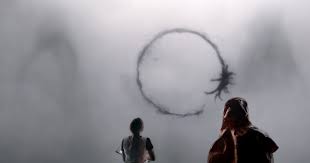
In terms of visuals, I can argue that I find the film quite lovely too.
If language is an expression of art, then imagery is, too. Consider the first, portentous visual of the alien ship in Arrival.  We are treated to an aerial view of Earth’s green, rocky landscape, and a bed of encroaching mist. Beyond and over the wall of mist is a giant levitating ship that looks like a pebble perched on its side. 
The ship, in fact, looks like a pebble you might choose to skip across a pond.  Its shape evokes the idea of a stone creating ripples in time, its influence expanding outward in all directions at once (past, present and future?)
Arrival is smart, emotionally-powerful, and beautifully-wrought. It doesn’t possess all the answers, but its brilliance arises in its ability to ask the right questions about the world, and our existence as human beings.
How would you approach translating this?
Arrival isn’t a movie about a linguist who saves the world, but about a linguist who comes to understand her own world in a way that makes her existence (and her daughter’s existence) not just bearable, but meaningful.
This is the great challenge for all of us, every day, isn’t it?

Movie Trailer: Arrival (2016)

Monday, April 03, 2017

Ask JKM a Question: Arrival (2016)?


A regular reader, David, writes:

"John, I cannot believe that you have not reviewed Arrival yet on your blog! It is one of the best science fiction movies of recent years, and an award winner too.  

Do you have any plans to feature it?

Is there some reason why you are ignoring it?"


David, you are not alone in your disbelief, let me say.

I have had probably ten e-mails from readers asking me to review Arrival

I have not done so yet because I simply haven't had the time to devote to a film that I know will represent one of my most important reviews in years.  

I have seen the film -- and I agree with your assessment -- but sometimes when a movie gets so many things right, and handles matters so beautifully, I pull back. I start feeling insecure.

I want to do the film justice, and get gun-shy, or fear that I will fail to do so. 

Yes, I know this isn't a good or healthy response, but I'm being honest. I've been putting off the review since the film was released for streaming a few months back.

I've also been holding back because -- as you may or may not know -- I am a college communication instructor, and Arrival deals explicitly with my subject matter. It deals with something I teach (Sapir-Whorf Hypothesis) and even name-checks it in the body of the film  

So again, I'm doubly motivated to get my review right, and therefore putting pressure on myself.

But no more hedging. 

Look tomorrow morning, Tuesday, for my in-depth review of Arrival!


Don't forget to ask me a question at Muirbusiness@yahoo.com


Cult-TV Theme Watch: Telescopes


A telescope is an optical device that makes distant objects appear closer because of the arrangement of the instrument's lenses.

Telescopes are also all about one thing: looking at the night sky and dreaming about what’s out there, in the dark, in the galaxy beyond.

Telescopes have appeared frequently in cult-TV history.

For example in the Irwin Allen series Lost in Space (1965-1968), one episode, “The Girl in the Green Dimension,” involves a telescope at the Robinson camp, which can see into the future.

The Space: 1999 (1975-1977) episode “Another Time, Another Place” also prominently features a telescope. 

On a duplicate of Earth, Commander Koenig (Martin Landau) finds a settlement of Alphans, including a duplicate Victor Bergman (Barry Morse). Victor, who keeps a telescope, has already determined that another moon has entered Earth’s orbit, and that information troubles him…at least until Koenig reveals himself.


One of the greatest episodes of Star Trek: The Next Generation (1987-1994) is “The Inner Light,” which finds Captain Picard (Patrick Stewart) living an alternate life on a planet doomed by climate change. At one point, he constructs a telescope, but in this case, the device is only a reminder of the stars that will never be achieved, for the population of the planet will die.


A telescope is also a regular feature in the Kent’s barn in Smallville (2001-2011). Clark (Tom Welling) looks through the telescope not only at the stars (where his distant home once existed…), but at the home of his love, Lana Lang (Kristin Kreuk).


The new Doctor Who (2005 - ) has also featured telescopes on more than one occasion.  "Tooth and Claw" is one such example.  Later, the TARDIS seems to be equipped with a telescope and planetarium ("Journey to the Center of the TARDIS.")

The Cult-TV Faces of: Telescopes

Identified by Hugh: Mission: Impossible.

Identified by Hugh: Lost in Space.

Identified by Hugh: Space:1999.

Identified by Hugh: The Smpsons.

Identified by Hugh: Star Trek: The Next Generation: "The Inner Light."

Identified by Hugh: Futurama.

Identified by Hugh: Smallville.

Identified by Hugh: Enterprise.

Identified by Hugh: Once Upon a Time


Identified by Hugh: Doctor Who

Sunday, April 02, 2017

Advert Artwork: Voltron (Matchbox Edition)


The Five Creepiest Clowns in Cult-TV History


Coulrophobia is the acute fear of…clowns.  

But why be afraid of clowns at all?  

After all, clowns are merely slapstick circus performers garbed in ridiculous accouterments (zany wigs, over-sized shoes, red noses, and pale white pancake-make-up faces…).  They are designed to appeal, through their outrageous behavior, to delighted kids. 

Right?

Yet children -- perhaps more than any of us -- often detect something dark and sinister in the clown aesthetic. 

Is it the inhuman skin palette?

The desperate desire to please, or to garner a laugh? 

The unavoidable perception  that -- underneath that painted, gigantic smile -- the performer isn’t really smiling at all?

Certainly, horror movies such as Killer Clowns from Outer Space (1988), Out of the Dark (1989), and Vulgar (2000), among others, have exploited the seemingly universal human fear of clowns.

This seems the perfect time to revisit this list, since the trailer for the remake of It (2017) landed this week.  Check it out, and you'll understand immediately why clowns can be...terrifying.


But movies are not alone in spot-lighting this monster or “boogeyman.”  

In cult-television history, scary clowns have also long been a staple of storytelling.  The circus or carnival is a frequent setting of popular genre series (including The Evil Touch, The Fantastic Journey, and Tales from the Crypt), and clowns have appeared again and again to terrorize our slumber. 

Below are my personal selections for the five creepiest cult-television clowns.  Your mileage may vary.


5. The Servants of the Gods of Ragnarok (“The Greatest Show in the Galaxy,” Doctor Who [1988 – 1989])

This story during the era of the Seventh incarnation of the famous Time Lord (Sylvester McCoy), overtly involves coulrophobia. In particular, the Doctor’s young companion, Ace (Sophie Aldred) is terrified of clowns. This is a fear the Doctor -- in his unofficial and ongoing role as her therapist -- hopes to disabuse her of.  Together, the duo decides to visit the Psychic Circus on the planet Segonax.

The truth behind the strange circus, however, is that the malevolent chief clown and his mechanical clowns actually serve the Gods of Ragnarok, beings who feed off of entertainment. 

After encountering these terrifying clowns and defeating the Gods, the Doctor determines that he doesn’t like clowns very much, either…and who can blame him?


4. The Ceiling Clown (“Dead Letters,” Millennium [1996 – 1999])

Chris Carter’s Millennium is a series rife with horror imagery of all varieties, and all of it artistically and beautifully wrought. In the third ever episode of the series, young Jordan Black (Brittany Tiplady) experiences a terrifying nightmare involving a clown.  But this being Millennium, it isn’t your normal, garden-variety clown. 

On the contrary, the briefly-seen clown is creepily perched -- like a hanging spider – from a ceiling in the Black household.  This clown is the stuff of nightmare fodder because though its body is oriented downwards (hanging from the ceiling), its head and face are upside down (or by our perspective, right-side up…).  This final bizarre touch -- the clown head at odds with the positioning of the clown body -- is just incredibly upsetting.

In the case of “Dead Letters,” the clown is almost a throwaway character, and separate entirely from the main story, which involves a serial killer.  But the disturbing dream imagery of the clown makes the viewer aware that there is something very dark and very menacing stalking suburbia.

I remember watching this episode on first run in 1996 (in my mid-twenties) and having visions of that hanging clown before I went to sleep that night.  I would love to see a Millennium movie with a full-grown Jordan experiencing visions of that clown again, and requiring the help of her father, Frank Black (Lance Henriksen) to exorcise them. Or imagine if Jordan’s child suddenly began having a vision of that ceiling clown, and it summoned up a memory in Jordan…


3. Pennywise the Clown (It [1990])

The dreadful Pennywise emerges from the amazing imagination of horror icon Stephen King and his novel It, and is performed in this TV-movie by the legendary and incomparable Tim Curry.

Here, the dreadful clown -- actually some kind of hideous spider-creature -- feeds on the imagination of several youngsters and friends, terrorizing their waking hours and their sleep. Curry is at his malevolent best in this role, and internalizes the character of this monster to a truly frightening degree.

In fact, when one thinks of evil clowns, Pennywise is perhaps the one name that leaps to mind immediately.  

Many would no doubt place this beast first on this list, but I have reserved the top two slots to TV clowns who disturbed me even more....


2. The Holographic Clown (“The Thaw,” Star Trek: Voyager [1996])

It’s one thing to be confronted with a scary clown in daylight, or even in nighttime. It’s quite another thing, however, to face a clown that can control reality, and re-shape the world to his bizarre, surreal, and disturbing taste.  That’s the very entity (Michael McKean) encountered by The U.S.S. Voyager in this brilliantly-crafted second season episode titled “The Thaw.”

Here, several alien scientists are trapped in a holographic world run by this malevolent clown...formerly but a figment of the computer system, but now sentient.  While their consciousness visits the realm of the clown, however, the scientists’ bodies slumber in suspended animation.  But one “life” impacts the other, as the clown learns, and he boasts the power, quite literally, to scare his victims to death.   Die in the hologram, and you die in reality…of a massive coronary.

Before long, this dark clown gets his hands on two Voyager crew-members -- Torres and Harry Kim -- and Captain Janeway (Kate Mulgrew) must face him on his terrain, where he possesses all the power and all the advantages.  Janeway’s only weapon to fight back against the the capricious, vengeful, monstrous creature is to show no fear whatsoever…no matter what macabre sights he shows her.

If there is such a thing as Hell -- a place where your life is no longer your own and reality can be reshaped to terrify you and make you suffer – then “The Thaw” does a creepy great job of imagining it. Hard to believe this frightening tale is an episode of the family-friendly Star Trek franchise.  It’s one of Voyager’s underrated gems, and worth re-visiting.


1. Pippo the Clown (“The Clown,” One Step Beyond [1960]).

I hadn’t even been born yet when John Newland’s paranormal anthology was broadcast for its original network run.  Instead -- as a teenage insomniac in the mid-1980s -- I encountered reruns of the series at 2:00 am, in syndication on a local channel. 

I remember watching the series during that twilight time -- when the rest of the world slept -- and feeling (in admittedly paranoid fashion…), that I was the only one watching; that somehow these stories were meant just for me.  

One of the most chilling and unnerving One Step Beyond stories was the second season entry, “The Clown,” starring a very young Yvette Mimieux. 

In this tale, a mean, jealous husband, Tom Reagan (Christopher Dark) grew so enraged at his wife’s kindness to a carnival clown that he murdered her…with the clown’s own scissors.  Although Pippo the clown was then framed for his wife’s murder, Reagan faced a new and unexpected terror.  Every time he looked in a mirror, he would see the clown -- still in costume and turned implacably murderous -- looming nearer…

This tale of vengeance and cosmic justice meted actually engenders sympathy for the rotten Tom because his punishment is so terrifying.  Pippo, the buck-toothed, silent clown, appears in rear-view mirrors and the like, and finally threatens to drive the man to an early death.  “The Clown” is visualized in moody black-and-white, expertly directed by Newland, and Pippo never speaks or utters a word of explanation, anger or remorse for his campaign of terror.

Instead, his rage-filled eyes -- seeking their quarry by blackest night -- convey his sinister emotions.  There’s a relentless, inevitable, driving quality about Pippo’s vengeance that, in my opinion, renders him the scariest clown to ever cross our TV screens.

So tonight, turn down the lights, close the door, crawl into your bed, and watch this episode about a clown and "prince of laughter..."

Saturday, April 01, 2017

Saturday Morning Cult-TV Blogging: Lidsville: "Weenie, Weenie, Where's Our Genie?" (1971)


In Lidsville’s (1971-1973) “Weenie, Weenie, Where’s Our Genie?,” the people of Lidsville attempt to devise a defense against Hoo-Doo (Charles Nelson Reilly). During planning, Mark (Butch Patrick) casually discard’s Weenie’s (Billie Hayes) advice, making the genie feel useless and unloved.

Weenie runs away, and puts on ear-muffs so he cannot be summoned by his master.  Mark and the other denizens go in search of the genie, but Hoo-Doo also wants the “indispensable” Weenie back in his possession.

Mark apologizes for his actions, and peace is restored in the land of hats.


Weenie is one of the weirder characters that appears on Lidsville. The genie is a “he,” but performed by a “she” (Billie Hayes), in the long tradition of spritely characters like Peter Pan.

Here, Weenie sure is sensitive, getting his nose out of joint because Mark doesn’t think he can help stop Hoo-Doo.  Mark isn’t exactly rude, but I suppose Weenie feels useless.  However, in fairness to Mark, Weenie is something of a bumbler, at least so far in the continuity. Immediately after the genie fails to create an anti-aircraft gun (creating, instead, a tricycle), he asks for other ideas.  That’s not exactly an attack on the genie, though Weenie interprets it at that way.


The rest of the episode is about Mark attempting to apologize and make things right, which is a fine subject for a Saturday morning TV series aimed at kids.  Even if offense wasn’t given on purpose, it was apparently still given. There’s never anything wrong with apologizing, or letting someone know that you didn’t mean to hurt his or her feelings.

Intriguingly, Hoo Doo seems to have greater patience than Mark does for Weenie’s bumbling. Then again, Hoo-Doo isn’t exactly a font of competence and good planning, either. At episode’s end, thanks to Weenie, Hoo-Doo has been transformed into a frog.  That’s this episode’s weekly humiliation for the villainous character.

In terms of a defense, the people of Lidsville don’t really come up with one. They build a slingshot to shoot pepper at Hoo-Doo, but then run out of pepper, instantly.  Like the other ideas that appear in the weekly installments, this notion is gone and forgotten by the next installment.

Next week: "Let's Hear it For Whizzo." 

Saturday Morning Cult-TV Blogging: The Ghost Busters: "A Worthless Gauze" (October 18, 1975)


In “A Worthless Gauze,” the ghost of Queen of the Nile, Farah (Barbara Rhoades) and her Mummy (Richard Balin) materialize in the graveyard on the outskirts of town.  These two spirits are in search of Simios, an ape sorcerer who can share with them the secret of immortality.

This ghostly duo from Ancient Egypt mistakes Tracy (Bob Burns) -- who has been practicing magic – for the great Simios.  They also mistake Tracy and Spenser’s (Larry Storch) incredible “secret” -- Kong’s (Forrest Tucker) surprise birthday party – for the secret of immortality.

The Ghost Busters, meanwhile, are also experimenting with disguises, and mustaches in particular.


This is another goofy, slapstick episode of The Ghost Busters that features moments of extreme silliness. The Queen’s Mummy, for instance, hangs up a sign on his sarcophagus: “Out to Lunch.” It is written in hieroglyphics!

Another ridiculous moment finds Tracy doing magic tricks, and magically switching places with Spenser on a car ride to pick up the weekly mission from Zero.

One additional interesting quirk this week is that the Mummy’s touch causes “instant mummification.” He is constantly trying to grab the Ghost Busters, but Tracy comes up with an interesting trick: he jams a boxing glove on the mummy’s hand.

One action here showcases the production drawbacks and limitations of The Ghost Busters. Spenser and Tracy run into Queen Farah and the Mummy in the graveyard. They are all standing next to a man-sized (but clearly lightweight) gravestone marked with the name “Lucy Moonlite.”  Spencer and Tracy run off, pursued by the bad guys. In the next shot, they run past the same gravestone (marked with the same legend). The scene that shows Kong running through the cemetery, right by -- you guessed it -- the same unmistakable gravestone.


From Lucy Moonlite’s constant re-appearing, we can surmise that the graveyard set is tiny, and that the series thus had relatively few resources on which to draw. At least the gravestone is seen from three different angles during the sequence, in an attempt to hide it.


Next Week: “Which Witch is Which?”

60 Years Ago: Star Trek: "The Man Trap" (September 8, 1966)

Stardate: 1513.1 The U.S.S. Enterprise visits planet M-113 to check in on archaeologist Dr. Robert Crater (Alfred Ryder) and his wife, Nancy...