
 Posts


I first saw director George Lucas’s blockbuster space opera when I was seven years-old. Up to that point, I had never witnessed a fantasy/sci-fi/monster movie crafted on such a grand scale, or one presented with such an incredible, unshakable sense of reality.
Unlike many genre films of the epoch (for example, Damnation Alley [1977]) there was never even a single moment during Star Wars when the “spell” was broken, or the fantasy facade broke down to accommodate a bad special effect, a lousy performance, a cheap set/costume, or some other weak production component.
Rather, that atmosphere of reality – of a different and fantastic reality, no less – was rigorously and impeccably sustained for two hours.
And because of that fact, Star Wars was the most exhilarating movie I’d seen up to that point. I remember coming out of the movie for the first time and feeling like I had been holding my breath for two hours. Then, over a period of several weeks, I saw the film in the theater at least three more times...and felt precisely the same way.
Last weekend, I went back and re-watched the original Star Wars again in its first theatrical cut, the cut before it became known as “Episode IV: A New Hope,” and before George Lucas tinkered with and updated the special effects. My express goal was to attempt to discern what had made the film so precious and magical to me as a second grader.
I now understand, I believe, at least partially, the answer to that riddle.
The great joy of Star Wars, even today, all comes down to George Lucas’s incredible ability to ground his otherworldly “space opera” world in a reality that is immediately recognizable to all of us. For instance, underneath the flashy lasers and colored light sabers, or the strange aliens and robots, the film boasts this driving, human feeling of yearning, of almost anticipatory anxiety.
Star Wars’ lead character, Luke Skywalker (Mark Hamill) gazes up at the night sky of Tatooine, and he wonders what awaits him. Where will he go next? When does his life really begin? When does he finally get to grow up and chart his own destiny? What is he supposed to believe in?
Lucas grounds the viewer in Luke’s personal “coming of age” story, yet that’s far from the only grounding the director accomplishes here. Without explaining in significant terms a back-story, Lucas crafts in Star Wars a lived-in world which nonetheless points to previous adventures, and to a larger universe beyond the main narrative.
It’s such a big (and yet consistent…) place, in fact, that it almost can’t all fit within the boundaries of the movie frame. Thu,s at times, it almost seems as if Lucas didn’t make it up his universe at all, or build it all from scratch. Rather, it’s as though he took a camera in-hand and actually traveled to a galaxy far, far away, filmed what he saw there, and brought that footage back for us to enjoy.
The film’s dialogue, filled with descriptors like “this time,” or “no more,” captures obliquely the notion that this adventure is set on just another day in this faraway galaxy, and that there are many, many other adventures to witness, and personalities to meet there. The film boasts many half-explored implications, from intimations about unseen characters like The Emperor, Captain Antilles and Jabba the Hutt, to tantalizing hints about the previous adventures of Han Solo, Obi-Wan Kenobi, R2-D2 and C-3P0. The scenery or set design itself possesses a kind of unexplored depth and breadth. There's a staircase leading up -- where precisely? -- beyond Docking Bay 94 on Tattooine. There's the packed-to-the-gills interior of a bustling, junk-filled Sandcrawler. There are even alligators in the sewers, so-to-speak, or rather a Dia Noga in the trash compactor.
The visual form of Star Wars reflects this narrative content in a most unusual and resonant fashion. Specifically, Lucas utilizes visual homage or visual tributes to previous and well-established cinematic productions to help us -- the audience -- process quickly and thoroughly the essential nature of life in the world of the Galactic Empire.
So even if we don’t consciously recognize or identify all the visual touches in terms of the original source material (such as The Hidden Fortress [1958], Metropolis [1927] or 633 Squadron [1964]), our eyes nonetheless understand the touches as belonging to some common “language” we all share. Star Wars is an accomplished blend of the familiar with the unfamiliar, the past with the present, and with the (imaginative) future. And Lucas’s choice to re-purpose imagery from film history is one key to help us understand his universe. Underneath this technique of tribute or homage is a simple yet elegant message about man's nature, and not least of all, his spirituality. In short, Star Wars offers a renewal of movie spirituality in an era of anti-heroes, cynicism, and the personal, idiosyncratic cinema.
“If there's a bright center to the universe, you're on the planet that it's farthest from.”

While being pursued by the Emperor’s minion, Lord Darth Vader (David Prowse), Princess Leia of Alderaan (Carrie Fisher) hides the tactical plans for an Imperial battle station called the Death Star with a small droid called R2-D2 (Kenny Baker).
With his counterpart, protocol droid C-3PO (Anthony Daniels) in tow, R2-D2 escapes to the desert world of Tatooine with the goal of finding former Jedi Knight, Obi-Wan Kenobi (Alec Guinness) and soliciting his aid.
On Tatooine, however, the droids are captured by scavengers called Jawas and sold to the Skywalker farm. There, a young man, Luke (Hamill), hopes to leave his dreary life working at the moisture farm, and tender his application to the Academy. But his uncle resists. He doesn't want Luke to go. He doesn't want Luke to grow up.
Soon, Luke and the droids meet up with Kenobi, an old man who urges the young man to help him reach Alderaan with R2 and the technical schematics. After his aunt and uncle are murdered by Imperial Stormtroopers, Luke agrees to join Obi-Wan's quest. They book passage to Alderaan aboard the Millennium Falcon, captained by Han Solo (Harrison Ford) and co-piloted by a Wookie named Chewbacca (Peter Mayhew).
Unfortunately, the commanding officer on the Death Star, Grand Moff Tarkin (Peter Cushing) plans to make Princess Leia reveal the location of the secret rebel base, and destroys her home planet of Alderaan to coerce her cooperation.
When the Millennium Falcon arrives in the Alderaan system from Tatooine, it finds not a beautiful planet, but the Death Star.
Now, Luke and his friends must rescue Leia, Ben must confront his old student, Vader, and they all must get the plans to the rebels, before the Empire and the Death Star carry the day…
For over a thousand generations, the Jedi Knights were the guardians of peace and justice in the
Old Republic. Before the dark times... before the Empire.

When you stand back and gaze at Star Wars from a good distance, you can detect that the film tells a very old story: the hero's journey. But it tells that tale in a new way, and in a new (final?) frontier: outer space.
Rather, it is the explicit details of the narrative that are new to audiences, from the history of the Jedi Knights and The Force to the explanations of such things as snub-nosed fighters, T.I.E. fighters, tractor beams, hyper-drive, Wookies, land-speeders and droids. The way to make all these people, concepts, and ideas immediately understandable, Lucas understands, is to mine much of film history for visual antecedents, ones that make the story graspable for audiences, even though they don't know the precise details of the Old Republic, the Galactic Empire, or the Clone Wars.
From the film’s opening crawl, this is the very technique Lucas regularly deploys. In particular, the crawl that appears immediately after the film's title harks back to Flash Gordon (1936), and the title cards used in each serial opener. In Flash Gordon, such screens conveyed important information about previous episodes in the thirteen installment production. This crawl is actually our first visual indication that Star Wars is a pastiche, or a work of art imitating and honoring the work of previous artists. It also sets the jaunty, almost retro tone of the picture. By recruiting this technique from the Flash Gordon films, Star Wars announces, specifically, its intention to be pulpy, lighthearted, swashbuckling fantasy and fun.
This was not a small detail in the 1970s. The disco decade was an era when such swashbuckling adventure films were not in vogue. In terms of the sci-fi genre, Dystopian-styled films dominated the landscape (The Omega Man, Soylent Green, Logan’s Run, and Damnation Alley, for example.). Not coincidentally, the same decade was the age of growling, violent anti-heroes like Dirty Harry and Paul Kersey (of the Death Wish films).
By commencing Star Wars with a 1930s-era, serial-like crawl, George Lucas effectively renounced contemporary cinema, and reached back to an older tradition, a “golden age” of more innocent fantasy fare. Not incidentally, the screenplay seems to share his point of view, describing the light saber of the old Republic as an "elegant" weapon for a more "civilized time." In other words, the past inside the Star Wars universe, and the past of Hollywood history outside Star Wars were both more elegant and civilized than the present of the Galactic Empire/anti-hero cinema.
By commencing Star Wars with a 1930s-era, serial-like crawl, George Lucas effectively renounced contemporary cinema, and reached back to an older tradition, a “golden age” of more innocent fantasy fare. Not incidentally, the screenplay seems to share his point of view, describing the light saber of the old Republic as an "elegant" weapon for a more "civilized time." In other words, the past inside the Star Wars universe, and the past of Hollywood history outside Star Wars were both more elegant and civilized than the present of the Galactic Empire/anti-hero cinema.
 |
| Our invitation to adventure in a more elegant and civilized time: Flash Gordon (1936). |
 |
| Our invitation to innocence in a cynical time: Star Wars (1977). |
After the opening crawl, Star Wars very much begins to deliberately ape elements and details from Akira Kurosawa’s film, The Hidden Fortress. That film also used “wipes” as visual transitions between scenes, but more importantly, involved two pseudo-comic individuals, Tahei and Mataschici, who escaped a pitched battle, wandered for a time in a wasteland, and were then captured and enslaved. They then became involved with the rescue of a Princess and the exploits of a General.
This familiar sequence of events is repeated with the droids R2-D2 and C-3PO in Star Wars. Two likable (and funny) robots escape from the rebel blockade runner battle, become lost in the Tatooine desert, and unwittingly become involved with the rescue of a princess and the exploits of a Jedi-Knight. The point in both films is to highlight two unassuming, even “common” individuals who become caught up in huge, important events beyond their control, and even their understanding. It's a ground's eye view of world-shaking incidents, of history unfolding.
In terms of Star Wars, the first twenty minutes of the film or so mostly revolve around the droids and their exploits, and this kind of “macro” focus is one way to introduce the Star Wars universe without inundating audiences with tech-talk and difficult-to-pronounce names or sci-fi concepts. Matters of galactic import (like the Death Star), can wait, and Lucas introduces his core concepts one at a time without risk of sensory overkill or confusion.
 |
| Two common men get caught up in world-changing events, in The Hidden Fortress (1958). |
 |
| Two lowly droids get caught up in galaxy-changing events, in Star Wars (1977). |
 |
| A trek through the wilderness, their future uncertain. |
 |
| A trek through the desert, their future uncertain. |
The first hour of the Lucas film is, on retrospect, my favorite portion of the film. After things settle down a bit, there's a quiet yet vital scene set in Ben Kenobi’s desert home. What Star Wars accomplishes here, again, is revolutionary, if in an unassuming kind of way. Kenobi quietly and steadfastly introduces us to his faith. He describes the Force as the thing that “gives a Jedi his power. It's an energy field created by all living things. It surrounds us and penetrates us; it binds the galaxy together.”
Again dismissing the tenets of the contemporary and cynical 1970s Hollywood, Star Wars thus reintroduces “spirituality” to a cinema that had asked, explicitly, “Is God Dead” in films such as 1968’s Rosemary’s Baby, and also, to some degree, Friedkin's The Exorcist (1973). Certainly Lucas's film is not a strict re-assertion of Christianity, necessarily, but rather a non-denominational acknowledgment of man’s inherent spirituality and interconnection. The Force, like belief and faith in Jesus Christ, is a promise of immortality in the Star Wars universe. We see this quality of belief depicted in Ben Kenobi’s heroic death – or disappearance – after his duel with Vader.
 |
| This famous Time cover set the tone for the late 1960s and early 1970s American cinema. |
 |
| But Star Wars re-introduces spirituality in the form of "The Force..." |
 |
| And the film even promises "eternal life" for those who believe in its precepts. |
As Star Wars continues, the film spends more time in space, and indeed, in space combat. Again, George Lucas chooses to make his “space opera” one that visually resonates in terms of film history. When Luke and Han take to the guns of The Millennium Falcon to destroy several pursuing TIE fighters, Lucas explicitly references combat visuals from Twelve O’Clock High (1949), a film about American flying fortresses in aerial combat during World War II.
Once more, viewers may not exactly recognize the specific reference, but they absolutely "get" the allusion to a previous global conflict, and a previous form of warfare. We may not understand how lasers work, or what powers TIE Fighters, but we do understand the settings and dynamics of aerial combat, even translated to space.
Once more, viewers may not exactly recognize the specific reference, but they absolutely "get" the allusion to a previous global conflict, and a previous form of warfare. We may not understand how lasers work, or what powers TIE Fighters, but we do understand the settings and dynamics of aerial combat, even translated to space.
 |
| The underside gun of a flying fortress in Twelve O'Clock High. |
 |
| A view on the inside looking out (from the same film) as a gunner targets evading fighters. |
 |
| From Star Wars: Targeting evading fighters. |
 |
| And again, an underside gun mount. |
The battle to destroy the Death Star follows the same film making approach. Only this time, Lucas re-casts a critical set-piece from the 1964 British film 633 Squadron as his point of origin and point of audience recognition. In that film, several Allied Bombers make a run against a Nazi base lodged between two mountains (essentially in a trench...). As the bombers make their attack run, they attempt to avoid blistering anti-aircraft guns. There is also an initial false start, and a false detonation at the target site. Additionally, enemy fighters swoop in to challenge the bombers and pick them off as they focus on their quarry on the ground. If you’re at all familiar with Star Wars, you will recognize the setting, sequence, and outcome of the Death Star trench scene as being very similar indeed to 633 Squadron.
The point isn’t that Lucas stole anything. The point is that when “you’ve taken your first step into a larger world,” to quote Obi Wan Kenobi, elements of that world need to be understandable immediately, so that other important concepts can be grasped. In other words, if you’re focusing on something like how a tractor beam works, or what is hyper-drive is, you’re not paying attention to the details of Luke’s quest, and Lucas’s story.
By updating old cinematic imagery, Lucas conveys his story -- and his message about spirituality -- in a way that we visually accept and understand, almost at once.
 |
| From 633 Squadron: the Nazi's strike back at attacking Allied aircraft. |
 |
| From Star Wars: The Empire Strikes back at attacking rebel spaceships. |
 |
| On the horizon, enemy fighters swoop in for the kill (in 633 Squadron). |
 |
| TIE Fighters swoop in for the kill (in Star Wars). |
 |
| In the trench, planes avoid blistering gunfire. (633 Squadron). |
 |
| In the trench, rebel X-fighters avoid blistering gunfire (Star Wars). |
I suspect this is the reason why, seriously, that George Lucas altered the dynamic of the Han Solo/Greedo sequence. In that scene as it was originally crafted, Han fires his blaster, and Greedo doesn’t shoot at all. It’s an almost anti-hero, Dirty Harry-esque moment for the Solo character. I believe that’s precisely the kind of aesthetic Lucas wanted to eschew and avoid, and so on retrospect, did just that by making Greedo shoot first. Han’s act was thus transformed from one of preemptive murder to self-defense. I’m not arguing that his selection was the right one, or that Lucas should have tampered with the scene, only that some of the changes Lucas has forged in terms of Star Wars tend to play into this very notion of Star Wars as pastiche, of a call-back to an earlier, more innocent generation of film productions.
Even the idea to title his Star Wars films numerically and with melodramatic sub-title fits in with this tradition of the crawl concept of Flash Gordon which boasted titles such as “The Unseen Peril.” That sounds a lot like The Phantom Menace, doesn’t it?
The two concepts I have discussed most frequently in this review are: 1.) how Lucas grounds the reality of Star Wars by creating a lived-in, recognizable universe and 2.) how Lucas attempts to hark back to a more innocent, swashbuckling, spiritual age of movies. If you link those two concepts, you will arrive at my unified theory of Star Wars, and at the very essence of the film itself. Star Wars presents a universe so authentically-rendered and well-thought out that you can truly believe in it. The careful forging of the world discourages cynicism or disbelief.
Even the idea to title his Star Wars films numerically and with melodramatic sub-title fits in with this tradition of the crawl concept of Flash Gordon which boasted titles such as “The Unseen Peril.” That sounds a lot like The Phantom Menace, doesn’t it?
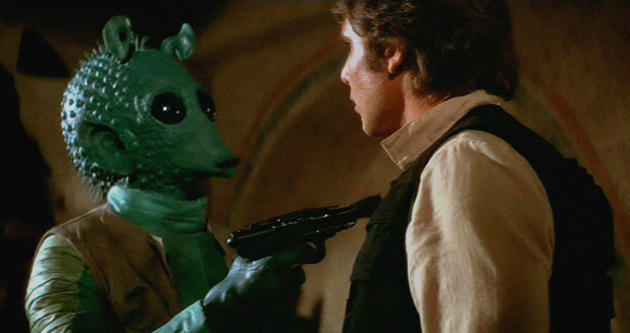 |
| If Han Solo shoots first, is he Dirty Harry? |
The idea of “May the Force be With You,” not unlike the exclamation “Go with God,” is inherently about belief; about believing in yourself and your capacity to tap the spiritual center of existence itself. Yet no one would possibly believe in Lucas's world or in that inspirational message if the special effects in Star Wars were unconvincing, if the aliens looked hokey, or if the space battles were confusing.
I believe that by referencing these older films and older visuals, Lucas was making certain that we could relate to Star Wars. It’s a unique and intriguing technique, and I submit it actually works very well. The later films in the franchise depend on vast, special effects set-pieces with digital backdrops and drooling creatures, and yet the greatest emotional thrill I felt during the saga occurred here, in the original Star Wars, as Luke and Leia swung boldly across a chasm together, and John Williams’ scored blared heroically underneath their leap.
A boy, a girl and a universe. The thrill and appeal of Star Wars are almost literally that simple. Despite making a high-tech film filled with laser blasts, spaceships, robots, and a complex internal history Lucas directs us through this complexity and gets right to the mythic, spiritual heart of his film.
As of today -- how many years after I first saw the film?? -- that pure-hearted (but intellectually-conceived) approach still works for me.


