


Subscribe To JKM

 Posts
All Comments
Posts
All Comments
Wednesday, July 04, 2012
Cloned from a Mutual Zygote: V vs. ID4 Mothership Edition

 award-winning creator of the web series Abnormal Fixation (2024), the audio drama Enter the House Between (2023) and author of 35 books including Horror Films FAQ (2013), Horror Films of the 1990s (2011), Horror Films of the 1980s (2007), TV Year (2007), The Rock and Roll Film Encyclopedia (2007), Mercy in Her Eyes: The Films of Mira Nair (2006),, Best in Show: The Films of Christopher Guest and Company (2004), The Unseen Force: The Films of Sam Raimi (2004), An Askew View: The Films of Kevin Smith (2002), The Encyclopedia of Superheroes on Film & Television (2004), Exploring Space:1999 (1997), An Analytical Guide to TV's Battlestar Galactica (1998), Terror Television (2001), Space:1999 - The Forsaken (2003) and Horror Films of the 1970s (2002).
Tuesday, July 03, 2012
Ask JKM a Question #6: Black Swan (2010)?

A regular reader named Todd asks me:
"Have you seen the movie Black Swan? If so, I would love to hear your thoughts on it. I thought it was a great psychological thriller with deep meaning and symbolism. I love reading your insight into various films. You pick up on stuff that I would never think of. It amazes me every time. Thanks for writing this great blog."
Thank you for your affirmative remarks about the blog, Todd, and about my writing. I have indeed seen Black Swan (2010), and I too find it a deeply disturbing yet weirdly beautiful work of art. That established, I also consider it a (brilliant) horror film.
Accordingly, I'll be reviewing Black Swan one week from today, on Tuesday, July 10th. So tune in that morning for my analysis and interpretation of this Darren Aronofsky film. Thanks for writing!
Don't forget readers, ask me a question at Muirbusiness@yahoo.com.
award-winning creator of the web series Abnormal Fixation (2024), the audio drama Enter the House Between (2023) and author of 35 books including Horror Films FAQ (2013), Horror Films of the 1990s (2011), Horror Films of the 1980s (2007), TV Year (2007), The Rock and Roll Film Encyclopedia (2007), Mercy in Her Eyes: The Films of Mira Nair (2006),, Best in Show: The Films of Christopher Guest and Company (2004), The Unseen Force: The Films of Sam Raimi (2004), An Askew View: The Films of Kevin Smith (2002), The Encyclopedia of Superheroes on Film & Television (2004), Exploring Space:1999 (1997), An Analytical Guide to TV's Battlestar Galactica (1998), Terror Television (2001), Space:1999 - The Forsaken (2003) and Horror Films of the 1970s (2002).
The Horror Lexicon #18: The Tour of the Dead

While dissecting what
he called “Dead Teenager Movies,” critic Roger Ebert once came up with a pretty
funny joke. I’m paraphrasing a little,
because I don’t remember the words exactly.
But the joke went something like this: “How do you know when a Dead
Teenage Movie is over?”
“The same dead teenager turns up twice.”
Turns out, this was a
pretty apt observation. Though I don’t
share Ebert’s disdain for the Slasher movie format, it’s undeniable that “The
Tour of the Dead,” as I term it, has become a de rigueur component of the sub-genre.
In the so-called Tour
of the Dead – universally set during the
final act -- the resilient Final Girl flees from a terrifying mad-dog killer
(usually masked), but the bloodied and savaged corpses of her friends and
associates begin popping up in her path...sometimes quite violently. The sudden re-appearance of these murdered characters provides both authentic
jolt scares for the audience, as well as horrifying obstacles to the character’s successful escape
trajectory.

Here, poor Laurie
Strode (Jamie Lee Curtis) visits the house across the street in suburban
Haddonfield, and sees the body of her friend Annie (Nancy Loomis) posed on a
bed…underneath a tombstone. As Laurie
recoils in horror from this macabre sight, other corpses pop out to terrify her, thus
providing more than Laurie’s Halloween quotient of “one good scare.” Laurie grows so terrified that she absently seeks retreat
(walking backwards, a big horror movie no-no…) at the doorway of a dark room…where the
white-masked Shape emerges from impenetrable blackness.
The Friday
the 13th movies adopted the “Tour of the Dead” convention,
starting in the first, 1980-era film. There Alice (Adrienne King) runs from nutty Mrs. Voorhees (Betsy Palmer), and navigates a veritable battlefield of
dead bodies. Steve’s corpse comes down
swinging from a Camp Crystal Lake sign, for instance.
Another corpse gets tossed through a window at Alice. Yet another ends up hanged on a cabin door.
 For the sequels, it was a case of rinse-and-repeat as imperiled Final Girls ran similar corpse gauntlets. The Tour of the Dead convention is entertaining in these franchise films, but entirely devoid of the "trick or treat" context of Halloween it doesn't make a whole lot of logical sense. Mrs. Voorhees (and later Jason) not only move from place to place killing camp counselors, but apparently pose the bodies, and calculate -- with precision accuracy -- what path the prey (like Alice) will ultimately take. What makes the conceit interesting (and a little funny...) in the original Friday the 13th is the way that director Sean Cunningham uses signage like "Danger," or "Keep Out" to subtly punctuate the gruesome exhibits on the Tour of the Dead.

 In some fashion, the Tour
of the Dead is is not just a final challenge to navigate and a visual signifier that the Final Girl
is really and truly alone and therefore without help, but a bloody reminder (to the character and to the audience)
that she was right about sensing danger. Where the other characters
blissfully ignored warning signs of impending massacre, the Final Girl heeded them. I’m aware that some critics may term the Final Girl’s
equation as being something akin to “Survival of the Chaste-st,” but I propose something more along the lines of “Survival of the Smartest.”
Final Girls – at least the good ones – boast insights, feelings and behaviors that their more impulsive friends
lack. And by undergoing the Tour of the Dead, the Final Girl gets confirmation of
her greatest character traits. She was right..and is still alive. Her friends were wrong and are now...ornaments.
In some fashion, the Tour
of the Dead is is not just a final challenge to navigate and a visual signifier that the Final Girl
is really and truly alone and therefore without help, but a bloody reminder (to the character and to the audience)
that she was right about sensing danger. Where the other characters
blissfully ignored warning signs of impending massacre, the Final Girl heeded them. I’m aware that some critics may term the Final Girl’s
equation as being something akin to “Survival of the Chaste-st,” but I propose something more along the lines of “Survival of the Smartest.”
Final Girls – at least the good ones – boast insights, feelings and behaviors that their more impulsive friends
lack. And by undergoing the Tour of the Dead, the Final Girl gets confirmation of
her greatest character traits. She was right..and is still alive. Her friends were wrong and are now...ornaments.
In some Slasher movies,
the Tour of the Dead is more ritualized than in others. In films such as Happy Birthday to Me (1981) for
instance, victims' bodies are propped up at a table (with a birthday cake…) and
posed as if at an actual birthday party. In Tobe Hooper's brilliant The Funhouse (1981), the bloody corpses become part of the amusement park environs, therefor blending entertaining, funhouse-style horror with the real thing.
As is the case with other elements of the horror lexicon, "The Tour of the Dead" reveals how the best horror directors deploy familiar conventions to good and inventive effect, while others just ape and imitate for the heck of it, for the sake of doing something that's expected, rather than what best tells the story.
As is the case with other elements of the horror lexicon, "The Tour of the Dead" reveals how the best horror directors deploy familiar conventions to good and inventive effect, while others just ape and imitate for the heck of it, for the sake of doing something that's expected, rather than what best tells the story.
award-winning creator of the web series Abnormal Fixation (2024), the audio drama Enter the House Between (2023) and author of 35 books including Horror Films FAQ (2013), Horror Films of the 1990s (2011), Horror Films of the 1980s (2007), TV Year (2007), The Rock and Roll Film Encyclopedia (2007), Mercy in Her Eyes: The Films of Mira Nair (2006),, Best in Show: The Films of Christopher Guest and Company (2004), The Unseen Force: The Films of Sam Raimi (2004), An Askew View: The Films of Kevin Smith (2002), The Encyclopedia of Superheroes on Film & Television (2004), Exploring Space:1999 (1997), An Analytical Guide to TV's Battlestar Galactica (1998), Terror Television (2001), Space:1999 - The Forsaken (2003) and Horror Films of the 1970s (2002).
Cult-TV Flashback: The Sixth Sense (1972)

“You enter a
strange room for the first time, yet you know you’ve been there before. You dream about an event that happens some
days later…A coincidence? Maybe. But
more than likely, it is extrasensory perception, a sixth sense that many
scientists believe we all possess, but rarely use.”
- From The Sixth Sense Press Kit, published in Senior Scholastic: “The Sixth Sense,” September 18, 1972, page 22).
-

After
originally airing for two seasons on ABC in the early 1970s, this hour-long
series was brutally cut-down to a half-hour length so as to be syndicated along
with the episode catalogue of Rod Serling’s Night Gallery. Mr. Serling even filmed new introductions in the
famous black gallery for the re-crafted The Sixth Sense episodes.
But
The
Sixth Sense’s “Night Gallery” stories, if you ever saw them, were
always nonsensical, in part because they were trimmed down literally fifty-percent from their original running
time. It was this abbreviated, hacked-up
The
Sixth Sense that aired on The Sci Fi Channel in the 1990s, for
instance. In 2007, Chiller ran episodes of The Sixth Sense, but I'm not certain if it was the chopped-up version, or the original.
Butchered
in syndicated format, The Sixth Sense episodes are almost unwatchable. Characters appear without introduction or
preamble, and allude to events that are no longer depicted. Characters are alive in one scene and dead the
next, with no explanation for how, why or when, their demise occurred. The
series in this corrupted format is baffling and incoherent, to put it mildly.

I
don’t mean to suggest The Sixth Sense is some kind of
unexcavated genre masterpiece, only that it hasn’t been granted a hearing by
genre fans in an uncorrupted form for literally forty years. No series deserves such a fate, frankly.
Imagine
how well Star Trek would play cut down to a half-hour, or Kolchak,
or Mission: Impossible.
Writer
Anthony Lawrence originally created The Sixth Sense after the success of
a 1971 TV movie titled Sweet, Sweet Rachel, which involved
a parapsychology expert, Lucas Darrow (Alex Dreier) protecting two women from
psychic assassins. When the television
movie proved successful in terms of ratings, ABC wanted a quick follow-up. Lawrence and developer Stan Shpetner thus crafted
The
Sixth Sense, a series which would follow the adventures of another
parapsychology expert, Dr. Michael Rhodes (Gary Collins).

This
damsel-in-distress role was played, in various installments, by beloved genre
actresses such as Mariette Hartley (“Eye of the Haunted”), Pamela Franklin (“I
Did Not Mean to Slay Thee”), Stefanie Powers (“Echo of a Distant Scream”),
Tiffany Bolling (“Witch, Witch, Burning Bright), Lucie Arnaz (“With This Ring I
thee Kill), Mary Ann Mobley (“Shadow in the Well), Carol Lynley (“The House
that Cried Murder) and Anne Archer (“Can a Dead Man Strike from Beyond the
Grave?”)

“He didn’t like children. He didn’t like women. He didn’t like men…He didn’t like stories
about sick people, or emotionally ill people.
He didn’t like stories about poor people. He didn’t like stories about ethnic
people. Essentially it came down to us
doing stories about rich white people who didn’t have any problems. And that was a problem for me.”
Fontana’s
tenure on the show was, perhaps not surprisingly, short-lived: “I left
one day, and Harlan Ellison left either the day before me or the day after
me. It all happened in fast succession,
I can tell you that much…It’s too bad, because the potential for stories about
extra sensory perception and abilities was great.”
The
abundant flaws of The Sixth Sense are apparent today, even with restored episodes
to view. For one thing, Dr. Rhodes always helped beautiful, young (25 – 35)
white women, but never actively romanced any of them. He just seemed to inhabit a white, upper-class
world of beautiful, psychically gifted females.
And
secondly, as a character Rhodes was not permitted to grow or show much by way
of passionate emotion. Collins’
performance on the series is actually kind of brilliant in a weird way,
simultaneously minimalist and intense.
But
the writing never ascribes much by way of humor or personal life to the man. As a lead character, Rhodes is certainly
dedicated and helpful -- and physically
capable – but we know precisely nothing about him save for his unwavering
support for ESP and parapsychology studies. It would have been great if the
series had more fully explored his background, including his childhood and the
development of his abilities as a “sensitive.”

Of
more legitimate interest is the series’ second strength: jarring and disturbing visuals and special effects. Some of the imagery in the series remains
downright haunting. In “The Heart that
Wouldn’t Stay Buried” a man is attacked by the statue of a bird, and it’s a
trippy moment. In “Witness Within,”
jump-cuts, slow-motion photography and a nice eerie blend of light and shadow
make a nocturnal attack almost pulse-pounding.
Likewise, in “Lady, Lady, Take My Life,” an insufferable bureaucrat is
murdered by a psychic “cathexis, and the
he screen goes blood red (with terror) as the poor man suffers twin
aneurysms.
In
one of my favorite episodes, the bizarre “Once Upon a Chilling” a man’s spirit
is projected outside of his cryogenic chamber and his spectral face is coated
in dripping, cracked ice…an image which terrifies rather than informs. In moments such as these you can sense a real
imagination in the visual presentation of the stories. If the stories were all up to snuff, and not
so predictable in terms of character, The Sixth Sense would have been a
contender.
 Some
of the more intriguing episodes in the series include the one starring Shatner
and Anne Archer (“Can a Dead Man Strike from Beyond the Grave”), written by
Gene Coon. And “With this Ring I Thee
Kill,” starring Lee Majors and Lucie Arnaz proves a weird call back to Faustian
legends and stories. The episode featuring Joan Crawford (and directed by John Newland) is also a humdinger, since it pits the Hollywood legend against Mansonite cult member crazies.
Some
of the more intriguing episodes in the series include the one starring Shatner
and Anne Archer (“Can a Dead Man Strike from Beyond the Grave”), written by
Gene Coon. And “With this Ring I Thee
Kill,” starring Lee Majors and Lucie Arnaz proves a weird call back to Faustian
legends and stories. The episode featuring Joan Crawford (and directed by John Newland) is also a humdinger, since it pits the Hollywood legend against Mansonite cult member crazies.
In
spite of flaws, The Sixth Sense must be viewed as something of a pioneer in terms
of horror television programming. It is
the first horror-oriented series, for instance, to feature continuing
characters rather than an anthology format.
It pre-dates Kolchak: The Night Stalker (1974) by two years, in this
regard. Considering that place of
importance in the horror genre, the series certainly merits a better fate than
to be cut to ribbons and offered only in a corrupt format.
Although
only a handful of season one episodes of The Sixth Sense are currently
available on Amazon streaming, my hope is that this will soon change. Failures and all, The Sixth Sense deserves
a full DVD release with all twenty-five episodes restored to original
formatting.
award-winning creator of the web series Abnormal Fixation (2024), the audio drama Enter the House Between (2023) and author of 35 books including Horror Films FAQ (2013), Horror Films of the 1990s (2011), Horror Films of the 1980s (2007), TV Year (2007), The Rock and Roll Film Encyclopedia (2007), Mercy in Her Eyes: The Films of Mira Nair (2006),, Best in Show: The Films of Christopher Guest and Company (2004), The Unseen Force: The Films of Sam Raimi (2004), An Askew View: The Films of Kevin Smith (2002), The Encyclopedia of Superheroes on Film & Television (2004), Exploring Space:1999 (1997), An Analytical Guide to TV's Battlestar Galactica (1998), Terror Television (2001), Space:1999 - The Forsaken (2003) and Horror Films of the 1970s (2002).
Theme Song of the Week: The Sixth Sense (1972)
award-winning creator of the web series Abnormal Fixation (2024), the audio drama Enter the House Between (2023) and author of 35 books including Horror Films FAQ (2013), Horror Films of the 1990s (2011), Horror Films of the 1980s (2007), TV Year (2007), The Rock and Roll Film Encyclopedia (2007), Mercy in Her Eyes: The Films of Mira Nair (2006),, Best in Show: The Films of Christopher Guest and Company (2004), The Unseen Force: The Films of Sam Raimi (2004), An Askew View: The Films of Kevin Smith (2002), The Encyclopedia of Superheroes on Film & Television (2004), Exploring Space:1999 (1997), An Analytical Guide to TV's Battlestar Galactica (1998), Terror Television (2001), Space:1999 - The Forsaken (2003) and Horror Films of the 1970s (2002).
Monday, July 02, 2012
Ask JKM a Question #5: Where Do You Get Obscure Titles?
 A reader, Hugh Davis, instructor of English, writes:
I am a fan of your writing and enjoy your blog. I will likely send you a variety of questions along the way, but I thought I would ask something more pragmatic first. What is your main source for seeing/collecting/(and especially) finding old shows and movies, particularly those which have never been released commercially? E-Bay used to be an occasional option, but they’ve really blocked selling non-commercial recordings, and iOffer can be hit or miss. What suggestions do you have?"
Hugh, that's a terrific question. I'll answer it as best I can.
Back in the 1990s, when I wrote Terror Television and Horror Films of the 1970s, I interacted with some great tape traders who encouraged historical scholarship by offering up obscure, never-commercially released TV programs, mostly.
At the same time (the 1990s) I created a vast library of video recordings -- taped off the air -- of cult-tv programming. I wish I had done even more of this, given the obscurity of some series today. Some of these programs were complete when I taped them, and some were Sci-Fi Channel re-airings, therefore all cut to hell. But my reasoning was that getting to see some of these shows -- even butchered -- was better than never seeing them at all.
You ask about my main source. For right now, my main source is likely the flea markets, yard sales and conventions that I frequent. You never know what people taped off the air, and what they are selling. The first two venues are obviously pretty hit or miss, though I've been gratified to find some crazy titles there. The third venue -- genre conventions -- is probably the most reliable.
For out-of-print titles, no venue is better, perhaps, than Movies Unlimited, which features a huge catalog of such titles. The prices are sometimes high, but this is a dependable company with excellent customer service, and a great selection. Honestly, it's fun to spend hours going through their catalog. And no, they aren't paying me for an endorsement. When I needed to see Let's Scare Jessica To Death again, back in the 1990s, for instance, when I wrote Horror Films of the 1970s, Movies Unlimited is where I turned. But again, this venue is for out-of-print titles rather than never-released ones.
I hope that helps! Happy hunting, and feel free to ask any further questions you like. If readers would like to add anything to my answer, please help out in the comments sections. I know a lot of you are collectors...for historical scholarship, too.
Don't forget, you can ask me a question by e-mailing me at Muirbusiness@yahoo.com, and putting "Ask JKM a Question" in the subject line. And let me know if I can use your name and your full e-mail.
award-winning creator of the web series Abnormal Fixation (2024), the audio drama Enter the House Between (2023) and author of 35 books including Horror Films FAQ (2013), Horror Films of the 1990s (2011), Horror Films of the 1980s (2007), TV Year (2007), The Rock and Roll Film Encyclopedia (2007), Mercy in Her Eyes: The Films of Mira Nair (2006),, Best in Show: The Films of Christopher Guest and Company (2004), The Unseen Force: The Films of Sam Raimi (2004), An Askew View: The Films of Kevin Smith (2002), The Encyclopedia of Superheroes on Film & Television (2004), Exploring Space:1999 (1997), An Analytical Guide to TV's Battlestar Galactica (1998), Terror Television (2001), Space:1999 - The Forsaken (2003) and Horror Films of the 1970s (2002).
Cult-TV Theme Watch: Ambassadors

Because of the ambassador’s function as a go-between
between two divergent or even opposite interests, this functionary has often
appeared in cult-television programming as a person of duplicitous or suspicious
motives. Much like the defector
character trope, which I featured a few weeks back, the ambassador is
someone who can appear to be one thing, but may actually be something else.
With ambassadors, hidden agendas abound.
In TV series of political intrigue and
competition -- such as the original Bruce Geller Cold War era program, Mission:
Impossible (1966 – 1973) -- the ambassador may be an important figure
who requires rescuing. This is the
premise of the first season installment, “Shock,” which features James Daly as a
captured ambassador secretly replaced by an enemy imposter of an Eastern Bloc
nation.
Revealing the political nature, perhaps, of space
adventuring, ambassadors have often been featured in prominent roles in
episodes of virtually every Star Trek incarnation.

Throughout Star Trek’s many incarnations, we’ve
met many other ambassadors, including Nancy Hedford (Elinor Donohue), Spock
himself (“Unification), Soval (Gary Graham), and even Captain Picard (Patrick
Stewart) in one “fantasy” scenario, “Future Imperfect.”
In virtually all these scenarios, the ambassador
is seen as a difficult sort; one whose need for successful diplomacy tends to
endanger missions, crew members or otherwise lead to danger.
Often in science fiction television, it is the
job, explicitly, of the Ambassador to act as peacekeeper, to prevent a war
during a cosmic or interstellar incident.
Sometimes these ambassadors are malevolent themselves, as was the case
in Buck
Rogers in the 25th Century’s “Planet of the Amazon Women.” Mark
Lenard, meanwhile played a different kind of alien ambassador, Duvoe, in the Buck
Rogers second season episode, “Journey to Oasis.” His
species could, oddly, separate into two parts: head and trunk. It’s a skill that his people have successfully
kept hidden. But as war looms with
Earth, Duvoe and his people must finally reveal more of their true nature.
 JMS’s Babylon 5 (1994 – 1999) featured a
number of colorful ambassadors among its regular cast of characters. These included the Minbari Ambassador, Delenn
(Mira Furlan), Londo Mollari (Peter Jurasik) of the Centauri Republic, G’Kar of
the Narn (Andreas Katsulas) and the fearsome-looking Vorlon Ambassador. As you might suspect, the sheer number of
ambassadors stationed on the space station Babylon 5 resulted in frequent
intrigue, espionage, and bickering.
award-winning creator of the web series Abnormal Fixation (2024), the audio drama Enter the House Between (2023) and author of 35 books including Horror Films FAQ (2013), Horror Films of the 1990s (2011), Horror Films of the 1980s (2007), TV Year (2007), The Rock and Roll Film Encyclopedia (2007), Mercy in Her Eyes: The Films of Mira Nair (2006),, Best in Show: The Films of Christopher Guest and Company (2004), The Unseen Force: The Films of Sam Raimi (2004), An Askew View: The Films of Kevin Smith (2002), The Encyclopedia of Superheroes on Film & Television (2004), Exploring Space:1999 (1997), An Analytical Guide to TV's Battlestar Galactica (1998), Terror Television (2001), Space:1999 - The Forsaken (2003) and Horror Films of the 1970s (2002).
JMS’s Babylon 5 (1994 – 1999) featured a
number of colorful ambassadors among its regular cast of characters. These included the Minbari Ambassador, Delenn
(Mira Furlan), Londo Mollari (Peter Jurasik) of the Centauri Republic, G’Kar of
the Narn (Andreas Katsulas) and the fearsome-looking Vorlon Ambassador. As you might suspect, the sheer number of
ambassadors stationed on the space station Babylon 5 resulted in frequent
intrigue, espionage, and bickering.
award-winning creator of the web series Abnormal Fixation (2024), the audio drama Enter the House Between (2023) and author of 35 books including Horror Films FAQ (2013), Horror Films of the 1990s (2011), Horror Films of the 1980s (2007), TV Year (2007), The Rock and Roll Film Encyclopedia (2007), Mercy in Her Eyes: The Films of Mira Nair (2006),, Best in Show: The Films of Christopher Guest and Company (2004), The Unseen Force: The Films of Sam Raimi (2004), An Askew View: The Films of Kevin Smith (2002), The Encyclopedia of Superheroes on Film & Television (2004), Exploring Space:1999 (1997), An Analytical Guide to TV's Battlestar Galactica (1998), Terror Television (2001), Space:1999 - The Forsaken (2003) and Horror Films of the 1970s (2002).
Come See Me at Fantasci this Saturday

I'll be speaking at the Fantasci Tenth
Anniversary Convention in Chesapeake, Virginia, this Saturday morning, and I
hope to see some readers there.
I go on at 10:30 am to give a talk I call
"The Horror Genome Project," about the horror films of the 1990s.
The premise is basically that genetic science is to horror films of the
nineties (like Mimic, Deep Blue Sea, Jurassic Park, X-Files: Fight the Future,
etc.) what the atomic bomb was to horror films of the fifties: a galvanizing
theme and a reflection of fears about science (and scientists) run amok.
Check out the link to the party, here, and if you
happen to be close-by, come and see me and watch the presentation! I plan to attend the con from 9:00 to noon, or thereabouts and would love to say hello.
I’m really looking forward to being back at
Fantasci. It was at this show, five
years ago, where I premiered my web series, The House Between (2007 –
2009), which I hope to have fully available – all 21 episodes, newly re-edited –
on DVD and streaming soon.
And remember, if you work at a University or for a convention that would like to have me speak (or deliver one of my seminars, like "Savage Cinema,") contact me at Muirbusiness@yahoo.com and we'll see what we can work out.
award-winning creator of the web series Abnormal Fixation (2024), the audio drama Enter the House Between (2023) and author of 35 books including Horror Films FAQ (2013), Horror Films of the 1990s (2011), Horror Films of the 1980s (2007), TV Year (2007), The Rock and Roll Film Encyclopedia (2007), Mercy in Her Eyes: The Films of Mira Nair (2006),, Best in Show: The Films of Christopher Guest and Company (2004), The Unseen Force: The Films of Sam Raimi (2004), An Askew View: The Films of Kevin Smith (2002), The Encyclopedia of Superheroes on Film & Television (2004), Exploring Space:1999 (1997), An Analytical Guide to TV's Battlestar Galactica (1998), Terror Television (2001), Space:1999 - The Forsaken (2003) and Horror Films of the 1970s (2002).
The Cult-TV Faces of: Ambassadors
 |
| Identified by Brian: Mission: Impossible: James Daly as Ambassador Wilson in "Shock." |
 |
| Identified by Brian: Ambassador Fox (Gene Lyons) on Star Trek: "A Taste of Armageddon." |
 |
| Identified by Brian: Ambassador Nancy Hedford (Elinor Donohue) on Star Trek: "Metamorphosis." |
 |
| Identified by Brian: Ambassador Sarek (Mark Lenard) on Star Trek: "Journey to Babel." |
 |
| Identified by Brian: Jonathan Harris in Get Smart: "How Green was My Valet." |
 |
| Identified by PDS: Ambassador Andros (Tim O'Connor) in Wonder Woman: "Judgment from Outer Space." |
 |
| Identified by Brian: Ruathan Ambassador, Buck Rogers: "Planet of the Amazon Women." |
 |
| Identified by Brian: Ambassador Duvoe (Mark Lenard) in Buck Rogers: "Journey to Oasis." |
 |
| Identified by Brian: Alien Ambassador (John Glover) in The Twilight Zone: "A Small Talent for War." |
 |
| Identified by Brian: Ambassador T'Pel (Sierra Pecheur) on ST: TNG: "Data's Day." |
 |
| Identified by Brian: Ambassador Spock (Leonard Nimoy): ST: TNG: "Unification." |
 |
| Identified by Brian: Ambassador Picard (Patrick Stewart): ST:TNG: "Future Imperfect." |
 |
| Identified by Brian: Selay Amassador, ST:TNG: "Lonely Among Us." |
 |
| Identified by Brian: Ambassador Londo Mollari (Peter Jurasik) on Babylon 5. |
 |
| Identified by Brian: Ambassador Delenn (Mira Furlan) on Babylon 5. |
 |
| Identified by Brian: Ambassador G'Kar (Andreas Katsulas) on Babylon 5. |
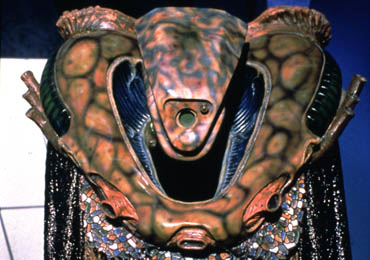 |
| Identified by Brian: Ambassador Kosh (Ardwright Chamberlain) on Babylon 5. |
 |
| Identified by Brian: Ambassador Soval (Gary Graham) on Star Trek: Enterprise. |
 |
| Identified by Brian: Ambassador Ovirda (Victor Garber) on SGU: "Seizure." |
award-winning creator of the web series Abnormal Fixation (2024), the audio drama Enter the House Between (2023) and author of 35 books including Horror Films FAQ (2013), Horror Films of the 1990s (2011), Horror Films of the 1980s (2007), TV Year (2007), The Rock and Roll Film Encyclopedia (2007), Mercy in Her Eyes: The Films of Mira Nair (2006),, Best in Show: The Films of Christopher Guest and Company (2004), The Unseen Force: The Films of Sam Raimi (2004), An Askew View: The Films of Kevin Smith (2002), The Encyclopedia of Superheroes on Film & Television (2004), Exploring Space:1999 (1997), An Analytical Guide to TV's Battlestar Galactica (1998), Terror Television (2001), Space:1999 - The Forsaken (2003) and Horror Films of the 1970s (2002).
Television and Cinema Verities # 26

“It
was shot late at night, and we had an eighty man crew shooting on this
hill. On the other side of the same
hill, Frank Sinatra and Peter Lawford were filming some war movie. Anyway, we were going along fine when Frank
Sinatra sent a messenger over to our side of the hill to tell us to keep it
down. Well, I gave the guy a message of
my own: I said he should tell Sinatra to ‘go fuck himself.’ The messenger returned to his side of the
hill, we resumed shooting on our side, and everybody thought everything was
fine. Then, suddenly, it got really
quiet on our side of the hill. I was
behind the camera so I didn’t know what was going on, but when I turned around,
Frank Sinatra was right there, standing just a few feet from me. ‘Johnny,’
Sinatra said deadpan, ‘I got your message.’
There was silence for a second, then everybody laughed…and it was over.”
- - One
Step Beyond
director, John Newland, describes his encounter with Frank Sinatra while
filming the episode “If You See Sally.”
From my book, An Analytical Guide to TV’s One Step Beyond (2001),
pages 165-166.
award-winning creator of the web series Abnormal Fixation (2024), the audio drama Enter the House Between (2023) and author of 35 books including Horror Films FAQ (2013), Horror Films of the 1990s (2011), Horror Films of the 1980s (2007), TV Year (2007), The Rock and Roll Film Encyclopedia (2007), Mercy in Her Eyes: The Films of Mira Nair (2006),, Best in Show: The Films of Christopher Guest and Company (2004), The Unseen Force: The Films of Sam Raimi (2004), An Askew View: The Films of Kevin Smith (2002), The Encyclopedia of Superheroes on Film & Television (2004), Exploring Space:1999 (1997), An Analytical Guide to TV's Battlestar Galactica (1998), Terror Television (2001), Space:1999 - The Forsaken (2003) and Horror Films of the 1970s (2002).
Sunday, July 01, 2012
Cult TV Blogging: Ghost Story/Circle of Fear: "Bad Connection" (October 6, 1972)

This week on the horror anthology
Ghost
Story/Circle of Fear, our host Winston Essex (Sebastian Cabot) muses
about the wonders of…the telephone.
Not the cell phone mind you, the
land-line.

Only there, the subject was the
hidden dangers of the television, not the phone. What if it had a mind of its own and could make you watch what it
wanted you to watch?
Here, Winston worries about what
would happen if the telephone could, literally, reach out and touch someone.
The story on that very subject, “Bad
Connection” fits into a weird horror TV subgenre in which the telephone is a diabolical
vehicle for terror. In the original Twilight
Zone, the telephone brought terror in both “Long Distance Call” and “Night
Call.” In the 1980s, well after this
episode of Ghost Story, an evil telephone terrorized Jean Marsh in “Answer
Me,” a first season installment of Tales from the Darkside.

Barbara grows increasingly – and dynamically -- hysterical as the
phone calls continue and escalate in terror.
Soon, she begins to see a shadowy form stalking her every move. Is
it her dead husband? Or did she misinterpret
his telephone message? Is someone else
trying to drive her mad? If so, why?
In exploring the answer to such
questions, “Bad Connection” directed by Walter Doninger proves immensely
entertaining. The episode stumbles over the boundary of camp at times, thanks in
large part to Karen Black’s dedicated if dramatically overwrought
performance. Much of the hour involves
Black screaming madly at the phone, or tripping suddenly and inexplicably into
a catatonic trance state. The star of
such 1970s classics as Trilogy of Terror (1975), Black never
fails to invest her genre roles with gusto.
This hour is no exception, and “Bad Connection” is fun because Black
anchors it, and isn’t afraid to go full-bore bonkers when the scene requires a mental
breakdown. She really commits -- physically and mentally -- to this role.

Some horror movies and TV
programs slip into this wonderful surreal, nightmare territory, and it’s a
valid choice. They make no real
conventional sense, and yet we recognize the nature of the terror in an emotional sense because we’ve all
experienced dreams wherein we’re being chased, or where strange, inexplicable
things occur. “Bad Connection” features
the weird dream-sense of a nightmare, and I can laud it on that level. Others might disagree with me, and note that
the writing here is silly or bad. I
suppose your mileage may vary, depending on how long a leash you’re willing to
give Ghost
Story.

I certainly wouldn’t rank “Bad
Connection” was among the best Ghost Story episodes produced. That honor goes to “The Dead We Leave Behind,”
the absolutely bizarre “House of Evil” (featuring Jodie Foster, a doll house,
and raisin-eyed cookie voodoo dolls…) and the brilliantly malevolent “Alter-Ego.” But “Bad Connection” is far better than the
real stinkers.
And, unfortunately, next week
brings us to just such another stinker: the interminable “The Summer House”
starring Carolyn Jones.
award-winning creator of the web series Abnormal Fixation (2024), the audio drama Enter the House Between (2023) and author of 35 books including Horror Films FAQ (2013), Horror Films of the 1990s (2011), Horror Films of the 1980s (2007), TV Year (2007), The Rock and Roll Film Encyclopedia (2007), Mercy in Her Eyes: The Films of Mira Nair (2006),, Best in Show: The Films of Christopher Guest and Company (2004), The Unseen Force: The Films of Sam Raimi (2004), An Askew View: The Films of Kevin Smith (2002), The Encyclopedia of Superheroes on Film & Television (2004), Exploring Space:1999 (1997), An Analytical Guide to TV's Battlestar Galactica (1998), Terror Television (2001), Space:1999 - The Forsaken (2003) and Horror Films of the 1970s (2002).
Subscribe to:
Posts (Atom)

-
 It is an indisputable fact that fan service and good drama don’t always go hand-in-hand in the cinema. In fact, sometimes these factors div...
 -
 It is quite difficult to believe, but in 2024, Ridley Scott’s Alien (1979) turns 45 years old. Perhaps the most amazing thing about Alie...