Tuesday, December 06, 2005

TUESDAY CATNAP # 21: Happy Holidays!


Christmas Garland in my house? Well, not today! For the last seven years (since we moved into our historic home, built 1912...), my wife, Kathryn, has decorated the staircase and ledge with garland. It's a long-standing tradition.

But not this year. Because Lila (pictured) just can't handle the garland this year. The moment it was up, she began obsessively chewing on it. We tried to distract her, to no avail. It was like Kitty crack to her. So I snapped a few photos, and then Kathryn took it down.

So garland? There's no Christmas garland this year in my house! (And there's one cranky cat complaining about it...)

Saturday, December 03, 2005

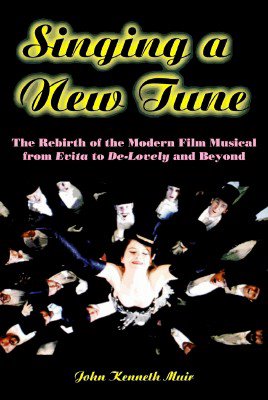
Midwest Book Review likes Singing a New Tune!

The good folks at Applause Theatre and Cinema Books sent me this review of my new book, Singing a New Tune: the Re-Birth of the Modern Film Musical from MBR Bookwatch:

College-level students of the film musical will want to make SINGING A NEW TUNE: THE REBIRTH OF THE MODERN FILM MUSICAL FROM EVITA TO DE-LOVELY AND BEYOND essential to understanding the new film musical. Critics around the world have claimed the movie musical is a dead art form - but though it no longer commands the center of media attention, it's by no means dead as film expert John Kenneth Muir presents in his story of the film musical from the early 1990s to modern times.

Over a dozen musicals from the last decade are analyzed to explain how artists have interpreted and imbibed such musicals with new life, using psychology, sexuality and more to revive the art from. Interviews with notable directors and screenwriters round out the analysis, providing a thorough, critical review of the state of the modern film musical...

SATURDAY MORNING CULT TV BLOGGING: Space Academy: "Planet of Fire"

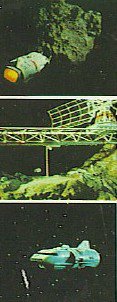
This week, on the cult kid-vid show from the 1970s, Space Academy, Tee-Gar Soom (Brian Tochi) experiments with a "cryotron," a device that will ultimately be able to "cool down hot planets." But Tee Gar is also due for a vacation, so he leaves the Academy and doesn't learn that his experimental cryotron device (which looks like a ray gun with a back pack... has a fatal flaw: the frozen objects become unstable and explode.

With Loki and Peepo, the oblivious Tee Gar heads to the asteroid of Daleus to do further tests on the cryotron, only to see the potential weapon stolen by a strange, solitary giant named Draymen. Draymen abducts freezes Peepo with the Cryotron, and then needs Tee Gar's help to restore the robot to normal. The only thing that can save the diminutive droid is -- wait for it -- moist heat. "Moist heat?" worries Laura, who catches up with Tee-Gar and Loki, alongside Chris, "where do we find that?" Fortunately, a hot spring on the planet surface gets the job done.

At the end of the day, Peepo is saved in the nick of time, and Draymen returns to the Academy as a new friend. Tee-Gar promises to continue work on his freezing device.

"All great men have suffered disappointment," advises Commander Gampu (Jonathan Harris), "from Galileo to the Wright Brothers..."

And that's the sermon for the day. There's also a lesson about friendship here. Draymen is confused that Peepo's buddies risked their lives to rescue him. "Maybe the way you act, you don't deserve them [friends]," Peepo suggests, and so Draymen reforms his nasty ways.

As usual Loki has the best line in the episode. "Robots have all the fun..." he complains. To which my wife replied, "that's true...because they don't have to watch episodes of Space Academy..."

Friday, December 02, 2005

The Weinstein Company to re-make 1980s TV series The Equalizer

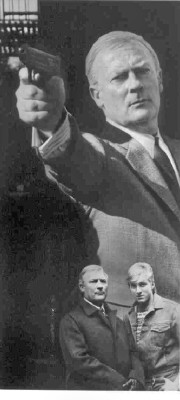
Don't know if you've seen this already, but ComingSoon.net is reporting that a remake of the popular CBS mid-1980s series The Equalizer (which starred Edward Woodward) is now in the works.

Here's the link and a brief excerpt:

The Weinstein Company has acquired the rights to develop and produce a feature film based on the original hit television series The Equalizer in which Robert McCall, a veteran covert operative seeking redemption for his darker exploits, quits a CIA-like agency and puts an advertisement in the newspaper that reads; Got a problem? Odds against you? Call The Equalizer. The announcement was made today by Harvey Weinstein, co-chairman of The Weinstein Company.


My thoughts on this news are mixed. I loved the original series...particularly Woodward's performance. I watched The Equalizer religiously as a teenager with my Mom on Wednesday nights, so I have fond memories of it. But look at the wretched job that Hollywood did with Dukes of Hazzard and Bewitched just this summer. And Night Stalker - a re-make of Kolchak - got axed by ABC after airing just six episodes. So, is re-making The Equalizer really a good idea given the industry's recent track record?

On the other hand, I think the idea could work, because the concept of the show (an ex-covert agent helps regular folk...) is pretty damn good. But the real question is this: who can Hollywood get to fill Woodward's shoes? I mean, the last thing I want to see is some young hunk as Agent McCall. No one under 45, please. That would suck royally, if like Stuart Townsend got cast or something. Instead, we need an "elder statesman"-type actor who brings gravitas to the role and is physically fit to boot. Right off the top of my head, I imagine Sean Connery or Patrick Stewart in the role. And if the producers want to skew a hair younger, how about Timothy Dalton? Just my thoughts at this early stage...

Anyone out there have any suggestions about who should play the movie version of The Equalizer?

CULT TV BLOGGING: Veronica Mars, Starting Season 1

People I know and respect have been raving about this TV series for months. And then I read not long ago how Buffy & Firefly creator Joss Whedon had called Veronica Mars his absolute passion, and a series that impressed him. Since I hold a high opinion of Whedon and his contributions to the medium of TV, I figured I really had no excuse anymore for not trying this series out.

So, on a whim, I ordered the complete first season box set of Veronica Mars (currently in its second season on UPN). The set arrived yesterday morning, and with anticipation, I watched the first three episodes with my wife last night, expecting great things.

I was not disappointed.

The "pilot" and first two episodes of this series met -- and exceeded -- all my expectations. How often can you say that about a TV show these days? Frankly, I'm kind of flabbergasted. Here's a series where the writing is smarter, snappier and wittier than anything else on the air. I wasn't prepared for a program - in the first friggin' episode, no less - to vault over ALL the writing I've seen on TV this year so far (and I'm including Surface, Invasion, Threshold, Supernatural, Night Stalker, Ghost Whisperer, Prison Break, Reunion, Boston Legal, My Name is Earl, even Lost and Medium).

Yes, I know I'm in the early stages with Veronica Mars here, but it's pretty rare for a series to come out of the box swinging so hard, and finding a confident narrative voice so quickly...

The DVD box describes Veronica Mars as "a little it Buffy. A little bit Bogart," and I think that's pretty apt. The series is set in and around Neptune High School- a playground for the very rich kids of privilege in California. There, cynical (but sweet...) Veronica Mars (Kristen Bell) suffers under the weight of her new status of "unpopular" after being dissed by the popular kids in school, including her former boyfriend, Duncan Kane (Teddy Dunn). You see, Duncan's sister, Lilly, was murdered last year, and Veronica's dad (formerly the Sheriff, now a private eye...) fingered Duncan's dad, billionaire Jake Kane, as the culprit. Protecting its own, the town-at-large didn't care for the accusations, and Veronica's Dad, Keith Mars (Enrico Colantoni) was thrown out of office in a recall election. Veronica was given the option of renouncing her father and his beliefs to stay popular and "cool," or joining in him in exile. She chose exile.

Now, Veronica and Keith work together in his detective agency, solving petty, sleazy cases about adultery and the like. But Veronica still wants to know what really happened to Lilly, as the case was never closed to anyone's satisfaction (despite a convenient arrest by the new sheriff). This is doubly important to Veronica because her Mom split town during the hassle with Keith, and somehow, she's also involved....

I'm no push-over as a critic (see my reviews on the blog of Threshold, Supernatural, and Ghost Whisperer, plus certain episodes of Lost and Night Stalker if you don't believe me...), but Veronica Mars has me totally entranced at this stage. "Pilot," "Credit Where Credit's Due" and "Meet John Smith" all move with grace and humor on a carefully layered double-track. On one narrative track is the sort of "case of the week," and on the other is the continuing story-arc about Lilly and her death. The mix is just right, and everything is held together by creator Rob Thomas's noir sensibility and the performance of Kristen Bell as Veronica.

And I have no reservations about stating this: Veronica Mars herself is a great character. She's Nancy Drew with attitude, and - like Sarah Michelle Gellar on Buffy the Vampire Slayer - Bell brings an interesting and potent combination of strength and vulnerability to her performances. I find it interesting that both Buffy the Vampire Slayer and Veronica Mars take as series leads' a "post-popularity" high school girl. That is, a girl who has been inside "the in-crowd" and ultimately rejected that shallow life, choosing instead a life of individuality. This choice (and it is a choice, mind you...) isn't easy, and both Buffy and Veronica take their lumps at school because they have moved outside the confines of the popular kids, the accepted norms. But what both characters have found in choosing self over group politics is an inner strength, one that can never be found by "joining," but only through, ultimately, doing your own thing in your own way.

Buffy and Veronica are thus both strong role models for not just girls, but any high school age kids going through the travails of high school. But I'm not addicted to Veronica Mars because it "teaches" good lessons or is morally valuable, but because the series is so damn compelling. Who doesn't love a good mystery?!

Again, I'm only three episodes in, but all those people who recommended this series are absolutely right. This is really, really good stuff. Can't wait to watch more. One more thing: why did I wait so long to catch up with this series? Well - mea culpa - I knew that Veronica Mars was set in high school, and the last thing I wanted to do was get into another teeny-bopper show. You know, I love Buffy the Vampire Slayer, but I get tired of all the "teen" programs on the WB, and so something about the idea of Veronica Mars and ANOTHER HIGH SCHOOL SHOW just turned me off. Let me just state for the record, if you're struggling with that same concern -- don't. The "teen" factor on this show is small; you won't be annoyed or irritated once. The performances and writing are both outstanding, and the high school as a setting is used cleverly and humorously...and not annoyingly. Just wanted to bring that up.

Veronica Mars, the complete first season, is currently available on DVD.

CULT TV FRIDAY FLASHBACK # 17: Now and Again (1999-2000)

Love the series; but hate that damn title.

Does anyone out there recall Now and Again, a one-season wonder that aired on ABC at the turn of the last century, created by Glenn Gordon Caron, the auteur who brought us both Moonlighting and the current hit, Medium? If not, you're really missing something special. For Now and Again wasn't merely a good sci-fi show, but probably one of the fifty best in history, a real overlooked treasure.

Never heard of it? Well, that's probably because of that overly generic, simple title. It's not Once & Again, nor Time & Again. It's Now & Again. Got that? Right. Let's move on.

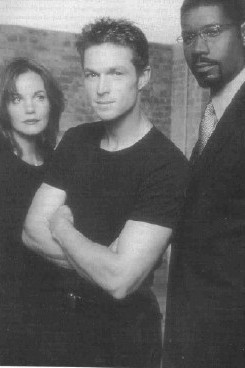
The tale depicted in Now and Again commenced as 45-year old Michael Wiseman (a role essayed by John Goodman) was told he was losing his job at Empire Insurance to a scheming little, 27-year old backstabber played by Chad Lowe. After a night on the town drinking with his old buddy and co-worker, Roger (Gerrit Graham), Wiseman headed home from Manhattan to his home in the suburbs, only to be accidentally pushed in front of a speeding subway -- and killed. Thus, Michael left behind a devastated family that included his beautiful but sharp-tongued wife, Lisa (Margaret Colin) and their troubled adolescent daughter, Heather (Heather Matazzaro).

But Wiseman's untimely demise was only the start of a very strange odyssey. In fact, following his death, Wiseman's brain was subsequently transplanted into an artificial body (Eric Close of Dark Skies), just moments after his death. Working for the government, the stern but brilliant scientist, Dr. Theodore Morris (Dennis Haysbert of 25) had thus engineered the world's first "super soldier," a hero in perfect physical condition. Only problem was that Morris required a living man's brain to control that perfectly-designed body. Formerly a hefty 292 lbs, the resurrected Wiseman - now conscious in a buff and healthy body of 25 years of age and a lean 172 lbs.- was delighted to know he had been given a second chance.

But there was a catch (isn't there always?) to his new life. The U.S. government insisted that Michael could no longer have any contact whatsoever with his beloved wife and daughter, on penalty of their deaths! For Michael, this accommodation was worse than damnation in Hell. A family man to his core, he was still very much in love with Lisa, and through the course of the series, he struggled to see her from time-to-time between missions saving the world from terrorists. Meanwhile, Lisa faced crises of her own. Through the treachery of Chad Lowe's character, she would not receive Michael's insurance money, meaning she could lose her house. So Lisa had to get a job. She also had to wrangle Heather, and face the prospect of being single at 40.

"Caron uses sci-fi to delve into the depths of familial love and loss," wrote Allan Johnson in Cinescape (March/April 2000) while covering Now & Again, "That such diverse themes work so well together is a tribute to Caron's talents a s a storyteller."

Writing in Variety, Ray Richmond noted that Now and Again was "quirky," "mesmerizing", "addictive" and "so wildly original it defies conventional categorization" (September 20, 1999, page 40). People Magazine called the program "stylish, clever and unpredictable," and Dr. Howard Margolin, host of Destinies the Voice of Science Fiction noted in my book, The Encyclopedia of Superheroes on Film and Television that Now and Again was "as much human drama as it was straight action adventure. Probably more so."

Now and Again lasted only 22 episodes on CBS, and the impatient network pre-empted the show nearly constantly, for such mundane offerings as a Candid Camera "special" and the Miss USA Pageant. Worse, it scheduled the series against Regis Philbin's powerhouse ABC game show, Who Wants to Be A Millionaire. Despite all the great reviews, Now and Again was hard-to-find on the schedule (it aired - sometimes - on Friday night), and hard-to-remember because of the generic-sounding title.

But that doesn't mean it wasn't a brilliant superhero show; the next evolution of 1970s programming like The Six-Million Dollar Man and 1980s affairs like RoboCop, which, like Now & Again, focused on an artificial man with "super" powers. But the superhero aspect, though ultimately rewarding, was never as interesting on Now & Again as the romantic and emotional angles -- which were positively heart-wrenching. Michael dealt with jealousy in "On the Town," when Lisa began to date, for instance. In "By the Light of the Moon," Michael found himself falling for the lovely young Dr. Taylor (24's Reiko Aylesworth...) only to feel as though he was cheating on the wife he still loved. The very set-up of the series, which saw a middle-aged man literally replaced by a younger model, concerned such topics as ageism, and as viewers, e wondered, could a middle-aged suburban housewife find love with the young Michael Wiseman, or rather his alias, Michael Newman? And if so, would she be threatening her own safety (and her daughter's?) I hasten to add that the series ended on a tense cliffhanger note, with Michael escaping from Dr. Morris, grabbing up his family, and going on the run. It galls me to know that we will never know what happened next...

As I wrote in the superhero book, the very names that Michael goes by in Now & Again, (Wiseman and Newman) spell out the central thematic tenets of Now & Again. In exchanging an older, experienced physical body (and appearance) for that of a young man's, the wise man had become the new one. And of course, "man" is the suffix of many-a-superhero. Spider-Man, Super-Man, Aqua-Man, Bat-Man, etc. Now & Again offered audiences the blending of Wise-Man and New-Man, the heroic (and fantastic) combination of a learned, accomplished, experienced mind with a young, spectacularly fit body. This was an artistic conceit, and one that served the series quite well over time.

Alas, Now & Again isn't available on either video or DVD today, and the Sci-Fi Channel only seems to air it periodically. But the series is soooo worth looking for. Seek it out. You'll be surprised how touching and inventive Now & Again remains.

TV BLOGGING: Invasion: "Origin of Species"

Invasion finally kicked things up to high gear last week. After literally months of doling out little clues and tiny hints piecemeal , suddenly, the series went ballistic and begn explaining things. And I must say, "Origin of Species" was a great episode (although Surface beat Invasion to the punch with a discussion of "invasive species" several months ago...)

This week, Sheriff Tom Underlay (William Fichtner) inched closer to being exposed, as his deputy figured out the trick Tom pulled on Mariel last week (substituting the corpse of an already-dead woman in the swamp, so Mariel would think she was wrong about seeing her own body in the water...). But then, the deputy, a one-armed veteran, was abducted by one of the glowing yellow aliens, and the audience witness at least part of the process that occurs when alien meets man. And, no surprise here - it's icky. With lots of organic tubes penetrating human skin. It looked painful, and the special effects were quite good. Imagine being trapped underwater, unable to breathe, with one of those giant alien rib-cages enrircling around you like a cage...

Then, Dave got kidnapped by two mysterious folk (an ex-CIA fellow and an Iraqi woman...) who told him and Russell that "strange lights" have accompanied hurricanes in Cuba and Brazil, among other places. And that people in each location were "changed" -- a change that resulted in mass suicide and the murder of children. They suggested that Russell needs to worry more about Mariel (and her exposure to his kids...), and that this time, in Homestead, the strangely-altered humans are reacting more "normally." Which makes me think that the aliens have been attempting this "invasion of the body snatchers" gambit for some time, and only now is their technique perfected (or close to perfected...)

There's still more to learn here, but Invasion just took a giant step forward in explaining some of the mysteries of Homestead, Florida. Can't wait for the next installment...

New Column up at Far Sector

My December "Transmissions Media" column is now live over on Far Sector along with the latest edition of the on-line mag. You can access my piece here. Regular readers of this blog will recognize elements of it: this is my pulling-together of the 2005-2006 TV season so far (as it applies to the genre). In other words, a report card of a kind at the half way point.

Here's an excerpt:

The TV season is half-over, and the “genre invasion” I wrote about in this space a few months ago is marching forward. There have been some casualties in this campaign, to be certain, but science fiction and horror on TV continue making significant in-roads with the networks, sometimes with surprising success.

The first genre casualty of the 2005-2006 season was ABC’s Thursday night drama, Night Stalker, a glitzy re-make of the original Kolchak: The Night Stalker series from 1974. Only six episodes of the series aired (though nine were produced), and ABC had the audacity to rip the program off the air in the middle of an unresolved two-parter called “The Source. “

Thursday, December 01, 2005

RETRO TOY FLASHBACK # 19: Playsets for Action Figures: The 1970s

Action figures need somewhere to live. That's just a fact of life. I mean, you can take 'em outside to explore "real" terrain on location (and risk soiling their spiffy uniforms...), but at the end of the day, you want your plastic figures to have a place to hang their hats.

And that's one reason why I've always loved action-figure playsets. Also, of course, if we're talking about TV/movie related playsets, these toys tend to recreate the sets of favorite productions. In other words, the bridge of the Enterprise on Star Trek, the Death Star in Stars Wars or the like. It's not a lot of fun owning action figures and having nowhere to billet them.

The first playset I ever was given (and which I still own...) was indeed Mego's Starship Enterprisee bridge playset from the year 1976. This blue-hued set housed the tall Mego Star Trek figures from the 1970s (Kirk, Spock, Scottie, Uhura, "Bones" and "Klingon"), and featured a lot of goodies for intrepid and youthful Trekkies, including a helm console (with two stools...), a changeable viewscreen display, and, of course, a Captain's Chair. Of course, the best feature in this set is no doubt the spinning transporter beam! Plug a figure in to the transporter chamber, spin the switch, and press a button (red or green...) to beam that crewman down!

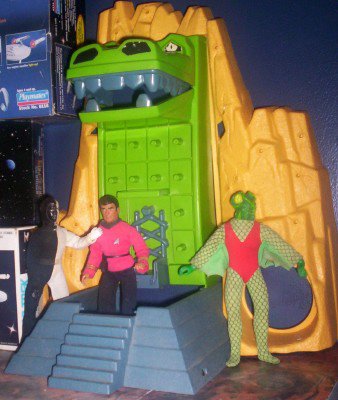
And where, pray tell, would you beam that landing party down to? Well, one option was Mego's "Mission to Gamma VI" playset, a recreation of the stone God Vaal from the second season Star Trek episode, "The Apple." This unique set, molded in sandy-yellow and green, came with a trap door at the foot of the monument and a two-story cave interior that is so cool you have to see it to believe it! Unfortunately, I know longer either the trap door or the backing behind Vaal, or even the alien accessories. Heck, at least I still have part of this toy. I can take solace in that.

As a kid, I also loved the Space:1999 Moon Base Alpha playset from Mattel, also released in the mid-1970s, and featuring a "control room and launch monitor center." Unlike the Star Trek bridge, this Main Mission Playset came with decals depicting actual clips of Eagles and space battles from the show, which to me made it seem more authentic. The 1999 playset also comes with a central "star flash" computer which, I suppose, tries to ape the look of Alpha's comm-post computer pillars. Okay, I'll buy that. This set housed the three Mattel action figures from 1999 (Commander Koenig, Victor Bergman, and Helena Russell) and also nicely provided them authentic-looking minimalist furniture (a chair and coffee table...)

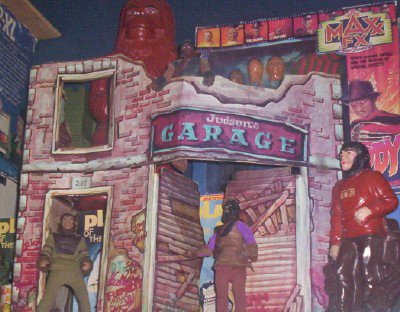
I also collected Planet of the Apes playsets from Mego over the years. In its heyday, Planet of the Apes toys were very popular, and I had the treehouse and other neat stuff. Today, I'm left with the Forbidden Zone set (a broken down thing called "Judson's Garage") and a few accessories like the catapult and wagon. But damn, you can't touch this stuff on E-Bay. It's too bloody expensive.

When Star Wars arrived in 1977, action figure playsets went into overdrive. I don't think I could possibly list all the ones I've owned, played with and enjoyed over the years. But let me try: there's the Death Star, the Rebel Attack Base on Hoth (from the Empire Strikes Back) and the Ewok Village from Return of the Jedi, just to name three. But Kenner also released a Droid Factory, the Mos Eisley Cantina, the Star Destroyer bridge (replete with Darth Vader's cubicle...), and even Yoda's house on Dagobah (complete with quick sand!). At one point in time, I owned all of these sets, though I pretty much played them out until they were trash.

The year 1979 brought Star Trek: The Motion Picture, and Mego released another Enterprise bridge playset, this time for the 3 inch figures from the movie. Alas, this flimsy plastic toy was not very well constructed, and was held together only by little adhesive squares that lose their "stickiness" after awhile. You can see pictured what's left of mine. It ain't pretty. There were always rumors of a "Vulcan shuttle" playset to attach to this bridge, but I've never seen it. Not on E-Bay. Nowhere...

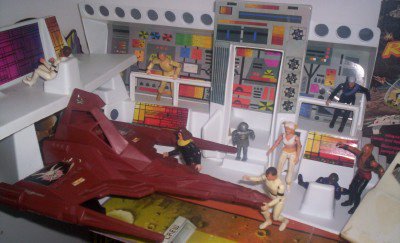
Mego also built a similarly crappy set for the 3 inch Buck Rogers in the 25th Century figures. It was called the Starfighter Command Center, and it too was made of flimsy plastic, those bloody adhesive squares and decals. Still, I love this playset, despite its generally poor construction... I just can't help myself.

Anyone out there collect playsets for their action figures? Which ones did you have as a kid, and do you still have 'em?

TV REVIEW: Lost: "What Kate Did"

"Are we saved?" Sawyer asked Kate on last night's episode of Lost. "No, Sawyer, not yet," Kate replied. Now there's an exchange just loaded with symbolism, don't you think? As the episode "What Kate Did" revolves around Kate's murder of her stepfather Wayne, "being saved" is a pertinent point, isn't it? Could it be that all the folks stranded on the island are waiting to be "saved?" in the Biblical sense? That somehow they are sinners, relegated to a purgatory of sorts? I realize that explanation's been bandied about for a long time on the Net, but either the writers were playing with us, or that dialogue had a big, fat double meaning. You decide.

One thing I learned from last night's episode: Jack ain't gay. (I had kinda speculated about that, given how the character always retreats when Kate gets physical with him...) Instead, Jack got wacked out, firewood-chopping jealous when a feverish Sawyer blurted out that he's in love with Kate. Nice to see things heating up. The Jack-Kate kiss last night was good, but the Sawyer-Kate kiss last season was better (and hotter). Sorry, Jack. I think you're going to end up with Ana Lucia...

Overall, "What Kate Did" was a good episode of Lost. If you've been reading my posts on the series this season, you know of my increasing ennui with the lengthy character flashbacks. This one, however, didn't bother me, perhaps because there was new information here; not just re-hash (like Michael's flashback; or Hurley's). Instead, we finally know - as the title suggests - exactly what Kate did. Good for Lost. Now move on.

What I enjoyed more than Kate's flashbacks was the meeting of the island's two most enigmatic (and spiritual?) characters, John Locke and Mr. Eko (sp?). "Don't mistake coincidence for fate," Eko warned Locke, and I thought that was an interesting point to bring up, given Locke's bent. More genuinely interesting was the discovery of the missing "spliced" film, which reveals (at least partly...) what should occur if the numbers are not entered into the computer. Another "incident." Oh boy, that sounds scary!

Also, the Dharma film warns against using the computer for any purpose other than typing in those bloomin' numbers. So guess what Michael does as the hour ends? Yep, he types "hello" into the computer at another prompt reading "hello." And then...he learns...

...he's communicating with Walt.

Damn, every time I think I'm out of Lost, it reels me back in. Great show. Every week.

Writer Interview: Alec Worley, author of Empires of the Imagination

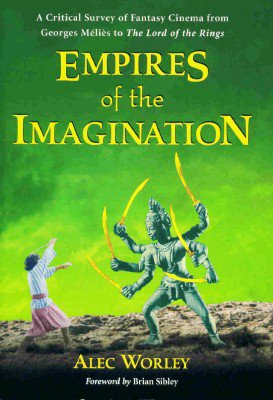
Recently, I had the great pleasure of discovering Empires of the Imagination: A Critical Survey of Fantasy Cinema from Georges Melies to The Lord of the Rings, a new reference book published by McFarland.

Written by Alec Worley, this book is a scholarly text devoted to the study of fantasy film. I noted in my review of the book for NCFLIX that the author undertook a difficult task, because even the very definition of "fantasy" is not settled. Yet what I discovered upon reading is that Mr. Worley had more than done his homework. In fact, he had worked carefully not only to succinctly define cinematic fantasy, but also provide a fascinating, dispassionate discourse on the subject. Empires of the Imagination is thus a stimulating and worthwhile read (and I recommend it.)

I recently had the opportunity to conduct an interview with Alec Worley on the subject of his book, and fantasy in film.

MUIR: Let's start at the beginning. How and when did you become motivated to write Empires of the Imagination?

WORLEY: Well, I was writing for a British horror magazine called Shivers, and the editor cautiously suggested that we might write a film-book together. He came up with the idea of a book about fantasy films, one that didn't include horror and science-fiction as part of its remit, as is usually the case. The only problem was coming up with a workable definition of fantasy that would encompass everything from The Grinch to Clash of the Titans. So I did a bit of brainstorming myself. Luckily I owned the only three serious books that seemed to exist on the subject (Peter Nicholls' Fantastic Cinema, John Clute and John Grant's Encyclopaedia of Fantasy and David Pringle's The Definitive Illustrated Guide to Fantasy), so I built on what I agreed with from each and came up with a theory that at least made sense to me. I then whaled on it with every argument and example I could think of, trying to tear it apart from every angle. Once I was satisfied the idea was still in one piece and would therefore carry an entire book, I pitched it to David who generously let me run off with it on my own.

MUIR: Let's cover some vital stats. How many films did you ultimately watch to write the book? How long did creating the book take from start to finish? And how difficult was it finding a publisher interested in the topic?

WORLEY: If I didn't have to watch all those movies, if I'd had a heftier reviews file to hand when I started, I probably would have finished the book within a year. But I must have gone through about 600 films or more, and had to be very selective about what I watched since by then I was working to a contract and time was now a factor. In the end it took about three years from start to finish, about one-and-a-half of which I was working nights at a reel assembly plant, splicing together those commercials you see at the start of a movie.

As for the publisher, I'd tried pretty much everyone in the UK, most of whom I'm still waiting to hear back from. The general feeling was the project was too whimsical for the academics and too thoughtful for everyone else. Then I approached editor Stephen Jones (of Best New Horror-fame) at a convention and asked if he could recommend a publisher. He asked if I wanted to make money, or if I wanted a proper book. I sensibly chose the latter and he put me onto McFarland, who have been magnificently supportive and professional throughout the whole thing. I really can't sing their praises enough.

MUIR: Discuss, if you will, some of the reasons why fantasy films as a genre have, for much of their 100 year history, been "ghettoized," as you put it? How has that changed today, or has it?

WORLEY: Fantasy always seems to have been taboo in western culture. In eastern cinema, fantasy has always been regarded as serious subject matter, from Germany's Die Nibelungen to Indian "mythologicals" like DG Phalke's Raja Harischandra. In the west we tend to see the genre more as a vehicle for whimsy, special effects and escapism, although some filmmakers have worked this to their advantage. Soviet filmmakers in the 40s, for example, utilized fairy tale to smuggle political satire past the Communist censors.

Here in the UK, the BBC ran a televised literary survey a few years back called The Big Read, which was won by Lord of the Rings (not surprisingly, since the book had topped a similar contest a few years before, and the publicity machine for the Return of the King movie was in full flight before the final result was televised). The response from the critics just about made my head explode with rage, the utter ignorance of these learned intellectuals as to just what fantasy is, what it can do, and what it has done. For a similar reason I find it difficult to understand Philip Pullman when he says he doesn't write fantasy.

The general consensus here was that fantasy begins and ends with Tolkien, anything like it that's any good has to go by another name. (One critic imaginatively defined His Dark Materials as "metaphysical fabulism.") The idea that fantasy equals mere escapism is crucially - only half the story. Many fantasy narratives begin with a character motivated by a wish to escape the pressures of the real world, but what the hero learns (in intelligent fantasy films like Wizard of Oz and Labyrinth) is that escape from reality is actually impossible. The point of embarking upon fantasy is to return to reality with a change in one's perception, so that you may live more in accord with the irresistible flow of life.

However, with the success of Lord of the Rings and given the response to movies like Narnia and Harry Potter, I believe these will probably only cement the negative view, unless both sides of the court, both fans and critics, achieve some kind of wider recognition of what the genre is and does. Tastes need to broaden on both sides, I think.

MUIR: You discuss the narrative strategies of the fantasy film in the book. Without giving too much away, could you delineate a few of those strategies here for our readers, with an example of each? (I think this is fascinating stuff.)

WORLEY: Well the way I see it fantasy cinema can be placed along a line spanning from documentary realism to avant-garde expressionism (by the way, I make absolutely no claims that literature or oral storytelling can be understood in the same way). It's an idea I borrowed from Louis Gianetti's book Understanding Movies. Basically I would place expressionistic types of story at one end of the scale and realistic stories at the other. As I put it in the book, the closer a film falls towards realism, the more its fantasy elements will be depicted realistically; the closer a film falls towards expressionism, the more its realistic elements will be distorted fantastically.

And here lies the four (well, five really) kinds of fantasy film. At the furthest reaches of expressionism lies pure surrealism (movies such as Bunuel's L'Age d'or), in which reality as we know it holds no more sway than it would in a dream. Fairy Tale (think Edward Scissorhands) sits the next step up towards realism. Here events are organised into a proper narrative but take place in a protean world shaped by the dictates of a God-like storyteller. Sitting dead centre in the realism/expressionism scale there's earthbound fantasy (It's a Wonderful Life), where the worlds of fantasy and reality invade each other. As we move away towards realism the forces of magic (the defining stuff of fantasy itself) becomes regimented more and more by the kinds of laws that affect our own world. Here we find Heroic Fantasy (Conan the Barbarian that's Barbarian, guys, not Destroyer, the crappy sequel everyone mistakes it for). This genre covers the exploits of superheroes like Hercules, Sinbad and Indiana Jones. Lastly, at the furthest reaches of realism, we have Epic Fantasy (Lord of the Rings). This is the most "realistic" breed of fantasy, realistic in that the magic within it is carefully disciplined to create the illusion of a living breathing world.

The theory's rather more involved than this, and there is a great deal of cross-pollination. The Harry Potter movies, for example, are part Fairy Tale, part Earthbound and part Epic. The important thing is not to see this as a set of pigeon holes, rather a sort of "spotter's guide to fantasy motifs," helping viewers and (it would be my fondest wish) writers and filmmakers to identify and understand the genre's components.

It's not about me trying to force my opinion upon everyone else, it's about (hopefully) generating some kind of serious debate on the subject.

MUIR: I thought that "Locating Fantasy" was a brilliant introduction to the book, and that you very carefully and thoughtfully defined fantasy in this section. How difficult was it to come up with that particular definition, and how would you say it eventually came to serve your survey? Were you constantly tweaking, or did you always have a destination in mind?

WORLEY: My definition of fantasy has always been that magic has to be responsible for all the weird stuff in a story as opposed to science. I really donÂ’t mean to be glib, but it's always seemed obvious to me, ever since I was a kid. It was the difference between Jason and the Argonauts and Godzilla. The moment you introduce science into what is essentially a fantasy story you change its entire outlook. Just look at how Lucas destroyed Star Wars with the revelation that the spiritual centre of the original trilogy (the Force) is actually nothing more than a rare blood group. Way to go, George.

Anyway, as I said before, I defined my argument and then tried to beat the crap out of it, reading everything I could, trying to find a chink, trying to contradict my theory. I don't know if you guys are familiar with Blackadder, a historical comedy Richard Curtis and Ben Elton wrote for the BBC in the 80s, but in one episode Robbie Coltrane plays Dr Johnson (author of the first English dictionary), who has a breakdown when someone mentions the word sausage, the one word he forgot to include in his book. Well, a friend of mine dedicated his life to finding what he calls "the Blackadder Sausage," the one example or movie that will bring my argument crashing down. Thankfully, he's still looking.

I wrote the Locating Fantasy chapter first and pretty much didn't touch it again. It was really quite spooky how fluently Empires came together after that, as if the book had already been figured out right down to details I hadn't even thought of, and all I had to do was write it all down.

MUIR: What would you say is your favourite type of fantasy film? In fact, what is your favourite fantasy film and why? Least favourite and why?

WORLEY: Of all the sub-genres I've really got a thing for Heroic Fantasy, probably because it's the most underrated and underexplored. It's the real outlaw of the pack, dealing as it does in the masculine psyche. Writers have done interesting things with this genre, Michael Moorcock's Elric and Pat Mills'
Slaine comics for example, but on film the genre hasn't quite got over Robert E. Howard yet. As for individual films, I could go on and on, but I'll give a quick run down. Neil Jordan's Company of Wolves has a weird magic about it that I find endlessly fascinating, along with Jan Svankmajer's Alice and Tony Harrison's Prometheus. I'm a sucker for goth kitsch like Edward Scissorhands, The Crow and The Corpse Bride, although I loathed Tim Burton's Willy Wonka.

Alain Resnais's Last Year in Marienbad and Jean Cocteau's La Belle et la Bete and Orphee are clearly masterpieces, but I'm not sure the're quite loveable enough to be anyone's "favourites." I think Time Bandits (next to Brazil) is probably the best thing Terry Gilliam has ever done. The Golden Voyage is my favourite Sinbad and The Barbarian my favourite Conan. (If only Milius would put together a proper director's cut) There's also a French film I really like called Brotherhood of the Wolf, which in many ways epitomises the sensual texture of Heroic Fantasy.

I cry like a little girl with a skinned knee at Wizard of Oz, A Guy Named Joe, Field of Dreams, Big and Watership Down and for entirely different reasons at Dungeons and Dragons and Ator the Fighting Eagle. Heroic Fantasy also probably has the largest concentration of stinkers, from Thor the Conqueror to The Son of Hercules in The Land of Darkness, movies too dumb to even laugh at. I grew up loving The Neverending Story, but came to loathe it, and the same goes for Ridley Scott's Legend. As for Lord of the Rings I think they're not without flaws (the dwarf jokes are dreadful), but really the very best adaptations we could possibly have hoped for. Considering Hollywood's idea of fantasy at the time of their making was Hercules: The Legendary Journeys, we should be thankful we never ended up with Kevin Sorbo as Aragorn.

MUIR: I notice you comment in the book on the difference between critical analysis and fan boy ardour. Was this a difficult line for you to walk while composing the text? Did personal preference color any of your reviews?

WORLEY: I was completely disciplined on this score. There are too many film-books out there on similar subjects that just gush and reminisce rather than analyse. I want the fantasy genre to be taken seriously, and in order to do that every film had to be looked at with a cold, critical eye, even when that movie was an old friend. I didn't deliberately set out to upset the fan consensus, just give a balanced view and as a result I hope I've given a fresh perspective.

MUIR: Lastly, what's your next project and when can readers look forward to it?

WORLEY: Several irons in several fires at the moment. I'm always guarded about future projects as I don't want to look like a dolt should they never come about. Aside from more film journalism (I've just done a couple of reviews for SFsite.com), I've got some short fiction and several comics projects on the boil (one of them a tribute to Dr Seuss about a flesh-eating zombies) and I'm currently putting some proposals together, one for a film book another for a children's book. Hopefully at least one of them will come to flower next year.


I want to thank Alec Worley for speaking with me on the subject of his book, and film fantasy. I wish him all the best with his future endeavours, and would just like to remind everybody that Empires of the Imagination is now available. You can pick up a copy at
McFarland's web site. Mr. Worley has given fantasy fans a great place to start (or renew...) debate on a genre now on the ascent. He's set the terrain for the discussion, and now it's up to readers to take it from there...

50 Years Ago: Land of the Lost: "Medusa" (October 9, 1976)

The fifth episode of the third (and final) season of the NBC Saturday morning series highlights the mythological Medusa -- snake-haired Gorg...