Subscribe To JKM


 Posts
All Comments
Showing posts with label re-imagination. Show all posts
Showing posts with label re-imagination. Show all posts
Friday, October 30, 2015
Movie Trailer: A Nightmare on Elm Street (2010)

 award-winning creator of the web series Abnormal Fixation (2024), the audio drama Enter the House Between (2023) and author of 35 books including Horror Films FAQ (2013), Horror Films of the 1990s (2011), Horror Films of the 1980s (2007), TV Year (2007), The Rock and Roll Film Encyclopedia (2007), Mercy in Her Eyes: The Films of Mira Nair (2006),, Best in Show: The Films of Christopher Guest and Company (2004), The Unseen Force: The Films of Sam Raimi (2004), An Askew View: The Films of Kevin Smith (2002), The Encyclopedia of Superheroes on Film & Television (2004), Exploring Space:1999 (1997), An Analytical Guide to TV's Battlestar Galactica (1998), Terror Television (2001), Space:1999 - The Forsaken (2003) and Horror Films of the 1970s (2002).
Tuesday, August 11, 2015
Movie Trailer: Dawn of the Dead (2004)
award-winning creator of the web series Abnormal Fixation (2024), the audio drama Enter the House Between (2023) and author of 35 books including Horror Films FAQ (2013), Horror Films of the 1990s (2011), Horror Films of the 1980s (2007), TV Year (2007), The Rock and Roll Film Encyclopedia (2007), Mercy in Her Eyes: The Films of Mira Nair (2006),, Best in Show: The Films of Christopher Guest and Company (2004), The Unseen Force: The Films of Sam Raimi (2004), An Askew View: The Films of Kevin Smith (2002), The Encyclopedia of Superheroes on Film & Television (2004), Exploring Space:1999 (1997), An Analytical Guide to TV's Battlestar Galactica (1998), Terror Television (2001), Space:1999 - The Forsaken (2003) and Horror Films of the 1970s (2002).
Tuesday, May 26, 2015
Movie Trailer: Poltergeist (2015)
award-winning creator of the web series Abnormal Fixation (2024), the audio drama Enter the House Between (2023) and author of 35 books including Horror Films FAQ (2013), Horror Films of the 1990s (2011), Horror Films of the 1980s (2007), TV Year (2007), The Rock and Roll Film Encyclopedia (2007), Mercy in Her Eyes: The Films of Mira Nair (2006),, Best in Show: The Films of Christopher Guest and Company (2004), The Unseen Force: The Films of Sam Raimi (2004), An Askew View: The Films of Kevin Smith (2002), The Encyclopedia of Superheroes on Film & Television (2004), Exploring Space:1999 (1997), An Analytical Guide to TV's Battlestar Galactica (1998), Terror Television (2001), Space:1999 - The Forsaken (2003) and Horror Films of the 1970s (2002).
Tuesday, July 31, 2012
Cult Movie Review: King Kong (1976)

Over a decade ago, I had a strange professional experience. The editor on a book I wrote about a classic British science-fiction TV series marked out in red ink every single reference I made in my text to the 1976 version of King Kong.
As
explanation, the editor opined that such a “bomb” could not be discussed as
part of legitimate King Kong history. If I
needed to refer to King Kong, then the 1933 film would do just fine.
This
anecdote reveals two things.
First,
it exposes how editors can impress their own viewpoints and biases on a
manuscript.
Secondly
-- and more relevantly for this review --
this story suggests the depth of hatred
the Dino De Laurentiis King Kong remake has aroused over the
long decades since it premiered. The
film is apparently not only “a bomb,” but it should actually be erased from the history books and our collective cultural memory. You…can’t…even…write…about…it.
As
you may have guessed, I disagree with the questionable conventional wisdom that
King
Kong (1976) is a bomb, and one unworthy of debate, examination, and
analysis.
In
the first case, the film grossed over eighty million dollars worldwide on a
budget of twenty-four million dollars, with a marketing budget of fifteen
million. King Kong thus cleared
its budget and turned a nifty profit, especially in 1970s terms. In fact, the remake had approximately the
same opening weekend gross as Jaws (1975), about seven million
dollars.
So
financially speaking, King Kong was definitively not a
bomb. The industry expectation recounted
in various articles of the day (including in Time Magazine) established that the film should gross between fifty
and one hundred million dollars.
Receipts landed just about in the middle of that ballpark, with eighty
million.

Critic
Pauline Kael certainly didn’t think so.
She wrote in The New Yorker that the new King Kong was a “romantic adventure fantasy – colossal,
silly, touching” and even termed it an “absurdist
love story.”
Meanwhile,
Time
Magazine called the film a “confidently
conceived, exuberantly executed work of popular movie art.”
Roger
Ebert also praised the film (and gave it “thumbs up” rating) during a 1976
episode of Sneak
Previews. Also,
the periodical America noted that “in making
a comment on the tragedy of the human spirit in an industrialist age, it [the
film] speaks directly to and about its audience.”
So
while the film undeniably received many negative reviews, it might be more accurate to state that 1976 Kong was controversial, or faced
mixed critical reactions. Those who declared
that King
Kong was a “bomb” were primarily die-hard fans of the original 1933
film, and members of the protean genre press (the same class that also,
incidentally, savaged Space:1999 [1975 – 1977]).
Considering
this dynamic and the timing of the film's release, King Kong may actually represent the
occasion of the very first “remake” fan war.
As is the case with all remakes, I can see both sides of the debate, but
elect to take each remake on a case-by-case basis. Some remakes are worthy and
interesting and others...are not.
In
the case of King Kong, there are indeed some fascinating aspects of the
film to remember and praise. It’s true
that the special effects in the latter half of this Oscar-winning film are an absolute
mess, especially in the film’s bungled finale atop the World Trade Center. And one can only cringe at the craven
attempts to sell the man-in-the-monkey suit (Rick Baker) scenes as featuring a giant Kong robot. Yikes...
Yet
-- warts and all -- this King
Kong speaks to the 1970s as trenchantly as the original Kong
spoke to audiences of the 1930s. The
film contextualizes Kong as an exploited natural resource, as a metaphor for
the 1970s Energy Crisis and America’s dependency on petroleum. And secondly, on a far more personal level, the film comments on the pursuit
of fame and its consequences in our modern culture.
I
grew up with the 1970s King Kong and thus possess great
nostalgic affection for the film. I’ll
be covering 1976 “Kong Mania” here tomorrow afternoon, in my weekly Memory Bank
piece, for example. But childhood
affection for it or not, I maintain King Kong is not the “bomb” -- either financially or creatively -- that
conventional wisdom has so often suggested.
“Ah, the power of it. Ah, the superpower! Hail to the power!
Hail to the power of Kong! And Petrox!”

En
route to this remote destination, the Petrox Explorer rescues the lone survivor
of a yacht explosion, the gorgeous would-be movie star, Dwan (Jessica
Lange). And upon reaching the island,
Jack, Fred and Dwan learn that it is indeed inhabited. The natives who dwell there cower behind a
huge wall in fear of a God called Kong,” in actuality a colossal gorilla.
By
night, Dwan is abducted by the natives and transformed into a “bride” or human
sacrifice for Kong. But as Dwan soon
learns, the giant gorilla is not a dangerous enemy, but a valiant and loyal protector. The men from the Petrox Explorer set out to
rescue Dwan from Kong even as Fred learns that there is no gusher on the
island…no oil. So as to spare his
professional reputation and save his job, Wilson decides to capture Kong and
bring him back to civilization as a “commercial” for Petrox.
After
Kong is captured and brought to New York City, the regal ape breaks free and
causes chaos in Manhattan. Finding Dwan
again, Kong carries her to the top of the Twin Towers. Before long, helicopters armed with machine
guns close in for the kill…
“Well, here's to the big one…”

As
you may recall, that incident occurred when OPEC slashed oil production by five
percent and then increased prices dramatically, something on the order of
seventy percent. The Arab organization
used this so-called “oil weapon” to
protest the U.S. government’s support for Israel during the Yom Kippur War.
At
home, American consumers were soon urged not to be “fuelish” about consumption, and to conserve gasoline. The embargo was lifted, finally, when the
Nixon Administration negotiated an Israeli withdrawal from Sinai.
But
the OPEC incident revealed to many Americans the heretofore un-excavated nexus
between government action, international relationships, oil companies, and
fossil fuel. If America was to become truly
energy independent -- and avoid a repeat
Energy Crisis in the process -- it would need to discover and dig up new sources
of petroleum.
King
Kong (1976)
is explicitly about this quest, and the mighty Kong himself stands in -- literally, in one case -- for petroleum;
for a precious and exploitable natural
resource.
In
the specific scene I mention, Kong is rolled out before an American audience in
Manhattan…ensconced inside a giant Petrox
gas tank. It would be foolish to
deny the potent symbolism of this imagery. An audience stands in awe of a giant container of gasoline, the
very life-line to its twentieth century life-style of leisure and consumption.
But
underneath that tank is...what, precisely?
A monster that -- if
set free – could threaten or destroy everything in our modern world, here
symbolized by the Big Apple.
If
one stops to consider that the ownership and control of foreign oil has been the precipitating cause of global conflicts on several occasions, one may begin to detect
the underlying context of this Kong remake. The race to possess and control oil could lead
not to a world of plenty, but to destruction and chaos. We try to control oil (or Kong), but look what happens?
Furthering
the symbolism, Kong is brought to America inside the vast cargo hold of an oil super tanker, a fact which also visually
equates the ape with petroleum, a valuable resource taken from a foreign locale
and made to serve American interests.
In
the original film, Kong was “the eighth
wonder of the world,” an amazing spectacle captured to relieve the boredom
and anxiety of a people enmeshed in an economic depression.
In the 1976 remake, Kong is literally a
mascot, a “commercial” (in the words
of the script) for an oil company hoping to beat its corporate competition to
larger profits. In fact, a literal
comparison is made between Kong and the famous Exxon campaign “put a tiger in your tank.” Only here the
royal and regal natural power is embodied by a primate rather than a feline.
In
toto, the “Kong as natural resource”
angle of the remake works surprisingly well. Wilson is described aptly in the film as an “environmental rapist” and Prescott worries
about what will happen to the island culture once it is bereft of the “energy”
(in this case creative and spiritual energy…)
that Kong’s presence provides it. Kong is “the juice,” in other words, that
powers every aspect of their lives, from organized religion to national security. When Kong taken from them….does their culture
die? What does it run on?
As
Richard Eder wrote in The New York Times “the impulse to explore, to discover, to
bring back something that you’ve discovered - [that which we found in the first
King Kong] is now replaced by simple
greed – the greed of the oil company representative Fred Wilson, to find a
gusher.”
In
the same vein, the film is veritably loaded with references to Gulf, Shell and
Exxon. And Skull Island itself is termed
in dialogue a “huge tank just waiting for
us to twist the top off.”
The idea
expressed, then, is that of out-of-control oil companies hoping to sustain our 20th century life style. In support of this endeavor, they can travel
anywhere in the world, claim natural resources as their own property, and in
the process destroy the natural beauty and even the people of those
terrains. The excuse? “There’s a national energy crisis!,” as
Wilson says.
In
charting this dynamic, the remake of King Kong evokes a far more cynical
and troubled world than the one dramatized in the original 1930s film. If the original film is a fairy tale of
mythic proportions, the remake is, by contrast, a cautionary tale about a world running out of gas, creatively,
spiritually and in terms of natural resources.
It’s a world that hopes to latch onto anything “new,” and exploit it for
its monetary value even if that “new” thing is destroyed in the process. Going even further, the decision for Kong to climb the World Trade Center -- a representation of western economic and global powers -- is symbolic in some sense too. As Time Magazine opined, the film might be seen as a "projection of Western fears of what might happen if the Third World should develop its potential power and fight back."
In the remade Kong, Dwan also fits into the leitmotif about exploitation. She is an aspiring actress who desires, more than anything, to be famous. Her experience on Skull Island with Kong is Dwan’s ticket to fame, and she realizes it. Dwan is, in essence, seduced by the possibility of being a “star” and so betrays Kong…the beast who protected her and sheltered her in a dangerous jungle. By contrast, Prescott possesses the wherewithal to detect Wilson’s exploitation of Kong, and he terms the whole affair a “grotesque farce.”
 |
| Menaced, literally, by Big Oil. |
 |
| Kong comes to America...in an oil tanker. |
In the remade Kong, Dwan also fits into the leitmotif about exploitation. She is an aspiring actress who desires, more than anything, to be famous. Her experience on Skull Island with Kong is Dwan’s ticket to fame, and she realizes it. Dwan is, in essence, seduced by the possibility of being a “star” and so betrays Kong…the beast who protected her and sheltered her in a dangerous jungle. By contrast, Prescott possesses the wherewithal to detect Wilson’s exploitation of Kong, and he terms the whole affair a “grotesque farce.”
But
Dwan can’t see or acknowledge the truth fully because she is obsessed with
herself, and with fame.
This
idea is woven nimbly into the screenplay by Lorenzo Semple, Jr. Early on, we learn that the character changed her name from Dawn to Dwan
in order to make it “more memorable,”
a sign of the character’s true aspiration to be a celebrity.
And
when Kong is captured, and feeling morose about his captivity, Dwan tells the
great beast not to worry, that he’s “going
to America to be a star.” This line
also suggests that for Dwan, fame is the highest achievement in our
culture.
Finally,
Dwan can’t risk rebelling against Fred’s wishes for her, or else, as Wilson
says, “I
promise you'll never get another booking in your life. You'll end up
tap-dancing at Rotary clubs.” This threat of public
obscurity keeps Dwan in place as a team member in the “grotesque farce.” Dwan rarely asks if Kong’s imprisonment and
loss of freedom – his exploitation
– is an acceptable price for her media super stardom.
One of the primary reasons I appreciate the artistry of the 1970s
King
Kong involves the clever blocking and staging of the final scene at the
foot of the twin towers.
Kong is dead and Dwan stands before the cameras at his side,
playing up her sadness and tears for maximum press impact. Prescott attempts to approach Dwan through
the crowd of photographers, to rescue her from the paparazzi (just as Kong did
earlier, at his unveiling in Manhattan). But then Jack stops short. A dark expression crosses his face as he recognizes that
Dwan is exactly where she wants to be: at
the center of attention.
The blocking and reaction shot (from Bridges) represent a visual
way of establishing a philosophical line of dialogue from the original film, but one not
included in the remake.
It was not the planes (or helicopters in this
case) that killed Kong. It was Beauty
who killed the Beast.
As the scene continues, the photographers grow so aggressive that
even the attention-hungry Dwan looks legitimately disturbed and menaced by their actions. But both of her dedicated protectors – Kong and Prescott – are now gone. As flash bulbs explode all around her, Dwan looks
dismayed, but the implication is clear. This is the bed she made for herself, and now she
must lie in it.
Importantly, Prescott has witnessed another man -- Kong -- destroyed attempting to
“protect” Dwan from that which she actively seeks – attention
-- and so he, finally, makes a different decision. He leaves Dwan to the tender mercies of the
press. Thus we leave King
Kong on a deliberately down-beat note. There is no happy ending to be found.
For Dwan, it’s be
careful what you wish for…you just might get it. For Jack, it's his realization that everything for Dawn – even the death of Kong – is a thing to
be used to further fame and fortune.
In the years since King Kong premiered, we have, as a
nation, descended much deeper into this kind of craven celebrity culture, where truly unworthy people become famous for fifteen minutes for participation in a tragedy, a trauma or a scandal. King Kong is an early
commentary on this facet of modern life, granting Dwan her fifteen minutes of
fame at the expense, literally, of a king among animals. Kong had no concern but to protect Dwan, and
was (innocently) unaware that she could not reciprocate emotionally. In essence, Kong is exploited twice in the
film: first by Wilson (as a natural resource) and secondly by Dwan (as a
gateway to fame and celebrity). This depth in terms of narrative strikes me as being more than enough meat for a "monster" movie.
 |
| Dwan is ready for her close-up? |
 |
| Jack realizes that she will always be a fame-seeker |
 |
| The press is her boyfriend now...and she knows it. |
In terms of forging a hypnotic spell, King Kong is quite an
intoxicating picture, at least in its first hour or so. Real locations (in Hawaii, I believe) provide
awe-inspiring natural vistas. There are
some shots featured here that are so gorgeous, so unimaginable on a visual
scale, that they literally prove jaw-dropping.
One lengthy “zoom out” from a tight shot in a natural canyon suggests a scale
far beyond our capability to fully process. Such visuals seem that much more amazing for having been lensed in the age before digital effects
and CGI. It’s absolutely appropriate
that the film was nominated for an Academy Award for Best Cinematography.
About mid-way through King Kong, the film
transitions from real life locations to studio sets that, alas reek of sound-stage fakery. Yet the transition -- while jarring -- may work thematically. In other words, the island seems to turn “uglier” and more
claustrophobic as Fred Wilson’s motives for it (and its inhabitants) also turn
ugly As man grows dominant (and Kong comes nearer to man's world), the visuals take a turn for the desolate and despairing.
At first, the island is a place of unfettered beauty and
innocence – God’s hand on Earth. But then, technological, 20th
century man shows up to put a stamp on it, and the land itself seems to change, revealing a craggy, hard-edged, ugly and ominous side. By the time we’ve
gotten to Kong’s smoky, desolate lair, Skull Island looks as though it could be a harsh, crater-filled landscape on the moon, or perhaps Mars. And then, of course, the movie takes us to a REAL jungle...New York City.
 |
| From this... |
 |
| ...to this... |
 |
| ...to this... |
 |
| ...to this... |
 |
| ..at last, to this. |
King Kong’s final scenes, atop the Twin Towers, are also pretty terrible in terms of visuals. In part this is so because of blue screen and rear projection work that fails to maintain, in proper ratio, the size of Kong and the size of the attacking helicopters. It’s also a matter of the lighting of the various component parts of the scene. The night-shots of the helicopters and night sky look washed out and dim compared to the footage of Kong.
And yet, in the final analysis, I can forgive the special
effects lapses of King Kong because I feel the film attempts to imbue the
“monster movie” form with a new sense of social relevance. King Kong’s game is to
ask questions about how, in modern times, we steal from nature and often destroy
nature for our own selfish purposes. The
Dwan and Wilson characters represent two sides of that particular coin. They are indeed selfish and foolish (or is it "fuelish?").
It ought to be noted, as well, that the 1970s King
Kong is the first version of the material to suggest more than a rudimentary monster/victim dynamic between Kong and his would-be bride. This is an important element also featured in
the Jackson remake of 2005. Here, in one
of the film’s best and most poetic scenes, Kong takes Dwan -- now covered in mud -- to bathe under a natural waterfall.
The moment is magical (and erotic, strangely...) not
merely because of Jessica Lange’s extreme and ravishing physical beauty, but because of
Kong’s gentleness and yes, even sweetness.
I don’t know that either of those qualities could be ascribed to the
1933 version of this “monster” character. This Kong seems a lot more humane and less violent than his predecessor. The waterfall scene is supported brilliantly, I should add, by the late John Barry's lush and romantic score, which -- accompanying the visuals -- practically causes swooning. In lyrical, visually ravishing moments such as this, it's awful hard to totally hate this production of Kong.


Yet if the end game is to hate all over King Kong (1976), there’s
obviously plenty to latch onto too. No
stop-motion effects, weak optical-effects in the last half, and a script that
probably features too many in-jokes about “male
chauvinist pig apes,” “the Empire
State Building” and the like. And
yet, for all its obvious failings, it must also be said that this (sentimental)
Kong wears its heart on its sleeve.
Or as Pauline Kael astutely noted, “I don’t think I’ve ever before seen a movie that was a comic-strip
great romance in the way this one is… it’s a joke that can make you cry.”
award-winning creator of the web series Abnormal Fixation (2024), the audio drama Enter the House Between (2023) and author of 35 books including Horror Films FAQ (2013), Horror Films of the 1990s (2011), Horror Films of the 1980s (2007), TV Year (2007), The Rock and Roll Film Encyclopedia (2007), Mercy in Her Eyes: The Films of Mira Nair (2006),, Best in Show: The Films of Christopher Guest and Company (2004), The Unseen Force: The Films of Sam Raimi (2004), An Askew View: The Films of Kevin Smith (2002), The Encyclopedia of Superheroes on Film & Television (2004), Exploring Space:1999 (1997), An Analytical Guide to TV's Battlestar Galactica (1998), Terror Television (2001), Space:1999 - The Forsaken (2003) and Horror Films of the 1970s (2002).
Monday, July 23, 2012
Blake's 7 to be re-booted next?
 IndieWire
is reporting that Casino Royale (2006) director Martin Campbell has signed a deal
to launch a TV re-boot of Blake’s 7 (1978 – 1981), the cult-TV
series concerning a band of space rebels fighting a totalitarian Federation
from aboard an alien ship of incredible technology, the Liberator.
So,
if everything works out, we’ll have Blake’s 7, and a re-boot of Space:
1999, called Space: 2099 on the tube at the same
time.
Of
course, I’ve read probably five or six times over the last decade about
attempts to re-launch Blake’s 7, either as a cartoon, a
film, or a new TV series, and nothing ever seems to happen. I wonder if this attempt will be any
different.
And
as I noted in an interview on Genre-tainment last week, the problem with rebooting Blake’s
7 now is that Firefly (2002) – a great series – already revived and
reflected many aspects of the Terry Nation legend. So the new Blake’s 7 will not only
need to genuflect to the original program, it will need to stake out territory
that differentiates itself from Firefly.
I
just wrote a post about remakes here on the blog, and noted the reasons why they
aren’t always desirable. But
I also wrote about the fact that I’ll review each remake on a case-by-case
basis. I stick by that. Also, I did write, way back in
1999 -- in my book about Blake’s 7 -- that a big-budget remake
with new special effects and a focus on the Dirty Dozen/Robin Hood aspects of
the legend could indeed prove pretty amazing.
Furthermore, I deeply miss space adventure on television. It’s been absent since the cancellation of SGU (2009 – 2011), and thus the thought that either
Space:2099 or Blake’s 7 – or both – could be airing soon fills me with more hope than despair…at least at this point.
If
you’re interested in learning more about the original Blake’s 7, check out my
book on the subject, available here.
award-winning creator of the web series Abnormal Fixation (2024), the audio drama Enter the House Between (2023) and author of 35 books including Horror Films FAQ (2013), Horror Films of the 1990s (2011), Horror Films of the 1980s (2007), TV Year (2007), The Rock and Roll Film Encyclopedia (2007), Mercy in Her Eyes: The Films of Mira Nair (2006),, Best in Show: The Films of Christopher Guest and Company (2004), The Unseen Force: The Films of Sam Raimi (2004), An Askew View: The Films of Kevin Smith (2002), The Encyclopedia of Superheroes on Film & Television (2004), Exploring Space:1999 (1997), An Analytical Guide to TV's Battlestar Galactica (1998), Terror Television (2001), Space:1999 - The Forsaken (2003) and Horror Films of the 1970s (2002).
Friday, May 18, 2012
Cult Movie Review: Lost in Space (1998)

Yes,
Hollywood was capable of crafting spectacular special effect, yet something
rung terribly hollow at the heart of
both of these lavish remakes.
Perhaps
the problem is that the A-list actors, writers, producers and directors engaged in
these remakes were essentially working with “B” material, but without the
appreciation or zeal for the material that the original “B” movie teams had so
clearly and abundantly demonstrated in the past.
There’s
a crucial difference, we must finally acknowledge between creating an original work of art and inheriting that same property years later, determined to make it “relevant”
and “popular” again.
The
artistry, invention and love that goes into making something for the very first time is not
necessarily the same thing as -- years after the property has made its name -- applying
a paint job, or a superficial renovation. But of course, even Lost in Space the TV series was an adaptation of a work of art in a different form, Space Family Robinson.
But the point is that when
a movie remake is launched, the property already possesses a history, a context, a
vibe, and a perception by the culture-at-large.
The critical task of the remake-r is to interpret those pre-existing
characteristics and determine the “why” behind the initial and residual
success.
But
that “why” isn’t always easy to understand, and it is even more difficult to
replicate.
The
message -- which I understood in 1998 and
try to hold in my thoughts even now
-- is that you can’t go home again.

Lost in Space on TV also featured this
great, mid-1960s space age paraphernalia: boxy, oversized and predominantly silver,
with lots of blinking, bright lights.
There was a can-do attitude – a holdover
from Camelot, perhaps – at work in the series too, despite the premise of
being “lost.” And love or hate the Dr.
Smith role and the use to which the character was put during three tumultuous seasons,
Jonathan Harris exhibited incredible commitment to that role.
And
the 1998 Lost in Space movie?
Absolutely
no expense was spared in terms of special effects, in terms of sets, and in
terms of lead actors, but somehow the movie doesn’t connect on the same simple
human level that the series did on a weekly basis.
The
filmmakers apparently believe we want to see in this franchise weaving spaceships and lots and
lots of fireballs. They think that’s “the
why” of Lost in Space, though the Irwin Allen series could afford no
such bells and whistles.
Or
perhaps the movie doesn’t work because, in a bow to reality and the drastic
changes in American culture, the new Lost in Space family is portrayed as
wholly dysfunctional and somewhat unpleasant. This is an attempt to make the family-oriented
property fit in better during a new era; to reflect our 1990s era domestic reality. But it’s nonetheless a change that isn’t
entirely welcome. It’s very much the
same problem that plagued the new Battlestar Galactica re-imagination.
There’s
a vast difference between a family facing challenges and crises from the outside – a kind of Little House on the Prairie template, where life throws ample challenges
at you – and facing internal, personal character flaws such as alcoholism or narcissism. In a dramatic crisis
situation and sci-fi setting, like the extermination of the human race or
being lost in space, viewers want to see – I
believe – characters clinging together and fighting the “elements,” as it
were, not battling “personal” subplots about alcoholism that were trite when As
the World Turns vetted them thirty years ago. I think people want to see the best of mankind
fighting the Cylons or space spiders, not the worst of us.
Or
finally, maybe this 1988 movie fails simply because some of the casting doesn’t
seem based on who is best for the role, but who boasts the most marquee
value. Matt Le Blanc, in particular,
doesn’t exude the intelligence necessary to portray a believable space
pilot. His gum-chewing horn-toad comes off
as hopelessly and irrevocably dumb. His dialogue,
consisting of lines like “Yee hah!,” “show time!” and “last one to get a bad guy buys the beer,” is banal on a level that the old TV series could not even have conceived
Critics,
generally, weren’t impressed with Lost in Space. Writing in The New York Times, Janet
Maslin wrote:
“This "Lost in Space" is
much more chaotic and less innocent than its source.” Roger Ebert (accurately) termed the film “dim-witted,”
and The San Francisco Chronicle called
it “a warm wallow in the cinema of the dumbed-down.”
All these critics were chipping away at the edges
of one particularly relevant argument: that
child-like innocence has been supplanted by a kind of witless breathlessness. The original Lost in Space wasn’t
Shakespeare to be certain, but nor was it patently, overtly, cheerfully dumb. Some episodes, even today, play as lyrical
fairy tales, stories of family values re-asserted in a land of
extra-terrestrial magic, and occasional terror.
You can’t look back honestly at some of those old
black-and-white stories, like “My Friend, Mr. Nobody,” “One of Our Dogs is
Missing” or “The Magic Mirror” without feeling a sense of wondrous, child-like
imagination, if not strict devotion to established science. It might have more in common with The Wizard of Oz than Star Trek, but Lost in Space, the TV series...had something, especially in those early black and white days.
By contrast, the Lost in Space movie seeks
to hammer the audience with a pile-up of catastrophic incidents (many
admittedly interesting, at least initially), and at the same time, pay lip
service to the family values vibe of the original.
In a bit of too-clever criticism, the movie’s Dr.
Smith asks at one point: “will every
little problem be an excuse for family sentiment?” That is precisely the movie’s modus operandi. To its ultimate detriment.
“And the monkey flips the switch”
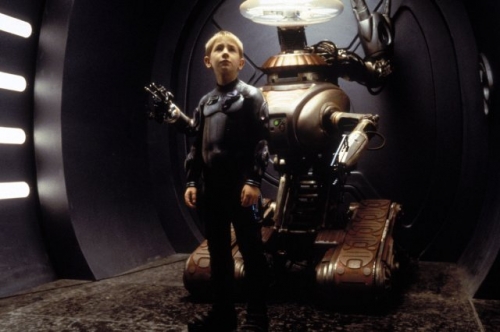
Professor John Robinson (William Hurt) leads a
mission to Alpha Prime to construct the second hypergate. Because of the long duration of the mission -- a decade -- his family comes along aboard the Jupiter 2. Among the crew are his wife Maureen Robinson (Mimi
Rogers), physician Judy Robinson (Heather Graham), petulant teenager Penny (Lacey
Chabert) and boy genius Will (Jack Johnson).
But Professor Robinson’s problems begin when a
new, less-than-cooperative hot shot pilot, Major West (Matt Le Blanc) assumes
the role of pilot on Jupiter 2, and a saboteur from the Global Sedition, Dr.
Smith (Gary Oldman) programs the ship’s Robot (Dick Tufeld) to destroy the
Robinsons once the craft is in flight.
Averting a disaster in space, the Jupiter 2 “jumps”
through the sun and becomes hopelessly lost in space and time. The Robinsons run afoul of strange, alien
spiders on a derelict spaceship, and later crash-land on an inhospitable planet
where they encounter their future, tragically-altered selves.
There -- in that peek into a dark future -- John gets the chance to see how his absence
as a father has affected a grown-up Will.
“There are monsters everywhere...I know, I am
one.”
 Lost in Space
combines a number of plots from the old TV series, including elements of “The
Reluctant Stowaway,” “The Derelict” and any episode in which Dr. Smith makes
trouble for the Robinsons by interfacing with alien biology/technology or
personnel (“Wish Upon A Star,” “Ghost in Space,” “The Space Trader,” “His
Majesty Smith,” “All that Glitters,” “The Dream Monster,” and so on…).
The film, directed by Stephen Hopkins, also
attempts fidelity in terms of production design. The Jupiter 1 in the film looks much like the
TV series’ Jupiter 2, for instance, and before the end of the movie, the newer high-tech robot has been re-built by Will to resemble the popular B9, that
famous “bubble-headed booby” and cousin to Robby the Robot. Even the interiors look like faithful if
updated reconstructions of the 1960s sets, only with more curves and a more
organic feel.
Of all the cast, Le Blanc fares the worst. He is utterly unlikable as West, and given
the worst dialogue to vet. William Hurt seems
bored and disconnected as Professor Robinson.
Mimi Rogers and Heather Graham are okay, and only Gary Oldman absolutely
shines. In fact, Oldman’s version of the
treacherous Dr. Smith character feels like a real tribute to Jonathan Harris,
coming off as arrogantly self-important and straddling the line between good
and evil. Oldman mines considerable
humor and menace from the screenplay, and is the movie’s most valuable player. He's great here.
The most contrived portions of Lost
in Space involve Maureen’s unceasing complaints about John’s “time.” She constantly nags him about spending more
hours with Will, even though she also has two daughters and he doesn’t spend
any time with them, either. So yes, apparently
only young boys, not young girls, require quality time with their father. Who knew the world would be so sexist, still, in 2058? I guess we know who wins the war on women...

The John-needs-to-spend-more-time-with-Will
subplot is a manufactured crisis and a contrivance that isn’t truly believable
given the narrative details. The movie
sort of proves it’s a non-issue when the older Will – even with Spider Smith as a surrogate father – does the right thing
to save the universe and his family. I
guess John imparted some good qualities to his boy in the time he had. He may be "busy" (again, saving the world") but he isn't negligent or absent.
Again, the old series didn’t contend with these “emo”
touches. The Robinsons were essentially space
pioneers and, well, a planet had to be tamed.
John Robinson (Guy Williams) was always there for his son if Will (Bill Mumy) needed him, but there
wasn’t this constant hand-wringing on the TV series about how much time the two were spending
together. Here, the subplot is a little
touchy-feely and unrealistic given the circumstances.
Bottom line: there’s not a lot of time for father-child
closeness when your spaceship is plunging into the sun, battling metal spiders,
crash-landing, or hovering at the edge of a dangerous space-time bubble.
Sorry, kid. Suck it
up.
Even family must, as we all know too well, bow to reality,
and I generally resent movies that suggest everything would be okay if a Dad
and son just spent a little more time together. Meanwhile, the planet is
falling apart….
Another problem with the film is that, in post-production,
apparently, someone decided that the film needed to be funnier. Therefore, we get an
out-of-left-field The Waltons joke (“and good night, John Boy...”) delivered in embarrassed
voice-over. The problem isn't that the joke isn't funny, though it isn't. The problem is that it doesn’t
fit the scene. We get a nice fade-out on
John and Maureen about to have sex, and then the very next instant, we’re onto a sound cue of the same two
characters saying “good night” to each other and the kids, like this is the
galactic Brady Bunch. Like so
much of the film’s humor, it’s groan-inducing.

It’s not just that the creature is composed of
bad CGI. It’s that the visualization of the creature is all wrong for
the earthy production canvas; fanciful and whimsical in a movie of skin-tight body
suits and dark browns and greys.
Despite my reservations about the movie, Lost in Space begins
relatively well. Even though the opening space battle between the Global
Sedition and United Global Space Force is entirely unnecessary, the first hour of
the film establishes well the threat to Earth. The first act boasts a decent pace,
and there’s a respectable level of excitement and anticipation. The battle on the alien derelict
against the metal spiders is also thrilling. From the point, however, in which
John goes into the time bubble, the movie gets lost itself.
Lost and
incoherent.
As the movie ends, Future Will throws Present John
through a time vortex, but it isn’t entirely clear if West already has the power cells
the Jupiter 2 needs for lift-off, if John has them, or if Future Will still has
them. Why is the Jupiter 2 attempting escape velocity without the power
source it needs? Why isn't anyone commenting on, essentially, a suicide run?

Also, Lost in Space never squares the circle in terms of the future. The
robot of the future comes back in time to the Jupiter 2…but in the “real”
timeline, Will never finishes building that robot. So if he does, there will be two robots?
If he doesn’t finish work on the robot, then
where did the robot come from, having never actually been constructed by Will? I’m not saying that this is an unworkable
dilemma, only that the movie might have made note of the time
paradox. A joke about it would have been fine.
As a general premise, Lost in Space boasts great
potential, even today. The idea of a
family alone on an alien world, trying to make a go of things, offers nearly
infinite story ideas. You don’t have to
make the movie schmaltzy, or wall-to-wall action to make the scenario work
effectively. You just need a few
characters you like, some tough conditions, and a sense that – as a
family – the pioneers will stick together and see the mission through,
no matter the challenges. But this Lost
in Space wants to hit you on the head with incongruous platitudes about
family (a lot like the Dark Shadows remake I reviewed on Tuesday…)
and then wow you with special effects explosions.
Although I felt a legitimate thrill hearing Dick Tufeld
voice the Robot again in this film, I remember well 1998 and my discontent
regarding this film. It remains a lost opportunity, and an emotionally hollow adventure.
Danger, Will
Robinson!
award-winning creator of the web series Abnormal Fixation (2024), the audio drama Enter the House Between (2023) and author of 35 books including Horror Films FAQ (2013), Horror Films of the 1990s (2011), Horror Films of the 1980s (2007), TV Year (2007), The Rock and Roll Film Encyclopedia (2007), Mercy in Her Eyes: The Films of Mira Nair (2006),, Best in Show: The Films of Christopher Guest and Company (2004), The Unseen Force: The Films of Sam Raimi (2004), An Askew View: The Films of Kevin Smith (2002), The Encyclopedia of Superheroes on Film & Television (2004), Exploring Space:1999 (1997), An Analytical Guide to TV's Battlestar Galactica (1998), Terror Television (2001), Space:1999 - The Forsaken (2003) and Horror Films of the 1970s (2002).
Tuesday, August 23, 2011
FROM THE ARCHIVE: Don't Be Afraid of the Dark (1973)

This Friday, writer and producer Guillermo Del Toro's horror remake Don't Be Afraid of the Dark hits theaters nationwide. The new film stars Katie Holmes and Guy Pearce, and is based on a great TV-movie from the disco decade.
A perennial in syndication throughout the 1970s, Don't Be Afraid of the Dark - directed by the late, great John Newland (the talent who hosted and directed 96 episodes of the classic paranormal anthology, One Step Beyond) - first aired near Halloween in 1973. I saw it for the first time sometime later, in 1977 or 1978, perhaps, and it absolutely terrorized my young psyche.
The made-for-tv film depicts the chilling tale of Sally Farnum (Kim Darby), a bored housewife. Along with her work-obsessed husband, Alex (Jim Hutton) -- who is devoted to becoming a partner in his law firm -- she moves into her grandmother's grand old country estate. There, she soon discovers an oddity in the basement study: the fireplace is sealed-up. Not just sealed-up, in fact, but barricaded. The bricks are reinforced with iron bars.
"Some things are better left as they are," warns Mr. Harris, the groundskeeper and repairman, "especially that fireplace..."
But Sally wants the fireplace operable, and so unbolts the ash-door on the side of the mantel. As she peers inside the hole with a flashlight, we can detect that the chimney shaft seems to stretch down and down, into blackest darkness. Perhaps all the way down to Hell itself...
Before long, a cadre of hairy, shriveled creatures, "ferocious little animals," as Sally describes them, escape from that abyss and are loosed upon the house. They thrive in darkness, and terrorize Sally. They knock an ashtray from her night stand in the middle of the night; they tug at her skirt and won't let go; they turn off the lights in the bathroom while she's showering. They even go at her with a straight razor.
And then things really escalate: the monstrous gremloids murder the interior decorator, tripping him up on the house's ornate and grand staircase.
But nobody, especially not the work-consumed Alex, believes Sally's fantastic tale that there are tiny monsters inhabiting the house; and worse - that they want to steal "her spirit."
Then, one night, a skeptical Alex finally gets the full-story from old Mr. Harris. Turns out that Sally's grandfather opened up that fireplace once before -- for the first time since the house was constructed in the 1880s, in fact. And he paid the price for his curiosity. One night, his wife heard cries and screams from the downstairs study. And something horrible dragged her husband down into the fireplace shaft. He was never seen again.
"To this day, I think he's still down there..." warns Mr. Harris.
In the conclusion of Don't Be Afraid of the Dark - in a twisted, malevolent variation of imagery straight out of Gulliver's Travels - the gnomes lasso the sedated Sally, and drag her down the stairs, towards that fireplace from Hell, and the long, dark chasm within. She awakens in time to see the rope tying her ankles together, and she clutches the nearby furniture for dear life as her diminutive nemeses tug and tug. She grabs a flash camera and snaps their photograph, exposing them to the damaging light of the flash bulb for an instant...
Arising from the same period in horror film history that gave us the brilliant, and equally chilling Let's Scare Jessica to Death (1973), Don't Be Afraid of the Dark is essentially the tale of a woman trapped in an unhappy and lonely marriage...and slowly but surely losing her grasp on reality (see also: Something Evil).
Sally's husband is mostly absent, and treats her as though she's a slow-witted child. All Alex cares about is that she's the "perfect hostess" for a dinner party, and the film functions literally as a metaphor of an unhappy marital relationship. Little things - literally, little monsters - keep getting in the way of the relationship, driving a wedge between the couple.
The terrifying notion at the heart of Don't Be Afraid of the Dark is the opening of a Pandora's Box, the fear of breaking down a wall and releasing something that can't be put back in its place. Again, without putting too fine a point on it, there's a psychological equivalent to this Pandora's Box (the fireplace...) in the film too.
Specifically, Sally deals with her fears about being just an "adjunct" to the successful, career-obsessed Alex, but her friend, Joan (Barbara Anderson) warns her that she's building "emotional mountains out of imaginary mole hills." Quite the contrary, by probing and questioning the way things are in her marriage, Sally is chipping away at the brick and mortar foundation of unquestioned, traditional male/female roles in such relationships. Just as she takes a hammer and cracks open the bricks in that fireplace, releasing anarchy, chaos and terror, she won't take for granted the status quo in her personal life either. Not unexpectedly, Alex is incapable of doing the same; and in the end, he fails his wife miserably. He loses her to the "darkness."
For a made-for-TV production, Don't Be Afraid of the Dark boasts a fascinating retro film style, a form that enhances its unsettling content. Though the picture is replete with '70s era techniques such as the ubiquitous zoom (which corrupts the frame to a large extent...), director Newland also clearly understood the value of suspense and effective imagery.
On the former front, the creepy little trolls in the basement aren't revealed for the camera (and then only in half-light) until after the thirty minute point of a 74 minute production. On the latter front, I would point to a beautifully-composed shot of the depressed, terrified Sally sitting in a white-walled ante-room. She's bracketed by curtains, and outside them is pervasive darkness; the domain of the little devils. It's clear from this deliberate "bracketing" that Sally's space - even in a large house - is becoming increasingly constricted and small. Much how she feels about her own role in he marriage to Alex.
The gremlins themselves are played by little people (Felix Silla and Patty Maloney, among them.) acting on over-sized, Land of the Giant-sized mock-ups of the Farnum house. This technique actually works rather effectively: the gremlin shots and Sally shots match-up almost perfectly.
Another strength of this tele-film remains the creepy, subtly disturbing musical score composed and performed by Billy Goldenberg. The jolting, macabre music makes effective some scenes that, perhaps, would be staged differently in today's filmmaking milieu.
Don't Be Afraid of the Dark is a retro 1970s horror treat. Made in the epoch such made-for-TV classics as Gargoyles (1972), Duel (1971), Fear No Evil (1969) and yes, Satan's School for Girls (1972). All of these tele-films, including this John Newland entry, featured a cinematic flair and a deep, palpable sense of dread. Hard to believe they were made for TV, and played to mass audiences, including kids. Today, these productions seem more chilling (and filled with disturbing implications) than many theatrical horror flicks. Like I said, this one really terrorized me as a child.
Because, as you may have guessed, there are no happy endings in Don't Be Afraid of the Dark. And that's another reason the film is so chilling, so fear-provoking, to this day. You leave it in abject terror, and you will, in fact, fear the darkness.
I wonder if the Del Toro/Troy Nixey picture will live up to the throat-tightening terror of this one. We'll know more in a few days. The previews certainly look encouraging.
award-winning creator of the web series Abnormal Fixation (2024), the audio drama Enter the House Between (2023) and author of 35 books including Horror Films FAQ (2013), Horror Films of the 1990s (2011), Horror Films of the 1980s (2007), TV Year (2007), The Rock and Roll Film Encyclopedia (2007), Mercy in Her Eyes: The Films of Mira Nair (2006),, Best in Show: The Films of Christopher Guest and Company (2004), The Unseen Force: The Films of Sam Raimi (2004), An Askew View: The Films of Kevin Smith (2002), The Encyclopedia of Superheroes on Film & Television (2004), Exploring Space:1999 (1997), An Analytical Guide to TV's Battlestar Galactica (1998), Terror Television (2001), Space:1999 - The Forsaken (2003) and Horror Films of the 1970s (2002).
Subscribe to:
Posts (Atom)

-
 Director Ridley Scott has already given the science fiction cinema two of its greatest and most cherished films: Alien (1979) and Blade...
-
 "Other Worlds lie outside our seeing; beyond the beyond; on the edge of within. The Great Pyramids: erected by the Ancient Ones as a ba...