


Subscribe To JKM

 Posts
All Comments
Posts
All Comments
Wednesday, February 05, 2020
Goosebumps Halloween Costume and Mask

 award-winning creator of the web series Abnormal Fixation (2024), the audio drama Enter the House Between (2023) and author of 35 books including Horror Films FAQ (2013), Horror Films of the 1990s (2011), Horror Films of the 1980s (2007), TV Year (2007), The Rock and Roll Film Encyclopedia (2007), Mercy in Her Eyes: The Films of Mira Nair (2006),, Best in Show: The Films of Christopher Guest and Company (2004), The Unseen Force: The Films of Sam Raimi (2004), An Askew View: The Films of Kevin Smith (2002), The Encyclopedia of Superheroes on Film & Television (2004), Exploring Space:1999 (1997), An Analytical Guide to TV's Battlestar Galactica (1998), Terror Television (2001), Space:1999 - The Forsaken (2003) and Horror Films of the 1970s (2002).
Video Game of the Week: Goosebumps the Game (Nintendo 3DS)
 award-winning creator of the web series Abnormal Fixation (2024), the audio drama Enter the House Between (2023) and author of 35 books including Horror Films FAQ (2013), Horror Films of the 1990s (2011), Horror Films of the 1980s (2007), TV Year (2007), The Rock and Roll Film Encyclopedia (2007), Mercy in Her Eyes: The Films of Mira Nair (2006),, Best in Show: The Films of Christopher Guest and Company (2004), The Unseen Force: The Films of Sam Raimi (2004), An Askew View: The Films of Kevin Smith (2002), The Encyclopedia of Superheroes on Film & Television (2004), Exploring Space:1999 (1997), An Analytical Guide to TV's Battlestar Galactica (1998), Terror Television (2001), Space:1999 - The Forsaken (2003) and Horror Films of the 1970s (2002).
Trading Cards of the Week: Goosebumps (Topps)
 award-winning creator of the web series Abnormal Fixation (2024), the audio drama Enter the House Between (2023) and author of 35 books including Horror Films FAQ (2013), Horror Films of the 1990s (2011), Horror Films of the 1980s (2007), TV Year (2007), The Rock and Roll Film Encyclopedia (2007), Mercy in Her Eyes: The Films of Mira Nair (2006),, Best in Show: The Films of Christopher Guest and Company (2004), The Unseen Force: The Films of Sam Raimi (2004), An Askew View: The Films of Kevin Smith (2002), The Encyclopedia of Superheroes on Film & Television (2004), Exploring Space:1999 (1997), An Analytical Guide to TV's Battlestar Galactica (1998), Terror Television (2001), Space:1999 - The Forsaken (2003) and Horror Films of the 1970s (2002).
Board Game of the Week: Goosebumps Terror in the Graveyard (Milton Bradley)

 award-winning creator of the web series Abnormal Fixation (2024), the audio drama Enter the House Between (2023) and author of 35 books including Horror Films FAQ (2013), Horror Films of the 1990s (2011), Horror Films of the 1980s (2007), TV Year (2007), The Rock and Roll Film Encyclopedia (2007), Mercy in Her Eyes: The Films of Mira Nair (2006),, Best in Show: The Films of Christopher Guest and Company (2004), The Unseen Force: The Films of Sam Raimi (2004), An Askew View: The Films of Kevin Smith (2002), The Encyclopedia of Superheroes on Film & Television (2004), Exploring Space:1999 (1997), An Analytical Guide to TV's Battlestar Galactica (1998), Terror Television (2001), Space:1999 - The Forsaken (2003) and Horror Films of the 1970s (2002).
Lunch Box of the Week: Goosebumps
 award-winning creator of the web series Abnormal Fixation (2024), the audio drama Enter the House Between (2023) and author of 35 books including Horror Films FAQ (2013), Horror Films of the 1990s (2011), Horror Films of the 1980s (2007), TV Year (2007), The Rock and Roll Film Encyclopedia (2007), Mercy in Her Eyes: The Films of Mira Nair (2006),, Best in Show: The Films of Christopher Guest and Company (2004), The Unseen Force: The Films of Sam Raimi (2004), An Askew View: The Films of Kevin Smith (2002), The Encyclopedia of Superheroes on Film & Television (2004), Exploring Space:1999 (1997), An Analytical Guide to TV's Battlestar Galactica (1998), Terror Television (2001), Space:1999 - The Forsaken (2003) and Horror Films of the 1970s (2002).
Tuesday, February 04, 2020
Buck Rogers: "Mark of the Saurian"

Just as an armistice has been declared between the Directorate and the Saurian Empire, a group of Saurian nationals masquerade in human form, as Ambassador Cabot (Linden Chiles) and his party.
Cabot and his team board the Searcher, and plot to take the exploratory ship into the “restricted zone” near the Delta Quadrant Defense Station. The Saurian plan is to secretly seize control of that station, a weapon so powerful it caused their people to seek peace.
Buck (Gil Gerard), suffering from “Cygnus Fever,” is able to detect the Ambassador and his party as they really are: alien infiltrators.
Although Wilma (Erin Gray) believes Buck’s story, the Searcher crew fears that Rogers is delusional, and even dangerous. They try to keep him in bed, and sedated, while the Saurians seek to stop him.
Meanwhile, Buck attempts to convince his friends that the Saurians are playing the crew for fools…

“Mark of the Saurian” is a solid episode of the second season Buck Rogers (1979-1981) format. Alas, the story also appears regurgitated, almost note for note, from another popular sci-fi series of the disco decade: Space: 1999 (1975-1977).
Fans of that series will certainly remember a Year Two story and two-part episode, called “The Bringers of Wonder.” There, Commander John Koenig (Martin Landau) is injured during an eagle crash, and consigned to Medical Center. While there, he undergoes a head-injury treatment that alters his brainwaves.
At the same time, a ship apparently from Earth, a super swift, nears Moonbase Alpha. It is manned entirely by friends of the Alphans, including Dr. Shaw, Helena Russell’s (Barbara Bain) mentor.
But when Koenig awakens, he doesn’t see human friends from Earth, he sees “monsters from another dimension” who are operating by their own malevolent agenda (a plot to detonate the nuclear waste domes on the moon).
Koenig attempts to convince his friends that he is not delusional or hallucinating, but they fear his injury is affecting his mind. He is out of his head, so-to-speak.
The points of similarity between the two stories are suspiciously numerous.
In both cases, we have the protagonist or hero of the show dealing with an injury/sickness. Koenig has a brain injury. Buck suffers from Cygnus Fever. This is important, because this “condition” is the excuse by which his subordinates fail to heed his warning about enemy infiltrators.
In both cases, one of the key alien infiltrators is a doctor or physician, an individual with access to the sick bay/Medical Center, and so can therefore attempt to harm the sick protagonist. It was Dr. Shaw in “Bringers of Wonder,” and Dr. Moray in “Mark of the Saurian” who commit this act. They both seek to stop the one person who can see the invaders as they really are.
In both cases, a man whose word is absolutely dependable is easily questioned because of the prior incident (brain injury/Cygnus fever), leaving that man to have to act alone, without the support of his friends.


In both cases, the aliens with the secret agenda (to detonate the domes; or take over the Delta Quadrant Defense Station) are only outed when the protagonist manipulates an instrument in the control room to alter the conditions of that room and make the aliens visible to shocked co-workers.
In “Bringers of Wonder,” Koenig uses sonic manipulation in Command Center to allow the Alphans to see the “earthlings” as he sees them...as slimy aliens.
In “Mark of the Saurian,” Buck adjusts the thermostat on the Searcher’s bridge, making it cold. The Saurians -- who are cold-blooded -- collapse, and when unconscious, appear in their true, reptilian form.
In sci-fi TV, many stories are influenced by older stories. Many series offer variations on a theme, or on a trope (like “the silicon based life form,” or the “fight to the death.”) But “Mark of the Saurian” isn’t a variation on a theme so much as it is a straight-up regurgitation of “Bringers of Wonder.” It is a point-by-point repeat.
That fact established, it’s not a bad episode in the scheme of things. Buck, feeling alone, discovers the two people he can truly count on in a crisis: Wilma and Hawk (Thom Christopher), and the episode helps us glean a sense of those friendships.
On the other hand, some questions are indeed left unanswered.
How do the Saurians trick Twiki and Crichton into seeing them as human beings? They are robots, after all, not susceptible to a disguise device that depends, apparently, on "body chemistry."


And since when has the Directorate been at war with the Saurians? And if the Saurians broke the armistice, does that mean the war with the Saurians will resume?
Finally, why is Buck so mean and insulting to his doctor in this episode? He is the worst patient, ever!
Despite such questions, I enjoy some of the call-backs to Season One in "Mark of the Saurian." These include the re-use of the space station miniature from “Space Vampire,” and the re-use of the Directorate dress uniforms, seen as far back as “Awakening.” Also, the Directorate gets a specific name-check.

If only we heard a mention of Dr. Huer.
Fans of 1970s electronic toys will also note that Lakeside’s Computer Perfection makes an extended cameo as a view screen control panel in Searcher’s sick bay. The unmistakable blue and white toy is seen several times at Buck’s bedside, and there are two close-ups of the game’s controls (under a blue hood).

Finally, one might wonder how I can enumerate all the similarities here to Space:1999 and yet still assess this Buck Rogers episode as one of the better second season shows.
The answer is simple. By comparison to efforts like “The Golden Man” or “Shgoratchx!"even a retread like “Mark of the Saurians” is a welcome relief.
award-winning creator of the web series Abnormal Fixation (2024), the audio drama Enter the House Between (2023) and author of 35 books including Horror Films FAQ (2013), Horror Films of the 1990s (2011), Horror Films of the 1980s (2007), TV Year (2007), The Rock and Roll Film Encyclopedia (2007), Mercy in Her Eyes: The Films of Mira Nair (2006),, Best in Show: The Films of Christopher Guest and Company (2004), The Unseen Force: The Films of Sam Raimi (2004), An Askew View: The Films of Kevin Smith (2002), The Encyclopedia of Superheroes on Film & Television (2004), Exploring Space:1999 (1997), An Analytical Guide to TV's Battlestar Galactica (1998), Terror Television (2001), Space:1999 - The Forsaken (2003) and Horror Films of the 1970s (2002).
Monday, February 03, 2020
The Cult-TV Face of: Mustaches
 |
| 1 |
 |
| 2 |
 |
| 3 |
 |
| 4 |
 |
| 5 |
 |
| 6 |
 |
| 7 |
 |
| 8 |
 |
| 9 |
 |
| 10 |
 |
| 11 |
 |
| 12 |
 |
| 13 |
 |
| 14 |
 |
| I5 |
 |
| 15 |
 |
| 16 |
 |
| 17 |
 |
| 18 |
 |
| 19 |
 |
| 20 |
award-winning creator of the web series Abnormal Fixation (2024), the audio drama Enter the House Between (2023) and author of 35 books including Horror Films FAQ (2013), Horror Films of the 1990s (2011), Horror Films of the 1980s (2007), TV Year (2007), The Rock and Roll Film Encyclopedia (2007), Mercy in Her Eyes: The Films of Mira Nair (2006),, Best in Show: The Films of Christopher Guest and Company (2004), The Unseen Force: The Films of Sam Raimi (2004), An Askew View: The Films of Kevin Smith (2002), The Encyclopedia of Superheroes on Film & Television (2004), Exploring Space:1999 (1997), An Analytical Guide to TV's Battlestar Galactica (1998), Terror Television (2001), Space:1999 - The Forsaken (2003) and Horror Films of the 1970s (2002).
Sunday, February 02, 2020
Mission Impossible Intro (1966-1973)

One of the greatest and perhaps most influential TV openings in history comes from the caper TV series Mission: Impossible, created by Bruce Geller.
I remain an ardent admirer of the TV series -- more so than of the film franchise -- because of the team dynamics and the intricacy and cleverness of the plots. The team aspect of the drama gets you rooting for the group, not just a James Bond-like hero, and the intricacy of the Impossible Mission Force strategies generates a surprising level of suspense, even nearly fifty years later.
The primary conceit of the Mission: Impossible opening montage is simple: the fire has been lit, and an explosion is imminent. In the meantime, we get an on-screen countdown of sorts to the fireworks.
Accordingly, the first images of the montage showcase a hand striking a match, and lighting that fire. In this case, that fire is represented by a super-imposed optical effect, a kind of moving white wick that burns from left to right across the screen.
This "lighting of the match" and sparking a "fire" also serve as metaphors, clearly for the show's foreign policy approach.
The IMF force -- without direct legal sanctioning -- goes into action, lighting a fire, essentially, under enemies of America, and then waiting (often patiently...) for those fires to explode.
Only, much like the taped introductions that open each mission (or episode), the fires don't burn America or the IMF team, they cause the "self-destruction" of the enemy instead.


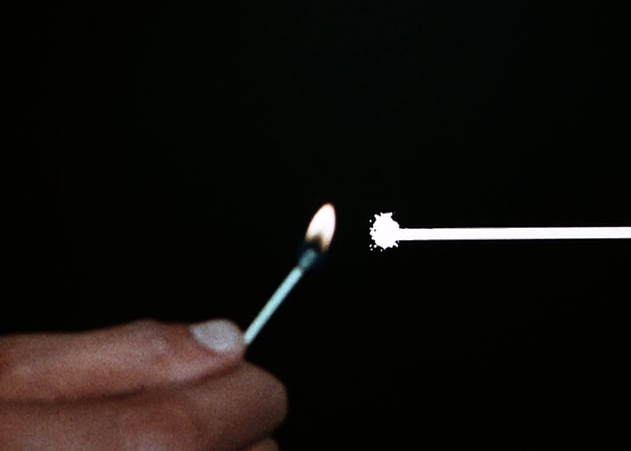

After the match is lit, the wick (with a burning tail...) continues to move across the screen and we are treated to a dazzling, brilliantly-cut montage of images from the episode in question.
The following frames are from the 1968 story "A Game of Chess." These images are cut at a rapid pace, to the music, and generate excitement and tension from the get go.
The following frames are from the 1968 story "A Game of Chess." These images are cut at a rapid pace, to the music, and generate excitement and tension from the get go.
The same technique -- flash-cutting to imagery of a specific episode within the general introductory montage -- has also been used to great effect on another Martin Landau/Barbara Bain series, Space: 1999 (1975 - 1977), and more recently, the re-imagination of Battlestar Galactica (2003 - 2008). I love this technique, it really amps up the excitement for the episode that is about to air. You wonder how all the pieces are going to fit together.
Also, this is a good time to mention that the well-shot images and perfectly-edited "clips" of each episode would not work so well in execution without the unforgettable theme song composed by Lalo Schifrin, which has become iconic in the pop-culture, and has been deployed for the modern feature film series because of its effective generation of suspense.
What you may notice in the following montage is the focus on items, on gadgetry, on tools. We see chess boards, brooches, gold bars, a safe combination, and other tools of the espionage trade.
And this is important to note for historical context. Mission: Impossible arose out of the James Bond fad of the 1960s, and focused on the ways that new (miniaturized) technology, when combined with psychological warfare and spycraft, could change the destiny of a political leader, or even a country.
What you may notice in the following montage is the focus on items, on gadgetry, on tools. We see chess boards, brooches, gold bars, a safe combination, and other tools of the espionage trade.
And this is important to note for historical context. Mission: Impossible arose out of the James Bond fad of the 1960s, and focused on the ways that new (miniaturized) technology, when combined with psychological warfare and spycraft, could change the destiny of a political leader, or even a country.


Next, teletype-style, we get the first word of the series' title typed out. The word is "Mission," and uniquely, the agents conducting the mission appear in title cards which resemble puzzle pieces. These agents -- whom we know only from their work, in the various strategies -- are the puzzle pieces that move around, fulfilling different roles at different times.


Finally, the wick reaches the bomb, and the title of the series literally explodes off the screen. This title layout is, again, something of a pop-culture trademark. It appeared recently, for instance, in Weird Al's video for Word Crimes. Only there, the screen read Mission: Literacy.

 award-winning creator of the web series Abnormal Fixation (2024), the audio drama Enter the House Between (2023) and author of 35 books including Horror Films FAQ (2013), Horror Films of the 1990s (2011), Horror Films of the 1980s (2007), TV Year (2007), The Rock and Roll Film Encyclopedia (2007), Mercy in Her Eyes: The Films of Mira Nair (2006),, Best in Show: The Films of Christopher Guest and Company (2004), The Unseen Force: The Films of Sam Raimi (2004), An Askew View: The Films of Kevin Smith (2002), The Encyclopedia of Superheroes on Film & Television (2004), Exploring Space:1999 (1997), An Analytical Guide to TV's Battlestar Galactica (1998), Terror Television (2001), Space:1999 - The Forsaken (2003) and Horror Films of the 1970s (2002).
Subscribe to:
Posts (Atom)
40 Years Ago: Howard the Duck (1986)
In 1986, the comic-book adaptation Howard the Duck -- executive-produced by George Lucas -- landed in movie theaters with a splat. The f...

-
 It is quite difficult to believe, but in 2024, Ridley Scott’s Alien (1979) turns 45 years old. Perhaps the most amazing thing about Alie...
 -
 It is an indisputable fact that fan service and good drama don’t always go hand-in-hand in the cinema. In fact, sometimes these factors div...