Subscribe To JKM


 Posts
All Comments
Posts
All Comments
Tuesday, June 28, 2016
Movie Trailer: Tarzan Escapes (1936)

 award-winning creator of the web series Abnormal Fixation (2024), the audio drama Enter the House Between (2023) and author of 35 books including Horror Films FAQ (2013), Horror Films of the 1990s (2011), Horror Films of the 1980s (2007), TV Year (2007), The Rock and Roll Film Encyclopedia (2007), Mercy in Her Eyes: The Films of Mira Nair (2006),, Best in Show: The Films of Christopher Guest and Company (2004), The Unseen Force: The Films of Sam Raimi (2004), An Askew View: The Films of Kevin Smith (2002), The Encyclopedia of Superheroes on Film & Television (2004), Exploring Space:1999 (1997), An Analytical Guide to TV's Battlestar Galactica (1998), Terror Television (2001), Space:1999 - The Forsaken (2003) and Horror Films of the 1970s (2002).
Tarzan Week: Tarzan and His Mate (1934)

Tarzan and His Mate (1934) is the finest of the Johnny Weismuller/Maureen O’Sullivan MGM Tarzan movies. It is (shockingly…) frank in its sense of eroticism, and -- for the first time -- brings into sharp focus the franchise’s ongoing central debate or argument about the real nature of white “civilization.”
In
this film -- as in all succeeding MGM Tarzan movies -- white hunters enter the
jungle and bring corruption, avarice and violence with them. They steal, they
lie, and they kill.
And so, finally, audiences come to agree with Tarzan’s assessment: they can’t be considered truly civilized. They don’t live in harmony with nature, and they seek to plunder it for some non-existent thing called “wealth.”
And so, finally, audiences come to agree with Tarzan’s assessment: they can’t be considered truly civilized. They don’t live in harmony with nature, and they seek to plunder it for some non-existent thing called “wealth.”
For
Tarzan, by contrast, “wealth” is his companionship with Jane, the river from which
they get their abundant water, and the sun that warms their skin. He can’t understand civilization’s focus on
material things, like the ivory of the elephants at the sacred graveyard.
It’s
strange how the film’s two ideas work hand-in-hand so well.

Jane
and Tarzan share a very erotic, natural, innocent (but clearly sexual…)
relationship, and the film depicts them in bed together, actually, at one
point. That sense of innocent joy in one
another is contrasted with the white interloper’s sense of greedy avarice.
That
interloper kisses Jane against her will at one point, and ogles her, by light
of lantern, when she strips down in a jungle tent.

Where Tarzan sees Jane as someone he truly loves, Martin Arlington (Paul Cavanaugh), the aforementioned interloper, sees her as another resource of the jungle to use and “own.”

Where Tarzan sees Jane as someone he truly loves, Martin Arlington (Paul Cavanaugh), the aforementioned interloper, sees her as another resource of the jungle to use and “own.”
Tarzan
and His Mate
also features an amazing -- even by today’s standards -- siege-style
conclusion.
Martin’s safari, with Jane in tow, comes under attack by a tribe of lion men who send man-eaters to kill them. The lions charge and leap, most convincingly, as the white hunters (including Holt and Jane) take refuge on a rock formation. That formation is soon breached, and the scenes of lions battling men (and one woman) look remarkably convincing.
Martin’s safari, with Jane in tow, comes under attack by a tribe of lion men who send man-eaters to kill them. The lions charge and leap, most convincingly, as the white hunters (including Holt and Jane) take refuge on a rock formation. That formation is soon breached, and the scenes of lions battling men (and one woman) look remarkably convincing.

Action-packed, legitimately erotic (but not cheaply so, like the Bo Derek Tarzan [1981]), and featuring a social commentary that questions what the word “civilization”
really means, Tarzan and His Mate is the greatest of all Tarzan adventures, and a film
that has lost surprisingly little currency in the eighty-some years since it
premiered.


“These
are animals. They are not human. It’s different.”
A
failed businessman, Martin Arlington (Cavanaugh) joins with hunter Harry Holt (Neil Hamilton) to go beyond the Great Escarpment in search of the legendary
elephant graveyard, where he can gain riches by taking the ivory found
there.
When, another expedition, belonging to a hunter named Van Ness, gets a head-start, Holt and the bankrupt Arlington realize that they need the help of Tarzan (Johnny Weismuller).
They seek out Jane’s (Maureen O’Sullivan) help, hoping she can convince the lord of the jungle to lead them to the graveyard. To convince her to do so, they have brought with them perfume, lipstick, and apparel from England.
When, another expedition, belonging to a hunter named Van Ness, gets a head-start, Holt and the bankrupt Arlington realize that they need the help of Tarzan (Johnny Weismuller).
They seek out Jane’s (Maureen O’Sullivan) help, hoping she can convince the lord of the jungle to lead them to the graveyard. To convince her to do so, they have brought with them perfume, lipstick, and apparel from England.
Tarzan
is not happy with the idea of men robbing the elephant graves, and he and
Arlington clash almost immediately.
Arlington attempts to kill Tarzan, and believes he has succeeded. While Cheetah and other chimps nurse him back to health, Harry and Martin convince Jane to return to England with them.
Arlington attempts to kill Tarzan, and believes he has succeeded. While Cheetah and other chimps nurse him back to health, Harry and Martin convince Jane to return to England with them.
After
looting the elephant graveyard, however, Martin’s safari is confronted by a
hostile tribe, and an attack by man-eating lions.
An injured Tarzan rouses himself for battle, even as Jane, Martin and Holt struggle to fend off the attacking beasts.

An injured Tarzan rouses himself for battle, even as Jane, Martin and Holt struggle to fend off the attacking beasts.

“Tarzan
knows nothing about money. That wouldn’t
mean anything to him.”
In
Tarzan
the Ape Man, James Parker (Jane’s father) and Holt (Hamilton) were seen
as good men who were, essentially, out of their element in wild Africa. They
ultimately forged a peace with Tarzan.
Tarzan and His Mate takes a hard turn away from that paradigm and gives the franchise its first fully-formed white villain: Martin Arlington. He won't be the last character of this type in the series, either.


Tarzan and His Mate takes a hard turn away from that paradigm and gives the franchise its first fully-formed white villain: Martin Arlington. He won't be the last character of this type in the series, either.


The
film was released in 1934, when America was still recovering from the stock
market crash of 1929, and in the throes of the Great Depression. Accordingly, Tarzan and his Mate opens
with Arlington explaining his financial woes to Holt, and his last chance to be
rich.
His “shot” involves the theft of the ivory in the elephant graveyard. So though he has lost his fortune, Martin has learned nothing. His agenda is to climb back to the top of the pack, as soon as possible; at least from an economics standpoint.
His “shot” involves the theft of the ivory in the elephant graveyard. So though he has lost his fortune, Martin has learned nothing. His agenda is to climb back to the top of the pack, as soon as possible; at least from an economics standpoint.
Arlington
is defined, in Tarzan and His Mate by his repetition of extreme violence to achieve
his ends.
First, he shoots dead an African worker who refuses an order, making an example of him to others.
Then, he shoots an elephant in the foot, so that it will instinctively lead him to the graveyard.
And finally, he shoots Tarzan so that the jungle man will not stand in his way collecting the ivory.
Arlington believes, then, that this technology gives him the means to control others, and that his designation as “civilized” gives him the right to command and manipulate others.
First, he shoots dead an African worker who refuses an order, making an example of him to others.
Then, he shoots an elephant in the foot, so that it will instinctively lead him to the graveyard.
And finally, he shoots Tarzan so that the jungle man will not stand in his way collecting the ivory.
Arlington believes, then, that this technology gives him the means to control others, and that his designation as “civilized” gives him the right to command and manipulate others.

Martin
also attempts to steal Jane from both Tarzan and Harry, proving that he boasts
no moral code at all. He also leers over
Jane, when seeing her disrobe in a tent.
He is a man of endless appetites who believes that his privileged
upbringing gives him the right to lie, cheat and steal if it keeps him in
power.
Tarzan
does not think so obsessively about himself.
He thinks, instead, of the elephants, who have the right, he believes, not to have their graveyards desecrated. He also is tender and sweet with Jane upon visiting her father’s grave. Although he is powerful and strong, he is also gentle and caring for others in a way that the so-called “civilized” Martin is not.
He thinks, instead, of the elephants, who have the right, he believes, not to have their graveyards desecrated. He also is tender and sweet with Jane upon visiting her father’s grave. Although he is powerful and strong, he is also gentle and caring for others in a way that the so-called “civilized” Martin is not.
Tarzan
and His Mate is a great adventure, but it is more than a kid’s matinee movie,
for certain.
Early in the film, the adult Cheetah dies to save Jane from a rhino attack. The ape’s child, young Cheetah, mourns her death, and the film doesn’t whitewash this stark moment. Death is part of life in the jungle. Wickedly, the movie also builds suspense by having the young Cheetah encounter a rhino later. Because of the earlier, emotional encounter, this moment gets viewers to the edge of their seats.
Early in the film, the adult Cheetah dies to save Jane from a rhino attack. The ape’s child, young Cheetah, mourns her death, and the film doesn’t whitewash this stark moment. Death is part of life in the jungle. Wickedly, the movie also builds suspense by having the young Cheetah encounter a rhino later. Because of the earlier, emotional encounter, this moment gets viewers to the edge of their seats.
And,
of course, though Tarzan and Jane are true of heart, their interest in each
other is also, well, adult.
Throughout the film, Jane wears an outfit that leaves her nude from midriff to toes, at least from certain angles.

And there is a delightful and revealing swimming scene here in which Jane swims completely in the nude. This is most unexpected, but the moment reminds one of Adam and Eve in the Garden. In any such comparison, Martin would be the snake, bringing lies and deceit to the couple’s world.
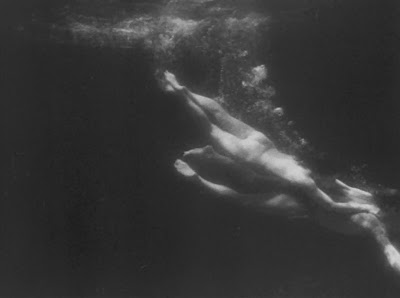
Throughout the film, Jane wears an outfit that leaves her nude from midriff to toes, at least from certain angles.

And there is a delightful and revealing swimming scene here in which Jane swims completely in the nude. This is most unexpected, but the moment reminds one of Adam and Eve in the Garden. In any such comparison, Martin would be the snake, bringing lies and deceit to the couple’s world.

As
I’ve noted, the eroticism is both surprising and, intriguingly, related to the
film’s overall viewpoint about civilization.
It is natural for Jane and Tarzan to be in love, and to express romantic (sexual) love. Arlington’s ardent desire for Jane looks perverse in comparison. The equation in these films is that Tarzan and the jungle represent a kind of innocence and moral code, and that white civilization interferes with that innocence and moral code.
It is natural for Jane and Tarzan to be in love, and to express romantic (sexual) love. Arlington’s ardent desire for Jane looks perverse in comparison. The equation in these films is that Tarzan and the jungle represent a kind of innocence and moral code, and that white civilization interferes with that innocence and moral code.

The
great thing, of course, is that while these deeper ideas are apparent to adults (and film critics too), the kids in the audience can focus on the thrills provided by
rhino stampedes, crocodile attacks and the aforementioned -- and amazingly
choreographed -- siege by lions.
Tarzan and His Mate is my favorite -- and perhaps the best made -- Tarzan movie in cinema history.
Tarzan and His Mate is my favorite -- and perhaps the best made -- Tarzan movie in cinema history.
award-winning creator of the web series Abnormal Fixation (2024), the audio drama Enter the House Between (2023) and author of 35 books including Horror Films FAQ (2013), Horror Films of the 1990s (2011), Horror Films of the 1980s (2007), TV Year (2007), The Rock and Roll Film Encyclopedia (2007), Mercy in Her Eyes: The Films of Mira Nair (2006),, Best in Show: The Films of Christopher Guest and Company (2004), The Unseen Force: The Films of Sam Raimi (2004), An Askew View: The Films of Kevin Smith (2002), The Encyclopedia of Superheroes on Film & Television (2004), Exploring Space:1999 (1997), An Analytical Guide to TV's Battlestar Galactica (1998), Terror Television (2001), Space:1999 - The Forsaken (2003) and Horror Films of the 1970s (2002).
Movie Trailer: Tarzan and His Mate (1934)
award-winning creator of the web series Abnormal Fixation (2024), the audio drama Enter the House Between (2023) and author of 35 books including Horror Films FAQ (2013), Horror Films of the 1990s (2011), Horror Films of the 1980s (2007), TV Year (2007), The Rock and Roll Film Encyclopedia (2007), Mercy in Her Eyes: The Films of Mira Nair (2006),, Best in Show: The Films of Christopher Guest and Company (2004), The Unseen Force: The Films of Sam Raimi (2004), An Askew View: The Films of Kevin Smith (2002), The Encyclopedia of Superheroes on Film & Television (2004), Exploring Space:1999 (1997), An Analytical Guide to TV's Battlestar Galactica (1998), Terror Television (2001), Space:1999 - The Forsaken (2003) and Horror Films of the 1970s (2002).
Monday, June 27, 2016
Late Night Blogging: Tarzan in Pop Culture
award-winning creator of the web series Abnormal Fixation (2024), the audio drama Enter the House Between (2023) and author of 35 books including Horror Films FAQ (2013), Horror Films of the 1990s (2011), Horror Films of the 1980s (2007), TV Year (2007), The Rock and Roll Film Encyclopedia (2007), Mercy in Her Eyes: The Films of Mira Nair (2006),, Best in Show: The Films of Christopher Guest and Company (2004), The Unseen Force: The Films of Sam Raimi (2004), An Askew View: The Films of Kevin Smith (2002), The Encyclopedia of Superheroes on Film & Television (2004), Exploring Space:1999 (1997), An Analytical Guide to TV's Battlestar Galactica (1998), Terror Television (2001), Space:1999 - The Forsaken (2003) and Horror Films of the 1970s (2002).
Tarzan Week: The MGM Tarzan Movie Matrix

Tarzan
the Ape Man (1932)
|
Tarzan
and His Mate (1934)
|
Tarzan
Escapes (1936)
|
Tarzan
Finds a Son! (1939)
|
Tarzan’s
Secret Treasure (1941)
|
Tarzan’s
New York Adventure (1942)
|
|
A
character falls to death from mountains of Great Escarpment
|
Yes
|
Yes
|
Yes
|
No
|
No
|
No
|
The
movie opens in the Residency
|
Yes
|
Yes
|
Yes
|
No
|
No
|
No
|
Someone
Tries to Convince Jane or Boy to return to Europe
|
Yes
|
Yes
|
Yes
|
Yes
|
No
|
No
|
Tarzan
and Jane go for a swim
|
Yes
|
Yes
|
Yes
|
Yes
|
Yes
|
Yes
|
White
society is Corrupt
|
Not Entirely
|
Yes: Arlington
|
Yes: Frye
|
Yes:Lancing
|
Yes: Thieves
|
Yes: Circus Owner
|
Rhino
attack
|
No
|
Yes
|
Yes
|
Yes
|
No
|
No
|
Climactic
Battle Against Hostile Tribe
|
Yes: Pygmies
|
Yes
|
Yes
|
Yes: Zambeli
|
Yes
|
No
|
We
Hear Tarzan’s Yell Before We See Him
|
Yes
|
Yes
|
Yes
|
Yes
|
No
|
No
|
Elephant
Grave Yard
|
Yes
|
Yes
|
No
|
No
|
No
|
No
|
Fish
Out of Water
|
Yes (Jane)
|
No
|
No
|
No
|
No
|
Yes (Tarzan)
|
award-winning creator of the web series Abnormal Fixation (2024), the audio drama Enter the House Between (2023) and author of 35 books including Horror Films FAQ (2013), Horror Films of the 1990s (2011), Horror Films of the 1980s (2007), TV Year (2007), The Rock and Roll Film Encyclopedia (2007), Mercy in Her Eyes: The Films of Mira Nair (2006),, Best in Show: The Films of Christopher Guest and Company (2004), The Unseen Force: The Films of Sam Raimi (2004), An Askew View: The Films of Kevin Smith (2002), The Encyclopedia of Superheroes on Film & Television (2004), Exploring Space:1999 (1997), An Analytical Guide to TV's Battlestar Galactica (1998), Terror Television (2001), Space:1999 - The Forsaken (2003) and Horror Films of the 1970s (2002).
Tarzan Week: Tarzan the Ape Man (1932)

Young
Jane Parker (Maureen O’Sullivan) joins her father, James Parker (C. Aubrey
Smith) and great hunter Harry Holt (Neil Hamilton) on a safari to the Great
Escarpment and beyond to discover “the
secret graveyard of the elephants,” where ivory is so plentiful it could “supply the world.”
En
route, Jane’s party grapples with angry hippos, and other dangerous wild-life.
But she also encounters a wild jungle man --
Tarzan of the apes (Johnny Weismuller) -- and becomes fascinated with him.
Tarzan kidnaps Jane for a time, but reveals his gentle and protective heart, and
the two begin to fall in love.
And, as
Jane soon learns, Tarzan is also able to communicate with the animals of the jungle,
including apes like Cheetah, and elephants.
Soon,
however, Jane, Harry, and James are attacked by hostile pygmies, and taken to a
village where they are forced to combat a deadly gorilla in a pit.
Tarzan comes to the rescue with an army of
elephants, but Jane’s father dies.
James
Parker is buried in the elephant graveyard, which Tarzan protects, and Jane
decides to remain with Tarzan in the jungle while Harry begins the long journey
home.

Tarzan
the Ape Man
(1932) is a good starting point for the cinematic adventures of Johnny
Weismuller’s Tarzan and Maureen O'Sullivan's Jane, but not, ultimately, as strong a work of art as its amazing 1934
follow-up, Tarzan and His Mate.
Two
qualities stand out, primarily, involving this first film today.
The
first is the remarkable chemistry between Weismuller and O’Sullivan.
There’s a
scene here in which Tarzan and Jane frolic in a river together, and it is downright electric; cinematic foreplay of the highest order.
The scene works so effectively because of
Tarzan’s abundant physical strength and sense of playfulness, and Jane’s sense of
emotional, mental strength. She keeps
resisting Tarzan, for fear of giving in, and he keeps pulling her closer.
I
could watch Weismuller and O’Sulivan in these roles forever, and not get tired
of their interplay.


And
the second value apparent in Tarzan the Ape Man is the absolute resourcefulness of the production.
In
this regard, the film crew never actually left California, and yet a wild
eco-system is depicted well via stock-footage, rear-projection, matte
paintings, trained animals, and wooded locales.
The film’s action is also intense, and virtually non-stop. Today we are used to and even inured to films that move a mile-a-minute, and yet Tarzan the Ape Man, made more than eighty years ago, still
moves at an amazing clip.
The
black-and-white photography mostly hides the seams in terms of matte paintings
and stock footage, and the stunt work is exquisite. Only occasionally can one make out (in the
distance) that Tarzan is swinging from a trapeze, and not a vine. The scenes with Tarzan outrunning or fighting animals are mostly very effective, and convincing.

It
is true, alas, that Tarzan the Ape Man is racist and sexist in the ways one might entirely expect of a film crafted in 1932. The
film’s finale features pygmies who are actually Caucasian dwarfs in black-face
make-up, for example.
And
upon Jane’s first appearance in the film, there is a visual joke about her
luggage, and the fact that, as a woman, she has over packed for her stay in
Africa.
Without
being an apologist, I hope, I would simply note that Tarzan the Ape Man, like
all works of art, is a reflection of the time period that produced it.
There
was no intent to be racist or sexist, but if you come into a fresh viewing of the
film in 2016, you may be shocked at some moments, such as the one in which
black safari servants are whipped by their white masters, or a character openly
expresses the idea that only white people have feelings.
The
film certainly isn’t PC, either.
One action scene sees the hunters (including
Jane) killing an attacking group of swimming hippos with their rifles. No such scene
featuring humans slaughtering animals (even unfriendly ones) would pass muster
in Hollywood today.

A
pre-code film, Tarzan the Ape Man pushes the envelope in terms of Jane’s
character in several ways. She strips down, for instance, in the Residency, and
is seen wearing a very sheer slip. She
leans over, in front of the camera, and little is left to the imagination.
In broader terms, Jane and Tarzan clearly
have “relations” in the film, without the word “marriage” ever entering the
picture.
In
some ways, the depiction of Jane is, actually, rather progressive. She is depicted,
for example, as a great shot with a rifle.
Also, she ultimately decides, without male interference, what she wants
in terms of a future. She doesn’t let some external sense of “civilization”
impact her choices.
It’s
also a delight to report that Jane gets the most, and best dialogue in the
film, perhaps because Tarzan is mostly reduced to grunts and gestures. The film
defines her, in terms of dialogue, as “capable and strong.”
Here,
Tarzan is not the dignified, English-speaking character of Burroughs, but more
a traditional wild man. As the film
series go on, we see that Tarzan possesses a very pronounced moral code, and
sense of right and wrong. He is not a savage. But he is also not a product of
WASP culture.
What
makes the Tarzan myth, as embodied in this film, so compelling?

For
one thing, this is a story of frontier’s edge. Tarzan lives far “beyond the last outpost of humanity” at
the Great Escarpment, a “sheer cliff,
which legend says rises from the plains to support the stars.”
He lives in a place of exploration, beyond
the rules and bureaucracy of modern human culture. In that place of legends there is the promise
of lost treasure, golden cities, forgotten people with strange customs, and
animals never before seen by human eyes.
This is the “heart” of adventure: a location on the very edge of the
world.
Also,
Tarzan, at least seen here, is visual human evidence that there is another way to live.
Tarzan lives in peace and communion with the animal world. This is not to say
that there aren’t battles with lions, crocodiles, gorillas and the like, only
that Tarzan respects the rues and inhabitants of the jungle, and they respect
him.
There is a refreshing
straight-forwardness, let’s say about these rules, or laws. In all the MGM Tarzan films, duplicity,
betrayal, avarice and other negative human traits only come into the picture
with the arrival of white men.
Tarzan
is also a paragon of the male of the species. He is strong, courageous,
true-of-heart, faithful, and endlessly loyal.
All the things that make a man act contrary to that nature in the “stone
jungles” of modern life have not turned his heart away from purity. He is not reduced by the smallness of
civilization, but rather the king of the jungle…as big and heroic as can be.
Clearly,
Tarzan is a wish fulfillment figure for men and women.
Men want to be him, and women want to be with
him, as has often been stated of James Bond.
Why is Tarzan attractive to women, generally?
According to my wife, it is because he loves
Jane without reservation, without end and would sacrifice his life for her…literally
on a daily basis. He is beautiful, physically, and offers her complete,
unconditional adoration and commitment. He has eyes only for her. He forgives her, too, when she trespasses
(see: Tarzan Finds a Son).
Tarzan
and the Ape Man
introduces the franchise’s cast of characters and environs, and does a splendid
job, despite the fact that time has passed by some of its humor and
observations about race and sex.
As I
noted above, I prefer the second film, Tarzan and His Mate, but this film
nonetheless made history and began a great run of adventure films in the 1930s.
award-winning creator of the web series Abnormal Fixation (2024), the audio drama Enter the House Between (2023) and author of 35 books including Horror Films FAQ (2013), Horror Films of the 1990s (2011), Horror Films of the 1980s (2007), TV Year (2007), The Rock and Roll Film Encyclopedia (2007), Mercy in Her Eyes: The Films of Mira Nair (2006),, Best in Show: The Films of Christopher Guest and Company (2004), The Unseen Force: The Films of Sam Raimi (2004), An Askew View: The Films of Kevin Smith (2002), The Encyclopedia of Superheroes on Film & Television (2004), Exploring Space:1999 (1997), An Analytical Guide to TV's Battlestar Galactica (1998), Terror Television (2001), Space:1999 - The Forsaken (2003) and Horror Films of the 1970s (2002).
Movie Trailer: Tarzan the Ape Man (1932)
award-winning creator of the web series Abnormal Fixation (2024), the audio drama Enter the House Between (2023) and author of 35 books including Horror Films FAQ (2013), Horror Films of the 1990s (2011), Horror Films of the 1980s (2007), TV Year (2007), The Rock and Roll Film Encyclopedia (2007), Mercy in Her Eyes: The Films of Mira Nair (2006),, Best in Show: The Films of Christopher Guest and Company (2004), The Unseen Force: The Films of Sam Raimi (2004), An Askew View: The Films of Kevin Smith (2002), The Encyclopedia of Superheroes on Film & Television (2004), Exploring Space:1999 (1997), An Analytical Guide to TV's Battlestar Galactica (1998), Terror Television (2001), Space:1999 - The Forsaken (2003) and Horror Films of the 1970s (2002).
Guest Post: Not the Ape Man You're Looking For (Tarzan Week)

Not The Ape You’re Looking for:
Edgar Rice Burroughs’ Original Tarzan
By Cassie Phillips
“I found a little book I could just afford, and I bought it,
and I took it home. And I climbed up my favorite tree, and I read that book
from cover to cover. And that was Tarzan
of the Apes (1912). I immediately fell in love with Tarzan.”

As
the new film The
Legend of Tarzan
is being released this week, it is a good time to discuss how the film could
potentially interact with the source material created by Edgar Rice Burroughs.
This
2016 Tarzan film will not be an origin story; instead it appears to focus on
what happens after he leaves the jungle, which is in some ways closer than one
would think to the original story.
Let’s
take a look at the original work and how it has evolved over the years:

Far Older Than You Think
To
understand Tarzan in the modern day and how to approach it from a literary
standpoint, we need to understand the time-frame during which it was written.
The
first book was published in 1912, when there were still uncharted corners of
the world and unexplored jungles. Anything was possible, and the thought of a
man raised by apes was entirely plausible to the readers of the epoch.
The
idea of a man living and surviving in the jungle after being raised by apes was
extraordinary, and it was part of a trend -- alongside the likes of H.G. Wells
and Jules Verne -- that involved taking the forming thoughts of adventure and
science fiction and walking the line of human knowledge.
Exotic
locations and strange tales make for interesting stories, and at the time of
writing, the deep jungles were perfect.
It
takes a lot more to evoke that sense of wonder today. We’re hardly impressed by
major blockbuster effects, even, so it’ll be interesting to see how modern
filmmakers take on this old character and a world that many modern viewers may
not even consider, strictly, “fantastic.”

A Pulp Tradition of a Prolific
Series
Some
writers today will write a sequel or make a series out of a book if it happens
to be successful.
With
his Tarzan
books, Burroughs created a small empire that spanned across at least twenty-four
books, depending on what you count (other works were considered official to the
canon but were not penned by the creator).
This
canon simultaneously gave future creators a lot of material to work with and
thinned out some of the quality of the series (not all the books met the
first’s high standards…).
This
was moderately common with successful pulp works, as Burroughs’ other famous
protagonist, John Carter, received similar treatment. The literary standards
weren't so high, nor was the reading level of the intended audience. This
wasn't a series about great themes as much as it was about big adventures.
Throughout
the novels, Tarzan travels around the world, has a son and makes a series of
allies and enemies too long to list fully list.
Here’s
a brief overview however, of some important background and adventures in
Tarzan’s world.
Firstly,
Tarzan is actually John Clayton, son of English parents John and Alice Clayton.
When
they are killed in Africa, John – as a child -- is raised by a she-ape of the
Mangani, named Kala.
Jack’s
ape name is “Tarzan,” which means “White Skin.” Raised by the apes, Tarzan possesses
many incredible physical skills. We all know, from pop culture allusions and
movie history that he swings adroitly from vines. But Tarzan is also agile, and possessed of
great speed and discipline.
After
the first book, Tarzan of the Apes (1912), wherein Tarzan first meets Jane
Porter and takes her back to Baltimore (her home, rather than England, as in
the Weismuller films), he is adopted into the Waziri Tribe. In The Return of Tarzan (1913), the
lord of the jungle helps the Waziri stave off ivory raiders.
After
marrying Jane, and having a son with her, Jack (jungle name: “Korak,”) Tarzan
saves his family from Russian kidnappers and foes, characters who recur in more
than one book.
By
the late 1910s, the Tarzan adventures
began to feature more overt fantasy elements.
There was one, in particular, that recurred: the lost city or kingdom.
In
1918’s Tarzan and the Jewels of Opar, for example, Tarzan encountered
a colony from the lost continent of Atlantis and a much-desired source of
gold.

In
Tarzan
and the Lost Empire, he found a colony of the Roman Empire in Africa. And
In Tarzan
at the Earth’s Core (1930), he crossed over into the land of
Pellucidar, from another Burroughs literary franchise.
In
Tarzan
and the City of Gold (1932), Tarzan butted heads with the evil queen
Nemone in Cathne (the titular city of gold) and sought to help the metropolis
of Athne (the City of Ivory).

By
the end of the literary series in the mid-1930s, Tarzan had, literally, become
an immortal being. This is ironic, since
he also seems to be an immortal character in our pop culture psyche.

Themes Over the Years
There
are a couple of themes over the years that you’ll want to keep on the lookout
for in the literary Tarzan, and its latest cinematic offspring.
The
first is that of man’s inner nature.
In particular: after being raised in the wild, is Tarzan is still a man on the
inside? Can someone adapt (or rather…evolve) from such a state of wildness? At
what point does instinct take over in a dangerous situation? In other words, though Tarzan is a man, will
he always be one with the jungle?
Then
there are the themes of exploration and
the unknown. What right does man have to explore nature and interfere with
it? Certainly, this theme was hit hard in the Tarzan films of the
1930s and early 1940s, as white hunters and raiders sought to loot the
treasures of the jungle, including the ivory found in the sacred and mysterious
graveyard of the elephants.
When
man and nature interact, who is in the
right? While these themes and questions might not have been intended in the
original texts, they do organically appear to anyone who is familiar with this
work.
More
importantly, in the new film -- as it has historically -- will adventure come first?
Will
the hero possess the same bravery and feral nature as before, or will there be
a shift based on creative needs?
Will
the values in the older works be acceptable to today’s audiences if they are
displayed onscreen?
Significantly,
a key aspect of Tarzan has always been adventure, or action. Gore Vidal, writing “Tarzan
Revisited” in Esquire in 2008, commented on how visceral the
Tarzan books remain in terms of their
action. He wrote, regarding Burroughs:
“[H]e does have a gift very few writers of any kind possess: he
can describe action vividly. I give away no trade secrets when I say that this
is difficulty for a Tolstoi as it is for a Burroughs (even William). Because it
is so hard, the craftier contemporary novelists usually prefer to tell their
stories in the first person, which is simply writing dialogue. In character, as
it were, the writer settles for an impression of what happened rather than
creating the sense of a happening. Tarzan in action is excellent.”

The Future of Tarzan
We
can't expect this 2016 edition to be the last Tarzan movie. The character is
far too established in our cultural memory, and other directors will take their
chances in future generations. Will future works lead us -- and Tarzan -- into
the modern day?
Will
we see a return to the hero as originally intended in the pages of Burroughs?
Will this 2016 take affect the global perception of the character?
Only
time will tell, and we should look forward to finding out the answers.
As
readers, do you have any thoughts as to what Tarzan means in today’s world? Are
there any adaptations that are your favorites or that you would like to draw
attention to? Have you read the original works?
Please
let us know what you think and leave a comment below.
Bio: Cassie Phillips is a tech
and entertainment writer who primarily writes for Culture Coverage
and Secure
Thoughts. She enjoys taking a look at old works to see how
they still interact with today's pop culture.
award-winning creator of the web series Abnormal Fixation (2024), the audio drama Enter the House Between (2023) and author of 35 books including Horror Films FAQ (2013), Horror Films of the 1990s (2011), Horror Films of the 1980s (2007), TV Year (2007), The Rock and Roll Film Encyclopedia (2007), Mercy in Her Eyes: The Films of Mira Nair (2006),, Best in Show: The Films of Christopher Guest and Company (2004), The Unseen Force: The Films of Sam Raimi (2004), An Askew View: The Films of Kevin Smith (2002), The Encyclopedia of Superheroes on Film & Television (2004), Exploring Space:1999 (1997), An Analytical Guide to TV's Battlestar Galactica (1998), Terror Television (2001), Space:1999 - The Forsaken (2003) and Horror Films of the 1970s (2002).
Subscribe to:
Posts (Atom)
30 Years Ago: The X-Files: "Home" (October 11, 1996)
“They really went caveman on him…” - Mulder in “Home.” I make no bones about the fact that “Home,” written by Glen Morgan and Jam...

-
 Director Ridley Scott has already given the science fiction cinema two of its greatest and most cherished films: Alien (1979) and Blade...
 -
 "Other Worlds lie outside our seeing; beyond the beyond; on the edge of within. The Great Pyramids: erected by the Ancient Ones as a ba...