Saturday, October 31, 2015

Happy Halloween, 2015; Quinn Martin's Tales of the Unexpected: "Force of Evil"


“In everyone, it has been said, there is a spark of the divine…But in others it is snuffed out.  Another force begins to stir…a force of evil.”
-      
    Opening narration of “Force of Evil,” from Quinn Martin’s Tales of the Unexpected (1977).


Perhaps the oddest episode of the short-lived Quinn Martin’s Tales of the Unexpected (1977) -- and therefore the most enduring -- is the two-part epic titled “Force of Evil.” 

Good Times released this feature-length story on VHS in the mid-1980s, all while keeping intact the series’ opening credits and voice-over narration (from baritone William Conrad).

But the fact that “Force of Evil” ended up on videotape as a stand-alone “feature” isn’t the only quality that has rendered this particular episode immortal. For those who have seen it, the episode (by Robert Malcolm Young) is unforgettable because it largely plays as a G-rated, TV version of the great psychological horror film, Cape Fear (1962). 

In that classic film, a lawyer named Sam Bowden (Gregory Peck) is stalked and pursued by Max Cady (Robert Mitchum), because Sam testified against the criminal in court. 

Now, Max Cady makes Sam’s life a living hell, and threatens the lawyer’s family.  The story ends in a conflict on a house-boat.  A remake from Martin Scorsese came along in 1991, with Robert De Niro playing Cady.

“Force of Evil” stars Lloyd Bridges as Dr. Carrington, a physician who has also testified against a criminal, Ted Jakes (William Watson)…who has now been released.  Ted immediately starts to make Carrington’s life a living hell by threatening his family, including his teenage daughter Cindy (Eve Plumb of The Brady Bunch).

In Cape Fear, Cady killed the Bowden’s pet dog. In “Force of Evil” Jakes burns down the family’s horse stable. 

Amazingly, “Force of Evil” comes to an end with Carrington also sending his family to hide on a houseboat, where Jakes ultimately shows up, and a final confrontation ensues in the surf.

The narrative details in common between productions are numerous, but “Force of Evil” distinguishes itself in a few ways. 

First, since this is a TV production, there is no way to depict any real physical violence, especially against children.  Instead, Carrington and Jakes just kind of endlessly brawl in “Force of Evil,” with neither achieving the upper hand.  The violence is pure TV western fisticuffs.  And because this is a TV show, no mention is ever made of what Jakes actually does to his victims?  Rape? Molestation? Murder?  We just know that he’s a really bad guy.

In the second instance, “Force of Evil” suggests that its villain, Teddy Jakes, is no ordinary man, but some kind of spectral avenger, literally a force of evil.  Dr. Carrington and his brother, a sheriff, attempt to kill Teddy and dump his body in a well.  But like Michael Myers in Halloween, Teddy Jakes just won’t die.  He keeps attacking, even though “by every law of human physiology” he should be dead.   The episode provides some nice visuals as clues to Jakes’ inhuman nature.  At one point, the episode surges towards him from a slightly low angle, while he stands stationary in the desert, and we get a sense of his powerful nature.  Also, throughout most of the episode Jakes wears sun-glasses, which hide “the window to the soul,” his eyes.

Finally, the episode ends on an ambiguous note.  Jakes’ body disappears, and so audiences can’t be certain if he is really good for gone, or merely waiting to deliver another strike. 

As the episode ends, Carrington’s wife receives a box of flowers.  Before we know what is in that closed box, however, the narrator Conrad, closes up shop:  “If you believe in the goodness of man, then the box contains roses.  But if you believe in a force of evil…it could contain almost anything!”

Cue End Credits.


I don’t know exactly precisely, but “Force of Evil” really fascinates me.  It is such an obvious cribbing of Cape Fear and yet, on some basic level, it is effective, and plays like a nightmare from which you can’t awake.  Even the inconclusive nature of the violence – made for television – reinforces the idea that this is some kind of surreal of dream event, and that Jakes can’t be stopped.  I also credit William Watson for delivering a great sleazy performance as Jakes.  He constantly snaps his gum and wears a shit-eating grin. 

Watching him scene-to-scene, you want to punch Jakes’ lights out too.

Adding to the notion that “Force of Evil” is some kind of dream-story, there is no logic whatsoever behind the narrative.  Carrington’s brother, the Sheriff (John Anderson), keeps claiming that there’s nothing the law can to do to stop Jakes.  But Jakes’ throws Carrington’s wife (Pat Crowley) down a well, and she could certainly testify to that fact.


Similarly, Jakes kills the Sheriff, but Carrington never notifies any police department of this fact.  The belief that “the law can’t do anything!” pervades this production even when the facts of the narrative overtly suggest otherwise, and that’s a byproduct of the episode’s origins in the cynical post-Dirty Harry mid-1970s, I would suggest.  In that paranoid world, only the criminals have rights, and the rest of us have to fend for ourselves, even against -- wait for it -- “a force of evil.”

Over the years, I have watched “Force of Evil” probably three or four times, and I have no idea why I keep going to the trouble to haul out the VC.  I feel very conflicted about the merits of the thing and yet I am drawn, periodically, to re-experience it.   

To some extent, my desire to see “Force of Evil” again and again must arise from the episode’s surreal, dream-like air.  The idea of being faced with a cackling monster that just won’t die remains good nightmare fodder, I guess.

“Force of Evil” is the only episode of Tales from the Unexpected you can purchase commercially today (on the second hand market, however), but it sure would be nice to get an official DVD release of the series one of these days.

Happy Halloween, 2015: The Evil Touch: "They" (1974)


This half-hour program aired in the early 1970s in syndication (1973-1974) and was made in Australia by American producer Mende Brown. The series featured a variety of American guest stars including Darren McGavin, Ray Walston, Vic Morrow and Leslie Nielson. 

The series was hosted by Anthony Quayle, who would walk out from a black background to address the audience during each installment (usually behind wisps of what appeared to be blue cigarette smoke...), and introduce and conclude each macabre story. His typical end note reminded audiences that "there is a touch of evil in all of us." Then, sardonically, he would add "Good night. Pleasant dreams."

Perhaps the weirdest entry of The Evil Touch (and that's quite an honor given some of the stories...) was "They", which aired in the New York market on June 2, 1974, and was written by Norman Thaddeus Vane and directed by Mende Brown.

Harry Guardino stars as Dr. Fenton, a man who is on vacation in the English countryside with his young son, Peter...a boy who has dreamed of the remote landscape and even the old English village that is their destination.


Just recently, a series of deaths have occurred there on the moors, on the rocks overlooking the ocean side. Narrator Quayle ponders "They say the sea can kill you," and then meditates on the nature of fate. "What makes people travel long distances?" He asks. "Is it destiny that leads them, or is the journey part of their destiny?"
Once you get your mind around that question, "They" descends into a world of barely linear storytelling that, despite this unconventional quirk, is actually quite compellingly surreal and horrifying; perhaps because it feels so dreamlike; or more accurately, nightmarish.

What happens next in the story is that Peter gets lost on the moors and runs into a cult of malevolent children who wear rings of black make-up around their eyes...a sort of quasi punk affectation. They (the children) are led by a porcelain young beauty, a black-haired wraith called Lydia (Alexandra Hynes). She has already met Peter in his dreams. "I've come to show you my favorite game," she tells young Peter in one nocturnal visit to his bedroom. "It's called...touch."

Anyway, Lydia and her cult of evil children want to initiate Peter into their "new order" and so therefore play another game with him, this time "blind man's bluff," to see if he is worthy of membership. Blind-folded, Peter almost walks off the cliff where the other five corpses were found dead, but his father, Dr. Fenton, finds him and rescues him as he is about to take a giant step for child-kind.

The boy and his father flee to what they hope is safety in a nearby cottage and lighthouse, only to discover that it is the residence of Lydia and her minions. What follows is a confrontation between Fenton and Lydia for possession of Peter's soul.

 “They” plays like Village of the Damned meets Lord of the Flies meets The Wicker Man on acid at Marshall Applewhite's Heaven's Gate.

And dammit if it isn't effectively unnerving.

Lydia tells Dr. Fenton - who is a renowned advocate and lecturer on the subject of birth control (because overpopulation leads to starvation and "the population bomb," he says, "is more dangerous than the atom bomb,") - that they are enemies.

She is the leader of "the Children of the New Order," a new cult with dozens of groups across England alone. The children of the new order have given up on the Old Ones (meaning grown-ups) and are converting children to their cause. They want a world of perfection...a world of children.

One-upping the Hippie generation in their philosophy, they believe that they can't trust anyone over fifteen...that with age comes corruption. The age of twelve is considered middle-aged by these kids.

Dr. Fenton attempts to reason with Lydia, "where do you get the experience, the maturity to rule?" He asks. Experience is sorrow, the cult suggests, maturity unnecessary.

In the final battle, Peter breaks Lydia's spell over him, and he and Dr. Fenton escape to the moors. But suddenly Dr. Fenton is trampled by a local bookshop owner whom Lydia has maliciously transformed into a wild pony (don't ask...). And then...on the bluff overlooking his father's corpse, Peter dons the black eye shadow and... joins "They.”

In closing, Quayle - our host - says "They are probably still somewhere on the moors..."

This it feels very 1970s in a lot of ways, and that's the era that the great Irish poet (and story editor on Space:1999), Johnny Byrne often called "the wake-up from the hippie dream." The Evil Touch's "They" portrays a generational clash in a world of limited resources, and does so in the language of "cultism."

The great civic leaders of the 1960s (JFK, Robert Kennedy, MLK), had been replaced by radical cult leaders like Charles Manson, Jim Jones and the like. It was an era of war (Vietnam), scandal (Watergate), and an Energy Crisis, and there was a feeling that things had to change in a drastic, revolutionary way, if the human race was to survive the next decade.

That's how cult leaders became powerful, because people were seeking answers in unconventional places. Of course, we did survive that era...but "They" plays into a fear of the impending end of the world, of an insurgency from "within" and it does so in the unsettling language of dreamscapes and phantasms.

Fenton's murder by the horse, for example, is cut as a lyrical montage, utilizing slow-motion photography, extreme close-ups of the horse braying, and a super-imposed close-up of Fenton's agonized face as he is crushed.

Additionally, there are jump-cuts, flashbacks and other "trippy" film techniques here that we associate from the disco decade era, and the film grain, naturalistic approach and isolated, picturesque setting all add-up to something strangely disturbing. The gaps in conventional narrative are filled in by the imagination, and the result is something that - no matter how weird (and it is very weird...) deserves to be considered artistic.

Not many people remember The Evil Touch, and that's shame because it often told very weird stories like "They," on a super-low budget.

But with that super-low budget came a super zeal and energy that the most expensive series mysteriously find difficult to replicate. The Evil Touch's "Kadaitcha Country" pitted Leif Erickson (as a Christian missionary) against an aborigine God in the Australian outback; "The Trial" found a haughty tycoon (with a secret) Ray Walston trapped in a nighttime carnival and pursued by a discredited brain surgeon-turned-tattoo-artist who wanted to perform a lobotomy on him.


Another good one, "A Game of Hearts" saw a surgeon, Darren McGavin, terrorized by a donor (jokingly named Skorzeny) whose heart he had transplanted to another patient. These synopses make the whole enterprise sound strange, I guess, but The Evil Touch is strange in its own gloriously individual way...and I love that.

Happy Halloween, 2015: Ghost Story/Circle of Fear: "Alter Ego"


Ghost Story/Circle of Fear fires on all thrusters with the chilling “Alter-Ego,” a macabre story about a kindly old school teacher named Miss Gilden (Helen Hayes) who unexpectedly grapples with a young student’s villainous doppelganger. 


At Mansfield House, our host Winston Essex (Sebastian Cabot) introduces the episode. Essex discusses the origins of chess, a deceivingly “harmless” game.  But, he notes, chess is based on war games: attack, defend…capture…checkmate.  It requires two players “under ordinary circumstances,” he opines, but in the upcoming story, the circumstances will be far from ordinary…

The horror commences when young Bobby Cameron (Michael-James Wixted) is sidelined by an accident and forced to stay home from school for a long stretch of time.  Bobby’s parents don’t know how to relate to the boy, or even how to really talk to him, and the boy’s loneliness grows and grows and grows. 

One day, while playing chess by himself in his room, Bobby is surprised to see an exact duplicate appear there.  Unlike the real Bobby, the doppelganger is sinister, secretive, and tricky.  Worse, the evil double seems to know all of Bobby’s thoughts.


When Bobby innocently makes a remark about how much he likes his elementary school teacher, Miss Gilden, the sinister twin heads off to school to make the instructor’s life a living hell.  The doppelganger quickly proves a distraction in class, but then sets about framing Miss Gilden for using force against him.  His plan is successful, and Miss Gilden is fired from her long-held teaching job just months short of her retirement.

At the Cameron home, meanwhile, Bobby grows more and more afraid of his duplicate.  The evil double kills the family cat and then turns his attention to Bobby.  Bobby realizes that he is indeed weakening, losing strength to his ever-more powerful double.  With little time left before he passes away, Bobby challenges the doppelganger to a game of chess…a battle of wits.  The evil twin agrees to the contest, unaware that Bobby boasts a secret ally…


When Ghost Story works…it really works, and “Alter-Ego” proves an excellent reminder of this quality.  This episode is absolutely riveting as Miss Gilden and the sinister Bobby duplicate play a real life game of chess, matching move and counter move perfectly.  The performances by Hayes and Wixted are more than equal to the material, and the teleplay by Dorothy Fontana is very strong too.  The story itself is based on a literary work by Stanley Ellin (1916 – 1986), and in 2001 I had the chance to ask Fontana about her contributions:

“It was based on a short story, and I had to develop the script out of that story.  It only had to be an hour long, but much of what goes on in a short story is internal.  I had to externalize much of the story.  And then when I heard Helen Hayes was going to do the episode, I was just thrilled.  I didn’t even conceive that she might be willing to do our little TV show, and when I saw it, I thought she was just wonderful.”


The “evil child” represents one of the great pop culture tropes of the 1970s, appearing in films and television series such as The Exorcist (1973), Space: 1999 (“Alpha Child”), and The Omen (1976) to name just three.  “Alter-Ego” is a highly cerebral variation of the tale, but also an expression of the idea that all children boast a good and a dark side.  Only in this case, the dark side is externalized as a separate (and murderous) entity. 

“Alter-Ego” captures our attention so easily and so fully because Miss Gilden is a charming, sweet, old woman, and does nothing to deserve the evil “attention” of Bobby’s double.  Any time Miss. Gilden attempts to fight back, she risks censure and unemployment.  The evil child realizes this fact of course, and keeps staging threatening incidents which require super-human patience from Miss. Gilden.

Those moments will require super-human patience from you as well, as it becomes increasingly clear that Gilden is falling right into the sinister double’s trap.  The episode’s final battle -- which involves the unexpected appearance of one of the dramatis personae -- does a great job of getting across the message that an evil child is nonetheless a child…and should be treated (and disciplined) as such.

Happy Halloween, 2015: Rod Serling's Night Gallery: "Fright Night"


“Fright Night” is a really fun, often chilling Halloween-styled episode from the third and final season of Rod Serling’s Night Gallery (1969 – 1973). 

In this story directed by Jeff Corey, a writer named Rick (Stuart Whitman) and his wife, Leona (Barbara Anderson) move into the home of Rick’s deceased cousin, Zachariah Ogilvy (Alan Napier).

The house is completely furnished, but the former housekeeper, Mrs. Patience, won’t stay on the premises after dark. She also informs the couple that Ogilvy only left one instruction about their ownership of the home.  Rick and his wife are not -- for any reason -- to move the crate in the attic. 

That trunk is not to be moved, and under no circumstances is it to be opened.  Someone will come for it,” she insists.


Rick and Leona settle in at “this very strange house,” but notice something odd.  One night, all the crickets stop making noises simultaneously, as if silenced by an unnatural force.

And on another night, Leona is certain she feels the presence of somebody in bed beside her, despite the fact that Rick is typing away in the attic.  An indentation on his pillow suggests that Leona is not wrong.

Then, one morning, Rick finds that a Satanic prayer has been typed (all-caps…) onto his manuscript. As Rick and Leona grow more accusatory about who may have typed that particular incantation, Halloween arrives -- the one night of the year the dead can walk the Earth -- and Zachariah returns for his crate.

A few simple genre ingredients and a strong 1970s vibe transmit a sense of menace in “Fright Night.”  The narrative makes extensive use of the haunted house trope, which is often a cover, at least subconsciously, for stories of marriages in trouble. 

Consider the paradigm: happy couples move into a new house together, but the honeymoon is over, literally and metaphorically. Despite their new locale, their relationship disintegrates.  Is it their fault, or the house’s?


“Fright Night” follows that established pattern, but not too aggressively, and focuses on some good, if somewhat familiar horror touches. For instance, the audience is treated to fearsome shots of a portrait -- Zachariah’s -- that seems to stare right through you, and whose eyes glow bright red at one juncture. 

Meanwhile, the crate in the attic seems to move frequently of its own volition. At one point, the trunk is opened, and psychedelic lights and shadows dance across the attic wall, playing out some ancient passion play about demonic possession. 


You’ve probably seen horror stories of this type many times before, but the direction is good enough that a tense atmosphere is maintained nonetheless. For instance, the first time we see the dusty attic, Corey’s camera tracks across the room at floor level, going slowly past empty chairs and wooden floor boards. The shot creates a sense of menace about what will be found there, in a place that has gone untouched for some time. And the shots of the crate veritably bouncing on the floor -- demanding attention -- similarly, increases one’s sense of terror about the narrative’s set-up.


Alas, much of the carefully-constructed horror is diffused when old Ogilvy shows up at the door on Halloween night to pick up his luggage. The visual presentation of this old crone is pure pulp comic-book, and in some sense ruins the atmosphere of dread that the episode seems to have been working towards.

 Beyond the grave there is no innocence,” one disembodied voice reports in the episode, and that seems abundantly true about “Fright Night.”  The episode generates suspense well, but seems frightfully outdated with the final appearance by its un-scary ghoul, who indeed resembles a trick-and-treater more than specter from beyond the grave.


The episode’s final bite -- that Rick and Leona have put the house on the market because Cousin Zachary promises to re-appear next Halloween for another crate -- is also anemic.  So “Fright Night” starts strong, due in part to its 1970s cinematography, but gradually loses its impact.  

It's funny to report, but the scenes that are so scary here involve those with no make-up or visual effects whatsoever, of that damn crate appearing where it has no right to be (and even after it has been locked away in the shed...). 

Happy Halloween, 2015: The Twilight Zone: "Nick of Time."


"Nick of Time" is a Richard Matheson story, and one of my all-time favorite installments of the 1959-1964 Rod Serling series, The Twilight Zone. There are flashier shows, there are scarier shows, but I really enjoy how ambiguous this story is.

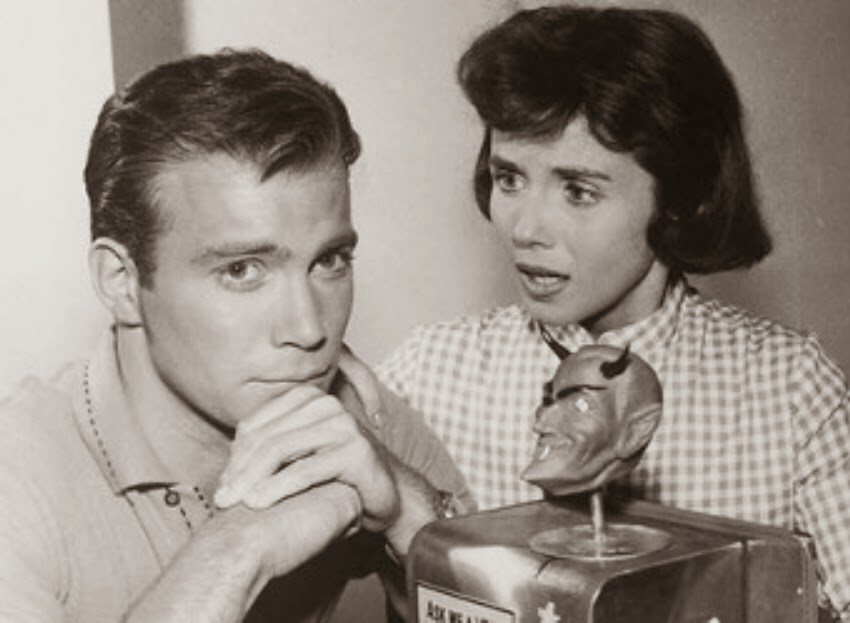
"Nick of Time" is the story of Don S. Carter (William Shatner) and his new wife, Pam (Patricia Breslin). Their car has broken down on their honeymoon trip to New York, and the couple is forced to make a pit stop for repairs in the sleepy little town of Ridgeview, Ohio. 


It is there, in the Busy Bee Diner, that this couple will -- according to narrator Serling -- find "a gift most humans will never receive," the ability to "learn the future." 

Why? Well, because this town and this diner rests on "the outskirts" of The Twilight Zone.

Our central character Don is an interesting guy, and Shatner's performance here is one of his best. Don's the superstitious type, with a rabbits foot on his key chain right beside a four-leaf clover. He is given to expressing himself in phrases such as "keep your fingers crossed." 


"It's like you married an alcoholic" he admits to Pam in one of his more lucid moments, aware of how superstitious he really is.

But on now to Don's unusual nemesis. It's a rinky-dink napkin dispenser with a Devil Bobblehead perched on top. It's the "one cent" "Mystic Seer," a fortune telling-device that for one penny will read you your future. It does so by ejecting little cards that cryptically answer yes or no questions.

Sounds harmless enough, right?


Not so fast...

First, the machine accurately predicts that Don will get the promotion he's been waiting for. 


Then it reports that the couple's car will not take four hours to be repaired, as was told the couple.

 Don grows ever more convinced that the "gizmo" is actually telling him his future. "Why was it so specific?" He asks Pam. "Every answer seems to fit," he insists. 

Pam isn't so sure.

And then things get really spooky. Don asks the machine if something will happen to the couple if they leave town. The answer: "if you move soon." 


He then asks, "should we stay here?" 

The answer: "that makes a good deal of sense." 

Finally, Bob interprets a message from the Devil Bobblehead to mean that he and Pam shouldn't leave the diner until after 3:00 pm that afternoon.

Pam objects and forces Don to leave the diner. At one minute to three, on the street outside, they are nearly run over by a speeding car...

Convinced and stubborn, Don returns to the diner and begins asking the Mystic Seer more questions, even though Pam begs him not to. "You made up all the details, and all that thing did is give back generalities," she tells him. 


He still won't leave. Not until his new wife tells him that the machine is running his life, and that she can't be married to a man who "believes more in luck and fortune" than in himself.


Don and Pam escape this trap, what Serling terms "the tyranny of fear and superstition," but in the episode's final shot, we see that another couple isn't so lucky. "Can we ask some more questions today?" They ask the machine.

"Do you think we might leave Ridgeview today?"

"Is there any way out?"


So again, in the most wonderful and entertaining terms imaginable, The Twilight Zone has presented us with a morality play of sorts, one about human nature.

Yet what's so enjoyable about "Nick of Time" is that we don't know whether Don is right (and the Devil machine is predicting the future), or if, in fact, he's merely superstitious and all the right answers are mere "coincidence" as Pam suggests. 

The ultimate point is, I suppose, what you choose to believe in: fear or hope. You can choose to believe that you are small and in danger; or you can take control of your life and face the hardships with strength,  and with the ones you love at your side.

Beyond a fortune telling device that may or may not be supernatural, there is no overt fantastical element in this installment of the Twilight Zone and yet it is oddly effective, and affecting despite this fact. 


Visually, it's assembled in clever fashion by director Richard Bare. The first shot of the episode is a wobbly view from a tow truck bed, looking down from a high angle at the car being towed, with Don and Pam inside. This is an important view, because it establishes right from the beginning of the episode that Don is not "driving" his life (nor his car). He's simply being pulled in one direction or another, towed by his fear and superstition.

Later, when the couple first enters the Busy Bee Diner with the Devil Bobblehead/Mystic Seer, the camera views Don and Pat from the far side of a lattice-work room separator/divider, a sort of visual frame-within-a-frame signifying entrapment or doom. 


This same camera set-up recurs at several important moments in the show. 

The first time, we view two other local residents in thrall to the Mystic Seer at the dining booth, also through this "entrapment" lens (the criss-cross frame of the lattice).

Finally, when Pam encourages Don to summon his inner courage, the shot has changed to reflect their strength. The lattice wall is no longer between camera and character -- a visual obstacle and blockade -- but rather behind the characters. They have escaped the trap. They have moved literally past it.

I also get a kick out of the extreme (and I mean, EXTREME) close-up shots of the Devil Bobblehead, always jittering ever so slightly but nonetheless playing his Satanic cards close to the vest. He's an interesting villain because he's inanimate and yet we "impose" some sense of fear or personality on him.


If it were just a napkin dispenser, minus the Bobblehead, this episode wouldn't work nearly so well.

Shatner's performance is so good because he plays a character suffering from a lack of confidence. That's funny, given that he's the guy who plays Captain Kirk, but I would argue that even there, in Star Trek, that's the quality that makes the character work so well. Kirk is a human being, a leader of men, but he still second guesses himself ("Balance of Terror") or fears losing his job ("The Ultimate Computer"). 


Watching early Shatner performances you get a sense at how deft the actor is in playing a likable yet vulnerable character. He doesn't quite reach the heights of hysteria in "Nick of Time" that he would achieve later in "A Nightmare at 20,000 Feet," but the script calls for different things. I really like Shatner in this kind of every man persona. To me, he represents the perfect 1960s young male: a self-aware, intelligent, resourceful, JFK-type with just enough self doubt and neurosis to make him thoroughly disarming.

I find it fascinating that Shatner's two Twilight Zones and one Outer Limits ("Cold Hands, Warm Heart") place the actor in the thick of a couple relationship in crisis. He's always playing a husband dealing with something terrible, and trying to convince his wife that he isn't insane. Gremlins on planes, Venusians on "Project Vulcan," or a fortune telling machine that may be the Devil Himself....

Friday, October 30, 2015

Ranking the Elm Street Movies


My week long retrospective of the Elm Street franchise is just about finished. This final post includes my ranking of all the films, from top to bottom.

Here goes:

1. A Nightmare on Elm Street (1984)

2. Wes Craven's New Nightmare (1994)

3. A Nightmare on Elm Street IV: The Dream Master (1988)

4. A Nightmare on Elm Street V: The Dream Child (1989)

5. A Nightmare on Elm Street III: Dream Warriors (1987)

6. A Nightmare on Elm Street II: Freddy's Revenge (1985)

7. Freddy vs. Jason (2003)

8. A Nightmare on Elm Street (2010)

9. Freddy's Dead: The Final Nightmare (1991)

Movie Trailer: A Nightmare on Elm Street (2010)

Cult-Movie Review: Freddy vs. Jason (2003)


SYNOPSIS: In the depths of Hell, mass murderer Freddy Krueger  (Englund) laments his inability to impact the children of the real world anymore.  The people of Springwood have forgotten his reign of terror, so he needs someone  to revive his fearsome legend. He discovers that individual in mad-dog killer Jason Voorhees (Kirzinger), the Crystal Lake slasher. Imitating Jason’s Mother, Freddy convinces Jason to travel from his corner of Hell to Springwood and begin a killing spree; one designed to revive the memory of Freddy. On Elm Street in Springwood, teenage Lori (Keena) and her friend Kia (Rowland) soon realize that the town is being stalked by not one boogeyman, but two.  Lori’s old boyfriend, Will (Ritter) joins them, after escaping Westin Hills Sanitarium, to help bury Freddy and Jason permanently.

COMMENTARY: Globally speaking, the overriding creative impulse behind cinematic monster meet-ups seems to be the pent-up fan-desire or built-in coolness factor associated with such clashes. These films answer, first and foremost, the question, wouldn’t it be cool to see (fill in the blank) fight (fill in the blank)? Bluntly written, that isn't the most artistic or dramatic motive underlining a work of art, or even a popular entertainment.  And because “versus” movies tend to feature two separate continuities, the screenplay writers involved also have to pack in a lot of supporting material, and make certain that each monster or participant is given a moment of glory. However,  these match-ups or contests do tend, at the very least, to reveal a new shade of the characters.  In both versus films, one “villain” unexpectedly becomes the hero or champion, while the other is dismissed as irredeemable or evil.  Whoever wins, we lose, in other words.  But by the same token, sometimes it takes evil to fight evil.

For example, in AVP, the Predator, Scar, joins up with Alexa (Sanaa Lathan), working with a human to defeat the real bad guys: aliens. And Jason adopts a similar role in Freddy vs. Jason, proving to be the slasher/monster that humans can -- if not work with -- then at least manipulate towards their own end. Indeed, Freddy vs. Jason is the first film in the Friday the 13th continuity to attempt to steer  the audience’s empathy towards the hockey-masked slasher and not away from him. Here, we get a dream sequence revealing Jason to be a bullied, neglected, ostracized child. Freddy, by contrast (and like the aliens) is sinister and unrepentant. He’s the “real” monster, the true evil that must be defeated.

Alas, other than that new perspective on the guy in the hockey mask, Freddy vs. Jason doesn’t have that much going for it. The human characters here are paper-thin, even though it is always nice to see the remarkable Katharine Isabelle (Ginger Snaps) in another horror role.   Also, Jason Mewes should probably sue the makers of the film for appropriating without permission his silver screen persona from the View Askewniverse in a few key scenes. Beyond the fact that the human characters are either dull or derivative, Freddy vs. Jason genuinely lacks scares too. The final battle at Crystal Lake is shot well, and it's really bloody, but it isn’t scary.   An unexpected side-effect of these monster-on-monster smack-downs, then, seems to be that terror dissipates, and two franchises are actually compromised rather than improved.

When a studio green-lights a project like Freddy vs. Jason, it no doubt expects to revitalize two franchises for the price of one.  Funny how that is almost never the real-world result. Even the attempt to be faithful to Nightmare on Elm Street and Friday the 13th lore is only partially successful in Freddy vs. Jason.  There’s quite a bit of rewriting or ret-conning going on here to get the two monsters into the same world either dreams or reality, and the ret-cons don’t always fit with the established canon. Most disturbingly, Freddy vs. Jason doesn’t seem to have much of a sense of fun about this clash of the titans. A lot of the Elm Street sequels got by on a wing and a prayer, action set-pieces and a wicked sense of humor.  But Freddy vs. Jason doesn’t express any sort of joy in Freddy’s return. We get lame one liners and all, but there's a sense that the filmmakers don't really love or fully understand the appeal of the material. Freddy vs. Jason ends, finally, with no real winners.

Freddy vs. Jason opens and closes strong, however, one must give it that much. The film commences with the words of the most unreliable of all narrators, Freddy Krueger, and in broad but effective strokes, re-tells the origin stories of Freddy and Jason.  The film squeezes much information into this colorful montage, and it works surprisingly well.  It’s an intriguing device to have Freddy speaking to the audience directly, telling the viewer his warped side of his own story, and it opens the film on a high note.  It feels like a fresh take. But after that ingenious opener, the film introduces the lead (teen) characters, and they are all as milquetoast as humanly possible. Lori is our standard feisty final girlTm and Will is the “outsider” but always loyal boyfriend.  There’s also your obligatory co-culture “best friend,” in this case African-American Kia.  These characters are so dull and so uninteresting, in part, because they don’t honor the tradition of either supporting franchise. Actresses such as Heather Langenkamp, Amy Steel, Patricia Arquette, and Lisa Wilcox all demonstrated how a solid, thoughtful performer could take a lead character in a slasher film and imbue that character with life, energy and individuality. That lesson has been forgotten here.  Lori's most memorable trait is, alas, her swollen lips, which appear to be the result of bad plastic surgery. The filmmakers seem bound and determined to feature elements or call-backs to previous franchise entries including 1428 Elm Street, Westin Hills Sanitarium, Hypnocil, the Freddy Worm, Jason’s mother, and Camp Blood, but they might have been wiser to focus on creating human characters that the audience can care about or can invest its energy in. Certainly, the Elm Street sequels are of variable quality, but they are enlivened by pro-social portrayals of insightful and courageous young women. Alice, the Dream Master, fights Freddy, it's true, but also goes through the process of self-actualization. Nancy Thompson, similarly, gets cast as horror's Prince of Denmark (or Princess), Hamlet, tasked with going through the lies of her morally questionable parents. These characters had weight and individuality, and made the films more than mere "dead teenager" movies. One would be hard-pressed to find teens less interesting than those featured in Freddy vs. Jason.

For example, that horrid Jason Mewes knock-off. That’s what he is, and there's no way to deny it. He’s a lookalike/sound-alike doing the Mewes’ shtick. Since that’s all he is, why didn’t the filmmakers actually just hire Jason Mewes himself?  Because audiences know that persona from the New Jersey Cycle (sevenfilms and counting), they would at least register him as an authentic human being and not a cipher. Instead, one can't see Freddy vs. Jason's stoner as a human being or person, just as a rip-off, a derivative clone, thus taking the viewer out of the movie's narrative every time he appears on screen. And, let's face it, love or hate the Mewes persona, the actor would have added a clear sense of fun to the proceedings. Imagine watching Mewes go up against Jason. It's impossible not to smile at the thought.

In another creative area all together, the movie's screenplay hems and haws. The movie wants to studiously avoid giving the audience a clear winner in the fight.  Freddy gets his moment in the sun, turning Jason into a human pinball in the dream world. Then Jason gets his glorious moment, decapitating Freddy and emerging from the water in (a beautifully-shot, beautifully-visualized) epilogue.   But Freddy winks at the camera, just so no one draws too strong a conclusion about the victor.  Did Freddy and Jason have it in their contracts that neither one could win? What's the fun of setting up a fight like this if no one can be crowned the winner?

Again, what is most intriguing about Freddy vs. Jason -- and it may not have even been intentional -- is that when these characters are thrown together, viewers, make judgment calls about the true villainy of our two starring monsters.   Jason seems compelled to maim and murder, but it feels instinctual, like it is part of his wiring.  He's a humanoid great white shark. Freddy, by contrast, relishes in his badness. He intellectualizes it, seeks out ways to increase his range, and manipulates others.  So Jason is the shark in Jaws, and Freddy is Hannibal Lecter.  If one accepts that comparison, Freddy is the more evil of these two monsters, and one almost can’t blame Jason for what he does. The sympathetic flashbacks make it clear that his vengeance is righteous, or at least justified. So, if you get in Jason’s way, yes, he will kill you (as Kia learns). But Freddy will seek you out, and find ways to get you, regardless of where you are, what you are doing, or why you are there. He's a puppet master and a schemer. Again, this comparison would not exist if we didn’t have the monsters sharing the same story.

Still, some of the ret-conning doesn’t work.  Apparently, the filmmakers desire for each monster to have “Kryptonite,” the thing/element that stops him in his tracks.  Freddy’s kryptonite is fire, and that is sensible.  He died in fire.  But now, suddenly, Jason is afraid of water?  He drowned in Crystal Lake in 1980, but many previous films have revealed him emerging from the lake, or attacking skinny dippers in the water (Part VII is one example of the latter).  But now he can’t even approach water without paralyzing terror?  That just doesn’t pass the smell test.

The fights between Freddy vs. Jason are well-orchestrated, and in that sense, every gets their money's worth. At least in this case, gore is not shorted. The wide-ranging final fight, which moves from cabin in the woods to construction site to lakeside, lives up to expectations in terms of violence and bloody depiction of said violence. The problem is -- again like AVP -- that the whole movie is constructed around a fifteen minute fight. The rest of the movie is merely filler, and often dumb filler at that.  There should be a TV series called “Versus” where all great movie monsters can fight one another with glorious special effects and extreme destruction, sparing us the necessity of seeing whole movies built for a single serving purpose.

Bottom line: Freddy vs. Jason isn’t fun enough or scary enough to honor its parent franchises. But it is bloody enough. Some days, that will do.  Perhaps it’s time to put these bad dogs to sleep for good?

Movie Trailer: Freddy vs. Jason (2003)

Thursday, October 29, 2015

Cult-Movie Review: Wes Craven's New Nightmare (1994)


The tenth birthday of cinematic boogeyman Freddy Krueger should have been a big deal to start with, that's for sure. 

Why?

Well, in the late 1980s, Freddy Krueger veritably ruled the box office and the horror genre, thanks in large part to three or four very talented people: Wes Craven, who gave birth to Freddy, Robert Englund, who gave the silver screen monster body and personality, and talents like Heather Langenkamp and Lisa Wilcox, who, on more than one occasion, gave Krueger worthy nemeses.

If imitation is the sincerest form of flattery, then Freddy was truly flattered throughout the eighties.  In the latter part of the decade, every new issue of Fangoria  seemed to trumpet the arrival of "a new
Freddy, a boogymena challenger to knock Krueger from his long-held king’s throne.  

The candidates didn’t end up being so imposing, from Harris (Richard Lynch), the cult-guru of Bad Dreams (1988), to I Madman’s (1989) Malcolm Brand.  Even Craven himself took a shot at toppling Freddy with his new monster: Horace Pinker (the great Mitch Pileggi) in 1989’s Shocker.

But by 1991, somehow, Freddy Krueger was played out. The last series film, Freddy’s Dead (1991), was a disaster, and his TV show (Freddy’s Nightmares) was cancelled after just two seasons.

After years holding on, and being praised as the best of the slasher pack, Freddy lost his cultural currency.

So New Line Studios did the only thing that made sense. It went back to Freddy’s dad, Wes Craven, one more time, and he devised a new twist on his most beloved character.  Craven revived the series, -- at least from an artistic stand-point -- with the brilliant Wes Craven’s New Nightmare (1994).

As Kim Newman pointed out in Sight and Sound (Jan 1, 1995, pg.62), “The major achievement of the film, given the complicated mix of in-jokery and philosophy and the by-now familiar nature of Freddy’s schtick, is that Craven manages to make things scary again.”

That was a big deal, considering the fact that after five sequels, Freddy had become more circus ringmaster than slashing, menacing murderer.

But even better, New Nightmare was scary in a smart way. The New York Post’s Thelma Adams observed that it is a “rippingly good movie-within-a-movie, a pop Day for Nightmare.”  Indeed, the film’s is-it-real-or-is-it-a-movie approach to the action might very well be seen as the missing link binding 1980s slashers to the most popular horror franchise of the 1990s: Scream (1996).

I love New Nightmare, however, not merely because it is scary, and not merely because it plays with our understanding of reality (and indeed, franchise history). 

Rather, I adore the film because it speaks meaningfully about the horror film’s place in American society.  It erects, brilliantly, in my estimation, a pro-social case for the horror film as art. 

Horror films offer a very necessary catharsis for our society, states the film's thesis. The monsters that we don’t capture on the screen will haunt us in real life. Thus horror movies not only “bottle” such monsters, butthey  help children grapple with the idea of evil in a way that does not endanger them, and, to the contrary, shows them how to survive.

A good scary story is more than entertainment. It is a journey survived, an obstacle overcome, a mountain climbed. A good horror movie can demonstrate how, once destroyed, order can be restored. It can shows us that monsters are defeatable, just as life's troubles can be defeated.

In case you couldn't tell, I love this film, and everything it stands -- and fights -- for.


"Every kid knows who Freddy is.  He's like Santa Claus. Or King Kong."

Former horror movie star Heather Langenkamp grows agitated when, following an earthquake in Los Angeles, she learns that her young son, Dylan (Miko Hughes) has been watching her Nightmare on Elm Street films.   

Worse, she is being stalked by an obscene phone caller, and is having nightmares about Freddy.

Before long, it seems as Freddy (Robert Englund) himself is crossing over into our reality, and using Dylan as a vessel to do so.

Desperate, Heather seeks the advice of her friend, John Saxon (himself) and horror movie guru, Wes Craven (himself), who suggests that it is time for the actress to reprise her role of Nancy Thompson if she hopes to defeat an ancient demon that has taken the shape of Freddy Krueger.


"I think the only way to stop him is to make another movie."

At its most basic form, Wes Craven's New Nightmare is a parent’s personal journey towards enlightenment.  

As the film commences, Heather obsessively protects her son Dylan from the danger of “scary movies,” of horror films, that she perceives. 

She admits that she wouldn’t allow Dylan to see her own motion pictures, namely Craven’s A Nightmare on Elm Street, and that she is uncertain about “doing horror roles" because of their impact on Dylan and other children his age. 


She thus makes an argument that all horror film fans  have heard again and again. Horror movies are bad! They are bad for society, and bad for young eyes!

Additionally, Heather does not understand why her boy -- here representing all of America’s children -- is drawn to scary stories in the first place.  Regarding Hansel & Gretel, Heather declares, “it’s so violent, I don’t know why you like it.”  

Horror movie fans have heard that one too. 

I get this one all the time, especially when I reveal how much I appreciate Last House on the Left (1972), or Straw Dogs (1971).  

How can someone so gentle, so nice, actually like movies filled with such horrible violence?  

Well, unlike a lot of folks, I prefer all my horrible violence to be on screen, not in real life. I work out my fears, my anxieties in these movies, imagining the unimaginable, and feeling a catharsis when I have survived it.

But back to the movie.  

As a result of his mother’s repression of horror films and bedtime stories, young Dylan becomes partially possessed by the demons he has only half-glimpsed in these apparent fiction.  

Because he has not seen the entire picture, the whole film A Nightmare on Elm Street, he has not witnessed his mother defeat Freddy’s evil. He is therefore left vulnerable to evil influences and emotions. He has nowhere to put that "horror" and no way to achieve closure.

To illustrate this point, Craven’s screenplay has Dylan awaken as if from a trance each time Heather turns off the television to censor his viewing.  His need for security is shattered, and Dylan screams in horror.  

Significantly, he is not frightened by the images of terror unfolding on the screen, but because his mother has robbed him of narrative closure; of the knowledge that, in the end, evil is defeated and the world is returned to normal.

Similarly, as Heather reads Hansel and Gretel to Dylan for the umpteenth time, he orders her to finish the story before he goes to sleep.  

Say how they find their way home, it’s important,” he insists.  


Craven’s implication here is that children like to be scared and that stimulating horror stories/films serve as an outlet for this need.  By seeing a scary story all the way through to its conclusion, children learn that they too can beat scary influences in real life. Horror makes them aware that they will survive.  

The form is cathartic, in addition to being fun.

As the plot of Wes Craven’s New Nightmare develops, Heather realizes that, as Craven eloquently puts it, an evil repressed can sometimes break through into “safe” reality.  A woman who has refused to allow her child to see horror films is then thrust unexpectedly into the position of defending them.  


“I’m convinced that those films can send an unstable child over the edge!” the well-meaning but parochial Dr. Heffner declares, but the horror Dylan faces is not imagined bur real, ironically, because the Freddy films are no longer being made in the 1990s.  

When they were produced in the 1980s, the series served as a healthy outlet for teenage fears and anxieties.  Since they have stopped, evil has escaped into the real world and is doing massive damage.

Craven explores this theme of horror as acceptable, even desirable outlet for fear by crafting an ongoing parallel between his Elm Street universe and the grim childhood story Hansel and Gretel.  

Since Hansel and Gretel is deemed acceptable “bedtime reading” by most parents, a Nightmare on Elm Street is, by extension, also acceptable. And like the witch in the scary fairy tale, Freddy Krueger even tries to shove Dylan into an oven and in the film’s denouement is cooked himself. 

In stalking the young boy, Freddy declares, “I’m gonna eat you up!” and that he has some “gingerbread” for the boy, and these moments heighten the film’s similarity to written folklore. 


The film’s conclusion is the final reiteration of this leitmotif as Heather and Dyaln sit together and read the New Nightmare script from start to finish as the camera gently pulls away from the duo, both safe and sound. 

This reading provides closure and vanquishes Freddy forever to the world of imagination…or at least until people stop making horror movies about this particular demon once more.

Rich in theme and intellectual heft, Wes Craven’s New Nightmare not only examines parental responsibility and the healthy aspects of the horror film, it is also profoundly self-referential in its commentary on the world of Hollywood filmmaking. Freddy masks, costumes, gloves and affectionate fan signs are all seen on the talk show stage. Memorabilia from the Elm Street line, including reference books, action figures and paintings are seen in executive Bob Shaye’s office, and fans like the creepy limo driver pop up everywhere and startle poor Heather in the tradition of Freddy himself.

Craven pointedly contrasts the fanaticism of some fans with the blasé attitude of those who make the films and profit from them.

That thing puts bread on our table,” Chase reminds Heather when she petulantly objects to Freddy’s new razor glove. 

“The fans, god bless ‘em, they’re clamoring for more,” Bob Shaye laughs, realizing that he has a money-making bonanza in this particular franchise.

Indeed, the very fact that the tenth anniversary of A Nightmare on Elm Street is a plot point in the film speaks to both fan devotion and executive greed.  Amusingly, Craven bites the hand that feed him here.  At the same time that he makes another horror sequel for New Line and Shaye, he criticizes the company for literally running Freddy into the ground.  

Freddy has returned to the real world not just because of repression, but because his mythos has become overly familiar, too watered down by mainstream concerns to be scary anymore. 

Even as New Nightmare slams past sequels, it is loaded with references visual and verbal to past entries in the Elm Street film cycle.  It is a movie about transformation and alternate reality bleeding in to ours, so by the movie’s climax Heather’s world has turned into the world of the 1984 film.  John Saxon is suddenly her father, her blond babysitter dies like blond Tina died, and so on. Heather's hair even goes gray again, and she finds herself inadvertently repeating dialogue from the original film such as “whatever you do, don’t fall asleep” and “screw your pass!”

The first Nightmare on Elm Street is not the only series entry referenced here. 

Dr. Heffner, the disbelieving professional, echoes Dr. Elizabeth Simms in Dream Warriors (1987), who felt that Freddy wasn’t real but rather a byproduct of “rampant” adolescent sexuality.  

The roadside death of a male protagonist, Chase, is reminiscent of Alice’s boyfriend Dan and his death in The Dream Child (1989), down to the inclusion of a pick-up truck in the sequence.  Another repetition from the fifth film is the subplot that a child can serve as a vessel of evil, one which Freddy can operate. 

 Finally, Heather’s comment to Dylan that people can only enter other people’s dreams in the movies represents a sly put-down of the premise of Dream Warriors.

By re-interpreting these standards of the Nightmare on Elm Street film series, New Nightmare transcends the familiar mythos and actually becomes oddly unpredictable.  Viewers believe they know all the twists, but all the twists are, themselves, twisted and given new meaning (and thus power) in their revision.

Wes Craven’s New Nightmare contains many intricate realities.  For instance, the audience here is watching a horror movie concerning an actress planning to play herself in a horror movie. Fictional and real worlds overlap, and this is buttressed by the presence of Nick Corri, Robert Englund, Sara Risher, Craven and others, all playing themselves in the drama.  

Wes Craven’s New Nightmare also succeeds on a primal, childhood level. It plays on fears of the dark, monsters, “what’s under the bed,” anxieties about hospitals, and more.  It also deftly blends humor with the fear of losing a child, that which is most valuable and innocent in the world. 

So credit Wes Craven for doing something here that many thought was impossible on Freddy K's tenth birthday.

He breathed new life into an old monster, and an old form too.


50 Years Ago: Land of the Lost: "Survival Kit" (September 18, 1976)

It’s very rare to come across an episode of  Land of the Lost  -- in any season -- that I vehemently dislike and judge almost entirely worth...