Wednesday, February 26, 2014

The Twilight Zone: "It's a Good Life" (1961) and "It's Still a Good Life" (2003)


In 1953, acclaimed author Jerome Bixby penned "It's a Good Life," a terrifying story later voted one of the greatest in sci-fi history.

Nearly a decade after the story's publication, television legend and producer Rod Serling famously adapted Bixby's story of a God-like (or Devil-Like?) child, Anthony Fremont (Bill Mumy), for The Twilight Zone during its memorable third season.

The result, which first aired on November 3, 1961, remains among the most famous -- and creepy -- installments of the landmark anthology program.

In his opening narration of "It's a Good Life," Rod Serling stands before a map of the United States and introduces viewers to the quaint little town of Peaksville, Ohio.


As our guide soon relates in staccato, clipped tone, something strange happened in this little American burg. "A monster had arrived" there and the "rest of the world disappeared," leaving Peaksville in a New Dark Age without electricity; without any modern conveniences at all, for that matter.

This monster, Serling quickly informs the viewers, is "a six-year old boy" named Anthony Fremont, who can make things happen...with his mind.

Anthony can also "hear" what others are thinking and has a nasty habit of wishing away his enemies "to the cornfield."

This frightening psychic power means that the grown-ups of Peaksville are constantly re-assuring and excusing the boy's bad behavior, so he doesn't turn his laser-like glare towards them. 

"That's a good thing you did, Anthony. That's a real good thing you did."


On the night of a birthday party, Anthony's neighbor Dan Hollis learns about the terror of the cornfield the hard way when -- after drinking too much -- he urges his terrified neighbors to kill the dictatorial child. Nobody moves. Although Aunt Amy does contemplate a fireplace poker, at least for an instant...

You're a very bad man," Anthony tells Dan before transforming the poor sap -- in a horrifying moment -- into a living toy; a macabre, bouncing jack-in-the-box.


Anthony's father then urges the boy to wish the monstrosity away to that cornfield, where all of Anthony's misshapen, monstrous creations dwell.

The capper of the episode is overtly pessimistic. On a whim, Anthony causes a snow blizzard. This sudden, drastic alteration in the weather will likely result in the destruction of half the crops supplying the town's food supply...

For almost fifty-years, "It's a Good Life" has resonated with generations of TV audiences, and I suppose that's primarily because the episode expresses some brand of universal truth about children and parents. 

When a child doesn't know limits, when a child isn't taught limits, the result may very well be a selfish, entitled monster. Not a monster who can destroy the world, like Anthony perhaps, but a monster nonetheless. 

When a child goes out-of-control, and the community does nothing, everyone suffers. Or as Ben Franklin once famously suggested: "educate your child to self-control, to the habit of holding passion and prejudice and evil tendencies subject to an upright and reasoning will, and you have done much to abolish misery from their future and crimes from society."


So it takes a village to raise a child. Or the village suffers. Or something like that. 

Considering this notion, it's not difficult to parse this iconic episode of The Twilight Zone as a commentary on what I sometimes term parenting paralysis. Nobody is entirely immune to this condition. Not me, certainly, though I try to be aware of it. 

I define parenting paralysis as the refusal of a parent to step up and do something that needs to be done "in the moment," even if it's distinctly unpleasant. But the downside of avoiding conflict is tremendous. The next time the same behavior pops up, it will be even harder to address...

Instead of confronting Anthony, the Fremonts in "It's a Good Life" just keep appeasing him over and over, refusing to acknowledge that every time they engage in this appeasement they simultaneously encourage Anthony's bad behavior. 

Behavior like creating three-headed gophers...that bite.

I don't know that Anthony is actually evil, as some have suggested. Rather, he's merely Id unloosed. He's six, and he wants what he wants he wants, and there is no one in his family courageous enough to subject those selfish desires to an "upright and reasoning will."

I have to say, Captain Kirk did substantially better addressing a teenager with the same powers, Charles Evans (in the episode "Charlie X"). As a father figure, Kirk understood he had a kind of psychological authority over the boy, even if the boy was the one with all the powers. There's no one like that in Anthony's world.

One aspect of "It's a Good Life" that I still find remarkable is the meticulous attention paid to detail. Specifically, the episode's screenplay informs the audience that Anthony doesn't like singing, and that he doesn't like people to talk while the TV is on. But Anthony also, apparently, does not like art work. And if you look closely, every painting, photograph or other piece of artwork in the Fremont house is missing...sent to the cornfield, I would presume. Throughout the episode, you can see shading on the walls, tell-tale signs of locations where picture frames once hung.

Again, the episode doesn't specify this particular dislike by Anthony, but again and again we detect those rectangular outlines and variations in shading...reminding us that once upon a time, art work was present. 

What's the larger purpose of such a background detail? Not to sound cruel, because I am a happy father who loves his child to the moon and back, but "It's a Good Life" suggests that in having and indulging a spoiled child, parents stand to lose a lot. The "comfortable" elements of their lives (electricity, art work, music, bars of soap etc.) virtually evaporate as the child becomes the sole focus of their lives.

I also have to admit, I get a kick out of the episode's not-so-veiled critique of television. There is no television in Peaksville, save for what Anthony generates from his strange and childish mind. The drama he creates consists of dinosaurs endlessly growling and duking it out on volcano tops. There's no human interaction whatsoever.


To please Anthony, one of his neighbors notes, deadpan, "It's much better than the old television..." Now, on one hand, she's trying to ingratiate herself with the boy and this is an entirely appropriate remark. 

On the other hand, I think I hear Serling's voice there, commenting on the quality of a medium designed to sell cigarettes and laundry detergent.

Perhaps the freakiest element of "It's a Good Life," -- and as a kid I was absolutely terrorized out by this -- is the fate of Dan Hollis. The episode utilizes two shots to reveal this fellow's metamorphosis into a Jack in the Box. In the first shot, we see a close-up of Dan's bobbing head, wearing a pointed cap. In the next shot, sequentially, we see a silhouette of Dan's head, the springs, and the box, on the wall.


Somehow, this one-two punch seems more psychologically effective than seeing some special effect deployed. Because the transformation involves two shots -- and is never viewed entirely in one frame -- it's as if the viewer's brain has to assemble the pieces. And when it does, the image is grotesque and disturbing.

I also love that at the denouement of the episode, Rod Serling feels no need to expand or explain any of what has occurred in the narrative during the preceding half hour. 

"No comment here," he says. "No comment at all." Again, I think that gets at the universality of the theme: that parents make monsters of their children by not disciplining them; by avoiding conflict.  The parents are, therefore, the ones to blame.

On February 19, 2003, the UPN update of The Twilight Zone broadcast a follow-up to this tale called "It's Still a Good Life." The story involves a grown Anthony (Bill Mumy) still holding Peaksville hostage to his narcissistic whims. But now he has a young daughter, Audrey (Liliana Mumy), who has kept her similar powers a secret. Anthony's Mom, Agnes (Cloris Leachman) believes that Audrey can be made to turn against her father, and save the town.

In addition, Audrey possesses a psychic power Anthony lacks: a creative power. She can return everyone and everything that Anthony has banished into the cornfield over the years. I felt that this was an interesting narrative development, and an effective counterpoint to Anthony's destructive abilities.

In fact, if you view the end of the episode in this light, I would submit that Audrey pulls a fast-one on her Dad. She beats him at his own game by making Anthony feel, for the first time, what it's like to lonely. This is the very thing that allows Audrey to use her power and actually restore the entirety of the world. I guess some people felt that this episode features a downer ending, that it lets two "monsters" rule the day. 

I would argue the opposite. Audrey doesn't so much as join up with her Dad, as skillfully undermine him. She wishes away all of Peaksville residents so that she and her Dad are really and truly alone. When he confesses he's feeling the effects of that isolation, Audrey brings back the world. Airplanes. Cities. Communities

That's a happy ending, isn't it? 

Sure, if you ever see these tourists in your town, you should think only happy thoughts, but still...at least the planet and human race are restored. The wrong of four decades ago is set right, at last. So if you want to see how things turned out for Anthony and his Mom, I recommend this follow-up episode so you can get a sense of closure.

However, If you are hoping that the story will be vetted with the same confidence, visual distinction and resonant imagery as the original you're going to be sorely disappointed by the pedestrian nature of the presentation.  The Twilight Zone's brand, for me, is expressive black-and-white photography, and staccato Serling-esque dialogue.  

"It's Still a Good Life" doesn't get the sound or images right, even if it is nice to see what became of indulged little Anthony.  

The Twilight Zone: "Nick of Time" (1960)


"Nick of Time" is a Richard Matheson story, and one of my all-time favorite installments of the 1959-1964 Rod Serling series, The Twilight Zone. There are flashier shows, there are scarier shows, but I really enjoy how ambiguous this story is.

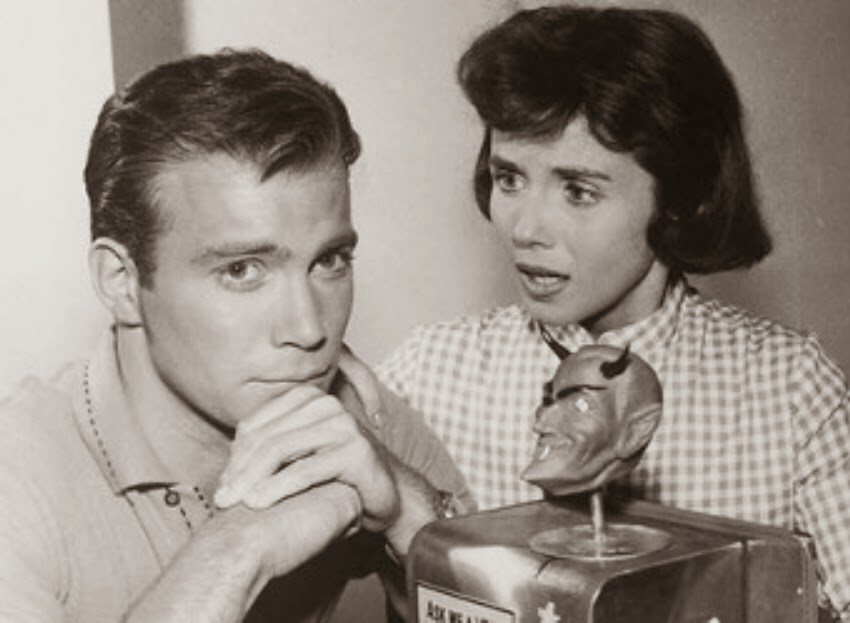
"Nick of Time" is the story of Don S. Carter (William Shatner) and his new wife, Pam (Patricia Breslin). Their car has broken down on their honeymoon trip to New York, and the couple is forced to make a pit stop for repairs in the sleepy little town of Ridgeview, Ohio. 


It is there, in the Busy Bee Diner, that this couple will -- according to narrator Serling -- find "a gift most humans will never receive," the ability to "learn the future." 

Why? Well, because this town and this diner rests on "the outskirts" of The Twilight Zone.

Our central character Don is an interesting guy, and Shatner's performance here is one of his best. Don's the superstitious type, with a rabbits foot on his key chain right beside a four-leaf clover. He is given to expressing himself in phrases such as "keep your fingers crossed." 


"It's like you married an alcoholic" he admits to Pam in one of his more lucid moments, aware of how superstitious he really is.

But on now to Don's unusual nemesis. It's a rinky-dink napkin dispenser with a Devil Bobblehead perched on top. It's the "one cent" "Mystic Seer," a fortune telling-device that for one penny will read you your future. It does so by ejecting little cards that cryptically answer yes or no questions.

Sounds harmless enough, right?


Not so fast...

First, the machine accurately predicts that Don will get the promotion he's been waiting for. 


Then it reports that the couple's car will not take four hours to be repaired, as was told the couple.

 Don grows ever more convinced that the "gizmo" is actually telling him his future. "Why was it so specific?" He asks Pam. "Every answer seems to fit," he insists. 

Pam isn't so sure.

And then things get really spooky. Don asks the machine if something will happen to the couple if they leave town. The answer: "if you move soon." 


He then asks, "should we stay here?" 

The answer: "that makes a good deal of sense." 

Finally, Bob interprets a message from the Devil Bobblehead to mean that he and Pam shouldn't leave the diner until after 3:00 pm that afternoon.

Pam objects and forces Don to leave the diner. At one minute to three, on the street outside, they are nearly run over by a speeding car...

Convinced and stubborn, Don returns to the diner and begins asking the Mystic Seer more questions, even though Pam begs him not to. "You made up all the details, and all that thing did is give back generalities," she tells him. 


He still won't leave. Not until his new wife tells him that the machine is running his life, and that she can't be married to a man who "believes more in luck and fortune" than in himself.

Don and Pam escape this trap, what Serling terms "the tyranny of fear and superstition," but in the episode's final shot, we see that another couple isn't so lucky. "Can we ask some more questions today?" They ask the machine.

"Do you think we might leave Ridgeview today?"

"Is there any way out?"


So again, in the most wonderful and entertaining terms imaginable, The Twilight Zone has presented us with a morality play of sorts, one about human nature.

Yet what's so enjoyable about "Nick of Time" is that we don't know whether Don is right (and the Devil machine is predicting the future), or if, in fact, he's merely superstitious and all the right answers are mere "coincidence" as Pam suggests. 

The ultimate point is, I suppose, what you choose to believe in: fear or hope. You can choose to believe that you are small and in danger; or you can take control of your life and face the hardships with strength,  and with the ones you love at your side.

Beyond a fortune telling device that may or may not be supernatural, there is no overt fantastical element in this installment of the Twilight Zone and yet it is oddly effective, and affecting despite this fact. 


Visually, it's assembled in clever fashion by director Richard Bare. The first shot of the episode is a wobbly view from a tow truck bed, looking down from a high angle at the car being towed, with Don and Pam inside. This is an important view, because it establishes right from the beginning of the episode that Don is not "driving" his life (nor his car). He's simply being pulled in one direction or another, towed by his fear and superstition.

Later, when the couple first enters the Busy Bee Diner with the Devil Bobblehead/Mystic Seer, the camera views Don and Pat from the far side of a lattice-work room separator/divider, a sort of visual frame-within-a-frame signifying entrapment or doom. 


This same camera set-up recurs at several important moments in the show. 

The first time, we view two other local residents in thrall to the Mystic Seer at the dining booth, also through this "entrapment" lens (the criss-cross frame of the lattice).

Finally, when Pam encourages Don to summon his inner courage, the shot has changed to reflect their strength. The lattice wall is no longer between camera and character -- a visual obstacle and blockade -- but rather behind the characters. They have escaped the trap. They have moved literally past it.

I also get a kick out of the extreme (and I mean, EXTREME) close-up shots of the Devil Bobblehead, always jittering ever so slightly but nonetheless playing his Satanic cards close to the vest. He's an interesting villain because he's inanimate and yet we "impose" some sense of fear or personality on him.


If it were just a napkin dispenser, minus the Bobblehead, this episode wouldn't work nearly so well.

Shatner's performance is so good because he plays a character suffering from a lack of confidence. That's funny, given that he's the guy who plays Captain Kirk, but I would argue that even there, in Star Trek, that's the quality that makes the character work so well. Kirk is a human being, a leader of men, but he still second guesses himself ("Balance of Terror") or fears losing his job ("The Ultimate Computer"). 


Watching early Shatner performances you get a sense at how deft the actor is in playing a likable yet vulnerable character. He doesn't quite reach the heights of hysteria in "Nick of Time" that he would achieve later in "A Nightmare at 20,000 Feet," but the script calls for different things. I really like Shatner in this kind of every man persona. To me, he represents the perfect 1960s young male: a self-aware, intelligent, resourceful, JFK-type with just enough self doubt and neurosis to make him thoroughly disarming.

I find it fascinating that Shatner's two Twilight Zones and one Outer Limits ("Cold Hands, Warm Heart") place the actor in the thick of a couple relationship in crisis. He's always playing a husband dealing with something terrible, and trying to convince his wife that he isn't insane. Gremlins on planes, Venusians on "Project Vulcan," or a fortune telling machine that may be the Devil Himself. 

The Twilight Zone: "Mirror Image" (1960)


In “Mirror Image,” young Millicent Barnes (Vera Miles) spends the night in a near-empty bus depot, and begins to experience what she fears are hallucinations or delusions.

Specifically, those around her -- including the cranky baggage clerk and the ladies room maid -- claim to have seen her before. And then, later, Millicent sees a suitcase that looks identical to her own.

Millicent grows ever more paranoid about the situation, but her terror reaches a crescendo when she spies an identical double of herself sitting on a bench nearby. Millicent comes to believe -- as she tells another commuter, Paul -- that a version of herself from a “parallel” world has come to this world to destroy her…

Paul dismisses her fears as a mental illness, until he has reason to question his own sanity…


This underrated and yet utterly creepy episode of The Twilight Zone (1959 – 1964) by Rod Serling concerns the notion that “each of us has a twin” in “a parallel world.”

Specifically, unlucky Millicent Barnes is confronted with her own doppelganger, who reveals, when she appears briefly on-screen, a kind of wicked malevolence. There’s a creepy shot of the doppelganger ensconced on the bus to Buffalo, NY, for instance. There’s a smug nastiness about her expression there, and it’s hard to get that smirk out of your thoughts.

“Mirror Image” is set almost entirely on just one large set: the bus depot interior. Although in some hands, this might be considered a limitation, the episode’s director, John Brahms, works wonders with the location.

For one thing, there’s no visual sign of a ceiling in the depot, which means that the walls and doors look exceptionally -- even expressionistically -- large, and the people inhabiting the depot look small and insignificant in comparison.

The clerk -- who turns off the lights for the night at one point -- notes ominously that “this place is like a tomb between now and morning.”

Secondly, the absence of many extras means that the large space of the depot is mostly vacant, so that, again, it seems to defy reality that a malevolent double or “counterpart” could be “hiding” anywhere nearby. 

When Paul views his double, for instance, the reverse angles don’t actually match. Paul looks up to see his suitcase gone, and in some of the same space he “occupies” in the frame, the double runs out the door.  It’s like two disjointed worlds are just barely overlapping one another.

Add to these touches the incessant sound of pounding rain outside the depot, and certain visual cues about the danger Millicent finds herself in, and “Mirror Image” builds a powerful and surreal sense, indeed, of the protagonist’s paranoia. 

In terms of the aforementioned visual clues, the neon over the ladies room, which read LADIES” at some points in the episode is seen to read merely “DIES.” 


“Mirror Image’s” apex of terror, however, is a nicely composed special effects shot. Millicent gazes into the bathroom mirror -- the door open behind her -- and sees both herself and her malevolent double reflected in the glass. 


In essence, there should be two Millicents --herself and her reflection -- but instead, and quite disconcertingly, there are four. The moment is subtly disturbing and wrong, and the effects are perfectly executed.

The episode’s kicker is chilling too. The man, Paul (Martin Milner), who consigns Millicent to a hospital, himself falls victim to a double of his own. And again, the double seems utterly unhinged and wicked: laughing and smiling at his counterpart’s plight. Paul gives the doppelganger chase, but loses him, standing alone in the dark, contemplating a world that has gone, frankly, insane.


Legend has it that Rod Serling devised “Mirror Image” when he was in an airport, and saw a man dressed like him, carrying baggage like his own. The terrifying thought came to him that the man could be him…after a fashion.  Or more aptly, another him.

There’s an undeniable dream (or nightmare…) logic to that thought, and that dream impulse courses vividly throughout “Mirror Image.” Millicent is told by the clerk at one point that she is “walking in her sleep” and truly, this Twilight Zone installment has the feel of a disturbing phantasm, one that can’t possibly be real, but can’t also be denied…or escaped.

The Twilight Zone: "Walking Distance" (1959)


The funny thing about The Twilight Zone is that there are 156 episodes of this classic anthology series, but during the yearly marathons on Sy Fy, the same thirty or so segments get rerun. 

The one with "Talky Tina," or the woman (Agnes Moorehead) in the remote cabin with little spacemen chasing her ("The Invaders'), or the one about a very special alien cookbook ("To Serve Man.") 

These episodes are all timeless and terrific and worthy of broadcast from here to eternity.

But there are other eminently worthy wonders in this land of imagination too; ones that don't quite bite with scalding irony, or sting with surprise and O'Henry twists. 


Instead, these installments tug at the heart strings and evidence a deep melancholy. Which brings us to my selection now: "Walking Distance," by Rod Serling. It originally aired in 1959...nearly fifty years ago, during The Twilight Zone's first season on CBS.

This is the story of 36 year old "vice president of media" Martin Sloan (Gig Young), a successful but overworked businessman. He feels like he's been at a "dead run" for a long time, and has grown tired. 

Martin makes an unexpected stop at a rural gas station one day, only to realize that he's within walking distance of his hometown, "Homewood."

It's a place he hasn't visited in over twenty years. 

While his car is serviced at the station, Martin walks down a dusty road (and we watch him go down that long path in a clever shot utilizing a mirror...), and straight into...the Twilight Zone.

For that old town -- a place of ice cream sodas, merry-go-rounds, games of marbles, Sundays in the parks and band concerts -- hasn't changed a whit in two decades.


It still costs a dime for a chocolate ice cream soda with three scoops, for example.

Martin wanders the streets and begins to remember a time in his life when things were simpler; slower...happier. He remembers a time when he was eleven years old carving his initials onto a gazebo in the park.

Then, wonder of wonders, Martin spies himself as a teenager carving those very initials. He has returned home....to the past. He has traveled back 25 years.


Excited, Martin runs to his house and sees his Mom and Dad; both long dead in the present. He pleads with them, telling them that he's their son. However, they fear he's a crazed man, a lunatic escaped from an asylum. 

Determined, the adult Martin chases down his young self on a merry-go-round, and tries to tell him a very important message. He succeeds only in scaring the teenage version of himself, and the boy falls and injures his knee. It's an injury that both Martins feel simultaneously since they are one in the same. 


"I only wanted to tell you that this is a wonderful time of life for you," the elder Martin whispers sadly after the boy has been taken away. "Don't let any of it go by without enjoying it."

Finally, Martin meets his father again at the foot of the merry-go-round and his Dad knows who he really is now, because Martin dropped his wallet. His father is loving but stern, and tells the elder Martin he must return to the present. 


"There's no room. There's no place," he tells him. "...maybe there's only one summer for every customer..." 

Giving the kind of advice only a Daddy can give, Martin's father also suggests "You've been looking behind you, Martin. Try looking ahead."

As Serling's closing narration makes plain, "Walking Distance" is about the fact that no matter how hard we try, we can't go home again. The past is sometimes so close to us that we feel we can reach out and touch it, that it is merely "walking distance" from here. 

A scent, a turn of a phrase, a photograph, a song, even an old TV episode (!) can spur images of a past that we have left behind...yet not forgotten. And many people, like Martin Sloan, experience that "errant wish" in terms of age.  They dream that a "man might not have to become older," that he might never have to outgrow the merry-go-rounds of his youth.

"Walking Distance" is a beautifully-shot episode of The Twilight Zone, as well as an emotional journey that speaks to hard human truths about mortality. At the center of the story is the merry-go-round as metaphor


Life is indeed like a merry-go-round, we understand. We climb on, it starts to spin, and it feels like we can't easily get off....not without jumping. The episode plays with that notion artfully as the adult Martin chases down his younger self on the spinning amusement park ride.

The merry-go-round is depicted at a cockeyed angle, spinning ever faster. As the elder Martin nears his prey, the camera adopts a high-angle during the chase. Tellingly, Martin never quite reaches his younger self, just as a merry-go-round spins and spins but never actually goes anywhere or reaches any destination. 


When Martin turns around and goes against the tide of the merry-go-round, time seems to slow down and this descent feels like a reckoning -- as past and future finally collide -- and Martin must make a choice about where he is going to live, and more importantly, how he is going to live. 

His world needn't be one of "no more cotton candy," "no more band concerts" but to change it, he has to change how he sees life. 


I love how the episode culminates around a tender conversation between father and grown son...a conversation that could not occur anywhere but the Twilight Zone, because in reality, the father is now long dead. Here, the "fifth dimension" makes room for a son -- no longer a kid -- to experience the wisdom of his father one last time; when he needs it the most.  I must confess, I find this conversation very emotional, very touching.

Martin's father is the age of the elder Martin, and one sense in both the performance and the dialogue that his Pop understands too well Martin's desire to return to the past; a past without responsibility or stress.

Rod Serling died young, and much of his work, including "They're Tearing Down Tim Riley's Bar" on Night Gallery expressed this wistful desire to return to a "simpler" time. "A Stop at Willoughby" on The Twilight Zone is a darker meditation on the same demons haunting "Walking Distance," but there the quest to stop running, to find peace, results only in death, not learning. 


In some sense, I guess I prefer "Walking Distance" because Martin Sloan does get a second chance to get life right; to change who he is. As sad as it is that the past is gone, there's also an optimistic side to this tale: every new day is a chance to recapture what was lost; or find a different kind of happiness.

I sometimes wonder if Rod Serling -- who wrote a whopping 90 episodes of the Twilight Zone's 156 -- felt like life was a merry-go-round he couldn't escape from.

Or if  -- with the help and catharsis of The Twilight Zone -- he managed to exorcise the same demons expressed by Martin Sloan in "Walking Distance."

The Twilight Zone: Action Figures (Big! Bang! Pow!; 2011)


Pop Art: The Twilight Zone (Gold Key Edition)


Board Game of the Week: The Twilight Zone Game (Ideal)


Theme Song of the Week: The Twilight Zone

Tuesday, February 25, 2014

Chris Carter's The After: Exploring Four Mysteries in the Pilot


I hope by now everyone has had the opportunity to watch the extraordinary pilot episode of Chris Carter’s The After (2014), available for free streaming at Amazon.com.

I wrote a review of the episode here, but today I want to discuss in detail some of the mysteries the drama establishes.

So if you haven’t watched the pilot yet, and you plan to do this, this post will spoil your sense of discovery. 

Stop reading!!

Go watch the program and then come back after an hour or so, and read this, okay?

Now, for everyone else, I want to elaborate on some of the series’ mysteries as they appear in the pilot. If and when the pilot goes to series, then we’ll have other aspects of the central mystery to discuss, no doubt, and some of the implications discussed below may also be moot.  As we learn more, some theories will gain traction, and others will become inoperative.


Mystery One: Missing Time

About mid-way through the pilot episode, Gigi (Louise Monot) seeks assistance from a harried and distracted policeman in the city proper, and he informs her that communications have been down for a day. 

This comment does not seem consistent with Gigi’s time-line as we experience it, suggesting that, somehow, time has been altered for her and the other individuals in the parking garage. 

Later in the program, if memory serves, Gigi repeats this information to the others as if she can’t understand why the policeman said it. The implication, I believe, is that they share her perception of time. The group of eight has been through something different, therefore, than the rest of the world.

We know that Chris Carter is familiar with the concept of “missing time.” 

It featured, for example, in The X-Files pilot in 1993. Basically, it is a phenomenon in which alien abductees “lose” time because their memories have been tampered with. They have been abducted, forgot the abduction (or rather, had the memories of the abduction erased….) and when they return to Earth, feel like they are missing a piece of their lives. Clocks and other time-pieces also reveal a discrepancy.

In The After, we might assume that the survivors we meet in the parking garage and elevator have been singled out by the strange phenomenon -- whatever it is -- and they have similarly seen their reality altered. They remember time differently than the rest of the world remembers it, or at the very least differently than the police officer Gigi encounters, who has been “out” in the world dealing with the crisis.

So when did this group of eight lose time?  When trapped in the elevator? When in the parking deck?

And why were they singled-out, targeted, and abducted, if that is indeed what occurred?


Mystery Two: March 7th

We learn in The After  -- after all eight people in Gigi's group gather in Francis’s (Sharon Lawrence’s) house -- that every individual there share one birthday in common: March 7. 

This could mean a couple of things, if we delve into the mystery.

The first possibility is one that a friend of mine in California e-mailed me about, and is based on a similar revelation from the movie Identity (2000). 

To wit: what if in The After, we are not dealing with eight separate people in a group, but actually one person with multiple personalities and a splintered sense of reality?  All the personalities -- essentially being just one person -- thus share a birth date.

The second possibility is that these survivors are part of a laboratory experiment of some unknown (alien?) sort. They have all been selected to be trapped together (and perhaps experience missing time..) because of their birth-date. 

They are the March 7th experiment group, in other words.

This would mean that the Dark Shadows group people not in terms of actual date of birth -- because the characters are clearly different ages -- but by astrological sign, perhaps.

The third possibility is very similar to the preceding speculation. The survivors in The After who gather in the house share a birth date because they have all ended up in Hell, purgatory, or some alternate spiritual dimension. 

In other words, this is the Hell of People Born on March 7th.  

If the Dark Shadow is a demon, he has been assigned to monitor them, and their actions. 

He has even been “branded” with their specific tattoos (like the 888, or the snake eating its tail) because he must keep track of them, and perhaps (with those red eyes…) he sees them differently than humans see each other.  His vision is different, in other words.  

So he keeps track of them, observes them, or perhaps even hunts them based on these identifying markings…which he also keeps on his body as a handy reference to his prey.


Mystery 3: The Dark Shadow

This intensely creepy being revealed in The After's denouement may either be an alien or a demon, but he certainly seems to be watching the survivors of the apocalyptic “event” very closely. Humanoid (meaning biped....) in shape, the creature seems to be able to re-shape himself at least to some degree. His bones and muscles re-form, and he skitters away in a kind of spider walk. 

The very term “spider-walk” might remind some horror genre fans explicitly of The Exorcist (1973), and the cut-scene involving a possessed Regan (Linda Blair) spider-walking down a staircase. 

This footage was unearthed more than a decade ago, and is seen in outtakes and some cuts of the film. The Exorcist reference or allusion may therefore suggest something important about the Dark Shadow’s nature.  

He could be a demon, like the creature in the Friedkin film. 

I should hasten to add, Chris Carter is an extremely knowledgeable person in terms of cinema and horror history, and his work often includes homage, tribute, and allusion. So we shouldn't take the manner of the creature's gait too lightly. It could be a clue.

I believe, at this juncture, that the Dark Shadow is an observer (at least at first), though he attempts physical contact with Gigi. The fact that he makes this effort suggests that he may not be afraid of being “seen” by his quarry.


Mystery 4: The Tattoos.

One character in The After – Tammy (Arielle Kebbel) -- has a tattoo: “888.”  

That number represents Jesus “the redeemer” in Christian numerology circles. By contrast, the Devil is 666.

In Chinese numerology, 888 is a number that represents good fortune. But given what we know of Tammy (that she is from the Bible Belt, and talks specifically about the Book of Revelation…), we must assume that her 888 tattoo is Christian in origin, meaning, and importance.

What other meanings could 888 have?  Well, the year 888 AD was a leap year, though I’m not certain why that would be important (except, after a sense, it could be termed a year with “missing time.”)

Finally, the tattoo has three eights, and as has already been established in these speculations, there are also eight survivors in The After, working together. So the 888 may have some secret significance, like the March 7th birthdate.

The Ouroboros tat -- the tail-swallowing-snake -- by contrast represents a repeating cycle. 

It also represents a “primordial energy” or unity that cannot be extinguished. The man who wears it, McCormick (Andrew Howard) could therefore be a former member of the Millennium Group (!), or a member of some other organization we don’t know about.  

Or, he might simply find the Ouroboros personally meaningful to him. 

However, if we put the 888 together with the Ouroboros, we get the idea of Christ the Redeemer and a Cycle that Repeats. Does this mean that The After reckons with Judgment Day, the Second Coming of Christ, and Armageddon, his battle with Dark Forces (represented by the Dark Shadows)?

We shall see, I hope.

Anyone else have any thoughts about these or any other mysteries on The After?  I’d love to read your thoughts and get a discussion going here about all of them.

I have noted before how much The After impressed me, and part of the reason why involves these (and other mysteries…), which seem highly symbolic, and related to Scripture. 

Carter's work is universally symbolic, which grants it layers, and makes it eminently worthy of a re-watch. 

 It looks like The After resurrects that same magic alchemy...

40 Years Ago: Howard the Duck (1986)

In 1986, the comic-book adaptation  Howard the Duck  -- executive-produced by George Lucas -- landed in movie theaters with a splat.   The f...