Tuesday, October 25, 2011

From the Archive: Millennium: "Thirteen Years Later"

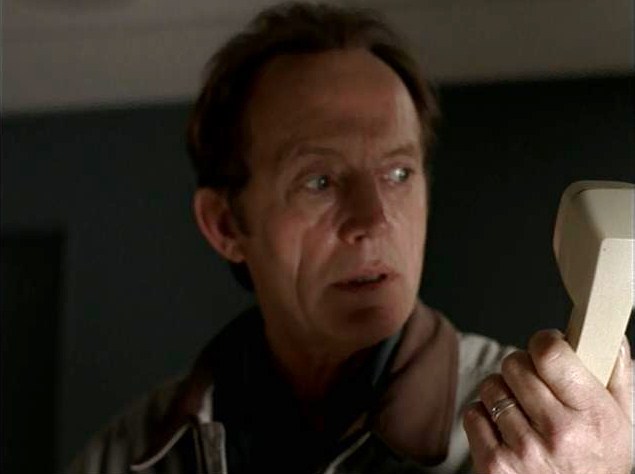
While investigating “The Madman Maniac” case on a horror movie set in Trinity, South Carolina, F.B.I. detective Emma Hollis (Klea Scott) asks profiler extraordinaire Frank Black (Lance Henriksen) an important question about their current investigation.

She asks him if he recalls the serial killer called “The Frenchman” -- a figure depicted so memorably in Millennium’s pilot episode in 1996 -- and wonders if this case could be similar in an important way. Except that instead of a Scripture-quoting serial killer, the contemporary investigation involves one who utilizes horror movie “quotations” or allusions as his source of creativity.

Quite reasonably, this raises a procedural question. Shouldn’t the case’s investigators be watching and researching horror films to glean a sense of the Madman Maniac killer’s next move, as well as his motivations?

Frank is impressed and agreeable regarding this course of action.

Queue John Carpenter’s Halloween (1978)…

This short scene is very much the lynchpin of the Millennium third season episode, “Thirteen Years Later,” and for two important reasons.

First and foremost, it suggests the leitmotif of Michael B. Perry’s complex story: horror movies serving as important clues in capturing a serial killer. And secondly, the very act of a horror-themed TV show delving into the horror genre (and referring to a previous episode in Millennium canon too…) heavily reflects the cultural context of the episode’s epoch.

Specifically, the year 1998 represented the pinnacle of the 1990s self-reflexive, post-modernist horror movement in cinema. This was the era of Wes Craven’s Scream (1996), I Know What You Did Last Summer (1997), Scream 2 (1997), Urban Legend (1997) and I Still Know What You Did Last Summer (1998).

More or less, all of these scary movies thrived upon the notion of killers taking horror movies as inspiration for violent behavior. And to varying degrees, the characters in these new-styled slasher films, realize they have actually landed in a horror film and either act accordingly and survive, or fail to…and die.

Intentionally mimicking this then-popular horror movie format, “Thirteen Years Later” both gazes at Millennium’s internal history (the events of the pilot, as well as Frank’s old case of over a dozen years ago) and the genre the series belongs to.

To succeed as self-reflexive satire of the horror format, this Millennium episode must first ape that form, and this is where “Thirteen Years Later” proves rather clever. In particular terms, the episode closely mirrors and rigorously conforms to the “Slasher Movie Paradigm” I excavated in my 2007 McFarland book, Horror Films of the 1980s.

As the title of the Millennium episode suggests, the narrative involves a crime or transgression in the past, in this case, a crime Frank investigated over a decade back. More significantly, it boasts what I termed an organizing principle or “umbrella of unity” too, in this case a world or venue from which all the killings draw inspiration and creativity.

In my book, I noted that: “The organizing principle is what every slasher film ultimately hangs its hooks upon. It is the key to every aspect of the film: from setting to character motivations to mode of kills and even final chase.” (page 20).

In Friday the 13th (1980), that organizing principle was the summer camp, Camp Crystal Lake. In He Knows You’re Alone (1981), the organizing principle was the world of weddings (brides, a church, a dress shop, a dress tailor…). In A Nightmare on Elm Street (1984), the killings by Freddy Krueger all occurred in the dream world.

In “Thirteen Years Later,” the organizing principle is simply the cutthroat world of contemporary, Hollywood: a 1990s-era movie set. This organizing principle makes way for the episode’s prospective victim pool (personal trainers, producers, ingĂ©nues, pampered Shakespearean actors, etc.), muddies the water in terms of useful clues (is that human blood or stage blood at the crime scenes?) and provides the critical clue about secret identity of the killer (hint: he’s a method actor).

Delightfully, the episode also positions Emma Hollis as that archetypal slasher movie character: the Final Girl. The final girl -- a term created by Carol J. Clover -- is “chased, cornered, wounded…but she alone also finds the strength either to stay the killer long enough to be rescued (Ending A) or to kill him herself (Ending B).” (Carol J. Clover. Men, Women and Chainsaws: Gender in the Modern Horror Film. Princeton University Press, 1992, page 35).

In “Thirteen Years Later’s” tense finale, after the killings are believed to be over, the real killer threatens Emma in her hotel room while she is alone, and she must summon the strength and composure to defeat him…even if he sounds an awful lot like her beloved mentor, Frank Black. She succeeds ably and proves her worth as a horror movie Final Girl.

By co-opting the crime in the past, the organizing principle, the victim pool and the Final Girl character from the Slasher Paradigm, “Thirteen Years Later” emerges as a full-on, affectionate celebration of the slasher genre. The segment’s best scene, not coincidentally, involves Frank Black’s lightning fast, unimpressed (but impressive) psychological profile of such slasher film icons as Michael Myers, Jason Voorhees, Freddy Krueger and even Norman Bates.

We’ve all seen these films and these characters over and over again – and cherished them – and yet Frank comes in -- and after watching only a little clip from each film -- diagnoses these Bogeymen in the most nonplussed and clinical (and therefore amusing) manner imaginable. This is a terrific moment, and one that reveals how adeptly Lance Henriksen broaches humor in what many viewers might perceive as an essentially humorless role. He plays the scene straight, thereby allowing the audience to detect the humor for itself instead of camping-it-up and going for obvious laughs. The moment is funny because Frank accomplishes in mere moments what a century of film heroes, psychologists and final girls cannot: he unearths the motivations for the seemingly unstoppable silver screen slashers.

The self-reflexive component of “Thirteen Years Later,” largely emerges -- Kevin Williamson-style -- in the number and specificity of the horror movie allusions. The episode tags not only Psycho, Halloween, Friday the 13th and A Nightmare on Elm Street, it pauses to remember The Texas Chainsaw Massacre (1974), The Omen (1976), Motel Hell (1980) and The Hitcher (1987). The killer re-creates the chainsaw attack from Leatherface’s film, and the severed finger in a lunch meal, from The Hitcher, to offer some specifics.

But most interesting, perhaps, is one relatively obscure literary reference seeded into the proceedings. Specifically, a relaxing Emma Hollis is seen reading an interesting book: Jorge Luis Borges’ Labyrinths (1962).

This is a critically-feted collection of short stories by a celebrated modernist who subscribed to the theory that anarchy and chaos dominate the world; and who, on several occasions, actually wrote “hoax” reviews of literary works that did not actually exist…by authors that likewise, did not exist.

Ultimately then, author Borges played with literary form in the same fashion that “Thirteen Years Later” plays with cinematic or visual form. The episode is about a killer who has no understandable pattern, but who is making a movie (that doesn’t exist) about a historical case (that also doesn’t exist). This is a fake form referencing a fake form, referencing a fake event.

You can’t get much more post-modern than that.

In terms of visuals “Thirteen Years Later” also deliberately apes the slasher milieu. The installment opens with imagery reminiscent of Psycho: a shower-head facing the camera (screen-wise above and before the audience), a playful composition which makes the audience remember Janet Leigh’s infamous stay at the Bates Motel and ultimately puts us in the shower.

The film’s first death set-piece then co-mingles stage-blood and real human blood; a visual metaphor for a twisting narrative which purposefully blends “the reality” of Frank’s old case with the illusions produced by commercial Hollywood,

After the action settles down in Trinity, South Carolina (a town named after the central location of the 1995 Sam Raimi/Shaun Cassidy horror serial, American Gothic), the visuals grow increasingly claustrophobic. By the time of the climax, in which Emma is imperiled, tight horror movie-styled framing rules the day. Thanks to accomplished director Thomas J. Wright, we get some lovely close-ups of Scott, and Emma’s space in the frame is increasingly restricted, bracketed on both sides by encroaching door frames and other objects.

In some ways, “Thirteen Years Later” feels like an atypical, out-of-step installment of the very serious Millennium. But digging a little deeper, one detects how the episode’s crazy killer echoes the modus operandi of previous serial killers seen on the program, only with a horror movie twist.

And more so, the self-reflexive, post-modern message -- epitomized by the presence of that book, Labyrinths -- reveals much about the episode’s intelligent approach.

Trying to determine reality and not artifice in “Thirteen Years Later” is enough to make even the stalwart Frank Black go insane, for the third time in his life.

Two severed thumbs up?

From the Archive: My Five Favorite Frank Black Moments

Over a span of three seasons and more than sixty-five episodes, Millennium  accommodated many different brands and styles of storytelling -- including some unexpected lunges into comedy -- and the face that always held it everything together belonged to Lance Henriksen.

Selecting just five favorite Frank Black moments is not an easy task because Henriksen and the series writers/producers/directors gave us so damn many of 'em in those three wondrous seasons. 

Anyway, these five "great Frank Black moments" come in no particular order, and from all three seasons of the series.

1. "Pilot" Frank introduces his family to their perfect yellow house. 

As the series opens, Frank Black and his family relocate to rainy Seattle, but -- caring spouse and supporting father that he is -- Frank has made certain that their lives have at least a ray of sunshine in them. 

Here, he shows them their gorgeous new home, a shining yellow house far away from the repellent darkness of Frank's work. 

In a beautiful, spontaneous moment, little Jordan (Brittany Tiplady) is so excited to see the new family home, she licks her Daddy's nose.  It's an innocent, childish gesture (lensed in close-up) that really cements the Black family bond, and reveals the closeness between father and daughter.  


2. "Lamentations"  Frank is in the wrong place at the wrong time.

Far away from the yellow house in Seattle, Frank Black deciphers a clue that suggests Evil Itself (in the form of Sarah Jane-Redmond's Lucy Butler), is on the way to "visit" his imperiled family.  And this time, Frank is too far away to help them. 

The expressions that cross Frank's face as he attempts to figure out what is happening, and if his family is safe, probably represent the closest thing to panic we ever see on the guy. 

If something can drive the solid, even-tempered, brave Frank Black to that unprecedented level of concern...watch-out. 

And sure enough, when Frank's friend Bletch enters the yellow house during a storm -- now a yellow house of horrors -- be afraid.  Be very afraid...

3. "Jose Chung's Doomsday Defense:" Don't Be Dark, Frank.

In this caustic satire of Scientology (called Self-osophy in Millennium), Frank attempts to ferret out the identity of a killer by using a copyrighted Self-osophy self-help technique. 

With a tape entitled "How Not to Be Dark" and a gimmicky head set, Frank engages in "Easy Visualization Therapy," and is asked by the taped voice to "picture something that disturbed him."

At that exact moment, the episode cuts ironically to a blood-curdling montage of every grisly vision from Millennium's first season and-a-half.  Horrified, Black rips off the head-set and nurses the mother of all headaches.  But the point is that Frank doesn't run from the darkness or try to deny it.  He faces it.  He isn't about "self" (or Self-osophy) and sometimes we all genuinely need to "be dark."

4. "Luminary:" Frank Black to the rescue.


An exhausted, freezing Frank Black carries an injured young man named Alex through the hostile, wooded terrain of wild Alaska in the uplifting "Luminary." 

When the young man's stretcher tilts and dumps the boy in the river rapids far below, Frank -- without batting an eye or hesitating a second -- jumps in after the boy. 

This courageous and self-less act represents Frank's ethos in a nutshell.  It's that father instinct.  It's that tenacious unwillingness to give up on someone he has sworn to protect.  He will literally do anything to help another human being, even at great risk to himself.

5. "The Sound of Snow:"  "Every day, I want to be with you."

Alone in the wild again, Frank is badly injured and experiences a vision that, in some small way, forces him to face his greatest loss. 

This moment reveals to us Frank at his most vulnerable and emotional, and does so with the one person that he can be so vulnerable with, his beloved Catherine (Megan Gallagher). 

It's a haunting, affecting moment, because we see beneath Frank's strong facade and see -- truly see -- his sense of pain and loss.  This moment always moves me, every time I watch "The Sound of Snow."  Frank faces guilt, loss, sadness and a future that isn't what he hoped it would be.

From the Archive: Millennum: "Powers, Principalities, Thrones and Dominions"

What comes after someone survives a terrible and terrifying event? What truths or new perspectives follow in the wake of pure, blood-pumping terror?

These are the pertinent questions raised and answered at least obliquely by “Powers, Principalities, Thrones and Dominions,” the Millennium first season segment that directly follows “Lamentation,” the unforgettable introduction of Sarah Jane Redmond’s demonic villain, Lucy Butler.

The battlefield or thematic terrain of the episode is well-enunciated in the week’s opening quotation from Charles Manson, which reads: “Paranoia is just a kind of awareness, and awareness is just a form of love.”

In other words, “Powers, Principalities, Thrones and Dominions” concerns awareness in general, and specifically Frank’s dawning awareness of a Cosmic Order outside the ken of mankind. This awareness comes to him only after an extended and painful period of self-doubt and grief.

But ironically, awareness would also not be possible without that self-same period of self-doubt and grief.

Penned by Ted Mann and Howard Rosenthal, and superbly directed by Thomas J. Wright, “Powers, Principalities, Thrones and Dominions” thus finds the series’ lead protagonist, Frank Black at his lowest and most world-weary ebb and then -- surprisingly -- opens his eyes to an unseen world; the world of angels, demons and cosmic hierarchies.

The title of the episode itself indicates the nature of those cosmic schemes or hierarchies. According to some Biblical scholars, “Thrones” are living symbols of God’s justice and authority, “Dominions” are beings who regulate the lower angels, “Powers” are the bearers of conscience and keepers of history and “Principalities” are the educators and guardians of the realm of Earth.

Or contrarily, “Thrones,” “Dominions,” “Powers” and “Principalities” may be the categories of evil Minions existing on Earth; the twelve principalities of Satan, for instance (death, anti-christ, covetousness, witchcraft, idolatry, sedition, hypocrisy, disobedience, rejection, hypocrisy, etc.).

Similarly, in Ephesians 6:12 the apostle Paul wrote: “For our wrestling is not against flesh and blood, but against the principalities, against the powers, against the world-rulers of this darkness, against the spiritual hosts of wickedness in the heavenly places.

This was the author’s manner of suggesting that anti-God, malevolent forces existed in places of state, in places of Empire, in places of government.

Thus, in pondering this episode of Millennium, we (along with Frank) find ourselves plunged into a war involving supernatural beings on Earth. On one hand are angel-like agents of God such as Sammael, who seems a “guardian of the realm of Earth.” On the other hand is Alesteir Pepper, a man of worldly wealth and power and perhaps, actually, a demon. Even Aleister’s name suggests evil, as he jokes with Frank, making an almost-cryptic allusion to the notorious poet and Satanist mystic, Aleister Crowley (1875-1947).

In terms of Millennium history, “Powers, Principalities, Thrones and Dominions” plays tonally almost like the epilogue or coda of “Lamentation,” and represents one of the earliest instances in the Carter series of direct supernatural involvement in human affairs. To recap, in “Lamentation,” Frank’s family is threatened by Lucy Butler, and his best friend, Bob Bletcher (Bill Smitrovich) is murdered in Frank’s own sanctuary, the yellow house where Frank tries in vain to “paint away” the darkness in life, per the words of series creator Chris Carter.

As “Powers, Principalities, Thrones and Dominions” opens, Frank grapples heavily with the death of “Bletch” and the invasion of his yellow sanctuary. Accordingly, the episode’s dialogue continuously maps Frank’s sense of world-weariness, confusion, and diffidence. “I’m not ready to come back to work yet,” he tells Peter Watts (Terry O'Quinn) with resignation during one phone conversation.

When Frank does become involved in a new case for the Millennium Group -- a seemingly-Satanic ritual-turned-homicide -- Frank admits that his “clarity is not what” he “had hoped it would be.” At home, Catherine worries what will happen to Frank if he cannot right his ship; if he cannot return to his true nature as a crusader against the darkness. “You can’t deny who you are Frank…if you let things go on this way, it’s only a matter of time…”

The unspoken ending to Catherine’s last sentence is no doubt an allusion to Frank’s nervous breakdown; the last time he lost his grip on his identity and his true, best self. Catherine clearly fears the same thing could occur again if Frank doesn’t find his emotional footing.

Interestingly, when Frank is confronted by Pepper, a man who may be a demon, he notes – in maddeningly ambiguous tones -- that “you’ve come to me before.”

This seems an implicit suggestion that Frank’s previous mental breakdown arose as a result of the works of a demon, even, perhaps, the Devil himself. Only now – upon recognizing the demon again (although perhaps in a different form) - does Frank understand what he is really battling.

Admirably, director Thomas J. Wright’s selection of compositions during the early portions of “Powers, Principalities, Thrones and Dominion’s” echo Frank’s crisis; his sense of uncertainty about himself, his gifts, and the nature of the world around him. Thanks in large part to these shot choices, death itself seems to oppress Frank in this episode, like an anchor pulling him down farther and farther.

To augment this perception of a man overwhelmed and oppressed by death, Wright stages shots of Lance Henriksen visually entrapped between support beams in Frank’s basements (the site of Bletch’s murder). This mise-en-scene limits Frank’s space in the frame and creates, in essence, a visual “cage” around the character.

Director Wright – a veteran of such programs as Beauty and the Beast, Otherworld, Dark Skies, and Nowhere Man -- also frequently positions Frank underneath heavy stone archways or obscured behind objects in the frame. These choices by Wright in general reinforce the lugubrious or heavy nature of the story, of Frank “denying who he is,” in the words of his wife, Catherine, and feeling defeated and overwhelmed by recent, tragic events.

At about the ten minute point of the episode, for instance, in the scene that finds Frank and Peter Watts discussing Sammael, Wright even positions Frank behind two coffins in the foreground, a visual indicator that death is foremost on his mind, and occluding, again, his space or freedom in the frame.

Another moment, early in the episode, also expresses Frank’s conflict. He gazes at his reflection in a bathroom mirror, and the idea, expressed by the director’s selection of angles, is that he is battling himself, (his reflection); battling his sense of doubt and uncertainty.

As the episode continues and Frank is drawn further into the seemingly unconnected case of a murderer named Martin, the profiler continues to flash on mental images of Bletch’s murder. But instead of denying the connection to the event that consumes his mind, Frank begins to explore it more fully. This is Frank’s perennial strength, his ability to face the darkness head on. Soon, he is listening to his visions instead of trying to dismiss them as symptoms of trauma or stress.

Again, Thomas J. Wright cannily finds exactly the right visuals to suggest Frank’s restored confidence. When, during the climax of the episode, Frank witnesses a parking lot confrontation between a diabolical attorney named Aleister and a stranger -- really the “angel of death” Sammael, for instance, Wright presents two competing visions of the conflict in fast succession.

In the consensus view of reality, Sammael is armed with a gun and fires it at Pepper at point blank range. But in Frank’s personalized, insightful view of the event, a kind of supernatural energy beam is emitted from Sammael’s palm and strikes the demonic lawyer. These rapidly alternating views of the same event make the audience aware that Frank again has confidence in his insights. He sees the event for what it is: a supernatural assassination; one of God’s agents (Sammael, who in literature is sometimes good and sometimes evil) “binding” and defeating an agent of Satan, Aleister Pepper.

Likewise, when Frank disarms Sammael after the confrontation, Wright’s camera adopts a low angle perspective, one that in cinema history traditionally represents power or strength. Frank and Sammael – again, an angel or supernatural creature of some variety – share a tight two shot, as Frank puzzles over the gun.

Both the perspective and the staging reveal Frank’s intrinsic strength. Visually, he is on equal footing with the angel in this case. The shot selection thus makes one wonder if Frank is actually a critical part of God’s hierarchy as well. Like a “Throne” is a symbol of “justice” and like a “Power” is a force of conscience, so thus is Frank himself, discerning truthfully that which other humans cannot see. The two-shot reinforces this notion, as it suggests a comparison, a kinship between the two objects or people sharing space in the shot.

When Frank declares that whatever force killed the man named Martin was “anything but natural” in “Powers, Principalities, Thrones and Dominions,” he is evidencing his sense of “awareness” (after the paranoia and doubt) as referenced in the episode’s opening quote. Frank has begun to detect that something bigger than man is involved in man’s affairs, and that he is, in fact, a crucial player in that supernatural war.

This idea represents a huge opening up of Millennium’s mythology, an embrace of religious mythology or “faith” in very literal, concrete terms. But what remains so remarkable about this episode is that Frank’s journey from awkward self-doubt to awakened awareness is charted not just in terms of dialogue or narrative details, but in the director’s artistic and meaningful selection of angles and viewpoints.

I often write on my blog that film and TV work best when form follows or reflects content, and this axiom is also true in spades of Thomas J. Wright’s work on Millennium, and this episode in particular.

Another way to put it: The teleplay for “Powers, Principalities, Thrones and Dominions” makes Frank aware that there is more on Earth than is dreamed of in man’s philosophy; but Wright’s clever, crisp and expressionist visualization of the teleplay makes the audience actually feel that another world exists side-by-side our own.

More than that, Wright’s steady direction shows us Frank’s place within the larger battlefield, and allows us to take the measure of the man. The Devil wants more than anything to co-opt Frank, to turn him to darkness, but the message of “Powers, Principalities, Thrones and Dominions” is that if Frank can maintain confidence in his “gift,” he will see through the Devil every single time.

Midnight of the Century: Millennium, Fifteen Years Later


Chris Carter's second TV series, Millennium (1996 - 1999), premiered fifteen years ago today -- on October 25, 1996 -- with one of the best-written, best-acted, best-directed pilot episodes I've seen in a journalism career that spans nearly two decades.  The  ensuing series ran far too briefly, for just three years on Fox in prime time.  Yet for me, Millennium remains something of the gold standard; a high-point of the horror genre in the medium of television.

Why do I still find so much of value in a decade-and-a-half old TV series, one set in the second term of Bill Clinton?  

Well, as bluntly as it can be put, Millennium was constructed artfully, with symbols and ideas that continue to resonate deeply.  Back in 1999, I wrote a book called Terror Television, and wrote of Millennium that it was "far better, far smarter, than just about any program on any of the American networks." 

I could easily (and happily) make the same statement today.

As part of Millennium's fifteenth anniversary, I'll celebrate today with some posts about the series, some of which you've seen before, and others which you have not.  But here, now, to start off, I want to break down some of the particulars of the series' artistry as i see them.

Context and Literary Allusion

Many episodes of Millennium open with a white-lettered quotation from a literary or religious source.  In short order, the episodes then depict a tale that echoes, contrasts, or mirrors that opening selection. 

Yeats ("Pilot"), Dostoevsky ("Dead Letters"), Melville ("The Judge"), Jean-Paul Sartre ("522666"), Robert Louis Stevenson ("The Well Worn Lock"), Cicero ("Walkabout"), Nietzsche ("Broken World"), William Rose Benet ("The Paper Dove") and even Shakespeare ("Monster") represent just some of the literary giants and thinkers Millennium routinely referenced.  The Bible was often mined for pertinent quotations as well.

These opening quotes were not included to be pretentious, but to provoke thought and to connect the viewer to the fact that the series concerns our history, our very nature.  It's an invigorating purpose and one that reminds authors that there is a direct link between past and present, a universality of the human condition.  The situations that criminal profiler  Frank Black (Lance Henriksen) encounters are situations that Shakespeare or Cicero contemplated or thought about, and so these opening quotes -- easily dismissed by some -- remind us of literary and historical past.  And since Millennium is, in some ways, about the passage of a thousand years, it's entirely appropriate, and even inspired, to focus on the link to our shared past.

In other words, these opening quotations help us contextualize the stories; but also contextualize Frank's journey in terms of human (or at least literary) history.  He's not just "a guy" trying to catch a serial killer, he's part of the ebb and flow of human history, doing battle at a vital juncture in such history.

The Yellow House

I find it almost endlessly rewarding how Millennium was devised on artistic terms, from its opening quotations to its very unique application of symbols and imagery.  The oft-mentioned yellow house on Ezekiel Drive, for instance, is perhaps the program's most important and familiar symbol.  Viewers associate yellow with brightness, and with bright, happy light, like that of the sun. 

Of course, the yellow house also represents Frank Black's only bright place away from the darkness and away from the horror that he witnesses on the job, and even within the recesses of his own mind.  Rewardingly, Millennium utilizes the recurring symbol of the yellow house in a plethora of stimulating ways.  It doesn't always mean the same thing.

In the series' first season, for instance, the house is seen as a place of safety for the Blacks, a sanctuary away from the world.  In the second season, it becomes a representation of paradise lost and the object of the heroic quest, when Frank is, literally, banished from it.   His purpose in life becomes reclaiming the yellow house and what it once represented (the wholeness of his family.)

In the third and final season, Frank's yellow house is but a sad memory, but yet one which remains intact inside the recesses of his mind.  He visits his former home in the episode "The Sound of Snow," and it has been painted white.  Still, the ever perceptive Frank envisions his Camelot, his yellow home in Seattle.  Frank's house is now an ideal, not a real place, one representative of a specific time and feeling. 

One might suggest that the yellow house of Millennium represents an escape from evil, "the painting away of the darkness" as Chris Carter beautifully described it, and yet it is also the very reason why Frank faces the heart of human darkness every day.  By facing the dark inside and out, Frank preserves the yellow, inside and out.  The two are interconnected in some significant way.  The house is part of Frank's yin and yang.

The yellow house could also symbolize, on a more basic level, small town America circa 1996.  Frank must rescue it from the encroaching evil.  Thus the yellow home is not merely beautiful in an architectural sense, it is a brilliant symbol because it shares with viewers an insight into Frank's personality and cause.  It represents his interior architecture, if you will.

It is the reason he fights; and what he fights for, since the yellow represents the sanctuary for his family, for his wife and daughter.

And yes, I painted my first home yellow, in honor of Millennium's yellow house.  We all have a " yellow house" in our minds; whether in our adulthood or as a remembrance childhood.  It is a place of safety, nostalgia, hope and dreams.   In Millennium, the yellow house is the center of gravity, the center of Frank's universe.

The Time is Near

The specter informing so many episodes of Millennium is the end of the world itself: doomsday.  This is a powerful and universal fear because many people suspect that the end will come one day...and perhaps soon.  Dinosaurs preceded us here and now they are extinct.  The Roman Empire came and went, a brief candle.  The Native American culture which once existed on this land we now inhabit is but a memory too. 

Time passes, cultures die, life is transitory and on some subconscious level, all humankind is aware of this fact, of the inevitable changing of the guard.  On a personal, individual note, we all must reckon with our appointed doomsday, our appointed apocalypse.  We will each die, and for us, that cessation represents, certainly, the end of the world.

Throughout Millennium's canon, the series writers obsessed on the universal human inquietude about our impending ends.  Could our demise arrive in a second great flood ("Force Majeure?")  Could it involve religion ("Forcing the End,") and, specifically the Anti-Christ ("Marantha?")  Would our end come from deliberate, blind tinkering with our science, or our genetic make-up ("Walkabout," "Sense and Antisense")?  

The series also looked at ethnic doomsdays ("A Single Blade of Grass), Y2K fears ("Teotwawki), and one of the best, "Jose Chung's Doomsday Defense, boasted the audacity to suggest what we've actually seen since Millennium was canceled, with the advent of so many damned remakes: a creative apocalypse.  Written by Daring Morgan, this installment of the series implied that all humans can look forward to for the next thousand years is "the same old crap."

Who Cares?

It probably seems strange to praise Millennium as an inherently optimistic series, considering how obsessively it wonders about the end of the world. 

Yet, Millennium boasts another recurring and potent symbol worth mentioning. That symbol is, of course, the child.  Segment after segment on Millennium explicitly involves children, and youth in general, because our offspring represent the future.  In our children, in our next generation, we see hope and fear, and Millennium shares this viewpoint.  

For instance, in one of the best hours written for any genre show in history, Millennium explores a very real "evil" of modern American society: the way in which our culture encourages children to be the same, to conform to expectations, and be "ordinary." 

The episode I refer to is titled "A Room with No View," and it concerns a demonic force, Lucy Butler (Sarah Jane Redmond) who captures promising kids.  These abducted teenagers have all been voted "most likely to succeed," and are well loved by classmates and parents.  There is something almost intangibly special, something attractive, charismatic and magnetic about each of them.  They all have spirit, for lack of a better term. 

But in "A Room with No View," our future leaders are captured and tortured until they succumb to the urge to become ordinary, invisible, corrupt.  In this case, Millennium views an apocalypse not in some outside force, such as a flood, but in our inability to inspire and support our children; to let them be who they choose to be.

Other episodes also very much involve children.  Chris Carter's "The Well Worn Lock" gazes at the terrifying problem of child abuse and how it intersects with politics, while "Monster" gazes at a child who -- for inexplicable reasons -- is purely and simply evil. 

The inspiring story "Luminary" involves a young man who forsakes the material "culture of desire" we've made here in the United States, and gives up all his belongings and money.  He goes to Alaska alone to seek wisdom.  When the boy disappears, Frank must find him.  But the very idea of renouncing things, of renouncing wealth, is a potent idea in Millennium (inspired by the story Into the Wild), and significantly, it finds purchase in the symbol for our future; in the next generation.

Throughout the series, the writers also followed the development and growth of Frank's daughter, Jordan (Brittany Tiplady).  But importantly, we also witnessed, dynamically, Frank's viewpoint as a parent regarding his daughter, and regarding children in general.  In the aforementioned "Monster," he delivers an impassioned, heart wrenching speech about what the arrival of Jordan meant to his life; and how it changed him. 

Specifically, Jordan's birth reminded Frank that he did not "manufacture" himself as a grown-up; that he too had been a child once.  And now he strives to see the child -- the potential -- in all of us, even the men he hunts.  If the serial killers are dark potential realized, then Millennium views children as exactly the opposite, as a source for hope.

The importance of the child (of our tomorrows, essentially) is signified in Millennium even in its opening credits, impressively.  As you can see in the photo above, there's an image of a young girl walking across a bridge, awkwardly, in danger of  a fall.  That's the bridge to the future (the 21st century) and she will either make the journey intact...or plummet to her doom.

The Fall of Rome?

Millennium is an abundantly introspective series, and yet in some strange way it reads as a little innocent and naive today, following a decade of war, torture, economic calamity, and more. 

But back before Y2K, before 9/11, before Katrina, the series set up a very specific analogy that America was like something akin to Rome...an empire on the verge of collapse.  And the cause of the collapse came from within; from a perversion or "weed" growing up inside our borders, and personified by the serial killers of the 1990s. The series brilliantly and quite originally suggested "pathology is part of the grotesque master plan" (Alyssa Katz, The Nation: Millennium," November 24, 1996, page 35), and constantly raised the specter that, as a nation, America was rotting from within; from a kind of inbred decadence. 

I have written about this before, but I believe that writers such as Chris Carter and Frank Spotnitz carefully used the concept of the "serial killer of the week," much like Star Trek used the concept of "the civilization of the week."

In each new encounter and each new episode, Frank would learn something valuable about himself, and something about the values of his country from case of  a twisted serial killer.   We saw this paradigm in "Weeds," "Blood Relatives," "Loin like a Hunting Flame" and "Wide Open," among others.  The idea was that madness had sprouted up in the land, a very specific madness born from "who we are."   The series suggested this madness would ultimately be America's downfall.  Unless men like Frank could stop it.

Lance Henriksen

It would be impossible to write of Millennium without considering the depth that Lance Henriksen brought to the role of Frank Black.  Even in a story that doesn't necessarily work on all thrusters, Henriksen completely invested himself in the role of Black. 

The scene I described above, in "Monster," is a perfect example.  The episode, as a whole, is pretty good, but boasts some pretty obvious deficiencies in the writing.  For instance, Lara Means (Kristen Cloke) is introduced in this episode as a semi-regular, and in the first twenty-three minutes, she quips "here's my thing" four times.  The viewer is practically bludgeoned with the catchphrase, and it's...well, lacking in nuance. 

But then, in the third act, amidst the dross, Henriksen delivers that speech; the one about childhood, about the importance of children; about the impact of his child's birth upon his life, and it's absolutely riveting.  Suddenly, you're not watching a conventional tale of an evil child; you're watching the story of a human being, of a committed father facing the loss of all that he cares for.  The scene is emotional and beautifully performed (and written), and Henriksen accomplished miracles like this on a regular basis.

We're all shepherds

For me, Millennium was always at its best when it addressed our human fears (about apocalypse, about our culture, about violence) and made us look in the mirror.  In the opening credits the first year, the question "who cares?" would pop up in almost accusing fashion.

That was an important matter. 

Who cared enough about the world to make it a safer place?  By the third season, the series had formulated carefully  it's answer to the question "who cares." 

The answer came, not surprisingly, from Jordan, from a child.  She said "we're all shepherds," meaning it is incumbent on each of us to care how the world turns out, apocalypse or no apocalypse.

For three years, despite format shifts, Millennium reminded us, "this is who we are," and in the process gave television one of its legitimate artistic masterpieces. 

Monday, October 24, 2011

In case you missed it...


...here's the audio interview I did with Keith Hansen at Untamed Dimensions on Saturday night at 9:00.  We went a bit over an hour, but had a blast.

You can listen to the audio here, and our subject is my book Horror Films of the 1990s, but we also get into classic 1970s horror films, the difference between terror and horror, the efficacy of CGI special effects in horror vs. fantasy and other nifty subjects. 

It was a heck of a lot of fun...

The Cult-TV Faces of: The Fugitives

Identified by Dr. Howard Margolin: Dr. Richard Kimble (David Janssen) in The Fugitive.


Identified by Dave: Ben Richards (Christopher George) in The Immortal.


Identified by Dr. Howard Margolin: Alan Virdon (Ron Harper) and Peter Burke (James Naughton) in Planet of the Apes.


Identified by Dr. Howard Margolin: Run, Joe, Run (1974).


Identified by Dr. Howard Margolin: Shem (Gareth Thomas) and Adam (Pierre Brice) in Star Maidens.


Identified by Dr. Howard Margolin: Logan (Gregory Harrison), Jessica (Heather Menzies) and REM (Donald Moffat) in Logan's Run.


Identified by Dr. Howard Margolin: David Banner (Bill Bixby) in The Incredible Hulk.


Identified by Dr. Howard Margolin: Kerr Avon (Paul Darrow) in Blake's 7: "Blake."


Identified by Dr. Howard Margolin: Bennu (Judson Scott) in The Phoenix.


Identified by Dr. Howard Margolin: Peter Barton and Louis Gossett Jr. in The Powers of Matthew Star.


Identified by Dr. Howard Margolin: The Sterling Family in Otherworld: "Rules of Attraction."


Identified by Dr. Howard Margolin: Chris Barnes and Robert Hayes in Starman.


Identified by Dr. Howawrd Margolin: Xev (Eva Haberman) and Stanley (Brian Downey) in Lexx.


Identified by Dr. Howard Margolin: John Crichton (Ben Browder) and D'Argo (Anthony Simcoe) in Farscape.


Identified by Dave: Thomas Hobbes (Scott Bairstow) and Pinocchio (D.B. Sweeney) in Harsh Realm.


Identified by Dr. Howard Margolin: Max (Jessica Alba) in Dark Angel.


Identified by Dr. Howard Margolin: Simon (Sean Maher) and River (Summer Glau) Tam in Firefly.


Identified by Dave: Rich Connelly (Jay Ferguson) and Dr. Laura Daugherty (Lake Bell) in Surface.


19


Saturday, October 22, 2011

Reminder: I'm on Untamed Dimensions in one hour!

Just a reminder, that, if you're around, I'll be talking Horror Films of the 1990s with Untamed Dimensions host Keith Hansen in one hour, at 9:00 pm EST.  Tune in if you can.

I'm on Untamed Dimensions, Tonight at 9:00 PM

I'll be the guest tonight on the second hour of Keith "Vyz" Hansen's Untamed Dimensions at 9:00 pm (EST) to discuss my new book, Horror Films of the 1990s, and other subjects related to the genre. 

You can tune in to the stream right here.

Long-time readers of the blog may also remember that Keith and I, a couple of years back, also did a four-part series on Chris Carter's Millennium -- a series which will be celebrating its 15th anniversary this coming Tuesday -- and you can listen to those episodes as well. 

Here are the links: episode 1, episode 2, episode 3, and episode 4.

Hope you'll tune to Untamed Dimensions tonight!

Friday, October 21, 2011

CULT MOVIE REVIEW: Pee Wee's Big Adventure (1985)


Week two of our Tim Burton Brief brings us to the director's first theatrical effort, 1985's Pee Wee's Big Adventure.  This nearly thirty-year old comedy remains a deft and amusing collaboration between Burton and Paul Reubens, a comedian who, in the early 1980s, created the character of Pee Wee Herman and saw that persona rise to national fame. 

If you're unfamiliar with Pee Wee Herman, he's essentially  a big-hearted but emotionally-stunted man-child dressed in a suit. Pee Wee is both charmingly innocent in nature and yet diabolically aggressive when he doesn't get his way. 

In other words, Pee Wee Herman is the Peter Pan Syndrome personified, or -- as Ralph Emerson described the mercurial child -- a "curly, dimpled lunatic."   

Although the Pee Wee Herman persona was originally aimed at adult audiences, the character increasingly became popular with children over the years, eventually starring in an Award-winning Saturday morning TV series, Pee Wee's Playhouse.  

Pee Wee Herman's Big Adventure retains the character's spiky edges, and in doing so acknowledges the difficulties of the adult world at the same time that it reveals Pee Wee's essentially good -- with some lapses -- childish nature.

To one extent or another, all of Tim Burton's films involve quirky misfits or oddballs, and perhaps there is no protagonist in the canon more quirky, or more oddball than Pee Wee Herman.  He's desperately afraid of girls, holds down no job, and focuses all of his obsessive  love upon a single, perfect object or toy: his bicycle.  Pee Wee thrives in a bubble of self-indulgent childhood and play, and when he looks outside that bubble, gazes enviously at those who may appear "cooler" than he does.

In the course of Pee Wee's Big Adventure, Pee Wee meets hostility from the "real" (adult) world in the form of an escaped criminal, a biker gang, the jealous boyfriend of an acquaintance, and not least of all, Francis Buxton.  Francis is a rich, indulged man-child, a kind of dark reflection of Pee Wee.  In all cases, except for Francis -- who is truly incorrigible and thus irredeemable -- Pee Wee works his child's magic upon his enemies, transforming them into friends and supporters.

The inference is obvious: unless you're a monster (like Francis...) you just can't hate Pee Wee for long.  We also saw this quality in the character of Ed Wood last week.  Through his eternal optimism and enthusiasm, Burton's Wood successfully drew others into his orbit, into his world of movie-making.  Through his child-like kindness and friendship, Pee Wee often accomplishes the same feat here, permitting other characters to "follow" their dreams the very way that he does.  Whatever his failings in terms of fitting in, Pee Wee is indomitable, and people around him pick-up on that admirable quality.

So what audiences get here is, basically, a very funny commentary on childhood; or perhaps upon society's view of children.  What makes the film so unrelentingly funny, however is that Pee Wee is most definitely not all sunshine and roses, and, certainly, neither are kids in real life.  Like any child, Pee Wee can be abundantly vindictive, capricious, out-of-control, and even ego maniacal.  The film often attains the pinnacle of silliness when Pee Wee -- in pursuit of his perfect bike -- must call upon his juvenile "id" to attain his goal.

It has been widely suggested by critics that Pee Wee Herman is an acquired taste, or that one's "mileage" for the character may vary.   Yet to some extent, Pee Wee Herman's Big Adventure thrives even beyond one's appreciation or approval for the central character because of the wild, visual flights of fancy evident here.  Even if Pee Wee fails to impress as a character or a comedic concept, his dazzling fantasy world of Rube Goldberg-esque inventions and colorful, strange misfits proves eminently memorable.  With Pee Wee Herman's Big Adventure, you get just not Pee Wee himself to enjoy, but access to Pee Wee's world.  In the final analysis, it's a pretty wild and imaginative place to visit.

Specifically, Burton executes a number of  clever visual jokes that reveal the essence of the unusual lead character and his world view.  In other words, Burton finds way to express with the camera the inner workings of Pee Wee's childish but ultimately admirable psyche.  To some degree, this practice makes the inscrutable, juvenile Pee Wee more sympathetic and heroic. 

And, of course, that's the point.

"Life can be so unfair."

Pee Wee Herman (Paul Reubens) sets out on one lovely day to pick up a new horn for his beloved bike at Chuck's Bike-o-rama. 

Unfortunately, Herman's nasty nemesis, Francis Buxton (Mark Holton) hires someone to steal his  bike.  But when Herman goes on the radio to detail his campaign to get the stolen bike back, Buxton re-hires his underling to get rid of it so he won't get into trouble with his Dad.

After visiting a fortune teller, Herman learns that the missing bike may be "in the basement of the Alamo," and sets off for Texas.  Along the way, he meets an escaped criminal, a waitress who longs to see Paris, a ghost named "Large Marge," a hobo on a train and even a biker gang.  Through it all, Pee Wee admirably keeps his focus on his bike...and makes friends in the process.

Finally, when he learns that a famous child star, Kevin Morton (Jason Hervey) has possession of the bicycle, Pee Wee goes to Hollywood and sneaks onto the Warner Bros. lot to get it back.  Pee Wee recovers his stolen treasure, and after a lengthy chase, becomes a star in his own right. 

As it turns out, a studio exec at Warners think that Pee Wee's big adventure would make a hell of a movie, especially if it starred James Brolin and Morgan Fairchild...

"Everyone has a big "but"..."

Pee Wee Herman's Big Adventure works so well as a comedy because Tim Burton unabashedly forgoes any sense of realism, and instead allows the audience to feel (Heaven forbid...) what it would be like to live in Pee Wee's world for ninety minutes.

For instance, as Pee Wee learns of the criminal and shocking theft of his bike, the camera goes cockeyed, Danny Elfman's score turns portentous, and we get extreme close-ups of a sinister-appearing robot Clown.  The bike had been chained to that clown, but now the clown seems to mock Pee Wee with it's very presence.  It's an evil Leviathan, passing judgment; mocking him.

In almost the very next scene, Pee Wee grows despondent over his loss of the bike, and once again, we seem to peek directly into his fevered brain.  Suddenly, everybody (even a mime...) rides by on wheels, implicitly mocking Pee Wee's lack of conveyance.  This is a particularly funny scene, as Pee Wee can't look anywhere without being reminded of the amazing treasure he has lost.  And we absolutely know that bike is amazing, because Pee Wee is practically blinded by the bike's radiance on the first occasion it is depicted in the film.

Soon, Pee Wee's unhappiness turns him into something of a monster, a fact we see expressed visually during a sequence set in a rain-swept alley.  Pee Wee enters the scene first as a shadow, as a giant, hunched over monster.  This image reveals how (an unfair) loss has informed the character's view of the world.  Again and again, Burton's exaggerated use of mise-en-scene tells us something critical about the emotional context of Pee Wee's world and his thoughts.

The film's first scene, in fact, is a pretty terrific reflection of Pee Wee's universe and psyche.  It's a dream sequence in which Pee Wee envisions himself racing in the tour de France. 

As the movie and scene commence, Pee Wee -- on his beloved bike -- passes the other racers effortlessly.  At first, he does so with that trademark little giggle of his.  Then, as he increases speed and vanquishes all of his opponents, the giggle turns to a cackle of ego maniacal glee.  There's something driving and a little out-of-control about this desire to win the race, to be the best, and the escalating insanity of Pee Wee's laughter reveals that.

He wins the race, but as Pee Wee is about to be crowned victorious, his alarm clock rings, exposing the scene as a dream. Instead of ending abruptly, however, the dream continues to unfold, and the gathered attendees just sort of wander away and disperse, a moment which reveals how "deflating" an awakening from fantasy can be.  And indeed, Pee Wee's whole world is fantasy.  When he awakens from it -- as is the case with the bike theft -- it's devastating to him.  Without making Pee Wee's Big Adventure sound like deep social commentary, there's clearly something here about a child's first experience countenancing the world. Witness Pee Wee's disappointment upon learning that the Alamo doesn't actually have a basement.  Why don't they tell kids thing like that, he practically asks.

As I wrote above, Pee Wee's Big Adventure seems to work at its apex of humor when the character's dark side is allowed free rein.  Pee Wee tackles Francis in a pool, and nearly drowns the cad, for instance.  At another point, Pee Wee is debauched when other bicycle riders in the park perform riding tricks, and he can't match them. Suddenly, he sets about to do so.  And when he fails rather clumsily, he nonetheless triumphantly opines "I meant to do that."

The idea here is of a child's id unloosed in a man's body and it is the very thing that makes Pee Wee's Big Adventure so funny.  We all possess an inner child making demands on us, and yet we can't act on those demands or impulses if we wish to be taken seriously.  When confronted with a name-calling bully, we can't just say "I know you are, but what am I?"  No, we must act like adults, even when we are challenged and insulted. The funny thing about Pee Wee Herman is that he possesses no such restraints.  Perhaps, Pee Wee's persona, in some way, is based on wish-fulfilment.

Sometimes, the childish id we carry inside is just about being recognized; about being the center of attention.  With that idea in mind, witness the wondrous and very funny moment in which Pee Wee -- playing a hotel clerk in a movie of his life -- almost unconsciously inches his way to center screen, upstaging "stars" James Brolin and Morgan Fairchild.

Pee Wee is not making this attention-grabbing move out of malice.  Rather it's as if the gravity of his own unquenchable ego pulls him towards the camera, demanding he take center stage.  Aren't we all like that, some days? 

Perhaps most of all, Pee Wee's Big Adventure is a delight because of the whimsical world Burton creates for Pee Wee to inhabit.  Hollywood is littered with instances of successful comedians trying to make a go of it in the movie business and failing (think Tom Green, or Andrew Dice Clay).   In such instances, the comedians transplanted themselves to the silver screen, but did not provide a compelling world to alongside their popular "characters." 

In the case of Paul Reubens, the comedian was clever to collaborate with Burton, a man who could build a cinematic world from the ground up, and more that, assure that it would work in conjunction with Pee Wee's essential nature.   It's pretty clear Tim Burton "gets" Pee Wee, or at least understands the concept of being different from the rest of the world.  That act of sympathy -- as well as a sense of daring visual imagination -- underlines all of Pee Wee's Big Adventure and it is also the quality, that, in some circles, earn this movie the descriptor of "classic."

Next week: Beetlejuice!

10 Years Ago: Star Trek Beyond (2016)

The world needed a good  Star Trek  movie in 2016. Why? As a reminder of who we are, who we have been, and who, I hope, we can be again. And...