Tuesday, July 04, 2023

Twilight Zone Marathon: "To Serve Man"


“To Serve Man” remains one of the most famous Twilight Zone episodes ever broadcast.  

Everyone remembers the tale’s unforgettable punch-line: “it’s a cook book!!!”  But by the same token, it’s easy to forget what a sturdy, brilliantly-constructed episode it is. 

Based on a 1950 short-story by Damon Knight (1922 – 2002), “To Serve Man” features a flashback structure.  

From his room (or cell…) on a spaceship in flight, an American man named Chambers (Lloyd Bochner) recounts how alien Kanamits (Richard Kiel) came to Earth promising friendship and peace, but actually executed an insidious and secret agenda.

Chambers explains how the alien spaceships were first seen over many cities across the globe, and how the U.N. Secretary General welcomed the aliens, with some reservations. 


But the 9-foot tall Kanamits promised peace and honorable intentions. They planned to transform Earth into a veritable paradise by offering economical new power sources, and radically improving means of agriculture.  And if humans didn’t want their help, the aliens promised that “nothing would be forced” upon them.

All the while, Chambers worked on translating an alien book that one Kanamit representative left behind at the U.N.  

The deciphered title?

To Serve Man.

Over the months, Chambers toiled further on the extra-terrestrial book even as excited humans boarded Kanamit spaceships and headed to the distant home-world for vacations, shopping excursions, and guided tours.

Chambers then decided to go on one such visit for himself.  

But before he left -- right as he was boarding a saucer in fact – Chambers’ assistant discovered a terrible secret.

To Serve Man was a cook-book…


Much of “To Serve Man” appears to concern humanity’s short-sightedness.

Chambers regrets that the human race should have been focusing on the “calendar” and not the “clock” while contending with the Kanamits. 

He states that humans should more often be worried about “tomorrow. And the day after tomorrow.”

This is a universal real-life refrain, certainly, in regards to man’s stewardship of the environment, and even his foreign policy principles. 

Too often, it seems, we are focused on crisis-management and dealing with what is right in front of our face, rather than planning for the looming disaster just around the next curve.

Here, humanity is taken in by the Kanamit promises of a brave new world, and immediate gratification too. 

“It was the age of Santa Claus,” Chambers notes with cynicism.

In other words, because things seem to be good at present, humans don’t look beyond that “shiny” surface to the future. In “To Serve Man,” no one really examines the alien race’s long-term motivations for fundamentally transforming the Earth. 

In this case, the Kanamits end war (with the creation of national force-fields…), hunger, and poverty…but for the express purpose of growing and fattening the herd.

Clearly, given the episode’s prominence in the pop-culture, “To Serve Man’s” most memorable moment arises when the other shoe drops. 

Chambers assistant tells him that “To Serve Man” is a cook-book. And then he is forced on the ship anyway…by a hulking Kanamit.

In that moment, Chambers learns that mankind has gone from “being ruler of a planet to an ingredient in someone’s soup.” 

Sooner or later,” notes Chambers caustically “we’re all of us on the menu.”


“To Serve Man” doesn’t really reveal much detail or background information about the Kanamits. We don’t know if there is famine on their world…only that we are their latest smorgasbord, and that they have been to other worlds…and done the same thing before.

And, I suppose, we know that their name -- Kanamit -- isn’t far from our word “cannibal.”

That's enough.  This episode is one of the most chilling of all the Twilight Zone canon.

Twilight Zone Marathon: "It's A Good Life"


In 1953, acclaimed author Jerome Bixby penned "It's a Good Life," a terrifying story later voted one of the greatest in sci-fi history.

Nearly a decade after the story's publication, television legend and producer Rod Serling famously adapted Bixby's story of a God-like (or Devil-Like?) child, Anthony Fremont (Bill Mumy), for The Twilight Zone during its memorable third season.

The result, which first aired on November 3, 1961, remains among the most famous -- and creepy -- installments of the landmark anthology program.

In his opening narration of "It's a Good Life," Rod Serling stands before a map of the United States and introduces viewers to the quaint little town of Peaksville, Ohio. 


As our guide soon relates in staccato, clipped tone, something strange happened in this little American burg. "A monster had arrived" there and the "rest of the world disappeared," leaving Peaksville in a New Dark Age without electricity; without any modern conveniences at all, for that matter.

This monster, Serling quickly informs the viewers, is "a six-year old boy" named Anthony Fremont, who can make things happen...with his mind.

Anthony can also "hear" what others are thinking and has a nasty habit of wishing away his enemies "to the cornfield."

This frightening psychic power means that the grown-ups of Peaksville are constantly re-assuring and excusing the boy's bad behavior, so he doesn't turn his laser-like glare towards them. 

"That's a good thing you did, Anthony. That's a real good thing you did."


On the night of a birthday party, Anthony's neighbor Dan Hollis learns about the terror of the cornfield the hard way when -- after drinking too much -- he urges his terrified neighbors to kill the dictatorial child. Nobody moves. Although Aunt Amy does contemplate a fireplace poker, at least for an instant...

You're a very bad man," Anthony tells Dan before transforming the poor sap -- in a horrifying moment -- into a living toy; a macabre, bouncing jack-in-the-box.


Anthony's father then urges the boy to wish the monstrosity away to that cornfield, where all of Anthony's misshapen, monstrous creations dwell.

The capper of the episode is overtly pessimistic. On a whim, Anthony causes a snow blizzard. This sudden, drastic alteration in the weather will likely result in the destruction of half the crops supplying the town's food supply...

For almost fifty-years, "It's a Good Life" has resonated with generations of TV audiences, and I suppose that's primarily because the episode expresses some brand of universal truth about children and parents. 

When a child doesn't know limits, when a child isn't taught limits, the result may very well be a selfish, entitled monster. Not a monster who can destroy the world, like Anthony perhaps, but a monster nonetheless. 

When a child goes out-of-control, and the community does nothing, everyone suffers. Or as Ben Franklin once famously suggested: "educate your child to self-control, to the habit of holding passion and prejudice and evil tendencies subject to an upright and reasoning will, and you have done much to abolish misery from their future and crimes from society."


So it takes a village to raise a child. Or the village suffers. Or something like that. 

Considering this notion, it's not difficult to parse this iconic episode of The Twilight Zone as a commentary on what I sometimes term parenting paralysis. Nobody is entirely immune to this condition. Not me, certainly, though I try to be aware of it. 

I define parenting paralysis as the refusal of a parent to step up and do something that needs to be done "in the moment," even if it's distinctly unpleasant. But the downside of avoiding conflict is tremendous. The next time the same behavior pops up, it will be even harder to address...

Instead of confronting Anthony, the Fremonts in "It's a Good Life" just keep appeasing him over and over, refusing to acknowledge that every time they engage in this appeasement they simultaneously encourage Anthony's bad behavior. 

Behavior like creating three-headed gophers...that bite.

I don't know that Anthony is actually evil, as some have suggested. Rather, he's merely Id unloosed. He's six, and he wants what he wants he wants, and there is no one in his family courageous enough to subject those selfish desires to an "upright and reasoning will."

I have to say, Captain Kirk did substantially better addressing a teenager with the same powers, Charles Evans (in the episode "Charlie X"). As a father figure, Kirk understood he had a kind of psychological authority over the boy, even if the boy was the one with all the powers. There's no one like that in Anthony's world.

One aspect of "It's a Good Life" that I still find remarkable is the meticulous attention paid to detail. Specifically, the episode's screenplay informs the audience that Anthony doesn't like singing, and that he doesn't like people to talk while the TV is on. But Anthony also, apparently, does not like art work. And if you look closely, every painting, photograph or other piece of artwork in the Fremont house is missing...sent to the cornfield, I would presume. Throughout the episode, you can see shading on the walls, tell-tale signs of locations where picture frames once hung.

Again, the episode doesn't specify this particular dislike by Anthony, but again and again we detect those rectangular outlines and variations in shading...reminding us that once upon a time, art work was present. 

What's the larger purpose of such a background detail? Not to sound cruel, because I am a happy father who loves his child to the moon and back, but "It's a Good Life" suggests that in having and indulging a spoiled child, parents stand to lose a lot. The "comfortable" elements of their lives (electricity, art work, music, bars of soap etc.) virtually evaporate as the child becomes the sole focus of their lives.

I also have to admit, I get a kick out of the episode's not-so-veiled critique of television. There is no television in Peaksville, save for what Anthony generates from his strange and childish mind. The drama he creates consists of dinosaurs endlessly growling and duking it out on volcano tops. There's no human interaction whatsoever.


To please Anthony, one of his neighbors notes, deadpan, "It's much better than the old television..." Now, on one hand, she's trying to ingratiate herself with the boy and this is an entirely appropriate remark. 

On the other hand, I think I hear Serling's voice there, commenting on the quality of a medium designed to sell cigarettes and laundry detergent.

Perhaps the freakiest element of "It's a Good Life," -- and as a kid I was absolutely terrorized out by this -- is the fate of Dan Hollis. The episode utilizes two shots to reveal this fellow's metamorphosis into a Jack in the Box. In the first shot, we see a close-up of Dan's bobbing head, wearing a pointed cap. In the next shot, sequentially, we see a silhouette of Dan's head, the springs, and the box, on the wall.


Somehow, this one-two punch seems more psychologically effective than seeing some special effect deployed. Because the transformation involves two shots -- and is never viewed entirely in one frame -- it's as if the viewer's brain has to assemble the pieces. And when it does, the image is grotesque and disturbing.

I also love that at the denouement of the episode, Rod Serling feels no need to expand or explain any of what has occurred in the narrative during the preceding half hour. 

"No comment here," he says. "No comment at all." Again, I think that gets at the universality of the theme: that parents make monsters of their children by not disciplining them; by avoiding conflict.  The parents are, therefore, the ones to blame.

On February 19, 2003, the UPN update of The Twilight Zone broadcast a follow-up to this tale called "It's Still a Good Life." The story involves a grown Anthony (Bill Mumy) still holding Peaksville hostage to his narcissistic whims. But now he has a young daughter, Audrey (Liliana Mumy), who has kept her similar powers a secret. Anthony's Mom, Agnes (Cloris Leachman) believes that Audrey can be made to turn against her father, and save the town.

In addition, Audrey possesses a psychic power Anthony lacks: a creative power. She can return everyone and everything that Anthony has banished into the cornfield over the years. I felt that this was an interesting narrative development, and an effective counterpoint to Anthony's destructive abilities.

In fact, if you view the end of the episode in this light, I would submit that Audrey pulls a fast-one on her Dad. She beats him at his own game by making Anthony feel, for the first time, what it's like to lonely. This is the very thing that allows Audrey to use her power and actually restore the entirety of the world. I guess some people felt that this episode features a downer ending, that it lets two "monsters" rule the day. 

I would argue the opposite. Audrey doesn't so much as join up with her Dad, as skillfully undermine him. She wishes away all of Peaksville residents so that she and her Dad are really and truly alone. When he confesses he's feeling the effects of that isolation, Audrey brings back the world. Airplanes. Cities. Communities

That's a happy ending, isn't it? 

Sure, if you ever see these tourists in your town, you should think only happy thoughts, but still...at least the planet and human race are restored. The wrong of four decades ago is set right, at last. So if you want to see how things turned out for Anthony and his Mom, I recommend this follow-up episode so you can get a sense of closure.

However, If you are hoping that the story will be vetted with the same confidence, visual distinction and resonant imagery as the original you're going to be sorely disappointed by the pedestrian nature of the presentation.  The Twilight Zone's brand, for me, is expressive black-and-white photography, and staccato Serling-esque dialogue.  

"It's Still a Good Life" doesn't get the sound or images right, even if it is nice to see what became of indulged little Anthony.  

Twilight Zone Marathon: "Nick of Time"


"Nick of Time" is a Richard Matheson story, and one of my all-time favorite installments of the 1959-1964 Rod Serling series, The Twilight Zone. There are flashier shows, there are scarier shows, but I really enjoy how ambiguous this story is.

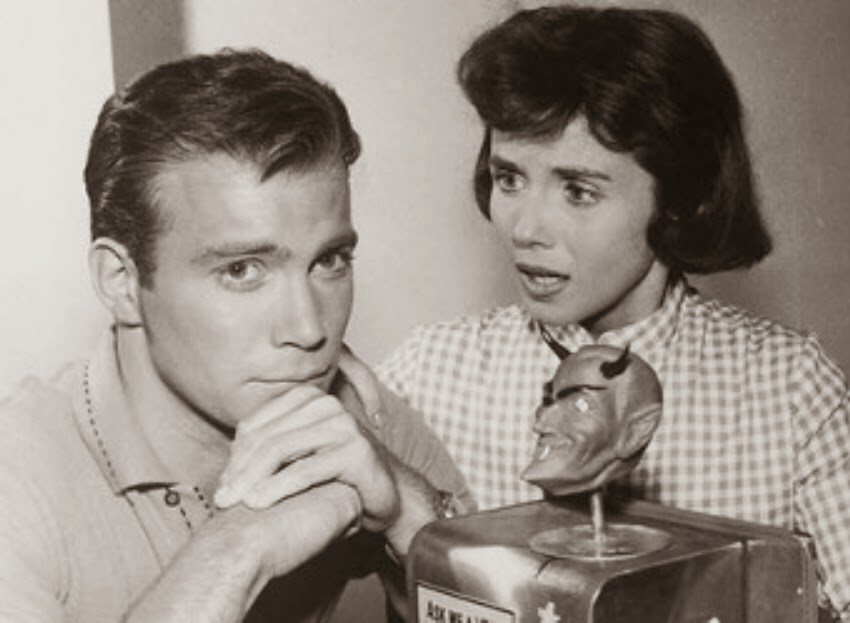
"Nick of Time" is the story of Don S. Carter (William Shatner) and his new wife, Pam (Patricia Breslin). Their car has broken down on their honeymoon trip to New York, and the couple is forced to make a pit stop for repairs in the sleepy little town of Ridgeview, Ohio. 


It is there, in the Busy Bee Diner, that this couple will -- according to narrator Serling -- find "a gift most humans will never receive," the ability to "learn the future." 

Why? Well, because this town and this diner rests on "the outskirts" of The Twilight Zone.

Our central character Don is an interesting guy, and Shatner's performance here is one of his best. Don's the superstitious type, with a rabbits foot on his key chain right beside a four-leaf clover. He is given to expressing himself in phrases such as "keep your fingers crossed." 


"It's like you married an alcoholic" he admits to Pam in one of his more lucid moments, aware of how superstitious he really is.

But on now to Don's unusual nemesis. It's a rinky-dink napkin dispenser with a Devil Bobblehead perched on top. It's the "one cent" "Mystic Seer," a fortune telling-device that for one penny will read you your future. It does so by ejecting little cards that cryptically answer yes or no questions.

Sounds harmless enough, right?


Not so fast...

First, the machine accurately predicts that Don will get the promotion he's been waiting for. 


Then it reports that the couple's car will not take four hours to be repaired, as was told the couple.

 Don grows ever more convinced that the "gizmo" is actually telling him his future. "Why was it so specific?" He asks Pam. "Every answer seems to fit," he insists. 

Pam isn't so sure.

And then things get really spooky. Don asks the machine if something will happen to the couple if they leave town. The answer: "if you move soon." 


He then asks, "should we stay here?" 

The answer: "that makes a good deal of sense." 

Finally, Bob interprets a message from the Devil Bobblehead to mean that he and Pam shouldn't leave the diner until after 3:00 pm that afternoon.

Pam objects and forces Don to leave the diner. At one minute to three, on the street outside, they are nearly run over by a speeding car...

Convinced and stubborn, Don returns to the diner and begins asking the Mystic Seer more questions, even though Pam begs him not to. "You made up all the details, and all that thing did is give back generalities," she tells him. 


He still won't leave. Not until his new wife tells him that the machine is running his life, and that she can't be married to a man who "believes more in luck and fortune" than in himself.


Don and Pam escape this trap, what Serling terms "the tyranny of fear and superstition," but in the episode's final shot, we see that another couple isn't so lucky. "Can we ask some more questions today?" They ask the machine.

"Do you think we might leave Ridgeview today?"

"Is there any way out?"


So again, in the most wonderful and entertaining terms imaginable, The Twilight Zone has presented us with a morality play of sorts, one about human nature.

Yet what's so enjoyable about "Nick of Time" is that we don't know whether Don is right (and the Devil machine is predicting the future), or if, in fact, he's merely superstitious and all the right answers are mere "coincidence" as Pam suggests. 

The ultimate point is, I suppose, what you choose to believe in: fear or hope. You can choose to believe that you are small and in danger; or you can take control of your life and face the hardships with strength,  and with the ones you love at your side.

Beyond a fortune telling device that may or may not be supernatural, there is no overt fantastical element in this installment of the Twilight Zone and yet it is oddly effective, and affecting despite this fact. 


Visually, it's assembled in clever fashion by director Richard Bare. The first shot of the episode is a wobbly view from a tow truck bed, looking down from a high angle at the car being towed, with Don and Pam inside. This is an important view, because it establishes right from the beginning of the episode that Don is not "driving" his life (nor his car). He's simply being pulled in one direction or another, towed by his fear and superstition.

Later, when the couple first enters the Busy Bee Diner with the Devil Bobblehead/Mystic Seer, the camera views Don and Pat from the far side of a lattice-work room separator/divider, a sort of visual frame-within-a-frame signifying entrapment or doom. 


This same camera set-up recurs at several important moments in the show. 

The first time, we view two other local residents in thrall to the Mystic Seer at the dining booth, also through this "entrapment" lens (the criss-cross frame of the lattice).

Finally, when Pam encourages Don to summon his inner courage, the shot has changed to reflect their strength. The lattice wall is no longer between camera and character -- a visual obstacle and blockade -- but rather behind the characters. They have escaped the trap. They have moved literally past it.

I also get a kick out of the extreme (and I mean, EXTREME) close-up shots of the Devil Bobblehead, always jittering ever so slightly but nonetheless playing his Satanic cards close to the vest. He's an interesting villain because he's inanimate and yet we "impose" some sense of fear or personality on him.


If it were just a napkin dispenser, minus the Bobblehead, this episode wouldn't work nearly so well.

Shatner's performance is so good because he plays a character suffering from a lack of confidence. That's funny, given that he's the guy who plays Captain Kirk, but I would argue that even there, in Star Trek, that's the quality that makes the character work so well. Kirk is a human being, a leader of men, but he still second guesses himself ("Balance of Terror") or fears losing his job ("The Ultimate Computer"). 


Watching early Shatner performances you get a sense at how deft the actor is in playing a likable yet vulnerable character. He doesn't quite reach the heights of hysteria in "Nick of Time" that he would achieve later in "A Nightmare at 20,000 Feet," but the script calls for different things. I really like Shatner in this kind of every man persona. To me, he represents the perfect 1960s young male: a self-aware, intelligent, resourceful, JFK-type with just enough self doubt and neurosis to make him thoroughly disarming.

I find it fascinating that Shatner's two Twilight Zones and one Outer Limits ("Cold Hands, Warm Heart") place the actor in the thick of a couple relationship in crisis. He's always playing a husband dealing with something terrible, and trying to convince his wife that he isn't insane. Gremlins on planes, Venusians on "Project Vulcan," or a fortune telling machine that may be the Devil Himself. 

Twilight Zone Marathon: "Mirror Image"


In “Mirror Image,” young Millicent Barnes (Vera Miles) spends the night in a near-empty bus depot, and begins to experience what she fears are hallucinations or delusions. 

Specifically, those around her -- including the cranky baggage clerk and the ladies room maid -- claim to have seen her before. And then, later, Millicent sees a suitcase that looks identical to her own.

Millicent grows ever more paranoid about the situation, but her terror reaches a crescendo when she spies an identical double of herself sitting on a bench nearby. Millicent comes to believe -- as she tells another commuter, Paul -- that a version of herself from a “parallel” world has come to this world to destroy her…

Paul dismisses her fears as a mental illness, until he has reason to question his own sanity…


This underrated and yet utterly creepy episode of The Twilight Zone (1959 – 1964) by Rod Serling concerns the notion that “each of us has a twin” in “a parallel world.” 

Specifically, unlucky Millicent Barnes is confronted with her own doppelganger, who reveals, when she appears briefly on-screen, a kind of wicked malevolence. There’s a creepy shot of the doppelganger ensconced on the bus to Buffalo, NY, for instance. There’s a smug nastiness about her expression there, and it’s hard to get that smirk out of your thoughts.

“Mirror Image” is set almost entirely on just one large set: the bus depot interior. Although in some hands, this might be considered a limitation, the episode’s director, John Brahms, works wonders with the location. 

For one thing, there’s no visual sign of a ceiling in the depot, which means that the walls and doors look exceptionally -- even expressionistically -- large, and the people inhabiting the depot look small and insignificant in comparison. 

The clerk -- who turns off the lights for the night at one point -- notes ominously that “this place is like a tomb between now and morning.”

Secondly, the absence of many extras means that the large space of the depot is mostly vacant, so that, again, it seems to defy reality that a malevolent double or “counterpart” could be “hiding” anywhere nearby.  

When Paul views his double, for instance, the reverse angles don’t actually match. Paul looks up to see his suitcase gone, and in some of the same space he “occupies” in the frame, the double runs out the door.  It’s like two disjointed worlds are just barely overlapping one another.

Add to these touches the incessant sound of pounding rain outside the depot, and certain visual cues about the danger Millicent finds herself in, and “Mirror Image” builds a powerful and surreal sense, indeed, of the protagonist’s paranoia.  

In terms of the aforementioned visual clues, the neon over the ladies room, which read LADIES” at some points in the episode is seen to read merely “DIES.” 


“Mirror Image’s” apex of terror, however, is a nicely composed special effects shot. Millicent gazes into the bathroom mirror -- the door open behind her -- and sees both herself and her malevolent double reflected in the glass.  


In essence, there should be two Millicents --herself and her reflection -- but instead, and quite disconcertingly, there are four. The moment is subtly disturbing and wrong, and the effects are perfectly executed.

The episode’s kicker is chilling too. The man, Paul (Martin Milner), who consigns Millicent to a hospital, himself falls victim to a double of his own. And again, the double seems utterly unhinged and wicked: laughing and smiling at his counterpart’s plight. Paul gives the doppelganger chase, but loses him, standing alone in the dark, contemplating a world that has gone, frankly, insane.


Legend has it that Rod Serling devised “Mirror Image” when he was in an airport, and saw a man dressed like him, carrying baggage like his own. The terrifying thought came to him that the man could be him…after a fashion.  Or more aptly, another him.

There’s an undeniable dream (or nightmare…) logic to that thought, and that dream impulse courses vividly throughout “Mirror Image.” Millicent is told by the clerk at one point that she is “walking in her sleep” and truly, this Twilight Zone installment has the feel of a disturbing phantasm, one that can’t possibly be real, but can’t also be denied…or escaped.

Twilight Zone Marathon: "Walking Distance"


The funny thing about The Twilight Zone is that there are 156 episodes of this classic anthology series, but during the yearly marathons, the same thirty or so segments get rerun. 

The one with "Talky Tina," or the woman (Agnes Moorehead) in the remote cabin with little spacemen chasing her ("The Invaders'), or the one about a very special alien cookbook ("To Serve Man.") 

These episodes are all timeless and terrific and worthy of broadcast from here to eternity.

But there are other eminently worthy wonders in this land of imagination too; ones that don't quite bite with scalding irony, or sting with surprise and O'Henry twists. 


Instead, these installments tug at the heart strings and evidence a deep melancholy. Which brings us to my selection now: "Walking Distance," by Rod Serling. It originally aired in 1959...more than sixty years ago, during The Twilight Zone's first season on CBS.


This is the story of 36 year old "vice president of media" Martin Sloan (Gig Young), a successful but overworked businessman. He feels like he's been at a "dead run" for a long time, and has grown tired. 

Martin makes an unexpected stop at a rural gas station one day, only to realize that he's within walking distance of his hometown, "Homewood."

It's a place he hasn't visited in over twenty years. 

While his car is serviced at the station, Martin walks down a dusty road (and we watch him go down that long path in a clever shot utilizing a mirror...), and straight into...the Twilight Zone.

For that old town -- a place of ice cream sodas, merry-go-rounds, games of marbles, Sundays in the parks and band concerts -- hasn't changed a whit in two decades.


It still costs a dime for a chocolate ice cream soda with three scoops, for example.

Martin wanders the streets and begins to remember a time in his life when things were simpler; slower...happier. He remembers a time when he was eleven years old carving his initials onto a gazebo in the park.

Then, wonder of wonders, Martin spies himself as a teenager carving those very initials. He has returned home....to the past. He has traveled back 25 years.


Excited, Martin runs to his house and sees his Mom and Dad; both long dead in the present. He pleads with them, telling them that he's their son. However, they fear he's a crazed man, a lunatic escaped from an asylum. 

Determined, the adult Martin chases down his young self on a merry-go-round, and tries to tell him a very important message. He succeeds only in scaring the teenage version of himself, and the boy falls and injures his knee. It's an injury that both Martins feel simultaneously since they are one in the same. 


"I only wanted to tell you that this is a wonderful time of life for you," the elder Martin whispers sadly after the boy has been taken away. "Don't let any of it go by without enjoying it."

Finally, Martin meets his father again at the foot of the merry-go-round and his Dad knows who he really is now, because Martin dropped his wallet. His father is loving but stern, and tells the elder Martin he must return to the present. 


"There's no room. There's no place," he tells him. "...maybe there's only one summer for every customer..." 

Giving the kind of advice only a Daddy can give, Martin's father also suggests "You've been looking behind you, Martin. Try looking ahead."

As Serling's closing narration makes plain, "Walking Distance" is about the fact that no matter how hard we try, we can't go home again. The past is sometimes so close to us that we feel we can reach out and touch it, that it is merely "walking distance" from here. 

A scent, a turn of a phrase, a photograph, a song, even an old TV episode (!) can spur images of a past that we have left behind...yet not forgotten. And many people, like Martin Sloan, experience that "errant wish" in terms of age.  They dream that a "man might not have to become older," that he might never have to outgrow the merry-go-rounds of his youth.

"Walking Distance" is a beautifully-shot episode of The Twilight Zone, as well as an emotional journey that speaks to hard human truths about mortality. At the center of the story is the merry-go-round as metaphor


Life is indeed like a merry-go-round, we understand. We climb on, it starts to spin, and it feels like we can't easily get off....not without jumping. The episode plays with that notion artfully as the adult Martin chases down his younger self on the spinning amusement park ride.

The merry-go-round is depicted at a cockeyed angle, spinning ever faster. As the elder Martin nears his prey, the camera adopts a high-angle during the chase. Tellingly, Martin never quite reaches his younger self, just as a merry-go-round spins and spins but never actually goes anywhere or reaches any destination. 


When Martin turns around and goes against the tide of the merry-go-round, time seems to slow down and this descent feels like a reckoning -- as past and future finally collide -- and Martin must make a choice about where he is going to live, and more importantly, how he is going to live. 

His world needn't be one of "no more cotton candy," "no more band concerts" but to change it, he has to change how he sees life. 


I love how the episode culminates around a tender conversation between father and grown son...a conversation that could not occur anywhere but the Twilight Zone, because in reality, the father is now long dead. Here, the "fifth dimension" makes room for a son -- no longer a kid -- to experience the wisdom of his father one last time; when he needs it the most.  I must confess, I find this conversation very emotional, very touching.

Martin's father is the age of the elder Martin, and one sense in both the performance and the dialogue that his Pop understands too well Martin's desire to return to the past; a past without responsibility or stress.

Rod Serling died young, and much of his work, including "They're Tearing Down Tim Riley's Bar" on Night Gallery expressed this wistful desire to return to a "simpler" time. "A Stop at Willoughby" on The Twilight Zone is a darker meditation on the same demons haunting "Walking Distance," but there the quest to stop running, to find peace, results only in death, not learning. 


In some sense, I guess I prefer "Walking Distance" because Martin Sloan does get a second chance to get life right; to change who he is. As sad as it is that the past is gone, there's also an optimistic side to this tale: every new day is a chance to recapture what was lost; or find a different kind of happiness.

I sometimes wonder if Rod Serling -- who wrote a whopping 90 episodes of the Twilight Zone's 156 -- felt like life was a merry-go-round he couldn't escape from. 

Or if  -- with the help and catharsis of The Twilight Zone -- he managed to exorcise the same demons expressed by Martin Sloan in "Walking Distance."

Twilight Zone Marathon: "One for the Angels"


"One for the Angels" opens with Rod Serling's staccato narration about "summer in the present." His words introduce us to Lou Bookman (Ed Wynn), a "pitch man whose life is a tread-mill," a character aged about 60. Today, Lou lives alone on a bustling city block, and is well-loved by the local children, who take an interest in the toys he sells on his stoop.


Then, one day, Mr. Death (Murray Hamilton) shows up in Lou's one-room apartment, and tells Mr. Bookman that the old man's departure from this mortal coil has been scheduled for midnight. The "pre-ordination is death in your sleep."

Lou tries to escape his death, and learns that there are only three valid reasons for appealing a death verdict: family hardship, priority for important individuals (a scientist working on a cure for a disease, for example) or unfinished business of a major nature. 

Lou feels his appeal falls under the third category because he's never made a truly big pitch, "for the angels." Mr. Death reluctantly agrees to give him more time to achieve that dream, but quickly learns that Lou has exploited the loophole. Now Bookman plans never to do another pitch again...so he will never die.

Unwilling to be outmaneuvered by a mortal, Mr. Death selects an alternative soul to take with him that night. He decides to take a little girl from the street, a friend of Lou's. When Lou realizes she is to be taken at midnight, he tries to delay Mr. Death by launching into a pitch for the ages, and the angels...


As the above-synopsis makes plain, this early Twilight Zone concerns both mortality and morality. In our effort to avoid one (mortality), we can, somehow, manage to ignore or circumvent the other (morality).  

Lou Bookman is 69 years old, and yet he very much wants to continue to live. He believes that he can trick death, and manages to do just that.  But Death chooses to kill a little girl, and that is an immoral thing, a that, for Lou, he cannot abide. So Lou steps in and makes his pitch for the angels, knowing full well that it is he, not the girl, who will travel with Death that night. Bookman's understanding of right and wrong ultimately wins out over his desire to keep on living.

"One for the Angels" is both sweet and sad for its depiction of Lou, a kindly, unmarried senior citizen, scraping by, barely making a living, and having lived in a one-room apartment for 21 years. And yet Rod Serling sees a kind of dignity in this man, and his life. Lou leaves the mortal coil having saved a child's life, having made room for another soul. Lou's life is not one we might choose for ourselves, but it matters, both to him, the children whom he has befriended, and, in fact, the cosmos itself. 

"One for the Angels" also remains memorable for its depiction of Mr. Death as a kind of mid-level bureaucrat. He is smartly-dressed, attractive (but not too attractive), and he uses the jargon of his job ("pre-ordination," etc.) He seems to rather dislike having to prove his identity, and he is obsessively concerned with administrative details. "When might we expect it?" He asks of Bookman's pitch "for the angels."  Like many bureaucrats, Mr. Death also seems to possess a limited imagination.  

Or, that's one reading of his character, anyway.  


Perhaps, Mr. Death knew all along that Bookman was going to try to outsmart him, and his ploy with the little girl was all pre-meditated, part of the overall plan to make Bookman feel his death was more meaningful, more palatable. Again, this goes back to Serling's view of humanity, and the notion that all people are valuable, that all people matter. 

The episode's only let-down, perhaps, is the underwhelming presentation of Bookman's big pitch. The episode cuts to shots of Mr. Death sweating, forking over cash, etc., but the audiences doesn't get to hear all of the sales pitch "for the angels." This is a bit disappointing since Lou's gift of gab is the thing, in a way, that saves a child's life. It feels like a failure of writing and presentation for the pitch not to come across with more stellar specificity than it ultimately does.

"One for the Angels" is sweet and humanistic. In this outing, Mr. Death is not someone to be feared or loathed, but  just a regular guy doing his job. In the end, this Not-So-Grim Reaper and Mr. Bookman walk off together, under the moonlight, and it's not hard to imagine that both men feel they have done a good night's work.

Twilight Zone Marathon: "Where is Everybody?"


Over sixty years ago, Rod Serling's The Twilight Zone (1959-1964) premiered on network TV (CBS) with this story: "Where is Everybody?"

Written by Serling and directed by Robert Stevens, "Where is Everybody?" follows the lonely trek of a wandering amnesiac, played by Earl Holliman. This adult man, dressed in military overalls, comes upon a lonely town called Oakwood. 

Although there are signs in the diner and at other locales of recent habitation, the man cannot find any other human...anywhere. He seems entirely alone, not just in Oakwood, but in the world itself.


Increasingly, the lonely man, fears he is going mad. 

Finally, he can't take it anymore, and the truth is revealed. He is actually Mike Ferris, an American astronaut-in-training who has just hit the panic button in an isolation tank on a military base.

For his long trip to the stars, Mike has been learning how to contend with being alone...for 484 hours and 36 minutes, precisely.  

But now, finally, he has cracked. The town and all its locations were delusions.

The next time there is a man alone like this, Mike's superior tells another officer, there will be no escape, no panic button as man faces "an enemy known as isolation."  

That enemy is a force waiting..."in the Twilight Zone."


The pop culture journey of The Twilight Zone begins with "Where is Everybody?" and with an opening narration from Serling which orients audiences to the fact that "The place is here. The time is now." He also alerts viewers to the fact that "this could be our journey."

Today, few critics or viewers would place this particular story -- basically a one-man show -- in the upper tier of series episodes, and yet "Where is Everybody?" still casts an incredibly creepy spell.  What the episode lacks in supporting cast members and pacing, it makes up for in symbol-laden imagery.  

Throughout the episode, for example, Ferris keeps encountering *almost* companionship.  He sees himself in a mirror at one point. So there is a "second" person to talk to, but it is merely a reflection. At another point, Mike encounters a woman, but again, not the companion he would seek. Instead, she is a mannequin.  He is like the mythic Tantalus, always near companionship but forever without real companionship.


The modern technology that should connect Ferris to other individuals also fails him throughout the episode. He attempts to use a telephone, but again, doesn't find the human connection he seeks. An operator's voice tells him that the number he has dialed is not working.  Failure, once more!

And in the diner, another bit of technology, a jukebox, is playing, but there is no sign of any other person for Mike to interact with.  The world seems to be spinning on, with all its devices, only devoid of human life.  One wonders if this could be Purgatory, Hell, or even a weird alien experiment.

Other symbols suggest Ferris's isolation throughout "Where is Everybody?". The audience sees the lonely town through his eyes, and through a barrier (a chain link fence) in one shot, suggesting his constant separation from home, safety, and the rest of the human race.


Intriguingly, it is via the mass media that Mike begins to put together the pieces of his mysterious past and his frightening present.  

For example, the only paperback on a kiosk is one titled "The Last Man on Earth," which seems to indicate (and be aware of...) his plight. And at the local movie theater, a film called "Battle Hymn" is showing. An image on the poster reminds Mike that he is in the air force officer.

A label on the movie poster reads "Now Playing," which is a remarkable self-referential touch. The TV audience watches the story of a U.S. military officer, while the movie theater shows a movie starring a military officer at the same time. Both stories are "now playing."  The poster and the label, "Now Playing" also function as a suggestion that Mike's plight, like a movie now unfolding, is not quite real.


These visuals very much carry the story, as do the sounds of life everywhere, which constantly haunt Mike.  It all feels very much like the dream that Mike fears he cannot awake from.

The episode's final reveal is not one of the more stunning ones in the Twilight Zone canon. The surprise ending (that the town is a delusion of a cracked mind) doesn't feel particularly special or shocking, even if it does foster empathy for the lone, wanderer. The audience learns that Mike has been wandering in his mind, not a real town, and that another astronaut will be doing the same thing soon, only for real...in space.

A few weeks back, I wrote about the early Twilight Zone's focus on the advent of the space program, and that new and unknown age of space travel seems to be the basis for this story. Can man survive in space alone? For long spells?  Without the sights and smells and companionship of home? This episode is very concerned with that idea, noting that man possesses a hunger for companionship, and that such companionship is the "one thing we can't simulate" on a space journey.

It's a good, solid point, and one buttressed by the overall eeriness of the episode's central scenario, an abandoned town, and a man without memory, or company.  Yet with sixty years of hindsight it is also easy to see how this episode doesn't necessarily play to Serling's writing strengths.  This is a series that consists often of great dialogue and stunning narrative u-turns.  

"Where is Everybody" depends on visuals, not Serling's brilliant use of language, and the final u-turn is a little ho-hum in the context of the series, overall.

Again, there's cleverness in abundance here, especially in visual execution: the idea of the cracked mirror as a reflection of Ferris's cracked mind, for example. 

But if anything, "Where is Everybody?" is a potent reminder of the fact that at the beginning, The Twilight Zone still had some growing to do before becoming the classic it is recognized as today.