Tuesday, December 17, 2019

Star Wars Episode V: The Empire Strikes Back (1980)


The Empire Strikes Back (1980) has grown steadily in critical esteem since its theatrical debut in 1980. This increase in approval is so dramatic, in fact, that The Empire Strikes Back has actually eclipsed its blockbuster progenitor from 1977, at least according to some fans and critics.

Yet, if you go back and read the reviews from mainstream newspaper critics in 1980, The Empire Strikes Back received only middling reviews, at least for the most part.  The Irvin Kershner film was appreciated for its rousing special effects…and not much else. 

Writing for The New York Times, Vincent Canby, for instance, termed the sequel a “big expensive, time-consuming, essentially mechanical operation.”

He also noted The Empire Strikes Back’s incomplete narrative, commenting specifically on the fact that the film features no real beginning, and no genuine end or closure.

In terms of outlining the film’s artistic strengths and weaknesses, The Empire Strikes Back is indeed a more difficult film than Star Wars to get a handle on.  Star Wars can readily be dissected as pastiche, and a critic can studiously catalog all of the film’s antecedents and inspirations in terms of Akira Kurosawa's cinema, war movies, and the like. 

By contrast, The Empire Strikes Back largely eschews this dedicated “homage” approach and delves deeply, instead, into the lives and decisions of its dramatis personae.  In other words, the characters take on a new, more in-depth quality here, and so the film need not rely on a shared cinematic shorthand to forge its mythic tale. 

The Empire Strikes Back excavates a far more complex set of psychologies than, perhaps, we might have expected from the swashbuckling Star Wars. Still, Lucas and Kershner prove highly adept at harnessing potent visual symbols to add layers of meaning to this more intricate epic.  Accordingly, The Empire Strikes Back is rife with earthbound points of reference that help us identify with and understand the characters and their travails.

Mr. Canby was absolutely correct in his assertion that The Empire Strikes Back’s narrative is incomplete, since this sequel’s narrative commences with the action of Star Wars and resolves in the finale of Return of the Jedi (1983).  


Yet the plain fact of the matter is that this very quality is actually one of the film’s primary and enduring strengths

Freed from the necessity of laboriously introducing the characters, and, similarly, resolving their crises, The Empire Strikes Back is instead able to plumb new aspects of character psychologies, and furthermore introduce new, visually-exciting worlds to the Star Wars universe.  The sights of The Empire Strikes Back -- from whirling asteroids to AT-AT juggernauts trudging through the snow, to a city in the clouds -- are truly wondrous.

Without carrying the baggage of introduction and closure in broad terms, The Empire Strikes Back can instead function superbly as a racing locomotive, one that sweeps audiences up in romance, action, and a powerful feeling of impending dread. 

It’s a bit paradoxical of an equation, actually. We get more of the characters’ humanity -- even Darth Vader’s -- in The Empire Strikes Back than we did in Star Wars while, simultaneously, the action never lets up.  There’s this dramatic pull of inevitability to the film, a veritable tractor beam tugging us irrevocably to an unknown destination as fates are forged, and crucial decisions are made.  The feeling of unstoppable momentum at The Empire Strikes Back’s cliffhanger conclusion is considerable, and one leaves the film aching to see more of the story.  You sit there with a lump in the throat, wanting more, and wondering how on Earth you can wait three years for the next chapter.  I can still feel resonances of this yearning for more today, more than thirty years after I first watched the film.

Yet The Empire Strikes Back could not have achieved this considerable sense of immersion if it had instead sought to include the “complete” narrative that some critics sought and missed.

I find it very difficult to compare Star Wars to The Empire Strikes Back in terms of relative quality. Star Wars accomplishes precisely what it needs to in order to introduce audiences to the world of a “long time ago, in a galaxy, far, far away.”  

Similarly, The Empire Strikes Back deepens audience interest in that world, and makes one long to see the next film, Return of the Jedi, where -- finally -- narrative closure occurs.

So it’s probably fair to state that Star Wars and The Empire Strikes Back both fulfill the roles they should as successive chapters in a cohesive trilogy.  However, those specific roles are significantly different, and even, in some senses, at odds with one another.

Intellectually, I appreciate the homage-rich pastiche qualities and “complete” aspects of Star Wars, which paved the way for a movie revival of spiritualism in the movie era of Dirty Harry and Paul Kersey

Yet emotionally-speaking, I admire immensely the involving, almost soap-opera, love-triangle, father-son /tragedy aspects of The Empire Strikes Back.  I especially appreciate how the galactic settings of the film, in a very important sense mirror the character conflicts and strife.  

Most of all, you get the sense in The Empire Strikes Back of utter confidence.  

The film never worries about establishing itself or validating its universe and story line.  Instead, it just probes deeper and deeper into the psychologies of the characters -- particularly Luke Skywalker -- at what turns out to be a dangerous turning point in the saga.

“Decide you must, how to serve them best. If you leave now, help them you could; but you would destroy all for which they have fought, and suffered.


Following the destruction of the Death Star at Luke Skywalker’s (Mark Hamill) hands, Darth Vader hunts the universe for the would-be Jedi.  

Meanwhile, Skywalker and the Rebel Alliance have made a base on the remote and inhospitable ice planet called Hoth. 

There, mercenary Han Solo (Harrison Ford) contemplates abandoning the cause because of the price that Jabba the Hutt has placed on his head.  Although Princess Leia (Carrie Fisher) pretends not to care, it’s clear that she and Solo have developed romantic feelings for one another.

Soon, Imperial probes find signs of the rebel base on Hoth, and Darth Vader orders a sustained surface attack on the Rebels.  After the Empire’s victory in a ground assault, Han Solo, Chewbacca, C3PO and Princess Leia flee the planet in the Millennium Falcon, and Luke and R2D2 head to swampy Dagobah to find Yoda (Frank Oz), the Jedi master who trained Obi Wan Kenobi (Alec Guinness).

When Solo and Leia find themselves ensnared in a trap on Bespin’s Cloud City, courtesy of Darth Vader, the bounty hunter Boba Fett (Jeremy Bulloch) and the scoundrel Lando Calrissian (Billy Dee Williams), Luke must decide whether to continue his training with Yoda or attempt to rescue his imperiled friends.

Upon his landing at Cloud City, Luke learns that Fett has taken Solo (encased in carbonite…) to Tattooine and Jabba.
  
And finally, Darth Vader divulges to Luke a devastating family secret...

No. Try not. Do... or do not. There is no try. 


A series of four visual symbols dominate The Empire Strikes Back, and each one is encoded into a specific setting or location, and intimately linked with the characters and the development of their relationships and feelings.

The inaugural symbol is “ice,” embodied by the snowy, desolate planet of Hoth.  

As viewers, we automatically associate ice with freezing, stagnation, and cold. In terms of  the film's characters, we recognize this coldness as relating very much to Princess Leia (whose personal quarters, we are told in the dialogue, are “freezing.”)  

Simply put, she cannot admit her romantic feelings for Han Solo.  Over the course of the adventure, the icy relationship between Leia and Han “thaws.”  I don't want to be accused of being sexist here, but the idea in terms of Leia at the beginning of The Empire Strikes Back is, literally, that she is "frigid" (emotionally, I mean.)  She covers her feelings in a mask or composure of apparent ice.

Similarly, Luke Skywalker as we find him on Hoth has become stagnant and "frozen," unable to take the next step in his training to become a Jedi Knight.  Until the specter of Obi Wan appears to him on the freezing plains of Hoth to reveal the existence of Yoda, a Jedi Master, Luke is merely walking in place.

On Dagobah, the film’s second significant symbol is revealed, and it relates to Luke Skywalker primarily. During his training with Yoda, young Luke unexpectedly encounters a tree that is powerful with “The Dark Side” of The Force.  He explores its impenetrable recesses, and it responds reflexively to his psychological weaknesses.  

Once inside the gnarled, ancient tree, Luke experiences a vision of  Darth Vader and then, in fact, a vision in which he becomes Darth Vader himself.   Under the hideous helmet, Luke's visage stares back at him.

In literature and psychology, the tree embodies several vital concepts.  Prime among these is the idea that a tree represents knowledge.  In The Empire Strikes Back, the tree on Dagobah reveals, specifically self-knowledge, a clue regarding Luke’s biological origin or identity (at this point, unknown to him).  

But it reveals more than that.  It reveals the nature of Luke's future struggle: whether or not he will turn to the dark side.

Additionally, in Native American lore, the tree symbolizes ancestry (your roots, to employ a pun), and so the Dark Side Tree is indeed our first, oblique indicator about from where Luke originated….Darth Vader.   If genetics is destiny, then the tree also reveals one path Luke may take: the self-same path that Anakin Skywalker undertook.

A third crucial symbol in The Empire Strikes Back -- a whale-like space monster -- appears during the action-packed asteroid belt sequence. This section of the film is chaotic and anarchic (as exemplified by the random trajectory of the asteroids…).  

Likewise, the characters of Han and Leia here are depicted as conflicted and uncertain about their developing relationship.  They settle down in a place (the belly of a space beast), where these issues begin to crystallize for them. Out of chaos, some clarity emerges...

In Christian myth, Jonah spent three days inside the stomach of the whale.  When he emerged from this second “womb,” his story proceeded with a sense of re-birth and rejuvenation.  Many Japanese folk stories repeat the same idea.  

On purely literal terms, then, when the Falcon escapes the belly of the space beast, its crew receives a second chance at life with Han’s scheme to hide the ship among the Imperial garbage.  

In character-based terms, there is a also kind of re-birth of the Han/Leia relationship following their kiss.  Their love has emerged from the icy, “frozen” quality it boasted on Hoth, and even the chaotic/combative nature of it as witnessed in the asteroid belt.  Their time in the belly of the beast is, after a fashion, what allowed them to find some clarity about their feelings and relationship.

Finally, the last passage of the film set on Bespin offers The Empire Strikes Back’s  final, and perhaps most powerful symbol: clouds

In terms of symbolic representations, clouds are often equated to a realm of “ethereal heights” but also a domain of “higher truth.”  

Here, Leia and Han admit their love for one another; a higher truth they avoided and quarreled over on icy Hoth.  

Similarly, Luke discovers the higher truth about Ben’s story (regarding the death of his father,) as well as Vader’s role in his life.  The self-knowledge hinted at in the Dark Tree on Dagobah become clear in the ethereal clouds, a place, explicitly, for truth telling.  

Indeed, truth becomes the paramount issue of this final section of The Empire Strikes Back.  

Is Vader telling the truth about his parentage of Luke? Is Lando a truth-teller or treacherous?  Is R2-D2 sharing the truth (but not believed) when he notes that the hyper-drive on the Millennium Falcon hasn't been repaired?  Even the discovery of the "truth" about Leia (that she possesses Jedi-ish abilities) comes about in the location of Cloud City.

I very much appreciate how The Empire Strikes Back's visuals -- ice, trees, the belly of the beast, and clouds -- all reflect in an important manner the psychology of the film’s three primary protagonists.  The symbols, essentially, track their progress from stagnation and frigidity to a higher understanding of the truth.  

From Hoth to Bespin isn't just a journey between star systems, in other words, but one of self-discovery and character evolution.

Hoth: A place where relationships and tensions are "frozen" in place.


Dagobah: Luke explores the Tree of (Self) Knowledge.


The Belly of the Beast: A (brief) re-birth follows chaos.


Bespin: A place in the clouds where a "higher" truth is discerned.

Of all the characters highlighted in The Empire Strikes Back, Luke Skywalker is deepened in the most significant terms. He harnessed the power of the Force to help him destroy the Death Star in Star Wars, but that was only the beginning of his journey, a fact we clearly register here. In this sequel, Luke is unexpectedly dealt reverse after reverse, defeat after defeat, and forced to look inside himself and consider his readiness and even suitability to become a Jedi Knight.

In the span of one film, Luke is badly injured by a Wampa, and nearly freezes to death.  He loses Leia's affections to Han, finds out that his trusted and beloved mentor, Ben, lied to him, and discovers that his father is one of the Most Evil Men Who Has Ever Lived.  Finally, for good measure, Luke sees one of his hands cut off during a light saber duel.  Now, he is already on the path of his father, becoming part machine as well as flesh-and-blood man.

Perhaps more troubling than all these reverses, however, Luke actually finds his very status as a hero questioned in The Empire Strikes Back.
  

Yoda informs him he is impatient and intemperate, and may not even qualify to train as a Jedi.  Luke is too old, too distracted, and too set in his ways.    

The film thus makes Luke reckon with the fact that he may have destroyed the Death Star, but being a full-bore Jedi Knight involves much more than that.  The film gives Luke something powerful to confront, and that “thing” is an awareness of himself and his own character flaws.  He holds the seeds of the Dark Side within him.  He could be just like his father; like Darth Vader.  He has learned too many bad habits and must now unlearn them.

Han’s journey, overall, is a bit more upbeat, despite how the movie ends for him.  He successfully wins Leia’s affection and goes nobly to his fate, thus proving he is concerned about more than money and rewards (per Star Wars).  He also learns that yes, it's possible for a Princess and a guy like him to fall in love.

As for Princess Leia, she comes to understand in The Empire Strikes Back that she can follow her emotions and yet not be made weak by them, as she initially feared.   She can love a "scoundrel" and still be strong and respected.  Leia need no longer be afraid of her feelings.All these characters are tested in dramatic fashion in The Empire Strikes Back, and so the film significantly deepens our understanding of all these heroes.  Luke’s destiny now features a darker, more dangerous edge, and Han Solo may have no future at all…


These are the worrisome, valedictory thoughts we ponder as we conclude a viewing of the film, and in this sense, the Star Wars "saga" truly becomes a story -- for a time -- about specific characters, not about special effects, or abstract heroic or mythic journeys.  

With The Empire Strikes Back, this is now the tale of three very individual, very human individuals.  The Empire may be striking back, but we care less here about a rebel victory over the Imperials than about how each main character faces or makes his or her fate.  This film brilliantly introduces us to memorable characters such as Yoda, The Emperor, Lando and Boba Fett, but it is the triumvirate of Luke-Leia-and-Han that rivets and consumes the attention.

It’s a crying shame that Return of the Jedi loses track this dynamic thread, and glosses over many of the critical character struggles we countenance here.  Luke’s anger and intemperance, Leia’s romantic choice about her future, Ben’s honesty, and Han’s grim fate are all treated in strictly two-dimensional, almost rote fashion in Return of the Jedi, a fact which leaves The Empire Strikes Back, arguably, as the emotional zenith of the Original Trilogy.

Star Wars Episode IV: A New Hope (1977)


Okay, it may not be the best movie ever made.  It may not even be the best movie I have ever seen.  However, I can safely assert that Star Wars (1977) is the movie that most changed my young life. 

I first saw director George Lucas’s blockbuster space opera when I was seven years-old.  Up to that point, I had never witnessed a fantasy/sci-fi/monster movie crafted on such a grand scale, or one presented with such an incredible, unshakable sense of reality.

Unlike many genre films of the epoch (for example, Damnation Alley [1977]) there was never even a single moment during Star Wars when the “spell” was broken, or the fantasy facade broke down to accommodate a bad special effect, a lousy performance, a cheap set/costume, or some other weak production component. 

Rather, that atmosphere of reality – of a different and fantastic reality, no less – was rigorously and impeccably sustained for two hours.

And because of that fact, Star Wars was the most exhilarating movie I’d seen up to that point.  I remember coming out of the movie for the first time and feeling like I had been holding my breath for two hours.  Then, over a period of several weeks, I saw the film in the theater at least three more times...and felt precisely the same way.

Last weekend, I went back and re-watched the original Star Wars again in its first theatrical cut, the cut before it became known as “Episode IV: A New Hope,” and before George Lucas tinkered with and updated the special effects.  My express goal was to attempt to discern what had made the film so precious and magical to me as a second grader.

I now understand, I believe, at least partially, the answer to that riddle. 

The great joy of Star Wars, even today, all comes down to George Lucas’s incredible ability to ground his otherworldly “space opera” world in a reality that is immediately recognizable to all of us.  For instance, underneath the flashy lasers and colored light sabers, or the strange aliens and robots, the film boasts this driving, human feeling of yearning, of almost anticipatory anxiety.

Star Wars’ lead character, Luke Skywalker (Mark Hamill) gazes up at the night sky of Tatooine, and he wonders what awaits him.  Where will he go next?  When does his life really begin? When does he finally get to grow up and chart his own destiny?  What is he supposed to believe in?

Lucas grounds the viewer in Luke’s personal “coming of age” story, yet that’s far from the only grounding the director accomplishes here.  Without explaining in significant terms a back-story, Lucas crafts in Star Wars a lived-in world which nonetheless points to previous adventures, and to a larger universe beyond the main narrative. 

It’s such a big (and yet consistent…) place, in fact, that it almost can’t all fit within the boundaries of the movie frame.  Thu,s at times, it almost seems as if Lucas didn’t make it up his universe at all, or build it all from scratch.  Rather, it’s as though he took a camera in-hand and actually traveled to a galaxy far, far away, filmed what he saw there, and brought that footage back for us to enjoy.

The film’s dialogue, filled with descriptors like “this time,” or “no more,” captures obliquely the notion that this adventure is set on just another day in this faraway galaxy, and that there are many, many other adventures to witness, and personalities to meet there.  The film boasts many half-explored implications, from intimations about unseen characters like The Emperor, Captain Antilles and Jabba the Hutt, to tantalizing hints about the previous adventures of Han Solo, Obi-Wan Kenobi, R2-D2 and C-3P0. The scenery or set design itself possesses a kind of unexplored depth and breadth. There's a staircase leading up -- where precisely? -- beyond Docking Bay 94 on Tattooine. There's the packed-to-the-gills interior of a bustling, junk-filled Sandcrawler.  There are even alligators in the sewers, so-to-speak, or rather a Dia Noga in the trash compactor.

The visual form of Star Wars reflects this narrative content in a most unusual and resonant fashion.  Specifically, Lucas utilizes visual homage or visual tributes to previous and well-established cinematic productions to help us -- the audience -- process quickly and thoroughly the essential nature of life in the world of the Galactic Empire. 

So even if we don’t consciously recognize or identify all the visual touches in terms of the original source material (such as The Hidden Fortress [1958], Metropolis [1927] or 633 Squadron [1964]), our eyes nonetheless understand the touches as belonging to some common “language” we all share.  Star Wars is an accomplished blend of the familiar with the unfamiliar, the past with the present, and with the (imaginative) future.  And Lucas’s choice to re-purpose imagery from film history is one key to help us understand his universe.  Underneath this technique of tribute or homage is a simple yet elegant message about man's nature, and not least of all, his spirituality.  In short, Star Wars offers a renewal of movie spirituality in an era of anti-heroes, cynicism, and the personal, idiosyncratic cinema.

“If there's a bright center to the universe, you're on the planet that it's farthest from.”


While being pursued by the Emperor’s minion, Lord Darth Vader (David Prowse), Princess Leia of Alderaan (Carrie Fisher) hides the tactical plans for an Imperial battle station called the Death Star with a small droid called R2-D2 (Kenny Baker). 

With his counterpart, protocol droid C-3PO (Anthony Daniels) in tow, R2-D2 escapes to the desert world of Tatooine with the goal of finding former Jedi Knight, Obi-Wan Kenobi (Alec Guinness) and soliciting his aid.

On Tatooine, however, the droids are captured by scavengers called Jawas and sold to the Skywalker farm. There, a young man, Luke (Hamill), hopes to leave his dreary life working at the moisture farm, and tender his application to the Academy.  But his uncle resists.  He doesn't want Luke to go.  He doesn't want Luke to grow up.

Soon, Luke and the droids meet up with Kenobi,  an old man who urges the young man to help him  reach Alderaan with R2 and the technical schematics.  After his aunt and uncle are murdered by Imperial Stormtroopers, Luke agrees to join Obi-Wan's quest.  They book passage to Alderaan aboard the Millennium Falcon, captained by Han Solo (Harrison Ford) and co-piloted by a Wookie named Chewbacca (Peter Mayhew).

Unfortunately, the commanding officer on the Death Star, Grand Moff Tarkin (Peter Cushing) plans to make Princess Leia reveal the location of the secret rebel base, and destroys her home planet of Alderaan to coerce her cooperation.  

When the Millennium Falcon arrives in the Alderaan system from Tatooine, it finds not a beautiful planet, but the Death Star.

Now, Luke and his friends must rescue Leia, Ben must confront his old student, Vader, and they all must get the plans to the rebels, before the Empire and the Death Star carry the day…

For over a thousand generations, the Jedi Knights were the guardians of peace and justice in the 
Old Republic. Before the dark times... before the Empire.


When you stand back and gaze at Star Wars from a good distance, you can detect that the film tells a very old story: the hero's journey.  But it tells that tale in a new way, and in a new (final?) frontier: outer space.  

Rather, it is the explicit details of the narrative that are new to audiences, from the history of the Jedi Knights and The Force to the explanations of such things as snub-nosed fighters, T.I.E. fighters, tractor beams, hyper-drive, Wookies, land-speeders and droids.  The way to make all these people, concepts, and ideas immediately understandable, Lucas understands, is to mine much of film history for visual antecedents, ones that make the story graspable for audiences, even though they don't know the precise details of the Old Republic, the Galactic Empire, or the Clone Wars.

From the film’s opening crawl, this is the very technique Lucas regularly deploys.  In particular, the crawl that appears immediately after the film's title harks back to Flash Gordon (1936), and the title cards used in each serial opener. In Flash Gordon, such screens conveyed important information about previous episodes in the thirteen installment production.  This crawl is actually our first visual indication that Star Wars is a pastiche, or a work of art imitating and honoring the work of previous artists.   It also sets the jaunty, almost retro tone of the picture. By recruiting this technique from the Flash Gordon films, Star Wars announces, specifically, its intention to be pulpy, lighthearted, swashbuckling fantasy and fun.

This was not a small detail in the 1970s.  The disco decade was an era when such swashbuckling adventure films were not in vogue.  In terms of the sci-fi genre, Dystopian-styled films dominated the landscape (The Omega Man, Soylent Green, Logan’s Run, and Damnation Alleyfor example.).  Not coincidentally, the same decade was the age of growling, violent anti-heroes like Dirty Harry and Paul Kersey (of the Death Wish films).  

By commencing Star Wars with a 1930s-era, serial-like crawl, George Lucas effectively renounced contemporary cinema, and reached back to an older tradition, a “golden age” of more innocent fantasy fare. Not incidentally, the screenplay seems to share his point of view, describing the light saber of the old Republic as an "elegant" weapon for a more "civilized time."  In other words, the past inside the Star Wars universe, and the past of Hollywood history outside Star Wars were both more elegant and civilized than the present of the Galactic Empire/anti-hero cinema.

Our invitation to adventure in a more elegant and civilized time: Flash Gordon (1936).

Our invitation to innocence in a cynical time: Star Wars (1977).

After the opening crawl, Star Wars very much begins to deliberately ape elements and details from Akira Kurosawa’s film, The Hidden Fortress.  That film also used “wipes” as visual transitions between scenes, but more importantly, involved two pseudo-comic individuals, Tahei and Mataschici, who escaped a pitched battle, wandered for a time in a wasteland, and were then captured and enslaved.  They then became involved with the rescue of a Princess and the exploits of a General.  
This familiar sequence of events is repeated with the droids R2-D2 and C-3PO in Star Wars.  Two likable (and funny) robots escape from the rebel blockade runner battle, become lost in the Tatooine desert, and unwittingly become involved with the rescue of a princess and the exploits of a Jedi-Knight.  The point in both films is to highlight two unassuming, even “common” individuals who become caught up in huge, important events beyond their control, and even their understanding.  It's a ground's eye view of world-shaking incidents, of history unfolding.

In terms of Star Wars, the first twenty minutes of the film or so mostly revolve around the droids and their exploits, and this kind of “macro” focus is one way to introduce the Star Wars universe without inundating audiences with tech-talk and difficult-to-pronounce names or sci-fi concepts.  Matters of galactic import (like the Death Star), can wait, and Lucas introduces his core concepts one at a time without risk of sensory overkill or confusion.

Two common men get caught up in world-changing events, in The Hidden Fortress (1958).

Two lowly droids get caught up in galaxy-changing events, in Star Wars (1977).
A trek through the wilderness, their future uncertain.

A trek through the desert, their future uncertain.
The first hour of the Lucas film is, on retrospect, my favorite portion of the film. After things settle down a bit, there's a quiet yet vital scene set in Ben Kenobi’s desert home. What Star Wars accomplishes here, again, is revolutionary, if in an unassuming kind of way.  Kenobi quietly and steadfastly introduces us to his faith.  He describes the Force as the thing that “gives a Jedi his power. It's an energy field created by all living things. It surrounds us and penetrates us; it binds the galaxy together.”  

Again dismissing the tenets of the contemporary and cynical 1970s Hollywood, Star Wars thus reintroduces “spirituality” to a cinema that had asked, explicitly, “Is God Dead” in films such as 1968’s Rosemary’s Baby, and also, to some degree, Friedkin's The Exorcist (1973).  Certainly  Lucas's film is not a strict re-assertion of Christianity, necessarily, but rather a non-denominational acknowledgment of man’s inherent spirituality and interconnection.  The Force, like belief and faith in Jesus Christ, is a promise of immortality in  the Star Wars universe.  We see this quality of belief depicted in Ben Kenobi’s heroic death – or disappearance – after his duel with Vader.

This famous Time cover set the tone for the late 1960s and early 1970s American cinema.
But Star Wars re-introduces spirituality in the form of "The Force..."

And the film even promises "eternal life" for those who believe in its precepts.

As Star Wars continues, the film spends more time in space, and indeed, in space combat.  Again, George Lucas chooses to make his “space opera” one that visually resonates in terms of film history.  When Luke and Han take to the guns of The Millennium Falcon to destroy several pursuing TIE fighters, Lucas explicitly references combat visuals from Twelve O’Clock High (1949), a film about American flying fortresses in aerial combat during World War II.  

Once more, viewers may not exactly recognize the specific reference, but they absolutely "get" the allusion to a previous  global conflict, and a previous form of warfare.  We may not understand how lasers work, or what powers TIE Fighters, but we do understand the settings and dynamics of aerial combat, even translated to space.

The underside gun of a flying fortress in Twelve O'Clock High.


A view on the inside looking out (from the same film) as a gunner targets evading fighters.

From Star Wars: Targeting evading fighters.

And again, an underside gun mount.
The battle to destroy the Death Star follows the same film making approach. Only this time, Lucas re-casts a critical set-piece from the 1964 British film 633 Squadron as his point of origin and point of audience recognition.  In that film, several Allied Bombers make a run against a Nazi base lodged between two mountains (essentially in a trench...).  As the bombers make their attack run, they  attempt to avoid blistering anti-aircraft guns.  There is also an initial false start, and a false detonation at the target site.  Additionally, enemy fighters swoop in to challenge the bombers and pick them off as they focus on their quarry on the ground.   If you’re at all familiar with Star Wars, you will recognize the setting, sequence, and outcome of the Death Star trench scene as being very similar indeed to 633 Squadron.

The point isn’t that Lucas stole anything.  The point is that when “you’ve taken your first step into a larger world,” to quote Obi Wan Kenobi, elements of that world need to be understandable immediately, so that other important concepts can be grasped.  In other words, if you’re focusing on something like how a tractor beam works, or what is hyper-drive is, you’re not paying attention to the details of Luke’s quest, and Lucas’s story.  

By updating old cinematic imagery, Lucas conveys his story -- and his message about spirituality -- in a way that we visually accept and understand, almost at once.

From 633 Squadron: the Nazi's strike back at attacking Allied aircraft.

From Star Wars: The Empire Strikes back at attacking rebel spaceships.

On the horizon, enemy fighters swoop in for the kill (in 633 Squadron).

TIE Fighters swoop in for the kill (in Star Wars).

In the trench, planes avoid blistering gunfire. (633 Squadron).

In the trench, rebel X-fighters avoid blistering gunfire (Star Wars).
I’ve long argued that Star Wars may not be a perfect film, but that the film offers a perfect presentation of a galaxy “far, far, away, and I think that’s the point of all the tributes and re-framing of scenes from The Hidden Fortress or 633 Squadron.  But the deeper point is the one I mentioned in connection with the Force and Flash Gordon.  George Lucas’s epic space fantasy serves as an explicit indictment of the 1970s self-involved “personal cinema,” and harks back to a time of greater innocence and greater adventure in terms of movie narratives. 

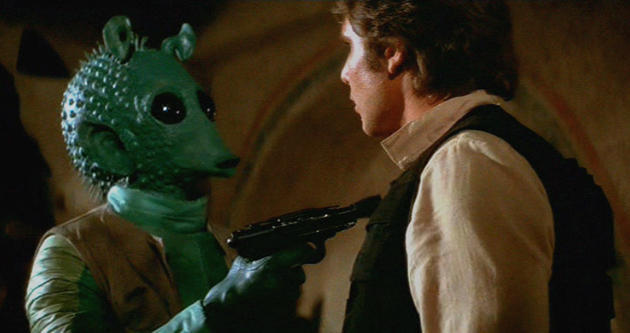
I suspect this is the reason why, seriously, that George Lucas altered the dynamic of the Han Solo/Greedo sequence. In that scene as it was originally crafted, Han fires his blaster, and Greedo doesn’t shoot at all.  It’s an almost anti-hero, Dirty Harry-esque moment for the Solo character.  I believe that’s precisely the kind of aesthetic Lucas wanted to eschew and avoid, and so on retrospect, did just that by making Greedo shoot first.  Han’s act was thus transformed from one of preemptive murder to self-defense.  I’m not arguing that his selection was the right one, or that Lucas should have tampered with the scene, only that some of the changes Lucas has forged in terms of Star Wars tend to play into this very notion of Star Wars as pastiche, of a call-back to an earlier, more innocent generation of film productions.  

Even the idea to title his Star Wars films numerically and with melodramatic sub-title fits in with this tradition of the crawl concept of Flash Gordon which boasted titles such as “The Unseen Peril.”  That sounds a lot like The Phantom Menace, doesn’t it?

If Han Solo shoots first, is he Dirty Harry?
The two concepts I have discussed most frequently in this review are: 1.) how Lucas grounds the reality of Star Wars by creating a lived-in, recognizable universe and 2.) how Lucas attempts to hark back to a more innocent, swashbuckling, spiritual age of movies.  If you link those two concepts, you will arrive at my unified theory of Star Wars, and at the very essence of the film itself.  Star Wars presents a universe so authentically-rendered and well-thought out that you can truly believe in it. The careful forging of the world discourages cynicism or disbelief.  

The idea of “May the Force be With You,” not unlike the exclamation “Go with God,” is inherently about belief; about believing in yourself and your capacity to tap the spiritual center of existence itself.  Yet no one would possibly believe in Lucas's world or in that inspirational message if the special effects in Star Wars were unconvincing, if the aliens looked hokey, or if the space battles were confusing. 

I believe that by referencing these older films and older visuals, Lucas was making certain that we could relate to Star Wars. It’s a unique and intriguing technique, and I submit it actually works very well.  The later films in the franchise depend on vast, special effects set-pieces with digital backdrops and drooling creatures, and yet the greatest emotional thrill I felt during the saga occurred here, in the original Star Wars, as Luke and Leia swung boldly across a chasm together, and John Williams’ scored blared heroically underneath their leap. 

A boy, a girl and a universe.  The thrill and appeal of Star Wars are almost literally that simple. Despite making a high-tech film filled with laser blasts, spaceships, robots, and a complex internal history Lucas directs us through this complexity and gets right to the mythic, spiritual heart of his film.

As of today -- how many years after I first saw the film?? -- that pure-hearted (but intellectually-conceived) approach still works for me.  

Monday, December 16, 2019

Star Wars Episode III: Revenge of the Sith (2005)


Revenge of the Sith (2005) finds the Galactic Republic embroiled in a Civil War with Separatists. Indeed, "War" is the very first word that appears in the film, on that famous yellow crawl.

Chancellor Palpatine (in office long past his term...) has been captured by the Separatists, and after an incredible space battle, Jedi Knights Obi-Wan Kenobi (Ewan McGregor) and Anakin Skywalker (Hayden Christensen) board the craft of General Grievous and Count Dooku (Christopher Lee) to rescue him. During the mission, Anakin slips towards the Dark Side by letting his vengeance get the better of him with aan act of murder urged on by Palpatine.

Meanwhile, Padme Amidala (Natalie Portman) reveals that she is with child, and this revelation terrifies Anakin, for he has been experiencing terrible visions (like the one about his mother, in Attack of the Clones.)

He fears that Amidala will die in childbirth and feels impotent to prevent this grim fate. Angry and feeling powerless Anakin seeks out the tutelage of Palpatine (Ian McDiarmid), who tells him that there are ways to save Amidala, if only he explores the Dark Side of the Force.

Eventually, feeling he has no option, Anakin succumbs. He betrays the Jedi Order but in doing so, no longer remains the man that Amidala loved. On opposite sides of the war now, Obi Wan and Anakin duel, and Obi Wan wins, leaving a hobbled, burned Anakin to die on the side of a volcano on the planet Mustafar.

While the Galaxy slips into darkness and an Empire is born, Amidala dies of a broken heart after giving birth to the twins, Luke and Leia. Anakin survives, but is now more machine than man, locked into a mechanical suit -- a cage -- and re-named Darth Vader.


In 1755, Benjamin Franklin wrote "Those who would give up essential liberty to purchase a little temporary safety deserve neither liberty nor safety." 

That is the essential idea at the heart of Revenge of the Sith, both in terms of the Republic, and on a more personal level, Anakin himself. And, in the tradition of all great art, this is a message that relates directly to the times we live in.

What has happened to the Republic? Well, to face a grave and gathering threat (the Separatist movement), the Senate voted for the creation of a "standing" clone army to fight evil renegade Count Dooku. In thousands of years (and presumably having vanquished many other threats), the Republic never required such an army, but rather was safeguarded by the noble protectors of peace, The Jedi Knight.

But now?

Fear-mongering often makes people make bad, rash decisions.

The first chip away at individual liberty in the Republic thus occurs when the Senate sacrifices the principles it has honored for so long, and puts a huge military force under the control of one man, the Chancellor. 

Then, by appealing to the Senate's sense of patriotism, the Chancellor is given further "Emergency Powers." He remains in office well past his appointed term, and then -- claiming an assassination attempt -- alters the structure of the Republic in the name of security. Now, he tells the Senate to "thunderous applause," it shall be a strong and safe Empire...but committed to peace.

This is how -- as Amidala says -- democracies die. The scared masses practically beg a "strong man" to protect them.

And he does. As he says to Darth Vader: "Go bring peace to the Empire." Alas, it is the peace of subjugation; the peace of oppression.


There are a number of interesting factors about this set-up that relate directly to America in the last several years (the time the prequels were made and released). 

The first thing to consider is this: we saw in Phantom Menace exactly how an Emperor began his ascent, chipping away at democracy a piece at a time. A Dark Lord and his allies, using the technicalities of the law removed the Supreme Chancellor (Valorum) from office, consequently gaining power for themselves. 

They did so by claiming that the Senate's bureaucracy had swelled to unmanageable and non-functional levels -- an anti-government argument -- and that Valorum himself was a weak man beset by scandal. The antidote was a self-described "strong leader," someone who could rally the Senate and get it to work again, someone like, say Palpatine. In other words, a man was chosen to replace a flawed leader, a man who could restore "honor and dignity" to the Republic.

In real life, of course, George W. Bush ascended to the Presidency, after the scandal-plagued Clinton. And after the attacks of 9/11, cowed Americans willingly accepted a massive new surveillance state with the passage of the Patriot Act.  And Bush had this to say to the World on November 6, 2001:"You are either with us or against us" in this war on terrorism.

In May 2005, George Lucas explicitly put the following words into Anakin Skywalker's mouth: "If you're not with me, you're my enemy."

And Obi-Wan's rebuttal? "Only a Sith deals in absolutes." 

Clearly, George Lucas has crafted Revenge of the Sith as a direct rebuke to the path America took post-9/11. Those who whine and cry that there is no such political message here are advised, simply, to grow up. You don’t have to agree with the message.  You don't have to like it.  But to deny its presence here is infantile.

What is clever and artistic about Lucas’s metaphor is not merely that it is timely (and frightening), but that Lucas tells his story on two parallel tracks. Fist, in terms of sweeping galactic governments, and second in personal, individual terms. Anakin goes through the same journey personally that the Republic citizenry undergoes on a wide scale.

Consider that he too is "terrorized," or rather, the victim of a terrible attack. Not necessarily by the Separatists, but by the Sand People on Tatooine. They kill his Mother. That loss hurts him deeply, and he pursues (mindlessly) his revenge against the agents who hurt him.

But then Anakin begins experiencing visions that he will also lose his beloved wife. So, like the Republic itself, Anakin willingly exchanges freedom and liberty for safety and security. He surrenders his golden ideals and turns to the Dark Side because he fears more "attack;" he fears the loss of his family.  He does not heed Yoda's warning that "fear of loss is a path to the dark side."

Thus Anakin is a follower. Might as well be a clone.

Anakin is prone to this weakness early -- as we can tell from his discussion on Naboo with Amidala in Attack of the Clones -- when he notes that a Dictatorship would make things easier, and thus prove preferable to democracy. Indeed it would be easier, which is why some Americans so gladly, to this day, accept the idea of a Unitary Executive.  But why would we give up our own paper, and hand it to someone else?


Only fear can make us do something so stupid.

For all his skills as a pilot and a warrior, Anakin is a weak-minded individual who would rather follow than lead; rather cede individual power and freedom to a dictatorship than make the hard decisions that go hand-in-hand with a democracy. 

Again, Anakin's path is a metaphor for the American populace in the post-9/11 milieu. When attacked, the first thing we do is scream for the government to protect us. We allow the Patriot Act to pass, and don't complain. We allow habeas corpus to be suspended...and we don't complain. We permit the Geneva Conventions to be violated...and we say nothing. We essentially become mindless, quivering "robots,' victims of politically-timed "Terror Alerts."  In other words, we all become Darth Vader: mechanical shells of our former selves, one now obedient to our Master. What remains of us appears humanoid, but functions mechanically and automatically; doing what is ordered.  Fear has programmed us to surrender our freedoms.


And when does Darth Vader/Anakin finally reject the Emperor? 

When his family is threatened...again. When it once more becomes a personal matter for him. He turns on his master not because it is the right thing to do, not for the ideals of democracy, but because he has been ordered to murder his son.

So the journey of Darth Vader is the journey of us. Anakin/Vader is explicitly a reminder of what happens to citizens when they cease to be rational; when they become so fearful that they trade away liberty for safety.

What remains so commendable about Star Wars, and in particular Revenge of the Sith is that George Lucas has given us a story about our times, but he has done so utilizing the language of mythology. There is no "Abu-Ghraib" episode; there is no "post September 11" mentality. There is no obvious metaphor for Islam and sleeper cells (spelled C-Y-L-O-N). On the contrary, Lucas has shown us that a galaxy far, far away holds much in common with what has occurred in human history; and what is happening now. It's all vetted on a symbolic level, not an obvious one.

Consider that the Star Wars films are about - over and over again - man's battle against the "dark side." Unlike many fans who respond to the films on a somewhat superficial level, I don't see that battle necessarily as occurring with light sabers, blasters and spaceships, but rather inside the human soul.

First Anakin, then Luke Skywalker is tempted to fall before darkness, to give in to hate and fear. The father does so; the son does not (at least in the OT).

But the movies repeat these themes (from one trilogy to the next), because that's humanity's constant battle. I can apply that battle to the context of post-9/11 age, and you can see how so much of it fits together, but you can also apply the films to other historical periods and cultures. The Rise of Fascism in the 1930s, for example.

That's why Star Wars resonates so much on a simple storytelling level. It's not just about "here and now," but rather man's perpetual struggle to fend off despotism. Revenge of the Sith tells us that people would give up any cherished right, just to feel, temporarily, “safe.”


It's no accident that so much of the final film's imagery is Hellish in color and dimension. Anakin and all those cowards who gave up their freedom for safety will dwell in that Hell of their own making.

Revenge of the Sith, to its credit, features a strong sense of inevitability. We know where it is headed, obviously, and yet are still shocked by the rapidity of the Republic's fall, and the regime change. This tidal wave of inevitability, which brings us right back to the beginning of Star Wars, is the film's greatest strength.

The film's first half-hour is its greatest weakness. Here, as if Lucas can't quite commit to Anakin's fall from grace (another reference to Hell, in a way...), we get a sustained action sequence in space and aboard Grievous's battleship. This set-piece is pacey, beautifully-filmed, and involving.  And yet, one can't help but feel the time would have been better spent on Anakin and Padme, and their feelings for one another, the feelings that, finally, cause Anakin to spiral to the dak side.

The film's  best scene, unequivocally, involves the Emperor's recitation of the Tragedy of Darth Plagueis the Wise.  This scene is fascinating in terms of the saga's history, in terms of the Emperor's back story, and in terms of the Sith.  It is absolutely riveting.  So many fans seem to hate the prequels, and yet I read constantly on the Internet these days speculation about Plagueis.  Clearly, this scene and its story of the Greatest Sith, works brilliantly. It is a foundation for a thousand speculations.

Finally, I love the film's great (largely un-discussed) punctuation or irony. Anakin goes to the dark side to discover immortality for those he loves.  He never finds it there.  But Yoda, and Obi-Wan, thanks to Qui-Gonn, discover that very immortality on the light side of the force (as we see demonstrated in A New Hope). 

Had Anakin stayed true -- and had faith in his friends (in democracy?) -- he might have had the very answers he so desperately sought. 

60 Years Ago: Star Trek: "The Man Trap" (September 8, 1966)

Stardate: 1513.1 The U.S.S. Enterprise visits planet M-113 to check in on archaeologist Dr. Robert Crater (Alfred Ryder) and his wife, Nancy...