Tuesday, May 14, 2019

UFO: "Mindbender"


By its very nature, science fiction television is a milieu for diligently exploring other realities.

Those "other" realities could include a starship exploring alien worlds in the 23rd century, or a mysterious island in the Pacific, where plane crash survivors toil.

Yet, over the years, some notable installments of science fiction TV series have also occasionally crossed paths with our kitchen-sink reality, right here. 

In this type of story, the fourth wall gets shattered...and shattered good.  

The imaginary world of the characters suddenly overlaps with the real world of the filmmaker or the writer. These mind-blowing tales thus ask (and demand...) that the regular audience suddenly view the familiar "universe" or canon of a sci-fi series in a different and often challenging way.  In other words, viewers are asked to recognize the artifice of storytelling, or even of movie-making.

One of the earliest examples of this genre trope came in 1960, in the first season of Rod Serling's anthology, The Twilight Zone

In the episode "A World of Difference" a business executive, Arthur Curtis (Howard Duff) discovers he's not really in his office taking business calls...he's on a movie set. He's an actor playing a part. Reality has shifted like sand beneath his feet. His memories of a wife -- of a life itself -- are nothing more than manifestations of a writer's imagination; of a script.

Rod Serling returned to the same theme in Night Gallery, in November of 1971.  In "Midnight Never Ends," a hitchhiking soldier comes to realize he's just a character trapped in a bad, in-progress story; just a cog in the inner workings of a writer's machine.  He can even hear -- from somewhere high up above -- the keys of a typewriter pounding away.

In 1998, Star Trek: Deep Space Nine featured a variation on this tale. Captain Benjamin Sisko (Avery Brooks) in "Far Beyond the Stars" hallucinates that he's a pulp science fiction author in 1950s America.

As a man named Benny, he writes a science fiction saga about a futuristic space station...and an African-American captain. All those people around him think the story is great, but worry that America isn't ready yet to believe in or accept a black star ship captain. 

So the question becomes: is Sisko that future captain, living in the 24th century?  Or is he but a frustrated, delusional writer of the Eisenhower decade...imagining a better tomorrow?

Astronaut Conroy discovers a strange moon rock in "Mindbender"
One of the most stylish examples of this self-reflexive story -- a story which finds characters in the drama becoming active participants not in a narrative, but in the "creation" of the drama -- is "Mindbender," from Gerry Anderson's UFO.  

This segment originally  aired on CBS in 1971, and was written by Tony Barwick.   

"Mindbender" arrived near the end of the 26-hour long episode series catalog, during a spell in which the writers, actors, and directors were functioning on all thrusters, consistently delivering dazzling science-fiction concepts in conjunction with cutting edge, expressive film techniques  In terms of narratives, late-era UFO episodes deal  persuasively with the drug/hippie culture ("The Long Sleep"), and even bend and freeze time itself ("Timelash").

In the imaginatively-conceived "Mindbender," an attacking UFO explodes over the lunar surface, just four miles from S.H.A.D.O.'s moon base.   Straker and Foster travel to the moon to investigate.

Leone meets Kubrick, Gerry Anderson-style.
Astronaut Andy Conroy, an amateur author of Westerns, recovers a strange translucent rock from the spaceship wreckage, and very soon loses his grip on reality. 

Specifically, Conroy begins to envision his comrades on Moon Base, including Nina Barry (Dolores Mantez) as dangerous, gun-toting Mexican bandits straight out of a Sergio Leone spaghetti western.

Commendably, Conroy's western-style hallucination is visualized by episode director Ken Turner as a deliberate tribute to the famous "Man with No Name" films of Leone and Clint Eastwood. 

The musical score lovingly evokes Ennio Morricone's famous work...almost down to a note.  And stylistically and physically the episode apes efforts such as A Fistful of Dollars (1964) and For a Few Dollars More (1965). For instance, Turner repeatedly cuts to extreme close-ups of Conroy's steely eyes, a staple of these great 1960s westerns. 

Gunfight at the Moon Base Corral
Additional shots feature grungy, grinning  bandits with bad teeth and other highly-unpleasant physical characteristics.  In other words, these phantasm individuals are purposefully exaggerated in the familiar spaghetti western mode too. 

The episode likewise deploys fish-eye lenses at points, and utilizes slow-motion photography for explosive shoot-out moments. 

Over a period of minutes, then, sterile, high-tech Moon base is transformed entirely (at least from Conroy's perspective...) into an outlaw Mexican town, and a gunfight ensues

I might add, this sort of anachronistic visualization is the last thing you would expect in the gadgetry-heavy, artificial future world of UFO.  It's a jarring conjunction of primitive and futuristic, and is appropriately "strange" and hallucinatory, well in keeping with the episode's narrative.

The aliens are here...
...or are they?
After Conroy's death on Moon base, the offending moon rock gets transferred to S.H.A.D.O. headquarters on Earth, located  under the movie studio. 

There, Captain James, another veteran astronaut, is exposed and also quickly goes insane.  He "sees" all of his co-workers as uniformed aliens and, like Conroy before him, goes on a paranoid shooting spree.  He abducts Colonel Lake, attempts to kill Straker, and is eventually subdued.


But the mystery deepens.  What is going on?

Soon, Straker learns the answer for himself. In his office, he comes in contact with the offending alien rock.

During an intense argument with bureaucratic, dollar-pinching General Henderson (Grant Taylor) Straker begins to lose his steely composure and grip on sanity.  "Let's get back to realities," Henderson argues, yelling at Straker.

And then -- just as his temper boils over -- Straker hears a voice (from somewhere off-screen...) yell "Cut" and "Print." 

Suddenly, a film crew descends upon him and begins calling him Howard Byrne...the name of an actor on the movie studio where Straker works.

Straker wanders out of his office...only to see that it is a TV show set surrounded by lights, cameras and other filmmaking paraphernalia. 

Confused, he heads out to the studio grounds and actually runs smack into his stand-in (Stuart Damon), who is even wearing a white wig, mimicking his distinctive hair-style. Soon, the confused Straker is ordered to report to Theater 7, where the rushes of his "show" are about to begin.

Straker obediently sits down in an auditorium and the footage commences.  He watches as footage from the pilot episode of the series, "Identified," plays on the screen before him.  After this sequence, Straker watches in torturous paralysis the death of his young son, Johnny...all material from another previous episode, "A Question of Priorities."
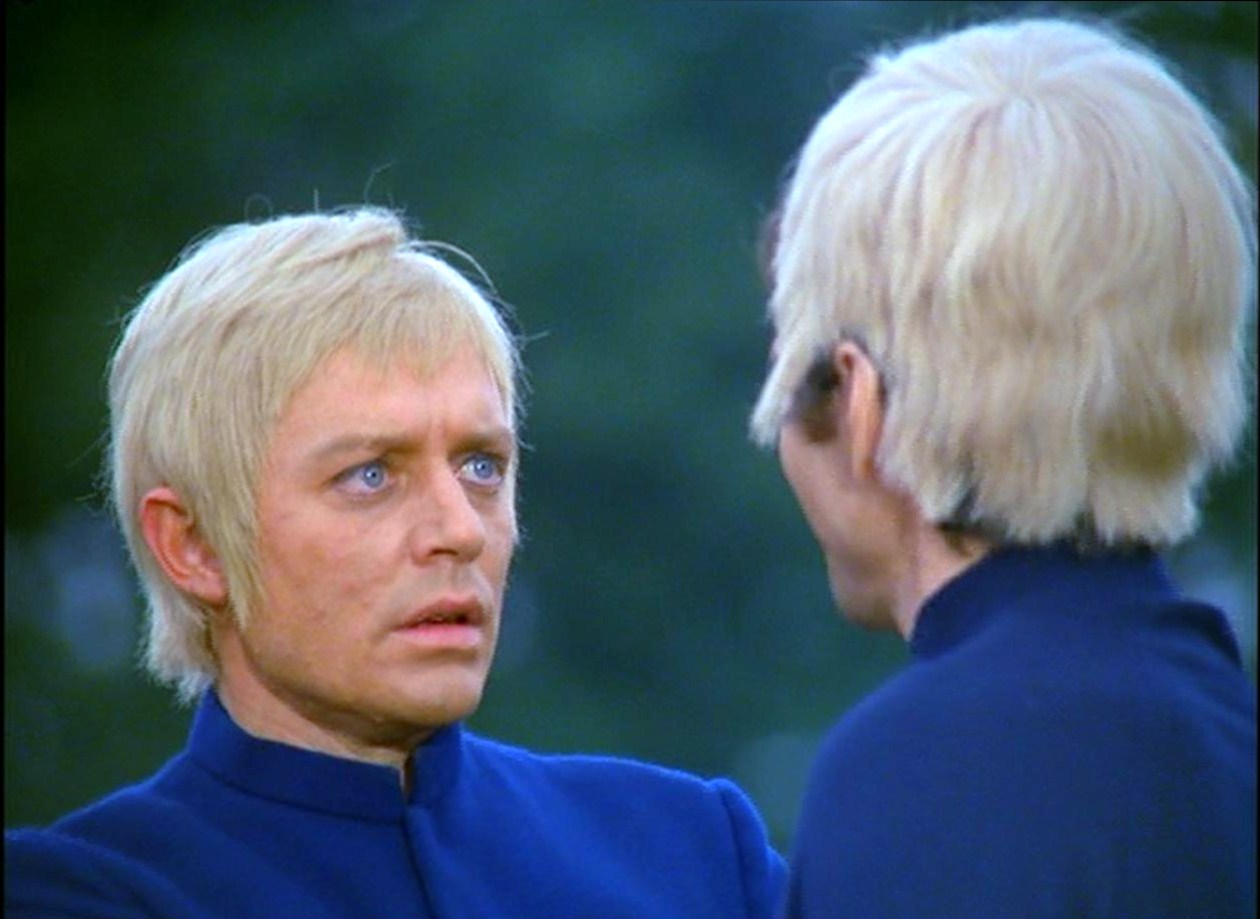
Face to face with a stand-in.
Paul Foster then sits down next to Straker, calling himself "Mike" (Michael Billington), and notes that this traumatic material will "make a great episode." 

An emotionally-affected Straker,  forced again to countenance his myriad personal failures (a recurring theme of the series in episodes such as "Confetti Check A-OK" and "A Question of Priorities"), objects. 

"That's my life!  That's my son!"

After seeing his son struck by a car, and his wife, Mary, tell him that she never wants to see him, Straker begins to really lose it (an outburst which "Mike" compliments as "method acting." )

But soon, the ever-rational, ever-resilient Straker realizes that he has been adversely affected by an alien "booby trap," one "aimed at the mind."  He understands that to get back to his world, his reality,  he must focus.  General Henderson has already informed him that he has a "monkey on his back," called "dedication."  Now he must tap into that dedication.

Isolation and alienation in the auditorium.
Straker returns to HQ to "play" the scene with General Henderson over again.  After a rapid, highly cinematic pull-back away from Straker depicting our protagonist as but one of many working actors on the studio lot, we get back to "realities," as Henderson puts it. 

With dedication and concentration, Straker recites his "dialogue."  He gets back in "the moment."

The longer he goes on, the more that Straker's reality reasserts itself.  The film crew transforms before our eyes -- in almost iconic composition -- into the courageous  men and women of S.H.A.D.O.  The walls re-form -- the fourth wall re-established -- and Straker is home, at last.

I admire how "Mindbender" works so well on two levels.  

On one level is the literal narrative: the story of an alien "booby trap" confusing the minds of S.H.A.D.O.'s best and brightest.  

On another, more metaphorical level, the subject here is film itself; how sometimes we replay events in our lives as if they're old movies.  We see this in Conroy's subplot, as he imagines himself a cowboy.  And we see it -- tragically -- with Straker, as he is forced to relive all his personal pain on the silver screen.

Straker strenuously objects to the idea that movie makers would steal his life and his memories and "put them up on the screen" for the entertainment of others...but that's what the art-form always does.  It takes from real life...and not always in a pleasant way 

Tragedy, regret, pathos...they all make a "great episode," don't they?

"This will make a great episode..."
"Mindbender" also gets at the fragility of the whole process of filmmaking, of the whole illusion, in some clever way.  Every week, we tune into a show like Star Trek or UFO and willfully suspend our disbelief. 

We know we are watching actors and special effects, a filmed entertainment with a pre-determined outcome and an emotion-provoking musical track. 

And yet with our whole minds (and our whole hearts...) we dupe ourselves into believing, after a fashion, that what we are seeing is "real;" that these characters truly "exist." 

UFO playfully blows the lid off that carefully constructed folie-en-famille, revealing to the audience not pilot Paul Foster, but actor Mike Billington; pulling back on high-angle shots of Moon base, Skydiver, and Straker's office and deliberately showing us that these environs are all carefully-constructed sets...merely artifice.

This is a high-wire act, be certain. The curtain is pulled back and the truth revealed, but in a science fiction series like UFO, there's no guarantee that once revealed, the magic can be restored.  Yet it is, most definitively, restored, by "Mindbender's" conclusion.  

As viewers, we greet Straker's escape from our reality back to his world as a huge relief.  We breathe easy again.   He escapes into fantasy, in one sense, as perhaps we might like to do.  The walls of suspension of disbelief are, again, erected...and we sneak back in, along with Straker.  We're back in the drama, back in the shared delusion or dream.

"Mindbender" plays beautifully with form and anticipates our every reaction.  The magician reveals -- at least briefly -- his hand, and then it's back to fashioning the magic again. And in shows like "A World of Difference," "Midnight Never Ends," "Far Beyond the Stars" and "Mindbender," the artist not only tells us a story; he invites us inside the process to take a nuts-and-bolts look at how that story gets delivered to us; at the ways the artistic mind conjures up the illusions of another world, another reality.

This kind of story can be done and has been done many times as a self-referential joke...a lark.  But sometimes -- when it is vetted so brilliantly (as is the case on UFO) -- this long-standing genre convention makes us ask important questions about what is real life and what is fantasy. 

More than that, it asks us to consider, perhaps, the reasons that we flock so readily and easily to the fantasy.

Monday, May 13, 2019

The Cult-TV Faces of: Pyramids

1

2

3

4

5

6

7

8

9

Saturday, May 11, 2019

National Twilight Zone Day: "One for the Angels."


The second episode of The Twilight Zone (1959-1964) is a remarkably affecting and sweet tale. It's amazing to consider that this fledgling series manages to hit its stride just two weeks into its run, but that's pretty much exactly what happens with this tale by Rod Serling, the first to introduce the series' recurring character: Mr. Death.

"One for the Angels" opens with Rod Serling's staccato narration about "summer in the present." His words introduce us to Lou Bookman (Ed Wynn), a "pitch man whose life is a tread-mill," a character aged about 60. Today, Lou lives alone on a bustling city block, and is well-loved by the local children, who take an interest in the toys he sells on his stoop.


Then, one day, Mr. Death (Murray Hamilton) shows up in Lou's one-room apartment, and tells Mr. Bookman that the old man's departure from this mortal coil has been scheduled for midnight. The "pre-ordination is death in your sleep."

Lou tries to escape his death, and learns that there are only three valid reasons for appealing a death verdict: family hardship, priority for important individuals (a scientist working on a cure for a disease, for example) or unfinished business of a major nature. 

Lou feels his appeal falls under the third category because he's never made a truly big pitch, "for the angels." Mr. Death reluctantly agrees to give him more time to achieve that dream, but quickly learns that Lou has exploited the loophole. Now Bookman plans never to do another pitch again...so he will never die.

Unwilling to be outmaneuvered by a mortal, Mr. Death selects an alternative soul to take with him that night. He decides to take a little girl from the street, a friend of Lou's. When Lou realizes she is to be taken at midnight, he tries to delay Mr. Death by launching into a pitch for the ages, and the angels...


As the above-synopsis makes plain, this early Twilight Zone concerns both mortality and morality. In our effort to avoid one (mortality), we can, somehow, manage to ignore or circumvent the other (morality).  

Lou Bookman is 69 years old, and yet he very much wants to continue to live. He believes that he can trick death, and manages to do just that.  But Death chooses to kill a little girl, and that is an immoral thing, a that, for Lou, he cannot abide. So Lou steps in and makes his pitch for the angels, knowing full well that it is he, not the girl, who will travel with Death that night. Bookman's understanding of right and wrong ultimately wins out over his desire to keep on living.

"One for the Angels" is both sweet and sad for its depiction of Lou, a kindly, unmarried senior citizen, scraping by, barely making a living, and having lived in a one-room apartment for 21 years. And yet Rod Serling sees a kind of dignity in this man, and his life. Lou leaves the mortal coil having saved a child's life, having made room for another soul. Lou's life is not one we might choose for ourselves, but it matters, both to him, the children whom he has befriended, and, in fact, the cosmos itself. 

"One for the Angels" also remains memorable for its depiction of Mr. Death as a kind of mid-level bureaucrat. He is smartly-dressed, attractive (but not too attractive), and he uses the jargon of his job ("pre-ordination," etc.) He seems to rather dislike having to prove his identity, and he is obsessively concerned with administrative details. "When might we expect it?" He asks of Bookman's pitch "for the angels."  Like many bureaucrats, Mr. Death also seems to possess a limited imagination.  

Or, that's one reading of his character, anyway.  


Perhaps, Mr. Death knew all along that Bookman was going to try to outsmart him, and his ploy with the little girl was all pre-meditated, part of the overall plan to make Bookman feel his death was more meaningful, more palatable. Again, this goes back to Serling's view of humanity, and the notion that all people are valuable, that all people matter. 

The episode's only let-down, perhaps, is the underwhelming presentation of Bookman's big pitch. The episode cuts to shots of Mr. Death sweating, forking over cash, etc., but the audiences doesn't get to hear all of the sales pitch "for the angels." This is a bit disappointing since Lou's gift of gab is the thing, in a way, that saves a child's life. It feels like a failure of writing and presentation for the pitch not to come across with more stellar specificity than it ultimately does.

"One for the Angels" is sweet and humanistic. In this outing, Mr. Death is not someone to be feared or loathed, but  just a regular guy doing his job. In the end, this Not-So-Grim Reaper and Mr. Bookman walk off together, under the moonlight, and it's not hard to imagine that both men feel they have done a good night's work.

Next up: "Mr. Denton on Doomsday."

National Twilight Zone Day: "Where is Everybody?"


Sixty years ago, Rod Serling's The Twilight Zone (1959-1964) premiered on network TV (CBS) with this story: "Where is Everybody?"

Written by Serling and directed by Robert Stevens, "Where is Everybody?" follows the lonely trek of a wandering amnesiac, played by Earl Holliman. This adult man, dressed in military overalls, comes upon a lonely town called Oakwood. 

Although there are signs in the diner and at other locales of recent habitation, the man cannot find any other human...anywhere. He seems entirely alone, not just in Oakwood, but in the world itself.


Increasingly, the lonely man, fears he is going mad. 

Finally, he can't take it anymore, and the truth is revealed. He is actually Mike Ferris, an American astronaut-in-training who has just hit the panic button in an isolation tank on a military base.

For his long trip to the stars, Mike has been learning how to contend with being alone...for 484 hours and 36 minutes, precisely.  

But now, finally, he has cracked. The town and all its locations were delusions.

The next time there is a man alone like this, Mike's superior tells another officer, there will be no escape, no panic button as man faces "an enemy known as isolation."  

That enemy is a force waiting..."in the Twilight Zone."


The pop culture journey of The Twilight Zone begins with "Where is Everybody?" and with an opening narration from Serling which orients audiences to the fact that "The place is here. The time is now." He also alerts viewers to the fact that "this could be our journey."

Today, few critics or viewers would place this particular story -- basically a one-man show -- in the upper tier of series episodes, and yet "Where is Everybody?" still casts an incredibly creepy spell.  What the episode lacks in supporting cast members and pacing, it makes up for in symbol-laden imagery.  

Throughout the episode, for example, Ferris keeps encountering *almost* companionship.  He sees himself in a mirror at one point. So there is a "second" person to talk to, but it is merely a reflection. At another point, Mike encounters a woman, but again, not the companion he would seek. Instead, she is a mannequin.  He is like the mythic Tantalus, always near companionship but forever without real companionship.


The modern technology that should connect Ferris to other individuals also fails him throughout the episode. He attempts to use a telephone, but again, doesn't find the human connection he seeks. An operator's voice tells him that the number he has dialed is not working.  Failure, once more!

And in the diner, another bit of technology, a jukebox, is playing, but there is no sign of any other person for Mike to interact with.  The world seems to be spinning on, with all its devices, only devoid of human life.  One wonders if this could be Purgatory, Hell, or even a weird alien experiment.

Other symbols suggest Ferris's isolation throughout "Where is Everybody?". The audience sees the lonely town through his eyes, and through a barrier (a chain link fence) in one shot, suggesting his constant separation from home, safety, and the rest of the human race.


Intriguingly, it is via the mass media that Mike begins to put together the pieces of his mysterious past and his frightening present.  

For example, the only paperback on a kiosk is one titled "The Last Man on Earth," which seems to indicate (and be aware of...) his plight. And at the local movie theater, a film called "Battle Hymn" is showing. An image on the poster reminds Mike that he is in the air force officer.

A label on the movie poster reads "Now Playing," which is a remarkable self-referential touch. The TV audience watches the story of a U.S. military officer, while the movie theater shows a movie starring a military officer at the same time. Both stories are "now playing."  The poster and the label, "Now Playing" also function as a suggestion that Mike's plight, like a movie now unfolding, is not quite real.


These visuals very much carry the story, as do the sounds of life everywhere, which constantly haunt Mike.  It all feels very much like the dream that Mike fears he cannot awake from.

The episode's final reveal is not one of the more stunning ones in the Twilight Zone canon. The surprise ending (that the town is a delusion of a cracked mind) doesn't feel particularly special or shocking, even if it does foster empathy for the lone, wanderer. The audience learns that Mike has been wandering in his mind, not a real town, and that another astronaut will be doing the same thing soon, only for real...in space.

A few weeks back, I wrote about the early Twilight Zone's focus on the advent of the space program, and that new and unknown age of space travel seems to be the basis for this story. Can man survive in space alone? For long spells?  Without the sights and smells and companionship of home? This episode is very concerned with that idea, noting that man possesses a hunger for companionship, and that such companionship is the "one thing we can't simulate" on a space journey.

It's a good, solid point, and one buttressed by the overall eeriness of the episode's central scenario, an abandoned town, and a man without memory, or company.  Yet with sixty years of hindsight it is also easy to see how this episode doesn't necessarily play to Serling's writing strengths.  This is a series that consists often of great dialogue and stunning narrative u-turns.  

"Where is Everybody" depends on visuals, not Serling's brilliant use of language, and the final u-turn is a little ho-hum in the context of the series, overall.

Again, there's cleverness in abundance here, especially in visual execution: the idea of the cracked mirror as a reflection of Ferris's cracked mind, for example. 

But if anything, "Where is Everybody?" is a potent reminder of the fact that at the beginning, The Twilight Zone still had some growing to do before becoming the classic it is recognized as today.

National Twilight Zone Day: A Nursery Rhyme For the Age of Space


The genre anthology Black Mirror (2011 - ) is beloved by today's audiences as a series obsessed with the nexus of human nature and technology. The titular black mirror is the reflective surface of a contemporary i-Phone, for example.

But going back nearly sixty years, it is possible to understand how Rod Serling's The Twilight Zone (1959-1964) also stood on the vanguard of American's culture's imagination about technology. Where today, Black Mirror ponders social media, video games, the cloud, and other evolving 21st century technologies, The Twilight Zone stood on the cusp of a very different world.

Consider, on October 1st, 1958, just a year before The Twilight Zone debuted, NASA came into being. And in 1959, some six months after NASA's foundation, the seven astronauts of Project Mercury were named. The first American in space, Alan Shepard, did not take that famous journey until May 5, 1961, years into the Twilight Zone's run. 

So as The Twilight Zone bowed, America stood on the precipice of a journey mankind had never undertaken before. 

Man-made rockets were going to carry the human race further than it had ever traveled. But no outcomes, no details were yet known about what might be "out there." The Twilight Zone, in its original era, dealt in the realm of "anticipatory anxiety" about the next step in human development.


It is appropriate then, that no less than four episodes of The Twilight Zone's inaugural season obsess on the opening journeys of the space age, on man's first, tentative, frightening steps away from planet Earth.  

It is true that other episodes in the series' run -- and also others in its first season -- explore a later age of "established" space flight ("The Lonely," "Elegy," "The Long Morrow,") but it is fascinating today to remember the four episodes from the 1959 season that fretted and worried about what the first astronauts to leave the safety of Earth's atmosphere would discover upon their historic flight.  

These are the stories that The Twilight Zone imagined would be "Chapter One" in the annals of man's' space age.


The premiere episode of The Twilight Zone, "Where is Everybody," not only began the network run of the series, but also initiated this recurring theme about the beginnings of manned spaceflight.  "The place is here, the time is now," Serling's narration notes, as it introduces the audience to a man (Earl Holliman) who finds himself wandering in an isolated, lonely town. 

Throughout the episode, he keeps running into the inescapable conclusion that he is totally alone in this atypical town.  There is not a soul to be seen, or heard.

And at story's end, viewers learn that this "last man on Earth" is actually an astronaut in training, one sitting in a hanger, on an air force base, in an isolation chamber. After he goes crazy from the loneliness of the experience in town (really an hallucination), an Air Force officer observes that "next time, it won't be a box in a hanger."  

In other words, the next time it will be real. 

A real life human being will have to deal with being alone in space, far away from his home, family, and every other human being, for a long period. Will he face what Holliman did, the episode wonders, "an enemy known as isolation?"


A few episodes later, another first step to space generates terror in The Twilight Zone. In "And When the Sky Was Opened," the X-20 rocket is launched with much fanfare. It travels 900 miles into space from Earth's atmosphere, the first such voyage of this type. When it returns to Earth, however, something strange occurs.  

The three astronauts who made the journey to Earth orbit are erased from existence, one at a time. Finally, even the rocket, the X-20, disappears from the world. It is as if someone, or some thing has taken them somewhere; ripped them from consensus reality. As the episode observes, the astronauts and their vehicle are "no longer a part of the memory of man."  

Today, this episode plays on an understandable if irrational fear about progress and technology, framed in an almost religious way. Would God be angry, the episode asks, if man were to leave his home, forsaking the Earth? Would an angry deity punish the men who dared to make that journey? Not by killing them, but actually by wiping them from the face of reality?  

These heroic men face terror and oblivion as an unseen force wipes away their histories and lives, before their eyes.  

Then, they just fade away.  

Was their offense so great, hoping to get a "God's eye" view of the Earth?


"I Shot an Arrow into the Air," the third Twilight Zone episode featured in this survey, is oddly, a variation on the premise of "And When the Sky Was Opened." In this tale, the Arrow 1, "the first manned aircraft into space" (think, the X-20!) is launched, with a crew of eight men aboard. 

Something goes wrong during the flight, and that accident is called "a practical joke perpetrated by Mother Nature." 

The rocket disappears from all tracking devices, radars, and watch posts on the Earth. A man in mission control discusses the lost rocket, and calls its story a "nursery rhyme for the age of space," an apt description of this Twilight Zone leitmotif.  The underlying fear is that something like this might happen, in real life, and quite soon. Astronauts sent to space could die in an accident, or even become marooned there. With six decades of hindsight, we know that space travel and accidents are not strangers, as Serling's series predicted.

The remainder of "I Shot an Arrow into the Air" follows the surviving astronauts, who believe they have landed on an arid asteroid, and go in search of water. One astronaut, however, is desperate to survive, and kills his ship-mates for their water canteens. 

After killing his captain, the last surviving astronaut crosses a mountaintop only to see, in the valley, below, a sign for Reno, Nevada. The Arrow 1 never left Earth at all, and now the astronaut is a murderer, and will pay for his crimes. He killed for a canteen of water on twentieth century Earth, only miles from civilization. 

This episode's stark photography and story are a clear influence on Serling's Planet of the Apes (1968) screenplay. In that story, astronauts also crash-land on Earth, mistaking it for another planet, and must traverse an arid wasteland in search of water and food. 

More to the point for this essay, however, "I Shot an Arrow into the Air" worries that mankind, when faced with life on an inhospitable world, will regress to his most barbaric, selfish nature. He will murder to stay alive. The underlying idea is that man may not be ready yet, to take to the stars. As "Chapter One" in the annals of manned space flight opens, there is the fear, displayed in this tale, that man is not the evolved creature of rockets, but still a cave man.


Finally, "People are Alike All Over," another first season episode, showcases yet another rocket "taking a highway into space," this time heading for Mars. Man is depicted "unshackling himself...and his tiny groping fingers into the unknown," Serling's narration tells us. 

The episode then showcases a fearful scientist and astronaut on the rocket, Conrad (Roddy McDowall). He is terrified of what might await mankind on the red planet.  He has good reason to be scared, as he soon finds out. After the rocket crashes on Mars, Conrad is captured by Martians and put on display in one of their zoos, where he spends the rest of his natural life, the man "from a primitive planet."

The photo above foreshadows Conrad's entrapment on Mars. In the shot above, he is trapped or caged by his fears of the space flight (which has not yet occurred, in the story). In the shot below, he is trapped or caged by what he discovers on his journey: man's inferiority in a cosmic sense.


Nearly sixty years later, it is easy to gaze at all these Twilight Zone tales and read them as simply "twist-ending stories" about failed space missions. Instead, one must remember the original context of the first season, and stories such as "Where is Everybody?", "And When the Sky Was Opened," "I Shot an Arrow into the Air" and "People Are Alike All Over."  

These tales were watched by a citizenry standing on the brink of a new frontier, not knowing what would await our brave astronauts out there. Would the first people to leave Earth find loneliness and nothingness, at a great distance from the rest of us ("Where is Everybody?") Would they face the wrath of an angry God by developing a technology that allowed them to leave this Eden-like home ("And When the Sky Was Opened?")  Would they face catastrophe, and revert to barbarism in a Darwinian battle for survival ("I Shot an Arrow into the Air?")  Or would they become the playthings of beings far more advanced than mankind ("People Are Alike All Over?")

Today, these science fiction stories remain ones that chill the blood. But imagine living in 1959, as NASA was founded, as the first astronauts were selected.  How must it have felt not to know what the opening chapter of space flight would look like? 

The Twilight Zone exploited these timely, and disconcerting fears brilliantly in its first season, and in these four tales, in particular.

Tuesday, May 07, 2019

UFO: "Close Up"


In "Close Up," Commander Straker (Ed Bishop) plans for NASA to launch a B-142 space probe equipped with a new electronic camera, a billion dollar piece of technology that, if properly deployed, should be able to photograph the alien home world.

One SHADO researcher, Dr. Kelly (Neil Hallett), however, wants 50,000 dollars for his project, which concerns close-up, micro-photography.  His request is denied, but Straker's is approved by General Henderson (Grant Taylor).

Thus, "Project Discovery" is launched. It involves interceptors pushing a UFO into a flight path where the camera-equipped probe can track it, and follow it back to its distant home planet. This is a plan developed by Lt. Ellis (Gabrielle Drake).

The mission is a success, and all that is left is for SHADO officers to wait four months for the probe to reach that far away planet and begin sending back data. When the first photographs of the alien world arrive, however, they are not what Straker or the others expected or hoped for, as Dr. Kelly quickly points out.


"Close Up" may just be one of the most dated episodes of this classic, fifty-year old science fiction series from Gerry and Sylvia Anderson.  In this UFO story, a scientist must explain to Straker about the importance of knowing distance and magnitude while reading photographs. And, the episode features a scene that, by today's standards, seems horribly sexist.

Let's begin with the photographs. "Project Discovery" is a billion dollar boondoggle for Straker, because the new, expensive and high-tech camera malfunctions, and no one can read the distance or magnitude of the photographs of the alien planet. The intel provided here by the camera is thus useless.

First, this is a black-eye for the Straker character, and it is a surprise that General Henderson doesn't rake Straker over the coals, or attempt to have him removed from command. This is just the expensive disaster that Henderson has, in previous episodes, been looking to hang around Straker's neck.


But beyond that, the episode ends with Dr. Kelly lecturing to Straker about the importance of "inner space," and understanding distance and magnification in photographs. Not only is this a seemingly basic fact treated as a cosmic revelation, but it makes all the other characters seem stupid for not realizing it. I suppose that the point of "Close Up" is that bureaucracy is inefficient. Kelly's plan costs only 50,000 dollars, but Straker went for the shiny object instead, the billion dollar camera.  And look what happened: no viable photos of the alien planet! The point is not bad (and actually forecasts the initial Hubble Telescope problems), but it sacrifices Straker's integrity as a character, and gives his nemesis, Henderson, all the ammunition he would ever need to have Straker removed from SHADO command.


The second problem with "Close Up" is the very dated treatment of Lt. Ellis, the commander of Moonbase. Straker sits down with her at one point in the drama and tells her that she is doing a "man's job," and that she should never forget that she is a "very attractive girl." 

Today, such comments would earn him a visit from SHADO's HR department, for certain.  We have heard in previous episodes how command of Moonbase should go to the "best man" for the job.  Apparently that descriptor was literal. This is considered a man's job. So even though racism is conquered in the world of UFO, apparently sexism is not.  


Compounding the problem, Straker categorizes the mature Ellis not as a woman, but as a "girl," and doesn't compliment her mind, her plan, or her tactical ability, instead paying attention to her physical appearance and calling her attractive.

As I always write in these matters, it is illogical and impractical to expect a TV series made a generation (or two...) ago to espouse today's societal standards regarding, race and gender.  My point in bringing this up is merely that this is one arena where the often forward-looking Gerry and Sylvia Anderson series is clearly dated. 

To make the sexism worse, the commander of Moonbase, Lt. Ellis, in the final scene, is asked to model for Kelly, basically, so he can demonstrate his micro-photography for Straker, on her bare leg.

Again, calling HR...

Next week: "Mind Bender."

Monday, May 06, 2019

The Cult-TV Faces of: Worms

1

2

3

4

5

6

7

8

9

50 Years Ago: Land of the Lost: "Survival Kit" (September 18, 1976)

It’s very rare to come across an episode of  Land of the Lost  -- in any season -- that I vehemently dislike and judge almost entirely worth...