Tuesday, January 08, 2019

Horror Lexicon #13: The Video Camera


One of my favorite lines in all of horror cinema comes from The Blair Witch Project (1999).  Josh (Joshua Leonard) gazes through a video camera view-finder at Heather (Heather Donohue) and trenchantly notes that the picture isn’t “quite reality.” 

He’s right, of course.  And that’s part of the reasons we love movies so much.  For ninety minutes or two hours, the camera becomes our eyes, and what we see through that camera isn’t quite reality.  It’s heightened reality.  It’s manipulated reality.  It’s shaped and edited reality.

Given how crucially important film grammar is in constructing an effective horror film, in crafting a sense of escalating unease and terror, it’s only natural, perhaps, that the camera itself has become an important player and topic of debate within the texts of many popular horror films. 

Thanks in part to technological improvements, the portable home video camera became affordable and lightweight in the mid-1980's.  Accordingly, a revolution in home movies began, and very shortly, this trend “trickled down” into horror movie narratives.  Videographers or amateur movie makers started out by appearing in the “victim pool” of mid-1980's horror films (April Fool’s Day [1986], Friday the 13th VIII: Jason Takes Manhattan [1989]), but more than that the camera soon became a player itself in the longstanding social argument about the value of horror as a genre.

Consider Henry: Portrait of a Serial Killer (1989), and the notorious scene in which Otis (Tom Towles) and Henry (Michael Rooker) go out “hunting” and kill a randomly-selected suburban family.  They record the horrific murder and rape spree on their camcorder and later -- while drinking a few beers -- kick back and watch their blood-thirsty escapades.  Otis even rewinds the tape, thoroughly entertained:  “I want to see it again.” 

The issue here is quite simply this: do we, as human beings, actually revel in the suffering of other people?  Does the video camera actually transform another person’s suffering into our entertainment?  This isn’t just a horror movie question, either.  This is a real life question.  Consider how often the grotesque footage of Saddam Hussein’s dead, bloody sons was replayed on cable television.  Or think how often the terror of the 9/11 attacks on the WTC were rerun in the days following the horrific event.  Do we, by watching recorded events, become complicit in a news event?  That’s certainly the territory of such films as Ringu (1998) and The Ring (2002).

A similar was developed in Flatliners (1990). There, a yuppie doctor-in-training, Joe Hurley (William Baldwin) secretly filmed all of his sexual conquests, and then watched and relived them later.  He had taken a liberty with his “lovers” and would have to pay for that moral trespass. His actions had consequences.  The video camera could be used to commit a crime, an invasion of personal space and privacy.

In the aforementioned Blair Witch Project (1999), the video-camera, as Josh notes, functions as a shield, distancing the viewer from unpleasant reality.  Josh notes that the camera offers a “filtered reality” in which one can “pretend everything isn’t quite the way it is.”  


In other words, the act of perceiving reality through a camera lens distances oneself from the objects and situations perceived.  In a non-horror setting, this was actually the subtext for the final episode of the popular sitcom Seinfeld in 1998.  Jerry and his friends watched a crime being conducted (a car-jacking) through a video camera, but did not intervene to actually stop the crime as it was occurring.  The apparently-passive act of gazing through the camera enabled George, Elaine, Kramer and Jerry to see themselves as being somehow apart from reality, and apart from community, even from the law itself.  There was no need to help the victim of a crime.  They were merely…watching, as they would a TV show.

With the heyday of found footage films upon us (including [REC], Cloverfield, Paranormal Activity, Apollo 18 and the like) we as viewers are asked again and again to reckon with the role of the camera in our lives, and in horrific scenarios. 

But where The Blair Witch Project asks us to assemble a sense of order out of grainy pixelized images that didn’t make sense in a conventional fashion and didn’t reveal anything about the looming threat (the Blair Witch), these later examples of the form strive more for certainty than uncertainty.  The Demon in Paranormal Activity (2009), for example, presents for a full-frame close-up at the end of the film, just so the audience gets its money’s worth out of a “creature feature.”  This (dumb...) ending belies the fact that more people own cameras now than at any time in human history, and nobody has ever, anywhere, recorded footage of a demon.    Films like Paranormal Activity don’t use the camera to reveal how our eyes can lie, only to assure that audience expectations are met.


The camera can also be a social good in the horror film.  It can be a tool of investigation and observation (The Lost World: Jurassic Park, Poltergeist), but more often the point of many horror films is that you can’t really hide from terror behind the eye-piece.  The camera may be a filter, but, in the final analysis, it’s a filter that doesn’t protect you.  Beyond the camera lens, life is happening in all its unpredictable, horrific, and sometimes wondrous forms.

The greatest terror associated with the video camera is that it could be all that survives a terrible event, a witness to death, and to your very end.  Years later, your footage might be found...

The video camera and videographer appear in (but are not limited to) such films as: Dead of Winter (1985), April Fool’s Day (1986), Slaughter High (1986), Cellar Dweller (1988), Friday the 13th VIII: Jason Takes Manhattan (1989), A Nightmare on Elm Street IV: The Dream Master (1989), Henry: Portrait of a Serial Killer (1989), Flatliners (1990), Mr. Frost (1990), Puppet Master 2 (1991), Basket Case 3: Progeny (1992), Prom Night IV: Deliver us From Evil (1992), Man’s Best Friend (1993) Brainscan (1994), Scream (1996), Anaconda (1997), Lost World: Jurassic Park (1997), Scream 2 (1997), Ringu (1998), The Blair Witch Project (1999), The Rage: Carrie 2 (1999), The Descent (2006),  [REC] (2007) Diary of the Dead (2007), Cloverfield (2008), Paranormal Activity 3 (2011), Apollo 18 (2011).

Monday, January 07, 2019

The Cult-TV Faces of: Scuba Diving

1

2

3

4

5

6

7

Thursday, January 03, 2019

The (Toy) Adventures of Metal Man


When I was a child in the 1970's, I became very enamored with sci-fi action figures. Today, in 2019, I still am.

Anyway, back in the disco decade I had my favorite franchise action figures, of course, but I also loved the ones that didn't come directly from a movie or TV show. Prime among these were The Micronauts, or in the parlance of the brand, "The World of the Micronauts."

But there was another action figure line of the same genre, I suppose you might say: "The World of Metal Man."  

There were various characters here -- Radon, Policeman, Soldier (Corporal Chrome?), Spaceman, Questar, Roton, and Rescueman, and the toy ads enticed children of the day to move Metal Man "into action."


The figures themselves were solid and quite heavy, and made of die-cast metal. They were in toy stores from 1979-1981, and I remember buying some at a Toys R. Us in Totowa (or was it Parsippany?). 

Some Metal Man vehicles were also released for the line, including a flying saucer with a transparent (which I still own), a rocket-sled-type spaceship, a police jeep, and a rescue chopper.


The figures were unique, and some quite beautiful in an an old-fashioned, Gen 1 robot kind-of -way. Questar was a chrome robot, for instance, who was packaged with a jet pack. And one robot, Roton, came with a recharge capsule.

I suppose I haven't thought much about the Metal Men in recent years, but every now and again, Joel and I play "Micronaut City" with my surviving Micronauts and accouterments. Well, I found a box of my old toys in my garage storage area, and lo and behold, I found a Metal Man recharge capsule and three Metal Man figures inside (along with a Micronaut Hydrocopter).  They are not in as good shape as the photos you see here.

Alas, the universe of Metal Man never grew as big or diverse as the universe of the Micronauts, but these toys were well-made, as I remember, and very distinctive.  

I probably would have always picked a new Micronaut toy first, if available/affordable, but every now and then, it was great to imagine the adventures of Metal Man.

Wednesday, January 02, 2019

Bedknobs and Broomsticks Record Album


Comic Book of the Week: Bedknobs and Broomsticks (Gold Key)


Bedknobs and Broomsticks GAF Viewmaster


Bedknobs and Broomsticks Little Golden Book


Bedknobs and Broomsticks Colorforms


Lunch Box of the Week: Bedknobs and Broomsticks


Theme Song of the Week: Bedknobs and Broomsticks (1971)

Tuesday, January 01, 2019

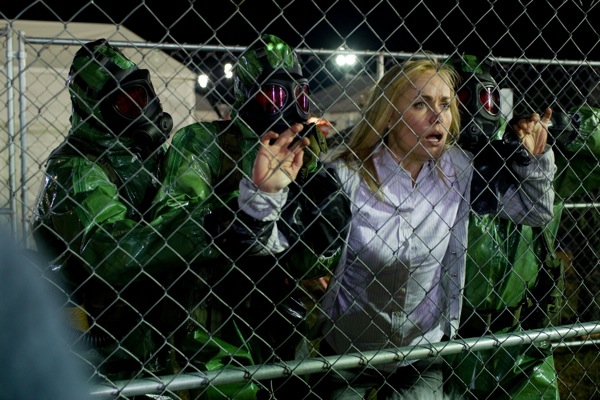
Horror Lexicon 12: The Bio-Hazard Suit


Once upon a time, the wardrobe of the horror genre consisted of diaphanous white gowns and black vampire capes.  

But by the 1970's, traditional Gothic wear was out-of-fashion, and high-tech horror chic was in.  

In films such as Robert Wise’s The Andromeda Strain (1971), environmental, hazmat or “bio-containment suits” were often the only thing that could protect heroic scientists from a new and insidious form of monster: the virus or “germ.”

And yet, during the same era, in harrowing films such as George A. Romero’s The Crazies (1973), the hazmat suit also became a short-hand for terror itself.  There, American soldiers occupied Evans City, PA, in bio-hazard suits, and declared martial law during the military’s attempt to contain a biological weapon code-named “Trixie.” 


These American soldiers carried flame throwers and guns, and saw the innocent families and denizens of the town as something akin to expendable cattle.  Therefore, the protective suits – on one hand a protection from danger – also became a barrier to communication, an impediment to human and humane behavior on the part of those who wore them.  Behind those suit masks, we couldn’t see how the soldiers felt, or if they were agonizing over their difficult choices.  We could only see how (horribly) they acted in the face of fear.

In short, that’s the yin-and-yang of the hazmat suit in horror films.  This wardrobe can work as a defense if a hero wears it, but represents a form of alienation or fear if worn by callous-seeming others or villains.  


Some films, such as Outbreak (1995) play with the conventions of the hazmat suit by featuring scenes wherein the protective suits rip and tear, and our heroes are exposed to a bug and therefore mortally endangered.  At another moment in the film, a scientist (Dustin Hoffman) is so convinced that he has discovered the cure for hemorrhagic fever that he (foolishly, in my opinion...) removes his helmet in the presence of the infected.  Fortunately for him, his gamble pays off.

The late 1980's and early 1990's represents the era of what I term "the Horror Genome Project," wherein many genre films featured “science gone amok” story lines.  These new age Frankenstein tales concerned irresponsible scientists who experimented with life – with the very building blocks of life – and created only…terror.  The remake of The Blob (1988) concerned this idea, as did such efforts as Mimic (1998).  In these settings, the hazmat suit was the scientist’s garb of choice.  We know that “clothes make the man” (or woman), so therefore the hazmat suit became a  de rigueur fashion touch in stories of scientists confronting their own creations, as well as seemingly alien or unknown terrors; Phantoms (1998) for instance.

In Steven Spielberg’s science fiction films, Close Encounters of the Third Kind (1977) and E.T. (1982), the hazmat suits are utilized by the master director as fearsome indicators of powers that audiences can’t understand.  The suits and helmets themselves obstruct transparency, hiding either conspiratorial government deceit, or “grown-ups” who obscure their “heart-lights” beneath layers of inhuman, inexpressive protection. 


The bio-hazard suit is featured in (but not limited) to appearances in films such as:

The Andromeda Strain (1971), The Crazies (1973), Close Encounters (1977), E.T. (1982), The Blob (1988), Alien 3 (1992), Carnosaur (1993), Return of the Living Dead III (1993), The Puppet Masters (1994), Mimic (1998), Phantoms (1998), Sphere (1998), The X-Files: Fight the Future (1998), [REC] (2007), Carriers (2009), and The Crazies (2010).

50 Years Ago: Land of the Lost: "Repairman" (October 2, 1976)

“Repairman,” the fourth episode of  Land of the Lost’s  third season, shows many signs of creative growing pains, though perhaps not as many...