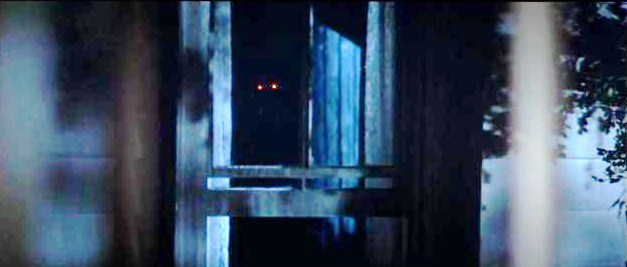
This week's selection from the horror movie lexicon remains one of the most controversial "vocabulary words" in the cinematic language. In the P.O.V. "stalk" shot or subjective shot, the camera adopts the first person perspective.
Essentially, this mean that, in quite a few cases, we are "seeing" through the very eyes of a film's killer.
The P.O.V. shot is so controversial because many film critics suggest it is, in some fashion, an immoral composition. They argue that we --
the audience -- are knowingly being transformed by filmmakers into killers ourselves.
Behind the eyes of a murderer, we experience the vicarious thrill of committing murder. We occupy the space and body of the killer, and his hands are our hands, this argument goes.
Contrarily, I've always believe that the P.O.V. shot does precisely what it was designed to do. First and foremost, it maintains the mystery of the "eyes" owner, the very person doing the killing in a particular narrative.
John Carpenter's Halloween (1978) is a perfect example of this particular approach. Consider the lengthy, elaborate P.O.V. tracking shot that opens the film, and whch reveals the film's first murder. The punch line or narrative twist at the end of this sequence is the surprise revelation that the brutal murderer is a child, little Michael Myers.
As this wholly unexpected horror is at last revealed, Carpenter's camera withdraws up, up and away from little Michael as though consumed by horror and indignation. The receding camera move represents a highly moral composition, then. But we wouldn't even get so artful a withdraw as punctuation were we not first surprised and terrorized by the identity of the killer.
Simply put, in many cases, the P.O.V. stalk shot actively preserves or elongates suspense, so that the killer's identity cannot be easily intuited. It seems appropriate to note, as well, that the first death sequence in Halloween -- the one that utilizes the P.O.V. perspective -- is far less explicit than it might have been. Michael's plunging butcher knife (partially obscured through the peep holes of a clown mask) is never seen to touch or otherwise penetrate human flesh.
So, at least in the hands of a maestro like Carpenter, there is a sense of tact and propriety when the P.O.V. is adopted.
The argument that the P.O.V. angle somehow encourages sympathy with the killer or encourages the act of killing seems suspect to me, anyway.
Film grammar consists of a wide variety of compositions and angles, and every one makes people "feel" a certain way. Instead of receiving some kind of vicarious thrill from observing up-close a murder, it's just as likely that a percipient in this scenario would be repulsed and horrified by the proximity to such violence.
And the horror film format is about engendering revulsion and horror.
Long story short, I find the application of the P.O.V. technique far less morally compromised than the glorious, full-color, bloody murders routinely depicted in action films like Rambo (1985), wherein we are expected to celebrate the death of a "villain" simply because he subscribes to a different ideology (communism), or is from a different nation (such as Vietnam).
The Point of View or P.O.V. Stalk Shot has indeed become a crucial element of the common horror lexicon, evoking feelings of shock and disgust in the audience, and also prolonging suspense before a slasher's identity is revealed. In some cases, the P.O.V. is even a directorial "feint," and the killer camera actually represents a practical joker, or a harmless friend "creeping up" on a Final Girl.
In other films, such as Sam Raimi's
The Evil Dead (1983), the P.O.V. shot appears untethered from gravity itself, and seem to race about madly, at high velocity, on that famous "shaky cam."
In other horror films, the P.O.V. is useful in noting how different creatures actually "see" the world. In this case, consider
Wolfen (1981), the infra-red vision of the extra-terrestrial in
Predator (1987), or the finale of
Alien 3 (1992). In each case, a new perspective is offered to audiences.
Especially popular in the 1980's and in slasher films, the P.O.V. shot has been featured in:
Halloween (1978), The Boogeyman (1980), Dressed to Kill (1980), Friday the 13th (1980), The Watcher in the Woods (1980), The Dorm that Dripped Blood (1981), Halloween II (1981), My Bloody Valentine (1981), The Boogens (1982), The Burning (1982), Hell Night (1982), Humongous (1982), Visiting Hours (1982), Curtains (1983), The Evil Dead (1983), One Dark Night (1983), The Prey (1984), Predator (1987) Child's Play (1988), Halloween IV: The Return of Michael Myers (1988), Night of the Demons (1988).


 Posts
Posts
 award-winning creator of the web series Abnormal Fixation (2024), the audio drama Enter the House Between (2023) and author of 35 books including Horror Films FAQ (2013), Horror Films of the 1990s (2011), Horror Films of the 1980s (2007), TV Year (2007), The Rock and Roll Film Encyclopedia (2007), Mercy in Her Eyes: The Films of Mira Nair (2006),, Best in Show: The Films of Christopher Guest and Company (2004), The Unseen Force: The Films of Sam Raimi (2004), An Askew View: The Films of Kevin Smith (2002), The Encyclopedia of Superheroes on Film & Television (2004), Exploring Space:1999 (1997), An Analytical Guide to TV's Battlestar Galactica (1998), Terror Television (2001), Space:1999 - The Forsaken (2003) and Horror Films of the 1970s (2002).