Tuesday, September 04, 2018

Star Trek Week 2018: "All Our Yesterdays"


Stardate: 5943.7

The Enterprise enters the Beta Niobe star system, where the star is about to go supernova in a few hours. 

The starship approaches Sarpeidon, a class-M planet in the system, and Captain Kirk (William Shatner), Mr. Spock (Leonard Nimoy) and Dr. McCoy (DeForest Kelley) beam down to investigate a technological center

They enter a library building, and find a most unusual librarian, Mr. Atoz (Ian Wolfe), who tends to a machine called “the Atavachron” and insists that they select “verism tapes;” discs in the library which showcase different historical eras of Sarpeidon.

After accessing one tape -- of a time period resembling 17th century England on Earth -- Captain Kirk hears a woman’s scream, and races through a doorway that is actually a time portal. Dr. McCoy and Spock race after him, but because McCoy was studying a tape of the Sarpeidon ice age, end up in a frozen wasteland.

Trapped in different time periods, the Starfleet officers must find their way back to the library, as the clock ticks down towards supernova.

In the ice age, Spock and McCoy encounter a lonely woman, Zarabeth (Mariette Hartley), who was exiled there by a tyrannical leader.  Spock, who is becoming more like the Vulcans of Zarabeth’s time period, 5000 years in the past, experiences a strong emotional connection to the woman. They fall in love.

However, Zarabeth can never return home to her time period, because of preparation through the Atavachron. She is doomed to spend the rest of her days in this frigid, frozen world.

Meanwhile, Kirk makes his way out of a prison, after being accused of witchcraft, and returns to the library. There he grapples with Mr. Atoz, who desperately wants to prepare Kirk, and then escape to his own “yesterday.”


“All Our Yesterdays” is a beautiful and successful Star Trek love story, from a season featuring too many weak love stories (“For the World is Hollow and I Have Touched the Sky,” “Requiem for Methuselah,” and “The Lights of Zetar.”)  

The fact that this episode succeeds so ably is even more surprising considering that the character who falls in love is the unemotional Mr. Spock.  Spock love stories are difficult to write well, and yet this story, from Jean Lisette Aroeste, is elegant and haunting.


Fortunately, a "logical" reason is given for Spock’s unusual emotional attachment. Upon returning to the past, he begins to act in the emotional, savage manner of Vulcans of the time period; pre-Surak. This idea is a wonderful addition to canon, and augments the already-established suggestion that Vulcans can sense each other over long distances, in the form of light telepathic contact (a factor also made evident in “The Immunity Syndrome,” and recently in Star Trek: Discovery’s [2017] “The Battle of the Binary Stars.”)

Given this mental connection to the Vulcans of 5,000 years in the past, it is natural and makes sense that Spock begins to behave in a different fashion, showing signs of emotion, falling in love, and eating animal flesh. I only wish there were as strong an explanation for Kirk’s behavior with Rayna in “Requiem for Methuselah,” or Scotty’s out-of-character actions in “The Lights of Zetar.”


Spock himself makes note of the changes in his character, and at one point nearly even kills the argumentative McCoy.  When McCoy calls him a name, Spock nearly strangles him, saying he doesn't like it, and never did.

Despite the outside forces working on the beloved character, the love between Spock and Zarabeth nonetheless feels absolutely authentic (again, something that can’t be said of the love stories in the other episodes I mentioned). Zarabeth is intelligent and strong, and alone. These are qualities that Spock might very “logically” feel himself drawn to. After all, he is an outsider among other humans, very much alone in some important ways.

The love story is made all the more touching by two factors at the end of the tale. First, Spock must leave Zarabeth, if McCoy is to go home. So, Spock must deliberately act against his desire and will to remain with Zarabeth, in essence stranding her alone all over again. 

And secondly, after he steps through the time portal, Spock returns to normal, and shows no sign of his previous attachment to Zarabeth. He is his "cool" unaffected self again.

Of course, we know Spock better than that. There is no doubt he remembers and still feels something powerful for Zarabeth. It is just that, in the present, he is better able to suppress his emotions. 

For me, this haunting ending, with Spock coldly disavowing his former emotional state, ranks right up with the codas of “City on the Edge of Forever” (Kirk’s “Let’s get the Hell out of here”) and “This Side of Paradise” (Spock’s “For the first time in my life…I was happy.”)

The tragic nature of this story is beautifully depicted by both Leonard Nimoy, as the confused and befuddled Spock, and Mariette Hartley as the lonely, desperate Zarabeth. It is a testament to both performances that this love story feels so real, and so, well...star-crossed.

If Spock’s story in “All Our Yesterdays” feels powerful and authentic, Kirk’s story proves markedly less interesting. He must battle accusations of witchcraft, and win over the trust and aid of the local prosecutor (Kermit Murdock), who is also a time traveler. The tale isn’t particularly interesting, but matters for Kirk grow even more intense upon his return to the library, and his battle of wills against Mr. Atoz and his duplicates.


Indeed, Kirk’s story becomes increasingly tense as the supernova event nears, and he must desperately attempt to locate Spock and McCoy…somewhere, in all of the planet’s history. At one point, Atoz gets the jump on Kirk, “prepares” him through the Atavachron, and nearly dooms Kirk to a life spent in the past.  These moments are very suspenseful.

The Zarabeth-Spock love story, however, ultimately became so beloved by Star Trek fans that A.C. Crispin continued the tale of their affair (and its aftermath: a child) in the novels Yesterday’s Son, and Time for Yesterday.

Less remarked upon, but no less interesting is the sci-fi idea put forward cleverly by this episode, that to travel through time -- and survive in another age -- a person must be physiologically prepared for their new home. Their cells, essentially, must be altered.  


I rather like this detail in "All Our Yesterdays," as it would preclude time travelers from moving, en masse into previous ages, and polluting a time-line. I would love to see Star Trek pick up this idea on a more recurring basis, since it suggests that time travelers can only exist for a matter of days in another era, before exposure to that age (and that age’s diseases?) kills them.  So, the events of many movies and episodes could still occur, but there would be regular danger for time travelers, if they overstayed their welcome.

Star Trek Week 2018: "The City on the Edge of Forever"


Stardate: Unknown

While the Enterprise charts dangerous time distortions around an unexplored planet, an accident occurs on the bridge. While treating Mr. Sulu (George Takei) for a minor injury, Dr. McCoy (DeForest Kelley) accidentally injects himself with a hypo full of Cordrazine, a dangerous drug.

In a state of complete panic and paranoia, McCoy flees the starship to the barren planet surface, and a landing party led by Captain Kirk (William Shatner) and Mr. Spock (Leonard Nimoy) pursues. There, on the planet, they encounter a device -- or perhaps entity -- called the Guardian of Forever.  It operates, essentially, as a time portal.

While the Guardian displays imagery of Earth’s past, McCoy jumps through the doorway and disappears. Immediately afterwards, the landing party loses touch with the orbiting starship. As Kirk soon learns, the United Federation of Planets, Starfleet Command, and the Enterprise no longer exist because McCoy has altered history.  He realizes that he and Spock must travel through the Guardian to the past to correct those changes and re-set the timeline as it should be.

Kirk and Spock travel to the year 1930, to New York City of the Great Depression. There, they find work with Sister Edith Keeler (Joan Collins) while waiting for McCoy to be swept by the same time currents to their location. 

While Spock struggles to power his tricorder with 1930s technology, Kirk falls in love with Edith Keeler.  Alas, she is the focal point in the time-line.  All of the future depends on her life…or death.


Widely considered the finest episode of Star Trek (1966-1969), “The City on the Edge of Forever” is also a contentious entry, owing to its troubled and very well-documented creative woes. 

Long story short: author Harlan Ellison was heavily rewritten, to his displeasure, and his original teleplay proved an award winner, despite its apparent deviations from established Trek lore. 

In Ellison’s version, there is a drug dealer aboard the Enterprise, named Beckwith, and he faces a terrible fate for his crimes.

The aired episode -- while not Ellison’s vision by a long shot -- is undeniably brilliant and beautifully. Basically, this Trek installment puts Kirk on the hot seat. He can choose personal happiness and contentment at Edith’s side, while sacrificing his friends, his future, and all of Earth itself.  Or he can choose duty and responsibility, and Kirk is always a creature of duty and responsibility.  Choosing this course requires him not just to lose Edith, but to essentially sacrifice her.

Hauntingly, Kirk chooses the well-being of the universe, a pure embodiment of Star Trek’s “the needs of the many outweigh the needs of the few, or the one” ethos. 


Kirk's final line in the episode, “Let’s get the Hell out of here,” captures well his anger and hurt at having been manipulated into such a position, into such a “no win” scenario. Forever time-crossed, Kirk and Edith can never be together, a fact which points in some way to a sadistic universe. Why would the Guardian bring these two together, only to tear them apart?  Why is Kirk made to suffer so grievously?

This tale humanizes Kirk significantly. Every day, he makes choices about who lives and who must die on the Enterprise and during its missions. But now, in this situation, he is made to feel the full impact of such a death.  He feels the loss -- because of his command decision -- more personally than ever before.

Captain Kirk has many lovers in Star Trek lore but Edith is likely his one, true, real, love.  She is no dalliance. No mere eye candy. Rather, one can see why she is a perfect partner for Kirk.  


To wit, Edith is an inspiration in a time of darkness, the Great Depression, reminding her suffering wards on a daily basis that the days ahead are worth living for.  She is also oddly insightful, able to forecast with pinpoint accuracy what mankind can one day become, if it outgrows war and hatred.  

Finally, she’s not merely curious...but tough and resilient. Edith is no pushover. She is compassionate and kind, committed to good work, and she is also a fighter.  She has a joy about herself and her purpose.

All these qualities make her appealing to Kirk, and to the audience too. Edith Keeler is a beacon of light in a dark world. Alone and lonely, Kirk is drawn to that beacon, quite naturally, though the two inhabit entirely different worlds.

“The City on the Edge of Forever” succeeds on the basis of the tragic love story, but also its unswerving ability to nail the characters with perfect, descriptive lines. 

for instance, Edith notes of Spock that he belongs as Kirk’s “side,” and says that he has “always been there, and always will.”  


That is just about the best (and most beautiful) description of the Mr. Spock character ever featured in any Star Trek episode. He is a fiercely loyal friend to Kirk. 

And once he is out of his drug-induced stupor, McCoy is his charming Southern self, concerned about all life, not merely his own.  We get a sense of just how charming and social the good doctor is during his moments with Edith.

It is a testament to the episode’s effectiveness that viewers are willing to gloss over certain practical questions here.  

Like: how does the Guardian determine which line of history is correct, and which isn’t? 

Similarly, the Guardian states that Kirk and Spock will be returned when things are set right, but there doesn’t appear to be a portal for them to jump back through.  

Does the portal just appear at their location, following Edith’s death in the street?

Some of this could be handled a little more clearly.


Most significantly, perhaps, it seems that a device or entity that has existed since before our “sun burned hot” in the heavens would possess some kind of safeguards so McCoy or other personalities of unstable behavior or hostile intent could not access it.  The Guardian, in a sense, is the greatest weapon in the universe.  It could easily be plundered or manipulated, and if it has any sense of self-awareness, wouldn't it understand that fact?

“The City on the Edge of Forever” is also remarkable, I would submit, for being representative of what I term Star Trek’s “pragmatic” brand of optimism. 

Specifically, Edith encourages a peace movement in America at the very time Hitler grows powerful in Europe, and threatens free people the globe over.  The episode stresses that Edith’s brand of peace is the right way, but that her movement comes “at the wrong time,” and Nazis take over the world because of it.


I call this “pragmatic optimism” because Star Trek always concerns peace as an ideal and goal, but also notes often that it is often necessary to root out and confront -- or fight -- evil. 

Overcoming violence is valuable and necessary in man’s evolution, yes (see: “Arena,” and “A Taste of Armageddon”), but the trick is also knowing that peace sometimes must be backed-up by a willingness to fight for your ideals, for your beliefs.  

Sometimes, though fighting is violent, it is also about defending the weak, or the defense of a principle.  Sometimes it is about stopping or preventing an injustice.  Real and lasting peace comes after these battles are waged. And there is often a real price for peace, in blood and treasure.

This idea recurs in the series. “A Private Little War” is a validation, essentially, of American involvement in the Vietnam War. It notes, with appropriate sadness and sobriety, that weak powers should not be destroyed by strong ones, but balanced with them…so that both survive.

Here, Edith’s peace movement “at the wrong time” is a warning to the real life peace movement of the Vietnam Era that though its goals were laudable, a retreat from the world would also carry an impact, and possibly a negative one.  There are consequences for action, it is true.

There are also, however, consequences for inaction.

In short, Star Trek acknowledges that there is almost universally a “battle for peace” that must be fought if that goal is to be achieved. 

Sure, it’s a rebuke of the late-1960s youth, or counter-culture, but that’s not entirely a bad thing. One cannot simply use peace as an opportunity to sit back and “tune out” from the injustices of the world.

Is “The City on the Edge of Forever” the best episode of Star Trek? 

I certainly understand why so many fans and critics think so. It is a moving, haunting episode. It is well-performed, inventive, and at times quite humorous. The fish-out-of-water premise seen here would recur as a favorite Trekkian theme in installments such as "A Piece of the Action" and The Voyage Home (1986).

In terms of my personal taste, however, I prefer “This Side of Paradise” -- an episode about how one character (Spock) has trapped himself in a “self-made purgatory” in which he cannot give nor accept love -- to this story of fate keeping Kirk from achieving any sort of personal happiness.

"City” is great, for certain, but there are s many great original episodes to choose from in the catalog.  I can’t honestly I declare that "City" is better than “Amok Time,” “Mirror, Mirror, the aforementioned “This Side of Paradise,” “Devil in the Dark,” “The Doomsday Machine,” or “The Corbomite Maneuver.”

Perhaps I should just close this review with the thought that “The City on The Edge of Forever” is a top ten episode of the series, for certain, and leave it at that.

Star Trek Week 2018: Star Trek is Out of This World


Monday, September 03, 2018

Star Trek Week 2018: "Mirror, Mirror"


Stardate: Unknown

On a mission to negotiate with the Halkans for purchase of their abundant Dilithium crystals, Captain Kirk (William Shatner), Dr. McCoy (DeForest Kelley), Mr. Scott (James Doohan) and Lt. Uhura (Nichelle Nichols) beam up from the planet’s surface during a powerful ion storm.

Because of that interference, the transporter malfunctions and landing party is sent to an alternate -- or parallel -- universe.

There, the Enterprise is a ship in a vicious Terran Empire, and all the crew wear knives, and devices called “agonizers.” The officers move up in rank by means of assassination, and control ruthless bodyguards. 

Worse, Kirk’s mission in this parallel reality is to destroy the Halkan race for resisting the Empire’s demand for their Dilithium crystals.  

Kirk plays for time, while Scotty works to modify the transporter to send the stranded crew members back to their own universe.

While Uhura contends with an aggressive Commander Sulu (George Takei), the ship’s security chief who runs the vessel like the Nazi Gestapo, Kirk must fend off his first officer, Mr. Spock (Leonard Nimoy), who has been ordered to kill him if he fails his mission. He must also block an assassination attempt by Mr. Chekov (Walter Koenig), and “bluff” his way through a relationship with the “Captain’s Woman,” the clever Marlena Moreau (Barbara Luna).

Meanwhile, on the Prime Enterprise, the mirror versions of Kirk, McCoy, Scotty, and Uhura are apprehended by Spock before they can make mischief.

Back in the mirror universe, Kirk and the others race the clock to get home to their dimension, and the captain attempts to convince Spock to mount an insurrection against the evil empire.


“Mirror, Mirror” is yet another absolute classic Star Trek episode, and one that has earned a long-lasting spot in the pop culture firmament.  

It’s really amazing to think just how many episodes of the original series I could write that sentence about, but it happens to be true in this case.  

The last episode in the second season that fits the bill of "all-time classic" is “Amok Time,” the season opener.  But think about this: that means that twice in four weeks, essentially, Star Trek delivered amazing narratives that not only endured fifty years, but become touchstones for a generation.

These are iconic episodes.

Here, of course, a visual touch is the one most widely remembered in TV history. 


In the “mirror” universe, Spock wears a beard, and that visualization became a kind of trope for parallel universes, repeated on South Park (1997 - ), and Mystery Science Theater 3000 (1989-1999) to name but two productions. 

Evil twins with beards (or rather, goatees), have also appeared in series such as Knight Rider.


The idea of a parallel “evil” universe has also recurred in  Star Trek on Deep Space Nine (1993 – 1999) in episodes such as “Crossover,” “Through the Looking Glass,” “Shattered Mirror,” “Resurrection” and “The Emperor’s New Cloak.”  The most memorable episode of Star Trek: Enterprise (2001 – 2005) is the two-parter set in the Mirror Universe, “In a Mirror, Darkly.”

In terms of exhilarating action, “Mirror, Mirror” is absolutely second to none, with the battle in sick-bay between Spock and the landing party proving a dramatic high point, and everything leading up to a nail-biting ticking-clock conclusion as the crew races to return home.  

Fifty years later, the last fifteen minutes of this episode -- with the crew struggling to get home, and McCoy spending precious minutes to save the Mirror Spock’s life -- prove almost unbearably suspenseful, despite the fact that we know it is all going to turn out okay.

It works that way because the episode's success depends on emotional investment, and constructs that investment brilliantly.  

Basically, this episode is all about the concept of nature vs. nurture.  If we are all raised in a totalitarian dictatorship, would we be the same people we are today?  

Would I be an insurrectionist blogger living on the lam, posting anti-Empire screeds? Or would I be minister of propaganda in the Empire? 


More to the point: would I be the same person?  Would I be “me?” Or would my environment change me so much that I would be unrecognizable to myself of the Prime Universe?

Here, all the Enterprise crew-members are twisted reflections of themselves, with Sulu proving the most terrifying for his apparent sadism and ambition. Chekov isn’t far behind him, though.  But still, Sulu takes the cake, and "Mirror, Mirror" offers my favorite George Takei performance in the entire series. 


But intriguingly -- through direct interaction with Prime Kirk -- at least two characters in the Mirror Universe demonstrate that the parallel reality isn’t, well, an exact opposite.  

Spock maintains his characteristic integrity, most notably. 


He continues to be a man who is loyal, trustworthy, curious and intellectual. He serves an evil organization, and yet is still a being of two worlds (as he is in the Prime Universe). Spock is part of the Empire, bound to its regulations, and yet apart from the Empire in his loyalty to Captain Kirk, and his logical thought patterns.

Secondly, a person who has never known love at all -- Lt. Moreau -- proves that she is responsive to positive emotions, and can embody all the “positive” traits we would hope of a friend and ally.  She becomes an supporter of sorts, and rescues the landing party with the Tantalus Field. 

True, she wants to escape with them to the Prime Universe, but still, she reveals the kernel, at least of integrity.  Like Spock, one senses that she is growing, evolving into someone "better," someone we would recognize in our own universe.


"Mirror, Mirror" also offers a series high-point for Nichelle Nichols' Uhura.  Though it is unfortunate that the character must again endure a "Captain...I'm...frightened" moment, Uhura nonetheless proves her worth in this episode.  She wrestles a phaser away from Marlena Moreau, and distracts Sulu -- dangerously so -- on the bridge, at a critical junction.  "Mirror, Mirror" reveals why Uhura is such a valuable team player.   And my God, she is also one of the most beautiful women ever to appear on American television.


McCoy, meanwhile, reveals his core, essential humanity again. Here, he risks everything to save his friend, Spock.  Even with the ticking-clock, and Sulu's gestapo everywhere, McCoy pauses to save Spock's life.  What a testament to his friendship for the green-blooded Vulcan.


In philosophy, there is a theory of knowing God called the “Via Negativa.” Basically, it means that you cannot define God by what God is; only by what God is not.  God is not hate. God is not mortal, and so forth.   

In a similar way, one might argue we cannot really know the Enterprise characters well until we see what they are not, and that’s the insight that “Mirror, Mirror” provides.

Captain Kirk is not the clawing, opportunistic creature of ambition that his Mirror counterpart so clearly is.  He aspires to be captain of the Enterprise, and a great captain.  He does not aspire to rule the universe.

Sulu is not the power-hungry conniver and plotter of the Mirror Universe. McCoy is not a vicious sadist, and on and on it goes.  

We come to a better understanding of who these beloved characters really are, then, by studying in this episode, what they aren’t.  And by seeing these protagonists in a cruel, duplicate universe, we also see how they don't fit there.  We see their virtues all the more clearly.

Another compelling aspect of the episode involves the Halkans. 

They are the same in both universes (much like Spock), thus showcasing that the mirror universe is not a perfect reflection, or opposite, only a universe wherein Earth took a terrible turn in pre-Trek history, becoming a totalitarian, conquering force.  

Quite simply, the people of Earth in this reality were...weak. They were infinitely weaker, in fact, than the Halkans are.  The Halkans live by their words and would “die as a race” rather than give up their profound philosophy of pacificism.  Apparently Earthers were not so resolute and gave up their freedom for conquest and power.  This plays, indeed, as a warning, about carrying ideology on your tongue, but not following through with meaningful action. Kirk's final speech to Spock is meant to spur him to that meaningful action, and bring about regime change.

Finally, I must note that I admire so much the ingenuity of this episode’s production design. The physical alterations to the Enterprise -- including Kirk’s throne-like command chair and the logo of the Empire (Earth, with a dagger going through it…) -- are simple, but effective. And other modifications, such as personal agonizer devices, an Agony Booth, and sentry-like bodyguards (even Vulcan ones!) add profoundly to the idea of a world that has gone terrifyingly awry.

“Mirror, Mirror” moves with pace, purpose, humor and fiendish ingenuity, and may just be one of the three or four best episodes of Star Trek. 

Star Trek Week 2018: Thoughts on Trek Movie Production Design


Sometimes I have termed the Star Trek movies 1979 – 1991 “my Star Trek” because of where they happened to fall in my life.   The original Star Trek was cancelled before I was born, and The Next Generation came around when I was a senior in high school.  So it is the movies that I closely associate with growing up, though of course I watched the original series in reruns as well.

It may be part and parcel of these feelings about “my” Star Trek era, but I have always felt very positively about the upgraded Enterprise interiors and exteriors, as well as the new Starfleet uniforms.  To my eyes, they looked simultaneously more futuristic and more realistic than their predecessors.

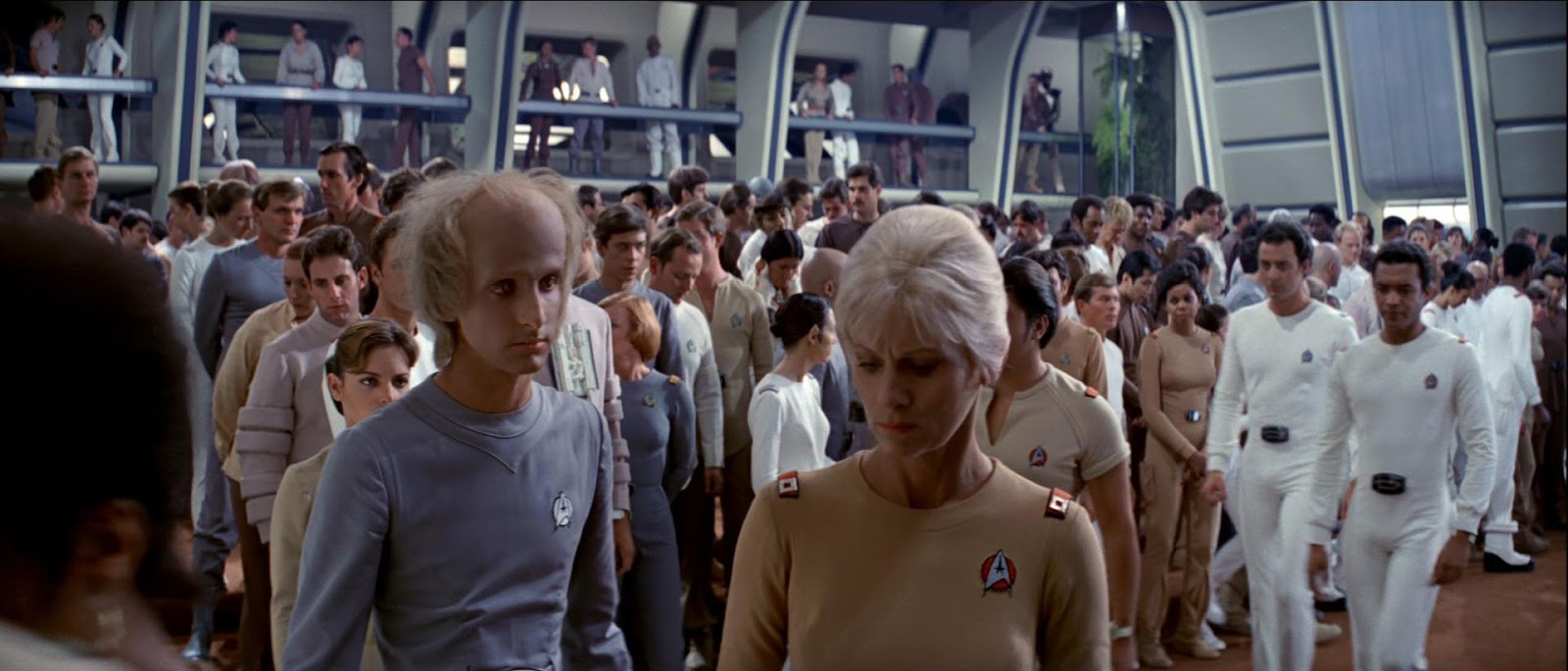
My favorite version of the Enterprise is the one featured in Star Trek: The Motion Picture.  I know some viewers tend to complain about the length of the dry dock scene with Scotty and Kirk surveying the great ship, but I have always felt that this particular moment -- better than any featured in the preceding TV series -- sells beautifully the size and grandeur of the starship. 

This is important stuff, because the scenes involving V’ger -- which reveal the Enterprise dwarfed by comparison -- thus sell the enormity of the film’s menace.  In other words, the Enterprise is huge…and V’ger is absolutely ENORMOUS.    Encoded in this comparison is the sense of alien life being truly alien; of being outside the realm of human scale.  I admire the film’s success transmitting this notion… especially when so few science fiction films even try.


The subdued lighting inside the new Enterprise also helps to sell the overall reality of the starship.  Much of the time, Wise’s camera takes up a “crewman’s eye” position on the bridge that makes us feel like we’re right there, conversing with the officers and watching events unfold.  The number of insert shots of view-screens and read-outs further enhances the sense of us being right there on the Enterprise, receiving and interpreting information. 

I like this approach very much, and the bridge set in the film is so great because all those displays and graphics actually look real, and the controls seem functional.  That’s not an observation you can make regarding the TV series bridge and the painted on, rarely-changing screens.

I guess I’m in the minority on this, but I also like how sleek, form-fitting, unisex, and deliberately un-military the uniforms of Star Trek: The Motion Picture appear.  They are simple, elegant and much less garish than their predecessors (again reflecting a shift towards Space: 1999 and minimalist 1970s aesthetics…).  For me, the TMP uniforms signal visually the “equal” nature of all demographics (male and female, alien and human) in Starfleet.  No more mini-skirts. 


Star Trek: The Motion Picture is much-criticized, but I agree with your assessment. I feel that the costumes, miniatures, and sets all successfully broadcast the impression of a real starship and starship crew living in a future age.  At times, accordingly, the film boasts an almost documentary-like quality.  What The Motion Picture forsakes in fistfights, phaser battles and conventional thrills, I feel it gains in verisimilitude.

In terms of the new Star Trek movie, I give lots of credit to J.J. Abrams and his team for really “owning” the original TV uniforms and making them look good on the big screen. I just have to think there was probably a tremendous creative push to replace the original uniforms with a sleeker, less garish color scheme, but god bless Abrams, he didn’t succumb to that pull.

The new bridge looks futuristic, but in broad strokes the lay-out is the same, with the familiar captain’s chair, front console, and turbo-lift.  And I absolutely love that the original “chirping” sound-effects from the series were retained.  In some sense, that affectionate and faithful touch “sells” the new bridge design for me.


I don’t know that I possess the deep well of affection for the new Enterprise exterior and interior designs that I do those of the Motion Picture Era, but I nevertheless count them a success.  The ship felt like Star Trek to me, only Star Trek re-interpreted for the 21st century. 

Again, I’m sure there was a considerable pull to go “gritty and dark” and make the Enterprise more submarine-like and less clean and bright, for instance.  

I’m glad the filmmakers didn’t succumb to that urge.

Star Trek Week 2018: 50 Things Star Trek Taught Us


1. "Above all else, a God needs compassion." ("Where No Man Has Gone Before")

2. "Raising my voice...doesn't mean I was scared or couldn't do my job.  It means I happen to have a human thing called an adrenalin gland." ("The Corbomite Maneuver")

3. "The sound of male ego. You travel half way across the galaxy and it's still the same song." ("Mudd's Women")

4. "We all have our darker side. We need it! It's half of what we are. It's not ugly...it's human." ("The Enemy Within")

5. "There are a million things in this universe you can have and a million things you can't have. It's no fun facing that, but that's the way things are." ("Charlie X")

6. "Space still contains infinite unknowns." ("The Naked Time")

7. "Worlds may change, galaxies disintegrate, but a woman always remains a woman." ("The Conscience of the King")

8. "War is never imperative." ("Balance of Terror")

9. "The more complex the mind, the greater the need for the simplicity of play." ("Shore Leave")

10. "Life and death are seldom logical." ("The Galileo Seven")

11. "I think children have an instinctive need for adults. They want to be told right and wrong." ("Miri").

12. "When there is no emotion, there is no motive for violence." ("Dagger of the Mind")

13.  "I speak of rights. A machine has none. A man must." ("Court-Martial")

14. "Sometimes a man will tell his bartender things he'll never tell his doctor." ("The Menagerie.")

15. "Madness has no purpose. Or reason. But, it may have a goal." ("The Alternative Factor")

16. "Do you know that you [mankind] are one of the few predator species that preys even on itself?" ("The Squire of Gothos")

17. "We're a most promising species...as predators go." ("Arena")

18. "Freedom is never a gift: it has to be earned." ("Return of the Archons")

19. "If there are self-made purgatories, then we all have to live in them." ("This Side of Paradise")

20. "Superior ability breed superior ambition" ("Space Seed")

21. "A lie is a poor way to say hello." ("City on the Edge of Forever")

22. "Pain is a thing of the mind.  The mind can be controlled." ("Operation: Annihilate")

23. "You may find that having is not nearly so pleasing a thing as wanting. It is not logical, but it is often true." ("Amok Time")

24. "You can't think a man to death. ("Catspaw")

25. "Threats are illogical." ("Journey to Babel")

26. "In every revolution there's one man with a vision." ("Mirror, Mirror")

27. "Vulcans never bluff." ("The Doomsday Machine")

28. "Logic is a little tweeting bird chirping in a meadow. Logic is a wreath of pretty flowers which smell bad..." ("I, Mudd")

29. "The idea of male and female are universal constants..." ("Metamorphosis")

30. "There's an old, old saying on earth, Mr. Sulu: "Fool me once shame on you, fool me twice, shame on me." ("Friday's Child")

31. "Everyone feeds on death, even vegetarians." ("Wolf in the Fold")

32. "Too much of anything -- even love -- is not necessarily a good thing." ("The Trouble with Tribbles"")

33. "They used to say if mankind could fly, he'd have wings, but he did fly. He discovered he had to." ("Return to Tomorrow")

34. "No one may kill a man. Not for any purpose. It can't be condoned." ("Spock's Brain")

35. "Without followers, evil cannot spread." ("And the Children Shall Lead")

36. "Physical reality is consistent with universal laws. When the laws do not operate, there is no reality." ("Spectre of the Gun")

37. "Only a fool fights in a burning house." ("Day of the Dove")

38. "The release of emotion is what keeps us healthy. Emotionally healthy." ("Plato's Stepchildren")

39. "We must acknowledge – once and for all – that the purpose of diplomacy is to prolong a crisis." ("Mark of Gideon")

40. "Herbert was a minor official, notorious for his rigid and limited patterns of thought." ("The Way to Eden")
 
41. "To be human is to be complex.  You can't avoid a little ugliness from within and from without." ("Requiem for Methuselah")

42. "Hours can be centuries. Just as words can be lies." ("The Cloud Minders")

43. "There's no honorable way to kill.  No gentle way to destroy. There's nothing good in war except its ending." ("The Savage Curtain")

44. "A library serves no purpose unless someone is using it." ("All Our Yesterdays")

45. "We all create God in our own image." ("The Motion Picture")

46. "The needs of the many outweigh the needs of the few. Or the one." ("The Wrath of Khan")

47. "The needs of the one... outweigh the needs of the many." ("The Search for Spock")

48. "To hunt a species to extinction is not logical." ("The Voyage Home")

49. "Maybe he's [God] not out there, Bones. Maybe he's right here. The human heart." ("The Final Frontier")

50. "Logic is the beginning of wisdom...not the end." ("The Undiscovered Country")


30 Years Ago: Chris Carter's Millennium (October 25, 1996)

Frank Black (Lance Henriksen), his wife, Catherine (Meghan Gallagher) and their daughter, Jordan (Brittany Tiplady) move into a beautiful ye...