Creator of the award-winning web series, Abnormal Fixation. One of the horror genre's "most widely read critics" (Rue Morgue # 68), "an accomplished film journalist" (Comic Buyer's Guide #1535), and the award-winning author of Horror Films of the 1980s (2007) and Horror Films of the 1970s (2002), John Kenneth Muir, presents his blog on film, television and nostalgia, named one of the Top 100 Film Studies Blog on the Net.
Wednesday, November 30, 2016
Comic Book of the Week: Star Trek: Deep Space Nine
Labels:
comic-books,
DS9,
Star Trek: Deep Space Nine
Pop Art: Star Trek: Deep Space Nine (MAD Magazine Edition)
Labels:
DS9,
MAD Magazine,
pop art,
Star Trek: Deep Space Nine
Model Kits of the Week: Star Trek: Deep Space Nine (AMT)
Labels:
AMT,
DS9,
model kit of the week,
Star Trek: Deep Space Nine
Trading Cards of the Week: Star Trek: Deep Space Nine (Skybox)
Theme Song of the Week: Star Trek: Deep Space Nine (Season One; 1993)
Tuesday, November 29, 2016
Star Trek 50th Anniversary Blogging: "The Deadly Years" (December 8, 1967)
Stardate: 3478.2
The
Enterprise visits Gamma Hydra IV, a planet near the Romulan neutral zone that
recently came in close contact with a rogue comet.
There,
a landing party consisting of Captain Kirk (William Shatner), Mr. Spock
(Leonard Nimoy), Dr. McCoy (DeForest Kelley), Mr. Scott (James Doohan), Mr.
Chekov (Walter Koenig) and Lt. Galway (Beerly Washburn find that scientists
Robert (Felix Locher) and Elaine (Laura Wood) have inexplicably aged years --
even decades -- in less than a day. Another of their team has already died.
Chekov is terrified when stumbling upon his corpse.
Aboard
the Enterprise, the landing party members -- except for Chekov -- begins to
show signs of the same mysterious malady they witnessed on the planet. They
begin to age rapidly.
Commodore
Stocker (Charles Drake), bound for a command at Starbase 10, wants Spock to
convene a hearing that will judge Captain Kirk incompetent, and see him
relieved of duty. Spock reluctantly
agrees, and the inexperienced Commodore takes command of the Enterprise.
Meanwhile,
Kirk’s old flame, Dr. Janet Wallace (Sarah Marshall) works with Dr. McCoy to
come up with an antidote to the aging illness.
While
they struggle to find an answer, Stocker directs the Enterprise through the
Romulan neutral zone, believing a direct course to Starbase 10 is necessary. The Romulans, however, intercept the
starship.
“The
Deadly Years” is another classic episode of the original Star Trek (1966-1969),
and one of the best installments of the second season. The story is affecting, exciting and
buttressed by great make-up effects.
One
reason “The Deadly Years” works so well is that the theme of the episode,
aging, is universal to the human experience.
We
are all going to grow old, and face diminished possibilities in terms of our
mental and physical acuity. As we age,
we grow weaker. For some of us, it will
be worse than that, and we will deal with age-related problems such as hearing
loss, arthritis, and even dementia. Old
age is, frankly, a terrifying and implacable nemesis.
The
universal nature of aging -- we will all experience it, without fail -- is not
the only reason that “The Deadly Years” is so effective. Before we face this particular enemy
ourselves, we will watch it take the ones we love, too. In the passage of the generations, we see our
once-strong parents begin to weaken, grow less independent, and less able.
Here,
we see the young and vital Captain Kirk transformed into a frail, forgetful,
belligerent old man. There is something incredibly sad and upsetting about
seeing a strong person rendered weak before our very eyes. Kirk is a force of nature, a man of high
energy. But even he is not exempt from the ravages of age.
The
episode is powerful too, in part, because of Sulu’s (George Takei) and Uhura’s
(Nichelle Nichols) reaction to Kirk’s aging, as he gives them orders that
require questioning. Kirk repeats himself (about planetary orbit), and orders a
signal sent using a code that the Romulans have already deciphered. In one pitiful moment, he is seen asleep in
his command chair on the bridge. It is
clear that Sulu and Uhura don’t want to question or harm Kirk, a man they
deeply respect, and at his hearing they make excuses for his behavior.
But
you can see it in their eyes how it much it hurts them to have to question him
and his competence.
One
aspect of “The Deadly Years,” I never fully appreciated in my younger days was
the unusual nature of the romantic relationship between Kirk and Wallace. It’s
a little kinky, in a sense. She only is
attracted to Kirk as he grows old and less capable. She comes on to Kirk as he
super-ages, and he realizes that this is her pattern of relationships with the
opposite sex; to find herself attracted to older men. Perhaps because then any
real commitment is time-limited.
It
is also bittersweet to experience “The Deadly Years” in 2016, fifty years
later, and reckon that the majority of the cast that grew old so colorfully (and
with extensive, effective make-up) for this episode, have indeed died in their
old age.
We
have lost De Forest Kelley, James Doohan and Leonard Nimoy. It’s impossible not to think of that fact as these
beloved actors “age” here in character.
Although
“The Deadly Years” ultimately sees our beloved characters restored to youthful
vigor, in real life there is simply no antidote to old age, to creeping
mortality. As a forty-six (soon to be
forty-seven) year old I am more conscious than ever that time only moves in one
direction, and that aging is an irrevocable, diminishing process. We may, hopefully, age gracefully. But, regardless, the aging process occurs.
Part
of that process of aging, I understand at almost 50, is failing to recognize
one’s own limitations. It is especially appropriate that the impulsive,
energetic Kirk would face this particular problem. He can’t let go of his
command, and cannot see how his failing faculties are impacting the crew and
the ship. And he feels such intense
betrayal and pain when Spock, under Stocker’s direction, must point out that he
has lost the capacity to command a starship. Et tu, Spock?
The
moments between an aged Kirk and Spock in “The Deadly Years” are especially
heart-breaking. Spock has performed his
duty, as he must. Kirk can’t see it that
way, and turns against his old friend.
“The
Deadly Years” is also a strong installment in terms of series continuity. This is the first episode to feature the
Romulans since the early first year segment “Balance of Terror.” It is also their
only appearance in Star Trek’s second season. The Romulans appear in their painted
bird of prey vessels, seen in that episode, and again fire their plasma-based
energy weapons.
Significantly,
Kirk’s resolution to the Romulan confrontation harks back to another early
first season episode of Star Trek. He re-uses the Corbomite
gambit he tricked Balok with in “The Corbomite Maneuver.” Again, it works.
One
might also make the argument that “The Deadly Years” is an influential episode
of Star
Trek because Dr. Kate Pulaski (Diana Muldaur) suffers a similar super-aging
malady in the second season Star Trek: The Next Generation (1987-1994)
episode “Unnatural Selection.”
Next
week: “Obsession.”
The Films of 1958: The Fly
Based
on the 1957 story by George Langelaan, The Fly (1958) is an unforgettable
horror movie that has -- across the long decades -- spawned a full-fledged
franchise.
Sequels to the original film followed in 1959 (Return of the Fly) and
1965 (Curse of the Fly), while the David Cronenberg remake (1986) and
its sequel, The Fly II (1989) bowed in the late eighties.
I
must have watched the 1958 original a good half-dozen times during my
upbringing in New Jersey, on The 4:30 PM Movie and in other
syndication venues. The Fly is one of those movies that, once you start watching,
you can’t turn away from.
Even though you know how it is going to end.
Speaking of endings, the
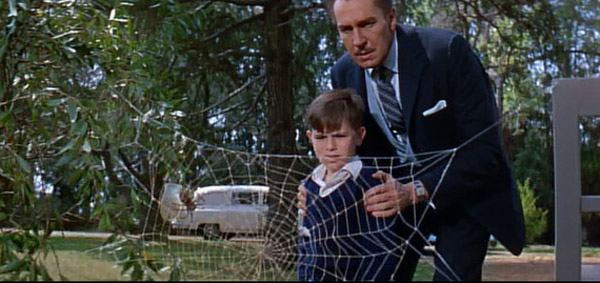
film’s horrific climax --- featuring a
fly with a human head trapped in a spider’s web -- stands as a pop culture
touchstone, and has been excerpted on series including The X-Files (1993-2002)
and Millennium
(1996-1999). That chilling denouement remains effective, even today, after being lampooned
multiple times on Mystery Science Theater 3000 (1989-1999) and The
Simpsons (1990 - ).
Today,
the 1958 film certainly shows its age, though it remains a thoroughly
entertaining and immersive picture. The Kurt
Neumann (1908 – 1958) film stands the test of time, primarily, in terms of its
commitment to scientific progress, even in the face of disaster. As for scientific accuracy, that's a different story.
“God gave us
intelligence to uncover the wonders of nature,” The Fly
asserts, and so even though the film involves a nightmarish end to a noble
experiment, audiences are left with the impression that man will move forward,
and eventually conquer the universe itself. That's a philosophy I can buy into, with hope and optimism.
So
there’s, oddly, a hopeful message embedded in The Fly's dark and creative
imagery.
Every time I watch The Fly, I recoil with horror from the results of the experiment, in particular the fly with the human head, trapped as a spider arrives to devour it. But I also appreciate that the film recognizes that sometimes there are casualties in the great march of human progress.
“You’re
the first to see a miracle.”
Francois
Delambre (Vincent Price) answers a telephone call from his factory
night-watchman, Gaston, who tells him he has just witnessed a horror. His brother’s wife, Helene (Patricia Owens),
apparently killed her husband, Andre (Al Hedison) using a hydraulic press to commit the bloody crime.
Francois
asks a police inspector, Charas (Herbert Marshall) to investigate. Eventually, Helene is cajoled into telling
the story of this horrendous murder.
It
began when Andre, a brilliant and committed scientist commenced a “completely new
line of research,” the instantaneous transport of matter across vast distances.
He invented a device called a "disintegrator/integrator” and after much
experimentation was ready to start with live experiments.
Unfortunately,
Andre first tested the device on the family cat, Dandelo, and the experiment ended
in disaster. Later, he tested it on himself, but something went terribly wrong. A house
fly found its way into the matter transmitter, and Andre’s atoms were mixed
with that of the insect. Specifically, his head and arm were replaced with fly
equivalents.
Helene
and her son, Philippe (Charles Herbert) went in search of a fly with a human
head and arm, with Helen aware it was the key to restoring Andre to normal.
Unfortunately, the fly could not be captured in time and Andre, fearing losing
his mind to a fly intellect, demanded Helene help him kill himself. He led her to the hydraulic press, and the rest was history.
Inspector
Charas considers the story preposterous, until he and Francois unexpectedly have a close
encounter with a fly with a human head, trapped in a nearby spider’s web.
“Humanity
need never want nor fear again.”
Today,
it is not difficult to poke holes in several aspects of The Fly’s narrative. Most of these problems stem from the science as it is presented
in the film.
I
will review these problems briefly, just to give readers a flavor of them.
The first involves Dandelo, the cat that
Andre experiments with. Forget the fact that it is unethical and inhumane for
Andre to experiment on the family cat. Let’s just consider the feline's fate. He goes through the disintegrator/integrator
and doesn’t come out. He never re-forms. We are told his atoms are scattered through all of space.
But, on the soundtrack, we hear Dandelo's plaintive (and disturbing) meows echoing about the laboratory.
Now, I’ll be the first to admit that this scene qualifies as authentic
nightmare fodder. But as science?
If
Dandelo’s atoms are scattered throughout the universe, how does he meow? He has no mouth, or tongue, or
skeleton, or circulatory system, or…on and on. There's no way he could make a normal cat sound or vocalization.
That
issue is relatively minor compared to the next one.
Andre and the fly switch
heads and arms, but how does the fly head and arm become human-sized, and how
do the human head and arm shrink to fly size?
Even if we permit that the organs trade enough matter for the size differentials,
how can one explain that Andre -- for days -- retains his human identity, while
boasting a fly head (and presumably, a fly brain)?
If the transfer truly did occur as it seems
to, then the fly brain would be in control from the minute the transfer is
complete. There would not be -- as
suggested in the film -- a slow loss of identity and humanity, at least so far
as I understand the science.
In this
regard, the 1986 The Fly is truly superior, since it involves gene splicing and
the total DNA interweaving of fly and human. The science in this film doesn't make any sense at all.
(Though, as always, I'm open to reading any theories readers may have...)
Another
problem involving this version of The Fly involves the details of the murder
investigation. Even if Andre’s head were crushed in the hydraulic press, wouldn’t
the police be able to determine that it was wrong in coloring, specific nature, and
size? An examination of the corpse, it seems, would validate Helene’s story
almost immediately.
In
a nutshell, these are the elements that age the picture in a significant way
today.
However, I don’t feel that these issues actually hurt The Fly significantly in terms of the film's visceral impact.
Why?
Well, there is a nightmarish, dream quality to the
reality of the film, and some of the incongruities actually lend to the
irrational, dream-like quality of the story. The most effective passages in the
movie are those in which Andre lurks in his basement laboratory, a black cloth
draped over his head.
Andre moves about stealthily,
hiding his true appearance, and the audience imagines all sorts of
horrors hidden beneath the cloth. The fly head is actually still
pretty effective in appearance, but not as effective as that cloth is.
The ebony cloth hangs
like a shroud not only over the scientist’s head, but over the march of human
progress as well. There's something incredible and highly resonant about the idea of science "blanketed" by the truly irrational; the monstrous. The daylight of discovery gives way to an eclipse of nightmarish monstrosity.
Helene’s
mental state, sometimes lucid, sometimes not, also lends an important
element to the dream/nightmare aspects of the film. She is trapped in a dream world
from which she cannot awake; one in which she and her son are engaged in fruitless,
bizarre activities (attempting to catch a specific fly) to help her husband
return to her, to be restored to humanity.
The scenes with Helene -- in her beautiful, very modern, mid-20th century home -- chasing a fly with a net, border on the insane. Her real life has given way to an absurd purpose.
Juxtaposed with the weird, nightmare imagery,
is The Fly’s sincere belief that Andre’s experiment is but a bump on the road
to a grand future.
There’s a remarkable scene
here in which Helene laments the fast march of progress. She thinks everything
is moving too fast, too quickly for people to assimilate her. Andre replies, brilliantly, that to their young son, all this progress will be an accepted fact of life, and nothing to fear.
This
is very true.
A generation ago, homes did not have computers in them. That was an advancement of the early eighties
that changed, forever, the family household. Lately, we have seen iPhones and tablets incorporated into daily life,
and again, to the younger generation, this seems completely normal. Not like
something that should be feared.
Each generation assimilates technological progress almost effortlessly.
But
fear is the first reaction to the unknown, to the shock of the new, and The Fly’s Francois aptly describes Andre as an explorer in a dangerous country. That is a great metaphor. Andre is the
first to chart the unknown world that could, one day, be common place. The danger of that frontier is worth it to such explorers, for
the betterment of all mankind. They take such risks knowingly.
The film
actually ends with young Phillipe noting that he wants to be the same type of
explorer as his father was.
That isn’t
just the plot of the 1959 sequel, but the promise that in the march of generations man will always drive
forward, in spite of the setbacks, in spite of the catastrophes. It is inevitable.
So The Fly is one part "don't tamper in God's domain," and one part, "the march of human progress can't be stopped."
Between those two poles, rests a terrified, mutant fly, screaming, "Help me...!" for cinematic immortality.
Labels:
1958,
cult-movie review,
horror,
The Films of 1958,
The Fly
Movie Trailer: The Fly (1958)
Monday, November 28, 2016
Memory Bank: The Star Trek Compendium (1981)
It was Christmas, 1981, I believe, when I visited my aunt Patty and uncle Bob at their house in Summit, New Jersey.
I was ten years old, and absolutely obsessed with Star Trek.
In part, that obsession had been super-charged by the premiere of Star Trek: The Motion Picture (1979), which I found to be a challenging and beautiful cinematic experience.
Basically, I lived and breathed Star Trek, and was desperate to see all the episodes of the original series again, because our local station, WPIX, always seemed to air the same handful of episodes ("That Which Survives" seemed to be on the air every other week, for some reason.)
Anyway, Patty and Bob presented me with a Christmas present, and one which absolutely inspired me: Allan Asherman's Star Trek: Compendium (Wallaby/Pocket Books), which was described on its cover as "the most thoroughly researched and complete Star Trek reference work ever published."
First, I have to say, I loved the look of the book cover.
This was a crucial part of the experience.
It was very futuristic, colored in metallic blue and silver (much like a poster of the Enterprise that hangs in my home office to this day). The Star Trek logo was that of The Motion Picture vintage, in golden or yellow lettering.
Future editions of the book lost the metallic sheen and the futuristic feel, I felt, though added photos from the TV series in its place. The lettering also changed back to the sixties TV show logo style.
The Star Trek Compendium -- which has indeed been reprinted and updated four times since the early eighties -- featured fascinating information on (according to the back cover): "photography and production," "technical matters," "series concept and continuity," "symbolism and trivia," "episode titles, dates of production and discussion of plots," and "career and biographical information of actors and production personnel."
In short, it was a treasure trove of information about my favorite TV series (and favorite new movie, too). The Compendium lived up to its description on the back cover as a "gold mine" of information about Star Trek.
I read, re-read and then read again The Star Trek Compendium, and basically it with me wherever I went. I read it in the car on shopping trips. I read it before bedtime. I read it with breakfast, the next day.
Sadly, the book came apart from the heavy usage, by about 1984. I continued to read it, even with pages falling out. I finally got a new copy at a used book store sometime later, but it was one of the later editions, and didn't have the same feel/look of that first edition.
Today, decades later, I still remember unwrapping this book at the holiday season, and thrill of leafing through the pages of the Star Trek Compendium for the first time.
For me, it was a magical time, and a magical book too. I am certain that this is among the handful of books that inspired me to become a writer.
I have just learned that Allan Asherman passed away, and I want to offer my deepest condolences to his family.
But I also want to offer the author my sincerest thanks for a book that was my constant compendium as I grew up. You made a difference, Mr. Asherman, in this young Trekker's life.
Cult-TV Theme Watch: Jet Packs
Haven’t
you always wished for a jet pack?
I
know I have. A jet pack is a device worn
on the back that can permit one to fly through the air or space (using propellant
fuel).
Cult-TV
has given us many memorable action scenes with jet packs over the years.
In
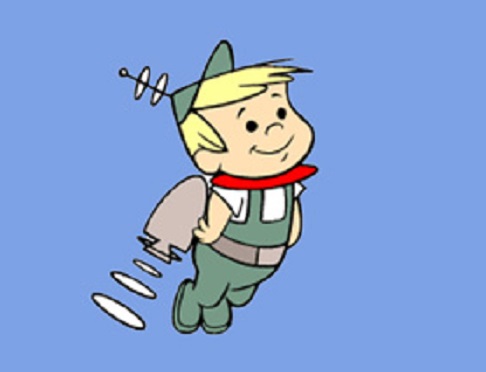
1960s animated series such as The Jetsons (1962-1963) and Johnny
Quest (1963-1964), rocket or jet packs were de rigueur.
In
the first, black-and-white season of Irwin Allen’s Lost in Space
(1965-1968), for example, John Robinson (Guy Williams) would often strap on a
backpack to search the barren planet where the Jupiter 2 had crashed. He flew for purposes of reconnaissance, but
also sometimes rescue. In some notable
occasions, he flew with passengers, like Penny (Angela Cartwright) in tow.
Filmation’s
post-apocalyptic, live-action, Saturday morning series Ark II (1976) was set in
the “Dark Ages” of the 25th century, as a giant roaming vehicle
searched for human life in the wastelands. The series’ central protagonist, Captain
Jonah (Terry Lester) would often take airborne journeys with his jet pack, also
known as the jet jumper.
In
Space:
1999 (1975-1977), the Alphans sometimes perform EVAs beyond their Eagle
transporters using rocket thruster back-packs (see: “The Exiles.”)
Another
Filmation series, this one animated, also featured a jet pack. Flash Gordon (1979-1981) introduced
a jetpack in its second season, and Flash and Dale, in particular, were often
depicted jetting about.
The
whole concept of jet-packs was satirized on Buffy the Vampire Slayer
(1997-2003), when the Nerds of Dooms’ leader, Warren had one at his disposal in
the sixth season tale “Seeing Red.”
Labels:
Cult-TV Theme Watch
The Cult-TV Faces of: Jet Packs
![]() |
| Identified by Hugh: Jonny Quest. |
![]() |
| Identified by Hugh: Lost in Space. |
![]() |
| Identified by Hugh: The Jetsons. |
![]() |
| Identified by Hugh: Ark II |
![]() |
| Identified by Pierre Fontaine: Space:1999 |
![]() |
| Identified by Hugh: Flash Gordon |
![]() |
| Identified by Hugh: Buffy the Vampire Slayer |
![]() |
| 8 |
![]() |
| Identified by Pierre Fontaine: Star Wars: The Clone Wars. |
![]() |
| Identified by Hugh: The Simpsons |
Labels:
the Cult-TV Faces of
Subscribe to:
Posts (Atom)
-
It is an indisputable fact that fan service and good drama don’t always go hand-in-hand in the cinema. In fact, sometimes these factors div...
-
It is quite difficult to believe, but in 2024, Ridley Scott’s Alien (1979) turns 45 years old. Perhaps the most amazing thing about Alie...