Monday, August 01, 2016

Man from Atlantis III: Killer Spores (May 17, 1977)


The U.S. Space Agency dispatches the Cetacean to recover a space probe that has landed in the ocean. 

Mark Harris (Patrick Duffy) brings the device back from the bottom of the sea, but mysteriously hears it “scream” upon doing so.

Once inside the ship, Mark, Elizabeth (Belinda J. Montgomery) and Simon (Kenneth Tigar) learn that the probe’s skin is infected with strange alien cells or spores.  These spores hail from space and were ripped from their home in the void.

The spores are visible only in darkness, except to Mark, who can see them at all times. The spores infect Mark, and Elizabeth likens the experience to demonic possession, since Mark is “forced to do things against his nature, against his will.

The spores grow angry after leaving Mark’s body, and begin to possess humans across California. 

The government wants to destroy them, but Mark communicates with the spores and they demand he send them home, at once.

Mark has just three hours to get them aboard a rocket bound for space…


Killer Spores is the story, in some ways that The Deadly Scouts should have been. It’s another story of aliens in human bodies, and Mark’s interface with them. But here, there is no sappy love story tacked on, and the aliens are not ‘evil’ beings, merely ones who wish to return home.

If one looks at the science fiction TV of the 1960s (represented, for example, by Star Trek [1966-1969]) and compares it with the science fiction TV of the 1970s (Space: 1999 or Man from Atlantis), one can see that they have a different starting point.  

Star Trek begins from the assumption that communication between different worlds, different beings is possible; nay inevitable. 

Space: 1999 and Man from Atlantis are not quite as optimistic. They proceed from the (perhaps realist... assumption that communication will fail; that differences will be too difficult to navigate at man’s current stage of development.

Killer Spores demonstrate this style of thinking in spades. The aliens have no use for humanity and believe that mankind will destroy Earth. Their interest is not conquest, trade, or partnership. Their mission is merely to escape (as quickly as possible) what they see as a doomed planet.  They seek no further knowledge of us. Unlike Mark, they are neither intrigued, curious, nor impressed by mankind’s nature.

They just want to leave.


There’s some nice symmetry or book-end imagery in this installment too, but again, it follows up on the paradigm I outline above.  

When the probe lands at the start of the story, Mark detects the spores screaming.  


When they leave, oppositely, he hears them laughing. 

This is the laughter of relief, he specifies, the laughter associated with a return to safe place.  In other words, these aliens shriek in terror upon being present on our Earth.  They are joyous and safe upon their return to space.  

To them, Earth is hell. 

Mark notes this, in the coda, in his typically non-emotional way but there is a note of social commentary here for certain.  Communication between people of different natures and ideologies may simply be impossible. 

Mark Harris may be the exception not the rule.

That’s a nice heady philosophy for Killer Scouts, and it makes for an intriguing segment.

There’s also one other scene with mentioning here.  

At one point, Mark nearly dies in the desert (possessed by the spores). He needs water to survive.  

Elizabeth runs through the desert carrying a cooler, and just a few meters shy of Mark's position, trips and accidentally dumps all the water in the cooler into the sand.  She cries, realizing her clumsiness may have killed Harris.


This is a very, very human moment, and one of Elizabeth’s best as a franchise character.  She cares deeply for Mark, and she is brilliant.  But sometimes, something awful and unexpected happens to humans -- like losing one’s footing -- and disaster could result.  The sight of Elizabeth laying in the desert, weeping at her own mistake, is quite powerful.  It reminds us, as Mark Harris might conclude, how fragile human beings really are.

There’s still a bit of filler in this Man from Atlantis telefilm. There are too many (silly) scenes of possessed humans going crazy and wreaking havoc in different settings. My favorite is the zombie traffic cop.  


But we get too many moments involving these zombies, even if the concept behind those moments (alien possession = demonic possession) is quite good.


Next up, the last of the telefilms: The Disappearances.

Man from Atlantis II: "The Death Scouts" (May 7, 1977)


In “The Death Scouts,” a pair of vacationing scuba divers (Tiffany Bolling, Burr de Benning) are pulled down into the water by mysterious assailants.  When they re-appear on dry land, they are no longer human, but alien scouts with frightening physical powers.

Working at the Foundation for Oceanic Research, Mark Harris (Patrick Duffy) teams with Dr. Elizabeth Merrill (Belinda J. Montgomery) and Dr. Simon (Kenneth Tigar) to investigate the duo.  Mark finds a spaceship at the bottom of the sea, and finds aboard it a symbol like the one on his swim-suit, suggesting that the aliens may be of his species.

Similarly, the alien scouts have webbed-fingers, which makes Mark curious about them, even as the Federal Government wants to eliminate the threat to earth and mankind that the duo could pose.


The second TV movie in the Man from Atlantis is already a bit of a step-down from the excellent original telefilm. There’s not a whole lot of plot or character development considering the episode’s length (90 minutes), and very little about Mark Harris or his history is actually learned in the story.  

On the other hand, at least there are breadcrumbs to follow.


“The Death Scouts” (written by Robert Lewin and directed by Marc Daniels) involves Mark’s discovery of a “spaceship from a water planet” and his interactions with two alien sentinels who possess many physical similarities to him.  However, they are -- at least initially -- hostile.


The story takes a (bad) turn when a hokey romantic attraction is suggested between Tiffany Bolling’s scout and Mark Harris. We move into hoary territory as she asks Mark if he understands the word “kiss.”  This is an attempt to tell a tragic story about Mark’s first encounter with love but it doesn’t entirely fit, perhaps coming too soon in his learning curve.  
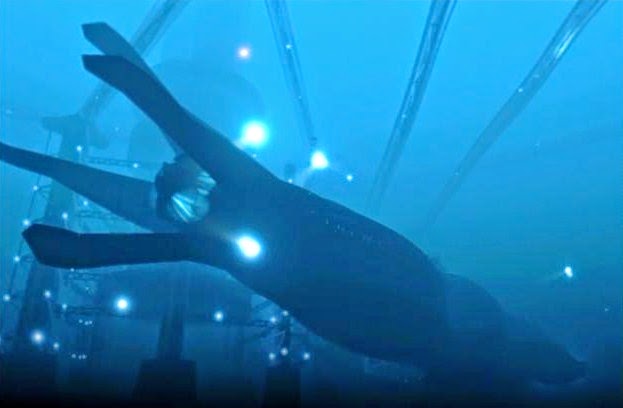
Intriguingly the last episode of the regular series, “Deadly Carnival,” retells (without apparent memory of “The Death Scouts”) Mark’s first romantic attraction…there with a carnival owner played by Sharon Farrell.

Of more genuine interest is Mark’s steadfast defense of the scouts, whom he believes hold the secret to his origins.  He has discovered the same symbol that is on his trademark yellow swimsuit in the alien control room.  

This means, of course, that the aliens have had contact with the people of Atlantis. Mark keeps defending the aliens, and he makes assumptions that aren’t true.  “They are my people. They have come for me.

Elizabeth, rightly, puts on the brakes. She helps him to understand that his “eagerness to know the truth” about himself has led him to accept lies, or assumptions.  Her point of view is ultimately vindicated, and Mark learns a lesson about trust, emotions and even prejudice.

Elements of “The Death Scouts” work very well. 


The relationship between Elizabeth and Mark is sweet, and one of mentor and student, with a hint of romance.  

I also admired the creepiness of the early scenes where something "alien" rises from the water, and pulls the scuba divers from their boat.  There's a creepy shot of a gray, indistinct hand and arm yanking one diver down.


The finale in the alien spaceship control room, with Mark deploying flares against the enemy scout while a self-destruct sequence activates, is filmed effectively and memorable.


I also like the '70s future-look of the ship. The interior would have been right at home on Space:1999.


My favorite moment, however in “The Death Scouts” is a small, but beautiful one. Mark leaves the airlock of a submarine after a long time on land, and he rolls and spins in the sea, perfectly expressing the joy of being back home.  

That’s the kind of visual unspoken character touch that keeps one watching Man from Atlantis.


Next: “Killer Spores.”

Man from Atlantis (March 4, 1977)


One night, a lone stranger washes up, unconscious, on the shore in California, and is rushed to a hospital. 

However, all conventional treatments fail to save this green-eyed young man with webbed fingers. 

Scientist and oceanographer Dr. Elizabeth Merrill (Belinda J. Montgomery) realizes that his lungs are “desiccated” and that he is a water breather by nature, one only “marginally equipped” for life on land.

The young man, soon named Mark Harris (Patrick Duffy) is taken into custody at the Naval Undersea Center and studied there by Merrill. She learns he is “perfectly adapted to aquatic life” and that though his skin appears human, it actually possesses “dolphin” qualities.

Mark, who can survive water pressure at 30,000 feet can outrace swimming dolphin and jump 20 feet into the air as well. Psychologically, he is “cool and calm.” If he possesses emotions at all, he seems to “conceal them.”

Soon Mark begins to resent his captivity, but Admiral Pierce explains to him the concept of defense of country. Still, Mark, who is an amnesiac, is not at certain he wants anything to do with the surface world.  

Meanwhile, Elizabeth learns, from a Navy computer, that Mark may be “the last citizen of Atlantis,” the mythical undersea kingdom believed sunken.

When three American submarines disappear in a “dangerous part of the world,” Mark -- a self-described “citizen of the ocean” -- goes to investigate.  To everyone’s surprise, he discovers some 36,000 feet down a “sea mountain habitat.”

There, a man named Mr. Schubert (Victor Buono), formerly a sea-going junkman, is planning to start World War III, and working to develop a homo aquatic…a being truly at peace with the sea.  

He realizes Mark holds the key to making that dream a reality…


The Man from Atlantis (1977-1978) starts right here, with this TV movie from the spring of 1977.  Man from Atlantis was written and created by playwright Mayo Simon, and produced by Herb Solow, who -- while he was at Desilu in the 1960s -- also worked on Mission: Impossible (1966-1973) and Star Trek (1966-1969).

The first TV movie is directed by Lee H. Katzin (1935-2002), who directed not only episodes of Mission: Impossible, but who launched Space: 1999 (1975-1977) as well with his work on “Breakaway” and “Black Sun.”

The quality that makes Man from Atlantis so compelling, even nearly 40 years later, is mystery. The premise is practically irresistible.

A man with no memory -- not to mention a series of strange biological aberrations -- washes up on the beach after a terrible storm.  From this point forward, the story involves Mark Harris’s efforts to “discover” himself. It’s a journey that the audience enthusiastically pursues with him, and with smart, sympathetic scientist, Dr. Elizabeth Merrill.

Mark Harris is part of a particular “school” of sci-fi and horror characters. He is physically superior to all those around him, and yet, by the same token, is an individual marked as different, or as an outsider.  He is alone in a very real sense, since his emotional states are different than ours, and he is marked -- with piercing green eyes and webbed fingers -- as not quite human.


The genre returns to this brand of character again and again, in decade after decade, because he or she tends to be very appealing as social gadfly.  Mr. Spock (Leonard Nimoy) on Star Trek in the late sixties is one example of a physically superior outsider who, because of his status, can comment effectively on the human world.  

Barnabas Collins (Jonathan Frid) in Dark Shadows (1966-1971) is another example, though one geared more to the “dark side” of the equation.

An extremely fit (and young) Patrick Duffy essays the role of Mark Harris here, and throughout the franchise, to remarkable effect.

Mark Harris's innocence and naïve nature never feel forced and artificial, and yet (unlike Spock), he doesn’t look down his nose at humans.  It is clear that Mar is both fascinated and confused by the human race. At the TV-movie’s end, he notes that he will remain in the human world (although he has been a captive of the Navy, essentially…) because he still has more to learn, both about himself and the people who inhabit dry land.  “I have not learned enough,” he declares.

And yet while he wants to learn more, Mark is admittedly baffled. “Explain feelings,” he demands at one point.  “I don’t know if I can,” replies Elizabeth.  Mark is thus a cold fish, but a cold fish whose interest in humanity has been piqued.


Much of the humor in Man from Atlantis arises from the (literal…) fish out of water premise. Mark doesn’t understand human emotions, behavior, or even language. He questions everything, including humanity’s sense of morality. He is therefore a perfect character to reflect on mankind, and the species’ treatment of the environment (particularly the oceans), and those who are different.

The production values are sterling in this original telefilm. Schubert’s underwater base and submarine (which is later re-purposed as the Cetacean...) are beautiful miniatures (created by Glen Warren Productions) and the sets for the interior of the same base are downright Bond-ian in size and spectacle.  The production also had the assistance and participation of the U.S. Navy, and there are scenes set here on the decks of real ships, which lends verisimilitude to the proceedings.


Thematically, the story succeeds because of the profound philosophical differences represented by the hero and the villain.  Mark is a person who wants to “learn” more about the world, and understand.  

Schubert, by contrast, wants to burn it all down, seeing the status quo as hopeless. “We’re going to shake our planet back to its roots,” he says.  Schubert also insists that there’s no “hope left but to start all over again.”  

Sadly, this "burn it down" approach has a corollary in real life politics.  There are those who espouse anger and destruction, rather than building on the basis of our successes.

This plot is very similar to that of The Spy Who Loved Me (1977), which premiered the same year as Man from Atlantis, and featured a villain with webbed fingers, Stromberg, and his desire to destroy the world and start fresh under the sea. 

In this case however, we do get that significant yin/yang, which makes all the difference; that opposition of innocence (Mark Harris) and cynicism (Schubert).  That symmetry lends artistic depth and interest to Man from Atlantis.

There are some strange 1970s moments in Man from Atlantis, like the Navy computer’s omniscient declarative statement that Mark must be the last citizen of Atlantis. 


And certainly, one can look at the series as an attempt to mimic the then-popular Six Million Dollar Man (1973-1978) or The Bionic Woman (1976-1978). Like those series, Man from Atlantis is about a person of unique abilities and senses working in tandem with the United States Government to stamp out national and international threats.    In the pilot for The Six Million Dollar Man and in this first TV-movie of Man from Atlantis, there are training scenes, for instance, which diagram the breadth of the special individual's abilities.  Mark races a dolphin, for instance.

Yet at its best, Man from Atlantis, by highlighting Mark’s outsider status, proves a solid vehicle for social commentary; for exploring man’s relationship with man, and with his planet. 

The series that followed this superbly-crafted television movie did not always live up to that task, however.


Next up: “The Death Scouts.”

Cult-TV Theme Watch: The Sea


The sea is an expanse of salt water, which covers the earth’s surface, or some other planetary surface, theoretically.

The sea has been the primary setting of several cult-tv series over the decades.


Consider Irwin Allen’s Voyage to the Bottom of the Sea (1964-1968), a series about a high-tech submarine, The Seaview, which explores the Earth’s oceans. Although many episodes deal with Cold 

War scenarios and espionage, many episodes also contend with the Seaview’s encounters with giant monsters, and underwater civilizations.


Steven Spielberg’s SeaQuest DSV (1993-1996) is a veritable remake of Voyage to the Bottom of the Sea, one featuring another high-tech submarine and its underwater missions. 

In the future world of SeaQuest, the UEO (United Earth Oceans) patrols the ocean, brings supplies to undersea colonies, and excavates buried treasures like the Library of Alexandria. In the second season, following the pattern of Allen’s sixties series, more fanciful menaces are featured, including a giant crocodile, angry Greek Gods, and so forth.


In a Star Trek: The Animated Series (1973-1974) episode, The U.S.S. Enterprise visits an ocean world, in the episode “The Ambergris Element,” and Kirk (William Shatner) and Spock (Leonard Nimoy) are transformed into water-breathers.


And in Star Trek: Voyager (1995-2001), a water planet or water world is encountered in the episode called “Thirty Days.” 


In Lost in Space (1965-1968), an early episode finds the Robinsons traversing an alien ocean in the chariot, in “The Hungry Sea.”

More terrestrial ocean-bound stories are featured on series such as Sea Hunt, starring Lloyd Bridge.  The series Lost (2004-2011) is set on an island in the middle of a sea or ocean.  Episodes such as “Adrift” involve (futile) attempts to escape the island by water route, using a raft.


Gerry Anderson’s UFO (1970) features a submarine/plane combo that launches from the sea, called “Skydiver,” and one episode – “Reflections in the Water” – features an alien base at the bottom of the ocean.  Another story, “Sub Smash” sees Skydiver plummet to the ocean floor, and Commander Straker (Ed Bishop) battle his claustrophobia.

The Cult-TV Faces of: The Sea

Identified by SGB: Voyage to the Bottom of the Sea.

Identified by SGB: Lost in Space: "The Hungry Sea."

Identified by SGB: Stingray.
Identified by SGB: UFO.
Identified by SGB: The Fantastic Journey

Identified by SGB: Cosmos

Not Identified: Land of the Lost (1990s)

Identified by SGB: SeaQuest DSV

9

Identified by SGB: The X-Files: "Biogenesis."
Identified by SGB: Star Trek: Voyager.

Identified by Terri Wilson: Lost.

13.

14

60 Years Ago: Batman:"Hot off the Griddle/The Cat and the Fiddle"

The second season two-part  Batman  story "Hot off the Griddle"/"The Cat and the Fiddle" -- which aired in September of ...