Tuesday, December 09, 2014

From the Archive: Outland (1981)


One of the best and perhaps most unsung science fiction films of the early 1980s is Peter Hyams’ Outland (1981), a movie which boasts the unforgettable tag-line: “Even in space, the ultimate enemy is man.” 

A 1980s re-imagination of High Noon (1952), Outland -- much like its Fred Zinneman directed predecessor -- thrives as both an action film and as a social critique of a particular span of the Cold War Era.

While High Noon allegorically concerned the McCarthy Hearings and Hollywood Blacklist, Outland concerns itself with out-of-control, unregulated business interests, and their deleterious impact on the average joe: the worker.  In both cases, a man alone faces a dangerous, corrupt establishment, and even though his cause is just, can't get his fellow-man to join him in the fight.

In terms of visualizations, Outland’s production design and special effects make the drama’s central location -- a mining town on Jupiter’s moon, Io -- feel abundantly like a real place.  The industrial, cramped, tactile sets generate a sense not only of verisimilitude, but of rampant claustrophobia.  One stunning, sprawling chase sequence in the film's second act makes outstanding use of the de-humanizing sets and the feelings they generate.  In some sense, the movie also plays like the space age equivalent of the gritty The French Connection (1971).

Finally, Sean Connery delivers an appealing lead performance as Marshal O’Niel in Outland, playing an older law enforcement official who realizes that he is part of a system that he despises, and attempts to change that fact.


“There's a whole machine that works because everybody does what they are supposed to. And I found out... I was supposed to be something I didn't like.”

Marshal O'Niel (Connery) has just been assigned to the Con-Am 27 installation on Io, the third moon of Jupiter. Seventy hours from the nearest space station, this mine boasts a population of 2,144 workers, and a supply shuttle visits once a week.

While O'Niel deals with his wife's (Kika Markham's) decision to take their son and leave the grim installation, there's also a rash of worker suicides to contend with. One miner rips open his atmosphere suit while on the surface, convinced that he is being attacked by spiders. Another worker walks into the airlock and mining elevator with no suit whatsoever...and leaves behind a boiling, bloody mess.

O'Niel is suspicious about these deaths, and learns from the post's dissolute doctor, named Lazarus (an outstanding Frances Sternhagen...) that there have been twenty-four such "suicides" in the past six months. O'Niel doesn't buy that explanation and learns that the station's administrator, Sheppard (Peter Boyle) is running an illegal drug operation.

Sheppard is using two workers -- Spota and Yario -- to pass the drugs to the population. The synthetic narcotic, an amphetamine, makes workers do their jobs much more quickly: 14 hours of work in 6 hours. Of course, this means a higher quota; which means the business is more profitable for Sheppard and his bosses.

But there's a down side, the drug also "fries the brain" and turns normal men psychotic.

O'Niel interferes with the drug-running operation, but learns he was given the assignment as Federal District Marshal on Io because it was expected he wouldn't rock the boat. He doesn't like that arrangement, and so confronts Sheppard. Sheppard responds by sending professional assassins to kill the meddling O'Niel.

Unfortunately, this frontier world is a place where nobody wants to stick their neck out, and O'Niel must face the killers alone...and the next shuttle is arriving soon.


I run a franchise. The company hired me to dig as much ore out of this hellhole as possible…The workers are happy. When the workers are happy, they dig more ore. They get paid more bonus money. When they dig more ore, the company's happy. When the company's happy, I'm happy.”

In High Noon, a retired law-man, Will Kane (Gary Cooper), learns that a train carrying a criminal he once put away, Frank Miller (Ian MacDonald) is coming to town.  Miller seeks vengeance, and has three gang-members to help him achieve that goal.  Realizing he can’t succeed alone, Kane asks for help from the local towns-people in Hadleyville, but they rebuff his entreaties for help. 

High Noon thus views civilization as oppressive and corrupt, and critic Pauline Kael famously termed the movie “a microcosm of the evils of capitalist society.” (Kiss Kiss, Bang Bang, Bantam Books, 1969, page 345.) 

High Noon's mythic, archetypal approach to storytelling -- which pits one man against a corrupt system -- likely explains why the western is widely beloved by people on all sides of the political spectrum, including Ronald Reagan and Bill Clinton. It is a film about individual morality, and that morality balanced against the presiding morality of a society at large.

Specifically, the townspeople's refusal to assist a good man facing a death sentence in High Noon was mirrored in the 1950s by the idea of artists going before McCarthy’s committee, and being forced to name names without anyone taking their side, or defending their rights, either.  The Encyclopedia of Politics, Media, and Popular Culture refers to the “allegorical sell-out of the townspeople" (page 9) in High Noon, in particular.  

It’s easier to do nothing and let evil win, than step-up and become a target one’s self, the movie suggests.

Outland is very much a reiteration of High Noon’s stance, though updated to the milieu of the 1980s.  It’s a film about one man who finds himself in a corrupt system and determines that no matter the cost, he can’t simply be a cog in the wheel.  When he sees that the system -- run by a giant, inhuman corporation -- is not only corrupt but actually murderous, he endeavors to rally the citizens of Io to help him.  But once more, it is easier to accept corruption as the norm than stand-up to it and risk bodily harm for a just cause.

The first connection to consider between High Noon and Outland involves character.  Kane and O’Niel share the name William, and are both family men and law-enforcement officials.  

The second connection revolves around choice of location. High Noon and Outland are both set on the outer edge of the frontier, where established civilization is far distant indeed.  Perhaps it is more apt to say that in both locations there is a veneer of civilization, but it is possible to easily scrape that veneer away.


Outland's director, Peter Hyams references the earlier film in other ways as well.  In High Noon, a train was bound for town, carrying a murderer.  When the train arrived, a whistle blew, and the town came to a kind of dead standstill.  

In Outland, that approaching train has been replaced by a space shuttle preparing to dock.  When it landson the platform, an alarm klaxon sounds, and the whole mining facility, likewise comes to a stop.

Similarly, both Outland and High Noon are “ticking clock” movies.  Both productions frequently cut to compositions focusing on clocks so as to build suspense while the villain's conveyance (either train or space shuttle) nears.  The idea is plain: the clock in both cases is ticking down to a rendezvous with destiny, and possibly death.


As the space shuttle nears Jupiter’s moon, Outland again acknowledges its source of inspiration.  Here, O’Niele goes before a corporate board room and to a saloon to solicit help, or at least sympathy, and finds none.  In High Noon, Kane likewise asks help from churchgoers and drinkers at a saloon, and is similarly rebuffed.  

What’s most critical here, perhaps, is the idea that the “board room” has supplanted the “church” as a place of community authority and morality in Outland.  If anything, this substitution only enhances the idea of a corrupt system, and looking out for one’s self.


The substitution of the corporate board room for a town church, and the move to outer space (and to a grittier style of film-making), help Outland establish its own identity and view-point beyond the studied tribute to High Noon, In other words, Outland takes the ideas of High Noon a bit farther.  Here, the target is explicitly unregulated capitalism (whereas one could make the case that  High Noon concerns any corrupt establishment), and the inclusion of a board room (over a community church), points a finer point on the social critique.

Outside of homage and social commentary, one reason I appreciate Outland so much involves the visualization of difficult life on Io. Here, the movie makers take special pains to create a tangible sense of place, a futuristic frontier town that, according to Sheppard "is just like any other mining town."

Only here, the frontier is even more dangerous than one can imagine, and we see several gory de-pressurizations in the movie. There ain't nothing like that in High Noon, for certain.

But more importantly, the environs of this futuristic outpost on Io are completely and believably rendered in virtually aspect here.. Since space and atmosphere are both at a premium, miners sleep in tiny compartments stacked several levels high and several rows deep. These compartments are not much larger than a casket...and demonstrate visually why miners might lose their minds in this setting.

Likewise, every detail, down to the hookers in the Leisure Club and Sheppard's spacious office, reveal to the audience something important about this location, and how it affects the human psyche.


At about the fifty minute point of Outland, director Peter Hyams ramps up the pace and directs a sustained action sequence that sees O'Niel taking spirited pursuit of Spota. Lensed in long shot and with few cuts (at least at first), this chase is not only exhilarating, it lends an immeasurable sense of reality to the locale.

We see Connery chase his prey from locker room to sleeping quarters, to a cafeteria to a kitchen with precious few cuts and thus precious little fakery.  A sense of geography is preserved, and the result, again, is that we believe our eyes: this is all real.  In many ways, this chase/fight is the film's high point, a crazed, accelerated tour of a futuristic installation that is utilitarian, depressing, and completely believable as an extrapolation of future technology.

So many cinematic stories set on other worlds view humans as perfect (like Star Trek), focus on confrontations with monstrous extra-terrestrials (like Alien) or deal with colossal scope, like the events of a galactic war (Star Wars). All of those franchise films are great, and I absolutely love them all dearly, but I can also appreciate the uniqueness of Outland: that it concerns human characters in space, not phantasmagoria. The filmmakers didn't feel the need to include any other fantasy elements, and the film is all the stronger for its singularity of focus. It is what it is: a personal confrontation on the newest human frontier; a test of self when one’s established view of self has been shattered.

I always like to point one other fact regarding great science fiction or fantasy films of the past, and I’ll do so again here. 

Everything about Outland had to be created from scratch. 

Every set had to be built from the ground up. A believable world had to be imagined, and then erected with a fine eye towards detail.  There was no computer generated imagery to take the load off real world construction, miniature-building, and other tasks  The resulting film is immersive and tense and involving, and that means that the production designers and art directors did a magnificent job.

I'm old enough to remember how shabbily Outland was received upon release by critics both in and out of the genre. Today, most of their complaints don't really hold up.

For instance, I remember one prominent science fiction author of the day expressing disappointment that the film ends with O'Niel simply punching out his enemy, Sheppard. This critic complained that it was an anti-climax -- and sorely disappointing -- not to have Sheppard murdered by the hero.

Well, all I can say in response is that the review must not have paid close attention to the film. Because when Sheppard contacts his bosses to acquire assassins, they warn him in no uncertain terms that "the next guy coming for someone will be coming for you." 

In other words, by defeating Sheppard's assassins and exposing the drug ring, O'Niel has already beaten his enemy. Sheppard's own allies are going to kill him, so O'Niel doesn't need to commit murder.

I find this a rather elegant resolution, rather than simply having O'Niel blast Sheppard with a shotgun.

Why?

Well, O'Niel could have murdered Sheppard at any point in the story if he had wanted to. This isn't really a story about O'Niel committing murder to make his point; it's a story about O'Niel's redemption, and his individual method for beating "City Hall."  What would be the point of killing Sheppard and then going to jail? At least this way, O'Niel wins, and isn't permanently separated from his family.

It's much better, I believe, to leave Sheppard dangling on the hook, waiting to be offed by the very people he conspired with.  That's sweet justice, as opposed to blunt-faced murder.  Again, it's illuminating to remember that many people saw High Noon as a rejection of violence as a meaningful solution to problems.  Though there is violence aplenty in Outland, to be certain, one could make the same claim here.  The protagonist, O'Niel, doesn't engage in any violence that would land him on the wrong side of the law, and thus sacrifice his standing as a just man.

A long-time victim of misplaced criticism, Outland is a great film with one foot in the past, and one in the future.  With nods to cinematic history, and to the then-contemporary "space race" trend in the American cinema, the Peter Hyams film reminds audiences that even when man goes to the stars he will take all of his own strengths and weaknesses along for the ride.

Movie Trailer: Outland (1981)

Monday, December 08, 2014

Memory Bank: Leif Ericson Galactic Cruiser/Interplanetary UFO (AMT/Round Two)


"Somewhere in deep space, beyond the edge of the known galaxy, a mysterious craft materializes out of a boiling nebula..."


My second-favorite non-TV or movie spaceship model kit of all time (after Gerry Anderson’s Starcruiser One) is the AMT Leif Ericson Galactic Cruiser, which -- for a time -- joined the universe of Star Trek. It was known in that line as the Interplanetary UFO or “Mystery Ship.”

A full and meticulous history of this gorgeous space cruiser kit is available here.  


In brief, the ship was designed, apparently, by Matt Jefferies, sometime in the mid-to-late 1960s, and was released 1967-1968.  

The original intent had been to create a model kit line called “Strategic Space Command.”  The Leif Ericson was designated an Explorer Class Galactic Cruiser (with a crew of 85) in the year 2075 and it housed an exploratory scout ship.


The kit itself was molded in glow-in-the-dark plastic, to give it a kind of luminescent or eerie UFO quality. 


In the late 1970s or early 1980s, I found a mint Star Trek version of the Leif Ericson galactic cruiser at Englishtown Flea Market in New Jersey -- an amazing bazaar of memories and dreams, if you ask me -- and I promptly constructed the thing, renamed it Yorktown (I had leftover decals from the U.S.S. Enterprise NCC-1701 kit).

I then made the ship part of my make believe world. I liked the ship not only because of the swashbuckling design, because it was from no particular series or story, and I could thus imagine my own universe for it.

I still have that kit that I found in Englishtown, though it has been through several re-paintings, and Joel played with it when he was four for a little while. 

Thus, I was delighted last week when, for my birthday, Kathryn and Joel purchased for me the Round Two re-release of the Interplanetary UFO Mystery Ship.  It was the perfect gift.


The old Leif Ericson here is just as beautiful as I remember her, and I have no plans to take the kit out of the plastic.

Right now, I just like looking at the box art and remembering how much fun I had playing with this nifty space cruiser during my childhood.

Cult-TV Theme Watch: Sherlock Holmes


Sir Arthur Conan Doyle’s great detective, Sherlock Holmes first appeared in print in 1887’s A Study in Scarlet

Sometimes after that -- as TV rose as an art form  in the mid-20th century-- the character migrated to the air-waves. Since the mid-1960s, the great detective has appeared in a number of televised adventures, and has been portrayed by a number of actors.

In 1959, Alan Wheatley played Holmes in a BBC production.  

In 1954, an American production starred Ronald Howard.  

In the 1960s, Douglas Wilmer and Peter Cushing each played the role on a British TV series.  


And from 1984 – 1994, Jeremy Brett portrayed Holmes for Granada television and for many fans, defined the role.

In recent years, we have seen Holmes re-imagined as a 21st century detective, both as Benedict Cumberbatch on Stven Moffat's Sherlock (2009 - ), and by Jonny Lee Miller on Elementary (2012 - )


Uniquely, Sherlock Holmes has also intersected with science fiction television at other memorable junctures.  


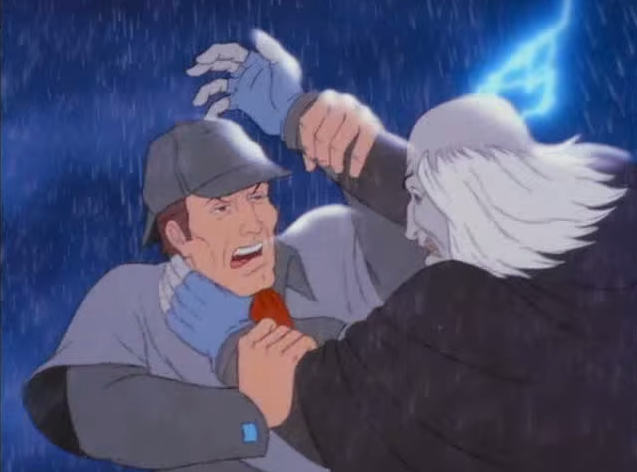
In 1987, an episode of Filmation’s cartoon series BraveStarr featured a two-part back-door pilot for a series called Sherlock Holmes in the 23rd Century. The series never arrived, but Jonathan Harris made for an interesting Professor Moriarity.


And on Star Trek: The Next Generation (1987 – 1994) it was established early in the first season that Data (Brent Spiner) had an obsession with the literary detective.  In “Lonely Among Us,” the sentient android used Holmes-esque deductive reasoning to solve a puzzle involving a body-jumping alien. 

By the second season, Data was embarking on full-blow Holmesian adventures in Victorian London in episodes such as “Elementary Dear Data.” There, he encountered the nefarious Professor Moriarty, a villain who recurred in the sixth season story “Ship in a Bottle.”

The Cult-TV Faces of: Sherlock Holmes

1

Identified by Hugh: Ronald Howard.

Identified by Brian: Douglas Wilmer.


Identified by Hugh: Peter Cushing

Identified by Hugh: Jeremy Brett

Identified by Pierre Fontaine: Sherlock Hound
Identified by Hugh: BraveStarr: "Sherlock Holmes in the 23rd Century."

Identified by Hugh: Star Trek: The Next Generation: "Elementary, Dear Data"

Identified by Hugh: Sherlock Holmes in the 22nd Century

Identified by Hugh: Benedict Cumberbatch

Identified by Hugh: Batman: The Brave and the Bold

Identified by Hugh: Jonny Lee Miller (Elementary)

Television and Cinema Verities: Frank Oz Edition


“The work was play. That's what we learned from Jim…He would make whatever work there was exciting and fun. He just would. So it wasn't leavened by fun, it was fun.

-Frank Oz discusses his time working with Jim Hensons and The Muppets. (From an IGN interview with Kenneth Plume).

Sunday, December 07, 2014

35 Years Ago Today: Star Trek: The Motion Picture (December 7, 1979)


"Why is any object we don't understand always called a thing?"

- Dr. McCoy (DeForest Kelley) in Star Trek: The Motion Picture.


The Star Trek franchise has re-invented itself on more than one occasion.  J.J. Abram's Star Trek (2009) wasn't the first instance of it.  Indeed, the expensive and highly-profitable film that first did so arrived in American movie theaters more than thirty years ago, on December 7, 1979, and was titled Star Trek: The Motion Picture.

Directed by Robert Wise (The Day The Earth Stood Still [1951]), Run Silent, Run Deep [1958], The Haunting [1963], Audrey Rose [1977]) and produced by TV series creator and "Great Bird of the Galaxy" Gene Roddenberry, this forty-five million dollar voyage of the starship Enterprise launched a film series that has endured a whopping three decades.


Despite proving a box-office bonanza and the father to ten cinematic successors of varying quality, Star Trek: The Motion Picture remains today one of the most polarizing of the film series entries.

The received wisdom on the Robert Wise film is that it is dull, over-long, and entirely lacking in the sparkling character relationships and dimensions that made the 1960s series such a beloved success with fans worldwide.


It is likely you've heard all the derogatory titles for the film too, from The Motionless Picture, to Spockalypse Now, to Where Nomad Has Gone Before (a reference to the episode "The Changeling.")

Conventional wisdom, however, isn't always right. Among its many fine and enduring qualities, Star Trek: The Motion Picture is undeniably the most cinematic of the Trek movie series in scope and visualization.

And, on closer examination, the films features two very important elements that many critics insist it lacks: a deliberate, symbolic character arc (particularly in the case of Mr. Spock) and a valuable commentary on the co-existence/symbiosis of man with his technology.

Star Trek: The Motion Picture also re-invents the visual texture of the franchise, fully and authoritatively, transforming what Roddenberry himself once derided as "the Des Moines Holiday Inn" look of the sixties TV series for a post-Space:1999, post-Star Wars world.

The central narrative of Star Trek: The Motion Picture is clever and fascinating (and, as some may rightly insist, highly reminiscent of various episodes of the TV series). Sometime in the 23rd century, a massive, mysterious space cloud passes through the boundaries of Klingon territory and destroys three battle-cruisers while assuming a direct heading to Earth.

The only starship within interception range is the U.S.S. Enterprise, a Constitution class starship just completing an eighteen month re-fit and re-design. Admiral James T. Kirk (William Shatner), Chief of Starfleet Operations, pulls strings and calls in favors to be re-assigned as captain of the Enterprise, arrogantly displacing the young, "untried" Captain, Will Decker (Stephen Collins).

After departure from dry dock, the Enterprise faces severe engine design difficulties of near-catastrophic proportion, but the timely arrival of the half-Vulcan/half-human science officer, Mr. Spock (Leonard Nimoy) resolves the problem. In the intervening years since the series, however, the inscrutable Spock has become even more stoic and unemotional, having attempted to purge all his remaining emotions in the Vulcan ritual called Kolinahr.

Upon intercepting the vast space cloud, known also as "the intruder," the Enterprise crew learns, following a series of clues, that the colossal space vessel sheathed within the cloud/power-field is actually an artificial intelligence, a living machine called V'ger. And at the "heart" of V'Ger is a NASA Voyager probe from the 20th century -- re-purposed by an advanced society of living machines on the other side of the galaxy -- sent back to Earth to find God, it's "Creator." In V'ger's quest to touch the Divine, Kirk, Spock and Decker each find personal enlightenment, resolving their personal dilemmas and also saving Earth from destruction.

All Our Scans Are Being Reflected Back...


The creative team of producer Gene Roddenberry (1921 - 1991) and director Robert Wise (1914 - 2005) consisted of two individuals who had very distinct philosophical views about technology, and the destination technology was driving mankind.

In Roddenberry's case, we must countenance his progressive concept of "Technology Unchained," the notion of technology becoming both beautiful (rather than clunky and mechanical...) and benign.

Man's machines, Roddenberry believed, would come to serve all the needs of the species, thus freeing humanity from the age-old dilemmas of poverty, dwindling resources, racial prejudice, hunger, territorial gain and war. This was an optimistic vision of man and machine in harmony, one given even fuller voice almost a decade later in Star Trek: The Next Generation (1987 - 1994).

By contrast, Robert Wise directed the technological thriller, The Andromeda Strain (1971), based on the best-selling Michael Crichton (1942-2008) novel about an alien organism (or germ...) threatening all human life on Earth. Wise once stated that The Andromeda Strain concerned "the first crisis of the space age," a descriptor which permits us to see Star Trek: The Motion Picture as a further meditation on a similar theme, only representing a (much) later planetary crisis, only in the 23rd century.

Wise also stated that technology, particularly that on hand in the subterranean Wildfire Laboratory, was the "star" of The Andromeda Strain.

In keeping with that motif, The Andromeda Strain's opening credits consisted of a space-age montage of technological symbols, from blueprints to graphs, to top secret communiques. Think of it as Dot Matrix as Jackson Pollock.

In the same vein, the characters in the film spoke in protean techno-babble on arcane subjects such as "Nutrient 24-5," "Red Kappa Phoenix Status," the "Odd Man Hypothesis," "Sterile Conveyor Systems" and the like. In all, Wise's 1970s sci-fi film represented a dedicated documentary-style approach, one that never easily accommodated a "lay" audience. Instead, you felt you were actually inside that underground complex alongside the Wildfire team.

Most uniquely, however, the The Andromeda Strain's climax concerned the pitfalls of technology: a teletype/printer experienced an unnoticed paper jam at a very inopportune moment. Some critics and film scholars have interpreted this malfunction as Wise's explicit warning about relying too heavily on technology, but the opposite was true. Had the printer worked as planned, one of the scientists would have transmitted orders for a nuclear bomb detonation at an infected site, a course of action that would have catalyzed and spread the Andromeda germ.

The machine's paper jam gave the flawed human being time to learn more, and re-consider the course of action. Given this analysis, one can detect that Wise was, perhaps, agnostic on the subject of man and technology, seeing both how it could prove a great tool, but also a great danger.

Star Trek: The Motion Picture serves, in several ways, as an unofficial "sequel" or heir to Wise's Andromeda Strain in terms of both approach and philosophy. Of all the Star Trek films, The Motion Picture is the only series installment to feature so many lingering insert shots of technological read-outs and schematics. For example we see a medical visualization of the Ilia Probe's physiology, a representation of "a simple binary code" (radio waves), "photic-sonar readings"(!) and several tacticals revealing Enterprise's approach and entrance into the cloud.

These multitudinous close-ups of computer graphics and read-outs not only enhance the notion of Enterprise as working starship -- with several interfaces directly at our disposal (fostering the documentary feel), -- but go a long way towards establishing the vital link between technology and crew, a symbiosis, if you will.


A great deal of time is spent in the Motion Picture on views of the crew gazing through the Enterprise's "technological" eye or window on the universe, the view screen. In a film about the combining of man and machine into a "new life-form," these moments carry resonance and significance: they reveal man already traveling down that road to symbiosis, relying on technology as his eyes, ears and (in the case of the ship's computer...) key interpreter of data or external stimuli.

In Star Trek, the TV series, Spock often gazed into a hooded library computer and we were denied access to what data he saw recorded inside (save for the reflected blue illumination on his face). In later Treks, stellar cartography played a role, but the high-tech, colorful displays it produced for crew members were not filmed as inserts. In other words, we saw Picard and Data interpreting the data, and the data itself. It's important, I believe, in Star Trek: The Motion Picture, that the data read-outs and view screen images are primarily brought directly to our eyes without dramatis personae coming between projector and percipient. For one thing, we feel as though we're actually aboard a ship in space. For another, we're taking part in that symbiosis of man and machine, we're interpreting the runes ourselves.

The underlying philosophy in Star Trek: The Motion Picture seems to consist of an admonition that man and machine work best together integrated, not when separated. V'Ger is a living machine who has "amassed" all the knowledge of the universe, but is without the human capacity of "faith," to "leap beyond logic," The machine (without human input or touch...) is cold, and barren, and incapable of believing in other realities (like the after-life) or other dimensions. Thus it is incomplete. Only by joining with a human (Commander Decker), does V'Ger find a sense of wholeness, of completion.


Kirk's journey is not entirely different. He views the Enterprise -- a machine itself -- as almost a physical lover in this film. When Scotty takes Admiral Kirk via a shuttle pod to inspect the Enterprise's re-designed exterior, Kirk has the unmistakable look of a man sizing up a sexual conquest, not a starship captain merely reporting to his new assignment. He avariciously sizes up the "woman" in his life (and ships are always "she" aren't they?). Like V'Ger after the union with Decker, Kirk ultimately finds a sense of completion once he has "joined" with the starship Enterprise, both metaphorically and literally. Once he is her captain again, Kirk is complete.

Consider for a moment just how many times Star Trek: The Motion Picture lingers upon the important act of a man entering -- or connecting to -- a machine. We watch Kirk's shuttle pod "dock" with Enterprise after a long, lingering examination of the ship. We see Spock, in a thruster suit, "penetrate" -- in his words, "the orifice" leading to the next interior "chamber" of V'Ger. This terminology sounds very biological, doesn't it? Consider that Spock next mentally-joins with V'Ger, utilizing a Vulcan mind-meld, yet another form of symbiosis.

And finally, we see Decker and Ilia physically join with the V'ger Entity during the film's climax. And make no mistake, that final act is equated with physical reproduction explicitly in the film's text. "Well, it's been a long time since I delivered a baby," McCoy notes happily in the film's epilogue, and Kirk remarks on "the birth" of a new life-form. They're talking about sex, about the union of two-life forms creating a third, unique life form.

Similarly, the journey of the Enterprise inside the giant V'Ger cloud replicates the details of the human reproductive process, with the final result proving identical: the birth of new life. In Star Trek: The Motion Picture, man and machine mate. They join in symbiosis to create something new, perhaps even as Spock notes, "the next step in our own evolution."

While Star Trek films have traded explicitly in both allegory (particularly The Undiscovered Country and the Cold War "bringing down the Berlin Wall in Space" idea) and social commentary (consider the environmental message of The Voyage Home), Star Trek: The Motion Picture is decidedly symbolic. That's an important distinction.

The central images in the film all symbolize the reproductive, joining process. Spock penetrates the V'Ger "orifice," to mentally join with a living machine. Decker and Ilia (V'ger's surrogate) are mated in a light show that some Paramount studio executives allegedly termed a "40 million dollar fuck." And even the journey of the Enterprise (essentially the male "sperm") through the fallopian tube-type interior of V'Ger -- carrying its creative material (the human spirit in this case) to the V'ger complex (ovum) -- reflects the overriding theme of mating/joining/symbiosis.


So is technology a help or a hindrance? For the Klingons, destroyed in the film's first act, technology doesn't seem to help much. All their elaborate technical read-outs and tracking sensors (again, shown in dramatic insert shots) only permit them to watch the progress of their annihilation down to the last detail; down to the last second.

On the Enterprise, technological attempts to understand V'ger are constantly stymied by the living machine. "All scans are being reflected back," Uhura notes in the film on more than one occasion, meaning that V'Ger is re-directing the Enterprise's investigative entreaties back at itself. This is a subtle indicator that the answers Kirk and the others seek are held within themselves; in the gifts, contradictions and essential nature of "carbon based life forms." They begin to key in on this fact when Kirk and Spock assign Decker to awaken the human (er, Deltan...) memory patterns of the Ilia Probe (a mechanism). The answer, they come to understand, rests in the human equation, not in a technological assessment of V'ger.

It's interesting to tally the scoreboard here. V'Ger (a machine) finds "God" and evolves with the help of a human (Decker). Kirk finds his peace with a machine (The Enterprise). Spock finds his answer from a machine, and that answer is an acceptance of humanity. Even Decker finds his "peace" with a machine that replicates (down to the last detail) the memory patterns of his lost beloved. Each of these main characters (Kirk, Spock, V'Ger and Decker) are intricately involved with the story's main conceit: the mating of man and machine; of "cold" knowledge and "warm" human emotions.


Our Own Human Weaknesses...and the Drive That Compels Us to Overcome Them...


Despite protestations to the contrary, Star Trek: The Motion Picture is a movie intrinsically,  organically, about character, and character development. In simple terms, the film's main characters (Kirk, Spock and Decker) serve as the deliverer of human ideals to the cold, empty V'Ger child so that it may "evolve." But in doing so, they also bring along a lot of "foolish human emotions," as Dr. McCoy asserts at the film's conclusion.

Captain Kirk begins the film, for instance, as a ruthless, single-minded "my way or the highway" obsessive. We see his determination to reclaim the "center seat" when he tells Commander Sonak at a space port that he intends to be aboard the Enterprise following a meeting with Admiral Nogura, Starfleet's top brass. We see it again when he rationalizes displacing Decker, off-handedly noting that his "experience...five years out there, facing unknowns like this one," make him the superior commanding officer. The contradiction in that argument should be obvious. Are different "unknowns" actually capable of being categorized? How does Kirk know that Decker's history and experience won't prove superior in dealing with this threat, the alien cloud? He doesn't: he just wants what he wants.

And to some extent, the Enterprise (Kirk's other half, or perhaps a representation of his id...) rebels against this egomaniac version of Kirk. Consider how much goes wrong on Enterprise when Kirk is acting in this selfish mode. The transporters break down, killing two new crewmembers. Kirk gets lost on his own ship and is discovered (in an embarrassing moment) by Decker, the very man he replaced. Kirk "pushes" his people too hard, forcing the Enterprise into warp speed before it is ready, and in the process nearly destroys the ship in a wormhole. He does so over the objections of Mr. Scott, Captain Decker and even Dr. McCoy. This Kirk is all ego and selfishness, until he remembers the key to commanding the Enterprise: listening to all viewpoints and making informed decisions. This also happens to be the key in any male/female relationship. Just treat her like a lady, Jim, and she'll always bring you home. This first Kirk is too hungry, too grasping, too desperate to "re-connect" with the Enterprise in anything but a physical way. Bones puts Kirk in his place, but all the malfunctions of the Enterprise subtly (and symbolically) perform the same function.


About half-way through the film, Kirk is still learning this lesson in humility, as Decker notes that as the vessel's executive officer, it's his responsibility to "provide alternative" view points. Kirk accepts that argument, but hasn't internalized it. By the end of the film, he is actively listening to others again, heeding Decker's request to join a landing party, and allowing Spock to proceed when the curious half-Vulcan overrides his orders and steals a thruster suit.

The familiar Kirk of Star Trek lore, the one who develops a strategy based on hearing all viewpoints, slowly re-asserts itself over the selfish one who wanted command and conquest of the Enterprise, and nothing else. A journey that began in selfishness, ends in his "unity" with the crew and ship, his acceptance and sense of joining with those around him, a reflection of V'Ger's joining with the human race. Kirk has, as he states, overcome human weakness.


Although Spock is half-human, he undertakes much the same journey as Kirk in the film. He returns to Starfleet because he has failed to purge himself of human emotion and believes that an understanding of V'Ger will lead him to that destination. McCoy fears that Spock -- like Kirk -- will put his own personal interests ahead of the ship's. What Spock ultimately learns from his encounter (mind-meld) with V'Ger is life changing for him. He discovers that V'Ger has achieved what he seeks, "total logic." But damningly, "total logic" doesn't make V'Ger happy. Thought patterns of "exactingly perfect order" don't leave room for belief (in the afterlife...), for the "simple feeling" of friendship Spock feels towards Kirk, or much else.

For all V'Ger's knowledge, Spock realizes that the alien is "barren" and "empty." Were Spock to pursue Kolinahr, he would end up the same way. Spock's "human flaw," if we can call it that, is also one of ego, his obsession with becoming the "perfect" Vulcan. In embracing friendship with Kirk, in feeling his emotions (and even weeping, in the film's extended version), Spock begins to embrace the emotions he has long denied...and provides Kirk with the key to understanding V'Ger's psychology. He would never have come to this epiphany had Spock not "joined" with V'Ger in a mind-meld. And that puts us right back at the theme of symbiosis.

Decker (Stephen Collins) undergoes an interesting character arc too. He is a young man who fears commitment and the responsibilities it brings. He left Delta IV, Ilia's home wold without even saying goodbye to the woman he loved, which is a pretty sleazy and avoidant thing to do. It might even be termed "cowardice." In the end, Decker overcomes this "human weakness" and joins with Ilia and V'Ger, saving the Earth, repairing his relationship with Ilia, and adding the human component to V'Ger that the machine life-form requires to "evolve."

When Kirk, Spock and McCoy return to the Enterprise, Kirk explicitly asks if they have just witnessed the "birth of a new life form." As I noted bove, Spock's answer is that perhaps they have seen "the next step" in their "own evolution." This is a statement that is linked to the characters themselves. Though Decker has physically evolved to another (higher...) dimension or plane of existence, Kirk and Spock have evolved too. Kirk is suddenly gracious and comfortable in his skin again instead of imperious and dictatorial. And Spock, for the first time in his life, understands that that his human emotions carry value, and augment his "whole" personhood.

To claim that there is little or no character development in Star Trek: the Motion Picture is wrong-headed in the extreme. In some fashion, this is surely the most important story of Mr. Spock's "life," his final recognition of his "human" half and the gifts it offers. When we cavalierly write off Star Trek: The Motion Picture, we are also writing off Spock's new enlightenment.


This is An Almost Totally New Enterprise...


Star Trek II: The Wrath of Khan is often termed the film that saved Star Trek, and there may indeed be truth to that argument. Certainly, I love and admire that Nicholas Meyer film. However, consider just how much material present in later Star Trek originates directly from the re-invention of the franchise in Star Trek: The Motion Picture.

Most notably, the Enterprise re-design and update -- featured in the first six feature films -- is introduced in this Robert Wise film (exteriors and interiors). This was also the first Star Trek production to feature a "warp" distortion effect around the ship when it went beyond light speed.

Also, the modern iteration of Klingons -- so beloved by Trek fans today -- is introduced here, in The Motion Picture. Before the Wise film, Klingons were swarthy guys with beards who talked about Klingonese (in "The Trouble with Tribbles") but didn't actually speak it. After Star Trek: The Motion Picture, the Klingons were menacing aliens with ridges on their foreheads (and boy would Next Gen go to town with THAT idea...), wearing convincing armor and speaking their own language.

We can't forget, either that Star Trek: The Next Generation's very theme song, as well as the Klingon theme featured in First Contact and elsewhere -- were re-purposed from Jerry Goldsmith's brilliant soundtrack for
Star Trek: The Motion Picture.

There seems to be this weird belief among many fans that Star Trek: The Motion Picture doesn't represent the best of Star Trek. While it is easy to see that the film doesn't accent the humorous side of the Star Trek equation, The Wise film does get so many things right. Most importantly, it captures the Kirk/Spock friendship in simple, poignant terms (in a scene set in sickbay). Imagine how easy it would have been for Gene Roddenberry -- just two years after Star Wars -- to cowtow to public opinion and make a huge, empty action film with laser blasts and spaceships performing barrel rolls. No one would have blamed him. I'll bet you a lot of fans would have liked that story better.

Instead, Roddenberry took a much more difficult route. He maintained the integrity of Star Trek and dramatized a story about mankind's future, and the direction we could be heading (with man and machine joined together, balancing weaknesses and sharing strengths). Some might declare that the film actually attempts and fails to reach the profound quality of Kubrick's 2001: A Space Odyssey. Certainly, I would agree The Motion Picture is not an equal to that film. However, here's another point of view: in Roddenberry's vision of man's evolution, it isn't some mysterious, unknown alien who transforms us for the better. No, in the universe of Star Trek, it's mankind playing a critical part in his own evolution, taking the reigns of his own destiny himself. We aren't victims of an alien agenda unknown to us. We're standing tall, ready to face what the universe throws at us. Somehow, this is more...noble.

In considering (or perhaps, re-considering....) Star Trek: The Motion Picture, our mission ought to be the same as the Enterprise's: to "intercept" and "investigate" this fascinating movie and judge for ourselves if it is just the cosmic bore critics complained of, or perhaps something a bit deeper. Of all the Star Trek movies, this is the one that shows us the most of the universe at large (Klingon territory, Federation spaceships, Vulcan, Earth...), most closely follows the creed of "discovering new life forms" from the series, and most makes us feel like we're actually passengers aboard the Enterprise. Perhaps we wouldn't want Star Trek to exist on this elevated, cerebral plateau for long, since humor and action are indeed shorted. Yet there's something intensely admirable about the fact that this careful, somber, thematically-consistent, intelligent effort was Star Trek's opening salvo in the blockbuster sweepstakes of the post-Star Wars age. While others sought to imitate, Star Trek chose its own path.

And that's how a movie franchise was born.

Advert Artwork: Buck Rogers in the 25th Century Edition


From the Archive: The Greatest American Hero (1981 - 1983)


ABC-TV unveiled The Greatest American Hero's two-hour pilot the night of March 18, 1981. The inaugural episode and ensuing series focused on a special education teacher at Whitney High School-turned-superhero, Ralph Hinkley (William Katt), and his attempts to become an effective...superhero.

A divorced father of a little boy, Ralph  -- or "Mr. H." as his students called him -- was experiencing difficulties on the job with his unruly new class (which was populated by such future star performers as Michael Pare, and Faye Grant as "Love Me Rhonda..."). 


Ralph was essentially a bleeding-heart liberal and do-gooder at heart, and he felt that he "ought to be able to do some good" with his class full of behavioral problems. Attempting to bond with them, he decided to take his class on an impromptu "geological trip" to the desert.

On the way to the desert, however, one of the rougher students, Tony (Pare) found himself in a confrontation with a by-the-book patriot and FBI agent Bill Maxwell (Robert Culp). Bill was there investigating a case with his ill-fated partner, John, that involved -- at least tangentially -- the weak, wimpy Vice President (Richard Herd) of the United States and a dangerous white-supremacist cult.

After the school bus breaks down in the desert, Ralph meets up with Bill again by nightfall, when the agent's car goes out of control. In a unique variation of the opening episode of The Invaders ("Beachhead"), the two men are then approached by a colossal UFO.


Only here, the flying saucer doesn't house invading aliens with jutting pinkies, but rather concerned humanitarians, like Klaatu from The Day The Earth Stood Still. 

Utilizing Bill's dead partner as their vessel, the aliens inform Bill and Ralph that the two men must work together to save the troubled planet from annihilation. To aid the men in this worthwhile endeavor, the aliens provide a special suit (and instruction manual...) that will grant Ralph "unearthly powers."

"You can change things," the men are told. "You can save this planet from destruction..."

And so an uneasy alliance is forged between Ralph and Bill. It's the beginning of a beautiful friendship, actually, but the two men don't realize it yet. 

Of course, there are bumps in the road along the way. In the pilot, for instance, Ralph manages to lose the suit's instruction manual in the desert, meaning that he must literally "wing it" when it comes to flying and other superhero skills. On his first test flight, he crashes into a wall head first. And this is after getting take-off advice from a young Superman fan...


As we soon learn, Bill and Ralph have very different ideas about how, exactly, the world should be saved. Bill envisions Ralph as a kind of Cold War avenger flying to Eastern Europe and smashing Russian strongholds. Ralph is more a world peace kind of guy.

Almost immediately, the "suit" also causes Ralph strife in his home life. He misses an important custody hearing for his son (because he gets locked up in an asylum...), and the suit causes constant stress in his romantic relationship with lovely but acerbic Pam Davidson (Connie Sellecca), his girlfriend and attorney.

For three winning seasons on ABC, the Ralph-Bill-Pam triumvirate of The Greatest American Hero battled terrorists, saboteurs, Russian spies, mobsters and an alien or two with an abundance of heart, and more importantly, perfect comedic timing.

The actors on the program shared a terrific chemistry, a welcome facet that rendered the not-always-stellar storylines of secondary importance. The audience (this author included) enjoyed watching the characters interact and grow each week. Even watching the episodes today, you can detect a jaunty, joie-de-vivre among the performers and their characters. The Greatest American Hero was never campy, as some may be wont to write, but rather delightful and witty.


The original Greatest American Hero pilot makes use of its beloved, Generation-X-touchstone theme song in a clever way too. Although it is heard in instrumental format over the opening credits (a helicopter flyby over L.A.), the vocals are not sung until the valedictory moment of the episode, after the denouement in which Ralph, Bill and Pam have been successful in saving the President of the United States from the bad guys and the power-hungry Vice President. 

We see Ralph cruising over the city (by night...) rightly proud of his accomplishment, and the song (with vocals) kicks in. It's a little bit like reserving the famous James Bond theme until the coda of Casino Royale (2006): a moment of maximum thematic impact that renders the song touching and inspiring at the same time.

Over the course of forty episodes and three seasons, Ralph Hinkley became more adept at marshaling his super powers, despite owning no instruction manual. 

In "Here's Looking At You Kid," he learned how to become invisible.  in "Now You See It," he learned that the suit granted him precognitive abilities, and so forth. As important as the super power development, however was the character development across the various installments. The characters quickly developed fun catchphrases (Bill's use of the word "scenario," for instance, or the phrase "this is the one the suit was meant for,")


Episodes also delved into personal matters. In "My Heroes Have Always Been Cowboys," Ralph was able to see himself and his new role as superhero champion in context with his own boyhood hero, the Lone Ranger. Bill suffered a mid-life crisis ("The Best Desk Scenario") too, and Pam and Ralph even got married by series end ("The Newlywed Game."

Another admirable aspect of The Greatest American Hero is the self-reflexive, post-modern tone. This is a series that concerns a legitimate every-man coping with the fantastic. Humor arise from the fact that Ralph, Pam and Bill are highly aware -- not oblivious -- to the ridiculous nature of the situations they often found themselves in. This was an approach later adopted by series such as Lois and Clark: The New Adventures of Superman in the 1990s, but The Greatest American Hero was a TV pioneer on this front. Ralph's original reaction to the suit (basically red long underwear...) is an example a realistic "oh, please...would you look at this thing?" 

And the Superman jokes are numerous and amusing, particularly Ralph's admonition to Pam that she is already "one step ahead of Lois Lane, since she never found out Clark Kent is Superman."DC Comics, however, wasn't amused by virtually any aspect of The Greatest American Hero. The company sued the makers of the series for copyright infringement and sought to kill the program in the crib. DC's beef was that it felt Ralph Hinkley was "patterned" after Superman. DC imperiously requested "all infringing negatives, tapes, photographs and advertisements" related to the ABC program "be delivered to DC Comics for destruction."

A U.S. District Court Judge thankfully ruled against DC, noting that there were "numerous differences" in the productions. That, for instance, in The Greatest American Hero, the lead character was "an ordinary person who reluctantly takes on abnormal abilities and is comically inept," whereas Superman boasted super powers "with grace and confidence."

The lawsuit wasn't The Greatest American Hero's only concern, either. A mere twelve days (on March 30, 1981) after the series premiered, a man named John Hinckley Jr. (a friend, incidentally of the Bush family) severely wounded President Ronald Reagan in an assassination attempt. Again, the hero's name on The Greatest American Hero was Ralph Hinkley, and ABC feared a public backlash. Accordingly, Ralph's last name was mysteriously changed to "Hanley" for a time, until the incident blew over.

In many ways, The Greatest American Hero represents the missing link of superhero TV programs. It is not hopelessly campy like some sixties superheroes (Batman, Captain Nice, Mr. Terrific). Nor does it blissfully ignore "the reality" (and occasional absurdity) of superheroes dwelling in "normal life" (like, to some extent, The Six Million Dollar Man or Wonder Woman).

And unlike many of today's unnecessarily dark, endlessly-angsty, violence-prone superheroes, The Greatest American Hero also boasts a great sense of fun about itself. Indeed, this series possesses the increasingly rare quality known as charm

50 Years Ago: Land of the Lost: "Survival Kit" (September 18, 1976)

It’s very rare to come across an episode of  Land of the Lost  -- in any season -- that I vehemently dislike and judge almost entirely worth...