Sunday, December 07, 2014

Outré Intro: The Greatest American Hero (1981 - 1983)


The Greatest American Hero (1981 - 1983) features one of the best, catchiest, and most memorable theme songs in all of TV history. 

"Believe it or Not" was composed by Mike Post and Stephen Geyer, and sung by Joey Scarbury.  The song was a pop culture phenomenon and reached #2 on the Billboard charts in August of 1981.

The song has also had a remarkable second life, "guest-starring" in everything from Michael Moore's Fahrenheit 9/11 (2004) and Mystery Science Theater 3000 ("The Pumaman") to The Following (2013).

Here, "Believe it or Not" adds significantly to the series introductory montage, capturing perfectly the mood of the images, and also of the series as a whole.

The Greatest American Hero concerns a gentle, put-upon single father and high-school teacher, Ralph Hinckley (William Katt) who is gifted with a superhero suit by benevolent aliens. 

But Ralph almost instantly loses the instruction manual to the suit, and this fact results in a lot of trial and error as his life is turned upside down by his new-found abilities and the pressure to use them responsibly (and correctly).

The introductory montage recounts Ralph's origin story (bracketed in book-end images of the alien spaceship), but also captures the humorous aspects of the tale.

We start with images of an approaching alien ship. It is night time, and the well-lit ship approaches the parked car of Bill Maxwell (Robert Culp), who is seated inside with Ralph.  

The alien ship sends down a beam of light...and presents a gift to all mankind, but for Ralph in particular.


Next we see the brightly-colored super suit, in the alien container or box, and experience Ralph's confusion/wonder/curiosity as he regards it.  This suit, quite clearly, is going to change everything.  

The freeze frame (title) image captures his mood, as he holds the alien-made suit.


After the image of the grand sounding title, which marks Ralph as the best of all protagonists (and a patriotic one to boot), we get a funny juxtaposition: his gag reel, essentially, as he learns to fly.  

We see a close-up of his face as he expresses terror in mid-air.

In sequence, we then see Ralph fly into a wall, land in the dirt, celebrate (mockingly) his new identity as a super hero, and ham-handedly attempt a covert operation in a trench coat.  

The Greatest American Hero?  More like a fumbling one...


Next, a shaky take-off and and another rocky flight.

 But then the images change to reveal how the suit has also altered Ralph's professional life.  

Faced with unruly students, he uses his mighty strength to slam a chair to the floor, grabbing their attention, and putting the pause button on their frissons.  

For all his failures as "the greatest American hero," the suit grants Ralph additional confidence in his comfort zone: the classroom. 

The final shot of this sequence reveals Ralph's satisfaction at having found a way, at last, to get the attention of his students.


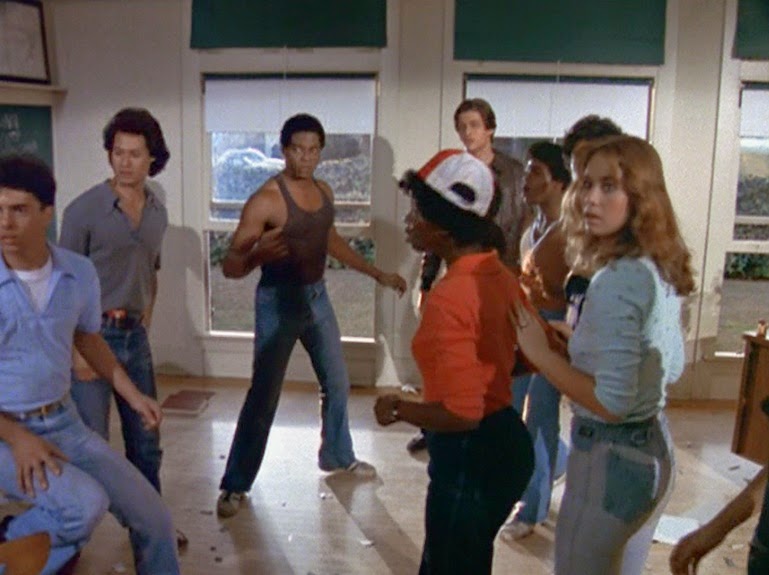
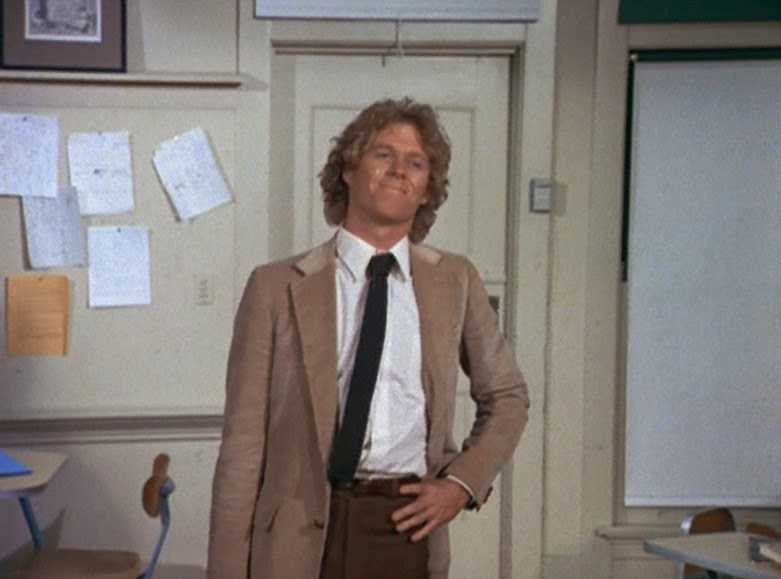


The images below qualify as both literal and metaphorical. Ralph crashes into a wall and smashes his head. 

Being a superhero is, literally, a head-ache, according to these images.  It certainly is for Ralph, who wishes to have some semblance of a normal life.

As Ralph hits the ground and massages his head, we meet our star: William Katt.


Next we are introduced to Ralph's professional back-up, and a great TV character: Robert Culp's Bill Maxwell, cranky FBI agent.  

The images showcasing the introduction of the character and the actor focus on action and adventure. He drives a car quickly, fires his gun at a bad guy, flashes a trademark grin and expresses a bit of frustration (probably at Ralph, his recalcitrant trainee...).


Last but not at all least, we meet the third point in our heroic triangle, Connie Sellecca's Pam.  

She is an attorney and Ralph's girlfriend.  Like Bill, she has an attitudinal side, but her heart (and her acerbic wit) is in the right place.  The series would not be complete without the skills and knowledge she brings to the table.


The remainder of the montage features images of Ralph using his powers. We see him startling Pam, materializing in a car (using invisibility) next to Bill, surprising even himself.  We also see him in action, arguing with Bill, and undertaking action with him.


Finally, our book-end imagery: The alien ship, and Ralph's sense of wonder at seeing it.  This is the moment that changed his life.  And if you were watching ABC the night The Greatest American Hero first aired (March 18, 1981) your life might have changed too!

To me, The Greatest American Hero is all about leaving (or being forced out of...) your comfort zone, and teaching yourself to do something you don't think you are capable of.  It's important that Ralph is a teacher in the series, since he has dedicated his life to helping others learn this lesson.  He is thrown a curve-ball, however, when he must learn the same lesson in his own life.


Below, the opening montage in action.


Saturday, December 06, 2014

Saturday Morning Cult-TV Blogging: Korg 70,000 BC: "Magic Claws"


In “Magic Claws,” Korg (Jim Malinda), Bok (Bill Ewing) and Tane (Christopher Mane), hunt a bear, but only succeed in wounding it. Bok is afraid.

Bok, the great hunter, feels humiliated by his fear. “The bear has made me nothing,” he says, and falls into a deep depression.

With Bok in a funk, Korg experiences a vision one night from the “Great Unseen Spirit.”  The spirit tells him that Bok must carry the claws of the Great Bear with him on his person, and if he does so, his great hunting abilities will return.

Bok believes the vision, and the family resumes the hunt for the bear…


In the final moments of “Magic Claws,” Mara (Naomi Pollack) questions Korg directly. Did he really have a vision from the Great Spirit? Or did he just fake the vision so that Bok would return to his normal self? 

Korg’s answer is a deflection.  “Does it matter?” He asks, rhetorically. “Bok has found his courage…”

So here we have another Korg episode (like “The Exile”) that looks very closely at religion and human nature.  In “Magic Claws,” Korg falsely conjures a vision of a God so as to engineer a social good for his brother. He lies, in other words, and claims to speak for God. 

Korg’s actions are fascinating here, and suggest an uncomfortable truth about species: that man has manipulated the religious belief of his own kind since before he could write, for the purposes of social-engineering.

The dictates of the Great Spirit in “Magic Claws,” indeed, foster order and routine in a world where such things are of great importance. Korg’s family cannot survive without Bok acting as hunter, so Korg does what he must to keep Bok in that role. He lies, and claims that an outside force wants Bok to be the hunter.


In this way, religion is important, we can see. It sets down unquestionable laws in a world where lawlessness could de-stabilize everything, but as Korg suggests, it is not what it claims to be: the word of some supernatural being.

Korg behaves as he does here to protect his family, and in a pro-social way. But what happens when the word of God is invoked in an anti-social way by a trusted leader? To launch a war? Or to accuse people of witchcraft or other crimes?  History is dominated by such examples.

How would Korg like it, for example, if Tor invoked a vision of the Unseen Spirit to suggest he can no longer collect fire wood, or fetch water?  

Agree or disagree with the episode’s point of view, it’s rather amazing that Korg 70,000 BC -- a series that aired forty years ago on network television, in a slot for children -- challenged the concept of religion.

Today, we are much more conservative as a nation in terms of our entertainment, and I wager this episode wouldn’t even get on the air without a rewrite that excluded the idea that Korg “lied” and pretended speak for God.

Saturday Morning Cult-TV Blogging: BraveStarr: "The Vigilantes"


In “The Vigilantes,” BraveStarr and Thirty-Thirty make return trip to Fort Kerium only to come upon a dangerous ambush on the way.  Dingo Men have captured a vigilante who is bound and determined to kill Tex Hex.

The vigilante wants BraveStarr to look the other way, but BraveStarr warns him to break no laws.

Then the vigilante becomes a “rabble rouser” in Kerium and starts “stirring things up,” so that a mob will go after Tex Hex.  Again, BraveStarr must intervene because as much as he hates Tex Hex “it is wrong for one person to be judge, jury and executioner.”


If you ask me, one of the worst things to happen in our modern popular culture is that many audiences have accepted vigilante justice as a noble or worthwhile thing.  Laws are for wusses, right?

“Revenge” has become an acceptable (and common) motive for so-called heroes and superheroes, and I find that fact highly disturbing. A reader said it here on the blog not long ago in regards to The Lone Ranger: heroes are supposed to follow the rules. 

That’s what makes their task or challenge so difficult. The bad guys break rules every way possible, but heroes must remain true to their values even in the face of such “cheating.” They have to succeed in a way that ennobles them not that drags them down into the sewer with the antagonist.

Or they’re not heroes.


“The Vigilantes,” an episode of the late 1980s Filmation-produced animated series BraveStarr gets to this point quite ably. A man in Fort Kerium wants to get rid of Tex Hex, but comes to loggerheads with the good town marshal because even though their agendas match their methods do not. 

As BraveStarr asserts “the law is what lots of people decided on.”

Unless and until the law is changed, that means no one has the right to break it, even if -- as the vigilante states -- “your puny laws do not work on crooks like Tex Hex.”

Bravestarr as a series, then, doesn’t elevate vengeance as a noble purpose or, even, as a valid choice. I would certainly like to see big budget films (especially in the superhero genre) take this stance, but I’m not holding my breath.  As BraveStarr says, “Do right…and others will follow.”

I also appreciate the episode’s stance that “Shooting hardly ever solves a problem. Usually, it makes it worse.”  I also feel that this is a lesson our pop culture must re-learn.  Guns are legal, cheap, and fully protected by law in America, but carrying a firearm comes with a great moral responsibility, and in my youth, heroes like Marshal BraveStarr took that responsibility quite seriously.

Filmation always featured message-heavy stories, and sometimes the moralizing gets a little old, a little preachy, a little thick. But on some topics, episodes such as “The Vigilantes” also provide a nice gut check about paths that need not be taken.

Friday, December 05, 2014

Movie Trailer: The Taking of Deborah Logan (2014)

Thursday, December 04, 2014

Terminator Genisys Trailer Lands

At Flashbak: The Five Best Starlog Covers (And the Three Worst)


My new list at Flashbak considers the five best Starlog covers, and the three worst ones.

Here's a snippet and the link (http://flashbak.com/the-5-best-starlog-magazine-covers-and-the-3-worst-26845/ ):


"Before the Internet Age, sci-fi geeks had to get their information about upcoming genre entertainment the old fashioned way: from print magazines, sold at the local newsstand, or delivered to your mail-box via monthly subscription.

From 1976 to 2009, Starlog Magazine – more than three decades -- reported extensively on the world of science fiction television, movies, and literature. The mag featured columns by “The Trouble with Tribbles” author David Gerrold (first “State of the Art,” then “Rumblings,” and then “Soaring.”)  Starlog also featured David Hirsch’s detailed and informative updates about the world of Gerry Anderson (“Space Report,”) in particular, behind-the-scenes information on Space: 1999 (1975 – 1977). 

The magazine featured great retrospectives from the likes of great writers such as Lee Goldberg and Jean-Marc Lofficier, and interviews from the meticulous film scholar, Tom Weaver. 

Starlog also grew up at the same time I did, and at exactly the right time, covering the release of Star Wars, and the post-Star Wars boom that brought us Alien (1979), The Black Hole (1979), Meteor (1979), Moonraker (1979), and Star Trek: The Motion Picture.

As a kid who grew up in the seventies and eighties, I remember the rush of discovering a new issue of Starlog, whether at a vendor location (mine was at the Englishtown Flea Market in N.J.), or in the mail.  It was always a thrill to see the cover of the magazine, and find out -- at a glance – what magical entertainments were impending.

With that thought in mind, here are five of my selections for the best Starlog Magazine covers from the span 1976 – 2009, as well as those for the three worst."

Wednesday, December 03, 2014

Buck Rogers in the 25th Century: "Unchained Woman" (November 1, 1979)


The early first season episode of Buck Rogers in the 25th Century (1979 – 1981) titled “Unchained Woman” finds Buck (Gil Gerard) undertaking the futuristic equivalent of an impossible mission. 

The man out of time is tasked with breaking a prisoner -- Jen Burton (Jamie Lee Curtis) -- out of an inescapable, subterranean prison on the moon Zeta 3 so she can testify against her boyfriend, Mal Pantera (Michael Delano), who has been ambushing Directorate shipping lanes.

Complicating the mission, Buck must also contend with a relentless and invincible android prison guard whom he has nicknamed Hugo (Walter Hunt). 

After escaping from the prison with Jen, Buck has to not only escape Hugo’s pursuit (and deal with hungry sand squids...) and meet Wilma (Erin Gray) at a rendezvous point. He must also deal with an unseen menace: Earth ambassador Warwick (Robert Cornthwaite), who is secretly allied with Pantera.


Watching "Unchained Woman" today, it is clear that the android Hugo is a sort of science fiction missing link between Yul Brynner’s Gunslinger in Westworld (1973) and Arnie’s cyborg from the future in The Terminator (1984). This relentless, incredibly strong individual drives much of the episode’s action and even provides “Unchained Woman” its sting-in-the-tail/tale conclusion. 

Although the mission ends successfully, Buck’s android nemesis is still “alive,” still hunting his escaped wards.  He is never going to give up. Ever. And in fact, the machine is referenced in a later episode ("A Blast for Buck.")


This is a funny happenstance, in terms of the pop culture, because guest star Jamie Lee Curtis is famous, of course, for being pursued by an unstoppable villain of another stripe, Halloween’s (1978) Michael Myers.  

Here, Jen believes she is finally free, but the episode cuts back to Hugo on Zeta's surface, his hand twitching, thus signifying the fact that the nightmare continues.


What remains so intriguing about “Unchained Woman” (and much of Buck Rogers’ first season, as well) is that it focuses on a crime or “caper” story.  The prison break-out story, for example, is a genre trope, seen on such programs as The A-Team and the tongue-in-cheek The Lone Gunmen (2000). The story itself is familiar, even old, but the writers for Buck Rogers cleverly adapt all the 20th century clichĂ©s to the 25th century setting thus making them memorable, and in some sense even fresh.  

Here, we get an underground prison on Zeta 3 (two-hundred feet beneath the surface and carved “out of bedrock”), an explosive medallion, android prison guards, a decontamination chamber, and prison identification bracelets. These trappings are inventive enough to make the story feel fresh. The episode's director, Dick Lowry, creates a lot of tension from the fact that the prison is inescapable, and Buck's only method of getting out, the aforementioned medallion, is torn from his neck and thrown in a garbage bin.


When you couple these futuristic trappings with Buck’s sense of humor and quips, “Unchained Woman” emerges as quite the entertaining romp. For example, here he notes, with apparent appreciation, that prisons have gone “co-ed” since his era.  At another juncture, he considers an android’s law-and-order “motto” (“On Zeta, they do things right…”) and suggests it would make a good bumper sticker. Gil Gerard makes such a good series lead because he can alternate readily between sincerity and humor without either emotion seeming forced. "Unchained Woman" puts those talents to good use.

Every sci-fi TV series possesses its own unique alchemy. Buck’s is ably represented by this episode: crime-related “caper” tales in which Buck goes undercover, helps someone, and  cracks wise along the way, all while contending with the technological "miracles" of a de-humanized future age. 

The nice thing about this formula is that it can be varied to be more serious (like the brilliant “Plot to Kill a City,”) more horrific (“Space Vampire”) or even a bit more on the comedic side (“Cosmic Whiz Kid.”) 

I still remember watching “Unchained Woman” for the first time, and worrying about how Buck was going to stop an unstoppable android. The episode’s cleverness comes from the fact that --in the final analysis -- he doesn't accomplish the impossible. The androids still functions, and is still out there, in search of his prey.


“Unchained Woman” is a fun episode of the series, bolstered by some nice location shooting in the desert, and some good special effects, such as the matte painting of the outpost called Station Post 7.  

Several Battlestar Galactica (1978 – 1979) costumes get recycled there, but it hardly matters. And one final bonus of Bill Taylor's teleplay is a rare subplot involving Dr. Huer's back-story and friendship with Warwick. Huer (Tim O'Connor) is a truly interesting character, a principled leader who grew up in a time of famine and ascetisim, while Earth was climbing back on its feet.  Buck Rogers rarely took the time to focus on the character, but "Unchained Woman" reveals his true humanity, and his sense of decency, and loyalty.

Buck Rogers GAF Viewmaster


Buck Rogers Halloween Costume (Ben Cooper)


Action Figures of the Week: Buck Rogers in the 25th Century (Mego)


Mego acquired the merchandise license for the 1979 revival of Buck Rogers and used the feature film (originally a TV-pilot) as the basis for its many toy designs, including Buck’s Starfighter Command Center and Buck’s Laserscope Fighter.

Today, I want to remember the action figures from the series themselves. 

Nine were released all together, including Buck, Twiki, Wilma Deering, Killer Kane, Ardella, Dr. Huer, Tiger man, Draconian Guard and Draco. 

If you watched Buck Rogers in the 25th Century on television with any regularity, you’ll immediately pick up on some of the discontinuities between the program and the toys.  Specifically, Pamela Hensley’s character was named Ardala, not Ardella.  And Kane -- a character played by both Henry Silva and Michael Ansara – was never referred to by the nickname Killer Kane. 

Finally of course, King Draco appeared in the pilot/movie for about twenty seconds and was never seen again on the series.  Not even once.

Despite such problems, I always enjoyed these three-and-three-quarter inch action figures.  They could fit easily inside the Land Rover, the Draconian Marauder and the Starfighter, and in general looked a great lot like their video counterparts.  The figures’ drawbacks included the fact that they came with no accessories, not even laser guns or helmets. 


And additionally, like The Black Hole action figures from Mego of the same vintage, these Buck Rogers figures could break very easily because all their joints were held together by silver pins.  Those pins  had an annoying habit of loosening up or even falling out.

I still remember seeing Buck Rogers in the 25th Century in theaters.  Afterwards, my parents took me to a Toys R Us store to buy me two action figures.  I was able to find Buck and Twiki and was pretty happy about it.  Our next stop was a carpet store and while my parents shopped, I flew Buck and Twiki around the huge store filled with rolled-up rugs. 

In short order, however, Buck’s interior elastic snapped, and the hero came apart into many pieces.  The very first night I had him!  Buck’s “accident” left me only with Twiki…which was a big disappointment.  

The astronaut had survived five hundred years as a popsicle only to spontaneously combust in a carpet store.

When we arrived home, my Dad glued Buck Rogers back together, but the poor guy was never quite the same, being now unable to move his hips. 

How could he teach my Princess Ardala figure how to boogie?

Buck Rogers Whitman Frame-Tray Puzzle


50 Years Ago: Land of the Lost: "Survival Kit" (September 18, 1976)

It’s very rare to come across an episode of  Land of the Lost  -- in any season -- that I vehemently dislike and judge almost entirely worth...