Creator of the award-winning web series, Abnormal Fixation. One of the horror genre's "most widely read critics" (Rue Morgue # 68), "an accomplished film journalist" (Comic Buyer's Guide #1535), and the award-winning author of Horror Films of the 1980s (2007) and Horror Films of the 1970s (2002), John Kenneth Muir, presents his blog on film, television and nostalgia, named one of the Top 100 Film Studies Blog on the Net.
Monday, May 06, 2013
Television and Cinema Verities #69
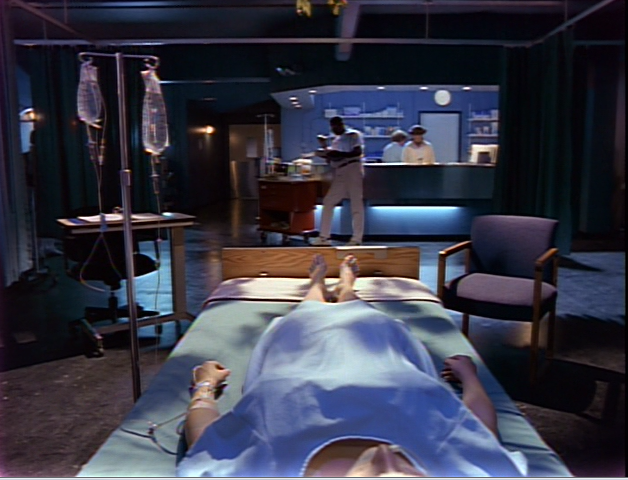
"On the episode I did, there were a lot of second-unit shots of the train going around the corners and things like that. One pretty long scene that I had was in a swimming pool. It's pretty weird to have a swimming pool on a train -- you'd think the water would splash everywhere."
Actress Rebecca Balding describers her memories of the short-lived cult series Supertrain (1979), in an interview I conducted with the actress in 2006.
Labels:
1970s,
Supertrain,
Verities
Sunday, May 05, 2013
Monument(al) Destruction #14: Beneath the Planet of the Apes (1970)
Star Blazers Episode #9
The
ninth episode of the 1970s animated series Star Blazers (1979) does a strong
job of showcasing imaginative visuals, and for that reason, this installment is
considerably more interesting than some of the earlier episodes.
In
this Star
Blazers episode, a damaged and “very
vulnerable” Argo suffers damage during an attack by the Gamilon fleet and subsequently
seeks shelter inside an asteroid belt.
These asteroids are the remnants of the destroyed tenth planet in our
solar system, Minerva. Realizing that
the ship is “not fit to go into battle
now,” Captain Avatar approves a risky defense strategy by Engineer
Sandor.
Specifically,
he activates an experimental “polarity
reactor” which magnetizes the ship’s hull, and pulls nearby asteroids onto
the ship…essentially burying the ship inside rock on all sides. This new “asteroid
camouflage” prevents the Gamilons from easily locating the Argo, at least
for a time.
This
episode features many dynamic visuals, which makes it a more interesting and
lively segment than some so far. For
instance, we see Argo’s engineers working on the damaged hull of the ship in a
thoroughly impressive sequence. This EVA
reveals scope well, with a team of personnel set against the backdrop of the
detailed ship, and again, this is precisely the kind of composition that
live-action programs of the day like Buck Rogers and Battlestar Galactica
would have been hard-pressed to emulate.
Here, the audience gets a sense of the massive scale of the repair
efforts.
The
visuals of Argo encased in asteroid rock, and then surrounded by a rotating
weapon called an “asteroid ring” (to
deflect Gamilon fire) are also incredibly impressive and inventive. It’s been a few weeks since the show has
revealed such flights of imagination.
If
this episode boasts any weakness at all, it is in the characterization of the villains,
the Gamilons. These aliens sweat,
grovel, whimper, gasp and are forced to speak dreadful dialogue such as “Boy that Star Force is really clever!” In toto, one wonders how the Gamilons ever
defeated the planet Earth, and brought it so low. In virtually every episode thus far they are
depicted as ineffective, even incompetent bunglers. Lacking courage, loyalty and equanimity, one
wonders how the Gamilon race has endured…
After
the serious action featured this week, there are only 338 days left for Argo to
complete its mission to Iscandar. And
the bloody ship still hasn’t left the solar system yet…
Labels:
1970s,
anime,
Star Blazers
Saturday, May 04, 2013
Monument(al) Destruction #13: Defiance (2013)
Labels:
Defiance,
Monument(al) Destruction
Saturday Morning Cult-TV Blogging: Shazam: "The Boy Who Said 'No.'" (October 24, 1974)
“The
Boy Who Said No” might be the weirdest and wildest episode yet of Filmation’s
live-action 1970s series, Shazam (1974
– 1977). It begins as another “moral of
the week” story about a kid making good choices, but ends with a crazy double
chase sequence.
In
“The Boy Who Said No,” Mentor (Les Tremayne) and Billy Batson (Michael Gray)
stop for groceries and park their RV.
While Billy is at the store, Mentor gets robbed, however, by a juvenile
delinquent named Ron Craig. A young boy,
Larry Burn, sees Ron at the scene of the crime, but refuses to i.d. the crook
because Ron has threatened and bullied him into silence.
The
Elders inform Billy that he should “translate” his concern “into fitting
action,” but Billy can’t get Larry to budge.
When Ron shows up at Larry’s ranch, however and abducts his father, it’s
time to call in Captain Marvel. The
jittery Ron attempts to evade capture first by stealing a helicopter and taking
off, and then by car-jacking Mentor’s RV…with Mentor and Larry inside!
The
moral of the week comes from Captain Marvel (Jackson Bostwick), who tells young
Larry that all the violence and pursuit could have been avoided if only he’d
reported Ron in the first place. The boy
admits he was “afraid to get involved.”
The
kooky aspect of “The Boy Who Said No” arises in the depiction of Ron, the
juvenile delinquent. After robbing an
old man in an RV, he commits crimes much worse to evade capture. He kidnaps three different individuals, and
steals two vehicles. That seems like a
lot of work -- and a lot of extra time in jail --- over a wallet that couldn’t
have had much money in it. In other
words, in order to evade the authorities for one crime, Ron commits much, much
worse crimes. It makes no sense whatsoever. At the end of the episode, Ron says he just
“needed money,” but if that were the case, why wouldn’t he have surrendered
earlier, instead of gravely compounding his guilt?
Mentor
is also downright weird in this episode.
He keeps making jokes about eating lunch. After he is attacked by Ron, for instance,
Mentor doesn’t appear overly concerned, and says “Yeah…but what about
lunch?” And at the end of the episode,
Mentor says he learned the lesson of the week too: “Don’t skip lunch.” This is just…strange. Maybe that knock on the head by Ron really
did poor Mentor some damage…
In
terms of action, “The Boy Who Said No’ featured twice as much action as most
episodes of Shazam, with Captain Marvel pursuing a criminal by air and by
land. The effects involving Captain Marvel
grappling with a helicopter in flight actually hold up pretty well, thanks to
some better-than-average stunt work.
There’s also a good shot of Marvel grabbing on to a passing tunnel and
braking the stolen RV.
Next
Week: “The Doom Buggy.”
Labels:
1970s,
cult-tv blogging,
Filmation,
Saturday morning TV,
Shazam
Friday, May 03, 2013
Movie Trailer: The Awakening (2012)
Labels:
cult movie review,
horror
Thursday, May 02, 2013
The X-Files 20th Anniversary Blogging: “One Breath” (November 11, 1994)
“One
Breath” vividly diagrams the boundaries separating life from death, as well as Dana
Scully’s “near death experience” at the shore-line between those states of
existence.
Gratifyingly, the episode provides resonant
visuals to embody this strange “border land.” Indeed, many of the episode’s images -- from the opening scene involving Scully’s
childhood, to her journey to a long, white tunnel of memory -- prove
unforgettable.
This
episode from early in The X-Files’ second season also
continues to chart Mulder’s emotional and moral disintegration, a painful path
initiated fully in last week’s episode, “3.”
Again, just to put in a plug for that commonly (and unfairly) maligned
episode, “One Breath” wouldn’t work half-as-well if not preceded by “3,” a
story which showcases Mulder’s guilt and consequent descent into nihilism.
As
the final piece of the Scully abduction arc, “One Breath” also finds causes for
hope and positivity. While Mulder keeps “willingly walking deeper into darkness,”
Melissa (Melinda McGraw) -- Scully’s sister -- reminds him that there is
nothing unnatural about death. She also
notes that there is nothing silly or trite about holding onto belief.
And
“belief,” of course, is a key theme of this imaginative and heartfelt TV
series.
We
see the theme given voice in Mulder’s near-constant refrain of “I want to believe,” and also in Scully’s
strong religious conviction or faith, which would seem, on a superficial level,
to clash with her obsessive focus on science.
But
the important thing The X-Files seems to state is not what one believes in, but the fact that belief exists at all.
Accordingly,
“One Breath” involves faith and belief (or lack of it) in virtually all the
primary characters. Skinner delivers a
stirring monologue here about his experiences in the Vietnam War, and the
Cigarette-Smoking Man and X provide examples to Mulder of what he could conceivably
become if he treads down the path of darkness: a lonely, empty, cynical shell of a man hated by all,
driven only by the exigencies of his personal and professional crusade.
Without
explanation, Scully (Gillian Anderson) appears in a local hospital, barely
alive, in a coma, and showing signs of “branched
DNA,” which suggests genetic experimentation. Her immune system “decimated” by this waste product,
Scully clings to life.
A
furious Mulder (David Duchovny), together with the Lone Gunmen (Bruce Harwood,
Dean Haglund and Tom Braidwood) attempt
to determine the cause of Scully’s condition, as well as a possible cure, while
a mysterious care-giver, Nurse Owens (Nicola Cavendish) tends to Dana’s spirit.
A
shadowy agent of the Cigarette-Smoking Man or “Cancer Man” (William B. Davis)
attempts to steal a vial of Scully’s blood for examination, but Mulder is
unable to interrogate the man because he is intercepted by his new government
informant, X (Steven Williams).
Despondent
over Scully’s condition, and by the fact that the plug will soon be pulled in accordance
with Dana’s living will, Mulder goes after the Cigarette Smoking Man with the
help of an unexpected ally: Assistant Director Skiner (Mitch Pileggi).
Death
is the great unknown of the human condition.
Because it is perceived as the “end” point of our journey on this mortal
coil, it is difficult to examine dispassionately, or to fully understand. No
one has come back and reported on the afterlife or lack thereof…at least no one
credible.
So
we who still dwell here must wonder: Are the phantasms of the “near death
experience” a legitimate sign of another world beyond this one, or merely the
brain’s chemical way of preparing and soothing us for that final moment of
cessation?
“One
Breath” finds a dynamic image to pinpoint Scully’s entrapment between worlds in
this episode. She holds onto life, but
death beckons. Accordingly, the episode
depicts her sitting alone in a row-boat that is tethered to a nearby deck by a
taut, stretched rope. Underneath the boat,
the water gently laps, ready to push her towards another shore, one more distant
and unseen. And when Scully is taken
off of life-support in the hospital, this image recurs. But here, the rope snaps, sending Scully towards
that distant shore…and away from us.
More
than anything, these visuals suggest “the in-between” aspect of Scully’s
condition. She could still travel safely
to the dock (where we see Mulder, Mrs. Scully and the mysterious Nurse Owens
waiting), or instead set a course for the unseen shore: towards death itself.
Another powerful scene in “One Breath” finds
Scully ensconced in a kind of endless tunnel or corridor, visited by her dead father
while she lays prone – in a white dress -- upon an antique table. Her father’s speech to Scully here is
extremely moving (especially if you are a parent…). He emotionally speaks of all his life
seeming like “one breath” or “one heart beat” because he is terrified
at the notion of not seeing his child again.
He would give up all his medals and honors, he says, to be with Scully
again.
Many
near death experiences are of this nature, and again, one can state that The
X-Files is true to the literature on paranormal subjects. Those who have “seen “the light at the end of
the tunnel” have also reported rejoining with lost loved ones.
Finally,
“One Breath’s” kicker is that Nurse Owens is not a typical nurse at all, but a
kind of “guardian” figure looking over Scully, protecting her. What I appreciate about the Nurse Owens
subplot is that it can be -- in the
spirit of many great X-Files
mysteries -- explained in two ways.
Either Nurse Owens’ is the voice of “survival” in Scully’s own mind,
telling her to stay, fight, and hold onto life. Or she is something else…something,
paranormal, like an angel or spirit.
The
episode largely avoids Touched by An Angel schmaltz by not
delving too far or deeply into Nurse Owen’s nature, and allowing her mystery s
to remain just that, a mystery.
Given
the episode’s visual exploration of Scully’s entrapment in that in-between
Netherworld, it’s delightful to report that, in many ways, this episode is also
a terrific one for the character of Mulder.
Here,
Mulder sees two people who have taken the path of darkness: X and The Cigarette
Smoking Man. They have become so
paranoid, so locked in their “visions” of conspiracy and hatred that they have
lost sight of their humanity and connection to humanity. X even states in this episode (to Mulder): “I used to be you.”
That’s
the point.
If
Mulder becomes the “player” that The Cigarette Smoking Man desires to see him
as, he will lose all the love, happiness and connection in his life. Accordingly, the episode provides Mulder a
dramatic choice concerning his future.
He can remain in his apartment to surprise (and then murder…) the men
who harmed Scully, or he can go to Scully in the hospital and make his peace
with her life…and her death.
Rather
than vengeance, Mulder chooses the latter course, and thus maintains his
connection to the world, the very thing that differentiates him from the
determined and black-hearted men of the conspiracy.
“One
Breath” elegantly makes all its dramatis
personae reflections of Mulder’s existential crisis. Skinner believed in something (patriotism,
specifically) but then lost that belief in Vietnam. He nonetheless found the power and the
strength to go on living.
The
Cigarette Smoking Man is a shell of a human being, by contrast, sitting alone
in a hotel room watching television without a friend or “connection” in
sight. When Melissa warns Mulder that he
could yet walk deeper into the darkness, this is no doubt the kind of life she
envisions for him. It is a life without trust, light, or love.
One
reason for my perpetual admiration of The X-Files involves its unswerving ability
to meaningfully connect form and content.
In keeping with that tradition, the visuals here prove nothing less than
poetic, and successfully reinforce the idea that life is a mystery, sometimes
terrifying, and sometimes profoundly inspiring.
In
particular, I love the moment in “One Breath” when the world returns around
Scully.
Notice
how I describe that moment.
Scully
doesn’t return to the world so much as it returns to her, taking shape and form
all around her prone, coming-to-consciousness form.
In
a sense, this image captures perfectly the essence of the human
experience. We cannot see and experience
the world -- or our death -- except through our
own eyes.
And
since how Scully and Mulder each “see” the world is a key component of The X-Files
formula, this shot from Scully’s perspective is a powerful reminder that --
after weeks of chaos and pain -- order is restored.
Both
of our lenses – belief and science -- are back.
The journey continues.
Next
week: another X-Files classic (and a real creep-show…) “Irresistible.”
Labels:
Chris Carter,
The X-Files
X-Files Promo: "One Breath"
Labels:
The X-Files promo
Wednesday, May 01, 2013
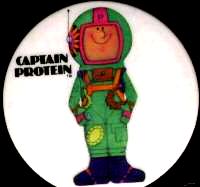
Pop Art: Captain Protein Edition
Labels:
pop art
Collectible of the Week: The Black Hole “Assortment of Fun” (Western Publishing Company, Inc; 1979)
The
year 1979 was one of my favorites in childhood, no doubt because it saw the
release of Star Trek: The Motion Picture, Buck Rogers in the 25th Century,
Alien, Moonraker, and last but not least, Disney’s The Black Hole. I collected toys, magazines, model-kits,
comic-books, novelizations and more from each of those productions.
But
as a fourth grader, I really, really
loved The Black Hole.
This boxed set from Western Publishing Company, Inc., includes many activity books and paper toys based on the film including a “Little Golden Book,” “A Golden Poster Storybook,” A Golden Book of Things to Do,” “A Press-Out Book,” “A Coloring Book,” “Crayons” and “2 Robot Puppets.”
The
two robot puppets, as you might surmise, are V.I.N.Cent and Maximillian And the press-out book allows the intrepid
kid to build paper versions of the Cygnus and the Palomino.
The
back of the box describes the set as “an
astronomical assortment of fun that’s out of this world,” and to a ten-year
old kid, that’s precisely what it was.
I remember that my (now-deceased) grandfather bought me this box set at a five-and-dime at the Jersey shore in the summer of 1980, and that during the whole week at the beach, I wanted to stay inside the rental and play with the Black Hole ships and robots. My parents had to force me to actually go to the ocean.
I
know…I’m a geek. But one of my favorite
parts of this toy is a paper backdrop of the Cygnus bridge, and small cut-outs
of all the major characters, from Captain Holland and to Commander Reinhardt.
To
this day, I remember that beach trip because of this very toy set, my grandfather's gift, and the time I
spent imagining further adventures and sequels to The Black Hole.
Labels:
1979,
collectible of the week,
The Black Hole
Model Kits of the Week: Strange Change
Labels:
model kit of the week
Subscribe to:
Posts (Atom)
50 Years Ago: Land of the Lost: "Flying Dutchman" (October 23, 1976)
While it is undeniable that the third season of Land of the Lost suffers in terms of its continuity with the preceding two years’ worth of...
-
Director Ridley Scott has already given the science fiction cinema two of its greatest and most cherished films: Alien (1979) and Blade...
-
"Other Worlds lie outside our seeing; beyond the beyond; on the edge of within. The Great Pyramids: erected by the Ancient Ones as a ba...