Wednesday, March 09, 2011

Walking in Another Person's Shoes: The Cult-TV Body Swap

After a fashion, all of science fiction television concerns the concept of identity, and a human individual's desire to protect, preserve, and nourish that identity. 

When you break down that assertion to specifics, it isn't difficult to discern how the genre is dominated by threats to the inner "self."  From evil twins, impostors and doppelgangers to alternate dimension counterparts, heroes in cult television almost constantly face challenges to identity Superheroes, for example, often suffer from amnesia: the total loss of memory and awareness of "who they are" or who they are destined to become. 

The Borg -- arguably Star Trek's greatest villain -- rob humans and other races of personal identity, assimilating individuality into a colorless collective.  

Similarly, vampires in Buffy the Vampire Slayer are demons who inhabit your (dead) body, but lack your human soul.

From one end of the genre to the other, villains in the pantheon might accurately be described as body thieves or identity robbers/identity corrupters.

Perhaps the most common genre convention in cult television is the idea of the "body swap." 

In body swap tales, two individuals change bodies, and in the process overturn the order of the status quo.   In sci-fi TV history, villains have swapped bodies with heroes, men have swapped bodies with women, and sane men have swapped bodies with mad-men. 

And in each example of this template, the great struggle in the drama is to re-assert personal identity and reclaim a life that might have been lost.  We cling to our identities. Without it, we are nothing.


The Joe Stefano, Leslie Stevens anthology The Outer Limits (1963-1965) featured an early "body swap" story during its first remarkable season. 

In "The Human Factor," by David Duncan, a scientist named Dr. Hamilton (Gary Merrill) has invented a device for treating the mentally-ill that can join the therapist's mind to that of the patient. This machine can not only share thoughts, but emotions as well...even the emotions "down deep...below the intellect."   

Hamilton has cause to test his mind-joining machine on an engineer named Major Brothers (Harry Guardino) at a military base in Greenland.  Brothers has gone mad with guilt over the death of a fellow officer, and believes that some kind of icy monster has infiltrated the facility.  His goal now is to destroy the facility, and everyone in it. 

But during a therapy session using Hamilton's mind-device, an earthquake occurs and Brothers and Hamilton switch minds and bodies.  Naturally, no other officer believes Hamilton's crazy story that he is actually the good doctor, now trapped in the body of a lunatic; and that a lunatic is now acting as the calm, steady psychologist. 

Disaster is ultimately averted but only because Hamilton's assistant, Ingrid (Sally Kellerman) is able to detect Hamilton's true, good self, inside Brother's body.  The idea of greatest importance in this body swap story is that man is more than a simple machine; that he exists as more than a physical presence, and boasts a soul or spirit (independent of physicality) that can be recognized as distinct and special. 

We would all like to believe that others would recognize our "essence," even if we seem different, or inhabit a different physical form. The Control Voice's ending narration dwells on the machine that made this particular body swap possible, and notes that it is neither good nor evil; that it is man who will always control his machines, and make such choices.


The final episode of the original Star Trek (1966-1969) "Turnabout Intruder," also concerns a body swap. 

This time, another mentally ill individual, a female scientist named Dr. Janet Lester (Sandra Smith), discovers mind-transference technology at on archaeological dig on the distant world of Camus II. 

A former lover of Captain Kirk's (William Shatner), Lester didn't make the cut at Starfleet Academy, and has since developed a deep  and abiding self-hatred.  She has blamed her failure not on her own instability, but on an exclusive world of Starfleet captains that refuses to "admit women."

In the course of the episode, Dr. Lester forces a body switch on Captain Kirk, and then assumes command of the Enterprise.  However, Dr. Lester's capricious, cruel nature soon becomes evident to the Enterprise crew, including Mr. Spock, Scotty and Dr. McCoy. 

When these officers attempt to relieve Kirk of command, Lester tries Mr. Spock for mutiny, and attempts to have Kirk (in her own body) executed. In this version of the body swap tale, the restoration of order again depends on a person -- a friend -- who can recognize a person's true essence outside of physical appearances. 

In this case, the Spock-Kirk friendship proves paramount, and Spock makes use of a Vulcan mind-meld to prove that Captain Kirk's true self is trapped in the body of Dr. Lester.  Again, the idea of the soul is raised, if not named directly.  In "Turnabout Intruder," Captain Kirk speaks of the things that make him "special," "only to himself."

In "Turnabout Intruder's" coda, Captain Kirk also notes that Dr. Lester's life could have been as productive and happy as "any woman's," which today is largely and rightly interpreted as a sexist remark.  But the point of his reflection is that if Dr. Lester had not hated her own identity and self, she could have accomplished wonderful things. 

The body swap story is often about a person who wants to change, to be different, and a person upon whom change is forced.  If you are happy in your own skin, you have no need to envy anybody else, or covet their identity.  But Janet Lester considered her identity not a gift (something special to herself, in the words of Kirk) but as a prison. And she sought to escape that prison at her first opportunity.


Chris Carter's The X-Files (1993-2002) took the idea of the "body swap" in a different direction entirely during the sixth season two-part episode, "Dreamland." 

In this tale, an experimental U.S. aircraft reverse engineered from UFO technology emits an energy wave that exchanges the bodies of Fox Mulder (David Duchovny) and government bureaucrat, Morris Fletcher (Michael McKean).   

This body swap tale is played largely for comedy, and a highlight of the show is an extended sequence during which Mulder sees himself as Morris in a bedroom mirror.  McKean and Duchovny literally mirror each others moves and expressions -- with perfect timing. 

Although this episode is a bit more fanciful and less serious than your typical X-Files segment, there's again a point to the drama: the idea of what it means to walk a mile in someone else's shoes.  

Here, Mulder is cut off from not just his body, his job, and his best friend, Scully, but from his obsessive, lifelong pursuits.  He finds himself with teenage children, a nagging wife, and no real friends. 

Morris, meanwhile -- at least in a certain sense -- does a better job with Mulder's life than Mulder did.  As Mulder, Morris attempts to get frisky with Scully, and enjoys his new, more youthful and athletic body.  Mulder gets moved into a suburban Hell, but Morris makes his time in Mulder's body enjoyable. 


The Farscape canon (1999-2003) also features a variation on the familiar  body swap story.  In "Out of Their Minds" by Ian Watson, a Halosian energy blast strikes Moya and all the refugees and fugitives aboad her (save for Zhaan) are shunted out of their bodies...repeatedly.  

There isn't just one switch among two characters featured in this dizzying, frenetic adventure, but several switches, spread out amongst Chiana, Rygel, John Crichton, Aeryn Sun and D'Argo. 

Like The X-Files installment, "Out of Their Minds" boasts a playful tenor, and doesn't shy away from issues of sexuality (a perpetual strength of Farscape, in general). 

Crichton spends some personal time in Aeryn's body, and Aeryn takes a peek down John's trousers while in his body.  In this sense, "Out of Their Minds" is about curiosity.  In real life, we never have the opportunity to become anyone else, let alone someone of the opposite sex...or a different species. 

When the displaced crew members of Moya pull together and defeat the Halosians, the point seems to be that although these characters are all different, they are all alike under the skin. When  they remember that and work together, they succeed. 

Walking in someone else's shoes and seeing something through someone else's eyes builds empathy for that person.


In Buffy the Vampire Slayer's fourth season two-parter "This Year's Girl," the renegade slayer Faith (Eliza Dushku) uses a mystical device to swap bodies with the very woman who put her in a hospital (and coma) for the better part of a year: Buffy Summers (Sarah Michelle Gellar). 

So the visiting Watchers Council actually apprehends Buffy in Faith's body, and Faith -- in Buffy's form -- is left to wreak havoc on the Slayer's personal life, including her romantic relationship with Riley (Marc Blucas).

This episode is another exploration of what it means to walk a mile in another person's shoes.  As Buffy, Faith has sex with Riley out of revenge, out of petty jealousy.  But Faith is upset and deeply-affected after the intercourse because she felt real love...something she had not experienced herself, and was not prepared for.  

 Suddenly -- and literally -- she's got skin in the game. She was affected by what she did; and now can't treat her new body so cavalierly.


Smallville's (2001 -2011) fourth season offered yet another variation on the commonly-seen body swap story, entitled "Transference." 

In this episode -- one of Smallville's finest hours -- Lionel Luthor John Glover) plots to steal Lex's body using a Kryptonian crystal or artifact.  But Clark (Tom Welling) jumps in at the last second to save his friend Lex, and he ends up being the person switched with Lionel. 

In this case, Lionel not only gets a new and younger body...he unexpectedly finds himself in an invincible one. 

At this point, Lionel is the undisputed villain of the series, and he returns to Clark's life in Smallville with super powers to go along with his criminal mind.  The kicker in this case is that after order is restored and Lionel is returned to his own body, he feels the after-effects of Clark's presence.  In an instant, Lionel is "born again," a reformed man.  The switch has changed him, but not because of himself, but because his body housed a being of rare, superhuman virtue.

"Transference" points to another aspect of "body swap" stories that proves irresistible. Actors featured in a regular series are suddenly gifted with an opportunity to play a different role; to emulate their co-stars, in many cases.

Smallville proves truly spectacular in this regard, with Welling deftly taking on the gestures, stance and mannerisms of Glover's character, and Glover doing the same for Welling's character.  That's the thing that makes this episode so funny, and it's really a credit to Welling (who gets most of the screen-time) for pulling off a brilliant, funny, and carefully-observed version of Lionel Luthor.

Like many other genre conventions, the body swap isn't going to disappear from cult television anytime soon.  It's too useful a trope, really.  The body swap mixes things up for the performers involved, allowing them to play insane, the opposite sex, or another series regular. But it also reminds us how precious and fragile personal identity truly is.   

It would be terrible, after all, to lose your body to another person.  Especially a person who might be you...better than you ever were.

Tuesday, March 08, 2011

The Cult-TV Faces of: Ice


Sunday, March 06, 2011

CULT MOVIE REVIEW: Unstoppable (2010)

Let's face it: sometimes a big, fat generic Hollywood blockbuster is exactly what you hanker for.

A good one can taste great and be less filling...and that's certainly the case with with the high energy, extremely entertaining Unstoppable (2010), a Tony Scott thriller starring Denzel Washington, Chris Pine and Rosario Dawson.

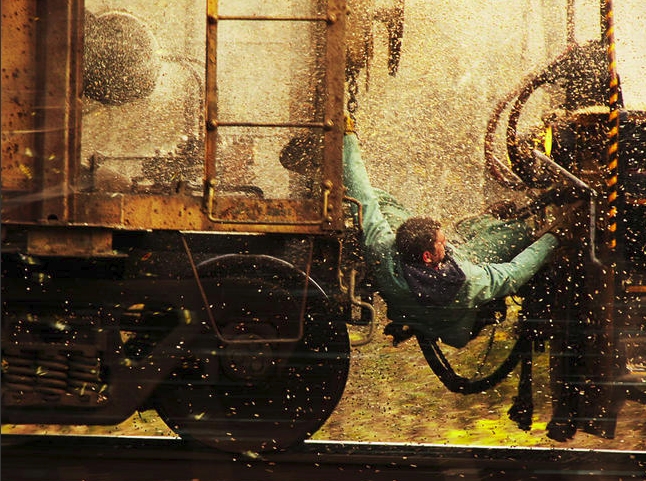
"Inspired by true events" that occurred in Ohio in 2001, Unstoppable is the harrowing, fast-moving tale of two very different men and one woman as they  attempt to avert disaster and stop a runaway train in industrial Pennsylvania. 

Now, that sounds like an extraordinarily simple plotline -- and it is -- but as always, the devil is in the details.

The runaway train, AWVR 777 no  mere "coaster."  Rather, she's  traveling at 77 miles an hour through heavily populated towns and transporting 30,000 gallons of a toxic, flammable chemical called Molten Phenol.  

As the film's put-upon train yard boss, Connie (Dawson) aptly notes, AWVR 777 is not merely a train, but a "missile the size of the Chrysler Building" racing towards 752,000 innocent people in downtown Stanton.

How did the train get out of control in the first place?  

Well, through a combination of "human error and bad luck," according to Connie, but she's just being gracious.  The real culprit is Ethan Suplee's character, the dimwitted, under-trained Dewey,  He's a slack  yard worker who absent-mindedly leaves the train-in-question on full throttle and unforgivably forgets to activate the air brakes before jumping off. 

Now his mistake could decimate the sleepy little town of Stanton and cost innumerable lives.

Reckoning with the runaway train on the front line are two unlikely blue-collar heroes: 28-year train company veteran and soon-to-be forcibly retired Frank Barnes (Washington) and wet behind the ears rookie, James T. Kirk...er, Will Colson (Chris Pine).  

Each of these guys is carrying abundant personal baggage. 

Barnes' wife died of cancer and he is estranged from his two daughters, who work at Hooters.  Colson is from a well-known local family but has a chip on his shoulder the size of a locomotive.  He's also estranged from his wife and child over an incident in which he pulled a gun on a police officer.

Unstoppable moves at a relentless, driving pace as Will and Barnes become the last two people on "the main line" capable of stopping AWVR 777.  Efforts to slow down the runaway train with another train fail...explosively.  A daring attempt to land a U.S. Marine on the back of the speeding train ends...with catstrophic injury.  And the dangerous strategy to derail AWVR 777 with "portable de-railers" just short of a hairpin curve near Stanton  proves absolutely futile.  It seems nothing can stop this rolling goliath.

As the train speeds irrevocably towards its rendezvous with certain disaster, death and destruction are at every turn.  Early on, a train carrying 150 school kids on a field trip celebrating "railroad safety" (!)  assumes a collision course with 777.  Later, a horse trailer (with frightened horses inside) stops on railroad tracks as the runaway monster bears down on it.

Soon, the nature of the threat becomes widely-known.  Press helicopters circle AWVR 777 like buzzards; and eventually the heartless train company gets involved too, just in time to really muck things up.  An executive in charge gets the bad news out on the golf course, and his first instinct is to check the company's bottom line.  "What's the stock de-valuation?" he wonders, should absolute catastrophe ensue.

This less-than-flattering portrait of the white-collar bosses is part and parcel of the movie's dramatic blue collar aesthetic.  Scott shoots the entire movie in an over-saturated, colorful, and gritty palette, one wholly befitting its workaday characters.   And the final conflict comes down to two guys who may not be saints but who know how to do their jobs versus over-paid buffoons and telephone jockeys who just want to keep their jobs and fortunes intact. 

Like all movies, Unstoppable is a product of its time, which means that the subtext here is entirely Great Recession Populism.  Good, hard-working joes like Barnes are being pushed into early retirement on "half benefits" to satisfy suit-and-tie executives hoping to reserve enough cash in big bonuses for white collar class.    The message, none too subtle, is that the runaway train called the economy -- the vehicle for wealth --- is barreling out of control, and only the know how of Main Street, not Wall Street can right the course. 

But Unstoppable succeeds well outside of it deliberate class warfare metaphors too.  There's a more simple, basic story here, one explicitly about human nature. 

Human error causes the danger in the first place, and then the movie brilliantly charts the domino effect of each and every response to that initial error. 

In the end, it's human ingenity and resourcefulness -- the opposite of Dewey's human error -- that resolves the crisis.  I appreciated both aspects of the movie's message; that we can control all of our "runaway trains," either to our mutual detriment or to our collective glory.  We just have to climb on, decide on a course, and say "all aboard..."

Director Tony Scott may not boast a reputation for subtlety, but here he certainly keeps all the trains running on time, to marshal an appropriate metaphor.  His camera never hangs back or slows down.  It spins, it races, it tracks, it arcs, it barrels, it circles...and the total effect is of a breathless, unstoppable juggernaut. 

Because of Scott's approach, this movie grabs your attention and imagination from the first moments and doesn't let go until the end credits roll.  I'm not the kind of film critic given to exhortations about movies being "adrenaline-packed thrill rides" or other hyperbolic nonsense.  But those shoes fit the movie in this case.  Unstoppable is one hell of a roller-coaster ride, and I recommend it entirely on that basis; as a better-than-expected, surprisingly efficient and entertaining action picture.
Frank Barnes - Denzel's character here -- has only one rule for life on the railrod track:  "If you do something, you better do it right."  That's an axiom Tony Scott and Unstoppable really live by.  Unstoppable would make a hell of a double feature with another railrod classic: 1985's Runaway Train.

Next stop: heart attack territory...

Saturday, March 05, 2011

Sci-Fi Wisdom of the Week


"This is television, that's all it is. It has nothing to do with people."

- The Running Man (1987)

Friday, March 04, 2011

CULT TV-MOVIE REVIEW: Dark Night of the Scarecrow (1981)


When I reviewed Satan's School for Girls (1973) earlier in the week, I opined that the 1970s likely represented the greatest decade for made-for-tv horror movies.  I still assert that's a fair statement, but it's only right to note that the 1980s produced quite a few genre high-points as well. 

Exhibit A may well be Joe Wizan and Frank De Felitta's exemplary Dark Night of the Scarecrow, a horror gem which originally aired on October 24, 1981 (just in time for Halloween...), on the CBS Saturday Night Movies

This TV-movie is not only cleverly-written and emotionally affecting, but visually accomplished as well, a legitimately cinematic trick-or-treat effort that would play well even on the big screen.

In short, Dark Night of the Scarecrow is a good, old-fashion comeuppance, or "revenge from beyond the grave" story; the very kind that longtime reader of EC Comics will recognize, enjoy and cherish. 

In this case, the milieu in which the cosmic scales of justice are righted is the American South, specifically "Bogan County," Texas.

As Dark Night of the Scarecrow's narrative begins, a surly, unpleasant post office letter carrier, Otis Hazelrigg (Charles Durning) complains to some of his redneck buddies about Bubba Ritter (Larry Drake), a mentally-challenged local boy who has been seen playing with a pre-adolescent girl, Marylee (Tonya Crowe), his best friend. 

Otis is certain -- absolutely certain -- that harmless Bubba is going to hurt, rape or kill the child.  Obsessed with Bubba, Otis mulls over doing something "permanent" to stop him.

When Marylee is injured by a fierce guard dog in a neighbor's yard, Bubba carries the bloodied girl home to her worried parents, crying that "Bubba didn't do it."   Despite his innocence, word quickly gets out that Bubba is responsible for Marylee's injuries, so Otis and three of buddies grab their rifles, hunting dogs, and a pick-up truck...and track the boy down like an animal. 

They eventually find the frightened Bubba, playing the "hiding game" in a local field; dressed as a scarecrow.   Otis and the others murder him, shooting Bubba at point-blank range twenty-one times.

Adding insult to injury, the judge in Bogan County -- part of the Good Old Boy network -- lets Otis and his buddies off scot free after Otis commits perjury under oath and claims that the murder was actually self-defense; that the handicapped Bubba was actually brandishing a weapon; a pitchfork that Otis himself planted on the corpse. 

Broken up and angry about the death of her son and this miscarriage of justice, Bubba's elderly mother warns Otis and his goons -- all so-called "men of the community" -- that "there's other justice in this world...beside the law."

The final stretch of Dark Night of the Scarecrow involves this "what you sow so shall you reap" dynamic. 

The scarecrow soon re-appears (in creepy, extreme long-shots) on the property of the murderers, an unmoving, lifeless symbol of a crime unpunished. 

Then, before long, each guilty man dies in what the legal authorities ultimately deem an "accident."  Harless Hocker (Lane Smith) ends up pulped in his wood chipper and Philby (Claude Earl Jones) is buried alive at the bottom of his grain solo.

Finally, Otis himself comes face-to-face with the scarecrow by darkest night in a lonely pumpkin patch...

What remains most remarkable and even poetic about Dark Night of the Scarecrow is the way in which director, Frank De Felitta, maintains the mystery and terror of the scarecrow/supernatural avenger. 

In each murder set-piece, for instance, the Scarecrow is never seen.  We only hear footsteps on the soundtrack, or get a brief P.O.V. stalk-shot.   

In one terrifying instance, we even see a hulking shadow inside Philby's house...just as the lights go off.  But otherwise, we never actually see the Scarecrow committing his just and bloody revenge against these redneck vigilantes.  Instead, we're left to wonder -- along with the intended victims -- if something supernatural is going on, and what it could possibly be.  Has Bubba returned from the dead?

Such questions are answered beautifully in the film's final two minutes, and specifically in a closing freeze frame that is both sad and as I wrote above, even poetic.  By this point in the drama, the menacing vigilantes are dead, and perpetually endangered Marylee is finally safe.  The director makes the decision to reveal his hand here; and the result is a memorable and shocking composition: one that acknowledges "otherworldly" justice but without the specter of fear or terror being involved.   It's a surprising, unconventional and almost lyrical moment in presentation; a perfect punctuation to a movie that has been -- in large part -- about human ugliness. 

Non-traditionally, Dark Night of the Scarecrow ends with beauty and a hand offered in love...the visual notion that friendship lasts, even beyond death.

But save for those valedictory moments, De Felitta commendably holds his fire throughout Dark Night of the Scarecrow.  The scarecrow is utilized to maximum effect throughout the film, but as just that: a scarecrow.  One who appears in the wide open fields, seemingly by magic, and stands there in long shot...unmoving. The scarecrow is a juggernaut waiting to come to life, waiting and waiting...

These shots are great because as viewers we expect the scarecrow to move, to come to life and burst into murderous action.  But De Felitta purposefully denies us that visual so that mystery is maintained and more than that, fear and anxiety build and build.  When will this avenging creature come to life?

The final shot, described above, relieves that mounting anxiety in an unexpected, emotional way, and it's all because of De Felitta's decision to not to reveal the Scarecrow in action, essentially a lumbering Jason Voorhees-type figure with a pitchfork.  Because we don't get that particular visual; the Scarecrow emerges as a larger more luminous threat in our psyches, in our fearful imaginations.

De Felitta proves an impressive director elsewhere too.  Rather than revealing the guard dog mauling Marylee, he cuts to a montage of garden gnomes, in close-up.  And he transitions from the wood chipper set-piece to a close-up of a bloody red ketchup dollop landing on Otis's plate.  In the former example, we get a metaphor for the townspeople. The gnomes, like the people of Bogan County, stand by unmoving and unaffected while an injustice is committed.  In the latter case, we get the idea that blood (or ketchup) is on Otis's hands (or plate...) because he was the ringleader who pushed the others to kill Bubba.

In terms of sub-text, Dark Night of the Scarecrow  really concerns racism -- or any "ism" that has taken hold of men who despise and deride any person who is different from the local norm. 

In this case, Otis and his brethren fear what Bubba -- a "physically grown" man might do to a local white girl  --  and set about to destroy him. They use the flimsiest of motivations to do so.  I

f this TV-movie were set in the Old South, the mentally-deficient Bubba might readily be replaced by an African-American.  But the point is absolutely the same.  Dark Night of the Scarecrow exposes the "good old boy mentality" and network that protects its own and seeks to destroy anyone who might look different, think differently, or not know his or her place in the established patriarchy.

The TV movie actually goes a bit deeper than that.  An almost throwaway line in the film marks Otis as a child molester, and there are some disturbing scenes in the film of Otis threatening the young Marylee.

But the important thing here is that Otis is guilty, we must assume, of the very crime that he pins on Bubba.  He is also "physically grown," after all, and apparently has worked out his unwholesome sexual urges before. 

So Dark Night of the Scarecrow gets at a critical point about these vigilantes.  Such folk often project their own behavior upon others; blaming others for crimes they themselves have committed.  It's all surprisingly nuanced, especially for a TV movie, and Charles Durning proves mesmerizing here as Otis Hazelrigg.  Never, ever does Durning reduce the character to cartoon dimensions.  Instead, Durning's Otis is a believable -- and terrifying -- face of hatred.

As I noted above, EC Comics also frequently traversed the realm of comeuppance "from beyond the grave."  I suspect this sort of story is so popular and long-lived because real life has never been, is not now, and likely never will be totally fair or just.   It's difficult to reconcile a belief in justice with the town's treatment of Bubba in Dark Night of the Scarecrow, for instance.  Hence the entrance of the "supernatural mechanism" in stories such as this one to fill that void. 

Dark Night of the Scarecrow expresses well the belief that justice is a universal constant, even if the scales of justice must be balanced outside the flawed auspices of man's law. 

But the great thing about this memorable TV-movie is that it goes one step further beyond meting out justice "eye for an eye"-style, to poetically suggest the beauty -- and endurance -- of good human qualities such as love and friendship.

Thursday, March 03, 2011

Lectures and Programs: American Culture and the Final Frontier at Hampden-Sydney College

On Monday, March the 21st, 2011, Hampden-Sydney College in Virginia will be hosting me for a new JKM genre lecture entitled Space: 2011: American Culture and the Final Frontier. 

The lecture will survey and analyze science fiction television (particularly of the space opera variety) from the late 1950s up through today, or from The Twilight Zone through SGU, to put it another way.  

The focus will be on the ways that space programs change, decade to decade, based on the cultural, political, and international events happening in the world.  In other words, I'll be looking at the real-life context of the programs, and explaining how popular series exploited these contexts or were otherwise impacted by them.

Among the TV series discussed will be Lost in Space, Star Trek, Space:1999, Battlestar Galactica, V, Farscape, Firefly, and many more.

I'm really looking forward to visiting the campus, meeting with  the students of Hampden-Sydney College, and discussing a subject that I truly adore.

Space: 2011: American Culture and the Final Frontier will be open to everyone, not just students and faculty, so if you happen to be in Hampden-Sydney, Virginia on March 21st, I hope you'll attend.   The program begins at 4:30 pm sharp, in the Gilmer Room, 019.   

And I'll not only be discussing science fiction television with the students, I'll also be selling and signing copies of my books too, so I hope to see you there, if you can swing it.

Also -- since Joel is a little older now and ready to see the world -- I'm  jumping  back on the university/convention/library lecture circuit, starting with this exciting engagement in Virginia.   If  you or your university want to retain me for one of my horror or science fiction movies or TV lectures, just contact me by e-mail and we'll see what we can arrange.

I'll post more about the Hampden-Sydney College engagement and my next sci-fi seminar soon.
 

Wednesday, March 02, 2011

CULT TV-MOVIE REVIEW: Satan's School for Girls (1973)


All considerations of quality aside for the moment,  a conscientious reviewer has to give Satan's School for Girls (1973) some pretty serious plaudits over that incredible title. 

But then again, Satan's School for Girls comes to us from the great age of TV-movies; when they boasted colorful and memorable monikers such as Don't Be Afraid of the Dark (1973), or A Cold Night's Death (1973). 

As the title makes abundantly clear, this made-for-TV movie was also produced during the rarefied age of  1970s Devil film: the wonderful spell between Brotherhood of Satan (1971) and The Exorcist  (1973).

Specifically, this Aaron Spelling TV-movie first aired on September 19, 1973, and later earned a reputation, according to The New York Times, as one of the most "memorable" made-for TV horrors of the disco decade.  It was even re-made in the year 2000, with Shanen Doherty in the lead role.

The original Satan's School for Girls stars fetching scream queen Pamela Franklin (And Soon the Darkness [1970], Legend of Hell House [1974]) as Elizabeth Sayers, a young woman investigating the apparent suicide of her beloved sister Martha. 

To that end, Elizabeth masquerades as a new student at Martha's former school, the exclusive and 300-year old Salem Academy for Women.

Elizabeth enrolls immediately in two classes: Behavioral Psychology with creepy Professor Delacroix (Lloyd Bochner) and an art class with hunky Dr. Clampett (Roy Thinnes).   In the latter class, Clampett urges the female students to "hang loose" and remember that everything in life is both "illusion and reality." 

Elizabeth soon befriends several students, including resourceful Roberta Lockhart (Kate Jackson), popular Jody (Cheryl Ladd) and the troubled Debbie (Jamie Smith-Jackson).  Debbie, in particular, appears afraid...and has painted a creepy portrait of the dead Martha trapped in what appears to be an old cellar.

Elizabeth locates that ancient cellar in her very dorm, Standish Hall, and learns from Roberta about a creepy local legend; about eight Salem witches who were hanged in a cellar just like that

After Elizabeth discovers that Debbie has also committed suicide, she investigates the files in the office of the Headmistress.  She learns that all the students at the school have been orphaned; just as Elizabeth herself has been orphaned.  She also learns that student files on Debbie and Martha are missing...

Then, late at night, when the power goes out, Dr.Clampett evacuates the campus save for Roberta and Elizabeth.  

In the dark, quiet loneliness of the cellar, Satan soon makes his play for eight young, impressionable and father-less souls to replace the ones he lost in Salem all those years ago. 

"I welcome what man rejects," he tells his would-be acolytes with open arms

And he's reserved a spot  just for Elizabeth...

Now, I'm not quite old enough (but almost old enough!) to remember Satan's School for Girls from its original transmission  Rather, I first saw it sometime in the early 1980s in weekend syndication.  I probably saw it when I was eleven or twelve, and it has stayed with me ever since.

And now, after watching Satan's School for Girls again, at least I have a better understanding of why that's the case. 

The movie, released on DVD by an outfit called "Cheezy Movies," looks like a relic from another lifetime.  The TV-movie is simple, straight-forward and even innocent in a weird sort of way by today's standards.  Yet some of the horror moments really do get the blood pumping.  This is a major accomplishment, because it's clear the movie was made for next to nothing.  There are no real visual or make-up effects to speak of, and almost the entire film takes place in just four of five interiors.

But Laurence Rosenthal's steroidal musical score works over-time to build shivers and anxiety, and director David Lowell Rich does an effective job keeping to the basics.  Many scenes have been lensed entirely at night, or in the dark, Gothic passages on the campus.  Thunder roars on the soundtrack, lightning crackles, and heavy doors creak regularly.  The fear expressed here -- simply -- is of being alone at night, in the darkness, and wondering if something malevolent might be hiding in the impenetrable blackness close-by. 

Nothing more complicated than that.

Yet it's amazing how many modern horror movies forget that it is the simple things that scare us the most.  A basement in the dark.  A storm at midnight.  The intimation of the diabolical.  Roy Thinnes in tight polyester pants...

Okay, I try not to do snark, in part because there are so many other places on the Internet where you can so readily find it, but if you're inclined to laugh or giggle at Satan's School of Girls, it's probably easy to do so.  I can't, in good conscience, deny that. 

The performances -- much like the narrative -- are oddly naive and almost child-like   But  if you're willing to buy into the movie (and it helps if you have some nostalgia for it), Satan's School for Girls unnerves in a very efficient, very 1970s fashion.  You want to giggle and assure yourself that a cheap TV-movie effort like this couldn't possibly bother you.

But just try watching it alone in the dark.  At night.  The cheesiness sort of evaporates and you find yourself in the midst of this very sincere, very straight-forward and eminently creepy tale.  Everyone involved really committed to it (just look at that actress screaming for her life in the still near the top of this post!) so what the hell is our excuse for not doing likewise, right?

And, if you dig just a little under the surface of Satan's School for Girls the movie actually features some interesting  ideas.  It's a movie about girls who don't have fathers, and who try to find a father figure in either Professor Clampett or Professor Delacroix.  Clampett urges the girls to "condemn nothing" and "embrace everything" -- the 1970s equivalent of "just do what feels good," and Delacroix treats the students like rats in a maze; hoping to awake them from their "passivity" should they ever encounter real "terror."

If you've seen the film, you know which of these guys is really the Devil in the disguise -- either the liberal artist or the paranoid psychologist -- but the push-pull between the clashing philosophies at least gives the viewer something to think about between scenes of screaming ingenues.

Satan's School for Girls is worth a curiosity viewing just for the cheeky title (as well as the bizarre opening sequence in which Martha grows terrified -- terrified I tell you! -- at the  sudden, unexplained appearance of not one, but two strange old men).  But more than that, if you let yourself buy into the premise of this 1973 made-for-TV movie, you might just get a good schooling in old-fashioned terror.

Pop Art: Power Records Edition


Tuesday, March 01, 2011

The Five Most De-Humanizing Rituals in 1970s Dystopian Cinema

I've been devoting considerable space here lately to science fiction cinema's unforgettable dystopias; those dark worlds of the imagination in which mankind takes a wrong turn on the road to a better future.  

These memorable and often haunting films dwell on such matters as overpopulation, food shortages, eugenics, and collectivist societies that snuff out all individuality and even humanity.

We've had great dystopian movies with us now for many decades.  In the 1960s we saw The Tenth Victim (1965) and Fahrenheit 451 (1966).  In the 1980s we saw Blade Runner (1982) and The Running Man (1987).  And recent decades have brought us such fare as Gattaca (1997), Minority Report (2002), Gamer (2009) and Surrogates (2009).

But the Great Age of Film Dystopias is unquestionably the 1970s; our nation's very own "crisis of confidence" decade.  The Energy Crisis, Watergate, the Vietnam War,  the Manson Family, Three Mile Island, Roe vs. Wade and the Iran hostage situation all became part of our national dialogue in what I often term the disco-decade. 

In terms of film history, those years between 1970 and 1979 also gave the world THX-1138 (1971), Z.P.G. Zero Population Growth (1972), Soylent Green (1973), Zardoz (1974), Death Race 2000 (1975), Logan's Run (1976) and many other examples of the genre.

In the days ahead, I hope to lay my hands on such harder-to-find dystopian efforts such as The Last Child (A 1970s TV movie), Amerika (a 1987 TV miniseries about a Soviet-takeover of the United States) and the grand-daddy of such dystopian imaginings, the not-currently-available-on-DVD  1984 (1984), an adaptation of Orwell's seminal literary work.

But before we get to such movie reviews, I wanted to pause here and acknowledge some of the qualities that make these cinematic speculations about our future so intriguing, and often so frightening. 

I looked back across my postings and saw that almost every 1970s film about dystopian futures shares one element in common.  All these films feature governments or other systems of control that turn human against human; man against his brother.  And they each do so, universally, utilizing some kind of futuristic technology or futuristic application of technology.

These films might thus be viewed as speculative endeavors and also as warnings about the shape of things to come; of future science or technology "run amok."  In all these future societies listed below, the government has created a new social "ritual" (a continental race, a form of legally-sanctioned punishment, a religious service, a public service, etc.) that actually runs counter to all that moral human beings currently hold dear.

So without further description, here are The Five Most De-Humanizing Rituals of 1970s Dystopian Cinema, by my assessment.


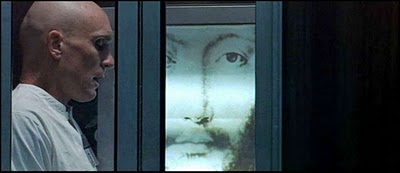
5.  THX Visits A Unichapel in THX-1138 (1971).  

In the future world of THX-1138, the act of going to Church and sharing worship with a community has been deliberately subverted by the government. 

Single-serving Unichapel kiosks instead service the worship needs of a vast subterranean city's population.  Although decorated with images of Jesus Christ, these unichapels offer platitudes and "Blessings of the Masses" rather than legitimate spiritual guidance. 

In fact, the Unichapels serve as a surveillance tool for the State because here citizens can unload all of their secrets, and thus Big Brother learns of them.  Off your drugs?  Falling in love with your roommate?  Now the State knows it all.

The Unichapel confession is so upsetting and de-humanizing a ritual, in my opinion, because it turns the focus of religion away from the needs and aspiration of a community (and doing good deeds) to a more selfish plateau.  The Unichapel sits just one.  There's no room for the community in it.  Worse, in adopting the "confessional" approach, the Unichapel actively turns penitents into informants.  And worst, those informants may actually be testifying against themselves.


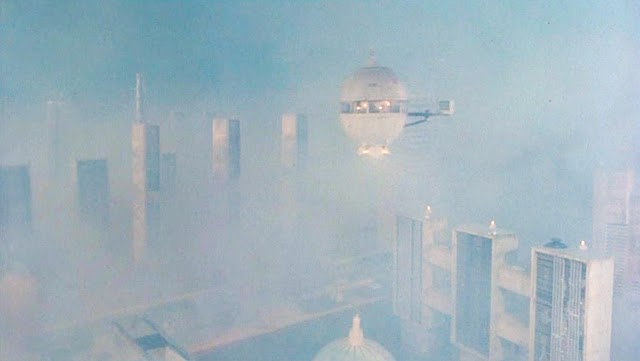
4.) Make Thy Neighbor Suffer: ZPG Zero Population Growth (1972). 

Happen to know anyone in the neighborhood who may be in violation of the World Deliberation Council's Zero Birth Edict? 

Well, if so, just telephone the police force and it'll send a futuristic helicopter over to drop an air-tight inflatable tent over the violators (usually a Mother, father and infant)! 

Trapped in the death tent, these nasty law-breakers will expire of asphyxiation over the next 24 hours, and you get to see it close-up since the tent is transparent!    Another bonus: for doing your civic duty, the State provides you extra food rations

Again, the idea here is of a neighbor being turned into a "rat" to squeal on his or her neighbors.  The State not only encourages such spying and informing, it provides incentive in the form of rations. Perhaps even more disturbing is the notion that an (illegal) child or infant could be punished for his very existence.  Like many dystopian ovelords, the State in ZPG wants people numb to the idea of killing for a so-called "common good." 

Once more, something immoral (the murder of families...) is ritualized; part of the legal law-enforcement process; and a duty of every citizen.


3.) The Trans-continental race: Death Race 2000 (1975). 

In the year 2000, in the United Provinces of America, the President decrees that the trans-continental race is "the American way of life," "no-holds barred." 

But drivers in this race compete to become the new American champion by running down innocent pedestrians.  They do so explicitly for points.  A female pedestrian is worth 10 points, a teenager is worth 40 points, children under 12 are worth 70, and senior citizens carry a whopping 100 points.

So, around the country, TV viewers watch with blood-thirsty glee as their fellow citizens are run down by the death racers.  This set-up is no doubt meant by the filmmakers as the equivalent of gladiatorial games and Roman bread and circuses.  While the President luxuriates in foreign palaces and the American economy stumbles after the "Crash of 79," the public is distacted by bloody road games.    The Running Man is a variation on this theme as well. 

But think about it: a favorite weekly TV show is nothing if not a "ritual," and the bloody ritual of the cross-continent "death" race is essentially murder as entertainment; as must-see TV. Life is supposed to be precious, but viewers of the race are meant to cheer when their race runs over a team of doctors, or an old lady.  How de-humanizing is that?


2.) "Going Home:" Soylent Green (1973). 

In the overpopulated, undernourished city of New York in 2020 (where 20 million people are unemployed), you can have privacy and anything else you desire...but you have to die to get it. 

In particular, government centers (called sleep shops in the literary version of the material) euthanize the citizenry. 

But hey -- before you die, you can live like a king, able to enjoy you favorite music and a montage of lovely images.  It's like Sarah Palin's Death Panels meets an IMAX theater.  Who wouldn't want to enjoy that?  At least once...

Again, in order to solve desperate problems (food shortages and overpopulation), the State has devoted itself to the death of its very citizenry.  It's highly disturbing to think that the only way to enjoy life's pleasures in this future world is to embrace death.  And death by sleep shop is a sanctioned ritual of this future world.


1.) "Carousel:" Logan's Run (1975).

In the shopping-mall, sex-on-demand, plastic-surgery-on-demand 23rd century of Logan's Run, you can have anything your heart desires...except your thirtieth birthday. 

On your "LastDay," by order of the computer that runs the City of Domes, all would-be-30-year olds must report for "Carousel." 

And what is Carousel?  On the surface, it appears to be a joyous religious ritual in which the old folks compete for re-birth or "renewal" by floating to the top of the heap in a weird gravity pool with glowing lights.  In reality, the assembled citizenry of the city watch and cheer in the stadium as Last Day participants are disintegrated by ceiling-mounted laser devices.

Again, Carousel represents the most hideous and de-humanizing idea of this dystopia.  It is state-mandated murder (or population control), but Carousel is even more immoral than the sleep shops of Soylent Green, because it masquerades as a mystical, religious tradition.  Thus citizens are uninformed, and believed they are witnessing re-incarnation, not disintegration.  Here, it's the deception that is so ugly.  The State has made a religious ritual out of population control, and the people are so ignorant that they cheer for death. 

Of course, in the case of Logan's Run, at least there's the Love Shop (and lots and lots of sex...) before you have to die young.

Your mileage may vary on these cinematic dystopias, but which of these 1970s worlds do you believe offers the most de-humanizing ritual, and why?

20 Years Ago: Doctor Who: "The Girl in the Fireplace" (May 6, 2006)

When The TARDIS lands on a derelict vessel deep in space, The Doctor (David Tennant), Rose Tyler (Billie Tyler) and Mickey (Noel Clarke) inv...