Wednesday, September 08, 2010

Tonight: Dressed to Kill!

Tonight at 10:00 pm, on Movie Geeks United, the topic of analysis is Brian De Palma's 1980 controversial (and brilliant...) thriller, Dressed to Kill.  Tune in here, tonight for part three of this exciting De Palma Thriller Series! 

And don't forget to check out the show on Sisters; and last night's Carrie episode.

While you wait for 10:00 pm, here's a look at my review of Dressed to Kill:

In many critical senses, Dressed to Kill explicitly concerns the sexuality of the dramatis personae. At least three primary characters undergo a process of sexual awakening or development in the course of the drama, and the film's stylistic approach is tailored to each character's particular brand of change/maturity/neurosis.

First we meet Kate Miller, a married woman who longs for sexual excitement and romance in her humdrum marriage. The film's dazzling and erotic opening scene involves Kate masturbating in the shower as she gazes lustfully at the almost-naked body of her husband nearby. But this sexual fantasy almost immediately goes awry. It is literally hijacked by a man in the shower behind her, forcing himself upon her. At first Kate is tantalized, aroused, but then the love-making grows violent, disturbing. She screams...

...and suddenly we're gazing (from a high-angle perspective) down upon Mr. and Mrs. Miller in bed as Kate's husband completes one of his "wham bang" specials...a quickie with plenty of gratification for him, not so much for her. After he has completed the...uh...transaction, Mr. Miller pats Kate absently on the cheek like she's a good dog or something, and moves entirely out of frame. Kate is left center-stage, feeling sexually frustrated and angry. She can't find what she wants...the fantasy aspect of her sex life always gives way to grim, unromantic reality.

This pattern (fantasy giving way to reality) is repeated in Dressed to Kill's central set-piece, set in the Museum. Kate arrives there and sits down on a bench. But when she looks around her, we see that she is not gazing at art so much as the romantic nuances of human behavior. There are young lovers nearby...holding one another affectionately; touching one another in ways that suggest romantic intimacy. In another corner, brazen sexual hunger: a sleazy-looking man comes on to a beautiful blonde in an unsuccessful pick-up attempt.

Importantly, these shots of strangers navigating romance/sex are staged from the outside looking in; from one room into another, showcasing a frame within a frame. This particular perspective grants the compositions a feeling of the intimate, the voyeuristic. They also mirror Dressed to Kill's very first shot: a slow glide around a corner to discover Kate masturbating in the shower. This is important: the approach is one almost literally of "peeking in" from the outside.

These random incidents arouse Kate's sexual yearnings, and soon a man sits down beside her on the bench...a potential lover. Following his arrival, we get several minutes of smiles, awkward glances, self-recriminations, mixed signals...and then a full-throated, fast-paced pursuit that climaxes in the taxi-cab as the stranger pulls off Kate's panties and goes down on her.

It's important to note that this sequence is vetted without any dialogue whatsoever. Instead, the mesmeric set-piece works because of De Palma's skilled shot selection, the facial expressions of the actors, and Pino Donaggio's lush score, which arouses our feelings of romance at the same time Kate becomes aroused. All I can say is that this sequence is pure magic, pure cinema. Kate's passion becomes our passion. We're putty in De Palma's hands.

But in terms of importance, this scene represents the deliberate repetition of the "fantasy" paradigm De Palma has already established (with Mrs. Miller in the shower during the film's opening scene). As before (with the rape...), a fantasy encounter is followed by grim reality. After the sexual liaison, Kate learns her lover has contracted VD and all romance and sexual excitement evaporates.

Instead of mere disappointment however, what follows the sexual fantasy this time around is a wave of shame and guilt. Kate has cheated on her husband for casual sex with a stranger -- violating her vows -- and may now have contracted an STD. De Palma forces us to linger on these feelings of shame, guilt and anxiety by holding on Dickinson in the elevator for an abnormally-long period of time. She's desperate to escape the "scene of the crime," as it were, but can't. Instead, she's confined in the elevator. As before Kate was similarly confined in another cubicle: the shower enclosure.

Then a little girl gets into the elevator with Kate...and just stares at her. Although the child could have no way of knowing the sin Kate has committed, it doesn't matter. The face of "innocence" glares at Kate following her immoral behavior and that staring visage makes the case (visually) for Kate's recriminations . More importantly, this extended time in the elevator (with the girl bearing witness...) forces the audience to reckon with some very important questions that ultimately have no place in the rest of the narrative. How will Kate tell her husband what happened? Does she now have VD?

Much as Hitchcock misdirected the audience by accentuating the importance of the stolen fortune in Psycho (1960), De Palma makes us focus, laser-like, on the fall-out of Kate's affair during this lengthy elevator sequence. And of course, he's leading us astray...

Kate's ring, her marital vows, even the threat of venereal disease are totally meaningless in the larger drama. Kate is suddenly ambushed and murdered by a weird, homicidal assailant. Again, De Palma purposefully echoes the beats of Psycho: particularly the Janet Leigh trick which saw the murder of the film's protagonist (Marion Crane) after the first act. De Palma's variation on this trick is particularly strong, particularly visual, however: he passes the baton of "heroine" directly from Kate to Liz in a single shot: a close-up of their eyes meeting. A lingering look is exchanged between them, and we have our new lead.

Kate's son, Peter, is the second character in the film who undergoes a maturing or sexual awakening. The young man is a technical genius who toils on esoteric scientific contraptions to the exclusion of everything else. In the course of Dressed to Kill, we see him build a computer, operate a self-made "bug" to listen in on private conversations, and even defend Liz with home-produced pepper spray/mace. Peter even designs and constructs his own stop-motion camera to catch the murderer. But -- as his mother realizes -- Peter is still a naive boy. In an early scene, Kate suggests that Peter name his computer contraption "Peter"...a slang term for a penis. She then explicitly tells him not to stay up all night playing with "his Peter."

The sexually repressed Peter doesn't take this advice until after the horrible murder of his mother. Then -- finally-- he has an obsession beyond the care and nurturing of his "Peter." He leaves his bedroom, encounters beautiful Liz (a hooker...)...and even becomes her heroic protector. At film's end, Liz says she's gotten used to having Peter watch her back...an explicit reminder that the action of the film has changed Peter from boy to man.

Peter's ill-fated mother out went in search of sex and romance...and found only death. Peter went in search of truth..conquered repression...and found the sex and romance his mother so desperately sought.

The third sexual awakening in the film involves the film's villain, Dr. Elliott. Elliott is actually a "woman trapped in a man's body," a man waiting to undergo sexual re-assignment surgery. But when aroused (by Kate and Liz, respectively), Elliott takes on the avenging female persona of Bobbi: a psychotic, razor-wielding murderer attempting to preserve her existence. This background is all explained tersely (and graphically) in one of the film's final scenes, yet another echo from Psycho (specifically the oft-criticized coda...). But well before this explanatory ending, De Palma offers us visual and audio tells as to Dr. Elliott's schizoid nature.

Every time Elliott is asked by a woman (again, Kate or Liz), if he wants to have sex, De Palma cuts to a shot of Elliott in a mirror on his desk. The face there -- though Elliott's -- symbolizes the disapproving glare of Bobbi...staring back at her "male" brother. We don't know it (at least consciously) during the film's progress, but these reverse angles are informing us that Dr. Elliott boasts a twisted reflection.

The aural tell is just as interesting as the mirror images. Early in the picture, Dr. Elliott tellingly refers to himself in the third person while noting that he has to "play" secretary in the office today. "The doctor will see you now," he tells Kate. In other words, Elliott isn't always "the doctor." Sometimes he's someone else. Sometimes he's Bobbi.

Elliott's sexual problem is two-fold. One, he is still experiencing the unwanted symptoms of male arousal when in the presence of sexy and willing women. And two, as Bobbi he expresses his sexual emotions in violent, fetishistic terms Look at the way Bobbi "dresses to kill" near the denouement, the long, lustful, purposeful way she unzips a nurse's blouse following one murder. The act of dressing as a woman is one thing Bobbi might be denied if Elliott's manhood reasserts itself; and in this sequence we visually detect the character's obsession with womanhood (but not necessarily hatred of womanhood, as critics argued).

The only character not overtly hung up on sex in some way in Dressed to Kill is Liz (Nancy Allen), ironically a successful, high-class prostitute. And one with a close eye on her stock portfolio to boot. Perhaps because sex is just business and not personal for Liz, she doesn't let it affect her judgment in deleterious ways.

Dressed to Kill's valedictory joke involves this character and her straight-forward, unencumbered view of sex. After Elliott is shot and incarcerated, Liz explains to Peter -- in graphic, explicit terms -- the nature of Elliott's sexual hang-ups. This description occurs in an up-scale restaurant, while horrified patrons listen on all sides. It's almost as though Liz is telling Peter a dirty joke in bad taste; and I suppose that's the point. Dressed to Kill is essentially the same thing: a long, dirty joke evoking passion and criticism on all sides from moral watchdogs...but completely acceptable (and sort of funny...) to any character not hung up on the hows, whos, wheres and whys of sex. People like Liz.


Your Lying Eyes and Ears

Another leitmotif in Dressed to Kill involves that De Palma-ism about the camera lying 24 times a second. Implicit in that statement is a distrust of technology itself. So it's extremely significant that Peter's technology in the film doesn't get to the truth of Elliott's story at all.

A camera is set up outside Elliott's office to snap photographs of patients coming and going (so Liz and Peter can identify the murderer...) but the camera only picks up "Bobbi." The camera can't comprehend what it photographs, so it cannot register that Bobbi is the same person as Dr. Elliott. This mistake sets up the dangerous finale in which Liz comes on to Elliott in his office. She doesn't know it, but she's arousing Bobbi's wrath by arousing Elliott.

Additionally, when Peter listens in on Dr. Elliott talking with Detective Marino at the police station, he hears only those truths that Elliott chooses to share...nothing that reveals the true identity of the murderer. Thus the doctor's "appointment book" becomes a kind of McGuffin...assumed to be all-important by police and witnesses alike, but actually signifying nothing of consequence. Bobbi didn't sign in. She's not a patient. She's...Elliott.

So the camera and the mic designed by Peter lie. And the form of Dressed to Kill echoes that content: De Palma's camera lies too. We constantly confuse Bobbi with her lookalike or doppelganger, Betty Luce -- the detective that Marino has assigned to trail Liz.

In one scene set in Columbus Circle, Liz is pursued by Bobbi and Luce simultaneously, and we can't distinguish between them. In fact, we don't know that we're even looking at two different characters! De Palma then fosters this confusion by arranging a misleading, split-screen montage. An image of Elliott -- listening to a voice mail from Bobbi -- appears on the left of the frame. At the same time, an image of what we take to be Bobbi -- but actually Luce -- appears on the right hand of the screen; spying on Liz.

See how the camera lies? In this sequence, it convinces us that Elliott and Bobbi are two different people when in fact there's a third, mystery personality (Luce). It's not a cheat; it's not a gimmick. We just have incomplete information. It's all adequately explained and makes sense in the end. But while we're in the thick of it, we believe we're seeing one thing but experiencing something else entirely. This is where De Palma truly excels, and we don't know if we should believe our lying eyes.
Think About Where Your Anger is Going...

Like many De Palma movies, Dressed to Kill is all about intertextuality. The references to Psycho are numerous, and as I've laid out above, considerable. From the Janet Leigh trick to the psycho-babble coda to the schizoid nature of the villain, it's easy to identify Psycho as the bedrock foundation and inspiration of the film.

And yet, Dressed to Kill is no simple knock-off. On the contrary, it assimilates the core Psycho components and then builds on top of them. Here, the Norman Bates character doesn't just pretend to be "Mother" by dressing up, but is on the way to actually becoming a woman. Furthermore, he doesn't live alone, in isolation, in some rural backwater.

On the contary, Dressed to Kill makes the schizoid man a respected professional who -- on first blush -- seamlessly operates inside our contemporary, technological, rational society. Madness has thus arrived in the modern city in Dressed to Kill...and it thrives there in anonymity. This isn't Psycho redux. This is Psycho + 1.

Again, De Palma finds ways to honor his cherished source material. The film opens in a shower (since Psycho's most famous sequence occurred there...) but then builds to a fever pitch in another distinctive enclosure: an elevator. By starting with Angie Dickinson in the shower, however, Dressed to Kill essentially states that it is beginning where Psycho left off. It's the next step. (And Fincher's Fight Club [1999] is the next iteration of the schizoid drama, but that's a post for another day...)

Dressed to Kill not only quotes from Psycho, but also the Italian giallo tradition. Here we have a film with a mystery component, an operatic score, excessive blood letting, and flamboyant camera movements. Where have you seen that alchemical equation before, Bava or Argento fans? Hitchcock wasn't able to produce Psycho in color, but De Palma makes the most of this advance in movie technology. He uses garish, bright colors in symbolic, effective fashion here. In the elevator death scene, for instance, Angie Dickinson is garbed head-to-toe in immaculate white, a color which is soon spoiled by her spilled blood during the razor attack. The red-against-white image is powerful in almost a primal way, and it works thematically (as in giallo tradition); suggesting the loss of Kate Miller's "purity" after the marriage-wrecking affair.

Tuesday, September 07, 2010

Tonight: The De Palma Thrillers -- Carrie (1976)

Movie Geeks United continues its week-long celebration of the "De Palma Thrillers" with an in-depth look at Carrie (1976) tonight, airing at 10:00 pm.   I'm featured on the program, along with critic Armond White.

 Here's the link, so don't miss it!

And here's a chunk of my review of this classic De Palma horror:

Although he had directed many fine feature films before this 1976 thriller (including the exquisite Sisters [1973] and the wacky Phantom of the Paradise [1974]), it was Carrie that truly landed Brian De Palma on the cinematic A list.

The director's critically and financially successful adaptation of the Stephen King novel not only assured De Palma a long and storied career in Hollywood, it also set off a virtual blizzard of celluloid King adaptations vetted by high-profile film directors (Tobe Hooper and Salem's Lot [1978], Stanley Kubrick and The Shining [1980], David Cronenberg and The Dead Zone [1981], George Romero and Creepshow [1982], John Carpenter and Christine [1983], Rob Reiner and Misery, etc.). This is a horror trend that endured well into the 1990s, and even to into this decade, though to perhaps a less-significant degree.

Carrie proved so resonant as a horror genre initiative, in fact, that it spawned a fad, a significant number of B movie imitations. These were films about wronged, lonely teens seeking bloody vengeance against their cruel school mates. These films had titles such as Ruby (1977), Jennifer (1978), Laserblast (1978) and Evilspeak (1981)

With his keen and accomplished visual sense, De Palma creates an intimate portrait in Carrie of this aforementioned adolescent, high-school cruelty. It's Lord of the Flies in a locker room...only with mean girls instead of wild boys. In her review of the film for New Yorker, critic Pauline Kael noted that prior to De Palma's film, "no one else has ever caught the thrill that teenagers get from a dirty joke and sustained it for a whole picture," terming Carrie a "terrifyingly lyrical thriller."

Most critics strongly agreed with the assessment that King's novel found perfect expression in De Palma's capable hands. Film Quarterly, Volume XXI (page 32) in 1977 noted that "De Palma develops his familiar motifs of exploitation, guilt and sexual repression with a sure hand, so that his visual fireworks for the first time do not seem themselves obsessional and out of control."

Roger Ebert wrote in his review of January 1, 1976 that: Brian De Palma's Carrie is an absolutely spellbinding horror movie, with a shock at the end that's the best thing along those lines since the shark leaped aboard in Jaws. It's also (and this is what makes it so good) an observant human portrait. This girl Carrie isn't another stereotyped product of the horror production line; she's a shy, pretty, and complicated high school senior who's a lot like kids we once knew."

Today, no less than three major sequences in Carrie have entered the pop-culture lexicon (and endured there for over thirty years.) These three sequences are so well-directed, so brilliantly-staged that they jump immediately to mind when considering the film. More importantly, they visually support the film's narrative: forging an understanding of Carrie's world and what it means, in some cases, to "grow up." Those scenes are set in a girl's locker room, at the senior prom, and finally, (ominously...) grave side.

In part, Carrie works so splendidly, because of the universality of the high school experience. Sometimes it feels like high school is a realm where cruelty -- along with apathy -- has become institutionalized.

Teenagers often seem to boast a sixth sense (or is it a killer instinct?) about those students who are less well-adjusted, who come from bad homes, or who are just more sensitive...and therefore vulnerable. And then those kids are ridiculed, teased, shunned and mocked sometimes, to the point of sadism.

Probably nothing could expose this milieu more clearly (or more artfully) than the locker room scene that opens Carrie. After a game of volleyball (shot from a high angle, as if to clue in the audience to the fact that something terrible is soon to occur...), De Palma cuts to the gym locker room. The steam from the showers softens the image on screen, providing the impression of a lulling dream, or even a sexual fantasy. Immediately, we start to understand how high school represents a time of sexual awakening.

As the camera pans right, accompanied by the romantic strains of Pino Donaggio's score, the audience sees gorgeous young women frolicking, nude or half-nude after their exertions on the court. As I wrote in Horror Films of the 1970s, this is an "erotic image of wood nymphs at play," one intended to arouse, titillate and stimulate. But as the camera moves past this fanciful action in a forward motion, we soon spy Carrie White (Sissy Spacek) alone in a shower. It's a strangely solitary, personal and erotic moment too. The young woman caresses herself in slow-motion. Glistening water drops decorate her euphoric face. A phallic-shaped shower-head sprays water down upon her.

Carrie's hands wander innocently down to her stomach, then her legs -- and, as curious viewers -- we wonder how far this scene is going to go. As Carrie's hands continue to spiral downwards to her legs, scarlet blood suddenly stains her skin, mixing with the pounding water. It's menstrual blood. On her fingers, on her legs. On the floor.

This is a typical De Palma bait-and-switch, a deliberate reversal or undoing of expectations. Those males in the audience aroused by the sight of female nudity are no doubt -- much like the disturbed school principal featured in the next scene -- not at all aroused by the visual of a high school girl getting her period. A sexy fantasy has given way to common reality
 
The dream-like nature of this sequence dissipates quickly now, giving way to abject horror. Carrie does not know or understanding what is happening to her. She believes she is dying. From a subjective point-of-view shot, we now see harsh reality: the other high school girls categorically reject Carries' entreaties for help and the "misty" look of the scene has evaporated. With startling cruelty, the girls even toss tampons at the desperate Carrie. We get close-ups of taunting, ugly faces, and hear the girls' mean chants. Those beautiful bodies in the slow-motion dream have given way to the cruel reality of high school. Mocking, teasing, the mob mentality. Like pack animals, the teen girls can smell the weak number in their pack...and go in for the kill.

This scene serves a few important narrative functions. First, the visual obsession on young, sexy bodies (and Carrie's body, in particular...) serve to note the full extent of this character's burgeoning womanhood. Though shy and awkward, Carrie is also beautiful in an innocent way...stepping into the realm of sexual maturity with awkwardness.

Secondly, the hurling of the tampons and the close-ups of twisted, evil faces mocking Carrie help to dramatize what a delicate, uncomfortable, embarrassing time this can be for those undergoing puberty. Through the cruelty of the girls in the locker room, we comes to sympathize for Carrie's feelings of isolation and separation. In addition to her sexual maturation, this scene charts Carrie's first steps into "psychic" maturity as well. Her outrage at the cruel treatment causes a telekinetic burst: the shattering of a lamp bulb over the shower enclosure. This is clear foreshadowing...
 

In English Class, Tommy is highlighted in the foreground of one shot, in an extreme close-up. Meanwhile, Carrie is depicted as diminutive and tiny, in the background of the self-same shot. Interpreting what our eyes see, he is thus paramount -- a towering paragon -- and she is literally almost a midget, an after-thought in distant orbit of his "star." Yet importantly, the characters share the same frame. De Palma's choice of shots here expresses Carrie's own (insecure) view of self. To her, Tommy is "big" and "shiny," at center stage, while she is "small" and far from attention. Almost unseen.

In Horror and Science Fiction Films II (Scarecrow Press, 1982, page 52), critic Donald C Willis noted that "it's debatable who's meaner to Carrie - her fellow students or her director, who draws out their elaborate prank for 90 minutes, then lovingly shoots its penultimate moments...in slow motion."

I understand his point, but, as always, we should ask the question "why?" I submit that that De Palma makes much of the film a torturous build-up to Carrie's moment of explosive rage not so we can mock her; but so we sympathize with her. The film spends much time on Carrie's home life with her stark-raving-crazy mother (Piper Laurie), a zealous, Christian, fundamentalist freak. Between these harrowing home sequences and those set in high school, the audience rightly wonders how much this poor girl can endure Then, De Palma grants us that gleaming moment of hope as Tommy and Carrie appear to develop a meaningful relationship. De Palma again pulls a bait-and-switch (with his lying camera, dammit!), letting the hope linger in our minds that perhaps, just perhaps, Carrie has found the very kindred spirit who will allow her to join the rest of the world and vanquish her intense loneliness and awkwardness.

Of course, this is not to be...

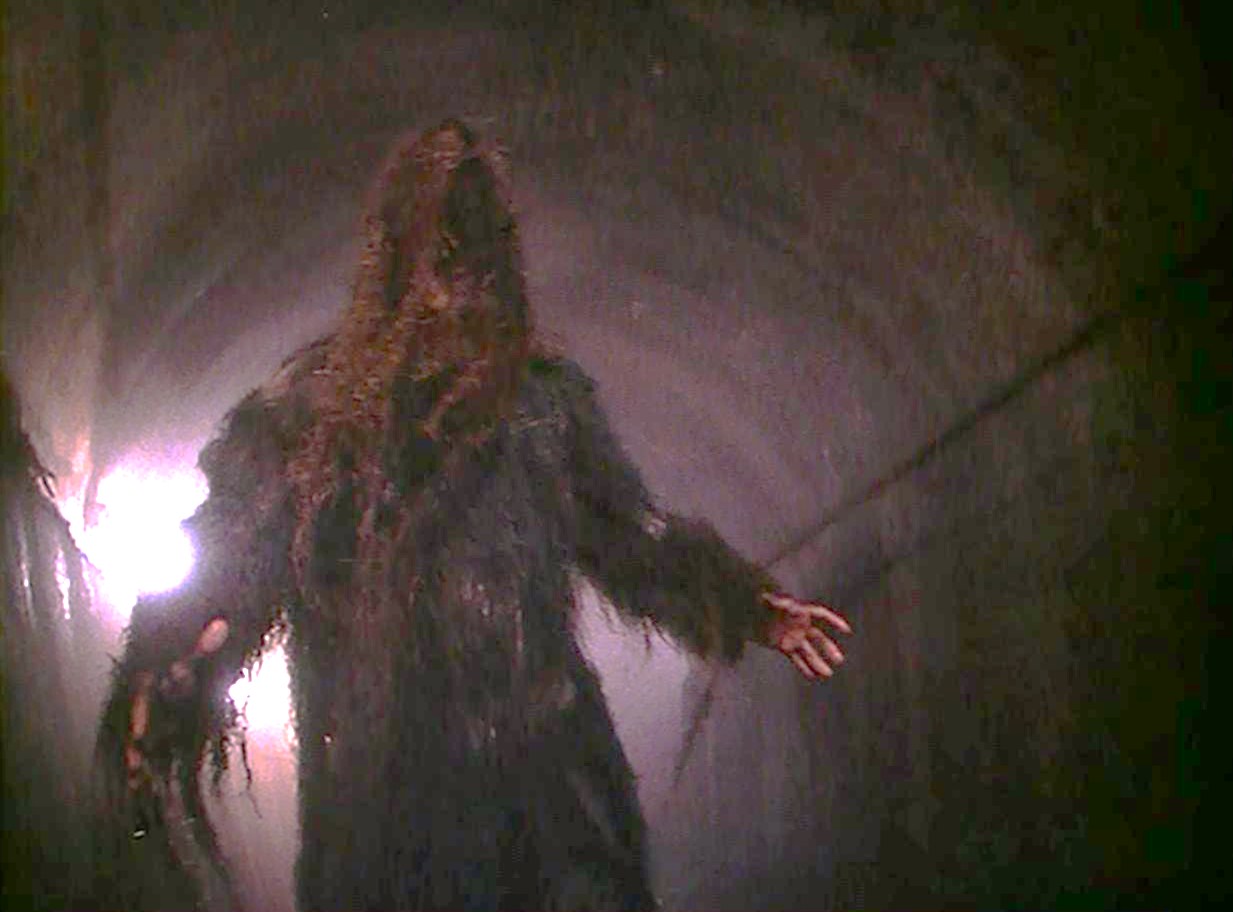
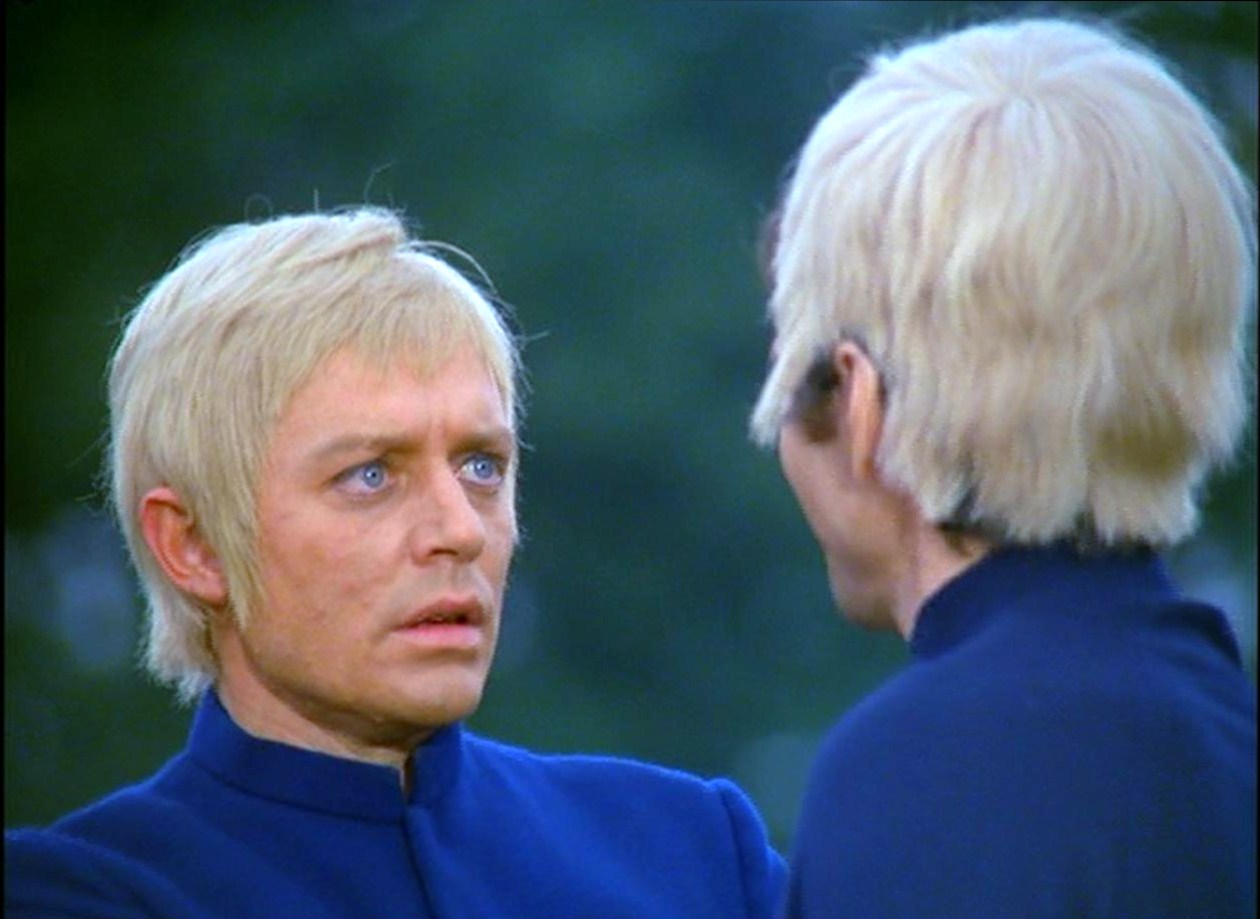
The Cult-TV Faces of: The Monster of the Week


Monday, September 06, 2010

CULT TV FLASHBACK # 118: UFO: "Mindbender" (1971)

By its very nature, science fiction television is a milieu for diligently exploring other realities.

Those "other" realities could include a starship exploring alien worlds in the 23rd century, or a mysterious island in the Pacific, where plane crash survivors toil.

Yet, over the years, some notable installments of science fiction TV series have also occasionally crossed paths with our kitchen-sink reality, right here. 

In this type of story, the fourth wall gets shattered...and shattered good.  

The imaginary world of the characters suddenly overlaps with the real world of the filmmaker or the writer.  These mind-blowing tales thus ask (and demand...) that the regular audience suddenly view the familiar "universe" or canon of a sci-fi series in a different and often challenging way.  In other words, viewers are asked to recognize the artifice of storytelling, of movie-making.

One of the earliest examples of this genre trope came in 1960, in the first season of Rod Serling's anthology, The Twilight Zone. In the episode "A World of Difference" a business executive, Arthur Curtis (Howard Duff) discovers he's not really in his office taking business calls...he's on a movie set. He's an actor playing a part. Reality has shifted like sand beneath his feet. His memories of a wife -- of a life itself -- are nothing more than manifestations of a writer's imagination; of a script.

Rod Serling returned to the same theme in Night Gallery, in November of 1971.  In "Midnight Never Ends," a hitchhiking soldier comes to realize he's just a character trapped in a bad, in-progress story; just a cog in the inner workings of a writer's machine.  He can even hear -- from somewhere high up above -- the keys of a typewriter pounding away.

In 1998, Star Trek: Deep Space Nine featured a variation on this tale. Captain Benjamin Sisko (Avery Brooks) in "Far Beyond the Stars" hallucinates that he's a pulp science fiction author in 1950s America.

As a man named Benny, he writes a science fiction saga about a futuristic space station...and an African-American captain. All those people around him think the story is great, but worry that America isn't ready yet to believe in or accept a black star ship captain. So the question becomes: is Sisko that future captain, living in the 24th century?  Or is he but a frustrated, delusional writer of the Eisenhower decade...imagining a better tomorrow?

Astronaut Conroy discovers a strange moon rock in "Mindbender"
One of the most stylish examples of this self-reflexive story -- a story which finds characters in the drama becoming active participants not in a narrative, but in the "creation" of the drama -- is "Mindbender," from Gerry Anderson's UFO.  

This segment originally  aired on CBS in 1971, and was written by Tony Barwick. 

As you may recall, UFO is set in the far flung, future year of 1980.  The series depicts the on-going battle between Earth forces under the umbrella S.H.A.D.O. (Supreme Headquarters Alien Defense Organization) and nefarious aliens from a dying world; aliens bent on harvesting human organs as replacement parts. 

The stalwart hero of the series, Commander Ed Straker (Ed Bishop) is a tough-as-nails combatant.  With a punk haircut -- and universally adorning a stylish Nehru jacket --  Straker commands S.H.A.D.O. from the cover of a bustling movie studio.

"Mindbender" arrives near the end of the 26-hour long episode series catalog, during a spell in which the writers, actors, and directors were truly working on all thrusters, consistently delivering dazzling science-fiction concepts in conjunction with cutting edge, expressive film techniques 

Wanda Ventham had joined the cast as Straker's gorgeous number 2 at S.H.A.D.O, Colonel Virginia Lake, and the final shows feature some great, amusing banter between Straker, Lake and Michael Billington's Paul Foster, a pilot working for the organization.  Late-era UFO episodes deal  persuasively with the drug/hippie culture ("The Long Sleep"), and even bend and freeze time itself ("Timelash").

In the imaginatively-conceived "Mindbender," an attacking UFO explodes over the lunar surface, just four miles from S.H.A.D.O.'s moon base.   Straker and Foster travel to the moon to investigate.

Leone meets Kubrick, Gerry Anderson-style.
Astronaut Andy Conroy, an amateur author of Westerns, recovers a strange translucent rock from the spaceship wreckage, and very soon loses his grip on reality. 

Specifically, Conroy begins to envision his comrades on Moon base, including Nina Barry (Dolores Mantez), as dangerous, gun-toting Mexican bandits straight out of a Sergio Leone spaghetti western.

Commendably, Conroy's western-style hallucination is visualized by episode director Ken Turner as a deliberate tribute to the famous "Man with No Name" films of Leone and Clint Eastwood. 

The musical score lovingly evokes Ennio Morricone's famous work...almost down to a note.  And stylistically and physically, the episode apes efforts such as A Fistful of Dollars (1964) and For a Few Dollars More (1965).   For instance, Turner repeatedly cuts to extreme close-ups of Conroy's steely eyes, a staple of these great 1960s westerns. 

Gunfight at the Moon base Corral
Additional shots feature grungy, grinning  bandits with bad teeth and other highly-unpleasant physical characteristics.  In other words, these phantasm individuals are purposefully exaggerated in the familiar spaghetti western mode too. 

The episode likewise deploys fish-eye lenses at points, and utilizes slow-motion photography for explosive shoot-out moments. 

Over a period of minutes, then, sterile, high-tech Moon base is transformed entirely (at least in Conroy's perspective...) into an outlaw Mexican town, and a gunfight ensues


I might add, this sort of anachronistic visualization is the last thing you would expect in the gadgetry-heavy, artificial future world of UFO.  It's a jarring conjunction of primitive and futuristic, and is appropriately "strange" and hallucinatory, well in keeping with the episode's narrative.

The aliens are here...
After Conroy's death on Moon base, the offending moon rock gets transferred to S.H.A.D.O. headquarters on Earth, located  under the movie studio. 

There, Captain James, another veteran astronaut, is exposed and also quickly goes insane.  He "sees" all of his co-workers as uniformed aliens and, like Conroy before him, goes on a paranoid shooting spree.  He abducts Colonel Lake, attempts to kill Straker, and is eventually subdued.


But the mystery deepens.  What is going on?


Soon, Straker learns the answer for himself.   In his office, he comes in contact with the offending alien rock.

During an intense argument with bureaucratic, dollar-pinching General Henderson (Grant Taylor) Straker begins to lose his steely composure and grip on sanity.  "Let's get back to realities," Henderson argues, yelling at Straker.

...or are they?
And then -- just as his temper boils over --  Straker hears a voice (from somewhere off-screen...) yell "Cut" and "Print." 

Suddenly, a film crew descends upon him and begins calling him Howard Byrne...the name of an actor on the movie studio where Straker works.

Straker wanders out of his office...only to see that it is a TV show set surrounded by lights, cameras and other filmmaking paraphernalia. 

Confused, he heads out to the studio grounds and actually runs smack into his stand-in (Stuart Damon), who is even wearing a white wig.  Soon, the confused Straker is ordered to report to Theater 7, where the rushes of his "show" are about to begin.

Straker obediently sits down in an auditorium and the footage commences.  He watches as footage from the pilot episode of the series, "Identified," unspools on the screen before him.  After that sequence, Straker watches in torturous paralysis the death of his young son, Johnny...all material from the episode "A Question of Priorities."

Face to face with a stand-in.
Paul Foster then sits down next to Straker, calling himself "Mike" (Michael Billington), and notes that this traumatic material will "make a great episode." 

An emotionally-affected Straker,  forced again to countenance his myriad personal failures (a recurring theme of the series in episodes such as "Confetti Check A-OK" and "A Question of Priorities"), objects. 

"That's my life!  That's my son!"

After seeing his son struck by a car, and his wife, Mary, tell him that she never wants to see him, Straker begins to really lose it (an outburst which "Mike" compliments as "method acting." )

But soon, the ever-rational Straker realizes that he has been adversely affected by an alien "booby trap," one "aimed at the mind."  He understands that to get back to his world, his reality,  he must focus.  General Henderson has already informed him that he has a "monkey on his back," called "dedication."  Now he must tap into that dedication.

Isolation and alienation in the auditorium.
Straker returns to HQ to "play" the scene with General Henderson over again.  After a rapid, highly cinematic pull-back away from Straker, depicting our protagonist as but one of many  working actors on the studio lot, we get back to "realities," as Henderson puts it. 

With dedication and concentration, Straker recites his "dialogue."  He gets back in "the moment."

The longer he goes on, the more that Straker's reality reasserts itself.  The film crew transforms before our eyes -- in almost iconic composition -- into the courageous  men and women of S.H.A.D.O.  The walls re-form -- the fourth wall re-established -- and Straker is home.

I admire how "Mindbender" works so well on two levels.  On one level is the literal narrative: the story of an alien "booby trap" confusing the minds of S.H.A.D.O.'s best and brightest.  On another, more metaphorical level, the subject here is film itself; how sometimes we replay events in our lives as if they're old movies.  We see this in Conroy's subplot, as he imagines himself a cowboy.  And we see it -- tragically -- with Straker, as he is forced to relive all his personal pain on the silver screen.

Straker strenuously objects to the idea that movie makers would steal his life and his memories and "put them up on the screen" for the entertainment of others...but that's what the art-form always does.  It takes from real life...and not always in a pleasant way.  Tragedy, regret, pathos...they all make a "great episode," don't they?

"This will make a great episode..."
"Mindbender" also gets at the fragility of the whole process of filmmaking, of the whole illusion, in some clever way.  Every week, we tune into a show like Star Trek, or Alias or UFO and willfully suspend our disbelief. 

We know we are watching actors and special effects, a filmed entertainment with a pre-determined outcome and an emotion-provoking musical track. 

And yet with our whole minds (and our whole hearts...) we dupe ourselves into believing, after a fashion, that what we are seeing is "real;" that these characters truly "exist." 

UFO playfully blows the lid off that carefully constructed folie-en-famille, revealing to the audience not pilot Paul Foster, but actor Mike Billington; pulling back on high-angle shots of Moon base, Skydiver, and Straker's office and deliberately showing us that these environs are all carefully-constructed sets...artifice.

This is a high-wire act, be certain.  The curtain is pulled back and the truth revealed, but in a science fiction series like UFO, there's no guarantee that once revealed, the magic can be restored.  Yet it is, most definitively, restored.  As viewers, we greet Straker's escape from our reality back to his world as a huge relief.  We breathe easy again.   He escapes into fantasy, as perhaps we might like to do.  The walls of suspension of disbelief are, again, erected...and we sneak back in, along with Straker.  We're back in the drama, back in the shared delusion or dream.

"Mindbender" plays beautifully with form and anticipates our every reaction.  The magician reveals -- at least briefly -- his hand, and then it's back to the magic again. And in shows like "A World of Difference," "Midnight Never Ends," "Far Beyond the Stars" and "Mindbender," the artist not only tells us a story; he invites us inside the process to take a nuts-and-bolts look at how that story gets delivered to us; at how the artistic mind conjures up the illusions of another world, another reality.

This kind of story can be done and has been done many times as a self-referential joke...a lark.  But sometimes -- when it is vetted so brilliantly (as is the case on UFO) -- this long-standing genre convention makes us ask important questions about what is real life and what is fantasy. 

More than that, it asks us to consider the reasons that we flock so readily and easily to the fantasy.

Sunday, September 05, 2010

The De Palma Thriller Series Begins Monday

Movie Geeks United begins a five-part series tomorrow night, Monday at 10:00 pm, celebrating the upcoming 70th birthday of director Brian De Palma. 

The series features  "in-depth analysis of five seminal thrillers from director Brian De Palma. Guests include producers Edward R. Pressman and George Litto, actors Keith Gordon and Nancy Allen, editor Paul Hirsch, critics John Kenneth Muir and Armond White, and cinematographer Vilmos Zsigmond."

Monday night's installment is an up-close look at the thrilling Sisters (1973), De Palma's great twist on the Psycho aesthetic.   You can start listening in at 10:00 pm, or catch-up after the show airs, by visiting Blogtalk Radio, here.

Each successive night of the week, check back in at the same location for shows on Carrie, Dressed to Kill, Blow Out and Raising Cain. I'll post reminders every day during the week about the upcoming programs.  Don't miss em!

And in the meantime, here's a look back of my review of Sisters:

Watching Brian De Palma's Sisters (1973) today, it's easy to detect the reasons why the director has so widely been touted as "the Next Alfred Hitchcock." His first thriller is perhaps the most inspired homage to the master's Psycho ever created (at least until the same director's Dressed to Kill in 1980).

First and foremost, the "Janet Leigh" trick (the notion that a lead character should expire early on in the proceedings...) is transferred successfully here. Also, in Sisters a surprise twist involving identity resonates and interacts meaningfully with Psycho's climax. Plus, De Palma shares another important trait with Hitchcock: a love of gallows humor. And for all the brutal, crotch-stabbing violence of Sisters, the film exhibits that wicked and subversive sense of black humor.

Yet De Palma's genius is revealed not so much in his multitudinous contextual references to the canon of Hitchcock (including Vertigo and Rear Window), but rather in the dramatic and clever manner by which he fractures the film's imagery. In other words -- in Godard's words -- it's not where De Palma gets his ideas from, but where he goes with those ideas. Here De Palma's purpose is entirely his own: to express, finally, a splintered mind/splintered sense of reality in the language of film grammar, thereby replicating the explicit content of his narrative.

...Inspired by a Life Magazine article about the Russian Siamese twins Masha and Dasha, Sisters tells the story of a gorgeous model named Danielle (Margot Kidder), who appears on the local New York TV game show, Peeping Toms (think: The Dating Game) and then goes out to dinner with the winning contestant, Phillip Wood.

But Danielle's bizarre ex-husband, Emile (William Finley) stalks Danielle to the restaurant and makes a scene there. Concerned, Phillip escorts Danielle home to Staten Island. And though her crazy husband stands watch outside their apartment, they spend the night together.

The next morning, Phillip is brutally killed after hearing Danielle speak to her (unseen) sister, Dominique. The murder (which occurs on Danielle's birthday...) is witnessed by plucky investigative reporter, Grace Collier (Jennifer Salt), from her own apartment. The police don't believe Grace's story of homicide because she wrote an expose about the police that the force considered anti-cop. Grace investigates on her own, drawn into a bizarre story of co-joined siblings, a mysterious mental institute, and the shocking truth behind Dominique and Danielle. We learn that Danielle never learned "to accept" the death of her twin Danielle, and, furthermore, that she "kept her alive" in her mind so as to deal with the guilt of having been the twin to survive a surgical separation. Sexual experiences with men (like Philip or Emile) represent the catalyst that awakens the Dominique side -- the murderous side -- of Danielle's tortured mind.

In 1976, Brian De Palma staged the climactic scenes of Carrie utilizing split screens. There, in a scene set at the high school prom, he crafted a visual cause-and-effect relationship with opposing freeze frames. In one frame, Carrie (Spacek) would gaze at something, a target. In another, simultaneous frame, her psi energy would generate explosions or fire.

In Sisters, De Palma's purpose is different, but no less powerful. First, he deploys the split screen to ease the audience through a transition from one protagonist to another. He thus finds a new way of "doing" Hitchcock; of expressing the essence of the "Janet Leigh Trick."

As Philip lays dying in Danielle's apartment, the frame is split. On one side (and filmed from inside the window), the audience sees Philip desperately seeking help as he dies. On the other side of the frame, in a different screen, viewers see from outside the window that another character is witnessing this bloody demise. It's the reverse angle, essentially. As Phillip -- current surrogate for the audience -- dies bloodily, Grace Collier, new protagonist, is introduced. It's a visual passing of the torch, a way to get from Janet Leigh, essentially, to Vera Miles, without the connecting, seconed-act presence of Martin Balsam. Instead, the switch in protagonists is expressed instantly, within the confines of a fractured composition. The effect: the audience feels "torn" (or splintered, like Danielle). The object of our interest and sympathy passes violently away and we are shocked. Simultaneously, our curiosity is aroused by the new presence in the film.

De Palma also paints a picture of contrasts with his split screens in Sisters. In one sequence, Grace Collier and unhelpful detectives are seen arguing in the downstairs lobby on one half-of-the-screen as the bloody clean-up of Philip's homicide in Apartment 3R is depicted on the other screen. Here "time" is the notion held in common between competing, simultaneous images. One image reveals time squandered as the police delay Grace Collier. The other image (of Danielle and her husband, Emile, hiding the murder..) reveals time used meaningfully. The effect generated here is suspense: we want to scream at the police to move faster, to do something, because we can see the progress of the cover-up. Again, we are asked to integrate or balance competing feelings: a sense of wanting Danielle to be caught against a sense of wishing Danielle not be caught. De Palma's splintered composition permits and actually encourages both impulses.

In it's totality, Sisters involves a severe psychotic split. Danielle's damaged mind has "split" so as to accommodate two distinct, individual (and competitive...) personalities: hers and Dominique's. Her schizophrenic nature is reflected in De Palma's pervasive use of the split screen; and the impact of this split is revealed, in narrative terms by the myriad thematic allusions to Psycho. There too, Norman was two people: himself and his mother; an innocent and a guilty party. One individual seemed to be two in Psycho, but in Sisters the idea of doubling/twinning/splitting is carried to new heights thanks to the technique of the split screen editing.

Even our ears, too, in Sisters are tuned to "register" Psycho thanks to Bernard Herrmann's score, but the visual imagination here goes brawnily beyond Hitchcock's considerable triumphs. Psycho tricked us (brilliantly), Sisters "splits" and divides our attention, mirroring the psychosis of Danielle/Dominique...

50 Years Ago: Land of the Lost: "Repairman" (October 2, 1976)

“Repairman,” the fourth episode of  Land of the Lost’s  third season, shows many signs of creative growing pains, though perhaps not as many...