Tuesday, October 17, 2006

TV REVIEW: Dexter: "Crocodile"

My newest TV addiction is Showtime's freshman serial killer drama, Dexter. We hear so much about morality in politics these days ("values voters" and all), but often morality is just a buzz word or a code for validating entrenched hate ( it's moral to hate gays; it's moral to hate terrorists; it's moral to exercise the death penalty, it's moral to give tax breaks to the rich and not the poor...at least according to some "values voters.")

Frankly, the question of morality (and what constitutes morality...) is often left unexplained or undebated in our national conversation.

So far as I can discern thus far, Dexter is a unique series in that it steadfastly addresses that void. As a series, it constantly asks the question: is Dexter Morgan - a sociopath - ...moral?

Wow! How can I ask such a question? I must be a crazy liberal, right? Well bear with me okay. Consider the facts: Dexter protects and nurtures his sister, Debra. That's "good" isn't it? He also takes wonderful care of his girlfriend Rita's children. He protects them and makes them happy. That too is "good," right? Dexter even boasts his own moral code: he follows the "Rules of Harry (James Remar)," his deceased Dad. And Dexter punishes the guilty (admittedly outside the confines of law...). Is enforcing "justice" not the very definition of righteous; of morality? What do you think? Am I barking up the wrong tree here? Is there a case to be made for Dexter as a moral man?

So...Is a man who can feel nothing...capable of morality? That's the enduring and provocative interrogative that Dexter has so expertly raised, and I have to admit, I'm obsessed with the notion. Can a serial killer with no milk of human kindness, no emotions, no feelings be termed good? Can someone totally dispassionate and boasting an insatiable urge to kill, contribute to the betterment of society? Can someone who has never felt emotional pain, truly understand what it means to be human? Or, does he - lacking the barometer of emotions - better understand our existence than those of us who have our judgment clouded? I wonder. And I'm very happy that a mainstream TV series has dedicated itself to tackling so valuable a notion. It proves to me that television has indeed arrived in a new golden age. Like Twin Peaks, Star Trek or Buffy the Vampire Slayer, Dexter looks to me like it can be analyzed in the same manner as great literature. Based on the first two episodes, it merits that comparison.

Many questions about morality occupy "Crocodile," Dexter's sophomore episode. At one point, Dexter even asks (in voiceover) "if God is in the details - and God is in this room - God is with me." It's a fascinating point to consider: Dexter employs eye-for-an-eye, Old Testament-style judgments against the evil, and he's learned to "always be sure" that his victims are guilty. So would our society, nay should our society laud and embrace a man like Dexter? Or shun him? Would you want him marrying your sister? Raising your kids?

Before you answer, consider at least that Dexter doesn't fool around with kids, practice graft like some very prominent Conservatives in Congress. Those men are worse than Dexter in my book. They are hypocrites who have hid their bad behavior under the label "moral" for years, right? They have judged others immoral (like President Clinton), when their sin was infinitely worse than his.

In its details, "Crocodile" confirms some of what I blogged about the premiere. To wit, Dexter comes flat out and notes that he is "the outsider looking in" on human society. This is troubling to him, however, because although he can see the pain of others, he "can't feel their pain." This observation comes up in regards to a gangster's brutal murder of a cop and his wife. Dexter attends the funeral and feels out of place. He's bored having to look grief-stricken when he really feels nothing. That's not nice, or even patient, but it doesn't speak directly to Dexter's morality. We can be moral without being polite, right? What does speak to Dexter's morality is that he wants to punish the guilty, and must weigh the consequences of doing so. To wit, he has an opportunity to kill the man who ordered the hit on the cop and his family, but to kill him then and there (in a men's room) would also expose Dexter and end his future capacity to punish the guilty. So which is the greater morality? Killing the bad guy, or preserving oneself to kill many bad guys? That's a true moral dilemma, folks.

Another one of Dexter's bad guys is Matt Chambers (alias Matt Brewster, Matt Rasmussen), a serial DUI murderer who has escaped justice in Boston and now Miami. If Dexter kills the local gangster, Matt Chambers gets away...and can kill again. So Dexter makes a choice.

What I like about this episode of Dexter, as well as each episode I've seen thus far, is that Dexter raises all these questions about morality but doesn't seem to boast a particular agenda. It seems more interested in observing and examining morality than in taking a definitive stance on it. The series doesn't sentimentalize Dexter. He calls himself a monster and does terrible things. Valid points. He also often responds to grotesque, macabre situations with tongue-in-cheek humor. So the series does not view him as a saint or anything like that...and yet he does good works. In recent years, television has given us many unusual heroes with foibles. Think of Monk, the detective with OCD; or Denny Crane, the crusading lawyer with alzheimers and a penchant for romancing younger ladies and talking out of turn. Dexter purposefully carries this trend as far as it can go, asking us to observe the life of a crusading sociopath; a man with no feelings, but who definitively does "good," who cleans up society's trash; and who is decent to his family and extended family.

Some people decry moral relativism in our culture. But after years of hearing some prominent politicians discuss "evil doers" across the globe and then categorically deny health care to children at home, I'm delighted to see a series that acknowledges that there are shades of gray in our world. Everything isn't black and white, and Dexter is the most philosophically deep program to come down the line in quite some time. It is consumed with dark questions about our existence, and what constitutes human morality.

Frankly, I'm riveted.

Saturday, October 14, 2006

TV REVIEW: Dexter: Series Premiere

Showtime's new series, Dexter, is a humdinger. Based on a novel "Darkly Dreaming Dexter" by Jeff Lindsay, this hour-long drama follows the life and pursuits of Dexter Morgan, (Six Feet Under's Michael C. Hall), a blood-spatter forensic analyst living in Miami.

Sounds like some variation on CSI or the like, right? A crime scene investigator working in a major American metropolis? Well, here's the first twist: the charming, handsome and well-liked Dexter also happens to be a sociopath...and a serial killer too. He readily admits this in the series premiere (in a well-written voice over); that he has no feelings whatsoever for anyone in his life. Instead, he feels nothing at all. Dexter can almost feel emotions for his sister, Debra, but otherwise...there's just an overwhelming void in his heart. "You can't get emotionally invested," he warns Debra - a cop - during her investigation of a serial killer who drains the blood from his sliced-and-diced victims.

When Dexter says that, he's speaking from experience...

Again, people reading this review might say "ho hum," another TV show about a serial killer. What's the big deal? Well, first of all, here the killer is the protagonist; not a villain to be hunted and caught by well-dressed (but ultimately interchangeable...) stock cop characters.

Even more impressively, Dexter adopts a wonderful narrative twist and central conceit. You see, Dexter's Dad (James Remar), also a cop, discovered that his (adopted) son Dex was a sociopath when Dexter was still very young. When he learned this fact, Dexter's Dad decided that his boy's urge to kill could be co-opted and re-directed for good, positive purposes. He realized that Dexter could exercise his urge to be "bad..." on bad people...murdering the perpetrators the police simply couldn't catch because of legalistic loopholes. Then Dexter's father taught his son how to hide his own sociopathic tendencies while spotting them (or targeting them...) in others. Flash forward to today: Dexter tortures and kills menaces like Mike Donovan, a child murderer who has evaded the police and gotten away scot free. While killing Donovan, Dexter notes his repulsion for the serial killer, and moreso for the murder of children. "I have standards," he notes; defining the difference between himself and his brethren.

The first episode of Dexter is filled with clever observations (again, usually in voice over) from Dexter about the normal populace he interacts with and hides from. Thus, in the time honored tradition of science fiction programs such as Star Trek, he is essentially the "resident alien" or "observant outsider." Lacking a conscience and lacking any emotions whatsoever, Dexter is a character who can look coolly and distantly at us. He has a perspective on humanity that comes from outside it. "Normal people are so hostile," he trenchantly notes at one point. "I'm a very neat monster," he realizes at another point, proving that he is also able to turn the microscope on himself.

Can a sociopathic serial killer utilize his "handicap" or "disease" (or whatever you call it...) productively for society at large? That's the central question of Dexter, and it's the most original idea for a TV series I've seen in some time. You watch this show and you're immediately drawn into Dexter's world view. You see things how he sees things: without passion or prejudice; without love or bias. He is a monster, and yet he's human through and through. Still, he lacks the essential trait that makes us all what we are (that being feelings...) and yet - thanks to his Dad's teaching - he boasts a moral code of sorts. Sure it isn't legal; but vigilantism never is.

Michael C. Hall is terrific as Dexter Morgan, and it's awesome how funny - and truth be told, how deep - this series is. For instance, there's a subplot involving Dexter's inability to understand "mating rituals" and sex. In fact, part of his plan to hide his sociopathic tendencies from the rest of the world involves a girlfriend named Rita (Angel's Julie Benz). She was raped some time back and now vehemently distrusts men. This means she doesn't want to have sex, and that suits Dexter just fine. He finds intercourse "undignified." Unfortunately, Rita realizes how much she trusts and likes Dexter, meaning that is ready to have sex with him...an idea Dexter can't stomach.

Dexter Morgan is an unusual and highly unconventional protagonist, and it looks like many episodes will involve his cat & mouse hunt of the serial killer also preying on the population of Miami. His new nemesis carves up bodies...but leaves no blood at the crime scene. Dexter is impressed by his opposite's skill, and learns that he manages this feat courtesy of a refrigeration truck. In the first episode, Dexter hunts him by night, and interestingly, the as-yet unseen serial killer is also aware of what Dexter "is," and thus throws down the gauntlet: he dumps a decapitated head on Dexter's car during their first night-time encounter.

Fascinating and boasting a distinct point of view, Dexter is already appointment television. It's an inventive series, splendidly acted and written, but what I like about it most so far is the high quotient of black humor. For instance, Dexter keeps a sail boat. Not because he likes sailing so much as because it is handy for body disposal. The boat is named "Slice of Life..."

Friday, October 13, 2006

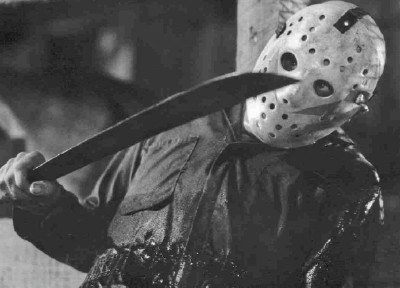
Happy Friday the 13th


Chi-chi-chi-chi, haah-haah-haah...

(That's horror-ese for: Don't Go In The Woods. Or: don't have pre-marital sex at Crystal Lake, and don't smoke weed either...)

Thursday, October 12, 2006

The Bionic Woman Gets "Re-Imagined"...and I Get a Headache

My good friend Fred - who always has his ear to the ground on genre news - sent me this interesting item. The next sci-fi series to get the Hollywood Special and suffer through a "re-imagination" (a la Battlestar Galactica or Night Stalker...) is the 1970s Lindsay Wagner classic, The Bionic Woman. And guess what? It's from the producer of the re-imagined Battlestar Galactica too!

Here's the skinny according to author Josef Adalian:

"Battlestar Galactica
exec producer David Eick is teaming with feature scribe Laeta Kalogridis to reinvent "The Bionic Woman" for NBC. Eick and Kalogridis will exec produce a new take on "Bionic," a 1970s spin-off of "The Six Million Dollar Man" in which Lindsay Wagner played tennis pro-turned-superwoman Jamie [sic] Sommers. Skein aired for two seasons on ABC before shifting to NBC in 1977 for its final year.

"It's a complete reconceptualization of the title," Eick told Daily Variety. "We're using the title as a starting point, and that's all."

Sounds familiar (and arrogant...) doesn't it? Because, what fans of the original Bionic Woman really liked was not the story; not the characters...it was just the brand name, right? So that's all that's going to be used in the re-do. What genius! I'm glad there are clever producers out there who realize storyline and characterization don't wins hearts and minds of fans; only franchise titles do. These producers could create memorable new, artistic shows (with memorable new titles), but instead, they feast on the bones of fan nostalgia and craft GREAT new product like The Wild Wild West (1998) or the movie version of Lost in Space (1998). We all want more of that magic, don't we?

And by the way, did I tell you, I'm remaking Star Trek, but my version also just takes the brand name, not the concept or characters. The series is actually about running (or trekking...) around Hollywood chasing celebrities (or stars...), thus a Star Trek. I'm sure Star Trek fans (who just love the name of the original show, not the characters or storylines...) would appreciate that. Wouldn't they?

What makes this news even worse is that Kalogridis is the talent behind the WB crapfest that was known as Birds of Prey. In case you forgot, that was the short-lived re-imagination that cast Batman as an absentee father, whose reign of crime fighting was remembered by Gothamites only as a myth. Because people really only liked the title Birds of Prey (it was a comic...), not the actual content.

Sarcasm aside, it's sad that these bean counting vultures are the people re-making our favorite shows. People who see marketable titles, and then decide to "re-invent" them not according to the property's inherent value, but according to their infinite personal wisdom instead. .But I'm sure there will be fans who eat up the new Bionic Woman and say it will be superior to the "cheesy" and "old" original. Because if there's any ruling edict of Hollywood remakes it is this: anything that came about in the 1970s is cheesy, and everything that is old, sucks. Right?

Wednesday, October 11, 2006

The Happiest Day...

Monday, October 9th was truly one of the happiest days of my life. My beautiful and incredibly strong wife, Kathryn gave birth to our first child, a son named Joel. He's the most adorable and sweet baby you've ever seen. We just got home from the hospital this afternoon, and so I missed blogging this week's Heroes and Friday Night Lights. Trust you'll all forgive the interruption in the blog on this occasion...

I guess I just wanted to share with all my readers the deep emotional joy and euphoria I feel at having this blessed, healthy son in our midst. In a silly way, I had hoped he'd arrive on a special day for me (Friday the 13th...), but seeing him here in my office nursing with Kathryn (right next to a cardboard stand-up of Captain James T. Kirk...) , I realize every day for the rest of my life will be very special indeed, and filled with love.

Don't worry, I won't blog here about breast-feeding or diaper changes - at least not often - but for today at least, I just couldn't keep this joy to myself...

New Column up at Far Sector

My monthly column is now up at Far Sector. It's called "The End of the World as We Know it (On Network Television), and looks at some of the early episodes of this season's sci-fi shows.

Here's a sample:

Last season (2005-2006), network television acknowledged the startling success of ABC’s Lost with a slew of imitators: serialized science fiction TV series that combined mystery and soap opera elements. All of them—NBC’s Surface, CBS’s Threshold, ABC’s double-hitter: Invasion and Night Stalker — bit the dust. None survived to see a second season (and in the case of Surface and Invasion, that’s a shame, as they both had a lot of promise.)

This season, the networks are at it again, attempting to blend science fiction 'high concepts' with soap opera character melodrama. The aliens and sea monsters of last year are absent, replaced by an entirely more fascinating breed of 'what if' set-ups. The trend has skewed from the fantastic and the extra-terrestrial this year to the dark. Real dark.

In particular, CBS’s Jericho is television’s first post-apocalyptic series since Planet of the Apes and Logan’s Run came along in the Cold War 1970s, and NBC’s Heroes gazes lugubriously at the next evolution of humanity. Yes, it’s a superhero show…but also something darker and more mysterious; something with a portentous sense of gravitas. In particular, both series appear obsessed with a change in the nature of humanity and our world; the end of man’s 21st century civilization as we know it. I can only account for this new mini-trend by noting that it’s surely a sign of the times. With Christian fundamentalists populating the White House and Islamic fundamentalists leading Iran, how long is it before this so-called global 'clash of civilizations' ends badly for all of us? Which breed of religious zealot will push the button first? Both sides want to initiate the “End of Days,” so it’s a toss-up, especially given our reckless new policy of pre-emptive war.

So — as always — television capitalizes on the cultural Zeitgeist, and in this case, predicts a 'shift' in our world that could be catastrophic.

You can read more of these observations, and the rest of the column,
here.

Saturday, October 07, 2006

SATURDAY MORNING CULT TV BLOGGING: Flash Gordon: "The Frozen World"

This week on Filmation's Flash Gordon, we have Chapter 8: "The Frozen World." Flash, Baron and Zarkov are hatching plans to unseat Ming (while Dale dutifully brings them tea...). The group realizes that the rebellion will need huge quantities of fuel to power their fighters, in particular, Orium. Prince Barin notes that Orium can be found in large quantities in the kingdom run by his cousin, Fria. It's called "Fridgia," and it is at Mongo's North Pole.

Flash, Dale, Zarkov and Thun head off in a leaf fighter (evading Ming's forces...) to meet Fria and request her help. Once again, Fria is a beautiful woman and Dale gets jealous (Hey, didn't that also happen with Queen Undina?) Anyway, Flash tells Fria that "the time is coming when the people of Mongo will rise up." Fascinated by the Earthling, Fria escorts Flash on a tour of her snow castle and informs the delegation that "ice itself" is the building block of her culture. She also tells Flash that he will find the "pleasures" in the city to his liking. Translation: she may live in Fridgia, but the Queen's not frigid.

Anyway, one of Fria's suitors, Count Mallow (That's Marsh Mallow, to you...) grows angry over Fria's attentive attitude towards Flash and attempts to kill Dale and Flash while they're swimming in a pool. Later, Flash rescues Mallow from a giant ice worm, and Mallow recants his evil ways. Unfortunately, before everyone can kiss and make up, Mallow, Dale, Zarkov and Thun are captured by a race of giants, and Flash and Fria are buried in an avalanche.

To be continued...

"The Frozen World" re-uses some footage we've seen before in Flash Gordon. The lair of the giants is actually the headquarters of the Beast Men from an earlier chapter. It wouldn't be so noticeable except that Fridgia is all icy blue, and the Beast Man mountain is desert red and orange. Oopsy.

Some other fun facts from this episode: Thun lets us know that "worry" is the natural state of the lion men. And also, Zarkov points out Sol, Earth's sun, to Dale, during the voyage to Fridgia. It looks very, very far away...

If you're keeping tabs, so far Flash has united The Hawkmen, Barin's Arboria, the Lion Men, the underwater kingdom of Undina, and now he's added Fridgia to the list. It's his own coalition of the willing to stop that despotic dictator, Ming.

Friday, October 06, 2006

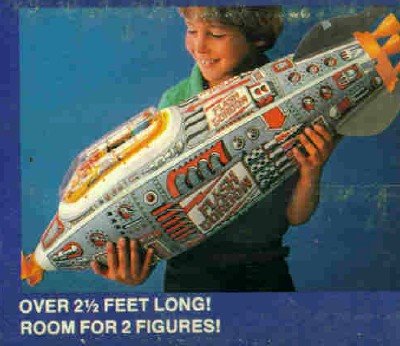
RETRO TOY FLASHBACK # 48: Mattel's Flash Gordon Rocket Ship


As regular readers here are aware, I've been blogging the animated Filmation series from the early 1980s, Flash Gordon. Considering that, it feels like an opportune time to feature a collectible toy from that TV series: Mattel's inflatable Flash Gordon rocket ship. What a toy this is...

Straight from "the greatest adventure of all," this whopping rocket ship ("not for use as a flotation device," in case you were wondering...) is over 2.5 feet long (and was made in Taiwan). It's a giant of a toy, with room to hold two action figures from the Flash Gordon Mattel line. The box notes that the toy is over "2.5 feet [81.6 cm] long from nose cannon to tail fin when chamber is filled with air."

The rocket's cockpit houses two figures and can "detach" to carry Flash or Zarkov (not included) on adventure. Yep, it doubles as a "modular space shuttle" that can be rolled out on "a recon mission." The nose cannon also detaches from the central rocket (and "re-mounts with cloth fastener!"). Also, the box suggests that kids can find "the eyelets and your own string" to hang the ship up.

I remember collecting the Flash Gordon action figures as a kid. I had four of 'em to be precise: Flash, Zarkov, Ming and The Lizard Woman. I bought them at a store called Newberry's in Verona, New Jersey...where they cost a dollar a piece. But I also recall seeing this massive inflatable rocket ship in the pages of a Sears catalog and desperately wanting it.

I never actually owned the rocket until I found one mint-in-box on E-Bay for cheap about two years ago. Although I like to keep my toys in their packages, I couldn't resist opening and playing with this one. It now stands inflated in one corner of my office, where the cats bat it (worse than Ming the Merciless, I guess...) and my wife complains that it's going to be destroyed.

Still, this toy is totally awesome, in part because of the size; in part because it is light and easy to maneuver, and in part because it actually has that visible cockpit atop the ship where you can sit your Flash figures! That's just cool...

Thursday, October 05, 2006

TV REVIEW: Friday Night Lights

Here's an admission for you: I despise football. I hate everything about it. Just having football on the TV gives me a throbbing headache. The sounds of the crowd and the whistles and the commentary make me want to puke. Why the fervent non-love? Well, there are too many reasons to name, but here's a good one: many of the professional players are overpaid, over-glorified thugs.

Another geeky complaint: I have painful, long-buried memories of professional football pre-empting Star Trek reruns on WPIX when I was a kid. I carry those scars to this day...

And besides, soccer is an entirely more fascinating and skill-based game than American football anyway...

So take this non-fan seriously when I write these words: the new NBC program Friday Night Lights offers one of the best shot, best edited and best acted series premieres in the history of the medium. Yes, it's that good. Unbelievably good. Like...feature film quality good.

Friday Night Lights, developed for television by Peter Berg, charts the life and times of a small West Texas town that loves football. The high school football team, "the Panthers," is the non-stop subject du jour on the radio, on local tv, in the papers, at political meetings and in the corridors of the high school. Football is love; football is life; football is obsession.

And this focus makes things really tough for the Panthers' rookie coach Taylor (Kyle Chandler). He must prove himself worthy of the coveted job, and quick. "With expectations like this, the only place you can go is down," he is told during the countdown to the first big game of the season. He is also hounded all over town by citizens who offer him unwanted advice, support...and ultimatums. "We want to win championships," he is reminded constantly. The season premiere follows the events in the small town from a Monday in training to the first Friday night game, and builds up tension so gloriously you can almost forget all this rigmarole is about a stupid game in which people throw and catch a ball, and tackle each other.

But television, like movies, isn't always about whether you win or lose. It's about how you play the game, and Friday Night Lights plays like no other show on television (or any show in television history...). The episode I watched was visually distinctive, to say the least. It appeared to be cut together entirely of "stolen" moments. In other words, the series boasts a nearly cinema-verite look in which it appears footage were grabbed on the fly and not laboriously prepared and staged (which of course, is exactly how it's done...). This brilliant visual palette and conceit captures something essential and true about the life of these townspeople. If all feels spontaneous, anticipatory, portentous, ephemeral...and isn't that the precisely the feelings we experience before we watch any sporting contest, local or televised? Who will win? Who will lose? Who will rise? Who will fall?

But if Friday Night Lights were only great-looking and only concerning sports-cliches, I wouldn't give a damn about this series. Instead, Friday Night Lights is something deeper. It's a window into a weird and fascinating American sub-culture ("This is Texas football," we are informed, with great seriousness). This is a world where Christianity and football are oddly tied together, like Jesus Christ himself dreamed of being a quarterback or some such thing. There are multiple times in the premiere episode wherein religion and sports are conflated into one glorious thing. "Here's to God and Football," one person says, as though he truly believes his team his blessed by The Lord and destined to win. Like God - if there is one - doesn't have more important things to worry about. This kind of hyperbole goes further. The young quarterback, Jason Steele is described in glowing terms as a "super star" and a "great leader." Even this is not enough for the town's myth-building apparatus, which includes the press. Taylor tells the news reporters that Steele's also a man of high moral fiber. Like that's somehow necessary to throw passes, right?

As depicted on this series, the weekly Red State football ritual looks distinctly bizarre...and delusional. "Let's pray" is a common refrain before games, during games, and after games, and yet when Jason Steele falls in battle (on the field) and is replaced by a great new star, he is virtually forgotten. The Panthers win their first game and get a new star to worship, and the old star suffers in a hospital with a spinal injury, his future career destroyed. Whom Gods Destroy?

If I'm not making myself plain, let me put it this way: Friday Night Lights isn't merely about football; it's about the whole culture surrounding football (and in particular, Texas football). As a slice of bizarre, almost alien life, it is unmatched in its sense of observing human life unfold. The premiere opens, for instance, with views of a shabby, tiny house with a trashy front yard and used old car pulling up. This is exactly what America looks like in a lot of places...but we don't often see this unromantic, realistic vision on Hollywood-produced television. Instead, Friday Night Lights visually cues us in to a very important fact: football is an obsession in West Texas because the people who aren't lucky enough to live in the butt-ugly McMansions (which we also see...) instead live in poverty.

It's not that football is their escape...it's that football is their distraction from unpleasant reality. The hullabaloo around the game distracts the citizens from how crappy things are right there in their front yards. And that's kind of sad, isn't it? That we elevate high-school athletes to men of "moral strength," and "superstar" status because they can run and tackle? That we throw our daughters at these men like whores so that we can receive some sense of basking in their greatness? Let's face it, we should be focusing on making certain our neighbors are fed and sheltered and warm. Elevating football to Christian crusade only puts a new spin on a very old game of bread and circuses.

But damn if this isn't a great show...

Tuesday, October 03, 2006

TV REVIEW: Heroes: "Chapter Two - Don't Look Back"

Well, I officially have a new TV addiction...

I enjoyed Heroes pretty well last week, but found myself absolutely engaged and immersed in the series on round two. "Chapter Two" was even more engaging and mysterious than the decent pilot. In fact, I'd go further. Although critics are proclaiming that Studio 60 is the best new drama of the season, I'd say Heroes takes that honor at this early juncture. At least until I watch Friday Night Lights, which has been the recipient of some hard-core critical buzz. I hope that one's good too. All television should be this addictive. Then I'll never get anything done...

But back to Heroes. In "Don't Look Back," the main characters deepen, and viewers are introduced to some new and compelling characters, including the villain. We also get our first look at the series' McGuffin (a Hitchcockian term for those of you who didn't know...): Dr. Surish's computer program that can locate the "special" people by tracking "DNA migration patterns" of the "human genome." This is likely what he died for. His son looks dedicated to completing his work, and this week a hit-man posing as an exterminator nearly gets the younger Surish.

On the new hero front, this week we meet Matt Parkman, played by Greg Grunberg (an actor I've admired since his days on Felicity...), a cop with the power to hear the thoughts of others. He's going through some rough times in his marriage, and facing the ridicule of the police department because he's flunked the detective exam three times.

Anyway, Matt runs across a crime scene in "Don't Look Back," one created by the series' maniacal villain (still unseen I think...): Siler. Siler is one of the gifted, evolved humans too, so now we know for certain that this breed can be super-villains as well as super heroes. After the Reflection Lady went on a bloody killing spree last week, I kind of suspected this development. Anyway, Siler's modus operandi involves sawing-off the skull-caps of his victims. Yikes! Matt manages to rescue a little girl who survived one of his attacks.

To follow up with our other characters (and Heroes has a large cast...):

My favorite, Hiro, was back in the action this week. I love this guy. Don't know why, I just do. After teleporting to New York, Hiro discovers a comic book called "9th Wonders" describing his achievements in bending the space/time continuum. He tracks the writer/artist of the comic, Isaac Mendez, down to his apartment only to find him murdered. Then, if you saw the show, you know what happened next! Hiro is arrested just minutes short of the nuclear holocaust Isaac the painter predicted (during a heroin binge). Hiro then escaped this attack by returning to Japan, to the very moment before he teleported. To him, it's October 2nd. The date of the nuclear mushroom, we now know is November 8. Mark your calendars, boys and girls.

Elsewhere, Claire Bennet is in search of her birth-parents, hoping they may hold the key to understanding her strange abilities. Her father, - The Man in the glasses - alas, is the head of the dark conspiracy surrounding these evolved men (and the murder of Dr. Surish...) and he now knows she's one of "them." This doesn't bode well for Claire.

Also: Nathan and Peter can both fly, we learn this week; and Niki - well, she's losing time, experiencing black-outs and amnesia when her violent mirror-image takes over. "Sometimes I look in the mirror, and I'm not sure it's me I'm seeing," she says. Fascinating stuff, no?

All this, and Stacy Haiduk (Seaquest DSV, Superboy) was a guest star, looking hotter than ever. (I have her action figure around here somewhere...). Who could ask for more? Until next week...

Sunday, October 01, 2006

CULT MADE-FOR-TV BLOGGING: Death Stalk (1974)

Now here's a strange little number: a quasi-savage made-for-tv movie from the disco decade. However, a better name for Death Stalk would actually be The River Mild, since it's the generic (and overly familiar) story of psychotic prison escapees attacking white-water rafters on a dangerous river.

Deliverance (1972) or even The River Wild (1994) remain scary to this day (just say the words: "squeal like a pig") because they're intense films wherein man battles harsh nature as well as his fellow man. Yet this TV variation is a terribly white-bread version of the same brand of material. Yes, this was made for TV about the time of Nixon's resignation, meaning there was strict censorship in terms of what could be depicted on screen, but Death Stalk still lacks both subtlety and artistry. Think of other great 1970s TV movies: Don't Be Afraid of the Dark, Bad Ronald, Gargoyles, Someone's Watching Me all leap to mind, right? The oddly-titled Death Stalk isn't anywhere in the same league. It filled a 90-minute slot in prime time, but precious else can be said about it. It's filmed in generic terms: the river, the mountains, even the violence conducted on the rafters...it's all genuinely...mild...and distinctly un-memorable.

Death Stalk finds two suburban couples rafting on a dangerous river for the weekend. A common refrain early in the film is "don't forget the booze." Anyway, there's Pat (Anjanette Comer) and Jack (Vince Edwards); and Kathy (Carol Lynley) and Hugh (Robert Webber). They're all enjoying their weekend nature excursion when suddenly they run afoul of four escaped convicts from the nearby penitentiary (in 1970s "bleeding heart liberal" lingo, a rehabilitation center).

In a great bit of seventies casting, the nasty convicts are played by Combat star Vic Morrow, CHiPs star Larry Wilcox, Three's Company's Mr. Roper (Norman Fell) and the psychotic Neville Brand of Eaten Alive (1976) fame. Guess which one I'd be scared of? Hint: it isn't Mr. Roper...

Anyway, the convicts tie up the men, and head up the river with the women in tow. "I've been in jail so long I was starting to believe the greatest smell in the world was coffee," a lecherous Shepherd (Brand) says, menacing Lynley's Kathy. And that's just part of Death Stalk's 1970s-era sexual underpinnings. Pat quickly falls for the leader of the convict pack, Morrow's Brunner. She steals a moment with her fellow captive and suggests to Kathy that they should *ahem* submit to the men. These two women have an in-depth conversation, in fact, about granting sexual favors to the convicts in order to stay alive. When Kathy reacts with horror to this thought, Pat gets offended and says Kathy should be down with the arrangement since she "played around" before marriage. Nice.

In another weirdly sexist touch, the women are treated by their husband as inferior, materialistic creatures. One of the husbands urges his wife to row the boat faster, and if she does so, he'll buy her a "new dress." Wow! I'll remember that with my wife, Kathryn, next time I want her to do something. Let's see how far it gets me...

Anyway, Hugh and Jack follow their missing ladies up the river in their supply raft, but Norman Fell turns the tables and waits for them with a rifle, and tries to pick them off. During the battle, Hugh - the corporate boss - proves himself a coward. Jack, by contrast, proves he's got the stuff to kill when driven to murderous rage. Imagine how that could play out in Deliverance, or a Wes Craven movie. Because here you won't find out. The resolution is just plain bland.

Death Stalk progresses with a washed-out visual palette, and director Robert Day seems unable to establish the river's geography, or the character's positions on the river. A consequence of this old-style TV thinking is that the climax falls to generate any excitement, or even a raised pulse. Jack catches up with his wife Pat, and finds her getting it on with Morrow's character. Then they all stare intently at each other. Pat whimpers a little bit. Then the credits roll over imagery of the river...

End of movie!!!! I found myself asking: "would somebody please break the ice?" Can't someone get mad? Can somebody hit someone? Or shoot someone? What kind of a horror movie is this, anyway?

Anyway, as readers of my work know, my favorite kind of horror movie is "the savage cinema" of the 1970s. Rape & revenge movies like Straw Dogs (1971), Deliverance (1972), The Last House on the Left (1972), The Texas Chain Saw Massacre (1974) and The Hills Have Eyes (1977). These movies concern random violence perpetrated on unsuspecting victims; wrong turns of fate and destiny; and those same characters (or the survivors anyway...) finding the interior mettle to stand up to the pure, unadulterated horror.

Death Stalk comes from the same time period in Hollywood history. But being made for TV, it lacks teeth. And, truth be told, it's kinda boring. And the sexual politics are downright weird. Where's Meryl Streep when you need her?

50 Years Ago on WPIX: Space:1999: "The Metamorph" (September 26, 1976)

'In “The Metamorph,” Moonbase Alpha emerges from its second encounter with a space warp, six light years from its previous position. The...