Friday, February 17, 2006

TV REVIEW: Lost: "One of Them"

UPN pulled a fast one on Wednesday night, 2/5/06 and didn't air a new Veronica Mars. Damn! Apparently, the network didn't want to waste an episode of this highly-acclaimed (and brilliant...) detective/mystery series in competition against the Olympics on NBC. Probably a smart move, though I'm subsequently going through VM withdrawal. But the last minute schedule switch meant I was available to watch Lost on ABC. And the inevitable happened...I fell asleep at about 9:36, lulled by pervasive flashbacks into a peaceful slumber.

Good thing I taped the episode, titled "One of Them," and authored by Carlton Cuse and Damon Lindelof. This episode brought back the crazy French lady, Rousseau (Mira Furlan) and she's been busy. Specifically, she netted herself a stranger in the forest, and then went to Sayid to help with finding out his identity. The interloper claims to be a widower from Minnesota who ballooned to the island and has been there for four months.

This tale didn't pass the smell test for Sayid, and - boom - we're off to the flashback derby as the former Republican Guard soldier remembers his "first time" as a torturer in the 1991 Gulf War. I've ragged on Surface for the lousy CGI it deploys, so fair is fair: the CG depictions of Iraq on Lost were unbelievably lousy. I lost track of the plot for a minute, gaping at the cartoony effects. Damn! This is like the most successful show on television, and it can't afford some decent CG? Time to kill off another character (and save some money on actors), then!

Meanwhile, in the present, Jack and Locke continue to battle over the "button." This reminds me of a Get Smart story I remember. Operation "Button, Button-Who-Will-Press-The-Button." Ultimately, nobody hits the button and some weird ass red and black tiles with impenetrable symbols appear briefly on the clock tiles. Then the button re-set, and my wife concluded that Locke must have hit ctrl-alt-delete. Whatever. Once again on Lost: a lot of build-up and suspense leading to...a total and complete cheat and non-answer.

At least this week, Sayid actually addressed some of the oddities on the island with another castaway (Charlie). To paraphrase, he asks if anybody remembers that Claire was abducted. Or that the Others can come and take them at any moment. Good questions, buddy. Cuz watching Lost these days, I'm thinking it's all about chasing tree frogs and eating ranch dressing.

We got about twenty minutes of new story in "One of Them." Which is better than the average lately. As far as the flashbacks...well, we already knew that Sayid was a torturer, didn't we? As I wrote last week, unless the point of this show is that the island is Purgatory and the flashbacks represent the characters grappling with their considerable sins, the flashbacks now serve no purpose dramatically. Except...to...slow...down...the....real...story...

And yet I tune in every single week, ready for more clue crumbs. May I have some more, sir? Please?

Thursday, February 16, 2006

RETRO TOY FLASHBACK #30: Sci-Fi Magazines!

I don't know if this is a statement on literacy in our times or what, but I grew up with a passionate love for each and every magazine on the market that featured science fiction or horror films, or TV shows, for that matter. So I decided it would be an appropriate topic for this "retro" Thursday (even though magazines - like record albums - aren't technically toys.)

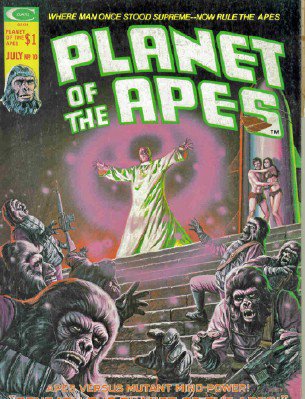
I know that many, many dedicated horror fans (and some movie directors too... ) started their love of genre 'mags over the years with Mr. Ackerman's Famous Monsters - but for me...my gateway periodical was actually Marvel's Planet of the Apes.

This great magazine (published in the mid 1970s) was really the best of both worlds for the young, book-nerd and intrepid Ape-o-naut. At either end of each issue was a beautifully-drawn comic book story, often an adaptation of a particular Apes film or part of an ongoing serial called Terror on the Planet of the Apes.

However, sandwiched in between these comic tales of simian domination were articles all about the cinematic world of Planet of the Apes. For instance, there was on issue boasting a photo spread of the impressive Ape City, which was incredibly cool. Other times, there were interviews with writers like Michael Wilson, behind-the-scenes stories about make-up and special effects, and even a feature on the Fox Ranch, where the movies were filmed.

I first discovered these magazines 'round about 1978, I'd guess, when I was a huge Apes fan. (I already owned many playsets and action figures from Mego...). Where did I buy the magazine? There was this little cramped store inside a warehouse-like building at Englishtown Flea Market, in New Jersey. And - I kid you not - the entire place consisted of floor-to-ceiling shelving loaded with comics and magazines of all varieties. It was simply amazing, and it was my first experience with a "comic book" shop. I purchased these Planet of the Apes magazines religiously (and they were like a buck a piece!).

From there, my love of Starlog developed. There was a vendor at Englishtown who sold these magazines as well. The mags were pinned up high by clips(near the ceiling...) along a big center aisle in the same building as the little comic shop.

If memory serves, I believe I started my Starlog obsession around 1980, the year of The Empire Strikes Back, so my first task was catching up on all the back-issues of the magazine. Do you remember how Starlog used to abbreviate all its movie and TV titles? I still hold those funny abbreviations in my brain. Close Encounters was CE3K. Lost in Space was LIS. Star Trek: The Motion Picture was ST: TMP. The Greatest American Hero was GAH. Anyone else remember that weird little tic in those long ago days?

I also remember how excited I was when I finally found the Starlog issue (#33) that featured all the reviews (including Harlan Ellison's and David Gerrold's) of Star Trek: the Motion Picture....which was something of an obsession with me.

In years to come, I came to realize that Starlog (of those days, anyway) had a distinct bias against certain shows (particularly Space:1999), and that was a bummer, but it was just fascinating to me a as a kid to read about movies in development, and pore over interviews with Han Solo (Harrison Ford) and memorize things like episode guides of Lost in Space or The Twilight Zone. I still have deep affection for Starlog, though I probably haven't purchased a new issue in years. My collection goes from 1 - 263, and then I stopped.

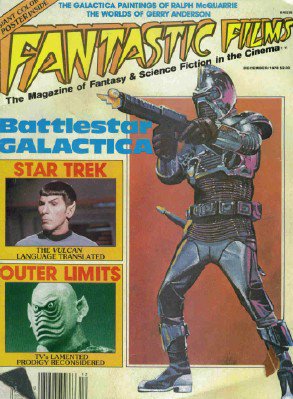
I also happened to love another genre magazine that was published at the ssame time, but died in the mid-1980s: Fantastic Films. I remember reading with enthusiasm about upcoming TV shows like Automan and movies such as Star Trek III: The Search for Spock, on one cross-country trip with my family. Those were the days....

Later on, in high school, I discovered Fangoria, and became a regular reader of that gory magazine (as well as the companion, Gorezone), even though some of the photo spreads really grossed me out. I liked the book and video reviews in Fangoria, as well as reports on what favorites like Sam Raimi, Wes Craven, John Carpenter and Tobe Hooper were doing through the late 1980s. It's funny, I remember that for a spell back in the Reagan decade, Freddy Krueger was so popular that virtually every Fangoria issue would feature a cover headline about a "new" icon who was about to unseat him. One was the ghoul of I, Madman (1989). And another was Richard Lynch, the guru of Unity Fields from Bad Dreams (1988). Anyone remember him?

The summer I was sixteen, my Dad took me out to get my working papers and Social Security card, and I quickly got a job working the morning shift at a local McDonalds Restaurant in Bloomfield, N.J. I worked every morning from 5:00 am to 11:00 am, and was an expert at making Egg McMuffins. I was working to make "living" money for college, and so I saved every single dollar I earned. But my parents literally made me spend some money on some fun things. I'm not kidding, they'd drive me to a used book and comic store in Passaic and forced me to buy entertainment-y things. That's cool, and guess what I chose to buy? Magazines! The late 1980s was a great time for magazine start-ups and I remember slurping up all the issues of an obscure magazine called Daredevils. Has anybody ever heard of this periodical? It was a great magazine that had a focus on classic movie actors (like Humphrey Bogart and Charlie Bronson), as well as James Bond movies and spy TV shows. But I think it folded rather quickly.

When I went away to college, I continued my habit of collecting sci-fi magazines. I lived on campus at the University of Richmond (in Robins Hall), and I would walk through a leaf-laden field, over a wood bridge, through a housing development, up a steep hill, across a highway to a comic book store called Dave's Comics. It was there that I was able to catch up on Cinefantastique. I rabidly collected this magazine through the 1980s and 1990s and was always impressed by the breadth of its genre coverage. I'll never forget collecting this magazine during the run of The Next Generation and Deep Space Nine, and I looked forward to the big issues that featured season reviews, replete with episode guides and extensive interviews. This was just a terrific reading experience.

It was also at Dave's Comics that I discovered another short-lived magazine that I fell in love with, one from the early 1990s called Epi-Log. Edited by William Anchors, this attractive magazine featured tons of detailed episode guides every month, and the editors even did theme issues, like horror, superheroes, spies, space adventure and the like. I should also add that although the photos were always in black-and-white, they were often rare, unusual shots, and I grooved on that.

Basically, I collect any magazines with science fiction covers gracing them. This means that I got my hands on a Mad Magazine with a Star Wars parody cover from 1977. This means that I would collect Time Magazine if it featured Star Wars, Star Trek, or Aliens.

Also - I cannot tell a lie - for a while in the 1980s I collected Playboy Magazine. For the articles, dude. For the articles. My favorite issue is the one displayed here on the blog...featuring Maryam D'Abo from The Living Daylights. There's a shot of this lovely actress riding the hood of Bond's car from Goldfinger...nude. There's another where she's cradling Blofeld's...kitty. You have not truly lived until you've seen these photographs.

I never imagined while collecting magazines as a kid, a teenager and a young adult that I would some day see my own books reviewed in these magazines (Fangoria, Filmfax, Sci-Fi Magazine), or that I would write articles for them myself (Filmfax, Cinescape, The Official Farscape Magazine). It's funny how life turns out sometimes, isn't it?

So...did you ever collect sci-fi and horror magazines? And if so, which ones are your favorites? Around Halloween last year, I finally had to purchase a huge filing cabinet for my office to maintain my collection.

Yep, these magazines are not only fun, they come in handy as research on my books. In fact, I wonder if my subscriptions are tax deductible?

Wednesday, February 15, 2006

MOVIE REVIEW: Last Exit

"You know you're in trouble when death is the least of your problems," reads the tag-line for Last Exit, an indie crime/horror thriller produced in 2003 and now released on DVD by Heretic Films.

Directed by David Noel Bourke, this movie represents the final word (or is it the last exit?) in neo film noir, featuring editing so electric and a score so pulse-pounding, you're likely to convulse while watching the film.

Last Exit dramatizes the highly disturbing tale of Nigel (Morten Vagelius), a down-on-his luck fella eking out an existence in Copenhagen, Denmark. He's married to a heroin addict (who finds out, in short order, that she's pregnant...) and Nigel desperately needs a job.

In finding one, Nigel runs afoul of a gangland boss named "The President" (Pete Damm-Ottesen) and does a little, ostensibly simple task for him, storing fifty boxes of videotapes in his apartment for two weeks. After that job, Nigel commits to another job, and then another, until he finds himself getting into serious trouble when a new career move involves the abduction of a child...for a price tag of $50,000 dollars.

Meanwhile, Nigel engages in an adulterous affair with the gorgeous Tanya (Gry Bay) and concludes that their first encounter "was the best sex" he had in a very long time. Indeed, and she expects to be paid for it! A disappointed Nigel pays her $1,000.00 out of his stash of $10,000.00, while at home, his wife, Maria (Jette Philipsen), gets suspicious. She needs the money for drugs, after all...

From there, things just spiral and spiral...until a very dark (and bloody) climax.


Looking back as I write this review, I recollect some of the disturbing images in this film like they were seared into my subconscious. There are gaudy neon lights, dark mean streets, and a world of vice including porn and drugs. In one moment, a girl shoots up heroin (and slaps her leg before sticking the needle in...).

And this all occurs before the title card, Last Exit.

From there, things really get dark, and this movie views the assorted illicit goings-on with a blunt, straight face. In fact, director David Noel Burke adopts a dynamic technique throughout the film. Specifically, his probing camera is often perched uncomfortably close to his dramatis personae, as if we're literally invading their personal space in the frame. I mean, the camera is actually so near to Nigel and the other characters that their faces sometimes appear distorted. This telling choice in composition makes the term up close and personal take on a new meaning, as we want to look away from the drug use, the crime, the nihilism...but are forced to stare at it in almost claustrophobic clarity

Still, we get some relief in Last Exit from the garish Copenhagen underworld, and that relief comes in the forms of wicked humor and long monologues about Quantum Theory. On the former front, there's a scene in which Maria dresses seductively in a black nightie to get Nigel's attention, but he just wants to watch television. The camera then cuts to the TV, and it's nothing but a parade of dull, static-y images. But apparently, for Nigel anyway, even static is preferable to intercourse with the old ball-and-chain...

On the latter front, a drug dealer is introduced in the film who seems to put the meaninglessness of Nigel's life into perspective. The world, he suggests, is a complicated tissue of events in which connections of different kinds combine or alternate to form the context of the whole. And Nigel, says the drug dealer, is an "integral" part of the system.

The brutal closeness of Last Exit pays off in that we feel as though we're actually living in that dingy, filthy little apartment with Nigel and Maria. There's even one scene where Nigel takes a crap on the toilet in a tiny bathroom while talking on the phone, and the camera doesn't flinch. Then there's also a horribly vivid (and shocking...) scene involving a broken bottle and marital murder, followed by gory, bloody clean-up. You'll laugh, you'll cry, you'll puke...

I know that some critics have compared Last Exit to the films of Quentin Tarantino, but I'm not certain if that's apt. The cinematic works of Quentin Tarantino are distancing, in a sense, because of all the post-modern allusions and homages to other films. At some level, you don't take the violence seriously in Tarantino's works (like Kill Bill) , because you know that, in some fashion, it's just a movie that's playing with conventions of another movie, one that the auteur admires. Last Exit feels more real, more genuinely sleazy and human (and immediate...) than that. There's less emotional distance between characters and percipient, and therefore the film is nausea-provoking and highly disturbing. There are times I was tempted to look away from the events unfolding on screen, but could not.

This movie is so blunt - so in-your-face (literally...) - that it rocked me back on my heels. Tarantino's films don't do that. I admire them from an aesthetic, almost intellectual distance, marveling at how they fragment time, or mirror classic movies. A cutthroat film-noir filmed at point blank range, Last Exit is that rare gift: the real deal. It will take your breath away, but after a screening, you may want to go outside and look at the sun for a while. Or hug your wife. Or take a shower. Or do some other life-affirming activity. The film is impressive, especially given limitations of budget and other considerations, but it's also decidedly bleak...

To learn more about Last Exit, check out Heretic Films. I will be reviewing more of their films here over the next few weeks and months.

MUIR BOOK WEDNESDAY #10: Exploring Space:1999

Sometimes, I can't believe it's been a decade since I turned in my final draft of my first book, Exploring Space:1999: An Episode Guide and Complete History of the Mid-1970s Science Fiction Television Series.

The book was actually published by McFarland in April of 1997 (almost nine years ago), and since then has been reprinted in both hardback and in soft cover. It even earned some nice reviews!

Which is crazy, because when I wrote the book, I figured that the "history" of Space:1999 was just about over. The laserdiscs had bombed on the market, the Sci-Fi Channel was about to stop rerunning the show - permanently, and new ventures like Babylon 5 and SeaQuest DSV were garnering significant popularity. I figured 'what chance does a 20 year old show from the 1970s have of achieving an objective re-consideration today?"

I wrote my book because I wanted to answer some of the absurd criticisms thrown at the series over the year, and least have it on the record - somewhere - because so many accusations were not true. Most of them, in fact, were false...and absurd.

I remember there was a TV special, for instance, in 1994 hosted by William Shatner, Carrie Fisher and Dean Cain, in which the writers authoritatively claimed that Space:1999 was inspired by Star Wars! That's a mean trick, considering Space:1999 premiered in September 1975 and Star Wars didn't come 'round until May of 1977...

But it's funny how fate works. In 1997, the very year my book was released, Columbia House released several episodes of Space:1999 on VHS. Then there were two huge series conventions in 1999 and 2000. And also by 2000, DVD was here to stay, and the entire series was re-released in that format to extraordinary sales and resurgent popularity.

As I write this today, there are new Space:1999 novels (from Powys Media), new models of the famous Eagle spaceship (from Product Enterprises) and even new action figures based on the series (from Classic Toys). The year 1999 did not herald the end of Space:1999 fandom as I had naively feared, but - to the contrary - seemed to indicate the arrival of a next phase with a brief "reunion" movie called "Message from Moonbase Alpha," starring Zienia Merton and written by series scribe, Johnny Byrne.

Exploring Space:1999 is my first child, the first book I ever wrote, so I do love it like a first-born, though I can see how my writing has developed and improved over time. Today, if I had the chance, I would probably take a different tack writing the book, because Star Trek is no longer the dominant force in science fiction television. Since I wrote the book, we've had a decade of X-Files, and Buffy the Vampire Slayer, plus Firefly, Stargate, a new Battlestar Galactica, Farscape, and Lost to consider. But for much of Space:1999's twenty something years, it had to deal with Star Trek as competition, and so that factored in to much I wrote about the series.

Anyway, Exploring Space:1999 features an interview with Catherine Schell (the actress who played Maya in the second season), it republishes (with permission) the New York Times review of the series by Isaac Asimov, and boasts a detailed episode guide.

Here's what the critics said:

"... [The book] offers a well-written look back at the show...He [Muir] takes the reader from the stunning pilot film portraying the marooning of Moonbase Alpha onward through two seasons of mystery and menace from beyond the beyond...This...thoroughly researched work also addresses the curiously strident attacks the show has received from fans of Star Trek. In the chapter Defending Space:1999, Muir compiles the criticism against the show (including a New York Times piece by Isaac Asimov) and provides good counterarguments for the series's place in the pantheon of television science fiction. Recommended..." - LIBRARY JOURNAL

"...a must for series fans..."-VIDEOSCOPE"

"...a comprehensive treatment of this neglected British-made television series...provides a detailed history...and presents a critical commentary that displays familiarity with a wide range of popular culture material." -AB BOOKMAN's WEEKLY

"...a perfect companion...insightful..." - TELEVISUALS & THEME TUNES

"Muir's book is a pretty good history of SPACE:1999, and it includes a painstakingly detailed episode guide."-FRANKLIN HARRIS, PULP CULTURE, Jan 07, 1999.

"Thorough and impressive..."-Martin Willey, THE CATACOMBS

"...a very well-made account...a thoroughly researched look into Gerry Anderson's...space epic...the author is honest and open about the show's flaws...and he goes a long way towards debunking some of the absurd criticism thrown at the series..." - POPACALYPSE: The TV Bookshelf.

"Invaluable information is provided on the series... [some of which] never revealed before. A must for any fan of the series." - LE SITE QUEBECOIS DE COSMOS:1999.


And here's a sample from the introduction:

Space:1999 occupies a unique and not altogether happy position in the Valhalla of televised space adventures. It is the program that [some] Star Trek fans love to hate, even 20 years after its debut.

When it is not being ridiculed or attacked, 1999 is often forgotten or overlooked by science-fiction historians and television critics, probably because it was a British-made product that never aired on the major American television networks. Perhaps Space:1999's biggest problem is simply that it appeared at the wrong time. It stands sandwiched between Star Trek (1966-1969) and Star Wars (1977), two milestones of the genre. Star Trek is noteworthy because it was the first serious space program [in America] to feature continuing characters, and Star Wars, of course, opened up a whole new realm of amazing special effects and make-ups. But between those great accomplishments stands a seldom-seen, spectacular exploration of the unknown that deserves far more attention than it has received.

Space:1999 premiered in September of 1975 and featured the ongoing outer space adventures of Commander John Koenig, Dr. Helena Russell, Professor Victor Bergman, and the 311 astronauts and scientists stationed on Moonbase Alpha. What made the series unique was that these intrepid heroes journeyed through space not aboard a warp-driven starship, but on the moon. On September 13, 1999, a surge of magnetic energy caused the nuclear waste dumps on the far side of the moon to explode. The result was like a giant nuclear engine, pushing the moon out of Earth's orbit and into a space warp which ultimately deposited the moon light-years across the galaxy.

Starring internationally renowned actors Martin Landau, Barbara Bain, Barry Morse and Catherine Schell, Space:1999 was the only serious space adventure of the early 1970s. Star Trek was long gone from first-run, and although Planet of the Apes (1974) and Harlan Ellison's The Starlost (1973) had premiered before Space:1999, both shows concerned bizarre future cultures rather than space travel. Battlestar Galactica, the next big outer space extravaganza, did not arrive on the scene until late 1978, and by then Star Wars had changed the face and feel of science fiction television forever...

Even though it is locked between two juggernauts of sci-fi, Space:1999 pioneered many of the groundbreaking visual effects that would later make such dramatic impact in Star Wars. Perhaps more significantly, many major 1999 character and story concepts would be repeated in the successful Star Trek productions of the '80s and '90,s particularly The Next Generation.

There is, however, much more to appreciate in Space:1999 than its historical position. It featured one crucial element that [contemporaries] Logan's Run (1977), The Fantastic Journey (1977)...and Buck Rogers in the 25th Century (1979-1981) all lacked: a brilliant and consistent vision of the universe. Indeed, the first 24 episodes of Space:1999 featured a richly-visualized world where space was a terrifying, confusing and spectacular mystery. Each story explored the unknown and portrayed the Alphan space voyage as a journey into wonder, awe, and horror. Unlike the futuristic superheroes of Star Trek, the travelers on Moonbase Alpha were recognizably human and contemporary. They were unprepared both technologically and psychologically for a long voyage into deep space, and as a result, their emotions, fears and attitudes often caused more harm than the aliens or space phenomena they encountered.

...Space:1999 episodes were often downright grim. The series was obsessed with mankind's failings and dark questions of existence... In many ways, Space:1999 was much more a child of The Outer Limits (1961-62) or Rod Serling's The Twilight Zone (1959-1964) than of Gene Roddenberry's Star Trek. Replete with effectively dark photography, stylish feature-film techniques, Gothic story lines and a Wagnerian musical score, Space:1999 represented a dark side of space adventure...

...Space:1999 was born after Watergate and Vietnam. Considering this, it is perhaps fitting that various episodes reflected a distrust of politicians ("Breakaway," "Earthbound" and "Dragon's Domain"), or addressed the futility of war ("The Last Enemy," "War Games.")

More importantly, and this is undoubtedly the reason Space:1999 is so universally despised by scientists, the program consistently and vehemently expressed distrust of the mainstream scientific community. In Star Trek's sunshine view of future technology, science had shaped man's world into a perfect society with no hunger, no disease, and no crime. In contrast Space:1999 was, in the words of Science Digest, about the downfall of "20th century technological man." Beyond the initial disaster which establishes the premise for the series, many Space:1999 episodes reflect a distrust of scientific solutions ("Breakaway," "Voyager's Return," "Collision Course," and "Black Sun.")

...So if you are a longtime Space:1999 fan, rediscover the mystery and excitement of Gerry and Sylvia Anderson's 'supreme space adventure' in these pages. If you are new to Space:1999 or a science fiction fan who has disregarded it because of popular reputation, read on and experience a world very different from Star Trek. It is a world where humans often make mistakes, where mysteries are intentionally left unanswered, and where the laws of physics defined by scientists no longer apply..."


Exploring Space:1999 is available at Amazon.com. Jump into a world beyond belief and order the book, if you can.

Sci Fi Wisdom of the Week: They Live (1988)

"It's business...that's all it is...What's wrong with having it good for a change?...What's the threat? We all sell out every day. You might as well be on the winning team!"

-The logic of selling-out, as spoken by a collaborator (George Buck Flower) in John Carpenter's They Live.

Tuesday, February 14, 2006

Happy Valentine's Day!


Won't you be my (bloody...) Valentine? Today's St. Valentine's Day, and here's a cupid's arrow straight through the heart to all my dedicated readers.

Thanks for sticking around, and I hope you have a happy holiday. Remember to tell the ones you love how you feel about 'em!

And don't eat too much candy...

TV REVIEW: Invasion: "All God's Creatures"

I'll never forget seeing the Donald Sutherland version of Invasion of the Body Snatchers back in 1978. My parents took me to see it in the theater, and the film terrified me. I didn't want to sleep for days, because I was afraid I'd be extinguished by a slimy, extra-terrestrial pod.

But anyway, one scene in that movie (one of the best horrors of the late 1970s, by the way) that really, really got under my skin involved a Pod Person who had come out...wrong. He was a homeless guy living in the park in San Francisco, and he had a little pet dog. Well, something went catastrophically wrong in the assimilation process, and the dog and man were combined to form a hideous, man-dog thing, or more accurately, a dog with a human face. It was really disgusting. I've watched the film recently and the effects don't really hold up, and besides, now I'm prepared for the moment. But at the age of 9, seeing it for the first time, unprepared, my young mind recoiled.

I was struck by memories of that scene (and my own childhood terror) on this week's episode of Invasion, "All God's Creatures," written by Michael Foley and directed by Harry Winer. The episode began creepily with a shadowy figure stealing into Russell's house while pregnant Larkin was taking a shower (oooh, Larkin, shower, ooh...).

Dave attempted to track the interloper down, only to discover that the thing entering the house and leaving behind wet footprints was a misshapen, half-formed version of himself...and one that apparently boasted his very memories (down to his love of his sister, Larkin, preference of beers, and enjoyment of Buddy Holly albums.)

Remember back in that early episode where Dave got pulled down into the water by one of the orange creatures, but got rescued in the nick of time? Well, now it turns out that the thing hooked on to his legs long enough to get a sample of his DNA. But it was just enough genetic material to create a twisted, deformed hybrid.

Gross!

I found this episode of Invasion both creepy and touching, the latter because it was obvious that the hybrid, twisted Dave believed he was the real one. And he still felt love for Larkin and his family. Even though he was a mutant. Sad, really. After the Dave knock-off died peacefully, I was reminded of a line of dialogue from another favorite movie from the 1970s, Star Trek: The Motion Picture. After a transporter accident mangled two crewpeople, Starfleet Command told Kirk that "what we got back, didn't live long. Fortunately." I'll never forget that line. It still gives me shivers (which is odd, since the movie was rated G, for all audiences.) I think the same can be said for the Dave hybrid...it's a blessing he didn't live long. But now we the viewers know that the assimilation process can go horribly wrong.

"All God's Creatures" also led into dangerous territory for Tom's daughter, Kira. She's having a teenage rebellion, and wants to go through the assimilation process. She feels left out, I guess, since the deputy (a prospective boyfriend...), her adopted Mom and her Dad all went into the water and were changed. It looks like she's going to go through the hybridization process, and I worry for her safety and future. We'll know more on that front next week.

Lately, Invasion has been far better and far more enjoyable than its popular lead-in, Lost, and this week continued the trend. The story of "Homestead" and this alien colonization is really getting under my skin. Literally.

Oh, I also got a kick out of the Church's billboard motto. Remember, this is the place where the hybrids (the storm survivors...) meet for "group", and so it's appropriate that the motto of the House of God is "We Are Not Alone." Where have I heard that slogan before?

CATNAP #31: Princess Lila


Lila sleeps next to me under the covers every night, and by 5:00 am is back up, rubbing her wet nose into my face for attention. Then, after I get up and start getting dressed, she makes moon-eyes at me from the dresser and I have to pet her. Then we all go downstairs for breakfast next, and Lila grazes a little before standing up on her hind legs at the breakfast bench for attention. Then I cradle her like a baby on my shoulder, and she purrs and sits with me while I drink coffee.

Yes, Lila is my princess in every way imaginable. Kathryn says that it is Lila, actually, who rules the roost. Sometimes, I agree...

Monday, February 13, 2006

Who's Your "Simple Country" Doctor (Chief Medic?)

Continuing our fantasy crew (see previous blog entries on irritating kids, spaceships, droid sidekicks and space babes!), this week it's time to choose our CMO: Chief Medical Officer.

In 1964, Irwin Allen's adaptation of Space Family Robinson, Lost in Space introduced to American TV audiences a very naughty, trouble-making Doctor named...Smith! Played with delicious (and flamboyant) glee by Jonathan Harris, Dr. Smith has a way of getting himself, and his shipmates on the Jupiter 2 into danger. If we all want to be turned into giant, ambulatory alien vegetables ("The Great Vegetable Rebellion"), he's our choice.

On September 8, 1966, a doctor nicknamed "Bones" appeared on "The Man Trap," the first aired episode of the original Star Trek. Played by the late, great, DeForest Kelly, Dr. Leonard McCoy is a CMO for the ages. He can cure silicon-based life forms ("The Devil in the Dark"), reverse an accelerated aging disease ("The Deadly Years") and counter (with a derivative of Klingon nerve gas!) the deleterious mental effects of spatial interphase ("The Tholian Web"). Dr. McCoy isn't only a great doctor, he's a terrific bartender. If he populates our sickbay, we'll always know where the Saurian Brandy is hidden. Also, Dr. McCoy is the one individual who offers us the most (and best) catchphrases. "He's Dead, Jim!" "I'm just a simple country doctor," "I'm a doctor not a (fill in the blank.)" Just about everything Bones ever said is memorable. I've always been a huge fan of both Kelly and Dr. McCoy, and I must admit, he'd probably be my first selection for a CMO.

But then, of course, there's stiff competition from Dr. Helena Russell (Barbara Bain), the doctor on Space:1999 (1975-1977). If you like the Ice Princess-type, she's our Doctor. Glacial, intellectual, with a dry wit that can cut you to the bone, Dr. Helena Russell also happens to boast the finest, most perfect cheekbones I've ever seen on a physician. Helena has pulled off her own share of miracles on Moonbase Alpha too, charting the enhanced telepathic abilities of the Alphans ("The Lambda Factor"), combating a basewide case of "lassitude" ("The Beta Cloud" ) and awaking from suspended animation all sorts of aliens both friendly and hostile ("Earthbound," "The Exiles," "Mark of Archanon.") Dr. Helena Russell is a widower (her husband died on a dangerous space mission to Jupiter...), but she's in love with Commander Koenig. Still, if you appreciate a kind of remote, elegant beauty and intellect, Dr. Russell would be a terrific choice. She's even led dangerous missions on the lunar surface ("The Last Sunset") and shown great resourcefulness (she opened gas tanks aboard a crashed eagle and fired a laser rifle into it, blowing it up as a "flare" for would-be rescuers to notice...)

On the 1970s Saturday morning TV show, there was also a young physician in-training, Tee Gar Soom (Brian Tochi). He's an energetic, agreeable young cadet, who also boasts super-strength, which I guess might come in handy on landing party missions. On 1978's Battlestar Galactica, a former socialator (prostitute) named Cassiopeia (Laurette Spang) trained to become a medic. She was gorgeous, young, and well, hot as hell.

On Buck Rogers in the 25th Century, there was Dr. Elias Huer (Tim O'Connor), but I can't really tell if he was a physician or not. He was more like a diplomat/world leader. And he relied awfully heavily on that Twiki bling-bling, Dr. Theopolis.

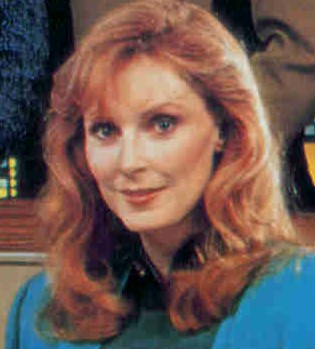
The multiple ensuing generations of Star Trek gave us more memorable doctors. Dr. Beverly "Bev" Crusher (Gates McFadden) joined the crew of the Enterprise-D at Farpoint. She's a widower like Dr. Helena Russell, but has the added (and unfortunate...) baggage of a teenage kid, Wesley. I like Dr. Beverly Crusher, however, because she's as quick with a phaser as she is a med-kit ("Best of Both Worlds") and because - ahem - she's hot-to-trot. Who can forget "Bev" sexily unzipping her uniform and explaining to Captain Picard that she hadn't experienced "the comfort" of a husband in many years in "The Naked Now?" Damn! Of course, Dr. Crusher is just as brilliant a physician as Dr. McCoy. Perhaps more so. I'll never forget the episode "Remember Me," in the fourth season of The Next Generation, when Dr. Crusher made the ultimate (and correct deduction) about her strange situation on an underpopulated Enterprise. "If there's nothing wrong with me, there must be something wrong with the universe..."

Beverly Crusher left the Enterprise-D for a while, and was replaced by Dr. Katherine Pulaski. Now, I must admit, I've always loved Diana Muldaur. She was great on Star Trek as Dr. Anne Mulhall in "Return to Tomorrow" and as Miranda in "Is There in Truth No Beauty." However, Dr. Pulaski - as a character - never really worked for me during the show's second season. She was abrasive, and worst of all, cruel to Data. How can you be cruel to Data? That's like kicking a kitten or something. Pulaski was brilliant, all right, but irritating as hell. And I hated that clips-episode "Shades of Gray," where Riker had an infection that could only be relieved by experiencing old emotions (meaning reruns from previous shows). The episode was horribly conceived and executed, and - really - Pulaski was horrible in it.

Deep Space Nine gave us Alexander Siddig's very funny, very inexperienced Dr. Julian Bashir, a stuck-up guy who - we learn after several seasons - is actually a genetically engineered super genius. Bashir is a fun guy, and if we have a holodeck or suite aboard ship, we should be sure to include him. I always get a kick out of the "early" Dr. Bashir in the series' first season, pining after Jadzia Dax, and being utterly terrified of Garak, the Cardassian tailor. I liked that he stuttered and stumbled over his words, and seemed genuinely awed to be out there on the frontier. In a franchise where people are too often perfect and unafraid of being in space, Bashir always reminded me that outer space/alien confrontations can be intimidating.

Voyager's Holographic doctor (Robert Picardo) is another solid selection for CMO. If we can keep him from singing opera and turning evil (as he did in one second season episode...), he'd be great! He's got an acerbic sense of humor (like Bones McCoy), but could there be a more experienced, more thorough physician? I mean, he's programmed with the memory and knowledge of Starfleet's best CMOS (including Bones). He might be the best choice for that reason alone. And - of course - we can deactivate the guy when he gets too prissy.

Other selections? On Enterprise there was Dr. Phlox; on Babylon 5 there was Richard Bigg's Dr. Franklin. Neither of these guys would be my first selection, but I suppose they could fit the bill. Also, Dr. Chapel, from Star Trek: The Motion Picture, Dr. Kate McRae from The Black Hole, Stephanie Beacham played a doctor on Sea Quest DSV. Or if we want to keep things simple, we can get the medical droid, Two-One Bee, from The Empire Strikes Back...

So who's our CMO? And does he or she make house calls?

Saturday, February 11, 2006

SATURDAY MORNING CULT TV BLOGGING: Space Academy: "Johnny Sunseed"

This week, on Space Academy, (in an episode directed by Ezra Stone and written by Don Heckman), a representative from the Federation is en route to investigate the Academy, a facility whose expenses are running high. The representative, however, is a weird guy named Johnny Sunseed who wishes to free mankind from the technical domination of machines. He also happens to be Gampu's brother.

At the same time, a strange sickness is affected many of the students at the Academy. Cadets, (including Adrian) suffer from a "systemic imbalance" that causes "silliness...detachment" and "an inability to do your job correctly." As my wife, Kathryn said, I suffer from this ailment frequently...

Anyway, en route to the space farm (which has been providing food to the Academy commissary...), Paul also goes bonkers while piloting a Seeker. He strafes the Academy in the ship, buzzing between the towers of the Facility in some nicely orchestrated miniature effects work.

Sunseed checks out the space farm with Peepo (whom he consistently calls Peppo) and proceeds to damage the computer-run gardening system, "overloading" power systems not just at the farm, but on the distant Academy planetoid! As a result, the Academy drifts on a collision course towards the space farm, but Gampu dispatches Chris, Tee-Gar and Adrian in Seekers 1, 4 and 5, which are equipped with "presser beams." The seekers keep the Academy from smashing into the space farm, while Gampu attempts a psychic link with his faraway brother. It works, and the space farm gets repaired.

Sunseed decides that nature and technology can exist hand-in-hand, and all's well that ends well, to quote a famous writer.

I enjoy watching this live-action Filmation show from the 1970s, though sometimes have to laugh at the weird stories. For instance, it's a fairly lousy system that a computer on a planet far away could affect the Space Academy's propulsion and power systems. I mean, there's a ready made sabotage plan, right there! If you can't attack the heavily armed/defended Academy, find the weak link on the space farm and incapacitate it from there. This reminds me of Return of the Jedi and the fact that the under-construction Death Star couldn't generate its own forcefield. Of course, at least there, it was all part of the Emperor's trick. On Space Academy, it's just poor planning.

Also, it doesn't really seem plausible to me that Johnny Sunseed could be a high-ranking official in the Federation since he despises technology. He's more like a cranky environmental activist than a government official. And why does Johnny Sunseed boast a different name from Isaac Gampu if they are biological brothers? Did Sunseed just adopt his flamboyant-sounding name in adulthood, given his proclivities towards nature? That could have been explained.

However, I'm a Space Academy junkie because I love the show's 1970s production design, particularly the miniature special effects. In this episode, for instance, three Seekers launch from the Academy bay, one after the other, and maneuver around in space in the same shot, and these are impressive special effects, especially given that this was a Saturday morning kid's show. Sometimes I just wish the special effects and model work was in the service of better, more adult stories.

Friday, February 10, 2006

TV REVIEW: Lost: "The Long Con"

Finally, a good episode of Lost!

"The Long Con" (a metaphor, I occasionally fear, for the overall direction of the series...) was written by Leonard Dick and Steve Maeda and directed by Roxann Dawson (where have I heard that name before? That's B'Elanna on Star Trek Voyager!)

The episode is a Sawyer-centric story, which is cool, because he's one of the most interesting characters on the series. In particular, the plot revolves around a surprise attack on Sun while she's minding her own business in a garden. The brutal attack is ostensibly conducted by "The Others," who just weeks ago promised a truce - provided the plane survivors don't cross a certain line in the sand.


This surprise attack, by the way, occurs at precisely the right moment to gin up support for Jack and Ana Lucia's proposed military action against the Others, Jack's Jihad. Kate suspects that Ana Lucia herself was behind the attack on Sun, but there's another agenda at work too. And then, Locke - fearing that Jack will use an armory full of guns to wage war - moves the weapons...only to have them intercepted by another party. At the end, all is revealed, and a new, uneasy alliance has been forged between two islanders who you wouldn't suspect of a team-up.

What I really enjoyed about this installment of Lost wasn't necessarily the focus on Sawyer, but rather the character fireworks occurring on the island. After all, previous flashbacks have revealed already that Sawyer is one B.M.F. (bad motherf@*#*...) so any further flashbacks on this subject are really just gilding the lilly. But overall, that's my problem with Lost.

A good series (and a good movie) is one where form reflects content. Where how the show is told is as important as what is told in the narrative. The flashbacks on the series, I believe, now serve no narrative function whatsoever since we are fully acquainted the characters. The only way the flashbacks could be valuable at this point is if the island is Purgatory, and thereby judging the "moral" history of all the characters, pre-final dispensation. If the island isn't Purgatory (and the writers says it is not...) then all the flashbacks are...what?

My opinion is that they are just a delaying tactic, preventing the writers from telling real, important stories involving the island's present. Like ones about the smoke monster; or the polar bear; or Walt talking backwards; or the exact details of the Dharma Initiative. Or what's up with Claire's baby. Or who Ethan was. Because to tell those stories, the writers would have to settle on one, coherent plot line, and they won't do that until they are forced to, when the ratings - inevitably - drop.

Anyhoo, the flashbacks were all right, if not earth-shattering. The cool part of the episode involved the beginnings of real division on the island. It looks like Jack and Locke are finally - and irrevocably - moving to different ends of the spectrum on how they deal with things. They don't trust each other, they don't like each other...and it's on! The teaser for next week's episode seems to indicate they're really going to have it out, with the computer countdown running out too. Wow!

But it wasn't just the growing divide between Locke and Jack that made "The Long Con," involving. Rather, I liked the set-up of the entire episode, how Sawyer located an ally in the weak and resentful Charlie. In fact, this episode is so good it retroactively makes last week's Charlie installment look better. Charlie is hurt, wounded, looking to embarrass Locke, and now he gets his chance. He's made an ally with the Devil.

Not that I think Sawyer is actually the devil. Quite frankly, Jack is too self-righteous and pretentious to be an adequate leader of the island. I wouldn't want his hands on the "red button" (or in this case, the guns) because he's a self-appointed crusader. He's likely to go all native and attempt to "liberate" the Others, if you get my drift. And Locke is just as bad. He's a zealot, a religious fanatic somehow held in thrall to the island. I wouldn't want him controlling the guns, either.

Sawyer - as selfish and irritating as he is - just might be the island's happy medium. He's not a true believer and he's not a do-gooder. But he is practical, and cunning, and so maybe having him as "the new sheriff" in town is the best deal imaginable.

"The Long Con" was a good episode, but I think Lost is living up to my prediction: about one in every four shows is worth watching. Let's see if next week's episode bucks the odds.

30 Years Ago: The X-Files: "Home" (October 11, 1996)

“They really went caveman on him…” -            Mulder in “Home.” I make no bones about the fact that “Home,” written by Glen Morgan and Jam...