Friday, December 16, 2005

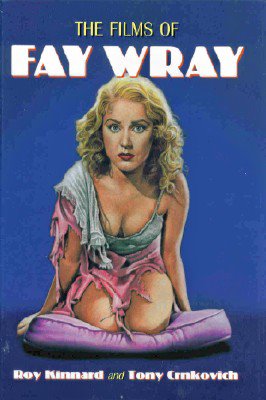
KONG BLOGGING: The Films of Fay Wray by Roy Kinnard and Tony Crnkovich

As part of my week-long Kong fest, I've been enhancing my film book library on the subject of the cinematic great ape. On Wednesday, I reviewed Ray Morton's colorful, vibrant history of the Kong character, but there's also another "giant" personality attached to the Kong "myth," and I wanted to post about her here, today. In part because I've always had a crush on her, since the first Thanksgiving when I watched King Kong (1933) on New York TV.

The late Fay Wray (1907-2004) was the first "beauty" to meet the giant "beast" of Skull Island. And what a beauty this talented actress was, both in terms of her gorgeous good looks, and in terms of personality. Authors Roy Kinnard and Tony Crnkovich have just written a highly-detailed, thoroughly-researched book about this iconic talent, The Films of Fay Wray (McFarland and Company Inc., Publishers; $39.95)

The purpose of this scholarly text is not just to celebrate the career of Kong's first love, but to excavate Wray's other work, which Kong fans may not know so well. The authors set out the facts about Ms. Wray's career succinctly in the introduction: only five of her seventy-seven movie roles from 1925 to 1958 were in the horror genre; and in sixty-seven of those efforts, she was the leading lady.

"The extent of Wray's career," the authors write, "as documented in this book, may come as a surprise to many. A likeable, dependable and competent actress, she has been directed by talents as diverse as William A. Wellman, Maurtiz Stiller, Erich Von Stroheim, Alan Crosland, Frank Capra, Michael Curtiz, Jack Conway, Karl Freund, Roy William Neil and Josef von Sternberg. Her leading men have included Gary Cooper, Emil Jannings, William Powell, Richard Arlen, Jack Holt, Spencer Tracy, Ralph Bellamy, Frederic March, Wallace Beery, Joel McCrea, Claude Rains, and Richard Barthelmess."

In other words, Ms. Wray was much more than unlucky Ann Darrow, Kong's lady love. The book goes into great detail to describe (often with the late Ms. Wray's input...) a remarkably successful acting career in Hollywood...but one ultimately overshadowed by Skull Island's most well-known denizen. The book is filled with interesting revelations about the making of that 1933 classic, including Wray's concern that there was too much screaming in the film. She calls the screaming "overdone," which is interesting, since she became known as the greatest screamer (or Scream Queen) in Hollywood, at least until the dawn of Jamie Lee Curtis.

There's a really interesting comment on the times that this book makes plain through its illustrations: Fay Wray showed much more skin in the 1933 King Kong than Naomi Watts does in the 2005 version. Yes, we indeed live in conservative times. Drats!

Anyway, on pages 93 to 96 of this text, there are some beautiful black and white cheescake photos of Ms. Wray in very revealing "jungle wear," that helps, in no small way, to explain why so many young men grew up with Wray as a first love. In addition to her talent, she was one fine-looking, athletic sex symbol. But we do live in restrictive, PC times now and so in the new Kong (which I love, as you can tell from my review...) much of the sexual angle of the story has been deleted. I miss that. I'll never forget those shots from 1933 wherein Kong takes Wray up to his lair, and peels off her clothing a piece at a time and then smells his fingers...very animalistic, very sexual, and apparently too much for our censorious times.

I enjoyed reading The Films of Fay Wray, and learning much more about this accomplished actress. The book is separated into 3 parts: Silent Films, Sound Films and 1950s Feature Film Supporting Roles, and two appendices describe appearances in theatrical shorts and TV guest spots. If you've ever had a desire to learn more about Kong's first love, this is no doubt the book to own.

You can order The Films of Fay Wray at McFarland's web site, or through their order line, 800-253-2187.

Thursday, December 15, 2005

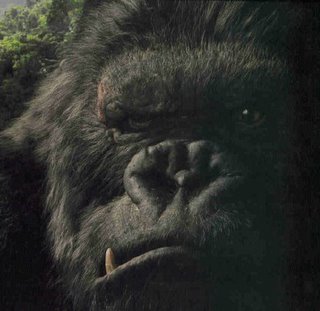
KONG BLOGGING: King Kong (2005)

Despite my love for the original King Kong (1933) -- as well as the 1976 remake introducing Jessica Lange -- Peter Jackson's two hundred million dollar update, which opened in theaters yesterday, wasn't necessarily an easy sale for me.

Why? Well, on the first count, I'm not one of those people who thinks the same movie needs to be re-imagined and re-made for every generation just because special effects have improved. Let alone a film already once re-made.

And I also think there's something very healthy about the idea of today's 15 and 16 year olds seeking out a film from 1933 or 1976, and becoming acquainted with what movies looked like in those eras. Cinema history is more than Napoleon Dynamite (which I love...) Wedding Crashers and Shrek. One of the greatest movie "awakenings" in my life occurred when my father began introducing me to the movies he loved from the 1960s, titles like The Great Escape, Cool Hand Luke, Hud, Bonnie & Clyde, The Graduate and the like. I was about sixteen when we did this together. I shudder to think how I would be different today had I - as a teen in the 1980s - not been exposed to such works. Today's teenagers, weaned on CGI and the Hollywood blockbuster mentality, could do with a little history lesson.

Secondly, and more importantly, I was one of those apparently few-in-number movie-lovers who didn't drink the Peter Jackson kool-aid after the last installment of Lord of the Rings; Return of the King. I greatly admired Jackson's first film in that trilogy, Fellowship of the Ring, but found both The Two Towers and Return of the King somewhat overlong, lugubrious, and laboriously paced. Let's face it, you could just watch Fellowship and Return and skip The Two Towers all together, and still get a pretty good sense of the Rings story without missing anything vital. The second film just kills time....for over three hours. I realize, this is heresy I'm writing to some people...

And yes, I am quite aware that Jackson and Return of the King took home a near-gaggle of Academy Award statuettes, but that fact doesn't change my estimation of these films. The latter two installments of the saga bored the pants off me. And believe me, you don't want me sitting around reviewing movies without my pants...

One quality a good filmmaker requires is discipline. Yep, discipline. The original King Kong was a taut and lean 90 minutes from start-to-finish. When I heard that Jackson's King Kong was going to run over three hours (three hours and seven minutes, I believe...) I really began to grow concerned. I remembered how the ending(s) of Return of the King rambled and rambled. And I wondered if Jackson weren't just a director badly in need of a close associate who would tell him that he hadn't just shit a golden egg, that his work, too, could use the experienced hand of a fine editor.

So, as I wrote above, I was not necessarily sold on the Kong remake, despite my love of the property over the years.

But now, having seen the film on opening day, I can state unequivocally and for the record that these amazing three hours move very quickly and enjoyably. Director Jackson knows exactly what he's doing, and this is a better film than any he's yet made. King Kong is an incredible silver screen spectacle - a monster movie epic on a scale heretofore unimagined, even by genre enthusiasts like myself.

Like I said, I was inclined to be wary, but came out of the film filled with awe, excitement and wonder. This movie is everything you imagine it could be; and much more. The special effects are, for the most part, quite fantastic, and the elements that have made Kong work so well as a story over the years have been augmented, nay improved. The end result is a film that makes more sense, and tugs more powerfully at the heart than either Kong predecessor.

This is Jurassic Park on steroids. And more.

Although I like all incarnations of Kong, if I'm being totally honest, I guess I've always felt a tiny disconnect with one element of the tale. Each film before this one - each in its own way - has wanted audiences to sympathize with Kong, with the Beast who "is as one dead" because of his love for a blond beauty. That element comes to the foreground most successfully in this version.

The dinosaur attacks on Skull Island in Jackson's version are so ramped up, so-over-the-top, so much the last word in edge-of-your-seat cliffhanger action, that you can't catch a breath. You'll squirm and gasp throughout these exhilarating moments. Kong and Ann swing from vines, fall from a precipice, fight off a pack of tyrannosaur and emerge triumphant, and so something is clear in this story in a way it's never been before in Kong history. These characters have bonded. An experience like this permits nothing else. They've been through the wringer together, and Ann has come to need Kong to survive on Skull Island, so it is natural that she would, after a fashion, fall for the big hairy guy.

This is really one of the best things about the movie. For the first time, you believe that a gorgeous blond actress could fall head over heels in love with a 25-foot tall gorilla. It's perfectly understandable; even rational, given the (admittedly peculiar) circumstances.

It's odd to write about a giant gorilla as a "character," but this version of Kong is far more developed too. He is a battle-scarred warrior, perhaps a little over-the-hill, even. He is the last of his kind, as you can see from his cave high over the island, where the bones of his ancestors and family lay scattered. And the natives in this film are terrible, psychotic people, so one senses that Kong has made his loneliness their worst nightmare. They live in mortal fear of their "God," and again, no version of the film has brought that idea home better than Jackson's. When you see the terrors of Skull Island this time around, you'll understand exactly how and why a giant gorilla might long for the company of a Vaudeville entertainer to take his mind off certain things. Like giant vampire bats. Or roving T-Rex packs.

And because the Ann Darrow/King Kong relationship makes more sense in this version, the last third of the film (set in 1933 Manhattan...) is far more effective. Again, this may sound absurd based on the fact I'm writing about a giant simian here, but the film works in the same rarified dimension as Romeo & Juliet or any other tale of star-crossed lovers. Ann isn't just "sorry" for Kong because she has sympathy for an innocent animal, she actually loves him, based on their experiences together. All her life, the script informs us, the people she loves have left her; leaving her vulnerable. Kong is the one creature always there for her; always fighting to protect her.

After the dinosaur stampedes (an amazing sequence), the spider pit (which will make you really uncomfortable...) and the film's other horrors, I figured it was impossible for Jackson to surpass his already considerable efforts for the climax. But he does just that . The portion of the film set in Manhattan, particularly atop the Empire State Building is utterly enthralling. You will feel awe (at the depiction of NYC during that time...), vertigo (at the dizzying heights), and anxiety (even though, of course, you know how it's all going to end.) This is an amazing climax to an amazing roller-coaster of a film, topped by a denouement for the ages. Does this sound like mindless praise? Well, just remember, as I enumerated above, I went in a skeptic. I wasn't inclined just to give the movie a pass because I love the character of Kong.

King Kong is a great Beauty & The Beast story, a tragic tale of a "brute's" love, and how it is ultimately used against him. I don't think the metaphor for male/female relationships has ever been better put in a monster movie. A lefthanded compliment, perhaps, but this is the most emotional and also the most satisfying Kong. It's also an unsurpassed thrill ride. The dinosaur stampede will knock your socks off, and the Empire State Building sequence will rip your heart out.

You can tell that every frame of this film is a labor of love.

But don't take my word for it, go see it. It's more fun than a barrel of...well, you know.

Wednesday, December 14, 2005

KONG BLOGGING: Ray Morton's KING KONG: THE HISTORY OF A MOVIE ICON, FROM FAY WRAY TO PETER JACKSON

My inner-fan-boy is euphoric.

Last week, UPS delivered my copy of Ray Morton's King Kong: The History of a Movie Icon From Fay Wray to Peter Jackson (Applause Theatre and Cinema Books, 2005).

One week later, I still haven't stopped drooling...

I review lots of books here and at NCFlix. I also write lots of film books. But I have to tell you straight up - no b.s. here - this volume has just vaulted to the top of my favorites in the film-book category.

Firstly, it is a gorgeous book, perhaps the most beautiful one Applause has yet produced (and it has been responsible for some truly lovely ones, including Singing a New Tune...), but more than that, it's now one of the most beautifully presented film books of all time. I would rank it right up there, alongside The Zombies That Ate Pittsburgh (a great, out-of-print text about the films of George Romero).

Anyway, King Kong: The History of a Movie Icon is a lavish, coffee-table-worthy edition with nearly 200 unbelievable photographs. These photos are reproduced and arranged beautifully throughout the book, and illuminate every aspect of King Kong's long history, from toys and collectibles to conceptual art, to promotional art, to never-before-seen behind-the-scenes candids. No cheap-y black-and-whites here! A lot of this stuff is featured in living, vibrant color.

The lay-out of the book is just perfect too, with the outer-left and outer-right margins on each spread reserved for smaller illustrations, aside from the text (where there are even more photos interspersed...) Want to see special effects storyboards for the 1976 King Kong? Check! Want to see poster art and news clippings? Check. Want to see Kong toys or gifts (like a King Kong candy bar?) it's all here in the kind of glorious detail that is usually reserved only for the biggest films (like Star Wars) and only at a very high price.

Finally, here is a book worthy of the King's good name...

When I was seven years old, my parents understood my fascination with all-things Kong and bought me Jeremy Pascall's The King Kong Story (Chartwell Books, 1977). I have held onto that book - from New Jersey to Virginia to North Carolina - for nearly thirty years. Now, finally, I own a Kong history that surpasses that slim (but nice) work in every way imaginable. Morton's book is thus an essential one for the Kong historian and fan, and a text you'll be proud, nay thrilled, to own.

Author Ray Morton hits exactly the right notes in his history of the Eighth Wonder of the World. He is an appreciative fan, but more importantly, an expressive, enthusiastic writer whose love for the subject (and careful research) shines through on every single page. His tone is perfect, and as a fan of the 1976 Kong, I can't express in writing how much I appreciate the fact that he didn't just diss the movie outright as an inferior remake. The 1970s Kong is a "valid" work of art in its own right, capturing the Zeitgeist of the disco decade, and Morton doesn't play the role of elitist, praising only the old Kong at the expense of the new. Instead, it's clear he loves all incarnations of this movie monster (or is Kong actually a movie hero?)

Everything you could possibly want to know about Kong, you will find in this book. From the making of the 1933 classic to its spin-offs, Son of Kong and Mighty Joe Young. There's a chapter on Kong's trip to Japan (for King Kong vs. Godzilla and King Kong Escapes) and detailed text on the really bad (sorry!) King Kong Lives (1986) as well as other recent ventures, including the Mighty Joe Young remake of a few years back. Morton's research is extensive, and he's interviewed everyone from Jeff Bridges to Rick Baker to Lorenzo Semple, Jr. So don't fear that this is just a regurgitation of things you already know; a tremendous amount of original, first-person research went into the preparation of this book.

Because of my love for Kong, and because of this volume's beauty, Ray Morton really had me at "hello" (or more accurately, as soon as I eyed that colorful cover art and felt the heft of this 348 page tome.) But then, the more that I read, the more that I became involved with his developing narrative. I hope the author will consider it the ultimate compliment when I state that he successfuly awakened my inner child; my young, innocent love for Kong and for monster movies in general. That's no mean feat, considering I write film books for a living. For the first time in a very long time, I was able to put all that experience aside and just enjoy a non-fiction movie book on its own terms.

I think my heart practically beat out of my chest when I reached the chapter on collectibles and turned to page 310. There, in a glorious, large photograph, is the cover of the Whitman Giant Classic King Kong adaptation (price: $1.00). I read this comic book religiously as a child. Probably over a hundred times. My parents bought it for me at a Ben Franklin store in Wisconsin, I think it was, when we were on a six week cross-country camping trip, back in the summer of 1979. That's a memory I hadn't excavated in a long time, but this book brought it back. And more. (There's even a photo of the King Kong viewmaster set, which I also owned when I was little...).

If you love King Kong, you'll love this book. That's about as plain as I can make it. I can't believe Applause is selling it for only $19.95. For a book with this quality text and the sheer number of gorgeous illustrations, I would have paid five times that...so reserve your copy now, because with Peter Jackson's version spawning new interest in the property, this is sure to go through its print run faster than King Kong can pound that hairy chest...

To order Morton's book through Applause, go to their web site here. The book is also topping the rankings at Amazon (and holding on to a 5 star rating!), and you can order King Kong: The History of a Movie Icon there as well.

King Kong is HERE!

King Kong opens today, and I'm just about as excited as a fan boy can be. I grew up with the 1976 film -- so I love that version dearly (and you can read my spirited defense of it, here.) But I also love the 1933 classic, one of the greatest masterpieces in a hundred years of cinema. I have done interviews with literally hundreds of talents in Hollywood in my writing career, and I can tell you with certainty, more people pursued the vocation of filmmaking because of their love of King Kong than just about any other film in history.

Enough of that, though. Let's celebrate today as King Kong Day! Some of the reviews are in, so I wanted to excerpt 'em below:

My favorite Internet critic is MaryAnn Johanson, the flick filosopher. She writes that Peter's Jackson interpretation of the material is:

"truly brilliant, beyond the amazing dinosaur battles and disgusting giant bugs and the monkey on the Empire State Building and all - It's about the primal force that is entertainment, how it speaks to us and moves and connects us when it's real."

Roger Ebert awards the film four stars noting that it is "magnificent entertainment." He also calls the new Kong "one of the great modern epics" and "one of the year's best films."

A dissenting voice comes from the Charlotte Observer's Lawrence Toppman. His review is titled "Great Ape, Fumbled Movie." He writes that Jackson's Kong is "a labor of love that's visually stunning and moving in its best moments," but also that it's "bloated, shallow, clunky, full of illogical scenes and at least an hour too long."

Tuesday, December 13, 2005

King Kong is Coming!!!!

Just a day now until Peter Jackson's King Kong opens big, in thousands of theaters.

I'll be celebrating the day tomorrow right here on the blog with a few Kong "centric" posts.

I remember going to see the John Guillermin/Dino De Laurentiis Kong (which I loved...) back in the Christmas season of 1976, almost thirty years ago (I guess I was just turning seven...)

Most of the advanced reviews for the new Kong have been pretty good, and I'm a sucker for monster movies, so my enthuasiasm level is pretty high.

Get ready for the Eighth Wonder of the World!

TUESDAY CATNAP # 22: The Dinner Bell


Nothing focuses a cat's (or three cats'...) attention so much as ringing the dinner bell. Feeding time!

A picture (or three pictures) is worth a thousand words...

Cult Sci-Fi Wisdom of the Week; Pain Edition

"Dammit, Bones - you're a doctor. You know pain and guilt can't be taken away with the wave of a magic wand. They're the things we carry with us; the things that make us who we are. We lose them...we lose ourselves! I don't want my pain taken away. I need my pain."
-Captain James T. Kirk, Star Trek V: The Final Frontier.

"Leave me with my pain, it reminds me I'm human."
-Commander John Koenig, Space:1999, "Guardian of Piri"

Saturday, December 10, 2005

SATURDAY MORNING CULT TV BLOGGING: Space Academy: "Life Begins at 300"

In "Life Begins at 300," another segment of the 1970s kids show Space Academy (written by Jack Paritz), a snobby cadet from Yellow Squad, Gina Corey (actress Paula Wagner) warns Commander Gampu (Jonathan Harris) that he should abort a Seeker mission to collect the mineral Zolium from a distant planet. She thoughtfully quotes "Stanley Crane's paper on Zolium Distribution," but Gampu doesn't consider the mission particularly dangerous.

Unfortunately, he's proven wrong, and Paul's life support badge malfunctions while he's collecting the Zolium on the planet surface. Worse, Peepo malfunctions in the atmosphere when sent out to save the cadet (with, of all things, an inflatable raft...). Though Paul is finally saved, Gampu now has serious questions about his own leadership. Was Gina right? "There's a very old saying: you can't teach old dogs new tricks," he bemoans. Then, Gampu tenders his resignation from the Academy and orders Gentry to transmit it to Earth.

But snotty Gina, who has constructed a device called "an extractor" to collect Zolium, also fails her mission, and it's up to Gampu - with his 300 year old wisdom and experience - to save her. He does so, and his faith in himself and his capabilities is restored. "We all need the experience of age, which I have, and the exuberance of youth, which you have," he tells the thankful Gina.

Ah, another lesson learned in the distant reaches of space! The most interesting thing about this episode is that it's the first one so far to include Jonathan Harris (Gampu) in more than a supporting role. I must say, he does rather nicely in the part...though his haircut is...regrettable. Also, this is the first time in the series we get to see Gampu's personal cabin, which is filled with Earth antiquities including old-fashioned spacesuits, tribal masks and shields, and nautical equipment. This decor makes a nice change from the typical Space Academy white.

I also just have to note how "Life Begins at 300" fits into that wonderful sci-fi TV convention: the mineral hunt. In so many science fiction TV series of the 1960s and 1970s, the hunt for a rare mineral resource was the plot of the day. Dilithium was in short supply in Star Trek ("Mudd's Women,") along with Ritalin ("Requiem for Methuselah.") On Space:1999, the moonbase desperately needed titanium ("The Metamorph") and tiranium ("Catacombs of the Moon.") On Battlestar Galactica, it was the valuable substance "tylium" that had to be mined by the ovions in "Saga of a Space World." Here, on Space Academy, Zolium is used to "regenerate life support badges."

I guess it makes sense that sci-fi TV shows would focus on this aspect of outer space: ideally, we hope it's a place brimming with the resources we require to sustain ourselves. But that remains to be seen. So when do we start mining the asteroid belt (and move into Outland territory?) I guess we have to win the war on terror, shore up Social Security and rebuild our crumbling infrastructure first. Sad, really. When I was a kid - watching Space Academy for the first time - I was certain that by the time of 36th birthday (last week...) we'd be making real progress towards Mars and beyond.

Thursday, December 08, 2005

RETRO TOY FLASHBACK # 20: Space:1999 Collectibles!

If you're a regular reader of this blog, then you know that I really, really love the 1975-1977 British space TV series from Gerry & Sylvia Anderson, Space:1999.

The TV show aired (on WPIX, New York) when I was six and seven years old, and I've just never forgotten it. I've been a "fan" now literally for decades, but the great thing about Space:1999 is that it rewards repeat viewing by featuring several episodes (like "Force of Life" and "Collision Course") that are open to various interpretations. At the time, the genre press had a fit about this ambiguous-style storytelling (this was pre-X-Files...) and reviewers wanted the show to be more like the colorful and comprehensible world of Star Trek, where man had conquered space.

But as I grew up (or pretended to...) and saw the world in shades of gray, I came to understand and appreciate all the wonderful visual and thematic flourishes on the show, until I was no longer a mere "fan," but actually an admirer and critic who would write extensively about the series.

What you may not know is that Space:1999 has always been my good luck charm, not just personally, but professionally. My first published book was Exploring Space:1999 in 1997. My first published article (also in 1997) was about Space:1999. My first sales to Cinescape and Filmfax concerned Space:1999. And my first novel, The Forsaken (2003), is an officially licensed continuation of Space:1999.

I could go on: my first convention appearances were at 1999 cons in California and New York in 1999 and 2000. I've been fortunate enough to interview series stars such as Martin Landau and Catherine Schell, writers like Johnny Byrne, directors such as Kevin Connor, and special effects genius Brian Johnson - all of whom worked on this mid-1970s space epic.

So anyway, as you can tell from this long-winded opener, Space:1999 is important to me for many reasons. It was my love and admiration for that particular program that essentially opened up my writing career at the beginning. My passion for it is what made a John Muir book happen in the first place.

Considering this, I thought it would be appropriate for my twentieth "retro toy" flashback to feature a cross-section of my Space:1999 toys. I know you've already seen some of these items (particularly the big Mattel Eagle, which was featured two weeks back...) but I wanted to feature a gaggle of the toys together (I also did this kind of post for The Black Hole, some months back). Occasionally, instead of picking out a particular toy (like Starcruiser 1) or a particular style of toys (like puzzles or playsets), it's fun to feature a wide variety of items.

Space:1999 arrived on American shores in September of 1975, and the toys, models and other merchandising associated with it came with that premiere. Planet of the Apes, The Six Million Dollar Man and Star Trek were popular (and heavily merchandised...) franchises at the time, but several companies also produced Space:1999 items.

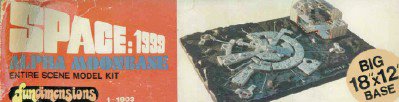
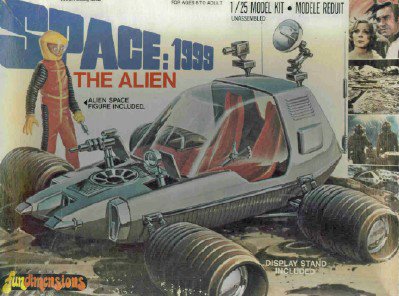
Besides the giant toy eagle, my favorite Space:1999 items invariably featured re-creations of the spaceships and locales seen on the show. In this regard, MPC/Fundimensions really did a great job, offering highly-detailed kits of the trademark Alphan spacecraft, the Eagle, and even a giant lunar diorama of Moonbase Alpha (with an enlarged section or "close-up" of Main Mission Headquarters and little eagles to go on the launch pads...).

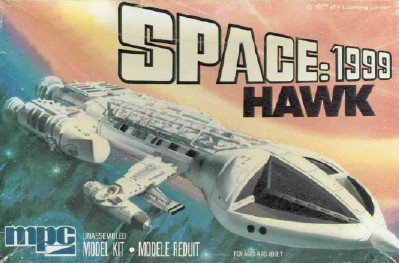
Another great kit came from the Year One episode "War Games," -- the Earth-built fighter-craft sibling to the Eagle, known as a Mark IX Hawk.

No doubt the strangest kit was one that didn't appear on the show at all , but was nonetheless packaged and sold as a Space:1999 vehicle. This was an alien car (not a moon buggy) known quite simply as "The Alien." The packaging featured stills from the series, but you won't find this (admittedly quite cool...) design on the show. Although I like this model, I would have preferred some kits of the alien crafts seen on the actual program...

As a kid, I also wanted to recreate the adventures of Commander Koenig, Dr. Russell, Professor Victor Bergman, Maya and the like, and therefore I needed some high-tech, "futuristic" accoutrements.

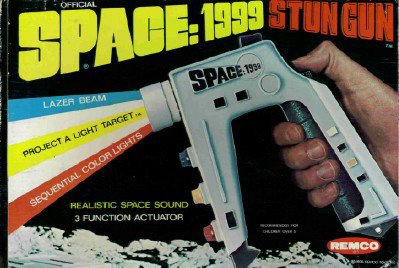
Helping out in this important category, Remco offered a Space:1999 stun gun featuring a "three function actuator" and "realistic space sound." The ad copy said the gun fired a "lazer [sic] beam." I've often compared the stun gun design on Space:1999 to a staple gun, and there's no doubt that this sidearm (along with Star Trek phasers and Logan's Run sandman "flare guns) is one of the most distinctive and easily recognizable in sci-fi TV history.

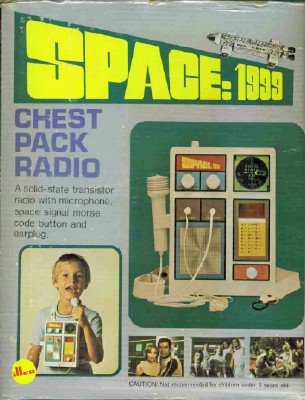
But if I wanted to head out onto the lunar surface for my adventures (well, my backyard...) I also needed the Space:1999 chestpack radio from Illco. This was a "solid state transistor radio with microphone, space signal morse code button and earplug." It was created to mimic the look and style of the Space:1999 atmosphere suit chest packs, and also bore the logo of the TV series.

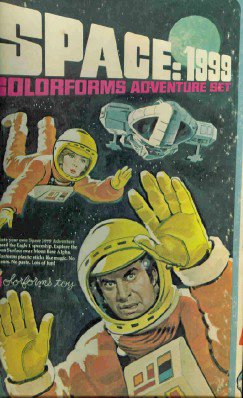
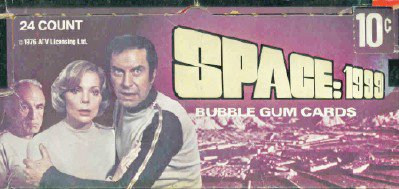
If it was a rainy day, I had a wide variety of "stay at home" toys to play with. There were Space:1999 colorforms (featuring a recreation of the Eagle interior inside...not very accurate...), puzzles from HG (three all together, I believe), and a set of trading cards (packs - 10 cents a piece).

And, of course, there were those Mattel playsets and figures, and that giant Eagle. Really, who needed school when you had such a universe of adventure to choose from?

I have many more items in my collection (a little pinballl thingie, action figures, records, comics, novelizations, a water gun and on and on) but this probably sufficient Alphan bling for one day. We all had toys that we loved as kids, and I don't think there
were any that enjoyed more than those from Space:1999.

Wednesday, December 07, 2005

TV REVIEW: Medium: "I Married a Mind Reader"

This episode of Medium aired originally on March 21 of 2005. In other words, it's a rerun from the first season. But heck, I'm new to Medium (having only seen a few episodes), so I'm going to review it anyway.

"I Married a Mind Reader" finds Allison DuBois (Arquette) home sick with a cold, watching a 1960s sitcom she remembers from reruns in childhood, called "I Married a Mind Reader." The TV show brings back memories, because it ended in a big Hollywood scandal. Married star Henry Stoller (Paul Blackthorne), killed his co-star and wife, Abigail Marsh (Frances Fisher), and is still (at age 84) in jail for the crime.

But things take a turn for the strange when Allison dreams herself back into the 1960s, taking on the identity of Dorothy Greybridge, Abigail's assistant on the TV program and Henry's mistress...and possibly the real perpetrator behind the crime...

I really got a kick out of this episode of Medium. True, it's a little lighter than the typical episode (like the gory "Still Life,") but that doesn't make it less fascinating. Of foremost interest is the loving recreation of 1960s Hollywood and a sitcom not unlike I Dream of Jeannie, or more closely, Bewitched. The black & white clips of the "I Married a Mind-Reader" show are evocative of a simpler, more innocent, and in some cases, more insipid time for mass entertainment. Every line of dialogue is a a carefully calculated (but ultimately harmless...) zinger, and every situation is "stock" (to borrow a phrase I heard repeatedly in a film I watched last night, Metallica: Some Kind of Monster). A much-put upon husband deals with his magically-oriented, troublesome wife. And hey, that's kinda (in a 2005 way...) the plot of Medium too. How very self-reflexive!

The inherent duality of 1960s Hollywood life is carefully crafted in this episode of Medium as a "perfect" suburban existence (life in the TV sitcom...) is contrasted with the sordid undertones of an industry built on good looks, money, passion, ratings...and secrets. The difference between TV as image (with actors as dream peddlers...) and the reality underneath (actors are just as flawed and venal as everybody else...) makes for compelling drama.

Medium's central conceit, nicely told through fun visuals here, is that psychic Allison goes into a "file cabinet" of thoughts to access the visions of others, and I found that a TV rerun was a nice, inventive way to get into this particular episode, and tell this story about a time and a crime long forgotten. The real Dorothy Greybridge, of course, is alive and in a coma when the reruns of "I Married a Mind Reader" are played on her hospital room TV, and that's how Allison gained access to them with her "thought antenna."

Ultimately, having watched a few episodes, I'm re-affirmed in my belief that the most valuable aspect of Medium is the chemistry/relationship between stars Matt Crower and Patricia Arquette. Like I indicated last week, these actors play between the lines, and there's a feeling of reality in this spousal relationship missing from such cookie-cutter programs as Ghost Whisperer. I find myself more involved in the "case of the week" because I'm curious to see how it will affect the DuBois marriage/relationship That's good writing and good acting. Because ultimately on TV, the people are more important than the stories. As the seasons wear on, the stories may repeat (and sometimes with markedly little variation...), but if we love the characters, we'll keep tuning in.

I'm still tuning in.

Tuesday, December 06, 2005

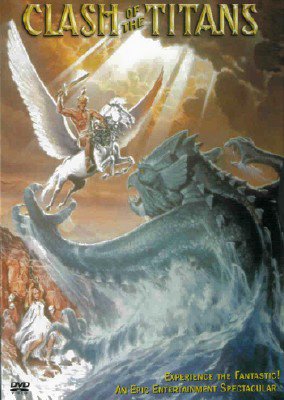
CULT MOVIE BLOGGING: Clash of the Titans (1981)

"The myth, the magic, the mystery... the combat, the courage... before history, beyond imagination..."

Those are just a few words of descriptive ad-copy (from the trailer...) heralding the ambitious 1981 adventure fantasy, Clash of the Titans.

This is a film I grew up with, and though I am quite aware that its story mangles the specifics of Greek Mythology, it's still a hell of a lot of fun.

Clash of the Titans also represents a golden "lost age" in film history and the development of visual effects, arising from an era when computers didn't create and control every aspect of special effects imaginable. Yes, Clash of the Titans arrived on screen with its fantastic effects courtesy of that legend, Ray Harryhausen, the latter-day heir to Willis O'Brien, and a true master of the form called stop-motion animation. All the effects are created here through that painstaking, unbelievably time-consuming process. Thus the models used (like that of the villain, Calibos...) are unbelievably detailed, and move exquisitely about their paces.

Clash of The Titans boasts a beautiful and disturbing (as well as atmospheric...) opening sequence, as a heartless king casts his daughter, Danae, and her infant son (Perseus) into a rageful sea. Filmed at Cornwall, these opening moments grant the audience a view of an angry sea and an accompanying cruel punishment. Set amongst craggy shores, crashing waves, and an entourage of soldiers (beautifully costumed...) this prologue begins the journey of Perseus in highly-detailed terms, and we feel as though we are really back there, in those ancient days, wondering what capricious fate awaits us...conjured not just by the sea, but by the whim of the Gods of Olympus.

The remainder of the film concerns the odyssey of Perseus (Harry Hamlin) as he grows to adulthood, and is instructed by his father, the King of Gods -- Zeus (Laurence Olivier, the king of actors...) to "find and fulfill" his destiny. He does so at the city of Joppa, a "Kingdom under a curse." It turns out that the beautiful princess Andromeda (Judi Bowker) has been put under a curse by her former fiancee, a monstrous creature called Calibos. Calibos was once a handsome man and heir to the throne of Joppa, but he hunted and killed all but one of Zeus's flying stallions and in retaliation, Zeus has transformed him into a devilish, horned beast with a tail.

Using three gifts from the Gods (a mirrored shield, an invisibility-rendering helmet and a sword that can slice stone), Perseus defeats Calibos and wins the hand of Andromeda in marriage. But all is still not well. The Goddess Thetis (Maggie Smith) is highly disturbed during the wedding when Andromeda's mother, the vain Cassiopeia (Sian Phillips) compares her daughter's beauty to that of the Goddess. Thetis thus orders Andromeda to stand as a human sacrifice to the "last of the Titans," the sea monster called "the Kraken," for her mother's insolence.

Worse - at least for unlucky Perseus - the gorgeous young woman must go to the sacrifice a virgin!! Perseus has only thirty days in which to find a way to save his beloved future wife, and with the help of a playwright named Amman (Burgess Meredith) and the leader of the Guard, Thallo, sets off on another quest. He must kill the Gorgon known as Medusa - a creature that can turn any man to stone with a gaze - and use her decapitated head to freeze the Kraken and thus free Joppa. He's assisted in his heroic journey by Pegasus, the last of the flying stallions, and Bubo, a little mechanical owl constructed by Hephaestus. But even this God-given gifts may not save Perseus as he crosses the River Styx with the Ferryman, Cheron, and heads out to the Isle of the Dead to confront Medusa, the beast with snakes in her hair...

I saw Clash of the Titans in the theater when I was ten or eleven years old, and I loved every aspect of it: the sword-fight with giant scorpions, the flooding and destruction of a city by the Kraken, and the wonderful flights of Pegasus. I still admire the film, particularly its craftsmanship. But when I was a kid, this film undeniably represented the state-of-the-art, and was heir to stop-motion film fantasy classics such as Sinbad and the Eye of the Tiger (1977), which I also adored.

Watching it today, I reluctantly realized how far special effects have really come today with computers. And as an old-school kind of guy, I'm loathe to admit it, but Clash of the Titans has certainly aged badly in 24 years. The monsters are all still amazing to behold, and convincingly rendered with stop-motion animation...yet, the process matching work seems rather dire, so that exposures between foreground and background elements just don't blend well. Goddamn! I hate that. Not because it ruined the film for me (it didn't...) but because I sooooo much wanted the effects to hold up in the age of Revenge of the Sith and other CGI glories. After watching Clash of the Titans, I can no longer cling to my perception that special effects "used to be better". They were carefully crafted - and mastered without computers - but I can't deny the efficacy of today's approach. As much as I wish I could.

But Clash of the Titans remains a fun movie, despite the "aged" special effects. The film reaches its apex on the Isle of the Dead, as Perseus hunts Medusa in her dark temple, with fires flickering all around. This sequence involves the best special effects in the film, and is also undeniably the most tense. Perseus's men are picked off one at a time by the Gorgon, who is armed with a bow and arrow, and our hero must rely on the mirror in his shield (and a reflection...) to take the head of the beast. This is a terrifying scene, and very suspenseful, and I also think it suffers least from the processing problems I noted above. There is exquisite matching (down to the reflected light of the fire...) between live-action and stop-motion, and it may have something to do with the fact that the scene was staged inside, and all aspects of lighting could be controlled. The outdoor shots - while containing beautiful location vistas - really show the mis-match in exposures to ill-effect.

Of course, Clash of the Titans also gives the world another derivative R2-D2 clone - in ancient Greece, no less - a helpful mechanical owl who speaks in clicks and whirs, just like the beloved Star Wars droid. This was de rigeuer in fantasy movies of the age (think V.I.N.Cent in The Black Hole, or Muffit in Battlestar Galactica or Twiki and Theo in Buck Rogers...or that little cursor thing in Tron, and on and on). But even that never bothers me...there's just something innocent and delightful about Clash of the Titans. And that quality survives, even if the special effects have aged more than I would prefer.

From a visit to the Stygian Witches, to the taming of Pegasus, to the final battle with the Kraken, Clash of the Titans is just as much daring fun as I remember it was. A rip-roaring fantasy and a fast two-hours at the movies. This film got a reference in Jay & Silent Bob Strikes Back, and I certainly understand why. It's probably a cultural touchstone for Generation X in that it was the stop-motion film for our particular generation. For the previous generation, it was probably Jason & The Argonauts or the amazing Seventh Voyage of Sinbad.

But for me, it's Clash of the Titans. Anyone out there seen this film lately? Does it still hold up for you? What draws you it, even after a quarter-century?


50 Years Ago: Land of the Lost: "Medusa" (October 9, 1976)

The fifth episode of the third (and final) season of the NBC Saturday morning series highlights the mythological Medusa -- snake-haired Gorg...