Subscribe To JKM


 Posts
All Comments
Posts
All Comments
Showing posts with label 1988. Show all posts
Showing posts with label 1988. Show all posts
Monday, October 31, 2016
Movie Trailer: Phantasm II (1988)

 award-winning creator of the web series Abnormal Fixation (2024), the audio drama Enter the House Between (2023) and author of 35 books including Horror Films FAQ (2013), Horror Films of the 1990s (2011), Horror Films of the 1980s (2007), TV Year (2007), The Rock and Roll Film Encyclopedia (2007), Mercy in Her Eyes: The Films of Mira Nair (2006),, Best in Show: The Films of Christopher Guest and Company (2004), The Unseen Force: The Films of Sam Raimi (2004), An Askew View: The Films of Kevin Smith (2002), The Encyclopedia of Superheroes on Film & Television (2004), Exploring Space:1999 (1997), An Analytical Guide to TV's Battlestar Galactica (1998), Terror Television (2001), Space:1999 - The Forsaken (2003) and Horror Films of the 1970s (2002).
Thursday, May 05, 2016
Video Game of the Week: Mission: Impossible (1988; NIntendo)
 award-winning creator of the web series Abnormal Fixation (2024), the audio drama Enter the House Between (2023) and author of 35 books including Horror Films FAQ (2013), Horror Films of the 1990s (2011), Horror Films of the 1980s (2007), TV Year (2007), The Rock and Roll Film Encyclopedia (2007), Mercy in Her Eyes: The Films of Mira Nair (2006),, Best in Show: The Films of Christopher Guest and Company (2004), The Unseen Force: The Films of Sam Raimi (2004), An Askew View: The Films of Kevin Smith (2002), The Encyclopedia of Superheroes on Film & Television (2004), Exploring Space:1999 (1997), An Analytical Guide to TV's Battlestar Galactica (1998), Terror Television (2001), Space:1999 - The Forsaken (2003) and Horror Films of the 1970s (2002).
Thursday, March 10, 2016
Cult-Movie Review: Hellbound: Hellraiser II (1988)

Upon
viewing Hellbound: Hellraiser II (1988) this week, I was struck with an
illuminating thought.
There
are two kinds of horror movies in 1970s and 1980s franchises.
The
first kind of movie is an artistic masterpiece, one that thrives on visual
imagery, on symbolism, and on subtext. In this category, I land movies such as
Halloween (1978), Phantasm (1979), A
Nightmare on Elm Street and Clive Barker’s original masterpiece, Hellraiser
(1987). These films operate on both a
literal level and a metaphorical one.
And
then there’s the second kind of horror movie in these franchises, which viewers
will often detect in the first sequel.
This
second brand of franchise horror film eschews the overt, careful artistry of
the first film and doubles down instead on internal mythology. In other words, the details of the world are
hammered out, and character motivations are more deeply explained. A sketch is
colored in, essentially, but in terms of symbolism some things get lost,
forgotten, or over-written.
Why
do horror franchises from this era operate in this fashion?
Well,
perhaps because symbolic imagery and sub-text may be limited to a specific,
singular narrative or set of characters. That imagery may be beautiful, canny
and informative, yet when time comes for a sequel with a new story, new
characters, and even a new setting, it is hard to sustain it. The zeitgeist has
changed, for one thing, and so symbols change.
Therefore,
intrepid filmmakers turn to the internal consistencies of the world where they
work. Like the idea that Michael Myers must have a concrete motivation for his
murders, and is thus the sibling of Laurie Strode.
Perhaps
this is why sequels so rarely live up to the originals. They don’t pinpoint an
adequate new sub-text or deep imagery to sustain the series. So instead,
additional concrete details are provided.
Yet,
inescapably, familiarity is the enemy of horror. The more we know, the less
scared we become. We are scared not when we know more, but when we no
less. The more vague the details, the
better chance that we will be unsettled by the film.
Hellbound
is the
second kind of movie in terms of this paradigm.
Specifically, Hellbound:
Hellraiser II is a mythology-based, world-building sequel to Clive
Barker’s brilliant horror film, Hellraiser (1987). It’s a good
mythology-based horror film on it own terms, but I miss the sheer artistic
inspiration of Clive Barker’s inaugural film in the franchise.
Hellbound opens with a recap of Hellraiser’s
scary ending, and then shows us the origins of Pinhead (Doug Bradley) himself.
It also finishes off any personal business left lingering between Julia (Clare
Higgins) and Frank (Sean Chapman), before settling down in Hell itself. The details of Hell, and even an evil Deity
(Leviathan, Lord of the Labyrinth) are all explored.
The
focus, as that description suggests, is on deepening and broadening the Hellraiser
universe. The focus is on providing more details, and revealing a consistent “universe.”
I
can’t complain too much, however since the solid 1988 sequel shows audiences how
Cenobites are manufactured, takes us to Hell for a grand tour, features the
great Ashley Laurence in a starring role, and reveals to us precisely the kind
of torment in Hell that Frank deserves.
There’s an overall reflection of literary mythology too -- an Orphean descent into the Underworld to
retrieve a loved one -- but even that is broadly applied.
So
by my estimation, Hellbound is a good horror film, of the second type.
It’s
just that traveling from Hellraiser to Hellbound is roughly akin
to going from Phantasm (1979) to Phantasm II (1988).
The
first film in each series is richly symbolic and reveals something about the
human condition, whether the fear of mortality, or mankind’s sexual obsessions.
Then
the ambitious sequel comes along, and it’s big and world-building and totally
impressive as a straight-up horror flick, but it exists almost purely on a literal
level, not a symbolic one.
Therefore,
in comparison to the original, I can’t help but register the sequel as a bit of
a disappointment, or at least a come down. I admire so much the rarefied,
symbolic level of Hellraiser and Phantasm.
This
is about me, as much as the film, a reader might conclude. I want my horror
movies to do more than just scare me a little, like I’m on a roller coaster
ride. I want the movie to concern or reflect something important; something
that makes me think about the world, myself, and my relationships.
So
I miss Clive Barker’s facility for visual symbolism in Tony Randel’s Hellbound,
but I still like the sequel for what it is (a rip-roaring, gory horror movie),
even if, at times, the movie looks to be held together by little more than spit
and polish.

“The mind is a
labyrinth…a puzzle.”
Following
the ghoulish events with Julia and Frank, Kirsty (Ashley Laurence) is remanded
to the Channard Institute, an insane asylum.
There,
she talks about the box, and doorways to Hell being opened and closed.
Listening
intently to her strange tale is Dr. Channard (Kenneth Cranham), a man who has
devoted his life to the study of the Lament Configuration.
Another
patient in his custody, young Tiffany (Imogen Boorman) is mute, but is an
expert at solving puzzles. Presumably, he has in mind for this ward to solve
one particular puzzle box.
Even
as Dr. Channard takes gruesome steps to revive Julia (Clare Higgins), Kirsty receives
a message that she believes is from her dead father. “I am
in Hell. Help me,” it reads, written in blood.
Kirsty
determines to go with Tiffany, into Hell, and rescue her father.
After
Tiffany opens the box, Channard meets his fate as a Cenobite, and engineers a
coup of the Labyrinth. Kirsty helps
Pinhead (Doug Bradley) finds his humanity for one battle against this new
cenobite, but it does not go well.
After
an encounter with Frank, Kirsty must summon all her resourcefulness to escape
Hell, and more than that, stop Channard.

“What tales will
she tell us from the other side?”
In
a significant fashion, Hellbound really is about tales from
the “other side.”
The
other world that we saw only briefly in Hellraiser, Hell itself, is depicted
for long stretches of the film. Some of the visuals are generally amazing,
while others prove a letdown.
The
matte painting, for instance, of the labyrinth, looks astonishingly good. There
are several shots which reveal Kirsty and Tiffany walking a long, narrow pathway
across that Escher-like maze. The maze extends to the horizon, but also stretches
downwards, across multiple levels.

Also
successfully depicted is Frank Cotton’s personal hell. He lives in a room where ghostly women “promise”
sex but never “deliver.”To Frank, this is a punishment on the scale of
Tantalus, and quite appropriate. He lives, essentially, in a trap that will
drive him mad for all eternity. And that’s
the reason he summoned Kirsty. He believes she’s a girl who keeps her “promises,”
and wants to test that theory.

Unfortunately,
when we don’t see the big matte shots, or visit Frank in his personal Hell, the
underworld is depicted in less than inspiring fashion.
In
fact it appears to consist of one hallway that branches off, and is filmed
again and again. At one point, we get a P.O.V. shot with the camera hurtling
through the corridor, and before the editor can cut away, it looks like there
are some boards or lumber balanced against one wall.
This
section of Hell: under construction.
When
one couples shots like this one with the fact that Chatterer’s make-up design
completely changes at one point, with no explanation, one gets the feeling that
the film was made in a tearing hurry, and suffered from a lot of tinkering
with.
Tiffany’s
weird hall-of-mirrors/carnival scene is similarly crude in visualization, and
doesn’t really add anything to the proceedings. Did she lose her Mom at a
carnival? The sequence never makes us understand why this circus-like place is
Tiffany’s personal Hell, or why she is permitted to escape it.
On
the plus side, the Cenobite-making chamber is radically evil and neat, though
it proves a stumbling block in future entries since it isn’t, apparently,
required to make Cenobites after all.
And
though I wonder about the rationale of making Leviathan a huge puzzle box, I nonetheless
love the deeply creepy black light it periodically shines across the realm. Instead of a lighthouse, Leviathan is a dark-house,
shining darkness throughout every corner of Hell.
To
get back to my treatise on mythology, Hellbound feels duty-bound to give
us a lot of information. It provides background
on Pinhead, revealing his pre-Cenobite life. We learn he was a British soldier
in World War I, and Hell on Earth, the next installment, even tells us his name.

We
also get to reconnect in the film, powerfully, with Clare Higgins’ Julia. Once
more, she gives voice to the film’s intermittent motif about literary mythology
(seen in the Orpheus-like story and in the damnations of Hell being like the
torments of Tantalus or Sisyphus). Here, Julia relevantly notes her role in the
myth; that she is both the “wicked stepmother” and “evil queen” in Kirstie’s
fairy tale. I love that Julia, formerly repressed and frigid, internalizes this
role and emerges from Hell as a siren, a seductress.
Again,
however, one has to wonder about the discontinuities between the two films, vis-à-vis
revival via human blood. Frank had new skin after three strangers and Larry were
killed in the first film. Julia in Hellbound kills a room full of
prostitutes, and still doesn’t have all her new skin yet.

Another
scene in the film is also incongruous. It shows a hospital ward of insane
patients being tortured by many copies of the Lament Configuration, even after
Pinhead has verbally confirmed that desire, not hands, call him. The scene
doesn’t make any sense, in light of that remark.
Yet Hellbound’s
heights of imagination generally tend to overcome such deficits. A
movie would really have to go some distance to prove itself bloodier and gorier
than Hellraiser
was. Hellbound manages that feat
with ease. The scene involving a straight razor, a bloody mattress, and a very
sick man, is one for the record books.

The
Channard Cenobite is hugely creative too, for example. Who in his or her right
mind devised an individual who is carried around by a giant worm that has
burrowed into that individual’s head? The conception and imagery of the
character is remarkable.

If
the final battle between Channard and Pinhead’s team had featured a little more
punch, a little more suspense, I’d rate the film even higher. I very much enjoy the scenes of Kirsty and
Pinhead teaming up, as it were, but I wish Pinhead put up a better fight before
getting his throat slit.

As
it stands, Hellbound is a perfectly satisfying mythology-based horror
sequel. For those who “have to see, have
to know…” -- like Channard -- the movie both promises and delivers.
For
those audiences seeking a film functioning at at the same artistic apex as Hellraiser
does, however, this first sequel may not exactly qualify as a “pleasure.”
award-winning creator of the web series Abnormal Fixation (2024), the audio drama Enter the House Between (2023) and author of 35 books including Horror Films FAQ (2013), Horror Films of the 1990s (2011), Horror Films of the 1980s (2007), TV Year (2007), The Rock and Roll Film Encyclopedia (2007), Mercy in Her Eyes: The Films of Mira Nair (2006),, Best in Show: The Films of Christopher Guest and Company (2004), The Unseen Force: The Films of Sam Raimi (2004), An Askew View: The Films of Kevin Smith (2002), The Encyclopedia of Superheroes on Film & Television (2004), Exploring Space:1999 (1997), An Analytical Guide to TV's Battlestar Galactica (1998), Terror Television (2001), Space:1999 - The Forsaken (2003) and Horror Films of the 1970s (2002).
Movie Trailer: Hellbound: Hellraiser (1988)
award-winning creator of the web series Abnormal Fixation (2024), the audio drama Enter the House Between (2023) and author of 35 books including Horror Films FAQ (2013), Horror Films of the 1990s (2011), Horror Films of the 1980s (2007), TV Year (2007), The Rock and Roll Film Encyclopedia (2007), Mercy in Her Eyes: The Films of Mira Nair (2006),, Best in Show: The Films of Christopher Guest and Company (2004), The Unseen Force: The Films of Sam Raimi (2004), An Askew View: The Films of Kevin Smith (2002), The Encyclopedia of Superheroes on Film & Television (2004), Exploring Space:1999 (1997), An Analytical Guide to TV's Battlestar Galactica (1998), Terror Television (2001), Space:1999 - The Forsaken (2003) and Horror Films of the 1970s (2002).
Tuesday, February 02, 2016
Die Hard on a Blog: Die Hard (1988)

Die
Hard is the
movie that launched a hundred cinematic knock-offs or so.
John
McTiernan’s blockbuster 1988 so dramatically and thoroughly revolutionized the action genre at
the end of the eighties in fact that -- for at least half-a-decade -- virtually every
new entry in the genre was described as “Die
Hard in a (fill in the blank.)”
Movie-going
audiences soon saw Die Hard on a Bus (Speed [1994]), Die Hard on a
battleship (Under Siege [1992]), Die Hard on a Train (Under Siege 2 [1995), Die
Hard on a Plane (Passenger 57 [1992], Executive Decision [1996]) and even
Die Hard in a Hockey Stadium (Sudden Death [1995]).
So
in the spirit of that memorable nomenclature, welcome to my newest blog series:
Die Hard on a Blog.
All
the movies I will feature here in the coming weeks include the critical element of a
nefarious terrorist or criminal threat acting inside a closed-setting, and the singular hero who combats it.
Today,
in the inaugural installment, I’ll remember the still-unmatched progenitor of
this cinematic trend: Die Hard.
The
film is very closely based on novelist Roderick Thorp’s (1936-1999) literary
work, Nothing Lasts Forever (1979), which in turn was inspired by the
author’s viewing of The Towering Inferno (1974).


The
novel concerns a retired detective, named Leland, who visits the L.A. high-rise
HQ of a company called Klaxon Oil. He is there to visit his daughter Stephanie,
for the Christmas party, when a German terrorist, Anton Gruber, takes
seventy-four hostages.
Many
elements in the film, including a barefoot hero, the gun taped to the
protagonist’s back, and the use of explosives in an elevator shaft, recur
directly from Thorp's written words.
Rich
in invention and humor, Die Hard (1988) succeeds on many
levels, and remains today much more than a thrilling fusion of disaster film
and thriller tropes.
First
and foremost Die Hard is absolutely dazzling from a visual standpoint, in large
part because director McTiernan eschews excessive and unnecessary cutting, and
preserves the space or geography of the action by utilizing tilts, pans, and
other, often extreme or sudden camera motions.
Not only is the space of the
action preserved in this fashion, but the rapid camera motion accelerates the film’s sense of
pace.
Our view of the action literally
banks, turns and performs barrel rolls. It’s as if we’re seeing through the
furtive eyes of the desperate hero, registering everything, everywhere, in an effort to
endure and survive.
Secondly,
for all its bells and whistles, Die Hard essentially boils down to a battle of
wits between two evenly-matched opponents, one ruthless, intellectual and
urbane (Alan Rickman’s Hans Gruber) and one wide open: Bruce Willis’s John
McClane.
At
times it actually feels like a realization of destiny that these two
resourceful, ingenious, determined characters should face each other, “mano
e mano” at the Nakatomi Plaza. No other place in the world is tall enough for
both of their egos and self-confidence, perhaps.
Yet
in terms of its pure, psychic appeal, Die Hard is actually something more
than a great and eminently satisfying action movie.
It is undeniably a primal male wish-fulfillment fantasy that was forged in a time when
masculinity was facing existential questions about its value and worth in
the larger American culture.
John
McClane’s battle in this film is not simply to defeat Hans Gruber or rescue the
hostages in Nakatomi Plaza, including his wife, Holly (Bonnie Bedelia).
No,
his battle, as I hope to explain in this review, is to redeem himself as an
alpha “male” and showcase his viability as such.
Some
might suggest that this leitmotif renders the film sexist in some way. I’m not here to make any particular conclusions
or social judgments about that notion, only to draw your eye and your intellect
to the argument the film crafts on both a visual and often sub-textual level.

“Just
a fly in the ointment, Hans, just a monkey in the wrench, just a pain in the
ass.”
For
Christmas, the NYPD’s John McClane (Willis) flies to Los Angeles to be with his
estranged wife, Holly (Bedelia) and his two children, John and Lucy. A limousine delivers him to the high-tech
Nakatomi Plaza, where Holly works a successful and high-powered career executive.
When
John and Holly reunite, they argue about their marriage, and the fact that
Holly now uses her maiden name, Gennero, rather than her married name, McClane.
Their
personal differences must wait, however, because a group of European terrorists
led by Hans Gruber (Rickman) invade the building, cut the power, and take seventy-four
Nakatomi employees hostage, including Holly.
John
seizes an opportunity to escape the offices, into the larger building. Almost immediately, he begins taking on the
terrorists, one-at-a-time, much to the irritation of the erudite,
well-organized Gruber.
John
also gets a call outside of the building for help, and ends up teaming via walkie-talkie with L.A. cop Al Powell (Reginald VelJohnson).
Before
long, news crews, and the F.B.I. are also on the scene, but McClane is the only
man on the inside of the building, the only man who can stop Gruber’s plan.
That plan involves explosives, a bank vault and much deceit…

“It’s
Christmas time, Theo. It’s a time for miracles.”
It
is plain to see how Die Hard adopts many key elements from The Towering Inferno.
There’s a rooftop rescue that goes awry in both productions, for example, a lot
of fire, and the same central location: a Los Angeles high-rise building. In both productions, helicopters are destroyed too.
Die
Hard takes that setting and those creative elements, however, and creates something new
for the cinema, an action movie in which the hero is an “every man” who is
outnumbered, out-gunned, and cut-off from authority He is tested quite
egregiously, and must succeed based on nothing but his wits and his cunning.
McClane is a man alone.
The
highest plateau of film quality, for me, arises with the idea of visuals mirroring
or reflecting thematic and narrative concepts. We see this idea play out in Die
Hard as director John McTiernan deploys a kinetic, almost
constantly-in-motion camera. Objects -- like a whirring table saw, for example
-- loom suddenly in the foreground. Or the camera suddenly shifts on its axis, and goes plummeting down a basement staircase the viewer has not yet detected.
This
approach possesses two virtues.
The first is that this brand of camera motion preserves the space of
the battlefield, to adopt a war metaphor. Were the film to feature an
over-abundance of cutting, the space (and time) would feel fractured. But by
whirling to register objects, or tilting and panning to see things, McTiernan makes us feel like
we are trapped in the building with McClane.
The
second virtue is connected to the first. The camera’s movement -- always “discovering” new objects, rooms, and
enemies -- recreates the mental state of the film’s characters. Around
every corner could be a threat or an opportunity, and the camera work expresses
a kind of nervous energy as Gruber and McClane both harness the (same) environment
to win the day.
The
camera-work also is adrenaline-provoking. We are never sure what we will see
next, and so we start paying attention to every detail, every moment of the
action. This is reflected in the character dynamics in so many ways. Hans picks
up that McClane is walking barefoot, and in the next moment, orders his henchman to
shoot out the glass from a nearby pane, creating an impediment for his opponent. The camera and
the characters learn things at the same time, and seize on that learning for
their game of chess.
Sometimes,
the camera moves brilliantly to reveal the proximity of danger. At one point, for
example, cinematographer Jan de Bont's camera tilts up from a smoldering bullet-hole in a vent
shaft to a close-up of a vulnerable McClane, perched inches away. The director
could have cut to a reaction shot, instead, of his hero. But that simple tilt tells us just
how close McClane came to death.
The
whole movie is filled with anxiety-provoking moments such as that one. As a result, Die Hard is
fun to watch -- a veritable roller-coaster ride of a movie -- and that’s primarily
because of the ingenuity and efficacy of so many compositions. The visuals engage us, and demand attention.
As
I noted above, Die Hard is also a primal male fantasy.
It is about a man who
grew up with heroes like John Wayne, Gary Cooper, Roy Rogers and James Arness
(Marshal Dillon) discovering, as an adult, that men like that are no longer called for in
American society.
Those cowboys were protectors and patriarchs, but Gruber dismisses
them all as products of a “bankrupt culture.”
Even other 80s male icons such as Rambo are name-checked, and Lee Majors’
The Fall Guy is seen on TV at one point. The
idea, I suppose is that American culture has changed radically in the 1980s, but no one has bothered
to tell the movies about that fact. We still
raise our boys into men thinking they can be cowboys. They still kill the bad guy, get the girl, and ride off into the sunset.
Yet
just consider for a moment the shift in demographics and the economy that
occurred in the eighties and how they changed the picture for masculinity in this
country.
By
1985 half-of-all college graduates were women, and women with outside-the-home
careers jumped to 49%. Women moved successfully into traditionally-male held
jobs in banking and white collar management too.
On
one hand, movies like Working Girl (1988) epitomized the
era. On the other, efforts such as Mr. Mom (1983) dramatized the
opposite side of that equation: a stay-at-home Dad raising the kids.
Die
Hard, very
simply, concerns a man, John McClane (Bruce Willis) who doesn’t cope well with
this shift in cultural expectations, and what that change means for his ego and self-respect. His journey in the film involves a successful attempt
to re-assert his role, value, and place in the American family when he is no
longer the primary bread winner or the "hero."

That
opportunity occurs at the workplace of his wife, Holly, who has moved out of
John’s home in New York with his two children, and earned kudos as an executive
at a Japanese-run corporation. Holly is a complete success, and is so confident
in that career success that she goes by her maiden name, “Gennero” instead of her
married name, “McClane.”
Several times, the film gives us visualizations of that name, Gennero. We see it in the building registry and on the door to Holly's office. In a very concrete, visible way, then, Holly has separated herself from her marriage, and her husband.

But
then John ultimately saves the day, and Holly introduces herself to Al Powell not as Holly
Gennero, but as Holly McClane.
That, right there, is the the punctuation of the whole movie. That’s
the whole wish fulfillment aspect in a nut-shell: the idea that John can bring his wife around
to his “idea of what this marriage should be.”
He doesn’t do this by being a good listener, by being a shoulder to cry
on, by being a good dad, or by being a partner in the work-force, an equal
earner.
He
does it by being just like those predominantly cowboy heroes of yesteryear. By besting the bad guys, getting the girl, and riding off into the sunset.
Yippy-kay-yay,
motherfucker.
The
sub-text, of course, is that John McClane and other men have been somehow
emasculated by the rise of women in the workplace in the 1980s. John is rudderless and alone,
and must re-assert himself and his male-ness.
This idea
gets a surprising amount of visual play in the movie because of a nifty little bait and switch trick. John keeps seeing gorgeous,
often naked women, and though he registers them, he doesn’t act on his sexual
impulses to conquer them.
What
type of shot or sequence or shots recurs in Die Hard quite frequently?
Well, it is a shot of a beautiful woman who is “seen” by McClane either in the same shot, or in cutaway reaction shot. Then, he kinds of sighs, and moves
on, with resignation, after noticing her allure
This
happens again and again in the film, and one must ask why. Why does this composition recur?
Let me give you the examples before I answer that question.
In
the airport, McClane sees a women in tight-white pants leap effortlessly into the
arms of her boyfriend. Her rear-end appears to defy gravity.

At
the party, McClane ogles a woman standing beyond a fountain, in long-shot. Here we get both the object of his gaze, and a view of his gaze.


Then, in
Holly’s office, a sexually available woman bursts in with her lover. John sees her, through the mirror, so that we get his gaze, and the object of his gaze in the same composition.

Immediately
after McClane escapes from Holly’s office, John heads to a floor upstairs. He
looks out a window, and sees an apartment across the way. A half-naked woman is
lounging there, in front of her window. The camera moves in on McClane as he
registers her presence. Again, this encounter features two shots: the object of McClane's gaze, and a view of him gazing at that object.


And, finally, during his chases back and forth through the infrastructure of the Nakatomi
Building, McClane twice sees a pin up of a nude woman. She catches his eye on one occasion, and he cranes his neck to look at her. On another occasion, he speaks to her like an old friend.

There
are no fewer than six instances, then, in Die Hard, wherein John’s gaze is explicitly connected to the visual of a sexually-desirable woman.
What
does it mean?
Quite simply, there’s the idea here that marriage and society -- and modern convention too -- shackle
men, and prevent them from being their true selves. These things hold them back, rendering them impotent, just as new-fangled 1980s ideas about women in the
workplace take away their manhood too (by the movie's way of thinking; not mine).
And
how does John exert or assert his manhood, if not by conquering these available, luscious women he constantly encounters?
By shooting guns. A lot. By killing terrorists.
By shooting guns. A lot. By killing terrorists.

In Die Hard, McClane asserts his masculinity not by having sex with all the abundantly desirable women he miraculously keeps casting his eyes upon, but by committing bloody violence and
re-taking his place as a powerful alpha male.
Now,
no man is an island, of course, and John still requires emotional support, even while doing
things that a man must do. He turns not to
his wife (who is unavailable to support him), but to a "bromance" with Al Powell. McClane finds that
for his emotional needs in a time of crisis he needs, simply, another man, and
one who is, importantly, a cop like he is.
Al
Powell has been rendered impotent by society too. He’s a desk jockey who hasn’t fired his gun
since an accident years earlier.
How
does he get his groove (and masculinity) back?
Again with a pistol, by killing someone.

Once more, I would like to stress that I’m not rendering any kind of judgment, pro or con for the argument that Die
Hard so carefully constructs. However, it is abundantly plain the message is there, and part
of a wish-fulfillment fantasy aimed straight at men in the eighties.
They have been held back too much, and if
they want to earn back the respect of women and men around him, they have to
be gun-toting heroes in the mold of John Wayne, Rambo, or any of the other
heroes that Gruber names.
The
appeal in Die Hard, not entirely unlike the appeal of the Dirty Harry films, is
the characterization of a male hero -- in a time of change -- reverting to "simple" cowboy form. Die Hard makes that characterization funny by references to Roy
Rogers’ sequin shirts, and by McClane’s foul-mouthed but nonetheless immortal
catchphrase.
In other words, Die Hard is a
movie that is both primal male fantasy and simultaneously smart enough to be self-aware
about it.
It
would be easy to write much more about this film.
For instance, Die Hard is one of my
favorite Christmas movie of all time, because -- again -- it deals so
ironically and with such self-awareness about the contradictions between a
holiday celebrating love and peace and the bloody violence in the Nakatomi
Building.

This conceit, this
juxtaposition, reaches its zenith of brilliance in the film’s final shot. Nakatomi burns and smolders, and the
soundtrack plays the song “Let It Snow.” The lyrics, in case you have forgotten, commence with: “The weather
outside is frightful. But the fire is so delightful.”
The
fire at Nakatomi Plaza is delightful?
Hell
yeah it is. For John McClane, who has won back his wife, defeated the bad-guy, and is horizon-bound.
When
I first devised the idea of writing about Die Hard (1988), I thought about all
the approaches I could take, and realized just how brilliantly the film
fulfills multiple functions.
It’s an
ironic Christmas story.
It’s a development of the Towering Inferno setting.
It’s
a primal male fantasy about re-asserting manhood according to the Hollywood
definition of that term, and, finally it’s an elegantly-shot action film too.
But
the passing of Alan Rickman demands that I add one more paragraph to an already
too-long critique of this film.
His Hans
Gruber is, without exaggeration, the perfect movie villain. Not because Gruber can
shoot. Not because Gruber threatens people. But because Rickman projects so much
intelligent, wit, and cunning.

At
one point, Rickman's Gruber quips about the “benefits of a classical education,” and that dialogue makes a valuable point.
Rickman, a slender intellectual sort is
able to project so much cerebral menace as Hans Gruber that we feel the
muscular, t-shirt clad McClane is in constant danger from him.
In short, Rickman proves
that not only is smart sometimes sexy, smart is also sometimes damned scary.
His best scene in the film involves Hans’
on-the-fly adoption of an American accent when he unexpectedly encounters McClane. This scene is rife with tension
because we don’t know what John knows, and we didn’t expect Hans to prove quite
so…adaptable in the field.
Gruber also gets a death scene that has yet to be topped in the action film genre (pictured above).
So if my description of Die Hard as a primal male fantasy is somehow disturbing or
uncomfortable for anyone, there’s no need to focus exclusively on that aspect.
Die Hard features so many other virtues -- from
its stirring fight scenes, accomplished camera-work and great performances to its brilliant Michael Kamen
score -- that’s it difficult to choose which one really makes the movie soar.
So
the year 1988 and the dawn of Die Hard?
A “time of miracles” indeed.
Next
Tuesday, Die Hard on a Blog continues with Die Hard 2: Die Harder (1990).
award-winning creator of the web series Abnormal Fixation (2024), the audio drama Enter the House Between (2023) and author of 35 books including Horror Films FAQ (2013), Horror Films of the 1990s (2011), Horror Films of the 1980s (2007), TV Year (2007), The Rock and Roll Film Encyclopedia (2007), Mercy in Her Eyes: The Films of Mira Nair (2006),, Best in Show: The Films of Christopher Guest and Company (2004), The Unseen Force: The Films of Sam Raimi (2004), An Askew View: The Films of Kevin Smith (2002), The Encyclopedia of Superheroes on Film & Television (2004), Exploring Space:1999 (1997), An Analytical Guide to TV's Battlestar Galactica (1998), Terror Television (2001), Space:1999 - The Forsaken (2003) and Horror Films of the 1970s (2002).
Movie Trailer: Die Hard (1988)
award-winning creator of the web series Abnormal Fixation (2024), the audio drama Enter the House Between (2023) and author of 35 books including Horror Films FAQ (2013), Horror Films of the 1990s (2011), Horror Films of the 1980s (2007), TV Year (2007), The Rock and Roll Film Encyclopedia (2007), Mercy in Her Eyes: The Films of Mira Nair (2006),, Best in Show: The Films of Christopher Guest and Company (2004), The Unseen Force: The Films of Sam Raimi (2004), An Askew View: The Films of Kevin Smith (2002), The Encyclopedia of Superheroes on Film & Television (2004), Exploring Space:1999 (1997), An Analytical Guide to TV's Battlestar Galactica (1998), Terror Television (2001), Space:1999 - The Forsaken (2003) and Horror Films of the 1970s (2002).
Tuesday, November 17, 2015
The Films of 1988: Phantasm II

Don Coscarelli’s Phantasm (1979) is a brilliantly-crafted horror movie, and a classic of the genre too, in no small part because it appears to operate on multiple levels of meaning and symbolism.
For
example, taken literally, the film is about a horrible ghoul (The Tall Man), and
his agenda to strip-mine Earth’s dead.
On
a far more complex level, Phantasm concerns the industry of death itself, from hearses
and coffins to graves and mausoleums. Death, we see, is an impersonal,
industrial process -- a factory, in some sense -- and the Tall Man is its
(cinematic) overseer.
Yet
as I’ve written before Phantasm also serves as a sensitive examination
of one boy’s reckoning with death as an inescapable fact of life.
Our
protagonist, young Michael (Michael Baldwin) dreams of combating the Tall Man
(Angus Scrimm), because he is a boogeyman or personality who can be defeated. Death itself -- the unstoppable, face-less force
that took away his brother Jody (Bill Thornbury) -- cannot be destroyed.
So
adolescent Michael conjures a “phantasm” -- a dream -- that is palatable to him
in a time of grief and mourning.
In
that dream, mortality can be overcome; death can be defeated. The Tall Man can
be buried forever. The film, featuring
moments of innocent, almost child-like wonder (witness the giant fly, born from
the Tall Man’s blood..), can thus be explained as a boy’s childhood fantasy of
beating death once and for all. A
fantasy that, in the denouement, he sees is but mere delusion.
Death
always wins.
The
sequel, 1988’s Phantasm II, is a very different film, and overall a far more
conventional one. By and large, the
metaphor behind the first film -- which involves both man’s desire and
inability to defeat death -- is left by the wayside, and the follow-up focuses
instead on action, weaponry, and loads of stylish excess.
These
predilections make Phantasm II a perfect horror film of the 1980s, an era when
escalation was the name of the game, and action replaced, to a large extent,
atmosphere.
Here,
the action scenes are deliberately stylish and over-the-top, in the mode of Sam
Raimi’s Evil Dead franchise, and Raimi himself is name-checked in one
crucial scene. Guns, grenades, flame throwers and other weapons dominate the
action, and one gets a thorough sense of the Rambo-fication of the franchise.
At
least two suburban houses explode in the film, and one (impressively lensed)
moment sees the Tall Man standing in the foreground while all hell breaks loose
behind him. He is literally surrounded by hellish fire.

It’s
not necessarily a bad tor unsatisfactory approach and Phantasm II is a wholly
entertaining rollercoaster of a film, even if it resolutely lacks the
intellectual and artistic heft of the 1979 original.
Where
Phantasm
II proves most intriguing is not in its crazy, often gruesome action,
but rather in its surprisingly effective (and prophetic?) vision of a
small-town America decimated by that Bringer of Death, the Tall Man.
I’ve
always liked Phantasm II second best in the franchise, judging it a solid,
well-made, involving sequel.
But
I do miss the absent piece of Phantasm’s creative legacy: the
acknowledgment and through-line that the Tall Man, his minions, and Michael’s
adventures are all some phantasm that reflects a very real fear in our kind;
the fear that death -- like taxes and horror movies sequels -- is utterly inescapable.

“Remember,
it was all in your imagination.”
Several
years after the death of his brother Jody, and his incarceration in a psychiatric
hospital, Michael (James Le Gros) is released and declared cured of his mental
illness. He promptly teams up with his old friend, Reggie (Reggie Bannister).
This
duo heads out on the road, in pursuit of the Tall Man, itching for a
fight. Michael can find The Tall Man
because he shares a mental link with another possible victim, a young woman in
Perigord, Oregon named Elizabeth (Paula Irvine).
Along
the way to reach and rescue Elizabeth, however, Reggie and Michael pick up a
stranger, Alchemy (Samantha Phillips), and must contend with booby traps left
by the Tall Man.
Finally,
the hunters reach Perigord, where Elizabeth has teamed with a priest, Father
Meyers (Kenneth Tigar), to put an end to the Tall Man’s reign of terror once
and for all.

“Let’s
go shopping.”
While
watching a sequel like Phantasm II, or for that matter,
James Cameron’s Aliens (1986), I often remember some of the punchy and very
smart dialogue from Wes Craven’s Scream 2 (1997). There, Randy Meeks
(Jamie Kennedy) explains how all horror genre sequels must ratchet up the body
count, feature more elaborate death sequences, and highlight what he terms “carnage candy.”
There’s
indeed much carnage candy in Phantasm II.
For
example, one unlucky minion of the Tall Man sees a silver sphere burrow inside
of him, hollow out his innards, then make its way through his neck, to his
mouth.

Another
extremely gory (and accomplished) scene finds the Tall Man’s face
disintegrating after being pumped full of hydrochloric acid.
Clearly,
the disgust quotient has been upped significantly since 1979, and now the
flying spheres or balls not only drain victims of their blood and gut them from
within, they lop off ears, shoot lasers (like a Predator shoulder cannon) and
the like.
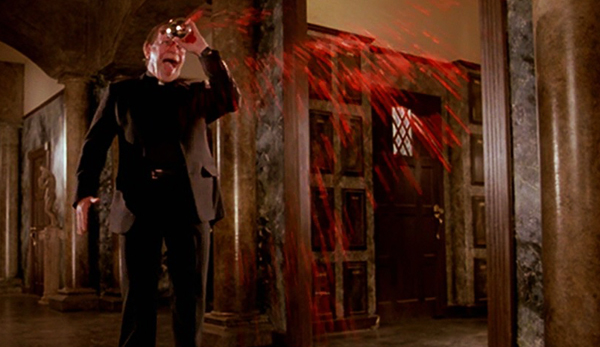
This
“bigger is better” mentality informing sequel is part and parcel of the 1980s
genre cinema. Consider, again, Aliens. The film stresses action over suspense, and
pits the original hero, Ripley (Sigourney Weaver) not against one
acid-for-blood xenomorphic monstrosity, but a veritable planet-ful of them.
Or
consider Tobe Hooper’s Texas Chainsaw Massacre Part II (1987),
which features -- amusingly -- dueling chainsaws, and entrenched commentary
about small-business owners in the Reagan Era.


Phantasm
II gets its
own dueling chainsaws scene (in which it is proved, for the record, that size
doesn’t matter…), and gives its audience full-on battle sequences with Reggie
and Michael overcoming dwarf minions by the dozen.
Reggie
takes out four of them with a customized shot-gun, with one pull of the
trigger.
One
early scene -- also perfect for the excesses of the eighties -- also sees
Reggie and Michael going “shopping,” buying items from a store and crafting their
signature weapons, including a fire extinguisher and the aforementioned shot
gun. They pay for all that they take,
and the focus is on making weaponry, so they can take the fight straight to the
Tall Man. As Reggie actually says in the film: “Come on, let’s go kick some ass!”
Phantasm
II possesses
two saving graces; ones that keep the film from being a brain-dead Rambo
in the Graveyard film.
The
first is the film’s sense of visual humor/style. As I noted in my introduction, Sam Raimi is
name-checked during one scene in an embalming room. A bag of ashes (Ash?) are
thrown in a bag labeled with the director’s name. This tribute is perfect, because Phantasm
II, much like an Evil Dead film, never stops moving, and
never remains still for along. Coscarelli’s camera plows through doors, one
after the other, in a very Deadite-ish gag that nonetheless works like
gangbusters.
Similarly,
Reggie’s run-in with a Graver (another Tall Man minion) is funny, tense, and
grotesque. Coscarelli demonstrates here
and throughout the film that he can shift between tones with aplomb, and keep
the whole enterprise moving at a crazy, gonzo clip.
More
impressive, however, is the subversive idea, just under the surface in Phantasm
II, that when Big Time Industry comes to a small town…the small town
dies. Much of the film involves Reggie
and Michael pursuing the Tall Man from American ghost town to American ghost
town. Michael observes that “small towns are like people. Some grow old
and die a natural death. Others are murdered.”
What
murders these small towns is the arrival of the Death Industry, under its CEO,
the Tall Man. He arrives, and strip-mines the towns for all their usable (on
his terms) resources. He takes over the local mortuary, and before you know it,
graveyards are being emptied at a rapid rate. His take-over (with his own
employees: dwarves and gravers, namely) literally kills the small towns in
short order. The denizens of the town die, and are made slaves.
Not
low-wage slaves, either. Just slaves.


For
many years (ten, actually) I lived in a beautiful southern small town; one with
beautiful old architecture and a downtown consisting of long-standing mom and
pop shops. In the span I lived there, this town was murdered, per Phantasm
II’s lingo, by the arrival on the main highway, not far away, of
shopping goliaths like Wal Mart, K-Mart and Target. The downtown shops emptied at an incredible
rate until the whole area -- so picturesque
and evocative of an earlier era in American history -- became a ghost town,
an image like something out Phantasm II.
So
perhaps Phantasm II is more than a perfect representative of its
gung-ho era -- the hyper-militarized, excessive, action packed 80s.
Perhaps
in some way the sequel was forecasting what the future of that world could one
day look like, in the 90s and beyond. Considering
the death, in so many places, of old fashioned, small-town America, it’s hard
not to view the enthusiastic line of dialogue in the film, “let’s go shopping!” as carrying an
ironic, double meaning.
I
also find Phantasm II’s undercutting of traditional religious belief to
be startling, especially given the traditional nature of the time period from
which the film hails. One of the most frightening notions ever put to the
horror film is voiced by the Tall Man here.
When
confronted with Father Meyers and his Christian faith, The Tall Man mocks
religion as fantasy, as delusion. “You think when you die, you go to Heaven?
You come to us!” He taunts.
It’s
a chilling declaration, and promise that the afterlife is not paradise, but
slavery. It’s downright chilling.
Finally, I appreciated Coscarelli's choice to tell Mike and Reggie's story (the 1979 original) through charcoal sketches in Elizabeth's notebook. I felt, personally, that this was an interesting and artistic way to resurrect images from the first Phantasm.

Phantasm
II cannot
match the brilliance and artistic depth of the original 1979 film, but in the
era of Freddy Krueger and Friday the 13th sequels,
it stakes out a claim for quality by balancing so well its scares and its laughs.
The sequel doesn’t open itself up very well to multiple readings, and the “dream”
or “rubber reality” concept is half-enunciated.
Here,
for example, Reggie doesn’t remember being attacked by the minions at Michael’s
house, even though Michael remembers it. This suggests the scene was a dream. But it is never explained how Michael parses this
experience in the real world. Was his
house actually destroyed by a gas leak?
It’s
awkward and confusing to viewers that Reggie only comes on board with the plan
to eliminate the Tall Man after his house also explodes, in the present. If the
movie had just treated the first scene as real, it wouldn’t need to create a
modern, artificial explanation for Reggie’s loyalty to the cause.
And
the film’s end, of course, is a slapdash re-assertion (or regurgitation) of the
original’s idea that Michael’s battle with the Tall Man is just a phantasm, not
reality. But it’s more difficult to make
that case here than it was in the original film because Michael seems to be sharing
a folie a deux with Elizabeth. Their delusion of a Supernatural (or alien?) Death
Merchant is mutual, thus making it unlikely to be just a young person’s fantasy
about defeating mortality.
So Phantasm II is great to look at, watch, and experience…but not so great to think about deeply. If you can accept the sequel on those terms, it remains one of the most entertaining horror sequels of the last half of the 1980s, and one featuring a few superb sequences. The Tall Man’s denunciation of our faith is one example, and the view of small town America decimated by the Big Death Industry is another.
So Phantasm II is great to look at, watch, and experience…but not so great to think about deeply. If you can accept the sequel on those terms, it remains one of the most entertaining horror sequels of the last half of the 1980s, and one featuring a few superb sequences. The Tall Man’s denunciation of our faith is one example, and the view of small town America decimated by the Big Death Industry is another.
award-winning creator of the web series Abnormal Fixation (2024), the audio drama Enter the House Between (2023) and author of 35 books including Horror Films FAQ (2013), Horror Films of the 1990s (2011), Horror Films of the 1980s (2007), TV Year (2007), The Rock and Roll Film Encyclopedia (2007), Mercy in Her Eyes: The Films of Mira Nair (2006),, Best in Show: The Films of Christopher Guest and Company (2004), The Unseen Force: The Films of Sam Raimi (2004), An Askew View: The Films of Kevin Smith (2002), The Encyclopedia of Superheroes on Film & Television (2004), Exploring Space:1999 (1997), An Analytical Guide to TV's Battlestar Galactica (1998), Terror Television (2001), Space:1999 - The Forsaken (2003) and Horror Films of the 1970s (2002).
Subscribe to:
Posts (Atom)
Guest Post: "Teenage Sex and Death at Camp Miasma"
As Sondheim wrote, "Every Day a Little Death." By Jonas Schwartz-Owen Two worlds run through Jane Schoenbrun's Teenage Sex ...

-
 It is an indisputable fact that fan service and good drama don’t always go hand-in-hand in the cinema. In fact, sometimes these factors div...
 -
 It is quite difficult to believe, but in 2024, Ridley Scott’s Alien (1979) turns 45 years old. Perhaps the most amazing thing about Alie...