Thursday, September 27, 2012

Star Trek: The Next Generation Day: U.S.S. Enterprise Bridge (Playmates; 1993)


As a kid, the one toy that I really, really wanted (besides a Moonbase Alpha for Space:1999 action figures...) was an relatively authentic recreation of the starship Enterprise bridge.  Back in the 1970s, Mego had created the widely-remember "action playset" of the original U.S.S. Enterprise bridge (replete with "Spin Action Transporter") but the detailing of the bridge was far from accurate. 

In 1979, Mego made a second attempt, creating a toy of the Enterprise bridge from Star Trek: The Motion Picture.  It was somewhat more accurate than its predecessor, and yet manufactured from this horribly light plastic.  Worse, all the controls were simply decals that easily came off, or might be applied crookedly.

But finally, in 1993, Playmates created the Star Trek bridge playset that kids like me had long dreamed of.  Unfortunately, by then, I was an adult. 

Regardless, Playmates offered this  "super" play-set of the NCC-1701-D bridge.  This huge toy -- the "control center of the starship Enterprise" -- was, by far and away the most accurate representation yet of any Star Trek bridge. 

And gosh darn it, it wasn't for Kirk's era. 

Still, I wasted no time purchasing this toy to go along with my ever-increasing collection of Playmates figures.

As you can see from the photos, this bridge toy is an "authentic reproduction" of the set featured on Star Trek: The Next Generation for seven seasons.  It features a light-up view screen that reveals a Romulan War Bird in close proximity, plus "swivel" panels and "pivoting" chairs for the crew.  There are even "pull-out" seats for the "aft workstations."  Another nice feature was that that this toy came with "Technical Blueprints" of the bridge, which was nice for -- ahem -- collectors.

This bridge playset deviates from the TV show only in the features added to Worf's security station.  Here, an array of push-buttons have been added to recreate sounds from the program.  These sounds include "hailing frequencies," "red alert," "tractor beam," "warp drive," "photon torpedoes" and "computer."  I always suspected Worf could run the whole ship himself, but here was the evidence. All the other stations were...superfluous.

I was twenty-one when this toy was released in 1993, and thus could not spend days on end playing with it, as I would have liked.  In fact, my girlfriend (now wife..) and I had moved into our first apartment together in 1993 while she finished college and I tried to bring home the bacon.

Despite such responsibilities, I did play hookey from my job at the Supreme Court of Virginia for one day, and set up the bridge for action.

Don't tell anyone...

Star Trek: The Next Generation Day: "Skin of Evil"


"... death is that state in which one only exists in the memory of others; which is why it is not an end..."

- Tasha Yar (Denise Crosby) in "Skin of Evil."

In this post, I remember the controversial first season effort "Skin of Evil" written by Joseph Stefano and directed by Joseph Scanlon.  It's an episode that has been widely termed an "unmitigated disaster." 

In fact, "Skin of Evil" is often considered one of the series' worst installments.  That's an honor I would more readily reserve for early first season programs such as "Code of Honor," "The Last Outpost," "Haven," Too Short A Season," "Home Soil," or the second season clips show "Shades of Gray." 

The reasons for the generally low-opinion of "Skin of Evil" are clear and definitely understandable. 

First, the episode kills off a popular regular character, Tasha Yar (Denise Crosby) and more than that, does so in a purposefully random or "meaningless" fashion.

In short, the beloved Enterprise security chief dies the ignominious death of a red shirt.

Star Trek: The Next Generation itself attempted to un-write this apparently unworthy demise in the excellent third season episode "Yesterday's Enterprise," by granting the character a more noble and meaningful second send-off.

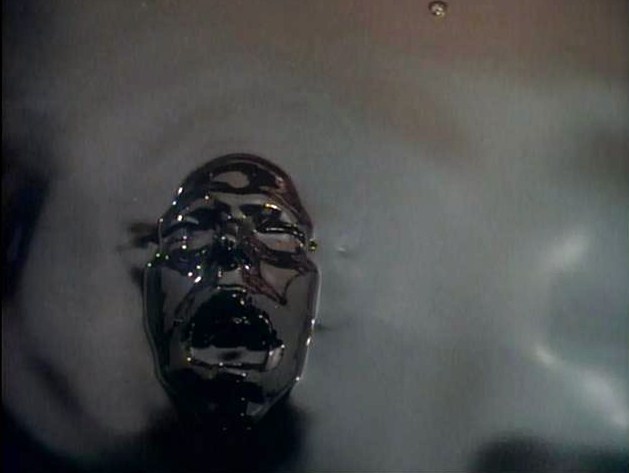
Beyond this character exit, there are certainly other grounds by which to deride "Skin of Evil" too, if that's the game.   For example, the episode relies heavily on repeat footage of the central threat, the oil-slick monster, Armus. One shot of him rising from the muck is repeated three times in less than an hour.

Seemingly routine scenes are not staged very well, either.  To wit, Deanna Troi is trapped in a shuttle craft for the duration of the episode with an injured pilot named Ben.  We never even see Ben until the last act, wherein Picard beams into the shuttle, checks him out, and concludes he is very weak indeed.  Why wasn't Deanna tending to him herself before this moment?  She may be injured, but is she physically paralyzed?  Why don't we see her limp over to the poor guy (he's two feet away, at most, for goodness sake...) and just check for a pulse?

In another scene -- right after Armus takes Commander Riker -- we get a blooper.  We see Geordi's phaser "plop" into the black muck, visible to the naked eye.  Again, this moment is indicative of the fact that the episode -- and the physical creation of the alien Armus -- was likely a nightmare to vet.

Also, it's difficult to deny that at least a few lines of dialogue are real groaners.  The holographic Tasha's comment during her funeral that Deanna taught her she could be "feminine without losing anything" was horribly antiquated-sounding even back in 1988.

Would that really be a concern of a Starfleet officer in the 24th century? I don't think people even worry about this in 2011, let alone 2311, or whatever.

Finally, an early scene in the episode that features Tasha discussing an upcoming martial arts competition with Worf is so sentimentally scored and so overplayed by the actors that it telegraphs immediately what is bound to happen next: Tasha's untimely death.  A little more subtlety would have been nice here, rather than a neon sign which seems to shout out "SHE'S GOING TO DIE!"

Yet -- going out on a limb -- I have always really enjoyed and appreciated "Skin of Evil" for the things it gets right rather than the things it gets wrong.  Therefore, I'm going to focus on those positive elements in this review, having already at least paid lip-service to the admittedly-numerous complaints Trekkers might have regarding this segment.

First, a re-cap.

As the Enterprise is en route to rendezvous with shuttle craft 13 and Counselor Troi (Marina Sirtis), something goes terribly wrong.  The shuttle crashes on apparently uninhabited Vagra 2 and both Troi and her pilot, Ben, are injured.  A force field seems to be blocking the Enterprise from beaming up the injured.

When an away team consisting of Commander Riker (Jonathan Frakes), Dr. Crusher (Gates McFadden), Lt. Data (Brent Spiner) and Tasha Yar beams down to attempt a rescue, it is deliberately blocked by a sentient oil slick, a sadistic and hostile creature called "Armus."

When Tasha attempts to circumvent Armus to rescue the wounded, the creature strikes her down in an instant; murdering her. The away team returns to the Enterprise immediately, but there's nothing Dr. Crusher can do to help save the fallen security chief.  Though now in mourning, the crew turns its attention towards rescuing the downed shuttle crew.

Counselor Troi, meanwhile, uses her gifts and talents as an empath and psychologist to learn the truth about Armus and his motives.  She learns that his world was once home to a race of "Titans."  In order to become beautiful, these aliens cast off their darkest, most evil qualities and created Armus...literally a skin (or shroud) of evil.

Once free of him, these aliens abandoned Armus on the desolate planet and headed off to the stars to meet their great destiny.  Alone and miserable, Armus now wishes only to strike out and hurt those who rejected him.  Troi determines he is "empty," and worse, wants to fill that emptiness with acts of pure malevolence and sadism.

Ultimately, Captain Picard (Patrick Stewart) is able to defeat Armus by reminding him that although the creature may boast the capacity to control and hurt the crew, only Picard possesses the ability to command them.  After the final confrontation, the shuttle crew is rescued, Armus is abandoned, and aboard the Enterprise,the bridge crew attends Tasha's funeral, an event meant to "celebrate" her life.

One of the reasons I admire "Skin of Evil" so much is that --  up to this point in Next Generation history, at least -- the series was kind of...well, soft.

Although I love and respect the Star Trek ideal of peacefully broaching contact with alien life forms, the very heart of good drama remains conflict.  In Star Trek: The Next Generation's first season, the Enterprise crew had already met aliens who wanted to debate philosophy (Portal, in "The Last Outpost"), or worked matters out peaceably with other races ("Home Soil," "Encounter at Farpoint.")  Some episodes even featured no overt "alien" conflict at all, but played merely as standard soap operas set in an idealistic future ("Coming of Age.")  The show felt perilously like a space adventure without the adventure.

This "safe" approach changed radically with "Skin of Evil" as the crew encountered an absolutely implacable foe.  Armus could not be reasoned with or negotiated with.  You could not appease him by "asking" what he wanted and then "mediating" a way to give it to him.  On the contrary, he was a creature (like so  many similar ones we find in the U.S. Congress today...) who existed only to oppose, only to obstruct, only to negate.

If he was not pure evil, then certainly Armus was hostility and id personified.  On a program that so often pitched soft ball alien interaction,  Armus -- the piece's villain -- really played hard ball. He was dangerous and capricious, and explicitly did not share the Starfleet belief that "all creatures have a right to exist."

Killing Tasha as he did was brutal, nasty and unmotivated, but the unnecessary and savage act reminds our stalwart crew that not everyone in the galaxy thinks in the same way as they do.  And this fact, I submit, brings out the steel in their spines, and makes the characters actually reconsider and re-evaluate their noble beliefs.

In particular, I love the moment in the episode wherein Armus asks Dr. Crusher if she is "scared" and she admits that she is, but doesn't back down.  That's a wonderfully human character touch, and McFadden is magnificent in that moment.

Another great character moment sees Data refusing to help Armus taunt Geordi, and then conclude that Armus should be destroyed.  Armus scoffs at this "moral judgment" from a machine, but the matter is of great import.

By killing Tasha and mocking Geordi, Armus has made Data reconsider Starfleet's core belief, that all creatures have the right to exist.  Again, this is a pretty powerful moment for Data and for the show.  A big complaint about Star Trek: The Next Generation is that the characters can afford to be magnanimous and noble because they live in a utopia, one where they are the most powerful folks on the block.  In this case, however, Data is not insulated by the paradise of the UFP, and must put those morals to the test in practice.

In a flash -- when his friends are hurt -- he abandons noble principle for expression of blood-thirsty vengeance, actually advocating murder.  An interesting shade of gray for the child-like android, no?  A very human (and understandable) response...

I also believe Riker is developed well here.  Worrying for Deanna's safety,  he allows himself to be absorbed by Armus.  Will goes from shouting to Data for help as he is dragged across the dirt to actively forbidding help and facing intense personal danger.  This selfless decision speaks volumes about his character, and how he applies his own sense of morality to conflict.

This is also likely one of Troi's strongest episodes in the first season, and perhaps the series in totality.  Instead of offering up blatantly obvious information about alien commanders such as the tiresome bromide "he's hiding something," she sharpens her psychological skills in "Skin of Evil" and really dissects -- effectively too -- Armus's mental weaknesses.

The series should have permitted the character to do more of that kind of thing; to counsel not just in treacly, touchy-feely terms, but in pointed strategic ones as well.  A counselor to a captain on a star ship would need to demonstrate his or her practical value in times of danger, and not merely belabor off-point opinions about how the crew is coping with stress ("they're anxious" or "they're inexperienced.")  Kirk had Spock to (logically) analyze situations and tactics on the bridge, and one can see from "Skin of Evil" how Troi might have served the same useful purpose if the writers had not been so blindly committed to featuring her in the tiresome "caregiver" mold.

Another quality I appreciate in "Skin of Evil" is the absence of techno-babble.  Over the years, The Next Generation descended into a mind-numbing morass of meaningless science fiction jargon.  Any alien, any phenomenon -- anything at all -- could be justified, explained, and ultimately defeated by the mealy-mouthed, nonsensical tech-talk.

"Skin of Evil" sidesteps this dramatic plague and writer's crutch, and instead forges a chilling sense of mystery about Armus.

As Data reports, the alien has "no proteins known to us, no circulatory system, no musculature, and no skeletal framework."  And yet...it lives.

Star Trek is supposed to be about the countenancing of alien life forms, and Armus, at the very least, is not the routinely-seen bumpy-headed humanoid.  There's a real sense of alien menace -- and difference -- about this being.  In short, the crew really deals with something unknown and horrifying here, and I appreciate that dedicated sense of ambition, that imagination to go beyond the conventional.

And "Skin of Evil" works overtime to terrify.  There are some great compositions of Riker's tortured visage, subsumed inside Armus, and terrifying views of the alien rising from the black bile, looming over the crewmen in the screen frame and appearing truly illimitable.   Perhaps we do see some of these shots one too many times, but again, I appreciate the risk-tasking that's on display here, the concerted effort to show us something we had not seen before.

In terms of style, I can also admire how the camera-work goes hand-held once Crusher reaches sickbay with Tasha, and attempts to revive the fallen officer.  The immediacy-provoking, jerky camera-work is much different from the program's typically formal approach to visualization, and it lets us know -- viscerally -- what's at stake.  The scene's final punctuation, Picard's disbelief that Tasha is "gone," thus proves gut-wrenching.

In fact, Picard gets a pretty good makeover in this episode.  He brilliantly outmaneuvers Armus and brings his people home safe, without firing a single phaser shot.  But his talking here is not for consensus-building or to convince an enemy of his peaceful ways.  Rather, Picard uses words to weaken Armus, to trick and deceive him, and that's a nice twist on the perpetually action-less hero.

I also appreciate the fact that Picard doesn't lecture Data about mortality at episode's conclusion.  Instead, Picard is magnificently terse.  Data asks Picard if by thinking of himself and his own feelings he has missed the point of Yar's memorial.  Picard replies, "No Data, you got it," and the episode ends.  It's a sharp comeback that makes the episode's point without explanation or excessive spoon-feeding. 

I suppose there's ample reason to dislike this episode because it dispatches Tasha the way it does. And yet, I suspect that the decision to kill the under-utilized  character  in such fashion was a brave and worthwhile one.

God knows, we don't all get to end our lives the way we wish, and exploring the stars is exceedingly dangerous business.  On top of that, Tasha selected a dangerous specialty.

 Accordingly, Yar's death may be the most realistic character death in Star Trek history.   And that's an important distinction.  We're not immortal supermen, even in the 24th century.  We're humans...and we die, sometimes unexpectedly.  Tasha's death reminds the audience of its own mortality, and again, that's a good thing, a bold move in a show that too often played things safe.  I appreciate the moment in the episode when the away team reports Tasha's death, and we see Worf's reaction, just for a few seconds.  He doesn't say a word; he doesn't over-emote.  He just silently gives this look...and it speaks volumes of his emotional state.  Another nice character touch.

I still remember watching "Skin of Evil" for the first time in 1988, and being pretty impressed by it.  The episode is thrilling, dangerous and emotional...and anything but soft. I suppose these qualities render it out of step with other installments, but for me, that's all to the good too.

You see, a problem I discern too often in Star Trek: The Next Generation, even twenty-five years later, is that the characters are too comfortable.  They possess too many resources with which to meet the unknown, and too much discipline in controlling their fear and anxieties. 

Medicine and technology can bring back the dead and dying  ("Shades of Gray," "Lonely Among Us," "Unnatural Selection").  All life forms can be reasoned with ("Home Soil," "Encounter at Farpoint," "The Neutral Zone" etc.) and our unchained technology makes life a virtual paradise, a world of material wealth and plenty.

For all of its flaws in terms of execution, "Skin of Evil" proves a dramatic reminder that there are some dark corners of outer space where reason can't save the day, where logic doesn't hold sway, where medicine can't bring back the lost, and technology can't give Starfleet an easy win.  A later episode "Q Who," gave the series a similar "kick" in its complacency with the introduction of the Borg, but "Skin of Evil" -- regardless of all its bloopers and drawbacks -- aimed the show in that very direction too, and courageously so. 

In my opinion, it's still a pretty worthwhile and imaginative course correction.

Star Trek: The Next Generation Day: Action Figures (Galoob; 1988)


This year is the 25th anniversary of Star Trek: The Next Generation, and I've been featuring episode retrospectives here on the blog to celebrate the occasion. 

Now, I want to remember the first line of toy action figures from the program, which were released in 1988 (near the end of the first season) and produced by Galoob.   

Years later, of course, Playmates produced a line of figures based on the series that far exceeded Galoob's in terms of selection and popularity.  But the Galoob Star Trek: The Next Generation figures remain cherished collectibles for me.  

 In part, this is because I remember the excitement and anticipation accompanying the premiere of Star Trek: The Next Generation -- the first new Trek series since 1973 --  and the thrill of seeing toys and model kits on the market anew.   My sweet and loving mother promptly ordered all the crew action figures for me, as well AMT's model kit of the Enterprise-D from a toy vendor in Florida, and I still remember the thrill of the toys arriving in the mail one afternoon 

Six crew members from the Enterprise-D were included with the first Galoob release in 1988.  These included Captain Jean-Luc Picard, Commander Will Riker (still beard-less at this point), Lt. Commander Data (in both golden speckled face and blue face variation, for some reason...), the ill-fated Lt. Tasha Yar, Lt. Geordi La Forge (before he became chief engineer), and Lt. Worf. 

These crew figures are all very much "show accurate" to employ a popular phrase, right down to the middle crease or ridge down the middle of their first season Starfleet uniform tunics.  Also,  the figures, like their namesakes, were of different heights and builds. 

The likenesses to the actors are also quite good, in my estimation.

Each of the crew members came equipped with a phaser 2, Dustbuster variation (the one seen in nice close-up in "The Arsenal of Freedom") molded in hand, and a tricorder (with strap) to sling over their shoulders.  I suppose the latter point was actually an inaccuracy, as characters only carried tricorders on straps in the Original Series, not in The Next Generation.

In addition to the stalwart crew members, Galoob released a group of early first season villains to challenge the crew, including Q in his judge's robes from "Encounter At Farpoint," the Ferengi from "The Last Outpost" and two singularly unmemorable races from "Lonely Among Us:" The Anticans and Selay. 

The line didn't stop with action figures, either.  Galoob also produced a Shuttlecraft Galileo vehicle for the Enterprise team and a neat but show-inaccurate Ferengi fighter for the bad guys.

A smaller, die-cast metal Enterprise-D was released, and it boasted the capacity to separate the saucer section.  Also released was a phaser one toy that acted as flashlight when activated.

Left widely unproduced and sold were planned figures, including a Romulan (seen in "The Neutral Zone") and acting ensign Wesley Crusher. 

I also vividly remember that the mail-order vendor from whom we purchased the available toys also offered for a time two or maybe three cardboard play sets, one of the Enterprise interior, and one -- if memory serves -- of the inhospitable planet surface from "The Last Outpost."

Alas, those sets were never produced, and my money was refunded.  I would love to see photos of these play sets today, as I've become quasi-convinced over the long years that I hallucinated them.  Only a Toy Collector magazine article from 1996 confirms I haven't lost my mind...

As I've written before, we normally associate Star Trek toys with Mego and Playmates, but I've always appreciated the Galoob line quite a bit.  The action figures look great hanging on my office wall, and make a nice counterpoint to the larger, somewhat strange-looking Playmates figures.


Star Trek: The Next Generation Day: "11001001"


The stories that I remember and appreciate on The Next Generation the most are those that truly took great risks with the familiar format.  And again, these aren't always the ones you might expect, or the so-called "popular" installments.  They aren't always the "epic" shows; merely segments which stretched the format and did a lot of with the characters and solid scientific concepts.  Sometimes these ambitious episodes failed (and were consequently derided), but at least it wasn't for lack of trying.

Given my general dislike of the Holodeck as a story ingredient, this Next Generation flashback in this retrospective series may come as a surprise.  "11001001" indeed features the holodeck in a prominent role, but this tale by Maurice Hurley and Robert Lewin doesn't merely send a crew member on vacation in another time and place instead of dramatizing an important and valuable "real life" story.  

On the contrary, "11001001" is all about the human impact of the holodeck technology, particularly on the character of William T. Riker (Jonathan Frakes).

As "11001001" commences, it is stardate 41365.9, and the Enterprise D. arrives at Starbase 74 for a routine computer upgrade. 

Performing the upgrade is a team of diminutive aliens known as "Bynars" from the planet Bynaus. 

Over time, the Bynars have grown so "interconnected" with computers and computer language that their "thought patterns" have become almost binary in nature.

As the Bynars work, the Enterprise crew relaxes, off-duty.  In a nice bit of characterization, the extroverted Riker seems at loose ends without his usual crew mates to pal around with, and so spends the first portion of the episode attempting to stave off boredom by visiting Dr. Crusher (Gates McFadden) in sickbay, watching Data (Brent Spiner) and La Forge (Levar Burton) paint in the conference room, and conversing with Worf (Michael Dorn) and Yar (Denise Crosby) about a competitive game called Paresi Squares. 

There's a slightly desperate quality to Riker here, and I appreciate this peek at his human frailties.  He's not a deep thinker (like Picard), and he needs other people around him.  When Riker tells Crusher that it looks like she's "packing up" to "leave forever," there's a vulnerable side to the character exposed, and it's good to see.  Frakes does especially well with this material, and carries this portion of the episode effortlessly.

Soon, Riker happens to the holodeck, where he find more Bynars working, and they ask him to test their upgrades to the system.  Almost immediately, Riker conjures a Bourbon Street bar in New Orleans, circa 1958, and indulges in a little trombone playing. 

His audience consist of one: a sultry but engaging woman named Minuet (Carolyn McCormick).  Riker plays "The Nearness of You" for Minuet, and soon comes to realize she is anything but a cipher.  In fact, Minuet seems responsive and intelligent in a way that no computer simulation ever has.  She seems to possess life itself; sentience.

Outside the holodeck, the Bynars manufacture an emergency for the crew to disembark, leaving only Picard and Riker aboard.  They the aliens steal the Enterprise and make for their home world, where a supernova has imperiled their civilization.  An EM pulse threatens to destroy their main computer, unless the Bynars can use the Enterprise -- with its computer -- as a repository for all their culture's knowledge and information. 

Once Riker and also Picard realize that Minuet is merely a distraction, they set the Enterprise's auto destruct sequence, and reclaim the bridge.  There, they find the Bynars incapacitated and assume their mission: saving the Bynaus main computer and therefore the civilization itself.  When the crisis ends, Riker returns to the holodeck and finds Minuet gone, only a "piece" in the now-ended Bynar tactic.  When Picard notes that "some relationships just can't work," Riker responds that, nonetheless, Minuet shall be "difficult to forget."

Like the original Star Trek's "Devil in the Dark," "11001001" concerns desperation, and an alien race that is so desperate to survive that it undertakes what could be misinterpreted as hostile action; here the theft of the starship Enterprise.  An enduring element of Star Trek -- and one that I love -- is that of mercy.  The men and women of Starfleet don't greet every challenge as an existential threat, and -- if able -- will demonstrate compassion and empathy for aliens in jeopardy and danger. 

This is a facet of our culture that is nearly extinct today, and such compassion and empathy is often viewed as a sign of weakness or vulnerability, not as a strength. 

Specifically, our culture encourages us to meet violence with violence, greet aggression with aggression, and target purported enemies for payback.  A wrong is not forgiven, it is cause for attack and reprisal.

Not so in the overtly idealistic universe of Star Trek, where the Bynars -- though acting poorly -- are treated fairly, and their world is saved.

But even that re-assertion of a great moral value is not the reason I appreciate this episode, even after almost twenty-five years.  Rather, I feel that the holodeck aspects of the story work remarkably well, and point to the evolution of the EMH  character in Voyager and other holographic characters as "sentient beings."  Here, Minuet is a fully-fledged individual, and Riker falls in love with her...regardless of her nature as a program. 

I often write, with respect to Woody Allen, that the heart desires what the heart desires, and this doomed TNG love affair seems indicative of that human truth.  Riker falls hard for a hologram, even though there's no real future in such a relationship.  She can't even leave the holodeck, actually.

Yet Riker loves her.  And that's just how the human heart works.  Once more, this idea carries tremendous relevance in our culture today, especially as some extremists seek to punish homosexuals for wanting what their hearts want.  But, like Riker, that's how they are wired.  It isn't a concious choice.  Star Trek has taken a lot of hits in the media lately for not featuring a "gay" character amongst its dramatis personae, but I don't think the attack is fair, or realistic. 

In showcasing characters who brave love with holograms, androids, aliens and the like, the various and sundry Star Trek series very clearly put forward the argument that it is not right to judge others for whom they love, and for how they love.

To expect a gay character to appear in a major role in 1987 Star Trek is not, entirely...logical.   

So in episodes such as "11001001" and "The Outcast," Star Trek did the next best thing: it made a compelling argument for acceptance of "alternate" life choices.  It paved the way for tolerance and compassion about such relationships.  That's pretty damn impressive, if you ask me.

Ultimately, this idea went further in Star Trek than "11001001," but this episode lays the groundwork for the idea that holograms are people too, and also the notion that the human heart cannot, necessarily, choose who to love or not to love.

In terms of "11001001," I also appreciate the fact that the episode doesn't make the mistake of drifting into overt sentimentality or schmaltz.  Jonathan Frakes underplays his last, heartfelt line of dialogue, and rightly so.  His comment about Minuet being difficult to forget thus transmits as not some angsty, shallow admission of personal pain, but as pure statement of fact.  As such, it resonates powerfully, and I commend Frakes and director Lynch for resisting the urge to make more out of the episode's valedictory moment.  It speaks volumes as it stands.

"11001001" is also one of the few Star Trek: The Next Generation episodes in the first season that seems to showcase an authentic and light-hearted sense of camaraderie and chemistry between the new cast.  There's a delightful moment here wherein Worf intentionally misunderstands the nature of sports competition to Commander Riker:  "If winning is not important, Commander, then why keep score?"

And I also love Riker's politically incorrect jibe to Geordi and Data about a blind man teaching an android to paint.  That's a priceless joke, and too often Star Trek: The Next Generation felt staid and sedate, instead of fun.  These remarks are not merely fun, but fun in the jaunty spirit of the original series.  They evidence a joie de vivre, and make the characters seem genuinely colorful.  "11001001" also offers one of the great lines of the entire season, when Riker asks Minuet "what's a knock-out like you doing in a computer-generated gin joint like this?"

I don't want to put too fine a point on it, but there's a very...Star Trekkiness...about this brand of dialogue.  It is both serious and creeping right up to the edge of camp.  It is smart, and it is funny.  And I wish Star Trek: The Next Generation featured much more of it.  Star Trek is always at its best when its characters acknowledge the humorous aspects of their situation.  Somehow, it makes the universe seem more real.

Another ingredient that works well in "11001001" is the concept of the Binars themselves.  They make for a fascinating alien race, being so interdependent with computers, and one wishes they had returned to the series in a more dramatic capacity at some point. 

Considering the nature of the Borg (representing the blending of biological and technological components), it seems there might have been  a powerful story here to tell about the Bynars.

Would they have considered the Borg brethren?  Would they have felt they could have changed the nature of the Borg...for the better?  And how would the Federation feel with a kind of proto-Borg culture like the Bynars within their borders?  In all, not revisiting the Bynars seems like a lost opportunity.

About my only quibble with the episode is - as usual - the writing of the Picard character.  Here, he spends the first half of the episode thanking profusely his crew for a job well done, complimenting them over very, very little.  I suppose his pervasive good cheer was an attempt to soften the stern character, but it plays as strange; like Picard has taken some brand of mood-altering drug like Prozac.  Suddenly the good captain is spouting "thank yous" and "well dones" repeatedly, as if in some kind of euphoric state.  Later in the episode, Picard also reveals his total lack of awareness of others, when he horns in on Riker and Minuet and just...won't...stop...talking.  Can't he see that they would like to be, you know, alone?   Eventually he realizes it, but only after quite a while.  Again, I'm not criticizing the dignified Patrick Stewart, only the writing of his character.

Overall, however, "11001001" is a great early episode of Star Trek: The Next Generation because it isn't just about fun and games and getting out of a pickle on the holodeck.  Instead, it's about the human problems that the technology of the holodeck creates, and how those problems emotionally impact the characters  In many ways, this episode may represent Frakes' finest acting work on the series.  Accordingly, "11001001""  is also one of the best episodes in terms of Riker's character development.  We see the extrovert growing lonely...and then answering that loneliness with a trip to the holodeck, and finding the unexpected specter of true love.

Certainly, "11001001" doesn't make any "top ten" episode lists for TNG, but that's because it isn't epic in scope (like the Borg episodes or the Klingon episode).  Instead, the episode achieves what the medium of television does best: it fosters a sense of intimacy and connection to a character.  "The Inner Light" is an episode that accomplishes the same thing for Picard (and it's one of my personal favorites), but "11001001" is an early segment of The Next Generation that really hits on all thrusters. 

This episode is all about interconnectedness: interconnectedness between the Bynars, interconnectedness between the Enterprise crew members, and finally, between Riker and Minuet.  "11001001" reveals how we can succeed when we connect meaningfully to others and also, emotionally, how we can feel lost when that sense of connection disappears irrevocably.

Star Trek: The Next Generation Day: "Encounter at Farpoint"


Although perhaps not one of the best installments of the series’ seven year run, the inaugural episode of Star Trek: The Next Generation certainly gets the job done.  “Encounter at Farpoint” ably introduces the new characters and their world, successfully (and affectionately) reminds the audience of Star Trek history, and offers at least two marvelous images that remain impressive and resonant, even a quarter-century later.

As “Encounter at Farpoint” begins, the new Galaxy Class U.S.S. Enterprise (NCC-1701-D) investigates the mystery of planet Deneb IV.  The primitive people there have apparently constructed a new base precisely to Starfleet specifications, but how they did so remains unknown. 

While the crew investigates, it must also deal with an interfering, all-powerful alien being called “Q” (John De Lancie), who puts Captain Picard (Patrick Stewart) on trial for the “crimes of humanity.”

This episode, directed by Corey Allen, opens with a textbook perfect visual.  Captain Jean Luc Picard steps out from the shadows, and we get our first good look at the commanding officer who will soon step “out” of Captain Kirk’s shadow.   At the same time as we watch the figure transition from silhouette, we hear the pleasing, authoritative cadences of his voice.  They exude command and control, discipline and power. 

It’s quite an entrance, and a good example of Stewart’s ability to hold the camera and rivet one’s attention.  Picard is quite a commanding figure indeed, and the specifics of his on-screen introduction remain positively iconic.  No one should doubt that casting a bald, British, middle-aged Shakespearean actor in the role of a starship commander was risky in 1987.  But from virtually image one of the series, Stewart shows that he’s got the chops, and the screen presence to pull it off.


A captain in the shadows...

..a hero emerges in the light.

Later in the episode, there is another visual that always thrills me.  Captain Picard welcomes Wesley Crusher (Will Wheaton) to the bridge of the Enterprise for the first time, and Allen’s camera adopts a first person subjective angle or P.O.V.  In other words, the audience takes up the position of Crusher’s “eyes,” looking out across the command bridge for the first time.  Enticingly, Captain Picard enters the frame and asks Wesley -- by extension the audience -- if he’d like to try out the center seat, the captain’s chair.

This is an invitation one of us would resist, I suspect.  

In fact, many of us in 1987 had dreamed of just such a thing; of living inside the Star Trek world of optimism, brotherhood, and peace, and charting our own starship’s course for adventure and knowledge. It’s wonderful that, without it seeming like a gimmick, the first episode of Star Trek: The Next Generation  pays heed to this deepest wish.  It’s a lovely visual touch and one aimed right at Trekkers who had grown up with the franchise and come to respect Star Trek's philosophy.


"Try it out."  Every Star Trek fan's dream come true.

Another pitch-perfect moment occurs about half-way through “Encounter at Farpoint” when Lt. Data (Brent Spiner) escorts an aged Admiral McCoy (DeForest Kelley) through the corridors of the new Enterprise.  The elderly Bones -- a dear, old friend with whom so many adventures have been shared -- reminds the android to treat the starship like a “lady” and that “she’ll always bring you home.”   This scene explicitly reminds the viewers of Star Trek’s heritage and history, and does so in a fashion that is funny and respectful.  

This scene represents a promise to the fans too.  The new show is going to treat the franchise like a lady as well, this moment seems to promise.  In other words, the dream is in good hands…


Treat her like a lady, and the Enterprise will always bring you home.

Also commendable in “Encounter at Farpoint” is the ultimate message of Farpoint and the Bandi, denizens of Deneb IV.  They are so desperate to achieve their goal (support within the Federation) that they cut corners and hurt living, sentient beings to achieve success they aren't ready for.  In other words, the ends justify the means, in their eyes.  In the year of Oliver Stone’s Wall Street and the age of rampant yuppieism in America, this is a powerful message to convey; that getting there fast and wrong is less important than patience and morality.  It’s a great philosophical foundation for The Next Generation to build upon.

Unfortunately, some of that valuable message gets buried in the Q subplot, which seems to eat up most of the time in the premiere story.  This is unfortunate, because we have seen many aliens like the Q before in Star Trek history (in episodes such as “Squire of Gothos”) and the Bandi story might have been much more interesting and dramatic if better developed.  I like "Q" as much of the next Trekker, but he tends to suck all the air out of the room.  If he is present, he becomes the story, in other words.

Of all the new cast members featured here, Marina Sirtis fares worst as Counselor Troi.  The actress has been very blunt about assessing her performance in this episode, and I commend her for her honesty.  She shouldn’t feel bad, however, because clearly she grows in the role, and today Troi is beloved by fans.  

But in “Encounter at Farpoint,”  Troi looks like a “space cheerleader” and acts like an emotional basket case.  At every development of the story, Sirtis over-emotes as Troi, suggesting a dangerous personal instability.  She cries, she gasps, she grimaces…she’s way over-the-top.  

And the dialogue doesn’t help the actress out a lick.  After Q freezes a crewman on the bridge and we clearly register that he is frozen, Troi runs up to him and declares, dumb-founded “He’s frozen!”  In other words, she’s declaring the obvious, and thus comes across as stupid...again playing into the space cheerleader cliché.

Also, Troi’s continual over-emoting robs the episode of some of its genuine, nuanced pathos.  The climactic moment when the two space creatures are rejoined over Deneb IV stands quite well on its own without Troi offering emotional play-by-play about “great joy and gratitude.”  Again, this isn’t Marina Sirtis’s fault.  Her dialogue once more belabors the obvious, and puts a fine point on information that doesn’t need to be repeated, or spoken aloud. 

I don’t want to belabor this point because I respect Marina Sirtis, and over the years, Troi certainly became a valued and intriguing crew member.  But if today “Encounter at Farpoint” occasionally feels cartoony or melodramatic, it is largely because Troi’s character keeps stating the abundantly obvious, and continues to overreact to everything. 


Looking back, “Encounter at Farpoint” is a strange mixture of boldness and timidity.  

It is bold in the way that it critiques 1980s America, with Q appearing as Colonel Oliver North, essentially, and yet timid in the very concept that underlines Q: a Star Trek “God” rerun.   In Star Trek, man is always being tested, it seems...

Similarly, "Encounter at Farpoint" is bold in the way it attempts to move the Star Trek mythos forward with new characters, yet timid in the way many new characters seem like Mr. Spock, only dissected.  Data (outsider), Troi (with special powers of the mind) and Riker (as first officer) all seem like little slices of the half-Vulcan character.  About all you can say here is that each character grows into a full-fledged and unique individual over time.

Of all the new supporting characters, I feel that Dr. Crusher comes off the best in "Encounter at Farpoint."  She’s not a crusty-McCoy doctor, but a bit prickly and edgy nonetheless.  I like her put-down to Riker when she accuses him of ingratiating himself with the Captain, and then her eminently rational turnaround when she realizes he’s actually got a point.  The message is plain: she’s not interested in shipboard politics, but knows when it’s time to do her job. I wish she had been written this way more often: as someone in firm command over her department and areas of expertise, but boasting a no-nonsense attitude when it comes to her interactions with others.

I remember after “Encounter at Farpoint” first aired, the response from my friends at high school was extraordinarily negative.  Everyone but me hated it!  I remember that one exceptionally bright (and dear) friend noted that too many of the new characters seemed to boast super powers (meaning Geordi’s vision, Troi’s empathy and Data’s strength), and that everyone looked like they were dressed as superheroes.  He had a point.  You can argue the validity of having an indestructible android, a telepathic counselor and a helmsman with extraordinary vision, one-at-a-time, but taken in toto as a command crew -- and without knowing how these qualities would play out over a series -- it does seem a little like overkill.  Isn't this supposed to be a show about the human adventure?

In the case of this series, however, patience paid off, and The Next Generation’s characters found their way, growing more likable, unique and human over the span of several seasons.  “Encounter at Farpoint” may not be great, but overall it’s a fine shakedown cruise, especially for the iconic introduction of Picard, the affectionate ode to Trekdom (in the form of that POV shot on the bridge), and the promise of respectful care-taking of a proud history and legacy (represented by Dr. McCoy's admonition to treat The Enterprise -- and Star Trek -- like a lady.)
  

Star Trek: The Next Generation Day!


I feel old today.  I can’t believe that it was twenty-five years ago this month that Star Trek: The Next Generation (1987 – 1994) first premiered in syndication across the United States. I was seventeen years old at the time, and was both excited and anxious about the idea of a new Star Trek series. 

After all, I hadn’t even been born yet when the first Star Trek (1966 – 1969) aired on network television, so this would be my first opportunity to experience the thrill of new episodes on a weekly basis.  But, I also wondered whether Star Trek could make the transition from one generation to the next, from the era of Kirk and Spock to the era of Picard and Data.

I needn’t have feared. 

For many fans (though not this one), Star Trek: The Next Generation surpassed the original series, and to this day represents the franchise at its best. 


I’ll always be an “Original Series” kind of guy, but I recently watched the entirety of Star Trek: The Next Generation and enjoyed it very much.  The series has its considerable problems, including the inconsistent writing of the Picard character, too many “Love Boat in Space” episodes (where the crew’s family members board the Enterprise to share the emotional trauma of the week), too many “wasted” episodes involving the Holodeck rather than going boldly where none have gone before, and a backward view of the female characters and their capabilities. 

And, in general, the Star Trek: The Next Generation movies are really, really dreadful.

Yet The Next Generation also features some truly great episodes, like “The Best of Both Worlds,” “Yesterday’s Enterprise,” and “The Inner Light.”   I watched “The Offspring” recently (directed by Jonathan Frakes) and found myself genuinely moved by it.  That episode should appear at the top of more best of TNG” lists, I suspect.

I realize that fans are always talking about what a great actor Patrick Stewart is, and indeed this is so.  But what really struck me on my re-watch of The Next Generation is how -- week in and week out for seven years -- Brent Spiner absolutely excels in the role of Lt. Data.  He brings innocence, humor and pathos to the role of the Soong Android, and in the process lifts even the most clichéd (“Datalore”) and confusing (“Masks”) material.  He's a marvel.

Again, I must mention “The Offspring,” an episode wherein Spiner skillfully underplays the heart-breaking finale involving the death of Data’s daughter.  That choice somehow -- paradoxically -- makes the thing all the more emotional. 

But enough specifics for now!  Today on the blog, I’ll be celebrating the 25th Anniversary of this series with Star Trek: The Next Generation Day.  I hope you’ll join me.

Let’s see what’s out there…

Wednesday, September 26, 2012

Late Night Blogging: Star Trek: The Next Generation promos and trailers


'


Memory Bank: Bond-Mania


Okay, so this week’s Memory Bank is a bit of a cheat.

I must acknowledge I wasn’t born yet when the great James Bond/Spy Craze of the mid-1960s -- circa 1964 – 1968 -- occurred.  I didn’t arrive on this mortal coil until the last month of 1969. 

And yet, I did experience Bond-Mania after a fashion.

Rerun fashion.

By the time I was six years old in the mid-1970s, many of the Bond imitations, knock-offs and parodies were airing on daytime television, or in the afternoon, on WABC’s 4:30 PM movie, for instance. 

So I did see all of those productions, even if they preceded my first experience with authentic James Bond: 1977’s The Spy Who Loved Me,starring Roger Moore.

But the James Bond/Spy Craze of the 1960s began in earnest, I would estimate with the release of Goldfinger (1964). 

It was the third film in the franchise (following Dr. No and From Russia with Love) starring Sean Connery, and the entry that seemed to cement all of the crucial ingredients, from the colorful death of a prominent character (Jill Masterson, her nude body painted entirely in gold), to the pop hit title track (from Shirley Bassey).  It also featured unforgettable villains (Goldfinger and Oddjob) and amazing spy gadgets.  It was Goldfinger, after all, that gave the world Bond’s Aston Martin DB5, replete with ejector seat, rear window shield, and rotating license plate.

Thunderball (1965) isn’t my favorite Bond film because I feel it is overlong, the villain is dull, and the editing somewhat sloppy.  But if I had seen it as a kid or as a teenager -- in theaters -- I readily admit I might have felt quite differently about the movie.  Importantly, Thunderball capitalized on all the elements that made Goldfinger so memorable, and featured great new gadgets, like Bond’s jetpack, used in the pre-title sequence.

After Thunderball’s success in theaters, the floodgates really opened in terms of James Bond’s impact on film, television, and merchandise.  

Casino Royale (1967) spoofed the 007 franchise and starred David Niven, Peter Sellers, Ursula Andress and Woody Allen.  It was either the greatest disaster in film history up until that point, or a post-modern masterpiece, depending on one’s perspective.   

Another (strange) Bond parody of the era was Dr. Goldfoot and the Bikini Machine (1965).  

Competing “spy” franchises of the Bond-Mania Era included the Matt Helm series, starring Dean Martin, and the Flint series starring James Coburn.  Matt Helm got four movies (The Silencers, Murderer’s Row, The Ambushers and The Wrecking Crew) whereas Flint only appeared twice, in Our Man Flint (1966) and In Like Flint (1967). 

Lesser lights -- like Operation Kid Brother (1967) starring Neil Connery and Super Agent Super Dragon – soon (failed) to take the world by storm.

On television, The Man from U.N.C.L.E. (1964 – 1968) starring Robert Vaughn and David McCallum, Get Smart (1965 – 1970) starring Don Adams, and Mission: Impossible (1966 – 1973) conquered the air waves and, at least at first, were smash hits.  

Audiences just couldn’t get enough of suave secret agents, their amazing gadgets, and their efforts to prevent the rise of forces like KAOS or THRUSH at the height of Bond-Mania, it seemed.

At toy stores, James Bond -- 007 himself -- also had a welcome presence thanks to toys and vehicles from Gilbert and Corgi, a road race slot car set, and a series of board games.

But Mattel was the toy company that outfitted the pre-adolescent spy of the mid-1960s most ably with its Agent Zero M line of toys, which included a sonic blaster, a cap gun, a radio gun, and a movie-camera gun.  The Sears Secret Sam Attache Case also got in on the espionage action.

As a Generation X’er who grew up with the Star Wars craze of the mid-1970s, I can only imagine how exciting it must have been in the mid-1960s to have Sean Connery headlining Bond films year after year, new spy toys in the stores, and a new secret agent TV show – funny or serious – on television week after week.  

As I stated above, I caught all this stuff on the second go-round, and enjoyed it tremendously, but that’s still different than being there when it all began.  If you lived through Bond Mania, consider yourself lucky.   I envy you!


10 Years Ago: Star Trek Beyond (2016)

The world needed a good  Star Trek  movie in 2016. Why? As a reminder of who we are, who we have been, and who, I hope, we can be again. And...