Saturday, December 02, 2006

SATURDAY MORNING CULT TV BLOGGING: Flash Gordon: "Revolt of the Power Men"

"Too long Ming has held my city and people captive," King Vultan notes in this chapter of Filmation's Flash Gordon series, numbered 15. Yes, the worm is turning, and the final battle is nearing.

"It is time for action," Flash agrees, noting that the rebellion needs "an edge" against Ming the Merciless, and that the edge may well be Sky City, the domain of Gordon's "feathered friend."

Flash, Barin, Thun and Vultan thus determine to re-take Sky City, unaware that Ming has dispatched his chief lieutenant, Captain Erzine, to capture Aura and Dale and to make the latter his bride. In this section of the episode, as the women are kidnapped, there's a lovely view of the interior of Ming's dome-shaped hanger bay, and it's an impressive design (and shot), as a warship in Ming's fleet is lowered into the chamber, surrounded by docked vessels.

Meanwhile, Flash joins up with Ergon, leader of the Power Men, on Sky City. The campaign to capture the city goes badly, however, and a stray blast hits the power generator. The city plunges out of the sky, but Ergon realizes before it is too late that the failed anti-gravity beams can be fed directly into the energy matrix, or some such thing. In the end, Sky City belongs to the Allies.

"A good day's work," is how Flash describes the battle before determining that now the fight is between Ming and him. He heads off to Mingo City -- and is promptly captured and frozen by Ming the Merciless.

One episode to go...

Wednesday, November 29, 2006

TRADING CARD CLOSE UP # 8: Alien 3


I've been a long-time admirer of Alien 3, the second sequel to Ridley Scott's 1979 classic, Alien. I'm not one of those fan fanatic bashers who hated the film because the creators had the audacity to kill Newt, Hicks, Bishop or any other beloved character/survivor of Aliens (1986). On the contrary, I've loudly championed Alien 3 (1991) as a great film, in a retrospective here.

Some of what I wrote in that piece:

"Fincher directed a visually dazzling film as determinedly different from Aliens as Cameron's vision was from the Scott original. Perhaps more significantly, Fincher created a film with a message more powerful and relevant than either predecessor. What the Alien faithful actually objected to in Alien 3 was not directorial approach, plot, or even theme, but Fincher's purposeful overturning of every expectation they had carried into the theater with them.

The roots of Alien 3's public relations nightmare can be pinpointed in the very nature of film sequels. The trick in producing a successful follow-up is giving audiences a big dollop of familiar material while also feeding them a diet of something different enough to avoid accusations of "ripping off" or "cashing" in on the source material. Fincher's task was doubly difficult because he not only had to produce a sequel that genuflected to Alien and Aliens, but one that could be heralded as a modern cinematic masterpiece and stand proudly in the franchise valhalla with the highly-regarded earlier movies.

This was no easy task, but Fincher succeeded by adopting an approach he would later repeat in Seven (1995), The Game (1997) and Fight Club (1999), by pointedly toying with audience perceptions and expectations. Although Sigourney Weaver as Ripley, the Bishop Android (Henriksen), the titular xenomorph, and even Weyland-Yutani, the villainous corporation, all returned for Alien 3 action, every plot twist in the third film boldly dashed viewer expectations.

...Appropriately, the film's dialogue echoed the decision to make a surprising, dangerous sequel. The film's lead convict, Dillon (Charles Dutton), gave voice to Alien 3's overall philosophy during a funeral service for the early casualties of Alien 3. Eulogizing the dead, he declared (for the benefit of Ripley and, no doubt, the audience) that "there aren't any promises. Nothing's certain. Only that some get called; some get saved. " It was this application of cruel, random - but realistic, fate, not some kind of "loyalty" to franchise stock characters, that dominated Fincher's challenging sequel."

Anyway, I'm writing about this subject today and featuring Alien 3 as my eighth trading card close-up. Because, let's face it, the execs at 20th Century Fox meddled with Fincher's vision, and Fincher - in my estimation - is one of the few modern "greats" in terms of directing horror/thriller films. Looking at Panic Room today, I can see that he marshals CGI imagery as part of a film's tapestry, not as a special effects gimmick, for instance. In fact, if Hitchcock were alive and making movies today, I imagine he'd use CGI in the manner that Fincher does. So - if execs hadn't interfered in the making of Alien 3, imagine just what a true, unadulterated masterpiece it might have been.

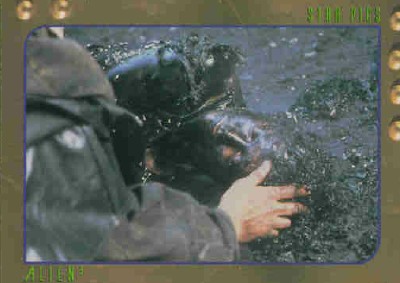
We already know the making of the film was a difficult period, but these trading cards from Star Pics are very revealing. The cards show tons of deleted scenes that would have changed the nature of the film we saw; and would have (perhaps?) remained truer to Fincher's vision. An example: there's a shot of Ripley in the mud of Fury 161 -- what is this? It's a different introduction in the film for her character than the one we saw. There's another card with a shot of her being carried into the prison installation, and it doesn't look familiar either Yet another of her finds her inside a cracked cryo-tube! I also know that in the original (and shot...) version of the alien birth, the xenomorph emerged from oxen, not a dog. Indeed, in the theatrical version of Alien 3, there's an entire subplot missing involving the capture of the Alien, and its release by a deluded prisoner named Golic.

So I gaze at these cards and wonder what might have been. In 1992, David Fincher was decried as a music video director and a hack, and his contribution to the Alien saga was routinely attacked, slighted and misinterpreted. With more than twelve years of hindsight, and a career now composed of great great films, many observers realize the critical community (and fans...) of the day were dead wrong. These cards remind us that somewhere - still - there's a great work of art in Alien 3, just bursting to get out...

And I still think Alien Resurrection sucks.

Monday, November 27, 2006

RETRO TOY FLASHBACK # 51: Gremlins Poseable Stripe Figure (LJN)


Straight from LJN (the company that also held the license to create toys from the movie Dune...), comes this 1984 retro-toy treasure: the Gremlins Poseable Stripe Figure. The very toothy and imposing Stripe stands at over a foot tall, has poseable limbs (and claws...), beady red eyes, and on his blue box is this legend: "WARNING: YOU MUST OBEY ALL MOGWAI RULES!"

Of course, this monstrous creature (the figure designed for ages 3 and up...) is from one of the most controversial genre blockbusters of 1984 (the same summer of Ghostbusters, Indiana Jones and the Temple of Doom and Star Trek III: The Search for Spock.) Basically, Joe Dante's horror movie featured a lot of violence (like a suburban mother sparring with a violent Gremlin in her kitchen...) yet the film was still aimed at children....the market that had appreciated E.T. Steven Spielberg was the executive producer and his clout was such that the movie (along with Indiana Jones) got a new rating "PG-13" instead of R. Yep, the M.P.A.A. created an entirely new ratings classification just to stay on the director's good side...

Anyway, this is indeed the figure of the malevolent Stripe, leader of the nasty gremlins (or Mogwai). The side of the box reminds us of the dangers of owning Mogwai by reciting the movie's warning. To paraphrase: Keep 'em out of water; Keep 'em out of light (sunlight is fatal...), and don't feed these buggers after midnight.

On the back fo the box, there's a Gremlins "Proof of Purchase" worth three points, and an admonition to "collect the entire line of Gremlins toys from L.J.N." These include the: "3 piece collectible gift set; wind-up Gizmo and Stripe; small Poseable Gizmo; Bendable Stripe; Large Poseable Gizmo; Large Poseable Stripe" and "Stripe and Gizmo Water Hatchers." As for me, I had this bugger, the Bendable Stripe, and the Large poseable Gizmo. But this is the only one that I have the box for.

Also on the back of the box is an array of photos showing how a kid can "have fun making up your own Stripe costumes from accessories found at home." I'm sure Mom would appreciate you raiding her closet.

How do I get my fun from this Gremlin? Well, this little thing really scares my wife Kathryn (he's very lifelike, actually...), so occasionally, when she's not paying attention, I'll sneak into the kitchen and pose Stripe in the pantry, or inside one of the dish cabinets. Once, I posed him in her closet while she was dressing for work; when she wasn't suspecting it. Finally, she laid down the law and told me I was no longer allowed to display Stripe, and that I had to put him back in the box permanentlyy.

So now he sits safe in his box on one of the high display shelves in my office. I think tonight I might put him in Joel's crib...

Saturday, November 25, 2006

SATURDAY MORNING CULT TV BLOGGING: Flash Gordon: "The Desert Hawk"

When we last left Flash Gordon, he was trapped deep inside the caverns of Tropica with fugitive Queen Desira (hottie!), Dale and Zarkov. Their enemy, Brasnor, is hot on their heels. He needs to kill Desira to take her kingdom, and claims she is an imposter to foster confusion.

A strange energy pull yanks our stalwart heroes out of an underground pool towards the roof of the cavern. We find out in Chapter Fourteen, "The Desert Hawk," that a meteorite of "superior density" has caused "suspended gravity" and that's why it's all funky in these parts. A giant bat attacks, but Flash knocks it out.

Meanwhile, far away in Arboria, Aura and Barin trade loving words on a castle ledge until interrupted by King Vultan. His "hawk sense" tells him that Flash is in trouble and needs help...

Back in Tropica, Flash and the other refugees escape into the desert, their "only avenue of escape," and proceed to get separated. In a time-honored cliche of sci-fi TV, Zarkov sends up "Morse Code" in the form of smoke signals, and Flash finds him.

Together, the heroes encounter Gandar, lord of the desert, a very-thinly disguised Arab king (he actually wears a turban...). Gandar takes them back to his desert kingdom, which resembles Baghdad (at least what Baghdad once looked like...). There's even a building that resembles a mosque. Together, Flash and Gandar mount a defense of the city against Gandar. Brasnor approaches in a caravan of laser-equipped armored cars.

The battle looks grim until - at the last minute - the cavalry arrives in the form in King Vultan and his Hawkmen (and several Arborian hunters.) Brasnor is defeated and Gandar is impressed. "Earth men never fail to amaze me with their unsuspected abilities," he says.

Finally, Queen Desira is triumphant over Brasnor, and offers her help to Flash in the rebellion against Ming. "Count on my help," she says.

Flash is confident. "No more we do run," he says. "The free men and women of Mongo are coming," adds a roaring Thun.

Two chapters to go before the fall of Ming...

Friday, November 24, 2006

TV REVIEW: Jericho: "Red Flag"

It's a subdued Thanksgiving in Jericho, Kansas this week, as the survivors of the nuclear attack on America attempt to hold on to some remnants of their previous lives. "There are some things the apocalypse can't change," Jake's Mom stubbornly asserts, referring to an annual Greene family football game. Yet, the game doesn't happen...in part because the family is tearing itself apart over Eric's decision to leave the pregnant April and go live with his mistress, Mary Bailey.

But there are bigger fish to fry in Jericho this holiday season. In "Red Flag," Vietnam-era Russian planes drop supplies over the town using American military parachutes...food, medicine, even a generator. The foodstuffs are from China, which is disconcerting to say the least. The food comes with propaganda flyers that read "Do Not Fight. China is your friend." This development leads Jake and some of the others in town to suspect the "aid" may actually be the second wave of the attack; an attempt to poison and soften up the population before ground troops invade. The Mayor, fearing contaminated supplies, holds back the food from the town and thereby creates a new controversy since people are beginning to starve.

As if this isn't troubling enough, Jonah (Remar) and his band of goons steal the power generator from the town (actually, from Stanley's field...), spurring a confrontation between the Mayor and his new (untested...) militia and the warlord's well-armed gang. Emily (Ashley Scott) comes to the rescue and retrieves the generator, an act which has unexpected consequences: Jonah's leadership is questioned and it looks like he'll face an insurrection in his ranks.

The episode ends with a murder, and with the specter of an upcoming election in Jericho. The story's theme is that the people are "holding on to traditions" like "nothing happened." Jonah is still trying to make money; as is storekeeper Gracie. Gray and the Mayor are still playing politics; and Eric is ignoring his responsibilities as a future father. Interesting times...

Wednesday, November 22, 2006

GameCulture Journal Goes Live!

Hey everyone, look at this! The inaugural edition of a new journal devoted entirely to the scholarly study of video games has just been published. How cool is that?

In the words of the editors, Game Culture Journal, is:

"...a periodical that examines the practices, institutions, history, and issues facing video games and video game players."

"Seeking to bridge the gap between popular journalism and arcane academic jargon, GameCulture Journal forges a critical edge while holding nothing above scrutiny."

"Video games have a solidified place in the cultural sphere, yet are still considered little better than children's toys by many - above and beyond all else, GameCulture Journal seeks to bring respect and dignity to games and gaming through serious discussion and scholarship."


Now, I'm an old guy from the Atari 2600 generation, but I'm tantalized by the possibilities this new journal offers. GameCulture Journal is a most welcome addition to the global conversation about video games, and it fills a void. I mean, it would be foolish to deny that video games are a new, burgeoning art form, and it's a terrific notion to build an arena where a critical, scholarly discussion of them is forged. What I hope to see here is debate not just about the games; but of the very vocabulary of game criticism. What are the terms we should understand while reviewing video games? What are the aesthetic criteria for judging video games?

I suspect terrific answers will be forthcoming soon. I already know I can vouch for the editors, Kevin Flanagan and Bobby Schweizer. They're two of the finest young writers, game enthusiasts (and people...) I've had the good fortune to meet in my career. I've collaborated with both of them before on a variety of projects, and understand that they are 100% committed to the journal's mission statement. With these two at the helm, great destinations are ahead.

Already, the first issue includes a book review, a statement from the editors and articles with such titles as "On Cultivating an Audiophilic Streak" and "Combat & Urban Decay: Class, Ideology, and the Legacy of the Beat 'Em Up."

So check out GameCulture Journal. And look for an article by an old Atari-guy down the road...

TV REVIEW: Day Break

After sitting through the two-hour premiere of the new ABC series, Day Break, a genre drama which finds a cop named Hopper (Taye Diggs) re-living the same tumultuous day over and over again, I'm experiencing a headache-inducing case of deja vu.

After all, it wasn't that long ago that a virtually identical concept was vetted thoroughly on another TV series called Tru Calling (Fox). Now, this may be a blatantly sexist comment, but if I'm going to be forced to watch endless repetitions of Ground Hog's Day on TV, please God, let Eliza Dushku be the star. Taye Diggs is a fine actor, but - come on - Taye or Eliza? No contest there...

The Day Break series premiere opens with noisy montage of the sun rising over a busy, metropolitan Los Angeles as commuters blithely go about their business. Subsequent scene transitions are also deja-vu provoking: washed-out and shaky quick cuts of metropolitan skyscrapers, just like you see on say, Boston Legal, Justice, Shark, etcetera etcetera. Let's call a moratorium on this technique right now. It's overused, it's unattractive and it is now officially cliched. Can't a clever director of photography think of another way to bridge sequences? One that doesn't involve causing seizures in the audience?

A close-up of a digital clock flipping from 6:17 to 6:18 am comes next, and then the pilot (directed by X-Files vet Rob Bowman) is careful to set up all the necessary details of the premise so we will understand that "yesterday is today" and that the same day is repeating ad infinitum, ad nauseum. So therefore Brett Hopper trips over his holster after getting out of bed with his girlfriend, Rita (Moon Bloodgood), spies garbage men out the bedroom window, and hears on the morning TV news that a truck filled with diapers has overturned on the free way. Again - deja vu - this is the self-same technique that Tru Calling assiduously utilized on a regular basis -- pointing out the minutiae of daily life and then observing (with delightful trickery...) how it can be changed, avoided, made to stay the same...whathaveyou.

My deja vu watching Day Break isn't merely confined to my memories of Tru (which was really - honestly - getting good when it was canceled...), No, in Day Break, Brett is framed for the murder of assistant D.A. Garza; a crime he didn't commit. This story element necessitates he spend his repeating day on the run, being ruthlessly hunted by fellow police officers Spivak (Mitch Pileggi) and Choi (Ian Anthony Dale). So what we have here is ultimately a twenty-first century version of the David Janssen classic, The Fugitive (1963-1967), only with a science fiction twist. It's a classic man-on-the-run premise, down to the hapless pursuers.

And hey, it's not just a science fiction twist either. There's a taste of The X-Files in this series; and not just in the presence of Pileggi (who was Mulder and Scully's boss, Skinner...) and director Bowman, but also in another story sub-plot: There's a shadowy conspiracy bent on framing Hopper; one independent of the police. A little paranoia can go far, I guess. And so can a healthy helping of 24 and Prison Break. Yep, Day Break is yet another serialized adventure necessiting regular watching. I'm going to have to quit my job and just camp out in front of the TV to keep track of all these serials (Lost, The Nine, 24, Prison Break, Vanished, Kidnapped, Heroes etc.)

"For every decision, there are consequences," a shadowy conspiracy figure informs Brett as he re-lives the same day over and over. That's what passes for wisdom and philosophy in Day Break, alas. In the pilot, we see our hero live the same day four or five times (I eventually lost count...). In two "do-overs" of that day, his girlfriend Rita is murdered. In another, his sexy partner (a corrupt narcotics cop played by Victoria Pratt), gets shot. So Brett must navigate his day absolutely perfectly or loved ones will be lost. He discovers this when on one rerun he prevents a bus accident, yet by not stopping for coffee on the re-do, misses the event (and sees the bloody results...).

Since this series has opted to make one day - repeated constantly - the dramatic battlefield, the pilot is brimming with plot devices and story fragments that can allow the series to head off in different directions if boredom ensues. Brett's sister Jen is being abused by her mean husband, for instance. Someone has also left Brett an important and mysterious package. Then there's a witness in a safe house Hopper needs to protect for an undercover Federal investigation. There's also the woman hit by the bus; then there's the day that Rita seems to disappear. There's Brett's sparring relationship with Rita's ex-husband, played by Firefly's Adam Baldwin with just the right amount of menacing glee. And on and on and on. There are so many passageways to new stories in this pilot that it's practically dizzying.

There is one thing that differentiates Day Break from its thematic predecessor, Tru Calling. On the old show, Tru's day would stop repeating when she solved a certain problem and saved a person who had asked her for help. It looks like that isn't going to be the case here. The day repeats no matter what; with no obvious key to move time forward to the next day. Furthermore, Brett awakes each "same" morning with the wounds and fatigue of the previous day...something that never happened to Tru. Not a significant difference you say? Well, beggars can't be choosers...

I will say that the second hour of Day Break was significantly stronger than the opening hour - which labored through a molasses-slow teleplay to establish a plot hook only an idiot wouldn't understand after a minute or so. The second hour took the show off in new, exciting directions and featured a tense car chase and motel shoot-out. The action was quite good, and even kind of involving. I can't believe it, but by the end of the second hour, I was actually kind of intrigued, and interested in knowing what would come next.

What ultimately broke me down in an otherwise repetitive, over-stuffed and derivative series? Well, I did like the notion that Brett is "cursed" with the knowledge that he could (and likely will...) lose his Rita, the woman he loves. There was something in the chemistry between those two characters; something sincere in that love relationship that I identified with. I always find Cassandra figures appealing. They see the future but are never believed and are helpless to change it.

But otherwise, you've seen this show before. Pick up the phone, Brett Hopper. That's Tru calling.

Tuesday, November 21, 2006

CULT MOVIE REVIEW: Blue Steel (1990)

Jamie Lee Curtis portrayed Laurie Strode in Halloween (1978), a beloved character who remains one of the most memorable (if not THE most memorable...) of the "final girl" archetypes in the slasher film paradigm. Given this fact, it seems oddly appropriate and resonant that the self-same actress would essay the role of Megan Turner, another endangered woman, in the 1990 horror-thriller Blue Steel.

In this film, another likeable Laurie Strode-type, the aforementioned Megan, is all grown up and getting her feet wet in the male-dominated world of law enforcement. During the course of the movie, the audience learns that this newly minted cop faces a number of challenges. Foremost among these, the amorphous "bogeyman" or "Shape" of adolescence (the menace dominant in Halloween) has changed; morphed into a threat even more frightening and endangering to both female adulthood and female independence. This menace is more traditionally realistic than Michael Myers, you might conclude...but no less unkillable: a patriarchal society that breeds male maniacs and which dominates and subjugates women.

In the course of Blue Steel, adult Megan encounters horrors unimagined by teenager Strode. She is sexually violated by a stalker (in a brutal rape scene), made the object of sexual prejudice on the force (by a wrong-headed police superior and Internal Affairs...), and deemed unacceptable by a society at large, which would prefer to "box up" women in traditional career roles like homemaker or office secretary. Why? Well, a female cop "scares off" men, as Megan is thoughtfully informed by a prospective date named Howard.

"Why would you want to become a cop?," he asks her with utter contempt. "You're a beautiful woman..."

By point of contrast, slasher Michael Myers - whether deemed an unstoppable force of nature like the shark in Jaws, a supernatural avenger, or a killer with the mentality of a child playing "trick or treat" - never touched Laurie or Annie or any other victim in an overtly sexual manner; never threatened to destroy a woman's standing in society. His threat was simple (though inescapable): a big, sharp kitchen knife matched with the desire and strength to kill. The threat in Blue Steel has in the early 1990s (the era of Anita Hill...) grown much more personal in that it is Megan's body and sexual person that is imperiled. And also, paradoxically, more generalized in that society neither protects nor approves of a female who wields power that might be traditionally termed "male." Megan's attempt to "be strong," has in fact, rendered her society's victim. This unacceptable notion (a woman cop) is what draws the moth to the flame; which brings the killer's obsession into focus.

But I get ahead of myself. Blue Steel, directed by Kathryn Bigelow (Near Dark) is Megan's story of self realization. She's a newly graduated female cop who prevents a burglary in a grocery store by shooting a violent (and armed...) assailant. One of the men in the store, a deranged customer named Eugene Hunt (Ron Silver), witnesses Megan's demonstration of lethal force and and becomes unhealthily obsessed with her. He stalks her, and even steals the dead assailant's gun from the crime scene; treating it as though it is an object of religious significance.

Megan quickly finds herself in trouble with her superiors in the police department because it now appears she killed an unarmed man. Her judgment is questioned. Since she's a woman, did she "panic" when confronted with a crime, and kill a man unnecessarily? That's the question! And make no mistake, it arises from our society's preconceived notions of male/female sex roles. A man's control of his emotions and particularly his fear, wouldn't be questioned quite so readily, would it?

So while Megan is suspended for the unauthorized use of the deadly force, her stalker, Hunt, begins to randomly kill people on the streets...and inscribes his bullets with Megan's name. At the same time, Megan begins dating Eugene - who works on Wall Street - unaware that he is actually the wolf in sheep's clothing, the menace systematically taking apart her life. Hunt, the so-called "44 Magnum Killer" and Megan, the female cop, soon share a "You Made Me/I Made You" dynamic (see 1989's Batman), which finally ends in a fierce shoot-out which balances Eugene's "weapon" (i.e. gun) against Megan's. Eugene, threatened and attracted by the show of force represented by a female cop, now feels the need to assert his dominance over her by using the same tool to destroy her. In other words, it is a pissing contest, and Eugene is threatened because a woman has dared to wield more power than he. He is abetted by a society which also disapproves of a man's "power" in the hands of a female.

Blue Steel is undeniably a child of Fatal Attraction (1987), and highly indicative of 1990s horror cinema in that it concerns monstrous psychotics (serial killers, mostly...) making in-roads into both middle-class society and suburban homes. Unlike Michael Myers or other slashers, however, the "bogeymen" of this age are not faceless goons who move in shadow and darkness, but rather colorful maniacs boasting definable, specific psychological disorders (which you'll find in the DSM IV). This evolution is a good development for actors; though not necessarily the committed horror fan, and Blue Steel clearly represents the knife's edge between the thriller/horror genres.

The horror genre is at its best and most effective when motives, movements and explanations are ambiguous. We don't know what Michael Myers "is." He is metaphorically and literally "the Shape" a mystery wrapped in an enigma wearing a white mask. Murderers like Eugene in Blue Steel lack that same sense of ambiguity (and hence, menace...); the sense that the killer could be something more than human (or less than human...).

And films like Blue Steel, since they delve into psychology, tend to provide more concrete reasons behind a killer's anti-social behavior. For instance, in Blue Steel, Eugene takes a night-time tour of Manhattan by helicopter. "When you're way up here, looking down at people," he says to Megan, his companion, "they're just little specks. Like they don't matter much." That is pretty much a manifesto, a movie diagnosis of the God Complex (and heck, the guy DOES work on Wall Street...) and while interesting in terms of characterization, the sense of horror (if not tension and anxiety...) is diminished. We fear that which we can't understand (like the Blair Witch, the shark in Jaws or Michael Myers...). Oppositely, understanding curtails fear.

Which is not to state that Blue Steel doesn't also operate on a highly symbolic level. Indeed, that's why I'm writing about it. In some senses it's a deep film that perfectly reflects the age of its production (the late 80s/early 90s). Basically, this is a film about a phallic symbol. Yep. The gun.

It's about a woman who dares to wield that power; and a threatened man who is so tantalized and uncorked by her wielding of it that he feels it necessary to dominate her and put her in "her place" with his own "weapon." That may sound like gobbledy-gook, but it's actually a fairly close and academic reading of the film's imagery. Eugene is so diminished by Megan's use of the gun (and the authority it brings her) that he stands before a mirror playing with his own...gun. He also works out, lifting weights, making himself feel more masculine and powerful in the process.

"You are God,"
he assures himself. "You are unique...they will fear your name." The implication is that he can't be feared - can't be respected - so long as a woman treads into the territory he feels is his; and that's why he becomes hellbent on destroying or "owning" Megan. Before he has sex with Megan, Eugene also - perhaps paradoxically - asks her to keep the gun on for love making. He caresses it and feels it in its holster; asks her not to remove it. If this isn't an acknowledgment of the power of the phallus in our society - to both sexes - I don't know what is.

As the film ends, the competition for control of the phallus, control of the gun, comes to a climax (did I just write that? Damn!). Shorn of her responsibilities as a police officer, Megan takes the law into her own hands (as a male movie icon like Clint Eastwood or Charles Bronson would also unquestioningly do at this juncture...) and decides it is time to utilize the gun. She fights a man explicitly on a man's territory: violence, vengeance...and heavy fire-arms. What the film successfully captures here, and which I think is highly important, is the idea that this might not be the best way to handle things. That the power of the gun and the bullet is a terrible one to wield; and not to be taken lightly. How do I come to this conclusion? Primarily from the visualizations in the finale; not the script, frankly.

The final shoot-out is a sustained, tense bloodbath (often depicted in slow-motion photography), which diagrams in loving, gory detail just how utterly destructive guns are; how devastating their power remains to the human form, the human flesh. Indeed, the apex of Blue Steel is the audience realization, perhaps, that Megan has been wrong to pursue the male power as her own. Not because a woman shouldn't wield it; but because no one should. The terror of bullet wounds and blood...it's anti-human; corrupt. wrong. When Megan finally takes out the murderous maniac Eugene at point-blank range (and the slasher conceit of the The Killer Who Won't Die/The Sting in the Tail/Tale rears its ugly head...), is it a moral victory? It's the end of the film, and the credits roll, but what do we learn?

I believe this was not a victory for Megan, rather another skirmish in the battle of the sexes, and a telling one at that. A woman can be just as violent, irrational and impulsive as any man, I guess. That, perhaps, is what "equality" means in 1990s America; the privilege and right to kill.

Even the title Blue Steel carries an underlying meaning. Right? I mean, it could have been called Purple Helmet, but the point is the same...we're all worshippers before the altar of the gun. Praise God and pass the ammunition.

Saturday, November 18, 2006

SATURDAY MORNING CULT TV BLOGGING: Flash Gordon: "Castaways in Tropica"

As this chapter of Flash Gordon commences, our heroes Flash and Barin have been forced to fight one another in the arena, in Ming the Merciless's "tournament of death." Since they are the last two gladiators, they are compelled to duel with "flame swords" on a high-wire over a raging fire.

At the last minute, Princess Aura realizes she loves Barin and rescues both the Prince of Arboria and Flash from the clutches of her father. Together with Dale and Zarkov, they all escape the arena together. Barin and Aura make for Arboria while the Earthers make for their (miraculously...) repaired rocket ship and blast off. Unfortunately, their ship runs out of fuel in the upper atmosphere of Mongo, and they're forced to set down again in dangerous territory.

That territory turns out to be the kingdom of Tropica, a land that looks like "The Garden of Eden" and is run by luscious Queen Desira and her major domo, Brasnor. Brasnor is hot for Desira, even though they're cousins. Also, Brasnor is planning an insurrection to seize the kingdom...

Flash, Dale and Zarkov are captured by Desira's men; basically armed guards in purple berets who ride horned beasts called gryphs. But Brasnor pulls a fast one, and stands idly by while a "tree dragon" attacks his queen. Flash saves Desira, and then Brasnor reveals his hand, taking everyone captive and imprisoning them in his mountain fortress.

"This is one prison that even Flash Gordon cannot escape," Brasnor cackles. When Flash does manage an escape with Desira and his friends, Brasnor bitterly observes that "the Earth man has more lives than a Mongo cat." Indeed.

The fugitives climb down the castle wall and into a cave, which is "honeycombed with abandoned passages from older ruins." They pause to take sustenance from a "bread tree" (a delicacy in these parts...), and then face a new danger from "rock termites," over-sized ants which eat everything in their path, including stones.

To escape the ants, Flash and his buddies jump into a river, but soon find themselves being pulled into a tunnel, as if by a magnet. "But where is it taking us?" queries a worried Dale Arden.

We won't find out till next week...

Friday, November 17, 2006

RETRO TOY FLASHBACK # 50: Buck Rogers Star Fighter Command Center


Last week for the retro toy flashback, I featured Mego's U.S.S Enterprise Bridge from 1980 (a favorite toy of mine...), and on a similar note, this week I'd like to remember another kindred Mego toy; also from 1980. It's Mego item # 85022. Otherwise known as the Buck Rogers Star Fighter Command Center (recommended for children over 5 years old. Thus, I barely qualify...).

Anyway, Buck Rogers in the 25th Century starring Gil Gerard ran on NBC TV from autumn 1979 to the Spring of 1981. It was a fun sci-fi show, and as a kid, I loved every campy minute of it. How could you not love a series featuring Erin Gray (in spandex...) and Pamela Hensley (showing mid-riff)? . Even as a child, I think I understood that the series was cheesy and inconsistent, but it hardly mattered. No, Buck Rogers in this incarnation was like James Bond in space; with neat spaceships, cool sets, and gorgeous ladies. The villains (which included Frank Gorshin and Julie Newmar), were also quite colorful.

Of course, I collected all of the Buck Rogers action figures of the day, though even my ten year old mind rebelled at the lack of care that went into some of the marketing. For instance, Princess Ardala was called "Ardella" on her action figure card. What, nobody could be bothered to spell check the character's name? And why make a figure of King Draco, who was barely in the show at all? And Kane was called "Killer Kane." He was never called that on the series; though that name came from earlier incarnations. Fine, whatever.

Anyway, Mego released a whole line of very cool Buck Rogers spaceships and toys, including the Directorate Starfighter (my favorite ship from the show), the Draconian Marauder (known as a Hatchet fighter on the series...), a Land Rover, and a Laserscope Fighter (not a design from the series). So it only makes sense that the same company would market a place to dock these ships, the Buck Rogers Star Fighter Command Center.

Christmas 1980 was the holiday of Buck Rogers for me. I'll never forget going over to my aunt and uncle's house in Summit, New Jersey and opening toy after toy -- all Buck Rogers models and figures (though, as I recall, this was also the Christmas of The Empire Strikes Back and my giant AT-AT. But that's another story).

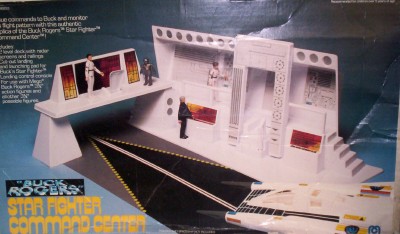
The toy box suggests: "Issue commands to Buck and monitor his flight pattern with this authentic replica of the Buck Rogers Star Fighter Command Center!" Indeed.

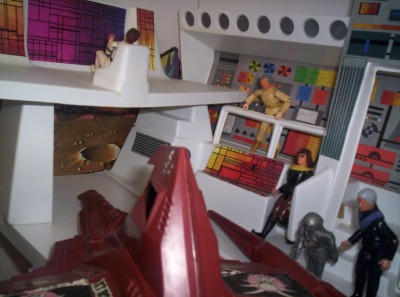
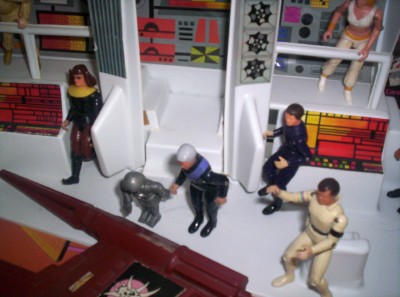
The toy also includes "2 level deck with radar screens and railings, "Cut-out landing and launch pad for Buck's Star Fighter," and "landing control console for use with Mego Buck Rogers 3 3/4 action figures and all other poseable 3 3/4 action figures." Wow, railings and radar screens! Okay, maybe not that very exciting on retrospect, but for me as a kid, this was exactly the kind of toy I wanted.

What remains most interesting about this toy is that what you see displayed on the box is not necessarily the toy you get inside. On the box, for instance, the upper deck of the landing pad shows a chair from Star Trek's U.S.S. Enterprise bridge. In the actual toy, a different style chair is molded to the deck.

Also, the decals on the box and the decals of the actual set are completely different. Wonder why? I do know that Mego was juggling a number of licenses at the time, including Star Trek, Buck Rogers and The Black Hole, so there may have been some franchise confusion. Just a guess.

This just goes to show you that back in the 1970s and 1980s, even great toy companies like Mego weren't necessarily paying close attention to the exact details of their (admittedly wonderful) products. This isn't really an "authentic replica" of the landing bay on the series. That's okay, it's still a fun toy, but authentic? Naah.

As you can see from the pictures, this toy today holds a cherished spot in my home office. Bidi-bidi-bidi.

Thursday, November 16, 2006

TV REVIEW: Jericho: "Crossroads"

One week before the "fall finale" of CBS's promising new series Jericho, and things are heating up in Kansas. When last we left the stalwart Green brothers (Eric and Jake), they had returned from Rogue River with the medicine needed to save their Dad, Johnston (the mayor). But...they'd run afoul of professional mercenaries who pillaged Rogue River (just 90 miles from Jericho).

In "Crossroads," this week's installment, the chickens come home to roost as the Ravenwood mercenaries, led by villainous D.B. Sweeney, arrive on the outskirts of Jericho with humvees and guns. Lots of guns. The town sets up a roadblock on a bridge, but Jake has tangled with Ravenwood before (in the Iraq War...) and knows they won't be stopped short of a violent confrontation. Jake wants to blow up the bridge leading into Jericho, an act which will stop the professional soldiers once and for all but also geographically isolate the town (and force those who live on the other side of the bridge - like farmer Stanley - to abandon their homes).

The idea of mercenaries run amuck in heartland America isn't quite as farfetched as it may seem, as this episode clearly reflects the situation in Iraq where our Federal Government has "outsourced" security to professional, hired soldiers rather than the military. These private contractors are not bound by the military standard of conduct, and can therefore do...whatever the hell they want want. Imagine being an Iraqi citizen trying to figure out the difference between an American soldier and one of these guys? Not fun. Indeed, some of these "outsource" soldiers were responsible for the atrocities that occurred at Abu Ghraib. So Jericho - like all good science fiction - extrapolates the "future" or an alternate reality based on ours. We recognize the world it depicts, and here we're being told something about Iraq (and also about contemporary America).

Meanwhile, Emily wakes up to realize it is her wedding day...though her fiancee Roger is still missing. Throughout the episode, Emily (Ashley Scott) "fantasizes" an alternate day. One where "the end of the world" didn't come, and she and Roger married. We are treated to snippets of the wedding preparations, the reception, and so forth, as Emily contrasts what is with what might have been. This is an interesting touch that doesn't get too maudlin, and helps to reveal to audiences how much the world of Jericho has changed in a month. (In the fantasy world, Stanley is watching a sports game on the telly, for instance.)

Trouble is also brewing for Eric. April is finally ready to tell him she's pregnant with his child, but before she can, he works up the courage to tell her he's leaving her for his mistress, Mary Bailey. This development is a little bit soap-operaish, if you ask me, but these days (the days of Lost, Battlestar Galactica...) sci-fi fans are frequently asked to accept soap opera plotting as a substitute for genuine genre thinking.. Contemporary producers have mistaken old General Hospital plots for "maturity" and for being "dark" or "angsty"...when in fact the stories of alcoholism, affairs, unwanted pregnancies, etc., are merely staples of the soap opera form. In some cases this development is acceptable (hey, Jericho IS about a small town and the lives of its citizens, so it gets a tentative pass on this front...), but Battlestar Galactica is supposed to be about the big issues (like the extermination of the human race and the search for a new home...) and Lost has bigger issues - like about a dozen or so mysteries - to contend with. I just wish those shows would get over themselves and actually tell science fiction stories; deal with science fiction concepts instead of As The World Turns-style intrigues, but then, I digress...

After stopping the mercenaries, Jake confronts his father (now recovered) and warns that the town needs a military, a "trained" and "sanctioned" security force. The Mayor agrees and gives his son the responsibility, handing him a U Ranger handbook. A wise decision or opening a Pandora's Box? Discuss amongst yourselves.

Truly, this brings up an interesting dilemma. The town of Jericho needs to be defended from marauding outsiders. But would you want a heavily armed (but inexperienced...) citizen police force marching your street? What's the balance? Hopefully, Jericho will tell us (and show us...) in the weeks ahead.

20 Years Ago: Doctor Who: "The Girl in the Fireplace" (May 6, 2006)

When The TARDIS lands on a derelict vessel deep in space, The Doctor (David Tennant), Rose Tyler (Billie Tyler) and Mickey (Noel Clarke) inv...