Saturday, February 28, 2026

50 Years Ago on WPIX: Space:1999 "Earthbound"


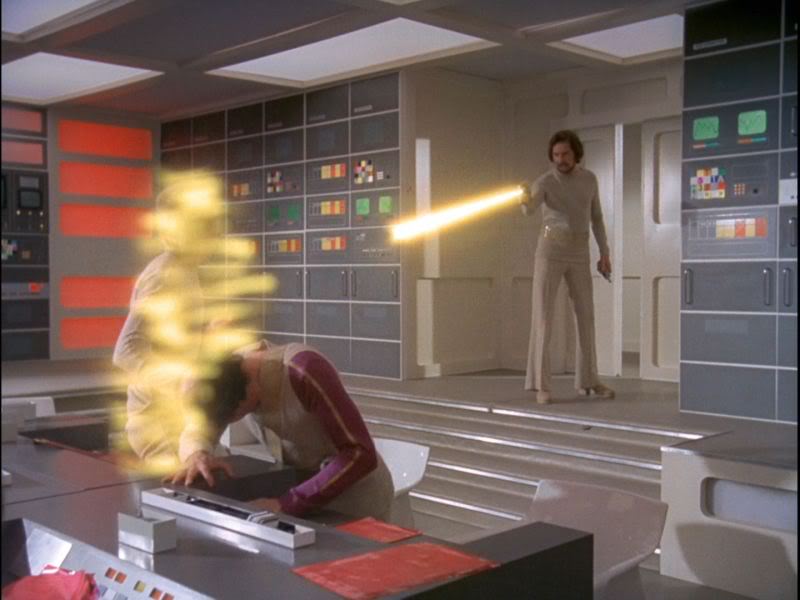
In “Earthbound,” Commissioner Simmonds (Roy Dotrice) complains in a Command Conference about the Alphans’ direction for the future.  

He wants to know why there has been no discussion -- and no concrete plans – for a return to Earth.  

Commander Koenig (Martin Landau) counters that a return to Earth is impossible and that the Alphans are, rightly, focusing on two primary goals: survival, and a new place to call home.

Simmonds is not placated.

Before long, Alpha detects a powered object -- an alien spaceship – approaching the moon.  

Rather than going into orbit, however, it crashes on the lunar surface.  Aboard an Eagle, Koenig, Professor Victor Bergman (Barry Morse) and Dr. Helena Russell (Barbara Bain) investigate the vehicle.  They force entry, and find several humanoid aliens in suspended animation in transparent sleep cubicles.

The Alphans inadvertently kill one of the aliens when they tamper with a sleep cubicle, an act which awakes the others, including Captain Zantor (Christopher Lee).  

Zantor shows no malice regarding the accident, and introduces his people, the Kaldorians.  They are the last survivors of a world that has grown sterile, and they are traveling to Earth where they hope to be welcomed as friends. 

Their journey, they report, will take seventy five years.

With one of their number dead, Zantor offers the vacant slot on his ship to an Alphan of the Commander's choosing.  Accordingly, Dr. Russell begins to study the suspended animation process while Koenig instructs Computer to pick one Alphan to return home to Earth. 

Simmonds wants Koenig to choose him, but Koenig refuses, noting that the choice must be objective. Simmonds refuses to accept that answer. He attacks Alpha’s power station and holds the base captive. 

Koenig realizes he has no choice but to let Simmonds return to Earth with the Kaldorians. 

But Simmonds has not allowed Zantor time to prepare a proper physiological matrix for him, meaning that the suspended animation process does not work correctly.  Simmonds learns this the hard way very soon into the 75 year journey.


One aspect of Space: 1999 (1975 – 1977) that I resolutely admire is the fact that many stories often re-purpose famous literary horror devices or narratives. There’s a valid thematic reason for this, too. The series’ heroes, the Alphans, are not prepared psychologically or technologically for a deep space journey.  They don’t understand the nature of the galaxy; they are not experienced. Outer space is not a place, necessarily for brotherhood among aliens.  It is a realm of mystery.

Accordingly, the Alphans often encounter beings and phenomena that we would term terrifying. 

Not always, of course. Some stories deal with wonder or awe, the other side of the equation.  

But a good number of stories, especially in Year One, contend with horror-based ideas, like the monster in “Dragon’s Domain,” a man with the Midas Touch (“Force of Life,”) ghosts (“The Troubled Spirit”), and even sadism and torture (“End of Eternity”).

“Earthbound,” a very strong early entry in the canon functions on a similar principle.

In particular, it pivots off a key element in Edgar Allen Poe’s (1809-1849) short story: The Premature Burial (1844).  In Poe’s time, a pervasive cultural fear, in fact, was being buried alive. Poe's tale involved a character obsessed -- wracked with fear, in fact -- regarding this fate. He took many steps to prevent such an outcome, and yet (it appeared, anyway...) that it was all for naught.


Intriguingly, “Earthbound,” takes that fear of being buried alive – of being trapped, unable to escape, in a casket -- and updates it for the space age. 

Here, Commissioner Simmonds fails to take the necessary precautions before entering a suspended animation chamber, and awakens only a short-time in on a seventy-five year flight.  All the other people on the ship -- Zantor and the Kaldorians -- are sound asleep and therefore oblivious to his desperate cries for help.  

And because the cubicle is transparent, we are able to watch Simmonds’ panic grow and grow, as he repeatedly throws himself against the unbreakable walls of the sleep cubicle  Finally he is left screaming, defeated, with no way to escape his premature burial.

Surrounding this climactic set-piece, “Earthbound” features some of the sharpest, and in a way, cruelest plotting in the entire series.  

Koenig orders the Computer to pick one name among the Alphans; one person who the base can reasonably spare if it is to continue to function.  Since Simmonds is not really a member of the base personnel, he is the natural choice to go. 

But Simmonds refuses to let “chance” (or, presumably, a machine) dictate his fate, and takes steps to assure that he goes home.  

Alas, the irregular manner of his methods -- blackmail, hostages, gunpoint diplomacy, etc. -- assure that he will not be adequately prepared for the voyage.  He does not trust Zantor, and doesn’t give him time to prepare a  biological matrix.  So he will go home…but he will never, in fact, see home.

At the end of the episode, the other shoe drops. 

Helena asks Koenig who Computer ultimately chose to return to Earth.  In one of the series’ greatest, most chill-inducing codas, Alpha's commander answers.  With one word.

“Simmonds.”

Landau’s delivery is great here. It is deadpan and straight-forward, imbued not with too much or too little emotion. It’s a simple declaration, and Landau's delivery allows the viewer take in the information for him or herself; to realize the full ramifications without spoon-feeding or hand-wringing.

In short, “Earthbound” represents Space: 1999 at the top of its game. 

Outside of the horror trope re-purposed for the near future, and the chilling, Twilight Zone-worthy twist or denouement, we also get examples of the Alphans at their best here. The Kaldorians are treated as friends and allies, not as monsters or enemies.  

A common criticism of the series is that the Alphans are always “menaced” by advanced aliens. Clearly, that’s not the case in “Earthbound.” If anything, the Alphans here are menaced by human nature; by Simmond’s selfishness and cut-throat determination. As Paul Morrow (Prentis Hancock) trenchantly notes at one point, the Alphans are better off without Simmonds.

And yet, as bad as Simmonds is, the Alphans clearly don’t wish for him to endure the horrible fate of being prematurely buried. Accordingly, the episode presents a three-dimensional depiction of the Alphans.  They know how flawed Simmonds is, and yet, as fellow human beings, they can still empathize with his predicament, and grim fate.


 “Earthbound” is notable, too, for the performance by the iconic Christopher Lee. Here, he is not Dracula, or even a villain with a golden gun. On Space: 1999, by contrast, he plays a regal and reasonable alien, a being who doesn’t permit the passions of the moment to alter his beliefs or actions. Lee is quite imposing as Zantor, especially in his first scenes, wherein we don’t yet know what he will do, or who he is.  

But Lee remains a fascinating presence right through his last appearance in the episode in part because he keeps the character’s motivations opaque. 

In the last scene, for example, Zantor could help Simmonds by telling him he needs to prepare a matrix. Instead, he behaves according to Simmonds demands...and keeps his mouth shut.  He makes a choice not to help a man he considers “diseased.”  

Is this murder, or merely an adherence to the logic of the moment?  

It is very likely that even if Zantor warned Simmonds about the necessity of a matrix, Simmonds wouldn’t believe him.  Hence, the same fate would result.  

But I love how ambiguous the moment is, in terms of Zantor's decision-making and feelings. He is "alien" in a true sense, I guess, and that's an intriguing touch.

The episode features some other welcome visual touches too, The Kaldorians arrive on Alpha bearing a gift: ceremonial gold eggs belonging to a life-form called a “libra bird.” Eggs, of course, represent fertility and re-birth.  And the Kaldorians are seeking their re-birth on Earth. In a way, they have already been reborn on Alpha, awaking from the deep slumber that has characterized their journey.

I should also note that I enjoy “Earthbound” because it remembers the basic premise of the series; that the Alphans are, essentially, us in space. They are men of the 21st century, with our flaws and foibles, not romanticized figures of perfection and “evolved” natures.

Here the Alphans accidentally kill a Kaldorian while attempting to open a sleep bay. It is a mistake, of course, but a bad one. Yet when you put human nature together with the unknown, such things may happen, even if the humans -- Koenig, Bergman and Helena -- have the best of intentions. 

If Zantor represents an alien mind-set, Space:1999 again presents us a look at fallible human nature too.

Wednesday, February 25, 2026

Abnormal Fixation 2.3 "Help Desk"


Tuesday, February 24, 2026

Abnormal Fixation Wins Atlanta Movie Awards in Category of Best U.S. Short!


Sunday, February 22, 2026

50 Years Ago on WPIX: Space:1999 "The Full Circle"


The reconnaissance team on Eagle 6 has not reported back from the forested planet of Retha. 

Commander Koenig (Martin Landau) orders Paul Morrow (Prentis Hancock) to retrieve the craft by remote control.  When the ship is explored at Moonbase Alpha, a primitive cave-man is discovered dead in the passenger module. He is the ship's only occupant.

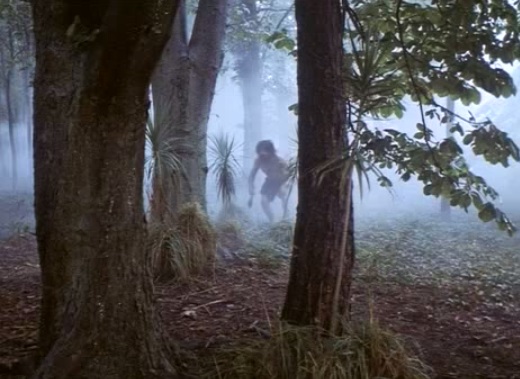
Koenig orders a full-scale rescue mission to the planet, unaware that a mysterious mist found on the planet surface is actually a time warp of sorts.  

When the Alphans step through the fog, they are re-made as primitive cave-people. As a primitive man, Koenig becomes Cave Chief, while Helena Russell becomes the tribal healer, and the Chief’s consort.

Unaware of what has happened to her fellow Alphans, data analyst Sandra Benes (Zienia Merton) encounters several cave people, who capture her and bring her back to the cave.  There, a primitive hunter (Oliver Cotton) and the Cave Chief battle for ownership of the beautiful and strange female in their midst.

On Alpha, Dr. Mathias (Anton Phillips) solves the alien riddle during an autopsy.  The caveman in the Eagle has caps on his teeth.  

He is one of the Alphans, not an inhabitant of Retha…


“The Full Circle” is likely not one of the better-regarded episodes of Space: 1999’s (1975-1977) Year One.  And yet, it is an episode that I like very much, and for two key reasons.  

First, the episode is set mostly in natural, real environs, and that fact gives the story a remarkable boost in terms of visuals and excitement.  The planet Retha is a combination of Black Park and Pinewood Studios back-lot exterior locations, and the contrast between sterile, technological Moonbase Alpha and such natural, wild locales is remarkable.

You could not recreate the “primordial” look and feel of Retha on an interior sound-stage, using papier mache rocks, nor, truthfully, by using a familiar So Cal location.  

To American eyes, therefore, “The Full Circle” looks genuinely like a journey to the prehistoric era, to a wild, untamed world. Director Bob Kellett’s camera-work is also remarkable, especially during the pursuit of Sandra by the cave-man Alphans.


Secondly, the episode’s thematic framework works very successfully. Specifically, "The Full Circle" ponders the (unchanging?) nature of humanity. It compares turn-of-the-millennium, space-age Alphans to Stone Age counterparts, and finds few meaningful differences.  

To wit: Sandra Benes (Zienia Merton) nearly bludgeons Commander Koenig (as cave man) to death with a rock. And Alan Carter (Nick Tate) literally goes “cave-man,” vengeful and hungry for blood when he worries that Sandra has been injured. These are the acts of rational, modern human beings?

As the episode’s coda suggests, the narrative is really about basic human emotions, about human instincts.  Sandra still acts by fight-or-flight dictates, for example, and this means that she is not far removed, in terms of nature, from the Cave Chief who -- in a manner very unlike Commander Koenig -- desires her.

As Koenig notes “it was only us there,” and the point is made. 

In 40,000 years, according to the episode’s timeline, man has not really evolved beyond savagery, beyond jealousy, rage, and other primitive emotions.  Those things still drive us, sometimes to survival, sometimes to disaster.


One scene suggests the similarities visually.  

At around the half-way point of the episode, we meet Alan, Victor and Kano huddled around a camp-fire, getting ready to turn in for the night. 

In the very next scene, we see the interior of the tribe’s cave, where a camp-fire is also at the center of the population, at the center of civilization.  The costumes have changed -- from Rudi Gernreich 1999 chic to primitive furs -- but man has not. He still needs fire. He still huddles with his fellow humans in the dark.  And he still doesn’t understand all the mysteries of nature, and the universe.


Where “The Full Circle” vexes some critics and viewers, I suppose, is in the story mechanism that makes the comparison between primitive man and space age man possible.  Here, a swirling mist is a time warp that changes Koenig, Helena and other Alphans from civilized to primitive. Even their clothes change with them.


The time warp mist is a solid device for making the story’s point, but leaves a lot of questions unanswered.  

How do the Alphan’s change costumes in the mist?  How does the time warp achieve that end? Does all the mist on the planet act in this fashion, or only in this one spot?  Is the time warp naturally occurring, a function of “nature” on Retha, or is it something that was designed by unseen inhabitants?

Personally, it doesn’t bother me that Space: 1999 fails to address such questions. I prefer to speculate, and have always felt that the time warp is some device or entity left behind the planet’s inhabitants.  

Perhaps they created it because they foresaw the end of their race, and wanted to go back to the beginning...get a second chance. Or perhaps they left it behind on Retha to preserve the planet’s natural, unspoiled nature. Any visitors would lose the capacity to alter the planet’s climate or terrain if reverted to primitive form. 

In the end, the details don’t really matter a whole lot, and it is what “The Full Circle” states about human nature that is valuable, and memorable. When you combine that statement with the beautiful location work, the episode emerges as one that is less disposable, and far more intriguing. Barry Gray's score is also one of his most unusual contributions, and underlines the action brilliantly.

Also, as is the case in many Year One stories (and “Earthbound’s” coda is an example), “The Full Circle” gains interest and suspense from a twist in the tale.  

It is learned, late in the story, that the cave-man in Eagle 6 is actually an Alphan. Specifically, he has caps on his teeth.  This information changes the whole nature of the story on the first watch.  Before this reveal, it is a natural assumption that the Alphans have encountered a world of primitive man.  

In fact, as Mathias's discovery suggests, they have encountered only themselves at a different stage of development.  

That twist is a surprising one, and like the device of the misty time-warp, makes the final point about humanity’s unchanging nature, all the more powerful.

Friday, February 20, 2026

90 Years Ago: Things to Come (February 20, 1936)


One of the pioneering "fathers of science fiction," author H.G. Wells (1866-1946) published a visionary chronicle of the future in 1933 titled The Shape of Things to Come.

As fascism rose across a continent like a dark tide, as economic depression savaged our own nation, this stirring (and fictional) account of world events from 1933 to 2100 presented the detailed imaginings of a committed Anti-Marxist socialist; one who accurately predicted many elements of our world today.

In his fictional account of "things to come," author Wells foresaw weapons of mass destruction (chemical "air torpedoes"), submarine-based missiles, the rise of Warlord-ism, the Blitz (and ensuing destruction of London), World War II, the invasion of Poland, "surgical" missile strikes, and much, much more.

Wells also envisioned other events: a world war lasting for thirty years, followed by a deadly plague ("The Wandering Sickness"), and then, the rise of a World State...and the end of nationalism.

In his future world, Wells' benevolent dictatorship eliminated not merely nationalism (and nation states), but organized religion. His conquering regime controlled the survivors of the human race through advanced technology, particularly mass transportation (planes). This World State also included the idea of advancement in society by intellectual merit, not by family name, class, or wealth. Finally, Wells saw the overthrow of the dictatorial World State after a hundred years...and a new age of technological progress beyond.


Alexander Korda and director William Cameron Menzies collaborated with Wells to bring this tale of man's future to the silver screen in 1936. The film, Things to Come, has earned the title "classic" as well as the descriptor "visionary.” It is one of the genre's earliest and most awe-inspiring masterpieces, not to mention a special-effects stunner. I first saw it when I was a teenager- -- cut up for commercial television -- and have read about it in probably every science fiction film reference book in history. It's an important, landmark film in terms of genre, in terms of content, and also in terms of special effects technology.

Things to Come's central plot is divided into three portions or Ages. There is the pre-War Age (set in 1936). There is the immediate aftermath of War (set in 1966-1967) --  the post-apocalypse -- and the beginning of the World State, and a future Age of Progress (set in 2036).

Each of these three sections is centered in a fictionalized version of London called "Everytown." And, to one extent or another, each passage also revolves around one family facing the inexorable winds of change; the Cabal family. 

This personal, identifiable element of family makes the film a sort of "generational" tale, and more easily approachable in terms of narrative. Raymond Massey stars as John Cabal in the first two portions of the film; and as leader Oswald Cabal in the Age of Progress section.

Our story commences in Everytown on Christmas Eve, 1936. John Cabal is a pessimistic brooder who believes war is inevitable, and worse, that it is impending. His friends and family members, including a young doctor, Harding, don't want to see war "mess things up," and resist the idea of war's inevitability. Cabal mulls over man's nature with grim fortitude. "We must end war. Or war will end us," he states.

Soon after this introduction to the characters, Things to Come depicts a happy Everytown by nightfall, at least until a truck with a white placard bearing the legend WAR SCARE appears in the background of a frame, in plain sight. 

In this portion of the film, we get a rapid-fire montage of several such war-themed placards until -- still on Christmas Eve -- war breaks out. Cabal was right...nothing could stop the conflagration of destruction. That very night, Everytown is bombed from the air in scenes eerily reminiscent of the Blitz (though they were shot years before...).

Before our eyes, we see a local cinema explode and crumble, a sign that the age of man's technology and leisure is at an end. 

As destruction rains from the sky, Menzies cuts to an image of a young blond boy -- no more than ten years old, perhaps -- wearing a soldier's helmet. The child -- apparently knowing what is to come -- begins to march like a "real" soldier. 

After a few seconds of lingering on this image, Menzies superimposes new images (silhouettes, actually...) of adult soldiers on the march; juxtaposing play and reality; indicating that even the young will be conscripted into the never ending conflict. And indeed they are: the war lasts for a generation. In 1960, it ends....but only because so few people are left.


Worse, pestilence follows. In the burned-out city of Everytown ("a cursed ruin of a town," as one character describes it) in 1966, a disease called the Wandering Sickness takes hold. Those who contract the illness are shot on sight. 

By 1967 half the human race is extinguished, and society attempts to re-build...in vain.

Everytown, for instance, comes under the corrupt leadership of "The Boss" (or "The Chief") played by Ralph Richardson, a warlord who quickly launches a new military offensive against neighbors called The Hill People. 

Since there is no longer radio, cinema or even newspapers, The Chief sees his propaganda scrawled crudely on a board displayed before the ruins of City Hall. On this board, the Chief promises "victorious peace" after the Hill People are conquered. But winning the war isn't easy, and the Chief knows what he needs to win: working airplanes. His chief engineer, Richard Gordon, can't promise him anything. "We shall never get in the air again," he laments. "Flying is finished."

Yes, it appears to be a Dark Age for mankind as Everytown runs short on medical supplies. It is also a place where knowledge of aeronautics and machinery seems ready to slip away forever...

But then, one day -- out of the clear blue sky -- a highly-advanced plane arrives in Everytown. The pilot is a gray-haired John Cabal, making a homecoming of sorts. He now serves in "Wings over the World," an organization of scientists and engineers dedicated to restoring trade and civilization to the area of the Mediterranean. 


Cabal's mission is also to stop "petty dictators" and bring an end to independent, sovereign states...the end of Nationalism. The Chief naturally resists, and has Cabal arrested and thrown in jail.

In a short time, however, Wings over the World arrives in force (in giant flying fortresses -- another prophetic concept from Wells), and bombs Everytown with the harmless "Gas of Peace." There is only one casualty in the attack: the Chief himself, who conveniently has suffered a heart attack. "He's dead and his world died with him," opines Cabal without pity, as the black-suited members of Wings over the World descend on Everytown by parachute. "Now...for a new life for mankind."


After a lengthy interlude during which vast machines build an advanced underground city, we skip ahead to the subterranean Everytown of 2036. 

Oswald Cabal is the leader of the city now (grandchild of John), but faces an insurrection from anti-progressives who fear that progress has gone too far; that technology is out-of-control and once again threatening the safety and peace of man. 

Exhibit A in their argument is the vast Space Gun -- a giant device that is primed to "fire" a rocket to the moon. Cabal plans to send his daughter, Katherine, and her boyfriend, there, to prove that human progress is unstoppable, limitless.

"We demand a rest," argues the leader of the anti-progressives on a giant, city-size view screen (seen by thousands of citizens). "The purpose of life is happy living!" 

Cabal doesn't hinder the speech (a fact which promises a world of free speech and free expression, at least...). Instead, he trusts that his people will be wise about the future. "They'll have to hear him," says Cabal. "They'll have to hear him and make of it what they can..."


In the end, progress marches on, and the rocket is fired into space. Gazing out into space via a telescope, Cabal debates the future of the human race with an anxious friend, one who sympathizes with the anti-progressive movement. 

Is mankind ever to stop moving forward? What comes after the moon? After the stars? 

At this interrogative, Cabal deplores the "ugly spectacle of waste" that represented warfare in the twentieth century, and says that progress, technology and wisdom -- the push into the future -- has made "danger and death worthwhile" and that the human adventure is only beginning. Mankind he believes, must "go on; conquest after conquest." The choice is as simple as "all the universe or nothing."

The film ends with a stirring, dramatic question from Oswald Cabal to his friend (and to us, in the audience.) "Which shall it be?"

That's a good and highly relevant question in our turbulent times of terrorism, warfare, and violence. The element I admire most about Things to Come is this pervasive, thorough and committed anti-war message.

What could mankind do -- what could we accomplish -- if we didn't squander our blood, our youth, our treasure, and our science on killing, on war? The sky -- nay the stars themselves -- would be the limit.

Wells also (rightly) predicted that for every advance in science that man forges, there is blow back; a counter-movement of men who want to take us "back" to an earlier era; who desire to believe in old superstitions and myth rather than utilize science to scale new heights. We see it now in the anti-intellectual movement that flourishes in this country today. For every two steps forward, a rump movement is trying to hold us back.

Nor is it difficult to understand why Wells has targeted nationalism and religion for extinction in his utopia of the future. As long as we divide ourselves into little teams (Democrats, Republicans, Christians, Muslims, Jews, liberals, conservatives, gays, straights, Marvel, DC, etc.) he believes we won't work together for the common good. It's not enough, apparently, that we're all human beings, or all citizens of planet Earth. 

If you watch the news, you know that some people (like Alex Jones) are mortally terrified of a united Earth, and yet dreamers like Wells and Roddenberry, alternatively, see it as a necessary precursor to utopia.

Yet what I find deeply troubling about Things to Come is this Welles-ian notion of a World dictatorship - benevolent or otherwise. Look at the scenes in the film featuring The Wings over the World air men -- strangely faceless and identical -- swarming through Everytown in their sleek black uniforms. This is just another face of fascism, isn't it? 

These men arrive, utilize deadly weapons (even the harmless "gas of peace" is technically a weapon...), and then impose their will on the citizenry using superior technology. Now, these men would tell you they are doing what's best for mankind. But I would argue that's the same point every dictator in history has likely made. 

Who knows what's best for mankind? Who chooses? 

The point, I suppose, is that human beings should be free to choose for themselves how they live; not have a particular ideology -- even progress forced down their throats. Or am I wrong? Do we need a strong hand to point us to the light?

Whatever its eventual form, Things to Come is accurate with this prediction of a World State. In our world, however, I believe it is likely to be a corporate world state, not a socialist one. There are steps being taken towards that today, if you look closely enough. Also, though I sympathize with Wells, I believe his socialist sympathies made him misunderstand human nature. 

Here's an example: In his vision, man reaches the moon in 2036, after a uniform World State is in charge; after nationalism is long dead. In our world, by explicit contrast, it was nationalism -- the Cold War with the Soviet Union -- that spurred the space race. We made it to the moon in 1969, because of the need to compete; the need to beat Russia. 

So I can see both sides of the nationalism debate. It divides us and makes us want to kill “others,” but it also spurs growth and competition. As far back as Athens and Sparta, nation states competed...and the competition brought about great art, great science and great literature, no?

Things to Come is a powerful film filled with fascinating ideas, but some do clearly border on the simplistic. Cabal is ruthless...but well-intentioned.  But how can we trust one man with all the power to be just?

Technology-wise, this film features extraordinary miniatures and blends them deftly with live-action sequences. The views of the Everytown cityscape of 2036 remain breathtaking and awe-inspiring. Some of the miniature war footage (of tanks rolling across barren wastelands) is virtually indistinguishable from stock footage. 

The aerial footage also appears remarkably real. This is an amazing achievement for a film made so long ago. It is ironic, however: Things to Come imagined a world where technological devices would become vast, colossal; in the real world, we've experienced a revolution of miniaturization instead.

Finally, the last moments of the film will remain with you, along with Cabal's probing question. The universe? Or nothing? Which shall it be? 

More importantly, if it's the universe, how do we find our way to that future? Benevolent dictatorship? United Federation of Planets? Global free trade?

Who’s got the answer?

Wednesday, February 18, 2026

Abnormal Fixation 2.2: "Spam Risk"


Sunday, February 15, 2026

50 Years Ago on WPIX: Space:1999 "Space Brain"


Yes, this is the (in) famous Space: 1999 (1975 -1977) that sees Moonbase Alpha’s interior overrun with…soap suds. And you know what? I love it.

Despite a silly-sounding (and appearing) menace “Space Brain” by Christopher Penfold is still pretty great. This is so because the episode intimates an alien (and ultimately impenetrable…) order to the universe, and more-so, an alien hand influencing Alpha’s journey…and perhaps not for the better.

In fact, I was so taken with the sub-text and “under”-story aspects of “Space Brain” that my first officially licensed Space: 1999 novel, The Forsaken (Powys Media; 2003), might be interpreted as a direct sequel to this episode’s events, one that seeks to address some of the mysteries presented in the televised story. 


In “Space Brain” Moonbase Alpha’s routine is unexpectedly disrupted by the sudden transmission on every vid-screen of streaming alien hieroglyphs. Commander Koenig (Martin Landau) sends out an Eagle to investigate the transmission’s point of origin, but quickly loses contact with the craft. 

In short order, a second ship is sent out, but one astronaut, Kelly (Shane Rimmer) returns from a spacewalk as a changed man.  He is now the “programmed” vessel for a vast entity in space, one on a collision course with the Moon. 

Meanwhile, a small but incredibly-heavy meteorite crashes near Alpha.  Concerned about the impending collision with the larger obstacle, Koenig orders an Eagle filled with nuclear charges launched.  It is tagged to detonate at the center of the space-going entity.

As the threat progresses, Dr. Helena Russell (Barbara Bain) and Professor Victor Bergman (Barry Morse) seek to understand the threat better, and Bergman soon realizes that the meteorite is actually the crushed remains of the first eagle craft, destroyed by alien antibodies. 

At roughly the same time, Helena understands that Kelly is acting as an intermediary, relaying messages from Alpha’s Main Computer to the entity in space, attempting to avoid the collision.

After undergoing a dangerous mental symbiosis with Kelly, Koenig accepts that the entity -- the so-called “space brain” -- is a peaceful organism, and one that turns at the “center of a whole galaxy, maybe hundreds of galaxies.” 

But disaster looms when the eagle armed with the nuclear charges can’t be recalled, and the Space Brain begins to emit deadly antibodies so as to crush the Moon in the very way it crushed the first eagle spacecraft…


One of the arguments I universally make in support of Space: 1999 as a highly-visual science fiction initiative is that it functions (like Prometheus [2012], for example) on largely symbolic terrain, and its stories -- often criticized as being somehow confusing -- are crystal clear once the symbols are noted, studied and then thoughtfully interpreted. 

“Space Brain” is no exception, and in terms of both visuals and musical choices, this episode proves rather impressive, despite the onslaught of killer soap suds.

For instance, “Space Brain” opens with various scenes of Moonbase Alpha personnel relaxing off-duty, solving puzzles (and trying to beat a puzzle record).  One of the first such shots depicts Alpha’s commander, Koenig, completing a puzzle in his office. 

The puzzle itself depicts a painting by Jacque Daret (1404 – 1470), created circa 1435.  Called “The Visitation,” this work of art reveals Mary (with Jesus still in utero) visiting another pregnant woman, Elizabeth.  Art critics have interpreted Deret’s work to symbolize Mary’s role as intermediary between God and Man. 

This work of art, then, reveals, in a sense, Kelly’s role in “Space Brain” as the go-between for Alpha and the entity in space.  In both circumstances, there is indeed a “visitation” and a human being is transformed by what she/he carries within.  The shot of the painting also reveals what Koenig only learns later: that the space brain, like Mary’s God, is a benevolent one.  On a much more basic level, all the “puzzle-solving” suggests the modus operandi of the teleplay: Koenig, Bergman, and Helena must each put together a piece of the space entity’s puzzle, from the indecipherable hieroglyphs, to Kelly’s odd physical condition, to the true (and horrific…) nature of the meteor.


Late in the episode, the action is scored to Gustav Holst’s Planets’ suite, namely the movement titled “The Bringer of War.”  In terms of practicality, this music was likely seeded in to lighten the load on composer Barry Gray.  There’s a real world, production reason for its use.

And yet in terms of appropriateness and interpretation, Holst’s composition also fits in well with “Space Brain’s” themes. Specifically, Holst’s work is a seven part suite, and each part describes the “character” of that planet, and that planet’s influence on the psyche of humans.  Consider then that “war” ascends in Koenig’s mind as he prepares a pre-emptive strike with the eagle carrying nuclear charges, and only later realizes the errors of his ways.  The “Mars” composition is also scored to literal war, as Alpha falls under siege, nearly crushed by the killer antibodies of the space brain. 

Put the two artistic visions and ideas held together -- peaceful interaction or Visitation between God and man, and then all-out war --- essentially present the two main perspectives depicted in “Space Brain.” The entity wants peaceful contact. The Alphans prepare for war.  The entity opens with communication and an intermediary. Human-kind faces a puzzle (and a crisis) with plans for destruction.  The book end works of art in “Space Brain” -- Daret’s and Holst’s -- convey much of the narrative’s deeper meaning.  Ignore the imagery and the soundtrack, and you’re not getting the entire picture.

Also, I often laud Space:1999 in terms of another quality for which it is widely disliked: it’s refusal to explain every aspect of its narrative and spoon-feed the audience easy answers. 


“Space Brain” never satisfactorily explains, for instance, why the nuclear-charged Eagle remote-control guidance system should short-out, rendering the collision with the space brain impossible to avoid.  Koenig himself dismisses – in explicit dialogue -- the idea that the space brain is behind the act.  By inference, this could mean, quite simply, that a third, unseen hand, is at work in this episode.  And that hand desires the space brain destroyed for some reason.  Thus it is using Alpha as its vessel for that very purpose. 

Again, we must go back to the painting, and the idea of Visitation.  Is Moonbase Alpha being used or visited by another force, only as a bullet to the brain, for some unknown purpose?

That’s the plot-line of my book, The Forsaken. 

But clearly, Alpha’s destruction of the space brain at the conclusion of this episode must boast terrifying and cosmic ramifications.  The dialogue explains how thousands of worlds depended on the space brain.  Accordingly, I speculate that the entity was a kind of regulating factor, ensuring the stability of stars and other environments.  Thus in its absence, everything becomes unstable, unpredictable…chaotic.  If you’ve read my book, you realize that’s my explanation for the wild, out-of-control, action-oriented events of Space:1999’s second season.  The galaxy has descended into chaos, and all bets are off.

Like I said, that’s my interpretation, but it need not be anyone else’s.  What I love about “Space Brain” is that it leaves open these little intriguing mysteries, and the viewers can fill them in, interpreting the clues in a way that they see fit, and that seems to fit the facts.  I’ve done so, as I note above, but other viewers are also welcome to interpret the symbols in a different fashion.  I much prefer these open-ended, stimulating mysteries to “techno-babble” resolutions we get in latter-day space operas.


The biggest stumbling block, of course, for “Space Brain” is the visual depiction of the alien antibodies.  The foam or soap-suds don’t look like organic antibodies, but rather just like a washing machine has gone dangerously out-of-control.  I realize that this visualization is a deal breaker for some viewers, and I accept that fact, but it’s truly a shame because there’s a lot going on in “Space Brain” beneath the bloody foam attack in the last act.

Wednesday, February 11, 2026

Abnormal Fixation 2.1: "Wi-Fi Wife"


Sunday, February 08, 2026

Abnormal Fixation crosses 1 million views on YouTube!

Every journey begins with a first step, right?  

The YouTube channel for our indie (and award-winning) mockumentary web series, Abnormal Fixation, just crossed one million views!

This figure doesn't count streaming, (we're on Fawesome and Relay at present,) but it's a good sign, I hope, that our audience is starting to find us!

Give us a watch when you get the chance!

50 Years Ago on WPIX, Channel 11: Space:1999 "Another Time, Another Place"


“This is the Earth.  But not the world we knew…Apart from us, it’s empty now.  A civilization once flourished here…another Atlantis, perhaps.”

-Victor Bergman describes a mysterious alternate Earth in Johnny Byrne’s “Another Time, Another Place.”

The Earth’s moon, in a region of distant space, passes through a strange, inexplicable phenomenon. The moon’s velocity increases as the Alphans experience dizziness, shock and double-vision. Dr. Helena Russell (Barbara Bain) gazes out of a window in Main Mission, and sees -- for a fraction of a second -- another moon, a duplicate, moving off into space.

Moonbase Alpha attempts to recover from this freak incident, but can’t. One Alphan technician, Regina Kesslan (Judy Geeson) begins acting strangely.  She exhibits signs of sun-burn, and seems to be living a past or future life in the present, one in which her husband, Alan Carter (Nick Tate) and Commander Koenig (Martin Landau) have died in an Eagle crash.

And then the news arrives that the moon has traveled into a new solar system, and is approaching…Earth. 

In fact, the moon will soon slip into the very orbit it left on September 13, 1999.  Hoping to learn if it is possible to settle on this strange Earth -- which seems almost devoid of all life -- Koenig, Russell and Carter encounters a group of Alphan colonists and realize that, in some strange way, the Moon has caught up with itself…or another version of itself…

But time is running out, for now there are two moons in the night sky…


For many humans, there is no more vexing problem to ponder, perhaps, than the one that goes: “What if I had just chosen to take the other path…” 

In ways poignant and profound, “Another Time, Another Place” explores this notion of paths untaken. The episode introduces the Alphans to a life that is simultaneously theirs and not theirs, one in which love has been acknowledged, and new destinies forged.  But it is also a world of death and despair, being both bleak and lonely.

Specifically, the Alphans encounter a version of themselves five years into the future... one that has settled on an inhospitable Earth.  Commander Koenig and Alan are dead, and Helena Russell is still in mourning over John’s passing.  In fact, part of the reason this episode remain haunting to this day involves Barbara Bain and her performance as the other Russell.  So often in cult-tv history we get “mirror” or opposite versions of characters, but Bain presents in “Another Time, Another Place” an older, sadder version of the character we all know. One who has found love with Commander Koenig, and then lost it…just as she lost her first husband, Lee. Now, she toils to keep the community alive, as John would no doubt want, but she’s lost, alone, and unhappy.

I had the great fortune to discuss the origin of the moody “Another Time, Another Place” with Space:1999 author and story editor Johnny Byrne (1935 – 2008) when I conducted a wide-ranging interview with him several years ago. “The idea of a doppelganger is something that is prevalent in my culture,” he informed me at the time.

“Growing up in Ireland, I didn’t have radio or television, so everything was imagination and history, and super[natural] history if you will. It wasn’t that we weren’t smart or educated -- I knew by heart everything Shakespeare had written by the age of 11. But to all of us, there was the real world and the other world.”

And the Alphans in “Another Time, Another Place” interface with a version of Ireland’s “other world,” but one relocated to the distant regions of outer space. 

“Well, the Irish believe there’s a very thin dividing line between fantasy and reality. In all Irish mythology there is an engagement with the other world, and people who come from that environment should have no trouble comprehending the kind of story I was writing for Space: 1999. It was the idea of leaving yourself, of discovering an alternative version of yourself.”

Specifically, Byrne based the space phenomenon which “doubled” the Alphans (and created doppelgangers) on an element of his everyday life. 

“One hundred yards up the road from the house where I grew up was this little church with a fantastic reputation. We heard that if you walked around the church sun-wise [clockwise] three times, you’d meet yourself coming out. That kind of legend was the core of “Another Time, Another Place." Our mythology is filled with situations in which a person stumbles into a mist and then emerges three hundred years later, or some such thing.  So I constructed a story around the experience of my upbringing.”

“Another Time, Another Place” goes further than that description suggests, however.  Commander Koenig must reckon with his corpse, with the possibility of a future in which he both marries Helena Russell, and then, because of an accident, loses her. The idea of coming face to face with yourself is one (terrifying…) thing, but the notion of going into the future and countenancing your corpse is of an entirely more bracing degree.

In fact, the specter of ever-present death hangs over this episode in a profound and disturbing fashion.  When Regina Kesslan is unable to reconcile the two universes that she inhabits, for instance the episode features a grim-reaper type-visage: a skull in a cloak. 

By the same token, Koenig and Carter visit a “dead” version of Moonbase Alpha, one gutted and salvaged for parts by the desperate Alphan colonists.

Even the Earth we see here seems haunted by the angel of death.  Man may have existed here, or never have existed at all.  But the trees appear to be dead and devoid of leaves, the soil is rust-brown, and night always seems to be falling.

Doppelgangers and Death beckon...


Another image of death, personal to Regina.


More Images of Doubles and Death.
A dead, twilight Earth.

It’s as if by splitting into two parts, the Alphans have entered a kind of twilight real, a place of half-life.  Thus the final, symbolic image of the episode -- Helena Russell clutching a groups flowers from the alternate Earth -- suggests two things simultaneously. The first is a kind of spring or re-birth: the flowers continue to live because the Alphans -- and the universe itself -- are made whole once more. 

Or, contrarily, the survival and thriving of these flowers could suggest visually that in some unknown way, the other Alphan community and its world also survived intact, though forever closed off from our consensus reality.  This notion harks back to Victor’s comment in the episode that there is an order to the universe, and ultimately the Alphans belong where they belong. The universe skips a track in this episode, and then restores itself, to state the matter bluntly.


I’ve always considered “Another Time, Another Place” a crucial piece in the Space:1999 Year One story arc, which Johnny Byrne confirmed was on his mind, even if, at times, he wasn’t always conscious of how it was working: “There was something deeply subconscious working all the time and none of us were aware of it,” he told me.  “And it only happened to those of us who were there all the time, because the writing of the individual scripts was only a step in the whole process.  We were in the planning of the episodes, we were seeing the dailies day-by-day, we were working ahead and looking at new stories.  We were at starship control, we were looking for those unidentified little blips – which were the scripts keying into something special.”

In terms of the story arc, we know that in series lore, the Alphans bring life to the planet of Arkadia in the final episode of the season (“Testament of Arkadia”), just as the Arkadians once brought life to Earth, and are therefore responsible for the dawn of man there. 

What if the planet Earth encountered in “Another Time, Another Place” is one in which this kind of symbiosis never existed? In which the Arkadians did not come to seed our world, and so life didn’t develop?

That’s just one possibility.  Another is that this is our Earth, only far into the future, when the memory of mankind is just that, a memory…like how we today think of Atlantis. In whatever way one chooses to interpret the multi-faceted ambiguities of this episode, “Another Time, Another Place” remains one of the most haunting installments of Space: 1999.

Abnormal Fixation 2.5 "Volatile Memory"