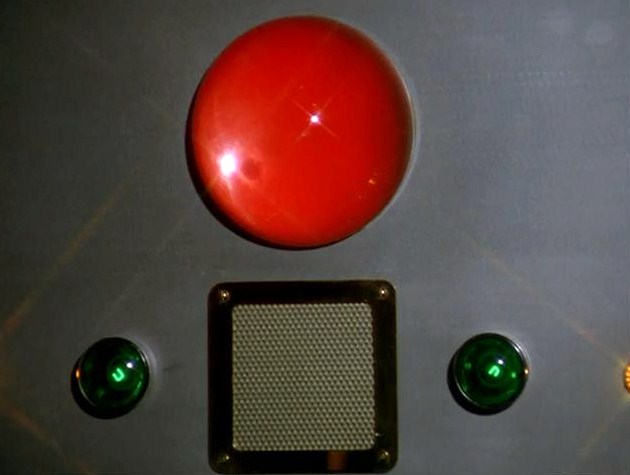
Tuesday, June 07, 2011

CULT MOVIE REVIEW: Forbidden Planet (1956)


"At times loud and frenzied, literally encircling the viewer with sight, sound, and fury, and at other times subtle and silently unnerving, Forbidden Planet is, on every conceivable level, a work of commercial art."

- Jeff Rovin. A Pictorial History of Science Fiction Films. Citadel Press, 1975, page 78.

To assess the dynamic in purely Generation X-friendly terms, Forbidden Planet is to the 1950s what Star Wars is to the 1970s.

Or perhaps what 2001: A Space Odyssey is to the 1960s.

In other words, Forbidden Planet is a visual space odyssey so involving, so expertly presented, so beautifully designed that it endures as a landmark in the history of the cinema. 

Even fifty-five years after its theatrical debut, Forbidden Planet still impresses, and on some level even terrifies, in significant degree due to the eerie "electronic tonalities" of the score devised by Louis and Bebe Barron.

Today, this 1956 film from director Fred M. Wilcox and writers Cyril Hume and Irving Block remains one of the boomer generation's most important genre touchstones, and has been referenced directly and indirectly in  a wide-range of high-profile sf productions including Serenity (2005) and Gene Roddenberry's original Star Trek (1966 - 1969).  

The film's mostly-invisible villain, "The Monster from the Id," is one that is still well-known by name in the pop culture lexicon.

At the movie's core, Forbidden Planet concerns an anxious fear not of technology itself, but of the human application of technology.  Or, more directly, human hubris.  The film reveals that for mankind (much like the ancient Krell), the stars can be our destination.  But our species could also lose everything it holds dear by failing to understand the greatest mystery of the universe: the human psyche.

Buttressed by "superior special effects" (Science Fiction Films. Bison Books Corp., 1984, page 39), Forbidden Planet truly  "thought big" and thus shines yet as one of the most imaginative and compelling movie visions of the future. 

As a kid of the 1970s,  I grew up frequently reading in the protean genre press about how Forbidden Planet was one of the greatest science fiction movies ever made.  Regardless of factors such as generational loyalty or nostalgia, those testimonials are absolutely, positively accurate.  This has been one of my favorite and most beloved films for a long time.

Delightfully, even if divorced from its Atomic Age original context, Forbidden Planet remains provocative.  The film remembers what so many science fiction visions of today fail to acknowledge; the fact that human beings -- and human problems -- must remain at the heart of any forward-thinking work of art. 

After all, when man reaches the stars he will still be man, and his decisions and wisdom (or lack thereof) will always spark the most invigorating of dramas.  Awe-inspiring special effects are one thing (and Forbidden Planet certainly deploys such effects brilliantly), but a story that connects to us, here and now, on an emotional level trumps such technical achievements every time.

"The secret devil of every soul set loose on the planet all at once..."

In the 23rd century, mankind endeavors to to conquer space, thanks in large-part to the invention of the hyper-drive, which makes interstellar travel possible.

As Forbidden Planet commences, space cruiser C-57D under command of stolid J.J. Adams (Leslie Nielson) approaches Altair IV, a world previously visited some two decades earlier by the Bellerophon. 

On approach to Altair IV, Adams and his ship are warned away from the planet by Dr. Morbius (Walter Pidgeon), who insists that he won't be responsible for the outcome should Adams ignore his counsel.

Adams sets down anyway on the craggy surface of the planet and soon encounters Robby the Robot, Morbius's highly-advanced mechanical servant.  Robby takes Adams, "Doc" Ostrow (Warren Stevens) and Lt. Farman (Jack Kelly) back to Morbius's home, where they meet the man.

The grave, serious Morbius is the last surviving original member of the Bellerophon expedition and reports that "some dark, terrible, incomprehensible force" killed the other humans on his crew.  However, he has been safe and secure in the intervening nineteen years, living alone on the planet with just Robby (his construct; something he "tinkered together") and his beautiful if naive daughter, Altaira (Anne Francis).

The ship's crew responds enthusiastically (*ahem*) to the lovely Altaira, even as Adams determines he must contact home base to request further instructions regarding Morbius.

Unfortunately, the cruiser's long range communication apparatus, the "Klystron Transmitter" is sabotaged at night by an unknown, apparently invisible foe.

In the days ahead, Morbius introduces Adams and Doc to the great archaeological find of Altair IV.  Beneath the scientist's house, inside a vast subterranean complex, stands an ancient power generator belonging to an alien race called the Krell.  The colossal machine -- whose exact purpose remains unknown -- is all that remains of the once super-advanced people.

In fact, the Krell were so advanced that they visited Earth before man even walked the Earth, and brought back samples of the planet's wildlife, including tigers and deer. 

In one impressive alien laboratory, Morbius demonstrates a Krell educational game, a "brain boost" machine that he himself has experimented on, augmenting his own natural intellect in the process.   

Alarmingly, Morbius also reports that the Krell civilization vanished in one night, on the eve of an almost divine achievement: the creation of a device that could render unnecessary all forms of physical instrumentality.

Awed and a little disturbed by Morbius's alien discoveries, Adams believes Earth  and the "United Planets" must be permitted to share in the wealth.  Morbius objects to the captain's interference, however.  

As if in response, the terrifying invisible foe returns again and again, night by night, growing ever stronger...and ever more murderous.

"We're all part monsters in our subconscious.  So we have laws and religion."

As any college level English student can dutifully attest, Forbidden Planet appears loosely based on William Shakespeare's play The Tempest (1610). 

That work by the Bard revolves around Prospero, a man who has lived on a remote island with his daughter Miranda for twelve years. 

Prospero is served by a spirit called "Ariel" and uses the auspices of Ariel's magic to create a  storm (a tempest) at sea.  The storm causes a shipwreck and draws important visitors (Alonso, Ferdinand, etc.) to Prospero's island for his unique purposes of personal and family renewal. 

Importantly, also residing on Prospero's island is Caliban (think cannibal): a monster who utilizes magic for much darker purposes. In the end, Prospero renounces magic and Ariel is set free from servitude, while Miranda and King Alonso's son, Ferdinand, are free to marry.

Shakespeare's last play, The Tempest is frequently assessed a highly-reflexive work of art because it compares Prospero's use of magic with the magic of the theater.  Prospero's renunciation of magic at play's end is thus said to represent Shakespeare's own pull-back from the stage; his professional retirement, essentially.  The Tempest is also widely considered a "post-colonial effort," drawing specific interest because of the way that Prospero treats (and mistreats?) Caliban, Ariel and the other denizens of the faraway island. 

Forbidden Planet certaily shares an abundance of common narrative and thematic points with Shakespeare's final literary endeavor.  If you substitute Altair IV for the remote island, Morbius for Prospero, and Altaira for Miranda, the comparison begins to take shape.  Captain J.J. Adams -- as love interest for Altaira/Miranda -- is at least part Ferdinand, and the extraordinary Robby the Robot fits the bill as Ariel, the servant of Morbius/Prospero. 

What seems rather unique about the transference of The Tempest's scenarios to the futuristic realm of Forbidden Planet is that the makers of this classic sci-fi film have made some very intriguing switches or substitutions.  

Here, technology -- alien technology -- replaces magic or the occult.  Robby is not a "fairy" or "spirit" like Ariel, but rather a thinking machine created from super-advanced technology; Krell technology.  Just consider  Clarke's third law, of 1961.  Advanced technology -- machines beyond our understanding -- appear as baffling as magic, right?

Furthermore, the film's "thing of darkness," to turn a Shakespearean phrase (Act II, Scene II), is positioned as a psychological, interior force, rather than as an exterior personality, Caliban.   It is the scientist/wizard's "id" in Forbidden Planet that creates problems, not a fellow and less honorable practitioner of the magical arts.  

Indeed, Forbidden Planet purposefully re-contextualizes Shakespeare's line in The Tempest that "we are such stuff as dreams are made of," so as to readily incorporate the the Id, which is one third of the human psychic apparatus as delineated by Sigmund Freud. 

Id is instinct.  Id is chaos.  It is aggression and destruction, with no overriding sense of morality, and it operates on passion and desire. Often, our nocturnal dreams  and phantasms are seen as the representative outlet of the Id, and in Forbidden Planet, Morbius -- immediately before his heroic demise -- explicitly names dreams as devious originator of his unpardonable sins. 

"What man can remember his own dreams?" Morbius asks desperately, suggesting that consciously he is fully separate from the the instinctive human urges which created the Monster from the Id and committed murder.  The truth is that the Monster here is actually a reflection of his basest, most primitive self.  Something that -- even in the era of space travel -- man cannot fully expunge.

Another substantial difference to consider when comparing The Tempest to Forbidden Planet involves the manner in which Morbius uses Robby.  Though it is clear from Morbius's demonstrations involving the robot that the scientist holds a kind of spell over him --  able to render Robby immobile with a simple voice command --  Morbius does not utilize Robby to bring visitors to his world. 

On the contrary, Morbius explicitly shuns such visitors while the cruiser is still in orbit.  This act separates him rather dramatically from his literary predecessor, Prospero.  In the denouement of both works, however, the non-human servant (Ariel/Robby) is freed from his master and takes part in the navigation away from the island/planet.  In Forbidden Planet's final scene, we see Robby at the controls of C-57D, having adjusted rather nicely to his new environs.

There are major differences in tenor as well.  In no significant or meaningful way does Forbidden Planet attempt to draw parallels between the technology of the Krell, for instance and the technological art form of film. 

On the contrary, Forbidden Planet plays its story completely straight, sometimes even underplaying moments so as to more fully erect a sense of complete, overwhelming reality about the film's universe.  Again, the idea at the root of the film is not a comparison of magic to art, but a comparison, rather, of  future technology to more current events, circa the mid-1950s.

In the Atomic Age, a literal Pandora's Box was opened thanks to the creation of The Bomb, and many people feared what could happen when mankind "tampers in God's domain."    That's the explicit fear of Forbidden Planet and the lesson to draw from the unfortunate, god-like Krell.  The film is about achieving a technological awareness that our species is not yet emotionally ready, not yet wise enough, to countenance.  No one man can possess such great power, and possibly use it wisely.

In terms of the post-colonial aspects of Shakespeare's work, again, Forbidden Planet differs significantly.  It is of interest here that both Morbius and Altaira treat Robby as a servant, but this seems no more than an oblique comment on human views of artificial intelligence, hardly applicable to the idea of post-colonial paternalism or racism.

The comparison to The Tempest appears most illuminating in understanding Forbidden Planet's theme: that of man harnessing a tool (whether magic or technology) responsibly.  The brief reference to the "Bellerophon" (the name of the first ship to visit Altair IV) expertly cements this thematic strand.  In Greek myth, Bellerophon is a demi-God and son of Poseidon who commits the crime of arrogance or hubris.  He attempts to fly Pegasus to Mount Olympus to reach the Gods, until Zeus retaliates (with a gad-fly), and Bellerophon falls back to Earth, forever broken by the experience.

Quite clearly, Morbius (a Bellerophon crew member) is the one who dramatically overreaches in Forbidden Planet, attempting to gain access to divine knowledge which is not his right nor his destiny.  Morbius's tale and Bellerophon's myth are both explicitly cautionary tales about human overreach.  In the film, J.J. Adams seems to recognize this in his impromptu requiem for the good doctor, and notes that the name Morbius will one day "remind us that we are, after all, not God.." 

Even the (unseen) demise of the Bellerophon space ship in Forbidden Planet seems to harken back to the myth.  Morbius describes how, during take off, it was pulled back and "vaporized," in flight.  Were the colonists going to share the secrets of the Krell with the outside world?  Were they reaching for Mount Olympus when they were downed?

"...a new scale of physical scientific values..."

An undeniable and perennial pleasure of Forbidden Planet is the style and epic scope of visual presentation.  This is a film that occurs entirely on a distant planet, and therefore involves both futuristic human technology and alien technology with absolutely no relation to Earth and our history or design aesthetics.

Consequently, no earthbound locations are featured -- redressed or not -- in Forbidden Planet, and nor were the film's makers able to rely on our modern digital technology (CGI).  Instead, a vast sound stage is converted into the expansive landing area of the C-57D, and some of the most impressive matte paintings you've ever seen are deployed, along with exceptional miniatures and some opticals, to diagram the world and scope of the Krell technology.

Morbius's house represents a splendid vision of what homes of the future might look like, from the inclusion of a "household disintegrator beam" disposal unit, to metal shutters, to an architectural scheme that incorporates both natural rock and plant-life right into the home's hearth. 

Although the C-57D's familiar "flying saucer" design may seem antiquated to some viewers, the interior of the ship is constructed in full, and in laborious detail: a multi-level affair with a central control station, hide-away bunk beds, and a "deceleration" post for braking (after light-speed).  And the impressive scene in which this craft lands on Altair -- and ladders descend and crew disembark -- plays as absolutely real, in part because so much of the craft's exterior has also been constructed to scale. 

Late in the film, Morbius takes Adams and Doc Ostrow on that extended tour of "the Krell Wonders" and this portion of the film is nothing less-than-awe-inspiring because of the visualizations, successfully living up to Morbius's high-minded description of a "new scale of physical values."   Morbius's matter-of-fact lecture during this tour only serves once more to effectively ground the film in a very substantial form of reality.  This is literally a tour, with a sort of teacher relating to us information about energy usage, power systems and more.  It might seem dry and lifeless to some, but the technical dialogue and professorial delivery actually serve a terrific purpose.  This approach enhances the believability of the enterprise.

This tour -- which plays as educational and real -- is a powerful contrast to the film's most visceral, memorable scene: the Monster from the Id's sustained attack upon the landed cruiser by night.  This particularly riveting sequence, with blazing laser weapons, crackling force-fields, and some unique wire-work (utilized to express the visual of spacemen caught in the grasp of the invisible monster) is still awe-inspiring and terrifying.  The famous monster is visible only sporadically -- an animated energy beast -- and thus terror is rigorously maintained.  The electronic tonalities I mentioned at the outset of the review also help out in maintaining the horror.  This planet and its monstrous denizen not only appear alien, but sound alien as well.  The monster's unearthly howl is not easily forgotten.

Some of the film's vistas also nicely eschew technology human ana alien for more natural settings.  There's an almost poetic shot and matte painting of the grave yard where the Bellerophon dead are buried.  Another shot evocative of the best pulp space art involves Altair at night, with two luminous moons hanging low in the black sky. 

In terms of design creativity then, Forbidden Planet is right off the charts.  Even today, science fiction films visualize holograms, force-fields, lasers and robots in much the same fashion as those concepts are crafted here.  Certainly, robots today are a little more streamlined than the wonderful Robby, but he remains quite impressive (and oddly lovable).  The New York Times' reviewer's words about him still hold up too.  He called Robby "a phenomenal mechanical man who can do more things in his small body than a roomful of business machines. He can make dresses, brew bourbon whisky, perform feats of Herculean strength and speak 187 languages, which emerged through a neon-lighted grille. What's more, he has the cultivated manner of a gentleman's gentleman. He is the prettiest piece of mechanism on Planet Altaire."  Easy, then, to detect why this robot has been beloved for several generations now.

In fact, if imitation is the sincerest form of flattery, then the makers of Forbidden Planet should feel remarkably flattered.  Star Trek adopted the film's "United Planets" template lock, stock and barrel, the captain/doctor relationship, and the Chief Quinn character (a Scotty-like miracle-worker) as part of its core, while Star Wars' C-3PO -- another robot of many languages --  and Lost in Space's B9 certainly owe much to Robby in concept and design.  We call this homage, of course. 

In the annals of cult television history, even The Tempest-like tale of a father and daughter living alone on a distant planet together has been oft-repeated, in Star Trek's "Requiem for Methuselah" and Space:1999's "The Metamorph" to name but two.  It is also said that Dr. Who's serial "Planet of Evil" derives from Forbidden Planet in name and concept.  It's a story of a scientist's good-intentioned overreach and devolution into a monster on a faraway world.

Forbidden Planet is a product of its time, and that means, among other things, that no racial minorities are featured in the film at all, which today may likely trouble some folks.  Also, Alta is defined in the film largely by her reactions and relationships with the men in her life.   She goes from being an obedient daughter, to being an obedient romantic partner.  She's not the independent spirit we might expect in today's cinema. 

But of course, the film was created in 1956, not 2011 and so was a projection of the future that included the America of that era as the foundation of everything.  Despite such concerns, Forbidden Planet remains a terrific and sometimes startling example of what traditional Hollywood can achieve in the genre when equipped with a good budget, a strong and literate script, and the most imaginative effects and production design possible for the day.

Forbidden Planet isn't a movie that was just "tinkered together" and nor is it "an obsolete" thing.  Contrarily, it's a sci-fi masterpiece that both inspires and warns us about our trajectory heading out there, into the Great Unknown.  

From Prospero in the 1600s to Dr. Morbius in the 23rd century, the human condition, it seems, remains a fragile, mysterious, and magical thing.

Monday, June 06, 2011

The Cult-TV Faces of: The Caveman


Identified by Will: The Adventures of Superman: "Through the Time Barrier"


Identified by Nate Yapp: Fred Flintstone, The Flintstones (1959)


Identified by Nate Yapp: Doctor Who: "The Unearthly Child."


Identified by Hugh: It's About Time (1966). Joe E. Ross and Imogene Coca.


Identified by Will: Lost in Space, "The Space Primevals."


Identified by Will: The Morgs in "Spock's Brain," from Star Trek.


Identified by Sci-Fi Fanatic: Valley of the Dinosaurs (1974)


Identified by Meredith: Space: 19999 "The Full Circle"


Identified by Hugh: Richard Kiel in Land of the Lost, "Survival Kit."


Identified by Will: Korg (Jim Malinda) in Korg, 70,000 BC (1974).


Identified by Nate  Yapp: Captain Caveman (1977)


Identified by Nate Yapp: Unfrozen Caveman Lawyer (Saturday Night Live)/Phil Hartman.


Identified by Sci-Fi Fanatic: The X-Files: "Jersey Devil."


Identified by Will: Star Trek Voyager: "Basics" (Part I)


Identified by Lonestarr357: Cave Guy from Freakazoid (1995 -1997).


Identified by Nate Yapp: Ben Browder in Farscape's "My Three Crichtons"


Identified by Nate Yapp: Sarah Michelle Gellar in Buffy the Vampire Slayer, "Beer Bad"


Identified by Nate Yapp: the Geico caveman, in the 2007 TV spin-off "Cavemen"


Friday, June 03, 2011

CULT MOVIE REVIEW: On the Beach (1959)


"Who would ever have believed that human beings would be stupid enough to blow themselves off the face of the Earth?"

- On the Beach

Stanley Kramer's On the Beach (1959) is a film about humankind learning to accept, with some measure of grace, the end of everything. 

In this grim adaptation of Nevil Shute's 1957 novel about nuclear war and aftermath, radioactive dust is systematically ending all human life on Earth.  There are no places to hide, no higher forces to appeal to, and no do-overs.  This is a world without hope, but in the final analysis, one not without some measure of dignity. 

That's cold comfort, however, given what mankind stands to lose.

And that's really what On the Beach proves such a wonderful reminder of: all those wondrous things about living on this beautiful green planet. Like being a father and a husband.  Like falling in love.  Choosing to live how you wish to live, and with whom.  Getting drunk, even.  All these human activities shall disappear forever, as the last survivors of humankind succumb to an atmosphere that he himself has poisoned. 

As we see at point-blank range, and frequently in intense, emotional close-ups, the survivors wish for more time.  They wish for a future.  They desire a happy ending.  They just want hope. But the movie's most effective and impressive point -- pushed quietly if deftly -- is that all those wishes died when the bombs fell.  The time for good wishes would have been before man set about to annihilate his brothers. 

One difficult-to-accept aspect of this, for the survivors, is that they didn't launch the war.  They didn't press the red button.  But they will die -- the human race itself, will die -- because someone else did.  In a way, On the Beach concerns the ultimate form of tyranny: the recognition of the fact that a few old men, in seats of power around the world, could kill billions in an instant because of a simple difference in ideological beliefs.   Individual liberty is nothing but a convenient illusion so long as nuclear weapons exist, because such weapons can destroy not just those deemed responsible for crimes, but whole populations; innocent and guilty alike.

Produced more than fifty years ago, On the Beach remains incredibly haunting today, almost paralyzing even, in its unblinking intensity.  It's a serious, artfully-crafted piece of work, and it suggests something very important, as New York Times critic Bosley Crowther observed: "life is a beautiful treasure and man should do all he can to save it from annihilation, while there is still time." 

Or, as the stirring, tragic final image of the film reminds those of us, explicitly, in the audience: "there is still time, brother."  Time enough for man to avoid the mistakes we see played out so dramatically in this impressive and deeply sad post-apocalyptic effort. 

We've successfully heeded that message for half-a-century since On the Beach, and for all our sakes, I hope we continue to do so.  But On the Beach should be required viewing for every politician who takes an oath of office, the globe around, just to be certain.

There isn't time. No time to love... nothing to remember... nothing worth remembering.

Set in the year 1964, some time after a worldwide nuclear war, On the Beach tells the tale of the U.S. submarine Sawfish (Scorpion in the novel), as it arrives in Melbourne, Australia. 

Captained by Dwight Lionel Towers (Gregory Peck), the Sawfish and her crew have escaped the radioactive dust in the atmosphere, but are aware that deadly fall-out will strike Australia in a matter of months if not weeks, killing all the people left alive.

A young Australian lieutenant, Peter Holmes (Anthony Perkins) is assigned to the Sawfish as a liaison officer, along with a guilt-ridden scientist, Julian Fletcher (Fred Astaire).  They join Captain Towers as he prepares for a new mission.  Specifically, he is to travel north to determine if "the Jorgensen Effect" is fact or merely (hopeful...) theory. 

The scientific hypothesis proposes that the terminal levels of radiation may be dissipating because of wintry weather patterns...a fact which could provide a sliver hope for the humans still alive in the southern hemisphere and counting down to death. 

Another mystery is also to be solved. A cryptic message in Morse Code is originating in San Diego (Seattle in the book) and the Australian authorities want to solve the mystery.  How could someone have survived in the mainland U.S.A. after the war?

Before the Sawfish sets sail on its mission of last hope, On the Beach focuses a great deal on the personal lives of the dramatis personae.  Peter is a new father, and married to an impressionable young woman, Mary (Donna Anderson).  When Peter learns that he could be away -- at sea -- when the fall-out hits Australia, he solicits suicide pills for his wife and infant daughter, Jenny, a fact which greatly disturbs Mary.

Meanwhile, Captain Towers, who has lost a wife and two children in the war, begins to feel increasingly attracted to Moira Davidson (Ava Gardner), a single woman and an alcoholic. 

As much as Towers appreciates Moira's companionship, he can't let go of the family he lost in America, and always speaks of it in the present and future tense.  At one point, he mistakenly calls Moira "Sharon," after his wife. Oddly, Moira is not bothered by this slip-of-the-tongue.  To be treated like a "wife," she suggests, is better than how she has often treated herself, before the war.

In time, Sawfish's mission proves a double failure.  Julian determines that radiation readings are strong and growing stronger, meaning that the fall-out will still strike Australia in weeks.  And the cryptic message from San Diego is a cruel joke: a window-shade tugging on a fallen coke bottle, over the telegraph equipment. The sad truth is that no one is left alive in the United States.  Still, one desperate officer jumps ship to die in his home-town.

As On the Beach reaches its solemn, inescapable conclusion, all the film's main characters must determine how they wish to face their imminent demise.  Peter, Mary and Jenny remain a family to the end, before taking the suicide pills.  Though increasingly in love with Moira, Dwight decides to return to America with his ship and crew...so they can die at home.  And old Julian, who has re-fitted a Ferrari and won the Grand Prix, chooses his own way of leaving this Earth as well: carbon monoxide poisoning. 

The final shots of the film provide us glimpses of an eerily empty Melbourne -- rendered eternally silent and lonely -- by the end of all human life on the planet.

We're all doomed, you know. The whole, silly, drunken, pathetic lot of us. Doomed by the air we're about to breathe.

The most obvious quality to admire in On the Beach is its resolute lack of Hollywood happy ending bullshit.  

The audience is told at the beginning of the film that poisonous radiation will kill everyone in Australia in a matter of weeks...and that's precisely what happens.

There's no third act miracle here, no sign from the Divine that man is blessed and forgiven for his trespasses.  The movie holds out hope for the characters (in the form of the Morse Code message from America, and the possibility of the Jorgensen Effect) but then methodically squashes those hopes.  

Kramer diagrams this disappointment -- this death of hope -- largely by showcasing shattered human faces.  There's one stunning sequence set on the submarine, in which Captain Towers surveys the dead west coast of America by periscope.  He doesn't say a word after countenancing the emptiness of San Francisco, he just steps down from the periscope, moved beyond words.  Another officer follows.  Then another.  Their expressions speak volumes about what they've seen...and how it makes them feel.

In exploring this world without hope, On the Beach asks the viewer to contemplate what it means to live when there is no such thing as a long term future.  It's a world in which your young children won't get the chance to grow up.  A world in which you won't still be alive for the trout season in a few months.  A world in which romantic relationships have no time to mature or develop.  What becomes of human interaction in such a world?  What, finally, becomes important when there is no time left?

On the Beach has been criticized, from time to time, because all the characters in the film evidence such remarkable restraint and dignity in facing the end of Life As We Know It.  But it's important to remember that this isn't an out-of-control zombie apocalypse.  Here, the infrastructure of Melbourne is intact and operating.  There are shortages of gas, but no shortages of food, or even alcohol, as the movie points out.  The people here aren't overtly endangered by an "enemy" in their midst, nor by a break down of all civilization.  They are simply and horribly faced with the specter of imminent death, blowing in the wind, towards them.  In this environment, they can steal food, rob banks, and kill each other, but those activities wouldn't change a lick the inevitability of their dilemma.  They are going to die now no matter what.  Survival is literally not an option, even if they fight tooth and nail (and break the law) for it. 

Accordingly, the film depicts human beings as nobly grappling with the inevitable.  The characters must each answer the question: what is important to you, today?  If you are to take your last breath in just hours, where do you want to draw that breath, and with whom?  Julian decides to race in the Grand Prix, a fiery race that brings death just a few weeks earlier to some of the less fortunate racers.  Peter and Mary cuddle in bed, before the end, discussing the time they first met "on the beach," and what they felt as they fell in love.  Dwight decides that he belongs at home, with his men, if he can make it back to U.S. waters.  And on and on it goes, right down the line, as each human being makes a final decision. 

How these men and women decide to die is as important, to quote The Wrath of Khan, as how they decided to live.

As you may surmise, On the Beach is not a happy film.  But it is a worthwhile one, and one beautifully-visualized, thanks to Stanley Kramer's direction. 

Early scenes in the film visually reflect Towers' uncertainty about his new social situation and status in Melbourne (a widower? single?), with askew, cockeyed angles, for example.  And Kramer's insistence on dramatic, extreme close-ups renders the story far more intimate than many cinematic "end of the world" offerings.  This film features characters who, while not necessarily flamboyant or colorful, you won't ever forget. They aren't heroes or villains, or larger-than-life in any way.  They are, quite appropriately, surrogates for us.  Just people who, more than anything, would like to live. We see ourselves in their faces, in their tears.

In particular, Gregory Peck delivers an absolutely heart-breaking monologue mid-way through the film, about the death of his family (and also about the death of the future).  He speaks the affecting words in a halting, uncertain, but driving fashion, as if Dwight is forcing himself to get through it.  It rings abundantly true: an admission both of weakness and strength, of a love that can't just go away, even in the face of death. 

Perkins and Anderson are deeply affecting throughout as well, but especially in their final moments of life, described above.  I can't imagine the horror that Peter faces here: knowing that he must administer suicide pills to his child and wife, and then -- finally -- join them.   Talk about a decision you can't imagine making...
If On the Beach boasts any weaknesses, they are mostly a result of the inability to create convincing post-nuclear vistas.  In the novel, for instance, the Golden Gate Bridge had collapsed, if memory serves.  In the film, the bridge is still standing, and San Francisco -- though empty -- looks whole. 

In reality, the city should be destroyed, and there should be some sign of corpses in the streets.  In the film, one character states that people separate from other people, from groups, when they go to die.  The observation may be accurate, but in the event of a catastrophic and sudden attack like this, it's likely that some people wouldn't make it to sanctuary, or would die in public places, I submit.  On the Beach makes it seem as if all our architecture would remain standing in the event of all-out global war, and it's simply not very believable.  Effective, yes, in the sense that we can reflect upon how desolate our cities look like without their human builders, but not necessarily believable.

There have been some critics who also complain that On the Beach is over-long and talky, but don't you heed them.  This is a literate, complicated film about a handful of likable, "average" people facing an end they can't prevent or stop.  It's not about bombs dropping, or battles being waged.  It's about grappling -- on a personal level -- with the knowledge that your own kind has destroyed the world and that you have very little time left to set your affairs straight.

Is it wishful thinking that mankind -- after blowing the planet up -- would behave with dignity on his deathbed? 

Perhaps, but to quote Fred Astaire in this film, "I'm not against wishful thinking. Not now."

Wednesday, June 01, 2011

Collectible of the Week: Star Wars Return of the Jedi CAP-2 Captivator (Kenner; 1983)


This is the Return of the Jedi (1983) edition of the CAP-2 Captivator by Kenner, a Star Wars "mini-rig" that was not featured in the Original Trilogy. 

You'd think that with all the amazing ship and vehicle designs featured in the Lucasfilm movies, Kenner would not have had to resort to coming up with new toy designs, but here was CAP-2, along with INT-4 (which looked like a mini AT-ST...), the MTV-7 (I want my MTV...), the MLC-3, and PDT-8. 

All these mini-rigs accommodated the small Kenner action figures so that you "could create your own Star Wars Adventures."

I always felt that CAP-2 Captivator was actually the coolest (and perhaps most outlandish...) of the Star Wars mini-rigs collection.  It features "suction cup feet" so you can "hide CAP-2 in secret places." 

I don't remember that as a design feature on other vehicles of the Evil Galactic Empire, but it's fun to make this thing climb walls, anyway. 

Also, the CAP-2 features rear-mounted, silver-painted teeth that can grip action figures.  This way, you can "capture Rebel prisoners and take them to Darth Vader."  Additionally, the cockpit opens and holds one action figure. 

On all the art for this edition of the CAP-2, bounty hunter Bossk is driving the CAP-2.  He's one mean customer, so watch out if the CAP-2 is headed in your direction...it means business!


Sci-Fi Wisdom of the Week


"One cannot behold the face of the gorgon and live!"

- Forbidden Planet (1956)