Posts
Posts


 Hey everybody!
Well, we're back from the fifth annual Fantasci convention in Virginia, and had a fantastic time. The weekend started out in particularly fun form because Kathryn and I had the pleasure of sharing our Scion XB for the six-hour trip with the lovely and talented actress Alicia A. Wood. Of course, - and this is par for us - we got lost along the way, but Alicia handled our wrong turns well. Still, she didn't much care for the music we forced her to endure en route - Squeeze and the soundtrack to A Mighty Wind - but Alicia stood up under the pressure.
As a side note, I should comment that I discovered this
 weekend that Alicia is herself a closet geek...a Harry Potter and anime geek. She's also educating herself by watching the Star Trek movies for the first time. I tell you, she's going to make a great Vulcan one of these days. I even taught her the Vulcan salute. To which she replied, "I've never actually seen anyone do that." It was like she was seeing an animal in a zoo or something.
The show was a tremendous amount of fun. There was fellowship, great panels, merchandise galore and a hall full of Klingons and pirates. Which got me thinking...Klingons were originally kind of like space pirates, weren't they? Discuss amongst yourselves...
The convention was a multi-faceted show with lots of things going on, and I met some great new friends,
 including a writer from Horrorwatch named BQueen, who offers her con report
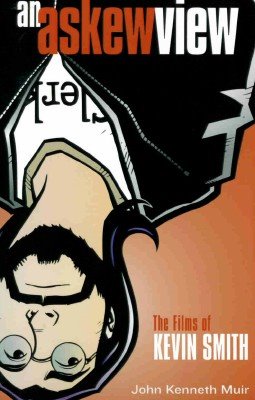
 here. She and I are on the same page about M. Night Shyamalan and Kevin Smith, but that doesn't really matter. What does matter is that she's a very cool and nice person, and I enjoyed our chat. We talked about The Descent, one of the best horror movies in years, and she had already read an advance copy of a horror novel I have in my queue, The Ruins.
Another new friend is Clay Hornik, a very thoughtful and friendly guy (and also - like BQueen - a fellow writer). We discussed matters about Doctor Who, particularly the new show, and Clay very kindly attended the showing of the first episode of my series, The House Between. He had nice feedback too, which is always better to get than negative feedback. Go visit Clay's
 Bookworm and Beyond
blog and read his feelings on the convention, and here's the money quote on The House Between:
"It does for Big Brother what Lost does for Survivor, reminiscent of both The Cube and The Prisoner, but made all the more creepy by the setting: an ordinary house, ordinary except for the void that surrounds it and the utter inescapability of the situation. The doors and windows won't open and there's nothing to see outside other than blackness.
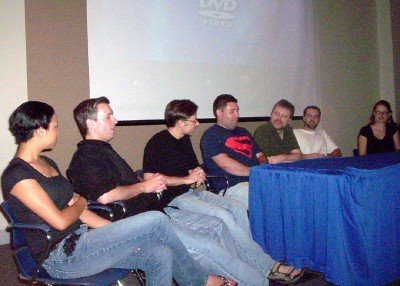
And that brings me Saturday night, and the premiere of the trailer for The House Between. Well, uh...we actually showed the rough cut of the first episode, "Arrived" instead.. We got a great reaction. The audience laughed at the right places, and to my immense amusement, one lady sitting across the aisle from me even jumped and gasped during a tense moment. How cool is that?
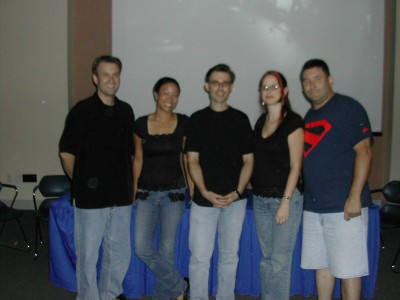
The best part of the night (and the weekend) was simply being with all my buddies. Both from the TV show and from the region itself (where I've been a speaker at cons before).
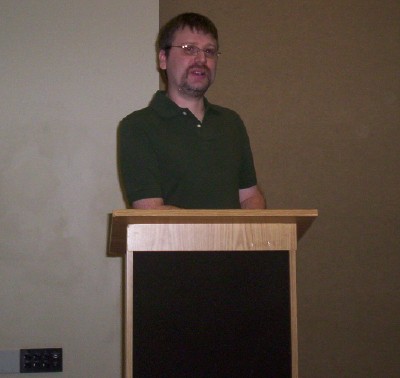 These are just the coolest, funniest, nicest people on Earth, and whenever I'm with them, I just want to soak up their presence and keep it close to my soul. Would it be weird for me to say that Kathryn and I are in love with absolutely every one of these folks? Well, weird it can be, because I just said it...
I want to thank my friends and partners in crime, Jim Blanton and Rob Floyd too, for inviting me to the con once more, and for providing me the venue to screen The House Between. You guys are the best.
Now, who wants to talk about Battlestar Galactica?