

Subscribe To JKM

 Posts
All Comments
Posts
All Comments
Showing posts with label Gerry Anderson. Show all posts
Showing posts with label Gerry Anderson. Show all posts
Monday, January 31, 2022
John on the Gerry Anderson Podcast, Part I

 award-winning creator of the web series Abnormal Fixation (2024), the audio drama Enter the House Between (2023) and author of 35 books including Horror Films FAQ (2013), Horror Films of the 1990s (2011), Horror Films of the 1980s (2007), TV Year (2007), The Rock and Roll Film Encyclopedia (2007), Mercy in Her Eyes: The Films of Mira Nair (2006),, Best in Show: The Films of Christopher Guest and Company (2004), The Unseen Force: The Films of Sam Raimi (2004), An Askew View: The Films of Kevin Smith (2002), The Encyclopedia of Superheroes on Film & Television (2004), Exploring Space:1999 (1997), An Analytical Guide to TV's Battlestar Galactica (1998), Terror Television (2001), Space:1999 - The Forsaken (2003) and Horror Films of the 1970s (2002).
Tuesday, July 30, 2019
UFO: "The Long Sleep"

In "The Long Sleep," Commander Straker (Ed Bishop) learns that a woman he accidentally hit with a car ten years earlier, Catherine Fraser (Tessa Wyatt), has awakened from her decade-long coma. He goes to visit her in a local hospital, and the young woman recounts an incredible story.
Catherine reports how she met another hippie, Tim (Christian Roberts), and they left London together. They then shared a day together -- along with some liberal recreational drug use -- at an abandoned rural farmhouse. While experiencing their drug trip, they encountered aliens, who were planting a device of some kind in the farmhouse basement.
The hippies stole a piece of the device, and the aliens sought to get it back, even as the addled youngsters failed to realize the danger to themselves, and to the planet. Tim fell to his death, after jumping from the farmhouse roof. Catherine fell unconscious only to see Tim being carried away by the aliens the following morning.
Catherine fled the scene, and then dropped the bomb piece somewhere...but all these years later, she doesn't remember where.
Straker fears that the alien weapon is a bomb, and remembers that an earthquake in Turkey from around the same time, killed 87,000 people. Would this bomb decimate England in the same fashion?
Also watching the awakened Catherine is Tim, now under alien control for the long decade. He uses dangerous alien drug to learn where Catherine dropped the bomb activation piece, and the aliens set out to complete a murderous plan a decade in the making.
In the end, the bomb is found, and exploded safely in space, but Catherine dies, leaving Straker moved at her story, and strange fate.

I will confess it right out the gate: "The Long Sleep" is one of my favorite episodes of UFO. In fact, it may have actually been the first episode of the series I ever saw, back when the Sci-Fi Channel was running the series on weekends in 1994. On my first re-watch in over a decade, I found the episode emotionally-moving, stylishly-filmed, and mind-blowing, especially in the weird climactic reveal of Catherine's rapid aging, as a result of Tim draining the life from her. It's a weird, but wholly inventive hour.
I love the story of Tim and Catherine, two kids minding their own business (circa 1970, the hippie era), tuning out of the world, and finding each other, only for things to go tragically wrong. Tim talks meaningfully about how he once desired to becomes a doctor, and in a horrible perversion of that dream, he becomes (or masquerades as) an alien-controlled "doctor." It is a horrifying outcome, but fascinating considering the counter-culture times. Tim wanted to check out of life, and give up his dream of being a physician, but then is forced, basically to become a "zombie" within the system, controlled by the aliens. Catherine, so much a part of the youth-culture, grows old before her time, losing the cherished youth and freedom, in a similar fashion. She is recruited, basically, by both the aliens and Straker in a deadly war, and the life is literally drained from her by her service.

It has always fascinated me how the hippie generation sold their souls for corner offices and stock options in the yuppie 1980's, but "The Long Sleep," sub-textually, at least, is about how youthful idealism gets drained away, bit-by-bit by a corrupt but powerful establishment/system, and freedom, idealism, and hope are lost, along with youth.
There are some people who look at hippies, no doubt, as destructive or irresponsible, but "The Long Sleep" shows them, like everyone else, eventually trapped by a system that mainstreams them into roles they don't necessarily want to play. My great friend and the script-editor for Space:1999 (1975-1977), Johnny Byrne, once termed the 1970's the "wake-up" from the "hippie dream," and "The Long Sleep" feels like a perfect visualization and exploration of that idea. The hippies thought they were charting something new, meaningful, and permanent -- a new way of living -- only to see their independence and counter-culture movement subsumed into the larger culture. Nothing changed, but the 1980's era of conspicuous consumption consumed them.

I admire the stylish touches of "The Long Sleep," from the slow-motion photography to the sepia-tone flashbacks, to the "bad trip" aspects featuring strobing red and blue lights (usually associated with the aliens.) The episode is weird and haunting (just like I prefer them). There's a surreal nightmare sense to Tim and Catherine's deaths. Tim transforms into a skeleton before our eyes, after his alien-sponsored mission is complete, and Catherine dies an old crone, since Tim was leeching life from her all along, to stay alive. These fates are horrific, and weird, and dream-like, and somehow speak to the idea of an epoch -- the hippie counter-culture -- living on borrowed time, as the mainstream culture also leeches life away from it.'
The episode also serves as a unique meditation on drug use. The recreational drugs that Tim and Catherine used impede their judgement, but make them feel free and unfettered. They find a crate of clothes and put on the clothes they want; the identities they desire. Ten years later, the drugs forced on Catherine by the establishment (human and alien) kill her. One drug, used willingly, frees her. The other, used by Tim, against her will and knowledge, ultimately kills her.

"The Long Sleep" is also, a bit surprisingly, a very strong Straker-focused episode. He feels enormous guilt about striking Catherine with his car, and embodies a father's care about her. It is clear she is not simply a means to an end for him (as she is for Paul Foster, who is very cold-blooded here). Ed cares about Catherine, and wants to explain to her why it is necessary to give her a second dose of the alien drug, to find the bomb. He knows, basically, that he is killing her, and there is a softness, gentleness in her approach to her. Perhaps her death reminds him of John, his son, who died in a hospital in "A Question of Priorities."
I have always found the last scene of "The Long Sleep" haunting. Straker walks out of the hospital alone, and stops in the courtyard, where he and Catherine once shared a visit. He pauses very briefly, and then continues on his way out, without a word, Colonel Lake (Wanda Ventham) moving to catch up with him. This is our last view of Straker in "The Long Sleep," and in the entire series, actually. He walks away, haunted by another loss in his life, and in this unending war with the aliens. He walks away, meditating on the cost of that war -- a perennial theme of UFO -- and strides into the cult-TV history books.
As most sci-fi fans know, UFO morphed into Space:1999, essentially, and for that I will always be grateful, since I some such a fan of that 1970's space opera. And yet, one cannot help wonder what a second season of this format would have brought to audiences. I feel like the last several episodes of UFO, from "Mind Bender" to "Timelash," to "The Long Sleep" took real chances, were ambitious, and were, finally, brilliantly-executed. Had the series continued for another season or two in this format, with the remarkable Ed Bishop further developing the haunted Straker, the series would be better remembered today, no doubt.
"The Long Sleep" really gets it right, and I must note, for the record that there is no Skydiver, no Moonbase, no Interceptors, no mobiles, in it. It is a story not about technology, but about people and relationships, and I feel like this was the vision of the future that UFO always wanted to enunciate, in tragic tales such as "A Question of Priorities," or "Confetti Check A-OK." Another season might have seen the writers, directors, and performers really make that vision a consistent reality, instead of the scattershot one we see develop in fits and starts in this single season.
Despite its large cast, the main takeaway from UFO is Ed Straker, and Bishop's focused, consistent , brilliant performance. He created in Straker a man who gave up everything in a time of war, and was haunted by his choices. I would have loved, circa 1996 or so, to see a movie starring Bishop as an older Straker, reflecting on the choices he made. Would he have been alone? Lost? Would he have been appreciated, or a name lost to history, his suffering solitary forgotten?
With that thought, we leave this retrospective of UFO, a truly memorable entry in the cult-TV Valhalla. Next week, I begin a retrospective of The Evil Touch, a low-budget, Australian horror anthology from roughly the same era, the early 1970's.
award-winning creator of the web series Abnormal Fixation (2024), the audio drama Enter the House Between (2023) and author of 35 books including Horror Films FAQ (2013), Horror Films of the 1990s (2011), Horror Films of the 1980s (2007), TV Year (2007), The Rock and Roll Film Encyclopedia (2007), Mercy in Her Eyes: The Films of Mira Nair (2006),, Best in Show: The Films of Christopher Guest and Company (2004), The Unseen Force: The Films of Sam Raimi (2004), An Askew View: The Films of Kevin Smith (2002), The Encyclopedia of Superheroes on Film & Television (2004), Exploring Space:1999 (1997), An Analytical Guide to TV's Battlestar Galactica (1998), Terror Television (2001), Space:1999 - The Forsaken (2003) and Horror Films of the 1970s (2002).
Tuesday, July 23, 2019
UFO: "E.S.P."

In "E.S.P.," a tortured man with extra sensory perception, John Croxley (John Stratton) encounters a U.F.O. His wife (Deborah Stanford) is killed when an alien ship crashes into his house, and aliens proceed to take control of his vulnerable mind.
Baiting Straker (Ed Bishop), Croxley writes a movie script about SHADO and sends it to Harlington-Straker Studios. The script contains references to every facet of Earth's defenses, and the men and women who defend the planet. Straker and Freeman (George Sewell) go to the wreckage of Croxley's house to confront him, only to find it a trap, with him waiting, ready to murder them.
Colonel Foster (Michael Billington) shows up at the last minute to save his cohorts, even as the alien-controlled Croxley fights to hold onto his mind.

"E.S.P." is another episode of Gerry Anderson's UFO in which an alien-controlled human attempts to assassinate Straker, a plot-line used in the appropriately-named "Kill Straker" and also in "The Man Who Came Back."
In-universe, this means that the aliens have recognized Straker, not Earth's technology, as the greatest barrier to their success. Out-of-universe, it means viewers get another overly familiar story.
The most intriguing facet of this episode is the script that Croxley writes about SHADO, and which focuses on the organization's installations and personnel. Had he really wanted to mess with Straker, Croxley might have sent it to a competing studio, rather than Straker's. Imagine Ed learning that a "UFO" film was in production at a rival studio, "outing" every aspect of his organization. That would have been a real security breach. As it arNSA, the script is just a trap to lure Straker to Croxley's ruined home.
The alien plan doesn't seem terribly thought out, but "E.S.P." works hard to generate empathy both for Croxley and the aliens. Croxley's extra-sensory perception is driving him to "mental illness," and then he loses his wife, his only foothold on normality. Straker's last thought about Croxley, that -- in the end -- Croxley let Foster kill him so as not to be a tool for the aliens -- is affecting, even if we don't quite understand how or why Straker arrives at that particular conclusion.

As for the aliens, they speak through Croxley and plead with Straker, noting that they are fighting "for existence" and that they "must come to Earth to survive." In another kind of sci-fi series, this admission might be the opening for a dialogue between Earth and the aliens. A peace treaty could be arranged, with the aliens trading their miraculous technology for access to Earth. Of course, they couldn't harvest bodies, but this episode suggests, in some small way, that the aliens want, at least, to talk. Of course, it is the aliens who began the relationship through abduction and murder, so it is understandable that Straker is implacable. Still, this (and other episodes) establish that the aliens have very few choices left, in the war to survive.

This episode is from the early batch of episodes (with Sewell as Freeman), and I confess that I generally prefer the latter batch of episodes, which are heavier on action, and feature more mind-bending plots. There is nothing in particular wrong with "E.S.P.," yet it is never terribly original, or even thought-provoking.
Next week, the last episode of U.F.O., the stylish "The Long Sleep."
award-winning creator of the web series Abnormal Fixation (2024), the audio drama Enter the House Between (2023) and author of 35 books including Horror Films FAQ (2013), Horror Films of the 1990s (2011), Horror Films of the 1980s (2007), TV Year (2007), The Rock and Roll Film Encyclopedia (2007), Mercy in Her Eyes: The Films of Mira Nair (2006),, Best in Show: The Films of Christopher Guest and Company (2004), The Unseen Force: The Films of Sam Raimi (2004), An Askew View: The Films of Kevin Smith (2002), The Encyclopedia of Superheroes on Film & Television (2004), Exploring Space:1999 (1997), An Analytical Guide to TV's Battlestar Galactica (1998), Terror Television (2001), Space:1999 - The Forsaken (2003) and Horror Films of the 1970s (2002).
Tuesday, July 16, 2019
UFO: "Kill Straker!"

A lunar module with Colonel Foster (Michael Billington) and an astronaut named Craig (David Sumner) aboard experiences something strange upon re-entry. A weird alien light and vocal message orders them to "Kill Straker!"
Upon return to Moonbase, Craig attempts to kill Straker while he sleeps, and then destroy the entire installation. Fortunately he is stopped in time.
Meanwhile, Foster is insubordinate to Straker, and even sides with General Henderson against him on a matter of SHADO appropriations.
Then, Foster attempts to murder Straker. Fortunately, it is realized that Foster is acting upon a "deep subliminal impulse" in his "subconscious." The alien programming is countered, but Foster could be relieved of his duties because he will never again be fully trusted.
Straker engineers a plan to prove that Foster is back to himself, however.

"Kill Straker!" does not hold up as one of the better episodes of UFO, in part because it is obvious to anyone who has watched the series even casually that Foster is not himself. Since it is obvious to viewers that something is grievously wrong with Foster, the same fact should be obvious to Straker, Alec, Ellis, and the others who work closely with him on a day-to-day basis.
Foster is insubordinate, rude, aggressive and mean-spirited towards Straker, and this is a total turnaround from what is seen in other episodes. Straker went to great lengths to defend Foster from charges of treason, for example, in the episode "Court Martial." There is just no way that Foster would suddenly turn on the commander unless he had been compromised. It makes no sense, given what we know of the characters. It seems to me that "alien brainwashing" should be on the table as an explanation immediately, especially given the acts of Paul's co-pilot, Craig.

Bottom line: It takes much too long for Straker and the others to realize the truth about Foster in "Kill Straker!" and that fact means that the episode doesn't quite hold up.
Not that there aren't some fine moments here and there. The confrontation in Moonbase control between Straker and Foster is powerful. It is Foster's "superior physique" vs. Straker's "superior will-power" in a control room where the atmosphere is slowly bleeding away.
The climax, with Straker attempting to kill Foster (to see if Foster will reciprocate the murderous behavior) is also pretty powerful. Straker attempts to goad Foster into striking back, but a terrified Foster doesn't take the bait. This character moment, unlike many in the episode, seems true to the characters. Straker doesn't resort to half-measures when he needs to prove that Foster is still a man he can trust.

It strikes me, while watching "Kill Straker!" that UFO predicted, in many ways, the post-9/11 paranoia of American culture. In virtually every episode of this short-lived series ("The Man Who Came Back," "The Psychobombs," "Kill Straker," "The Cat with 10 Lives," etc.), a "normal" and trusted person is activated as a sleeper agent for the aliens.
It's a virtual blueprint for asymmetric warfare in the 21st century. All due credit should be given for a forward-looking series, and yet, by the same token, the same old plot has grown tiresome after nearly a whole season of look-a-like plot elements.
Next week: "E.S.P."
award-winning creator of the web series Abnormal Fixation (2024), the audio drama Enter the House Between (2023) and author of 35 books including Horror Films FAQ (2013), Horror Films of the 1990s (2011), Horror Films of the 1980s (2007), TV Year (2007), The Rock and Roll Film Encyclopedia (2007), Mercy in Her Eyes: The Films of Mira Nair (2006),, Best in Show: The Films of Christopher Guest and Company (2004), The Unseen Force: The Films of Sam Raimi (2004), An Askew View: The Films of Kevin Smith (2002), The Encyclopedia of Superheroes on Film & Television (2004), Exploring Space:1999 (1997), An Analytical Guide to TV's Battlestar Galactica (1998), Terror Television (2001), Space:1999 - The Forsaken (2003) and Horror Films of the 1970s (2002).
Tuesday, July 09, 2019
UFO: "The Man Who Came Back"

In "The Man Who Came Back," A long-serving SHADO astronaut, Craig Collins (Darren Nesbitt) is presumed dead in his space capsule after a fire develops. Meanwhile, S.I.D. (Space Intruder Detector) is attacked by UFOs, and badly damaged.
Eight weeks later, however, Collins is mysteriously discovered alive and well, and returns to work. He is needed to help repair S.I.D. since he and Straker (Ed Bishop) were the astronauts who put the satellite in orbit in the first place, years earlier.
Collins, however, becomes the target of suspicion when he begins to act strangely. He is widely jealous of Paul Foster (Michael Billington), who has taken up with Colonel Lake (Wanda Ventham) in his absence.
He also is competitive with his brilliant mission commander, Grey (Gary Raymond). When Foster is injured working out with Collins, and Grey is nearly murdered when the air gauge in his moon base quarters malfunction, Straker becomes Collins' partner on the S.I.D. mission. Grey warns Straker not to go, but Straker is reluctant to believe that one of his "closest friends" could be an alien-controlled assassin.
Unfortunately, Collins is indeed under alien control. As Grey suspected, the aliens have "burned out the personality centers" of the astronaut's "brain" and are controlling him via radio waves. Collins attacks Straker during a space walk to S.I.D. but Straker manages to rip out his air hose, and kill the astronaut in time.

"The Man Who Came Back" is a tense and successful episode of Gerry and Sylvia Anderson's UFO. The episode's value is lifted primarily via the delightful performance of Darren Nesbitt as Craig Collins. Nesbitt makes Collins an easy-to-hate yet charismatic character, one who routinely shows disrespect to friends, associates, and lovers alike.
However, this trademark disdain just seems to be his personality, not "alien control," so there is some doubt about whether he is a actually an alien "sleeper agent" waiting to be activated, at least for much of the hour. (Until we see him willfully sabotage Grey's air supply, anyway). The scene in which he "accidentally" injures Paul with a heavy bar bell is also a terrific moment.

The most intriguing aspect of " The Man Who Came Back," however, is not the familiar human-subverted-by-aliens plot-line, but rather the depiction of romantic (or just plain sexual?) relationships in SHADO.
Here, Collins is upset to learn that Colonel Lake has moved past her relationship with him to one with Paul Foster.
So, everyone just seems to be fucking...everyone. And mostly without judgment or scorn. It is just taken as fact that (at least on Moonbase), the crew people pass the time by having sex with one another. It's 1960's free love or promiscuity, updated for the "futuristic" timeline of the series' 1980's setting.

Unless I am mistaken, no romantic relationship between Foster and Lake has been featured in other episodes, yet here they are depicted as lovers.
I don't object.
It's just weird the way the characters go in and out of relationships, and those relationships are not referred to ever again in the series. I suppose in this "future" human-kind has gotten over hang-ups such as jealousy, or a devotion to monogamy.

In terms of draw-backs, this episode doesn't do much for Straker's reputation as a strong commanding officer. He rationalizes convincing evidence away, regarding his "friend," Collins, and puts his life (and therefore the success of the SID mission) in danger, by his refusal to listen to Grey.
Straker is often portrayed in the series as a near emotionless machine, one with a clockwork mind and ruthless logic. It is difficult to believe he would let himself get into the life-and-death struggle in space that we see depicted in this episode's climax, without a back-up plan. Like "Close Up," this episode actually makes Straker look a bit foolish.
Finally, this episode features some stock footage of the rocket launch from the 1969 Anderson live-action science fiction film, Journey to the Far Side of the Sun. "The Man Who Came Back" also features a dazzling opening sequence, an alien assault on S.I.D. that sends the satellite spinning out of its orbit. Even today, these effects hold up very well.
Next week: "Kill Straker!"
award-winning creator of the web series Abnormal Fixation (2024), the audio drama Enter the House Between (2023) and author of 35 books including Horror Films FAQ (2013), Horror Films of the 1990s (2011), Horror Films of the 1980s (2007), TV Year (2007), The Rock and Roll Film Encyclopedia (2007), Mercy in Her Eyes: The Films of Mira Nair (2006),, Best in Show: The Films of Christopher Guest and Company (2004), The Unseen Force: The Films of Sam Raimi (2004), An Askew View: The Films of Kevin Smith (2002), The Encyclopedia of Superheroes on Film & Television (2004), Exploring Space:1999 (1997), An Analytical Guide to TV's Battlestar Galactica (1998), Terror Television (2001), Space:1999 - The Forsaken (2003) and Horror Films of the 1970s (2002).
Tuesday, July 02, 2019
UFO: "Ordeal"

In "Ordeal," Colonel Paul Foster (Michael Billington) finishes up a tour on Skydiver and then heads home, where he parties (drinks...) heavily before reporting to a SHADO health spa in England.
There, he gets locked in a sauna. Soon, the aliens attack the spa, murdering the medical staff and SHADO officers, and capturing Paul. They take him aboard their craft, and force him to breathe liquid for the long interstellar journey to their world.
Skydiver's Captain Waterman refuses to shoot down the UFO carrying Paul away from Earth, but Moonbase scrambles interceptors to stop it in space. Foster's UFO is shot down, and explodes on the lunar surface, but he survives the inferno. SHADO's doctors attempt to revive him, and free him from the liquid atmosphere of his helmet. It goes poorly, however, and...
...Foster awakens, having passed out in the sauna in the health spa.

"Ordeal" is widely regarded as the worst episode of UFO. It has earned this reputation, largely, on the basis of its final act twist. That twist, of course, is that Paul Foster dreams the entire adventure, and that the abduction and ensuing action are not real...just a sauna-induced fantasy/nightmare.
It is true that this ending is underwhelming (and a common narrative cheat in Anderson productions -- see Space:1999 "A Matter of Life and Death" and "War Games.") However, on the other hand, the episode is visually dynamic, and one of the few stories to take on (other than "Mindbender") the perspective of a single character.
In this instance, the character is Paul Foster.

In terms of visual style, "Ordeal" plays, at first, in psychedelic fashion. Foster attends a wild party (wearing a truly hideous gold blouse) and drinks and dances to excess. The camera literally goes wobbly, as if under the influence itself, as he spends all night drinking. Accompanied by "Get Back" on the soundtrack, the party sequence depicts a night of substance-abuse, hedonism and debauchery.
On the second front, the episode, overall plays like Foster's "bad trip," and at times, adopts his point-of-view during it. When Paul is taken to Moonbase for instance, we see through his eyes (and through the alien green fluid) as Ellis and the others attempt to restore him to breathing normal air. During the abduction, we see through his "foggy" vision at the alien who carries him away, too. They are blurred and slowed, as if the moment is not quite real.

The most disturbing moment of the episode occurs when Ellis attempts to free Foster from the alien helmet and it begins jetting out torrents of the green liquid. We see Foster choking and sputtering out the fluid as he begins to drown. Fortunately, it is all a dream.
But, dig a little deeper, and the episode "Ordeal" is surely a cautionary tale about excess. Foster begins the journey by drinking heavily and forgoing sleep, but by the end is, actually, paying the piper for his behavior, vomiting and retching from the aftermath of the experience. The visions he experiences while under the influence, simultaneously, go from relaxing to nightmarish. It is indeed, a "bad trip," and this idea would have a lot of currency among the youth of Great Britain (and America for that matter) circa 1970-1971.

So, if one chooses to look at "Ordeal" as an expression of Paul's hedonistic life-style, and not a traditional UFO adventure, maybe it isn't such a complete loss after all. It is a visual representation of what it feels like to drink, party, forgo sleep, and then see the pleasant buzz turn dark. Kinda neat, or ambitious, for a one-off episode.
The obvious drawback in gazing at "Ordeal" in this fashion involves some specific moments, however. We see a number of scenes of Straker and Alec at SHADO HQ, for example, talking about how to get Paul back safely, or destroy the craft he is in, so he doesn't suffer a fate worse than death.
These scenes must also be a product of Paul's imagination, if we are to assume the episode represents his "dream," yet they are not performed or filmed in such a way that they seem odd, or off, or like the product of a subjective hallucination or drug/alcohol-fueled delusion. On the contrary, they seem like perfectly normal scenes we've seen a dozen times with the aforementioned characters.
Although it would have sacrificed the surprise ending, I submit it that it would have been better to shoot these sequences in subjective fashion as well, so the episode is all of a piece, stylistically. As it stands, "Ordeal" doesn't quite hold together.
It's not actually the final twist that is so bad, it's the fact that the many scenes at SHADO feel like cheats, because Paul would obviously not be privy to these moments, or, in his compromised state, would visualize them in a way that should seem, well, abnormal.
Still, "Ordeal" is well-filmed, and a nice showcase for Michael Billington, who rolls with the punches here. It's nice that Foster is not strait-jacketed into being a perfect little marionette, always playing the hero, and always doing what is right and proper. This episode reveals that he enjoys wine, women and song a little too much, perhaps.
Next week: "The Man Who Came Back."
award-winning creator of the web series Abnormal Fixation (2024), the audio drama Enter the House Between (2023) and author of 35 books including Horror Films FAQ (2013), Horror Films of the 1990s (2011), Horror Films of the 1980s (2007), TV Year (2007), The Rock and Roll Film Encyclopedia (2007), Mercy in Her Eyes: The Films of Mira Nair (2006),, Best in Show: The Films of Christopher Guest and Company (2004), The Unseen Force: The Films of Sam Raimi (2004), An Askew View: The Films of Kevin Smith (2002), The Encyclopedia of Superheroes on Film & Television (2004), Exploring Space:1999 (1997), An Analytical Guide to TV's Battlestar Galactica (1998), Terror Television (2001), Space:1999 - The Forsaken (2003) and Horror Films of the 1970s (2002).
Tuesday, June 25, 2019
UFO: "The Responsibility Seat"

In "The Responsibility Seat," Straker (Ed Bishop) reluctantly agrees to an interview -- as a movie studio head -- with reporter Josephine Fraser (Jane Merrow). The interview goes smoothly, but she leaves her microphone-equipped purse in his office, and it records a SHADO intercom summons, identifying him as "Commander Straker."
Straker pursues Fraser to recover the tape before she can become a security threat, leaving Alec Freeman (George Sewell) in charge of SHADO. In Straker's absence, Alec has a crisis of his own to solve. A Russian lunar rover is, for some reason, on a collision course with Moonbase.
Straker and Jo get to know each other, but Straker soon learns that she is a criminal, one who will use blackmail and extortion to get ahead in what she deems to be a "man's world."

Depending on one's point of view, "The Responsibility Seat" is either sexist itself, or a commentary on sexism. I prefer to see it as the latter.
The world of UFO posits a future in which racism has ended, but sexism, apparently, has not. In this "man's world," Jo Fraser has found difficulty succeeding, professionally and personally, according to the rules. So, she has broken the rules...and the law, to overcome this injustice.
It is clear that Straker is attracted to Jo, and they nearly have sex in this episode. One suspects he is attracted to her not only physically, but in terms of her personality. Jo is intelligent and strong, and has found a way to succeed in the (unfair) world on her wits.

This is one of the few episodes of UFO that features a romantic interest for Straker, so Jo's unique attributes as a person who functions outside of law and order, and outside society, is fascinating. Is Straker attracted to her because she is so unlike him? She is strong, like he is, but separate from any hierarchy or organization. Is he drawn to her because he admires, in some way, her freedom and independence? Her ability to behave and do as she sees fit, free from the heavy burden of "responsibility" that he, by contrast, carries?
Since the episode is titled "The Responsibility Seat," this is certainly a possibility to consider. Straker wants to escape the so-called responsibility seat, and Jo is the perfect example of someone else who has done so. She goes from job to job, payday to payday, with no sense of responsibility or accountability for her actions.
Of course, the episode is also termed "The Responsibility Seat," because Alec is asked to fill in for Straker while he attempts to plug any possible security leak. And, in his role as commander of SHADO, Alec does face a crisis. What's so intriguing about the episode's depiction of this crisis is that Alec is the one deemed to be carrying the heavy burden of responsibility, yet it is Paul Foster (Michael Billington) actually on the line. He must get aboard a runaway Russian rig, outmaneuver two husky pilots (who are basically drunk and disorderly), and turn off the rig's power before it strikes Moonbase.

Yet Alec is the one feeling the heat?
This is an administrator's view of responsibility and pressure, for certain. He is thousands of miles from the actual action, but knows the buck stops with him. But Foster is the one who could die, of course. All Alec really does is have to report failure or success to his higher-ups. What's at stake for him? A demotion?
Finally, the sexist reading of this episode is that Straker falls for an attractive con-woman, one who uses her looks to get ahead, illicitly. I think my reading is preferable, however, because it suggests that Jo Fraser is fighting for more than merely herself, but rather against an unfair system. This reading also improves the characterization of Straker. He's not just a man running after an attractive woman and hoping to score with her, but a man looking for an escape from "responsibility" with a woman whom he admires, and is almost uncontrollably drawn to.
If one looks at "The Responsibility Seat" in this fashion, it fits in well as part of the tragedy of Ed Straker. He is a man who has lost his family, and his personal life, for his role as commander of SHADO, defender of the Earth. In this story, he finds a woman he could truly love, and yet, again, must give her up, in this case because they are from two such different worlds.
If one looks at "The Responsibility Seat" in this fashion, it fits in well as part of the tragedy of Ed Straker. He is a man who has lost his family, and his personal life, for his role as commander of SHADO, defender of the Earth. In this story, he finds a woman he could truly love, and yet, again, must give her up, in this case because they are from two such different worlds.
Next week: "Ordeal."
award-winning creator of the web series Abnormal Fixation (2024), the audio drama Enter the House Between (2023) and author of 35 books including Horror Films FAQ (2013), Horror Films of the 1990s (2011), Horror Films of the 1980s (2007), TV Year (2007), The Rock and Roll Film Encyclopedia (2007), Mercy in Her Eyes: The Films of Mira Nair (2006),, Best in Show: The Films of Christopher Guest and Company (2004), The Unseen Force: The Films of Sam Raimi (2004), An Askew View: The Films of Kevin Smith (2002), The Encyclopedia of Superheroes on Film & Television (2004), Exploring Space:1999 (1997), An Analytical Guide to TV's Battlestar Galactica (1998), Terror Television (2001), Space:1999 - The Forsaken (2003) and Horror Films of the 1970s (2002).
Tuesday, June 18, 2019
UFO: "The Sound of Silence"

In "The Sound of Silence," A UFO trails a NASA probe back to Earth, and puts down in a lake in the English countryside. Soon, an alien stalks the nearby grounds, tracking the movements of a local estate owner and famous equestrian show jumper, Russell Stone (Michael Jayston) and his sister, Anne (Susan Jameson).
After a local tramp, Ben Culley (Nigel Gregory) and his dog are found murdered, and Russell disappears, Commander Straker (Ed Bishop) sends Colonel Foster (Michael Billington) to investigate the situation.
There is a pitched battle on the lake, as SHADO Mobiles destroy the UFO. A strange tube is found among the wreckage, and brought back to HQ. Straker and Foster fear it is a bomb, set to detonate, but the truth is something stranger and more frightening. They have recovered Russell Stone, who is sealed inside the canister, having been prepared to be sent to the alien home world...

"The Sound of Silence" is another underachieving episode of this classic and generally high-quality series. This segment focuses on the Stone family, characters who the audience has no vested interest in. Worse, Russell Stone -- whose life is on the line in the drama's last act -- is a cold, unsympathetic person. He nearly tramples Ben Culley, without sympathy, and is not at all a warm personality. He seems as cold and distant as the aliens who capture him. Yet the success of the episode's third act depends on audience identification with him, as an alien abductee.
As was the case in "Destruction," the previous episode I reviewed here on the blog, UFO's large cast seems mostly like an afterthought here, far away from and only minimally involved in the action at hand. Straker is sidelined or the most part.
By contrast, the story might have worked effectively as a horror tale, with the alien creeping around the woods, abducting and killing people and animals, but the pacing is flaccid, and the episode has no sense of style beyond the freeze-frames during the opening credits. The tramp, Culley, meanwhile, is referred to as a hippie, and the episode also features some-dated jokes about Native American people.

There are a few highlights in "The Sound of Silence,: although even they are marred, to some extent by other factors. The battle between the Mobiles on the shore and the UFO rising from the lake is incredibly impressive. It is literally a show-stopper. The visual highlight of the story loses a bit, however, from Billington's disinterested performance. Foster is ostensibly leading the Mobile attack, but is only seen in cutaway shots and doesn't respond with much urgency, even as explosions and laser beams dot his immediate area. In short, the live-action performance doesn't match the intensity level of the miniature work.
The final canister opening scene at Shado HQ is indeed tense, and well-orchestrated, by comparison, and yet still feels like a missed opportunity. We learn that Russell is "all packed up, ready for shipment," but beyond that tantalizing detail we learn little of why the aliens warehouse humans in this fashion. Is it so their organs survive long distances? Light speed travel? Does travel in this manner preserve life? This plot-strand seems like a tailor-made opportunity to provide a few more bread-crumbs of knowledge about the aliens, but then the episode doesn't really deliver.

Finally, again, there's a stalker-y aspect to Paul Foster's behavior in "The Sound of Silence." In "The Dalotek Affair," we saw him romance a scientist he mete on the moon. She then was administered the amnesia drug and forgot all about him. Later, Paul found her on Earth, and began a romantic dalliance with her all over again. He does the same thing with Anne Stone in "The Sound of Silence." He returns to her estate after she has been dosed with amnesia, and hits her up for thinly veiled "riding lessons."
Once, this kind of thing is forgivable, perhaps. But twice? Does Paul make a habit of stalking women who have no previous knowledge of him, but whom he has met and interacted with? It feels a bit creepy. I know he is the series' resident horn dog, and everything, but in these particular relationships the women are on unequal terrain. He knows all about them, and they know nothing about him. Why is he so insecure that he has dalliances with amnesiac women, where he always holds all the power? It's weird.
Next week: "The Responsibility Seat."
award-winning creator of the web series Abnormal Fixation (2024), the audio drama Enter the House Between (2023) and author of 35 books including Horror Films FAQ (2013), Horror Films of the 1990s (2011), Horror Films of the 1980s (2007), TV Year (2007), The Rock and Roll Film Encyclopedia (2007), Mercy in Her Eyes: The Films of Mira Nair (2006),, Best in Show: The Films of Christopher Guest and Company (2004), The Unseen Force: The Films of Sam Raimi (2004), An Askew View: The Films of Kevin Smith (2002), The Encyclopedia of Superheroes on Film & Television (2004), Exploring Space:1999 (1997), An Analytical Guide to TV's Battlestar Galactica (1998), Terror Television (2001), Space:1999 - The Forsaken (2003) and Horror Films of the 1970s (2002).
Tuesday, June 04, 2019
UFO: "Destruction"

In "Destruction," A UFO attacks a royal Navy destroyer in the South Atlantic, and is shot-down by missiles. Commander Straker (Ed Bishop) is curious about the reasons behind the attack, and asks Paul Foster (Michael Billington) to glean information from Admiral Sheringham's (Edwin Richfield') attractive secretary, Sarah Bonsanquet (Stephanie Beacham) about the encounter.
Straker and Colonel Lake (Wanda Ventham) soon discover that Sarah is secretly using a special refracting telescope with a "radio wave jammer" to help the aliens get through Interceptor defenses, perhaps because her father, a former astronaut, has been abducted by them.
Regardless, the aliens are bound and determined to get through to the destroyer, which is dumping a toxic nerve gas into a deep trench in the ocean. Should the nerve gas escape its containers, all of human life on Earth would be wiped out.

"Destruction" is a very weak episode of UFO, for numerous reasons, and therefore a crushing disappointment. Several episodes of the series, from "The Cat with Ten Lives" to "Flight Path" deal with the idea of a human pressured by endangered loved ones, into helping the aliens. This is at least the third time that narrative has been used in one season.
On one hand, the idea of compromised individuals becoming turncoats fits in with the overall scheme of the "human cost" of the war between planets. On the other hand, even with Straker's final worry about how many humans are compromised in this war, the story doesn't feel fresh. Uniquely, however, Sarah pays no consequences for her actions. In the past, turncoats such as Roper pay with their lives, and get some form of redemption. Sarah gets no punishment, and no redemption.

Furthermore, the alien plot in "Destruction" doesn't really make much sense, given what we know of the enemy's motives. We know from previous episodes that the aliens harvest human bodies, and, because they are non-corporeal, need those human bodies (or feline ones, as the case may be), to exist, to pilot craft, and more. So why on Earth would the aliens attempt to utilize a nerve gas that would destroy all life on Earth? Doing so would rob them of the very resource they most need to harvest: us! So the narrative does not stand up to any kind of scrutiny.
These are significant problems. In terms of characters and social context, "Destruction" isn't very good, either. We''re back in sexist-ville here, with Straker basically ordering Foster to romance a young woman, Sarah, to get information from her boss. I wonder where in the SHADO manual this is described as an acceptable tactic. It's ugly for two reasons.
First, the strategy suggests that a woman will sacrifice top secret information, and loyalty to her superiors, for a handsome face and nice bod. Secondly, it reduces the character of Foster -- a pilot, and, at times, a rather cunning strategist -- to nothing more than a handsome face and nice bod. Basically, "Destruction" transmit the notion that Paul's looks, or "charms" are more important than his abilities, and that idea doesn't do the character any favors.

Finally, "Destruction" may just must be the dullest episode of UFO ever made. The final alien attack on the destroyer goes on and on, seemingly endlessly, with not a single member of the primary cast involved in the events to make it meaningful or vital. Skydiver shows up for the party late, but Straker, Foster, and Lake are never on-screen to comment from HQ, or otherwise show their engagement in the crisis. It's a terrible, un-involving denouement.
I suppose all episodes of this series can't be stylishly compelling or mind-blowing (think "Timelash," "Mindbender," or "The Cat with Ten Lives,") but "Destruction" is a really pedestrian, poorly-conceived, and poorly-executed installment of this fifty year old cult series.
In two weeks: "The Sound of Silence."
award-winning creator of the web series Abnormal Fixation (2024), the audio drama Enter the House Between (2023) and author of 35 books including Horror Films FAQ (2013), Horror Films of the 1990s (2011), Horror Films of the 1980s (2007), TV Year (2007), The Rock and Roll Film Encyclopedia (2007), Mercy in Her Eyes: The Films of Mira Nair (2006),, Best in Show: The Films of Christopher Guest and Company (2004), The Unseen Force: The Films of Sam Raimi (2004), An Askew View: The Films of Kevin Smith (2002), The Encyclopedia of Superheroes on Film & Television (2004), Exploring Space:1999 (1997), An Analytical Guide to TV's Battlestar Galactica (1998), Terror Television (2001), Space:1999 - The Forsaken (2003) and Horror Films of the 1970s (2002).
Tuesday, May 21, 2019
UFO: "The Cat with Ten Lives"

In "The Cat with Ten Lives," three UFOs approach the moon, but retreat once interceptors approach. Three more UFOs appear in short order, and the first three are pinpointed as decoys. Moonbase survives an attack with only ground tanks as defense.
Meanwhile, an interceptor pilot, James Regan (Alexis Kanner) returns to Earth and visits with his wife, Jean (Geraldine Moffatt). After an evening playing at a seance with friends, the couple returns home, and on the way, encounter a cat in the road. After rescuing it, the Regans are abducted by aliens. Jean is taken, but James and the cat are returned, apparently unharmed.
At SHADO, Dr. Jackson (Vladek Sheybal) has developed a new theory about the aliens. An autopsy of a recovered alien pilot reveals that it has a fully human brain. In other words, the aliens don't merely harvest human parts, they seem to be incorporeal, possessing humans and other life forms.
This means that the cat is controlling Regan. He returns to the moon, unaware that he is being controlled, and set-up to to launch a kamikaze style attack on the base. At the last minute, however, the controlling cat is stopped, and Regan comes to his senses. He crashes his interceptor (and is killed), but moonbase survives...

"The Cat with Ten Lives" is a terrific episode of UFO for two reasons, primarily. In the first case, the episode finally provides some additional information about the aliens, and their mysterious nature. And in the second case, the episode is one of the most stylishly presented, in terms of mise-en-scene. The episode is gloriously filmed.
In "The Cat with Ten Lives," SHADO learns that the mysterious alien invaders are "not humanoid at all," and that they "just use our bodies," and our altered brains, by removing emotion and creativity from the human equation. Dr. Jackson likens the aliens to "living computers" and the idea is that beings on Earth -- humans, felines, or otherwise -- can be lobotomized, essentially, to serve as receptacles or containers for alien life forms. The question the episode does not answer is, simply, why do non-corporeal aliens desire to be corporeal, to take our bodies? It would have been fascinating to learn that the answer to that question. This is another reason I wish the series had gone on for several more seasons. There was still so much about the aliens to explore.

Beyond the idea of non-corporeal aliens taking our form and walking among us, "The Cat with Ten Lives" is beautifully filmed. And by that, I don't just mean it is pretty. Rather, the choice of camera angle augments and reflects the content of the story-line.
For instance, during the Ouija seance/game at the Thompsons' house, the camera adopts an overhead shot that reveals the group's vulnerability, as well as the lay-out of the board. As the danger increases, the camera begins to rotate and spin, until Regan is upside down in the frame, a visual suggestion that his jeopardy is the greatest. He is vulnerable to alien control, and this shot establishes that fact in a way we visually understand.
The episode's alien abduction scene is also incredibly effective. There are P.O.V. shots here of the alien boots, as we watch -- from Regan's, perspective -- as he is dragged from his car, lifted by the aliens, and carried across the threshold of their landed ship. We have heard so many tales of alien abduction since this series aired in 1970, but one has to wonder if this evocative scene -- involving an abductee at night, alone on a forest road, taken by aliens -- informed some beliefs/stories on the subject over the decades. It's a textbook "alien abduction" scene, and one of the first in television history.

There are questions to be raised, of course, about this episode's narrative.
First, it takes an awfully long time for anyone to suspect that the cat is dangerous. Yet we have never before seen a cat in SHADO HQ. Its appearance there should have raised some alarms for Straker and the others, sooner.
Secondly, Straker makes an unequivocally bad call in this episode. He puts a man who has just lost his wife to alien abduction in the driver's seat of an Interceptor (escorting the all-important Venus Probe). Why on Earth would he do that? The pilot, Regan, is traumatized, and clearly not fit for duty. Sadly, Straker has no good reason for this bad call, save for contrivances of the plot. Usually, the writing isn't this obvious.

Finally, though the special effects are gorgeously vetted, the episode's climactic sequence, with Regan dying to save SHADO, seems reminiscent of earlier episodes, such as "Flight Path." Basically, a compromised SHADO officer/astronaut, proves loyal in the end, and pays for his past betrayal with his life. And everything ends with an explosion on the moon.
Next week: "Destruction."
award-winning creator of the web series Abnormal Fixation (2024), the audio drama Enter the House Between (2023) and author of 35 books including Horror Films FAQ (2013), Horror Films of the 1990s (2011), Horror Films of the 1980s (2007), TV Year (2007), The Rock and Roll Film Encyclopedia (2007), Mercy in Her Eyes: The Films of Mira Nair (2006),, Best in Show: The Films of Christopher Guest and Company (2004), The Unseen Force: The Films of Sam Raimi (2004), An Askew View: The Films of Kevin Smith (2002), The Encyclopedia of Superheroes on Film & Television (2004), Exploring Space:1999 (1997), An Analytical Guide to TV's Battlestar Galactica (1998), Terror Television (2001), Space:1999 - The Forsaken (2003) and Horror Films of the 1970s (2002).
Tuesday, May 14, 2019
UFO: "Mindbender"

By its very nature, science fiction television is a milieu for diligently exploring other realities.
Those "other" realities could include a starship exploring alien worlds in the 23rd century, or a mysterious island in the Pacific, where plane crash survivors toil.
Yet, over the years, some notable installments of science fiction TV series have also occasionally crossed paths with our kitchen-sink reality, right here.
In this type of story, the fourth wall gets shattered...and shattered good.
The imaginary world of the characters suddenly overlaps with the real world of the filmmaker or the writer. These mind-blowing tales thus ask (and demand...) that the regular audience suddenly view the familiar "universe" or canon of a sci-fi series in a different and often challenging way. In other words, viewers are asked to recognize the artifice of storytelling, or even of movie-making.
One of the earliest examples of this genre trope came in 1960, in the first season of Rod Serling's anthology, The Twilight Zone.
In the episode "A World of Difference" a business executive, Arthur Curtis (Howard Duff) discovers he's not really in his office taking business calls...he's on a movie set. He's an actor playing a part. Reality has shifted like sand beneath his feet. His memories of a wife -- of a life itself -- are nothing more than manifestations of a writer's imagination; of a script.
In the episode "A World of Difference" a business executive, Arthur Curtis (Howard Duff) discovers he's not really in his office taking business calls...he's on a movie set. He's an actor playing a part. Reality has shifted like sand beneath his feet. His memories of a wife -- of a life itself -- are nothing more than manifestations of a writer's imagination; of a script.
Rod Serling returned to the same theme in Night Gallery, in November of 1971. In "Midnight Never Ends," a hitchhiking soldier comes to realize he's just a character trapped in a bad, in-progress story; just a cog in the inner workings of a writer's machine. He can even hear -- from somewhere high up above -- the keys of a typewriter pounding away.
In 1998, Star Trek: Deep Space Nine featured a variation on this tale. Captain Benjamin Sisko (Avery Brooks) in "Far Beyond the Stars" hallucinates that he's a pulp science fiction author in 1950s America.
As a man named Benny, he writes a science fiction saga about a futuristic space station...and an African-American captain. All those people around him think the story is great, but worry that America isn't ready yet to believe in or accept a black star ship captain.
So the question becomes: is Sisko that future captain, living in the 24th century? Or is he but a frustrated, delusional writer of the Eisenhower decade...imagining a better tomorrow?
So the question becomes: is Sisko that future captain, living in the 24th century? Or is he but a frustrated, delusional writer of the Eisenhower decade...imagining a better tomorrow?
 |
| Astronaut Conroy discovers a strange moon rock in "Mindbender" |
One of the most stylish examples of this self-reflexive story -- a story which finds characters in the drama becoming active participants not in a narrative, but in the "creation" of the drama -- is "Mindbender," from Gerry Anderson's UFO.
This segment originally aired on CBS in 1971, and was written by Tony Barwick.
"Mindbender" arrived near the end of the 26-hour long episode series catalog, during a spell in which the writers, actors, and directors were functioning on all thrusters, consistently delivering dazzling science-fiction concepts in conjunction with cutting edge, expressive film techniques In terms of narratives, late-era UFO episodes deal persuasively with the drug/hippie culture ("The Long Sleep"), and even bend and freeze time itself ("Timelash").
"Mindbender" arrived near the end of the 26-hour long episode series catalog, during a spell in which the writers, actors, and directors were functioning on all thrusters, consistently delivering dazzling science-fiction concepts in conjunction with cutting edge, expressive film techniques In terms of narratives, late-era UFO episodes deal persuasively with the drug/hippie culture ("The Long Sleep"), and even bend and freeze time itself ("Timelash").
In the imaginatively-conceived "Mindbender," an attacking UFO explodes over the lunar surface, just four miles from S.H.A.D.O.'s moon base. Straker and Foster travel to the moon to investigate.
 |
| Leone meets Kubrick, Gerry Anderson-style. |
Astronaut Andy Conroy, an amateur author of Westerns, recovers a strange translucent rock from the spaceship wreckage, and very soon loses his grip on reality.
Specifically, Conroy begins to envision his comrades on Moon Base, including Nina Barry (Dolores Mantez) as dangerous, gun-toting Mexican bandits straight out of a Sergio Leone spaghetti western.
Commendably, Conroy's western-style hallucination is visualized by episode director Ken Turner as a deliberate tribute to the famous "Man with No Name" films of Leone and Clint Eastwood.
The musical score lovingly evokes Ennio Morricone's famous work...almost down to a note. And stylistically and physically the episode apes efforts such as A Fistful of Dollars (1964) and For a Few Dollars More (1965). For instance, Turner repeatedly cuts to extreme close-ups of Conroy's steely eyes, a staple of these great 1960s westerns.
 |
| Gunfight at the Moon Base Corral |
The episode likewise deploys fish-eye lenses at points, and utilizes slow-motion photography for explosive shoot-out moments.
Over a period of minutes, then, sterile, high-tech Moon base is transformed entirely (at least from Conroy's perspective...) into an outlaw Mexican town, and a gunfight ensues
I might add, this sort of anachronistic visualization is the last thing you would expect in the gadgetry-heavy, artificial future world of UFO. It's a jarring conjunction of primitive and futuristic, and is appropriately "strange" and hallucinatory, well in keeping with the episode's narrative.
I might add, this sort of anachronistic visualization is the last thing you would expect in the gadgetry-heavy, artificial future world of UFO. It's a jarring conjunction of primitive and futuristic, and is appropriately "strange" and hallucinatory, well in keeping with the episode's narrative.
 |
| The aliens are here... |
 |
| ...or are they? |
There, Captain James, another veteran astronaut, is exposed and also quickly goes insane. He "sees" all of his co-workers as uniformed aliens and, like Conroy before him, goes on a paranoid shooting spree. He abducts Colonel Lake, attempts to kill Straker, and is eventually subdued.
But the mystery deepens. What is going on?
Soon, Straker learns the answer for himself. In his office, he comes in contact with the offending alien rock.
During an intense argument with bureaucratic, dollar-pinching General Henderson (Grant Taylor) Straker begins to lose his steely composure and grip on sanity. "Let's get back to realities," Henderson argues, yelling at Straker.
And then -- just as his temper boils over -- Straker hears a voice (from somewhere off-screen...) yell "Cut" and "Print."
Suddenly, a film crew descends upon him and begins calling him Howard Byrne...the name of an actor on the movie studio where Straker works.
Straker wanders out of his office...only to see that it is a TV show set surrounded by lights, cameras and other filmmaking paraphernalia.
Confused, he heads out to the studio grounds and actually runs smack into his stand-in (Stuart Damon), who is even wearing a white wig, mimicking his distinctive hair-style. Soon, the confused Straker is ordered to report to Theater 7, where the rushes of his "show" are about to begin.
Straker obediently sits down in an auditorium and the footage commences. He watches as footage from the pilot episode of the series, "Identified," plays on the screen before him. After this sequence, Straker watches in torturous paralysis the death of his young son, Johnny...all material from another previous episode, "A Question of Priorities."
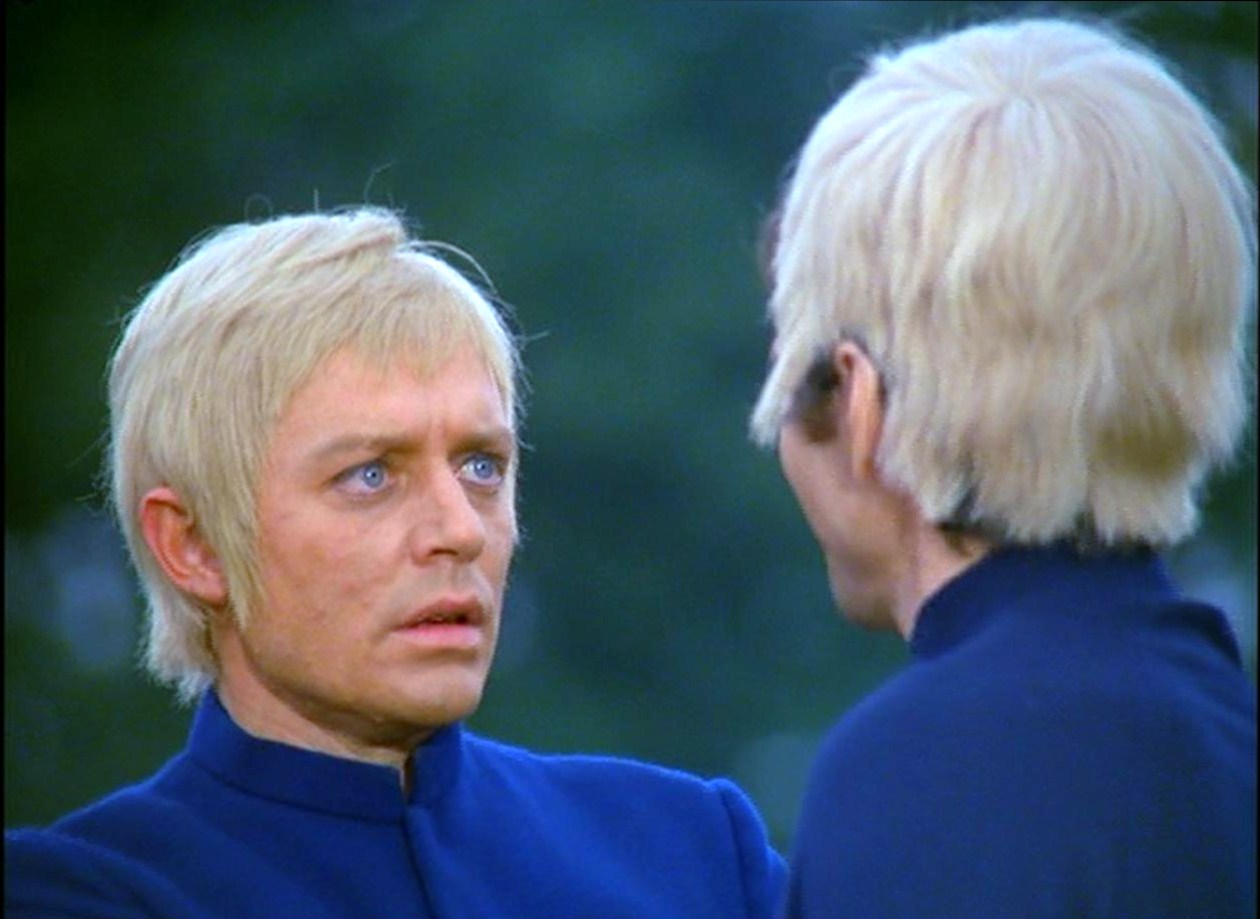 |
| Face to face with a stand-in. |
Paul Foster then sits down next to Straker, calling himself "Mike" (Michael Billington), and notes that this traumatic material will "make a great episode."
An emotionally-affected Straker, forced again to countenance his myriad personal failures (a recurring theme of the series in episodes such as "Confetti Check A-OK" and "A Question of Priorities"), objects.
"That's my life! That's my son!"
After seeing his son struck by a car, and his wife, Mary, tell him that she never wants to see him, Straker begins to really lose it (an outburst which "Mike" compliments as "method acting." )
But soon, the ever-rational, ever-resilient Straker realizes that he has been adversely affected by an alien "booby trap," one "aimed at the mind." He understands that to get back to his world, his reality, he must focus. General Henderson has already informed him that he has a "monkey on his back," called "dedication." Now he must tap into that dedication.
 |
| Isolation and alienation in the auditorium. |
Straker returns to HQ to "play" the scene with General Henderson over again. After a rapid, highly cinematic pull-back away from Straker depicting our protagonist as but one of many working actors on the studio lot, we get back to "realities," as Henderson puts it.
With dedication and concentration, Straker recites his "dialogue." He gets back in "the moment."
The longer he goes on, the more that Straker's reality reasserts itself. The film crew transforms before our eyes -- in almost iconic composition -- into the courageous men and women of S.H.A.D.O. The walls re-form -- the fourth wall re-established -- and Straker is home, at last.
I admire how "Mindbender" works so well on two levels.
On one level is the literal narrative: the story of an alien "booby trap" confusing the minds of S.H.A.D.O.'s best and brightest.
On another, more metaphorical level, the subject here is film itself; how sometimes we replay events in our lives as if they're old movies. We see this in Conroy's subplot, as he imagines himself a cowboy. And we see it -- tragically -- with Straker, as he is forced to relive all his personal pain on the silver screen.
On one level is the literal narrative: the story of an alien "booby trap" confusing the minds of S.H.A.D.O.'s best and brightest.
On another, more metaphorical level, the subject here is film itself; how sometimes we replay events in our lives as if they're old movies. We see this in Conroy's subplot, as he imagines himself a cowboy. And we see it -- tragically -- with Straker, as he is forced to relive all his personal pain on the silver screen.
Straker strenuously objects to the idea that movie makers would steal his life and his memories and "put them up on the screen" for the entertainment of others...but that's what the art-form always does. It takes from real life...and not always in a pleasant way.
Tragedy, regret, pathos...they all make a "great episode," don't they?
Tragedy, regret, pathos...they all make a "great episode," don't they?
 |
| "This will make a great episode..." |
"Mindbender" also gets at the fragility of the whole process of filmmaking, of the whole illusion, in some clever way. Every week, we tune into a show like Star Trek or UFO and willfully suspend our disbelief.
We know we are watching actors and special effects, a filmed entertainment with a pre-determined outcome and an emotion-provoking musical track.
And yet with our whole minds (and our whole hearts...) we dupe ourselves into believing, after a fashion, that what we are seeing is "real;" that these characters truly "exist."
UFO playfully blows the lid off that carefully constructed folie-en-famille, revealing to the audience not pilot Paul Foster, but actor Mike Billington; pulling back on high-angle shots of Moon base, Skydiver, and Straker's office and deliberately showing us that these environs are all carefully-constructed sets...merely artifice.
This is a high-wire act, be certain. The curtain is pulled back and the truth revealed, but in a science fiction series like UFO, there's no guarantee that once revealed, the magic can be restored. Yet it is, most definitively, restored, by "Mindbender's" conclusion.
As viewers, we greet Straker's escape from our reality back to his world as a huge relief. We breathe easy again. He escapes into fantasy, in one sense, as perhaps we might like to do. The walls of suspension of disbelief are, again, erected...and we sneak back in, along with Straker. We're back in the drama, back in the shared delusion or dream.
As viewers, we greet Straker's escape from our reality back to his world as a huge relief. We breathe easy again. He escapes into fantasy, in one sense, as perhaps we might like to do. The walls of suspension of disbelief are, again, erected...and we sneak back in, along with Straker. We're back in the drama, back in the shared delusion or dream.
"Mindbender" plays beautifully with form and anticipates our every reaction. The magician reveals -- at least briefly -- his hand, and then it's back to fashioning the magic again. And in shows like "A World of Difference," "Midnight Never Ends," "Far Beyond the Stars" and "Mindbender," the artist not only tells us a story; he invites us inside the process to take a nuts-and-bolts look at how that story gets delivered to us; at the ways the artistic mind conjures up the illusions of another world, another reality.
This kind of story can be done and has been done many times as a self-referential joke...a lark. But sometimes -- when it is vetted so brilliantly (as is the case on UFO) -- this long-standing genre convention makes us ask important questions about what is real life and what is fantasy.
More than that, it asks us to consider, perhaps, the reasons that we flock so readily and easily to the fantasy.
award-winning creator of the web series Abnormal Fixation (2024), the audio drama Enter the House Between (2023) and author of 35 books including Horror Films FAQ (2013), Horror Films of the 1990s (2011), Horror Films of the 1980s (2007), TV Year (2007), The Rock and Roll Film Encyclopedia (2007), Mercy in Her Eyes: The Films of Mira Nair (2006),, Best in Show: The Films of Christopher Guest and Company (2004), The Unseen Force: The Films of Sam Raimi (2004), An Askew View: The Films of Kevin Smith (2002), The Encyclopedia of Superheroes on Film & Television (2004), Exploring Space:1999 (1997), An Analytical Guide to TV's Battlestar Galactica (1998), Terror Television (2001), Space:1999 - The Forsaken (2003) and Horror Films of the 1970s (2002).
Subscribe to:
Posts (Atom)
50 Years Ago: Logan's Run (1976)
In the 23 rd century, the survivors of a nuclear war live inside The City of Domes, a paradise of plenty. The world is a hedonist’s delight...

-
 Last year at around this time (or a month earlier, perhaps), I posted galleries of cinematic and TV spaceships from the 1970s, 1980s, 1...
 -
 Director Ridley Scott has already given the science fiction cinema two of its greatest and most cherished films: Alien (1979) and Blade...