
 Posts
Posts


"One creature, caught. Caught in a place he cannot stir from in the dark. Alone, outnumbered hundreds to one, nothing to live for but his memories, nothing to live with but his gadgets, his cars, his guns, gimmicks... and yet the whole family can't bring him down..."
-Matthias (Anthony Zerbe) contemplates Neville (Charlton Heston) in The Omega Man (1971).
As I wrote in Horror Films of the 1970s (2002), Charlton Heston is legend.
To the kids who grew up in the 1970s, the great actor is not the larger-than-life religious messiah of The Ten Commandments, nor the 1990s-era NRA hawk of "from my cold, dead hands" fame. Rather, Heston remains the ultimate science-fiction anti-hero and bad ass.
In a relatively short-span (from 1968 to 1973), Heston fronted four remarkable dystopic and post-apocalyptic science-fiction visions: Planet of the Apes, Beneath the Planet of the Apes, The Omega Man and Soylent Green.
He did so with cocksure arrogance and larger-than-life charisma, prompting Pauline Kael to note on one occasion that Heston was a "god-like hero, built for strength...an archetype of what makes Americans win."
Call it the Heston Mystique.
It's a truly unusual and specific alchemy at work in these particular films. Planet of the Apes, The Omega Man and Soylent Green are all authentic leftist nightmare visions of unpleasant futures; pointing to the folly of nuclear or germ warfare, and railing against environmental apocalypse, militarism, and entrenched corporate, political and even religious interests.
And yet in all these instances we have this grinning, caustic icon of the right-wing (in his later years) countenancing such concerns...the last man standing, the last man advocating for our way of life.
Even if our way of life -- in some sense -- is directly to blame for the apocalypse at hand.
Only Nixon could go to China, and only Charlton Heston could take on such terrifying post-apocalyptic and dystopian worlds, perhaps. But the frisson generated as a right-wing icon takes on traditionally left-wing concerns about the end of the world grants each of the aforementioned films a special kind of enduring power and resonance, that's for certain.
Although The Omega Man arrived smack in the middle of this cycle of Heston sci-fi films (after Apes and before Soylent), it really makes the most of this his unique persona. The film opens with Heston -- decked out in cool sun-glasses -- patrolling the lonely streets of a post-apocalypse 20th century city in his red convertible. He races down the garbage-strewn boulevards, listening to Max Steiner's Theme from "A Summer Place."
Then, he sees a shadowy figure move in a nearby edifice's upstairs window. And he whips out a machine gun...
It's one of those wonderful movie moments: first trading on well-articulated feelings of loneliness and isolation (enhanced by the epic, long-distance aerial shots), and then reaching for terror...and a just little bit of humor as Heston -- singular defender of the human race -- cuts loose on an enemy quite abruptly.
Later in the same scene, Heston dons a stylish tan jacket that makes it look as though he's out on safari. He carries a red gas tank in one hand and his machine gun in the other, and thus is perfectly accessorized to stave off the End of Life As We Know It. Coupled with Ron Granier's heroic, rousing score, this moment in The Omega Man really...kicks.
If you ever want to dissect the unusual Heston Mystique, this moment is probably the place to start.
If you ever want to dissect the unusual Heston Mystique, this moment is probably the place to start.
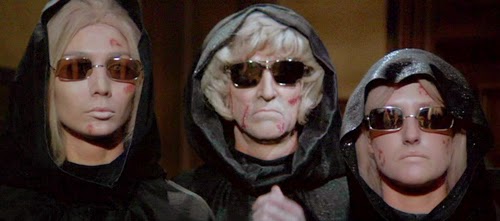
Another suitable place would be the scene in The Omega Man in which Heston informs the leader of the Family -- a group of albino mutants -- that he's "full of crap."

"Is this the conclusion of all our yesterdays? Is this the end of technological mankind?"
The Omega Man is the second silver screen adaptation of Richard Matheson's 1954 landmark novel, I am Legend.
The first version starred Vincent Price and was called The Last Man on Earth (1964). The third, I am Legend (2007), headlined Will Smith. The Omega Man has often been termed the least faithful of the cinematic bunch, yet in many ways it's also the best film of the three, neither ultra-low budget nor saddled with dated and ridiculous CGI effects.
In The Omega Man, Colonel Robert Neville (Heston) has survived a biological plague that, in March of 1975, wiped out the vast majority of mankind. As the story opens, it is the year 1977, and Neville -- living a life of unending isolation -- devotes his days to discovering the location of "the Hive;" the hideout for The Family, a menacing gang of neo-Luddite, photophobic mutants. If Neville owns daylight in this metropolis, the Family owns the night. And every midnight, the Family surrounds his urban dwelling and calls Neville out, hoping to destroy this last remnant of technological man.
The Family's leader, the loquacious Matthias (Zerbe) believes that the plague was God's punishment of man; judgment on his dependence and belief in science and technology. Now, he and his "Family" devote their lives to burning books and works of art, and destroying all evidence of 20th century technology.
"In the beginning, we tried to help one another, those that were left," he tells Neville. "We tried to clean things up, set things straight. We buried things and burned. Then it came to me that we were chosen. Chosen for just this work: To bury what was dead. To burn what was evil. To destroy what was dangerous."
In short, Matthias gives new meaning to the term eliminationalist rhetoric. He wants nothing less than to erase Neville -- and twenty centuries of human development -- from the history books.
"In the beginning, we tried to help one another, those that were left," he tells Neville. "We tried to clean things up, set things straight. We buried things and burned. Then it came to me that we were chosen. Chosen for just this work: To bury what was dead. To burn what was evil. To destroy what was dangerous."
In short, Matthias gives new meaning to the term eliminationalist rhetoric. He wants nothing less than to erase Neville -- and twenty centuries of human development -- from the history books.
While out in the city one day, Neville unexpectedly encounters a fellow survivor named Lisa (Rosalind Cash). She is allied with a brilliant med-student, Dutch (Paul Koslo) and several small children. All of them are currently unaffected by the still-rampant plague, but could "turn" at any moment.
When Neville realizes that mankind could have a future again in this small group, he re-doubles his effort to produce a vaccine for the germ that destroyed almost all life on Earth. He realizes that the key to destroying the plague involves his own untainted blood...

"Your art, your science...it was all a nightmare, and now it's finished."
In some respects, the first portion of The Omega Man -- with Heston's Neville alone in a vast urban jungle of glass, cement and metal -- remains the strongest and most memorable portion of the film.
Neville continually drops one-liners, to an audience of one: himself.
"Another day, another dollar." "There's never a cop around when you need one." And -- during a viewing of Woodstock (1970) -- "They sure don't make pictures like that anymore."
All these jokes are determinedly cliched, and yet these familiar turns-of-phrase from before the apocalypse also seem poignant because they no longer carry their original meanings. Rather, they call attention to Neville's plight.
Another day another dollar? Money is worthless.
There's never a cop around when you need one? There's nobody around. Period.
They sure don't make pictures like that? In fact, no new movies are being made.
Neville's sarcastic running commentary reveals just how pointless and empty his life has become; and how impossible it is to forget the past, and the dead.
Another exemplary scene early in the film finds Neville hunting down the Family in the empty Hotel Premiere. He passes through a fancy hall with a grand chandelier, and then moves into a dining room where a long dinner table is still set with the finest china and linens. Again, table settings, fancy dishes, frilly gold curtains, and ornate light fixtures seem damned unimportant in the face of extinction. The visuals in this scene get at that idea; at the notion of man as having gone the way of the dodo or the dinosaur; with only these empty forms and shapes left behind.
Many such moments early in the film practically tingle with this electric idea of a fully-decorated but unpopulated world, as well as Neville's seething, caustic anger about his fate. For instance, there's a moment when he spies a pin-up calendar on a car dealership wall, and has to take it down. He can't bear to look at it; to be reminded of the fairer sex. It's just too much to bear..
And the scene in the movie theater, with Neville lip-synching the words to hippie dialogue in Woodstock (1970) is some kind of twisted genius. It gets to the tension inherent in casting right-wing Heston in a role such as this (or in the role of Taylor in Planet of the Apes). Heston's Neville doesn't give a flying hoot for the hippies or their counter-culture belief system. But here he is, alone at the end of the world, and, well, he'll settle even for a hippie's faux profundity as company.
By having Neville accept and repeat the words of Woodstock, the movie knowingly puts this guy in the role of humanity's defender. Messy humanity's defender, I should say, longing for all the species' stupid conflicts, nonsense, and silliness. Neville is there...celebrating it; mourning it. It's the equivalent of George Clooney playing Neville after the apocalypse, lip-synching to a Rush Limbaugh recording, or a Bill O'Reilly show. There's a tension to it; an irony. And a poignancy too.

The Omega Man also thrives as a good old fashioned action film. There's an exhilarating motorcycle escape in a football-stadium, scored heroically -- again -- by Granier, and culminating in a slow-motion jump. It's sort of refreshing and eye-opening how basic and well-staged it is, with no digital effects or CGI backgrounds or herky-jerky camera work and editing. To quote Neville, "they don't make pictures like this anymore."
I suppose most of the ire and brickbats directed at The Omega Man over the years involve the film's ending. In case you've forgotten, the climax finds Neville speared to a modern art fountain outside his apartment. As he dies in a pool of his own life-saving blood, Neville slips into a Christ pose; of Jesus Christ on the cross. I know this ending really upset critic Howard Thompson at The New York Times, who called it "phony" and "florid."
I agree that this ending is bracing, but would nonetheless argue that the way for it is is paved early on. A young girl gazes at Neville admiringly and asks, "Are you God?" If that's not a clear set-up for the quasi-religious denouement, I don't know what would be.
But on more basic terms, what's intrinsically wrong or wrong-headed with the comparison of Neville to Christ? Both men die for the sins of the world; and both die giving humanity a second chance. In John 1:7, it is written “and the blood of Jesus Christ his Son cleanseth us from all sin.” In the case of Neville, his blood will also cleanse humanity of the plague; the sin of germ warfare made manifest in flesh.

Secondly, a critical part of Matheson's original novel is the mythologizing of Neville as a kind of bedtime story for the vampires, a bogeyman. Though The Omega Man de-mythologizes and de-romanticizes the tale to a considerable degree, this ending brings it all back in. This movie's events serve, in a sense, as an origin story of how mankind got a second chance.
That line of Scripture quoted above actually begins with the words "If ye walk in the light, as he is in the light.." And consider too that throughout the film, Neville is dramatically associated with the light; just as the Family is associated with the dark. Neville only operates in the day time, and he preserves also the light of knowledge: of literature, art, medicine and science. In the case of the latter two, those are the very things which enable Neville to share his life-giving blood.
So the Crucifixion pose, if you will, not only works thematically; but it works in terms of the literal story and what these characters witness and will come to remember. This is especially true of the children, particularly that little girl who asked if Neville is God. She will grow up and tell her children about the man whose blood saved the human race.
To some -- especially as generations pass -- Neville will indeed seem as a God, or at least a Savior.
I don't find the ending of The Omega Man sacreligious or profane, or even overly florid. I think it's the perfect and valid ending to Neville's particular story. After having spent years in the "wilderness" of Los Angeles alone, he returns to humanity and finds redemption both for himself and his people. He has gone from being "hostile" and "not belonging" to saving the human race. Furthermore, the casting of Heston, whom many associate with religious imagery because of Ten Commandments, lends further validity to a religious or mythological interpetation of Neville's life.
Finally, I've been writing about dystopias a lot lately. There gets to be, at some point, common ground with the post-apocalyptic film. They aren't always one in the same, but in the case of The Omega Man, I would argue that they are. The film depicts not just life after the fall of man, but a new and terrifying order, a "Family" (in the style of Charles Manson's) that wants to burn and destroy everything of value, from art to literature to sculpture. This Family would leave the Earth in a new Dark Age without beauty, without imagination, without past, and therefore without potential.
That's the "Hell," so-to-speak, that Neville delivers the world from. And that's why he earns his valedictory crucifixion.
Neville continually drops one-liners, to an audience of one: himself.
"Another day, another dollar." "There's never a cop around when you need one." And -- during a viewing of Woodstock (1970) -- "They sure don't make pictures like that anymore."
All these jokes are determinedly cliched, and yet these familiar turns-of-phrase from before the apocalypse also seem poignant because they no longer carry their original meanings. Rather, they call attention to Neville's plight.
Another day another dollar? Money is worthless.
There's never a cop around when you need one? There's nobody around. Period.
They sure don't make pictures like that? In fact, no new movies are being made.
Neville's sarcastic running commentary reveals just how pointless and empty his life has become; and how impossible it is to forget the past, and the dead.
Another exemplary scene early in the film finds Neville hunting down the Family in the empty Hotel Premiere. He passes through a fancy hall with a grand chandelier, and then moves into a dining room where a long dinner table is still set with the finest china and linens. Again, table settings, fancy dishes, frilly gold curtains, and ornate light fixtures seem damned unimportant in the face of extinction. The visuals in this scene get at that idea; at the notion of man as having gone the way of the dodo or the dinosaur; with only these empty forms and shapes left behind.
Many such moments early in the film practically tingle with this electric idea of a fully-decorated but unpopulated world, as well as Neville's seething, caustic anger about his fate. For instance, there's a moment when he spies a pin-up calendar on a car dealership wall, and has to take it down. He can't bear to look at it; to be reminded of the fairer sex. It's just too much to bear..
And the scene in the movie theater, with Neville lip-synching the words to hippie dialogue in Woodstock (1970) is some kind of twisted genius. It gets to the tension inherent in casting right-wing Heston in a role such as this (or in the role of Taylor in Planet of the Apes). Heston's Neville doesn't give a flying hoot for the hippies or their counter-culture belief system. But here he is, alone at the end of the world, and, well, he'll settle even for a hippie's faux profundity as company.
By having Neville accept and repeat the words of Woodstock, the movie knowingly puts this guy in the role of humanity's defender. Messy humanity's defender, I should say, longing for all the species' stupid conflicts, nonsense, and silliness. Neville is there...celebrating it; mourning it. It's the equivalent of George Clooney playing Neville after the apocalypse, lip-synching to a Rush Limbaugh recording, or a Bill O'Reilly show. There's a tension to it; an irony. And a poignancy too.
The Omega Man also thrives as a good old fashioned action film. There's an exhilarating motorcycle escape in a football-stadium, scored heroically -- again -- by Granier, and culminating in a slow-motion jump. It's sort of refreshing and eye-opening how basic and well-staged it is, with no digital effects or CGI backgrounds or herky-jerky camera work and editing. To quote Neville, "they don't make pictures like this anymore."
I suppose most of the ire and brickbats directed at The Omega Man over the years involve the film's ending. In case you've forgotten, the climax finds Neville speared to a modern art fountain outside his apartment. As he dies in a pool of his own life-saving blood, Neville slips into a Christ pose; of Jesus Christ on the cross. I know this ending really upset critic Howard Thompson at The New York Times, who called it "phony" and "florid."
I agree that this ending is bracing, but would nonetheless argue that the way for it is is paved early on. A young girl gazes at Neville admiringly and asks, "Are you God?" If that's not a clear set-up for the quasi-religious denouement, I don't know what would be.
But on more basic terms, what's intrinsically wrong or wrong-headed with the comparison of Neville to Christ? Both men die for the sins of the world; and both die giving humanity a second chance. In John 1:7, it is written “and the blood of Jesus Christ his Son cleanseth us from all sin.” In the case of Neville, his blood will also cleanse humanity of the plague; the sin of germ warfare made manifest in flesh.
Secondly, a critical part of Matheson's original novel is the mythologizing of Neville as a kind of bedtime story for the vampires, a bogeyman. Though The Omega Man de-mythologizes and de-romanticizes the tale to a considerable degree, this ending brings it all back in. This movie's events serve, in a sense, as an origin story of how mankind got a second chance.
That line of Scripture quoted above actually begins with the words "If ye walk in the light, as he is in the light.." And consider too that throughout the film, Neville is dramatically associated with the light; just as the Family is associated with the dark. Neville only operates in the day time, and he preserves also the light of knowledge: of literature, art, medicine and science. In the case of the latter two, those are the very things which enable Neville to share his life-giving blood.
So the Crucifixion pose, if you will, not only works thematically; but it works in terms of the literal story and what these characters witness and will come to remember. This is especially true of the children, particularly that little girl who asked if Neville is God. She will grow up and tell her children about the man whose blood saved the human race.
To some -- especially as generations pass -- Neville will indeed seem as a God, or at least a Savior.
I don't find the ending of The Omega Man sacreligious or profane, or even overly florid. I think it's the perfect and valid ending to Neville's particular story. After having spent years in the "wilderness" of Los Angeles alone, he returns to humanity and finds redemption both for himself and his people. He has gone from being "hostile" and "not belonging" to saving the human race. Furthermore, the casting of Heston, whom many associate with religious imagery because of Ten Commandments, lends further validity to a religious or mythological interpetation of Neville's life.
Finally, I've been writing about dystopias a lot lately. There gets to be, at some point, common ground with the post-apocalyptic film. They aren't always one in the same, but in the case of The Omega Man, I would argue that they are. The film depicts not just life after the fall of man, but a new and terrifying order, a "Family" (in the style of Charles Manson's) that wants to burn and destroy everything of value, from art to literature to sculpture. This Family would leave the Earth in a new Dark Age without beauty, without imagination, without past, and therefore without potential.
That's the "Hell," so-to-speak, that Neville delivers the world from. And that's why he earns his valedictory crucifixion.


