Posts
Posts


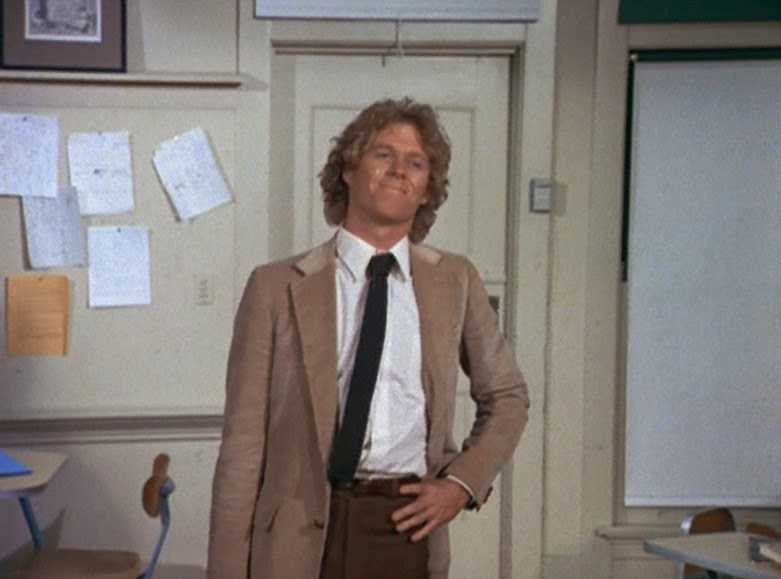
ABC-TV unveiled The Greatest American Hero's two-hour pilot the night of March 18, 1981. The inaugural episode and ensuing series focused on a special education teacher at Whitney High School-turned-superhero, Ralph Hinkley (William Katt), and his attempts to become an effective...superhero.
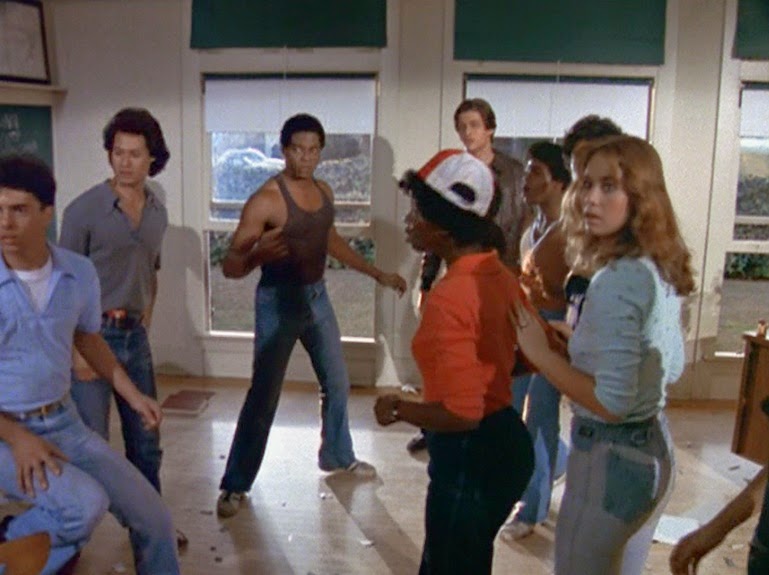
A divorced father of a little boy, Ralph -- or "Mr. H." as his students called him -- was experiencing difficulties on the job with his unruly new class (which was populated by such future star performers as Michael Pare, and Faye Grant as "Love Me Rhonda...").

Ralph was essentially a bleeding-heart liberal and do-gooder at heart, and he felt that he "ought to be able to do some good" with his class full of behavioral problems. Attempting to bond with them, he decided to take his class on an impromptu "geological trip" to the desert.
On the way to the desert, however, one of the rougher students, Tony (Pare) found himself in a confrontation with a by-the-book patriot and FBI agent Bill Maxwell (Robert Culp). Bill was there investigating a case with his ill-fated partner, John, that involved -- at least tangentially -- the weak, wimpy Vice President (Richard Herd) of the United States and a dangerous white-supremacist cult.
A divorced father of a little boy, Ralph -- or "Mr. H." as his students called him -- was experiencing difficulties on the job with his unruly new class (which was populated by such future star performers as Michael Pare, and Faye Grant as "Love Me Rhonda...").
Ralph was essentially a bleeding-heart liberal and do-gooder at heart, and he felt that he "ought to be able to do some good" with his class full of behavioral problems. Attempting to bond with them, he decided to take his class on an impromptu "geological trip" to the desert.
On the way to the desert, however, one of the rougher students, Tony (Pare) found himself in a confrontation with a by-the-book patriot and FBI agent Bill Maxwell (Robert Culp). Bill was there investigating a case with his ill-fated partner, John, that involved -- at least tangentially -- the weak, wimpy Vice President (Richard Herd) of the United States and a dangerous white-supremacist cult.
After the school bus breaks down in the desert, Ralph meets up with Bill again by nightfall, when the agent's car goes out of control. In a unique variation of the opening episode of The Invaders ("Beachhead"), the two men are then approached by a colossal UFO.

Only here, the flying saucer doesn't house invading aliens with jutting pinkies, but rather concerned humanitarians, like Klaatu from The Day The Earth Stood Still.
Utilizing Bill's dead partner as their vessel, the aliens inform Bill and Ralph that the two men must work together to save the troubled planet from annihilation. To aid the men in this worthwhile endeavor, the aliens provide a special suit (and instruction manual...) that will grant Ralph "unearthly powers."
"You can change things," the men are told. "You can save this planet from destruction..."
And so an uneasy alliance is forged between Ralph and Bill. It's the beginning of a beautiful friendship, actually, but the two men don't realize it yet.
Of course, there are bumps in the road along the way. In the pilot, for instance, Ralph manages to lose the suit's instruction manual in the desert, meaning that he must literally "wing it" when it comes to flying and other superhero skills. On his first test flight, he crashes into a wall head first. And this is after getting take-off advice from a young Superman fan...

As we soon learn, Bill and Ralph have very different ideas about how, exactly, the world should be saved. Bill envisions Ralph as a kind of Cold War avenger flying to Eastern Europe and smashing Russian strongholds. Ralph is more a world peace kind of guy.
Almost immediately, the "suit" also causes Ralph strife in his home life. He misses an important custody hearing for his son (because he gets locked up in an asylum...), and the suit causes constant stress in his romantic relationship with lovely but acerbic Pam Davidson (Connie Sellecca), his girlfriend and attorney.
For three winning seasons on ABC, the Ralph-Bill-Pam triumvirate of The Greatest American Hero battled terrorists, saboteurs, Russian spies, mobsters and an alien or two with an abundance of heart, and more importantly, perfect comedic timing.
The actors on the program shared a terrific chemistry, a welcome facet that rendered the not-always-stellar storylines of secondary importance. The audience (this author included) enjoyed watching the characters interact and grow each week. Even watching the episodes today, you can detect a jaunty, joie-de-vivre among the performers and their characters. The Greatest American Hero was never campy, as some may be wont to write, but rather delightful and witty.

The original Greatest American Hero pilot makes use of its beloved, Generation-X-touchstone theme song in a clever way too. Although it is heard in instrumental format over the opening credits (a helicopter flyby over L.A.), the vocals are not sung until the valedictory moment of the episode, after the denouement in which Ralph, Bill and Pam have been successful in saving the President of the United States from the bad guys and the power-hungry Vice President.
We see Ralph cruising over the city (by night...) rightly proud of his accomplishment, and the song (with vocals) kicks in. It's a little bit like reserving the famous James Bond theme until the coda of Casino Royale (2006): a moment of maximum thematic impact that renders the song touching and inspiring at the same time.
Over the course of forty episodes and three seasons, Ralph Hinkley became more adept at marshaling his super powers, despite owning no instruction manual.
In "Here's Looking At You Kid," he learned how to become invisible. in "Now You See It," he learned that the suit granted him precognitive abilities, and so forth. As important as the super power development, however was the character development across the various installments. The characters quickly developed fun catchphrases (Bill's use of the word "scenario," for instance, or the phrase "this is the one the suit was meant for,")

Episodes also delved into personal matters. In "My Heroes Have Always Been Cowboys," Ralph was able to see himself and his new role as superhero champion in context with his own boyhood hero, the Lone Ranger. Bill suffered a mid-life crisis ("The Best Desk Scenario") too, and Pam and Ralph even got married by series end ("The Newlywed Game."
Another admirable aspect of The Greatest American Hero is the self-reflexive, post-modern tone. This is a series that concerns a legitimate every-man coping with the fantastic. Humor arise from the fact that Ralph, Pam and Bill are highly aware -- not oblivious -- to the ridiculous nature of the situations they often found themselves in. This was an approach later adopted by series such as Lois and Clark: The New Adventures of Superman in the 1990s, but The Greatest American Hero was a TV pioneer on this front. Ralph's original reaction to the suit (basically red long underwear...) is an example a realistic "oh, please...would you look at this thing?"
And the Superman jokes are numerous and amusing, particularly Ralph's admonition to Pam that she is already "one step ahead of Lois Lane, since she never found out Clark Kent is Superman."DC Comics, however, wasn't amused by virtually any aspect of The Greatest American Hero. The company sued the makers of the series for copyright infringement and sought to kill the program in the crib. DC's beef was that it felt Ralph Hinkley was "patterned" after Superman. DC imperiously requested "all infringing negatives, tapes, photographs and advertisements" related to the ABC program "be delivered to DC Comics for destruction."
A U.S. District Court Judge thankfully ruled against DC, noting that there were "numerous differences" in the productions. That, for instance, in The Greatest American Hero, the lead character was "an ordinary person who reluctantly takes on abnormal abilities and is comically inept," whereas Superman boasted super powers "with grace and confidence."
The lawsuit wasn't The Greatest American Hero's only concern, either. A mere twelve days (on March 30, 1981) after the series premiered, a man named John Hinckley Jr. (a friend, incidentally of the Bush family) severely wounded President Ronald Reagan in an assassination attempt. Again, the hero's name on The Greatest American Hero was Ralph Hinkley, and ABC feared a public backlash. Accordingly, Ralph's last name was mysteriously changed to "Hanley" for a time, until the incident blew over.
In many ways, The Greatest American Hero represents the missing link of superhero TV programs. It is not hopelessly campy like some sixties superheroes (Batman, Captain Nice, Mr. Terrific). Nor does it blissfully ignore "the reality" (and occasional absurdity) of superheroes dwelling in "normal life" (like, to some extent, The Six Million Dollar Man or Wonder Woman).
And unlike many of today's unnecessarily dark, endlessly-angsty, violence-prone superheroes, The Greatest American Hero also boasts a great sense of fun about itself. Indeed, this series possesses the increasingly rare quality known as charm
Only here, the flying saucer doesn't house invading aliens with jutting pinkies, but rather concerned humanitarians, like Klaatu from The Day The Earth Stood Still.
Utilizing Bill's dead partner as their vessel, the aliens inform Bill and Ralph that the two men must work together to save the troubled planet from annihilation. To aid the men in this worthwhile endeavor, the aliens provide a special suit (and instruction manual...) that will grant Ralph "unearthly powers."
"You can change things," the men are told. "You can save this planet from destruction..."
And so an uneasy alliance is forged between Ralph and Bill. It's the beginning of a beautiful friendship, actually, but the two men don't realize it yet.
Of course, there are bumps in the road along the way. In the pilot, for instance, Ralph manages to lose the suit's instruction manual in the desert, meaning that he must literally "wing it" when it comes to flying and other superhero skills. On his first test flight, he crashes into a wall head first. And this is after getting take-off advice from a young Superman fan...
As we soon learn, Bill and Ralph have very different ideas about how, exactly, the world should be saved. Bill envisions Ralph as a kind of Cold War avenger flying to Eastern Europe and smashing Russian strongholds. Ralph is more a world peace kind of guy.
Almost immediately, the "suit" also causes Ralph strife in his home life. He misses an important custody hearing for his son (because he gets locked up in an asylum...), and the suit causes constant stress in his romantic relationship with lovely but acerbic Pam Davidson (Connie Sellecca), his girlfriend and attorney.
For three winning seasons on ABC, the Ralph-Bill-Pam triumvirate of The Greatest American Hero battled terrorists, saboteurs, Russian spies, mobsters and an alien or two with an abundance of heart, and more importantly, perfect comedic timing.
The actors on the program shared a terrific chemistry, a welcome facet that rendered the not-always-stellar storylines of secondary importance. The audience (this author included) enjoyed watching the characters interact and grow each week. Even watching the episodes today, you can detect a jaunty, joie-de-vivre among the performers and their characters. The Greatest American Hero was never campy, as some may be wont to write, but rather delightful and witty.
The original Greatest American Hero pilot makes use of its beloved, Generation-X-touchstone theme song in a clever way too. Although it is heard in instrumental format over the opening credits (a helicopter flyby over L.A.), the vocals are not sung until the valedictory moment of the episode, after the denouement in which Ralph, Bill and Pam have been successful in saving the President of the United States from the bad guys and the power-hungry Vice President.
We see Ralph cruising over the city (by night...) rightly proud of his accomplishment, and the song (with vocals) kicks in. It's a little bit like reserving the famous James Bond theme until the coda of Casino Royale (2006): a moment of maximum thematic impact that renders the song touching and inspiring at the same time.
Over the course of forty episodes and three seasons, Ralph Hinkley became more adept at marshaling his super powers, despite owning no instruction manual.
In "Here's Looking At You Kid," he learned how to become invisible. in "Now You See It," he learned that the suit granted him precognitive abilities, and so forth. As important as the super power development, however was the character development across the various installments. The characters quickly developed fun catchphrases (Bill's use of the word "scenario," for instance, or the phrase "this is the one the suit was meant for,")
Episodes also delved into personal matters. In "My Heroes Have Always Been Cowboys," Ralph was able to see himself and his new role as superhero champion in context with his own boyhood hero, the Lone Ranger. Bill suffered a mid-life crisis ("The Best Desk Scenario") too, and Pam and Ralph even got married by series end ("The Newlywed Game."
Another admirable aspect of The Greatest American Hero is the self-reflexive, post-modern tone. This is a series that concerns a legitimate every-man coping with the fantastic. Humor arise from the fact that Ralph, Pam and Bill are highly aware -- not oblivious -- to the ridiculous nature of the situations they often found themselves in. This was an approach later adopted by series such as Lois and Clark: The New Adventures of Superman in the 1990s, but The Greatest American Hero was a TV pioneer on this front. Ralph's original reaction to the suit (basically red long underwear...) is an example a realistic "oh, please...would you look at this thing?"
And the Superman jokes are numerous and amusing, particularly Ralph's admonition to Pam that she is already "one step ahead of Lois Lane, since she never found out Clark Kent is Superman."DC Comics, however, wasn't amused by virtually any aspect of The Greatest American Hero. The company sued the makers of the series for copyright infringement and sought to kill the program in the crib. DC's beef was that it felt Ralph Hinkley was "patterned" after Superman. DC imperiously requested "all infringing negatives, tapes, photographs and advertisements" related to the ABC program "be delivered to DC Comics for destruction."
A U.S. District Court Judge thankfully ruled against DC, noting that there were "numerous differences" in the productions. That, for instance, in The Greatest American Hero, the lead character was "an ordinary person who reluctantly takes on abnormal abilities and is comically inept," whereas Superman boasted super powers "with grace and confidence."
The lawsuit wasn't The Greatest American Hero's only concern, either. A mere twelve days (on March 30, 1981) after the series premiered, a man named John Hinckley Jr. (a friend, incidentally of the Bush family) severely wounded President Ronald Reagan in an assassination attempt. Again, the hero's name on The Greatest American Hero was Ralph Hinkley, and ABC feared a public backlash. Accordingly, Ralph's last name was mysteriously changed to "Hanley" for a time, until the incident blew over.
In many ways, The Greatest American Hero represents the missing link of superhero TV programs. It is not hopelessly campy like some sixties superheroes (Batman, Captain Nice, Mr. Terrific). Nor does it blissfully ignore "the reality" (and occasional absurdity) of superheroes dwelling in "normal life" (like, to some extent, The Six Million Dollar Man or Wonder Woman).
And unlike many of today's unnecessarily dark, endlessly-angsty, violence-prone superheroes, The Greatest American Hero also boasts a great sense of fun about itself. Indeed, this series possesses the increasingly rare quality known as charm