Showing posts with label Die Hard on a Blog. Show all posts

Thursday, March 03, 2016

Die Hard on a Blog: A Good Day to Die Hard (2013)


The final Die Hard movie -- so far anyway -- proved a giant hit at the box office, and yet drew the worst reviews of the franchise.  A Good Day to Die Hard (2013) also returns Bruce Willis to his most famous role, cop John McClane, and sends him, for the first time, out of the United States, for one of his demolition derbies.

The fish-out-of-water aspect of the series is left intact, then, as John goes to Moscow to save his grown son, Jack (Jai Courtney), a spy, from danger. The “buddy” element of the franchise, which shows up in Die Hard with a Vengeance (1995), and Live Free or Die Hard (2007) is thus satisfied,, too with a resentful son trading caustic quips with Daddy McClane.

The plot is also familiar in terms of other long-standing Die Hard conceits. A man who appears to be a legitimate political dissident, Koromov (Sebastian Koch), is actually just a glorified thief.  

As McClane aptly notes during the film’s action, it’s “always about the money.”

A Good Day to Die Hard is the weakest of the Die Hard films, despite its nods to series standards, for a few crucial reasons. The first involves the action.  It is quite impressive and spectacular at times, especially a car chase on a Moscow highway. And yet the action seems to possess the least visceral impact possible. There's something distant and remote about it all. Sure, there is plenty of shooting, jumping, crashing and exploding in this sequel...yet somehow it seems totally routine and un-engaging.

The routine, ho-hum nature of the violence actually made me miss McClane surfing on a jet plane, in Live Free or Die Hard. That's how un-impactful it all feels.

A part of the problem be the aforementioned epic or spectacular scope, actually. As I’ve written in my other reviews, the Die Hard aesthetic altered the path of action films for a generation. Before Die Hard in '88, action stars were muscle-bound goliaths like Stallone or Schwarzenegger. The characters they often played seemed downright indestructible.

Die Hard flipped the script and gave us a very vulnerable -- but determined -- every-man hero in Willis’s fit but not steroidal John McClane.  He wasn't a muscle-man, he was one of us.

Yet the sad path of the franchise -- as I hope I have demonstrated in my reviews -- is a slippery slope towards mitigating the protagonist's defining characteristic: his mortality.  

In this film, McClane survives crashes, fireballs, collapsing skyscrapers -- and the radiation of Chernobyl -- with just light scratches.  Willis is also the most restrained and unemotional he has ever been in his trademark role, and taken together, it’s a lethal combination.  McClane might as well be a smirking robot at this point.

Actually, A Good Day to Die Hard is a lot like a Bourne movie: international in its locations, epic in its stunts, and featuring a kind of inscrutable figure as its star. 

But John McClane isn’t suffering from amnesia and searching for his identity, like Bourne was.

Unfortunately, the screen writers seem to be suffering from amnesia. They appear to have forgotten which franchise they are writing for.


“Well, it’s confusing…”

When John McClane (Willis) learns that his estranged son, Jack (Jai Courtney) is in some kind of legal trouble in Russia, he hops a plane to Moscow to help out.

In truth, Jack is a U.S. spy working to extradite a dissident named Komarov (Koch) who possesses a data file that could provide hard evidence that the Russian defense minister is conducting illegal business.

Jack and John reunite, and rescue Komarov, but learn that he is in league with his daughter, Irina (Yuliya Sniger) on a daring heist.  In particular, they plan to rob a vault in Chernobyl, and procure weapon-grade uranium for sale on the black market.

Now -- without back-up or allies -- John and Jack must put their differences aside, travel to Chernobyl, and stop the Russian father-daughter combo from making the uranium available to terrorists.


“You’re out of your depth, John.”

The first truly international Die Hard is a disappointment. 

Throughout its history, the franchise has featured sharp writing and real clarity (not to mention brevity) in terms of crafting memorable characters. Sadly, this film gets mired down very quickly in Russian politics and power struggles, generating a feeling of boredom and ennui with the proceedings. 

I can understand choosing to pick up and run with the idea of John as a fish out of water again (as he was in L.A., in the 1988 original) but I can’t imagine why the decision was made to inject him into the thoroughly uninspiring business with Russian gangsters. We get long scenes here of Russian competitors threatening one another, and vying for superiority. Ultimately, it's all wasted time.

A Good Day to Die Hard also sets its finale, implausibly, in Chernobyl, and keeps John and Jack there for a good length of time. John asks if he is in any danger from the radiation, but never gets a satisfactory answer except that he could lose his hair. 

I’ll give him a response. 

He is in no danger, at all, because he has become an indestructible character at this point.

This John McClane can survive the collapse of buildings, fireballs, and yes, any radiation he might happen to pick up. The final act of A Good Day to Die Hard is so implausible and over-the-top that it is breathtaking in its cartoon dimensions.  Jack has apparently been gifted with his Dad’s indestructible DNA, and he survives all the same disasters too, while hardly breaking a sweat.


I can’t claim that the action is particularly badly filmed, or poorly orchestrated and edited. All I can claim is that the action doesn’t create any sense of pace or involvements.  I keep coming back to that elaborate street chase in Moscow.  

The stunts are great in that chase.  So why doesn’t it prove thrilling?  Why doesn’t it get the blood running? Why is the enjoyment of it only intellectual in nature, a recognition that the scene must have been a bear to orchestrate?


The only answer I can provide is that the audience doesn’t feel invested in the story, or the characters. 

And that’s probably the worst thing one could say about a Die Hard movie, since the franchise has always banked on the appeal of its funny, edgy, wise-cracking hero. 

But McClane is just a shadow of his former self here, sullen and quiet. He seems disengaged. 

I appreciate that the character wants to reconcile with his son, but McClane seems, well, highly medicated in this outing.  He doesn’t seem fully there, and so the audience is never fully engaged either.

Though I have made my feelings plain that this is my least favorite Die Hard movie, I feel I should note that it may not be quite as “rotten” as some critics claim.  Like the other films, it is competently made.  It’s just that -- unlike the other films in the franchise -- it feels heart-less and soulless.  There's something rote about it. For me it is a "C-" or thereabouts. But the rest of the films earned much higher than barely-passing grades.

One aspect of A Good Day to Die Hard that I enjoyed is the nearly sub-textual fascination with the 1980s…the era from which the John McClane saga sprang. 

This movie goes back to Chernobyl and reminds us of the disaster that occurred there (in franchise time, just a year or two before the Nakatomi Plaza incident). And one villain has the audacity to tell John “It’s not 1986, Reagan is dead.”

Perhaps, encoded in that line of dialogue, is the intent on the part of the writers and the directors, to update John for the post-9/11 Era; to bring McClane firmly and irrevocably into the 21st century. 

I like the call-back to John’s beginning as an action-hero, and the acknowledgment that the Die Hard films have long since outlived their original context.

But the problem, again, is that no worthy paradigm replaces the old Die Hard one here. The Jason Bourne movies are their own thing, and have cast, already, a spell on the look and feel of modern Bond movies.  I see no motivating reason to import that aesthetic to Die Hard.

Already, that paradigm feels old and used up, and so A Good Day to Die Hard doesn’t gain anything from its sense of seriousness, or even from the international canvas.

How else can I put this?

It’s not a good day for Die Hard.  

My recommendation: bring John and the franchise home. And someone wake up Bruce Willis.

Thursday, February 25, 2016

Die Hard on a Blog: Live Free or Die Hard (2007)


John McClane enters the 21st century – not to mention the post-9/11 age -- in Live Free or Die Hard (2007), the first PG-13 entry in the durable action franchise.

Although it’s difficult to be particularly judgmental of the generally entertaining Live Free or Die Hard (2007) -- especially given the quality of its follow-up, A Good Day to Die Hard (2011) -- this movie also provides ample evidence to suggest the franchise’s best days are behind it.

In particular, Live Free or Die Hard features a bland, forgettable villain, played by Timothy Olyphant, and regurgitates, almost precisely, the format of Die Hard with a Vengeance by eschewing a single location story and partnering up McClane with another bicker-some partner, in this case one played by Justin Long. Where Samuel Jackson’s Zeus Carter battled McClane over issues of race, Long’s character offers a generational challenge to the put-upon cop.

Live Free or Die Hard’s greatest drawback, however, is that this third sequel to McTiernan’s 1988 classic transforms McClane into a veritable superman, one able to fly cars into helicopters and surf a military jet in flight. The whole idea of the every-man with a “die hard” personality is lost, to a great extent. And since Willis plays McClane with greater restraint than ever before, we don’t even have his darting eyes and furtive movements to suggest is he in constant jeopardy, or afraid for his life.

Certainly, there’s a great scene in Live Free or Die Hard wherein McClane describes exactly what it costs him, personally and emotionally, to be a hero, but that scene -- firmly planted in reality -- is but a passing blip in a film that, intentionally or not, makes the case that McClane is as indestructible as Arnie’s Terminator.

Len Wiseman directed Live Free or Die Hard, and the movie was a huge success at the box office. The film is no embarrassment (again, in light of A Good Day to Die Hard…) so this second-guessing of ingredients is largely academic.  Still, this entry in the canon accelerates Die Hard’s descent towards generic, mindless action franchise. It may not be a bad movie overall, but it is another rung down the ladder towards mediocrity. 

The fact that the movie’s PG-13 rating doesn’t even permit McClane to utter his immortal catchphrase -- “yippee kay yay, motherfucker” -- is an omen, perhaps, that business and demographic concerns have finally eclipsed artistic ones in the Die Hard universe.


“You’re a Timex watch in a digital age.”

After arguing with his daughter, Lucy (Mary Elizabeth Winstead), divorced cop John McClane (Willis) is tasked with bringing in a hacker, Matthew Farrell (Justin Long) who may have knowledge of an escalating cyber-attack on financial markets and the government of the United States. 

At the same time, however, assassins are sent to kill Matt, and John is once again in the wrong place, at the wrong time, facing a terrible threat.

As Matthew explains to John, a group of well-organized, well-funded hackers are attempting a “fire sale” attack on the U.S. 

When John gets Matthew to Washington D.C., he learns that the culprit is the once well-respected Thomas Gabriel (Timothy Olyphant), who pointed out to the government its lack of defenses in the case of a cyber-attack.

Now Gabriel is showcasing that lack of defense, but in reality, is planning a huge cyber-robbery.

When Lucy is kidnapped by Gabriel, John and Matthew must work together -- despite generational differences – to short-circuit Gabriel’s escalating attack and save the day. 

They will require the help of an expert hacker, a guy called Warlock (Kevin Smith).


Another day in paradise.”

I’ve written about this concept before, but in the first decade of the twenty-first century -- just around the time of Live Free or Die Hard’s production, actually -- TV and film switched places; suddenly switched paradigms. 

Suddenly, television was the venue for intelligent, niche programming that would never have survived on a “big” network in earlier eras.  Think Dexter (2006-2014), or Mad Men (2006-2015).  And movies, which had survived and thrived through an independent film movement of great quality in the 1990s, began to become horribly, catastrophically homogenized, so as to attract all possible demographics and win the all-important opening weekend sweepstakes. 

One can argue why this switcheroo occurred and remains in place today, but Live Free or Die Hard feels like it bears the weight of the switch. 

Remember how Die Hard had all those weird-moments with pin-up girls, and Christmas party revelers snorting coke and having sex?

There are no moments like that in Live Free or Die Hard.

Remember how Zeus Carver and John McClane shared some really tough, really frank conversations about race relations in Die Hard with a Vengeance?

There is nothing so edgy or frank, or for that matter, real, in Live Free or Die Hard.

Remember how John McClane’s catchphrase alone gets each Die Hard film a hard R rating?

The character’s very catchphrase is not uttered in the theatrical version of Live Free or Die Hard.

It all makes one wonder if Die Hard was sold in a “fire sale” to Walt Disney Studios.

The switch to a more generic, safer approach, ill-suits the Die Hard franchise, because the films concern a stubborn man who is not easy to live with. McClane is confrontational, and, well, edgy. John makes enemies wherever he goes because he is “die hard.” He doesn’t tolerate fools, and he knows how to get things done. If someone isn’t helping him with a problem, they’re part of the problem. The first film made his world view abundantly clear, especially in terms of the “Dwayne” character, a bureaucrat and fool.  So if you take away John’s ability to cuss, and you’re already downgrading the individuality of the man, and his distinctive viewpoint.

But much worse than censoring John’s ability to swear, is the film’s insistence on censoring John’s ability to bleed, or break bones. 

In Live Free or Die Hard, John McClane is thrown off a jet in mid-air and keeps going. He doesn’t miss a beat.


John’s timing and reflexes -- while traveling 55 miles an hour -- are so great that he is able to “kill a helicopter” by launching a car at it. 

These are not the feats of a “die hard” police man; these are the feats of a superhero.


Another way to put it involves the concept of gravity. In the earlier Die Hard movies, John accepts the limits of gravity, and works within those limits to achieve his desired ends.  He sends C4 explosives strapped to a chair down an elevator shaft to blow up terrorists with an RPG. Gravity is his friend.  The chair drops eighty or so floors via the auspices of gravity. John delivers a bomb, in other words, with gravity’s help.

The set-pieces in Live Free or Die Hard, by contrast, are all about John defying gravity.  Jon surfs the back of a jet fighter -- standing on two feet -- as it accelerates and spins high in the air.  When at last he is thrown off the jet, he is flung a great distance, and his bones don’t shatter when he lands. 

See the difference?  Here, he is not a man working with gravity, he is a man somehow defying it…until he doesn’t. Look at how he drives a several-ton truck up a steep incline, and it doesn’t tumble down, towards the Earth. At least not immediately.


Here, it is clear, we have moved into the terrain of outright fantasy.  Die Hard becomes a stunt-filled comic book instead of a film series about a guy who is so stubborn, so thorny that he will just not give up.

It’s a huge shift in the paradigm, and one that doesn’t fit well with series history. 

Some of the outrageous stunts here would be more forgivable, perhaps, if we felt more in touch with the characters. 

Timothy Olyphant’s character, Thomas Gabriel, is the Marco Rubio of Die Hard villains. He’s young, he’s attractive, and he’s hip, but…on close analysis, he’s nothing more than acceptable. 


Like the villains in all the Die Hard movies, Gabriel is supposed to be a cunning and brilliant thief, who cloaks his venal love of money behind some act of apparent terrorism, in this case one that reveals to the U.S. government how vulnerable it is to cyber-attack.

But ask yourself a question: do you ever once believe that Olyphant’s Gabriel is a thief? Pulling a con?  Does he ever get a truly memorable scene, or even a memorable line of dialogue?

Mostly, he’s just a handsome bad guy who fits the template of action movie villain.  Now, this isn’t an attack on Olyphant, who is a great actor and has delivered remarkable performances in TV series such as Deadwood (2004-2006) and Justified (2010 – 2015). Even Olyphant has reported that the character of Gabriel is undeveloped.

Gabriel looks good, provides some generic menace, but never shows off any real humanity. The best two villains in the Die Hard series -- played by Alan Rickman and Jeremy Irons, respectively -- ably convey humanity.  We get the sense that they are particularly clever robbers, ones engineering the greatest cons (and robberies) of all time.  There’s no sense of joy or accomplishment from Gabriel. He’s an off-the-shelf, generic villain to go with the off-the-shelf, generic action scenes.


I appreciate aspects of the film. I appreciate that John is now world weary; beaten down by life. He sees very clearly that fighting bad guys has not made him happy, or held his family together. He has many regrets.  This is all conveyed in a powerful scene, and the moment demonstrates why Willis is so great for this role.  He boasts great range as an actor.

But that’s the thing.  The screenplay must make use of that range. Not just here or there.  All the time.
We should be encountering a John McClane who is in danger, on the edge, half-crazy, running on adrenaline.  The movie rarely uses him in that way.  Like a real person.  Like a person we will wish we could be.

Except for a flash of humanity here or there, McClane might as well be played by Schwarzenegger this time out.

So no, this movie doesn’t “die hard.” But it doesn’t exactly “live free” either.

It lives, instead according to the sanctified rules of homogenized movie-making in the 21st century.  The key rule of that style of movie-making is: be as broad-based in your appeal as possible, no matter the subject matter of your film.

It’s all… “Yippy-kay-yay…you (gender neutral, PG rated put-down).”

And that’s a disappointment.

Movie Trailer: Live Free or Die Hard (2007)

Tuesday, February 16, 2016

Die Hard on a Blog: Die Hard with a Vengeance (1995)


The third Die Hard film re-establishes the action franchise’s reputation for excellence…with a vengeance. 

The highest grossing American film of 1995, Die Hard with a Vengeance -- directed by John McTiernan -- thrives so fully as a work of art and a splendid entertainment because it lets go of many of the series’ past-their-prime characters, settings, and ideas.

Die Hard with a Vengeance is set during a hot, sweaty summer -- when temperatures rise -- instead of during a bitter cold Christmas, for example.

Similarly, this third Die Hard film doesn’t play the “fish out of water” card a third time, and the writers permit John McClane (Bruce Willis) to actually work in the city he actually calls home: New York. It’s nice to see him on his own turf for a change.

And even more rewardingly, this second sequel doesn’t shoehorn in cameos from supporting characters who are no longer crucial to the narrative.

Beloved but ancillary personalities such as Al Powell, Dick Thornburg and even Holly Gennero McClane are all absent from the action this time around, and that’s as it should be. Accordingly, they no longer divert time and energy away from the storytelling. 

That probably sounds terribly harsh, but the fact of the matter is that action movies shouldn’t be forced to cater to the demands of fan service.They should focus, instead, on thrills, suspense and movement.

This Die Hard even eschews the franchise’s trademark obsession with a threat in a single, isolated location (a snowed-in airport, or burning building), for a sprawling city-wide chase instead.

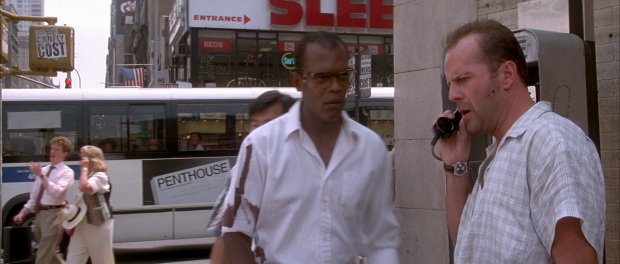
Finally, Die Hard with a Vengeance adds an unforgettable new character to go toe-to-toe with McClane on his harrowing journey: Samuel L. Jackson’s Zeus Carver. 

Accordingly, a man “alone” story (and franchise) becomes a buddy story instead; one with razor-sharp repartee and a high degree of consciousness about the black/wide divide in New York City at the time. 

Where Die Hard 2: Die Harder (1990) enthusiastically regurgitated the ending from the first film, and took pains to repeat familiar scenes and character tropes, Die Hard with a Vengeance feels edgy and fresh by contrast. The franchise feels rejuvenated.

All these changes are a recipe for a return to form, and Die Hard with a Vengeance proves itself the second best film in the five-strong saga, behind only the original Die Hard.


“It’s nice to be needed.”

During a hot summer, a mad terrorist who calls himself Simon detonates a bomb in busy Manhattan. As the city attempts to respond to this act of terrorism, Simon demands that NY police officer John McClane -- now “two steps shy of being a full-blown alcoholic” -- play a game with him.

John, still mourning the end of his marriage, has no choice but to agree, and his first task involves wearing a sandwich-board with racial profanity printed on it in Harlem.

Understandably, John’s incendiary garb catches the attention of Zeus Carver (Samuel L. Jackson), a proud and outspoken individual who interferes…and thus becomes part of Simon’s plan.

Simon leads John and Zeus on a merry chase through the city, playing “Simon Says” with them regarding an incoming train, and a bomb in a park and other challenges.

Soon, John learns the truth: Simon is actually Peter Gruber (Jeremy Irons), the brother of Nakatomi terrorist Hans Gruber. 

And while revenge appears to be his game, this Gruber shares his brother’s uncanny ability to misdirect authorities.


“This guy wants to pound you until you crumble.”

Die Hard with a Vengeance commences with a blast. The sequel opens with a crisply-cut montage of ordinary life in Manhattan, edited to the Lovin Spoonful’s 1966 hit, “Summer in the City.” 

Then a bomb detonates on a busy street, flipping over cars in the process, and the idea of tempers flaring on this hot summer day is beautifully expressed. 

This is a day which will see an explosion of violence and hot temperatures. Not only is this a summer-time setting a determined shift away from the wintry, Christmastime Die Hard and Die Harder, but the setting enhances the idea of temperatures rising among two very different men: John and Zeus.  They are like oil and water, and do not work together easily or well.

And that idea, of course, ties in with the “binary liquid” bombs Simon utilizes. These explosives only detonate when two unlike fluids flood together into one vessel. On their own, they are not combustible, but in combination…watch out!  


As one character notes “once the two liquids are mixed…be somewhere else.”

This is an observation abundantly true of John and Zeus as well. They bicker, quip, and challenge each other throughout the movie, with tempers soaring and accusations of racism flaring. But they also manage to solve problems, work together, and save the day. 

When they combine, things do get hot, though.  Indeed, everywhere John and Zeus go, they behind leave a trail of destruction and explosions. They are very much two unlike ingredients combining to explosive effect.

I appreciate that the movie makes race an issue, and doesn’t soft pedal its importance in the dialogue. So much of Die Hard 2: Die Harder felt rote, a by-the-numbers repetition of the ingredients that made Die Hard so great.

Yet there seems an ambitious attempt here to move back into a realm approximating our reality. John and Holly have broken up, and their rift isn’t easily repaired. John is an alcoholic, and has lost his sense of purpose. The reality of racism -- and racial mistrust -- fits into this leitmotif as well, and neither main character is ever treated as the bad guy. Instead, they circle each other warily, wondering if the other is a racist, or just very, very opinionated. Both men are heroes.

The late great Michael Kamen (1948-2003) contributes another pulse-pounding score for a Die Hard film here, and in this case, he weaves the popular Civil War song “When Johnny Comes Marching Home” (1863) into the proceedings many, many times. It works beautifully in the context I’ve described.

It’s an exaggeration to say that John and Zeus are fighting a civil war with one another, perhaps, but the movie does feature the idea that Simon is provoking a war of sorts in New York while he waltzes into the Federal Reserve Building to rob its gold.  Gruber knowingly makes temperatures rise on a hot day, so no one will detect his true agenda. He sets the City against itself. He sets blacks against whites. He even sets parents against police (setting a bomb in a school), and he mixes those “binary liquid bombs” of McClane and Carter.  That sounds very much like the definition of a civil war.


Irons also gives audiences the third Die Hard villain in a row to fake an American accent or dialect, and the idea has totally lost its impact by now, even if, overall Irons makes for a fiendishly effective villain.  I must admit, I enjoy the film’s call-back to Hans Gruber (Alan Rickman), and love the idea of that mastermind boasting an equally diabolical brother. Simon/Peter has some interesting tics, or at least appears to, but like his brother, he is really all about the money.

Die Hard with a Vengeance also succeeds because the action alternates from frenetic kineticism to buttoned-down suspense so assuredly. 

Sure, we get some amazingly choreographed moments like John’s impromptu taxi drive through Central Park, but then -- moments later -- we get this contained, intimate suspense scene involving the defusing of a bomb, or the playing of a Simon Says game.


The film is actually like a game of Simon Says in terms of its structure. It stops then starts, then stops again, until given license to cut loose. Every Die Hard movie needn’t work in this way,  of course but this new paradigm makes the film feel fresh and unpredictable.

Die Hard with a Vengeance possesses so much energy and verve, so much heat, if you will, that one might conclude it is only “two steps shy of being a full-blown” masterpiece.


Next Thursday for Die Hard on a Blog: Live Free or Die Hard (2007).

Movie Trailer: Die Hard with a Vengeance (1995)

Tuesday, February 09, 2016

Die Hard on a Blog: Die Hard 2: Die Harder (1990)


The biggest problem with Die Hard 2: Die Harder (1990), perhaps, is that it follows on the heels of a legitimately great movie in its franchise.  

John McTiernan’s Die Hard (1988) is brilliantly constructed in terms of its character dynamics, its camera-work, and even its primal male fantasy sub-text. It's the gold standard in terms of the action genre, at least for its era.

Die Hard 2 is good enough to merit a positive review, and proved an even bigger success at the box office than Die Hard did. But watching Die Hard 2 today, one cannot help but feel that virtually every ingredient featured this time around is a bit less artfully calibrated.

The villains are a huge step-down from Alan Rickman’s Hans Gruber, for one thing. Similarly, McClane begins the slippery descent from Every Man to Super Man in this movie, and the supporting characters who make a return appearance -- like narcissistic Dick Thornburg (William Atherton) -- feel shoe-horned into the plot. 

When the movie culminates with the first Die Hard’s R-rated catchphrase, and the same closing song  too -- “Let it Snow” -- the impression of not a sequel, but a rehash, is firmly cemented.

By contrast, the next film in the cycle, Die Hard with a Vengeance (1995) throws out enough standards (the isolated location, the man-alone syndrome, and the Christmas Day setting) to transmit as a more legitimately original follow-up to a masterful action classic.

This first sequel, however, expertly solidifies some intriguing elements that, perhaps, aren’t always considered in regards to the Die Hard formula. I admire here, for example, McClane’s pattern of cooperating with other Every Men (and Women) such as Marvin (Tom Bower) the janitor, Barnes (Art Evans)  the airport engineer, and non-narcissistic journalist, "Sam" Coleman (Sheila McCarthy)  

They are all real people, working real jobs, often going up against the bureaucracy -- or Establishment --  a key obstacle, if not outright villain, of the overarching Die Hard saga.

Undeniably, Die Hard 2: Die Harder is impressively-made and boasts moments of pure exhilaration. It is also superior to some of the franchise’s later entries, so it has that going for it. Yet -- to quote again  Roger Ebert and his review of Halloween II (1981) --  this sequel is still a “fall from greatness.”

Perhaps this sequel is not a steep fall, or a crash on the runway, but Die Hard 2 nonetheless begins showing the incipient symptoms of franchise-itis.


“You’re the wrong guy in the wrong place at the wrong time.”

L.A. cop John McClane (Bruce Willis) waits in Dulles Airport in Washington D.C. for the arrival of his wife, Holly (Bonnie Bedelia) from California.

Unfortunately, the renegade Colonel Stuart (William Sadler) and his team of special forces troops take over the air-port, stop all incoming flights, and attempt to rescue an incoming American hostage, deposed strong man General Esperanza (Franco Nero).

McClane must now get Holly’s plane safely to the ground before it runs out of fuel, and defeat Stuart, Esperanza, and a fiendish double agent, Major Grant (John Amos).


“Another basement, another elevator…how can the same shit happen to the same guy twice?”

Die Hard 2: Die Harder is based on the 1987 novel 58 Minutes by Walter Wager, which concerns a retired police detective fighting to defeat terrorists who have seized an airport, and get his daughter --trapped on a plane overhead --  down to the ground safely.

So if Die Hard was a dynamic extension of The Towering Inferno (1974) paradigm, Die Hard adopts its setting from not only a novel (like Thorp’s Nothing Lasts Forever), but from the disaster genre too, namely Arthur Hailey’s Airport.  

In the Airport movies -- which were released from 1970 to 1979, approximately -- a plane in flight is jeopardized, and intrigue occurs at an airport. Die Harder adds to this common scenario seem key real life "current events."


Colonel Stuart, for example, is a clear corollary for convicted felon (and failed senate candidate), Lt. Colonel Oliver North, who lied to Congress, and was a “functionary” in the Iran-Contra Scandal, which was still big news in 1989, when Die Hard 2 was conceived.  

The film also recreates the international conspiracy angle of that illegal operation with the presence of Esperanza and Grant as shadowy colleagues. In other words, the villains in this piece are American soldiers who don’t view the rule of law as an obstacle to them. They pursue their illegal and so-called patriotic agenda anyway, which actually involves propping up right wing dictators in third world nations. American lives mean nothing to these vainglorious scoundrels.

The James Bond franchise also featured an Oliver North-like criminal -- Joe Don Baker's Whitaker -- in 1987, in The Living Daylights.But despite the intentional resemblance to such real-life malfeasants, Stuart, Eperanza and Amos -- three villains for the price of one -- still can’t match Rickman’s urbane, self-aware Gruber in terms of menace. 

There’s even an unnecessary scene here in which Stuart apes a fake accent (Southern) to trick a British plane into crashing. The whole attempt comes off as a pale imitation of the “Bill Clay” scene in Die Hard.  

All three actors are fine in their roles, I should hasten to add, and I’m a big fan of Sadler (see: Bill and Ted’s Bogus Journey.) But three lesser-villains just don’t make up for one guy who is, essentially, the perfect bad guy. I believe it was a mistake dividing the villain role across three individuals, as not one of them offers the same kind of intricacy or three-dimensional personality as Rickman projected.  They don't have enough screen time, for one thing.

Renny Harlin achieves much directing Die Hard: Die Harder, but some of the core visual conceits here are quite different, and inferior to the original strategy. McTiernan’s furtive, desperate, rolling, tilting, panning camera is gone, and a consequence of that absence is that the action doesn’t feel quite as immediate. 

As I wrote in my review last week, Die Hard’s photography aped the man-alone desperation of McClane.  No such technique informs the action here.

Also, the camera-work and narrative details made it truly seem that McClane was in mortal danger throughout Die Hard.  He had to run across broken glass in one scene, and paid the price in blood. He was scared and desperate, and often won battles on the basis of pure grit and luck. In Die Hard 2, he has much greater -- and perhaps -- super-heroic luck.


For instance, there’s a silly scene set at the under-construction Skyway Annex. McClane is seen rolling across the floor -- in plain sight -- and terrorists bracket him. 

He rolls and pivots, in clear view, picking off the terrorists, and they don’t get in even one clear shot.  Not even a flesh wound!  Again, McClane is an obvious, slow-moving target.  

Even an Imperial stormtrooper would graze him!

The shot looks awesome, of course. McClane looks bad-ass slowly rolling across the floor, expertly picking off his nemeses, but the sense of furtive desperation is gone.

Similarly, in a later scene, McClane is trapped inside a grounded plane, as Stuart lobs a half-dozen or so grenades into the cockpit with him. The devices land next to his face, at his feet, and around the cabin. Yet McClane still gets ample time to strap himself into a chair, pull an eject lever, and escape the cabin before even one grenade detonates.

At most he would have 3-5 seconds, once the grenade lands.

He gets a lot more time than that to achieve his spectacular escape. 

Again -- mea culpa -- I love this scene in terms of the special effects presented, and Willis's spirited performance. It is fantastic and delightful to see the chair (with McClane strapped to it...) hurtle right towards the camera (taking up a position high in the sky), as an explosion blossoms below him. 

 But Harlin doesn’t get us to that great visual punch-line without cheating the set-up.


One is left to conclude that McClane has begun the journey from determined, gritty, human cop to Rambo-like super-hero. The slide is reversed a bit in the next film, which gives McClane a hang-over, and restores the furtive camera-work. 

But then the slide continues, unabated in the franchise.

Still, I appreciate how Die Hard 2: Die Harder sets out to establish or fully-cement some aspects of the so-called Die Hard paradigm. 

Here, McClane allies with people who, if not outright blue collar in terms of their jobs, are either cultural/gender minorities, or out of power, to achieve his ends.  

He befriends a reporter named Samantha, for instance, who comes through for him right when he needs her.  McClane treats her with respect (or at least more respect than Stuart does...), and Samantha gets him access to a helicopter when he needs it.


Engineer Barnes, largely ignored and considered unimportant by his superiors and Carmine, demonstrates ingenuity and initiative in finding the terrorists’ headquarters at a nearby church.  


And Marvin the janitor is crucial in leading McClane from one part of the airport complex to another. These three friends -- disdained, disciplined, and lacking privilege and/or authority -- are crucial to John’s success.


By contrast, Die Harder also diagrams the idea that there are two kinds of bad guys in these films.  

First, there are the terrorists who actually attempt to do evil, with finely-crafted strategies and brute force.  

And then there is the establishment, or bureaucracy, which prevents John from doing his job successfully.  

Representing the latter category, we meet two police officers, Carmine Lorenzo (Dennis Franz) and his brother, Vito (Robert Constanzo), who make one wrong-headed decision after the other, thoroughly gumming up the works and making it easier for the terrorists to complete their anti-social tasks.  

Trudeau (Fred Thompson) is a more neutral “establishment” figure, one who must be persuaded to trust McClane, but who then qualifies an ally of sorts.

Part of the Die Hard franchise’s Every Man appeal involves this “Fighting City Hall” story angle. John makes friends and enemies as he fights the good fight. And he has a perfect barometer in choosing his friends. They are are usually lower-level, disenfranchised people who nonetheless know their jobs, and clearly see right from wrong.  

Yet the nearer the distance to power someone becomes, these movies tell us, the harder it is for people to embody that kind of clear-headed thought. They are bogged down in red tape, and lose their clear moral compass.

Die Hard 2: Die Harder succeeds as much as it does because the location/setting -- a snowed in airport -- is unique and intriguing, and the danger to the planes overhead is palpable. It is a horrific scene, indeed, when the terrorists trick a plane into landing…and it blows up on the tarmac. 

We all harbor a fear of flying, at least at some level, and Die Hard 2 absolutely taps into that universal dread.


Yet still, by the end of the film, I felt that the sequel had failed to tread boldly enough into new territory. Having John note “how can the same shit happen to the same guy twice” is meta and funny, I suppose, but  the in-joke doesn’t cure the film of its particular deficit: repeating too many of the ideas that informed John McTiernan’s original.  It tells the same jokes, in other words, but tells them less effectively and artfully.

For purposes of franchise building, I absolutely believe that McClane can -- and indeed, must -- get himself into danger again.  

I have more trouble believing it would occur again on Christmas Eve, and so intimately involve his wife Holly and journalist Thornburg. The movie’s choice to end again with fire and “Let it Snow” is also a sign of creative exhaustion.  

Too many notes are, literally, repeated.

Clearly, Die Hard 2: Die Harder got the job done, both at the box office and in terms of fan expectations. I can second-guess it all I want, and the facts don't change.

It’s a solid sequel. But at the same time, some of Die Hard’s inspiration clearly didn’t make the flight with the rest of the luggage.


Next Week for Die Hard on a Blog: Die Hard with a Vengeance (1995).