The first two films in the long-lived Alien franchise tend to stir passionate debate, especially when placed in direct comparison to one another.
There are those viewers who appreciate Ridley Scott's terrifying, original 1979 "space trucker" film and consider it the superior work of art. And then there are those who feel just as strongly regarding James Cameron's intense, militarized sequel, Aliens (1986). The bottom line, however, is that each film is superb in its own unique manner and style.
James Cameron's greatest decision regarding Aliens, perhaps, involves his judgment to move the protean film series in a fresh direction. His sequel does not, in any significant manner, attempt to re-create the Gothic atmosphere of Ridley Scott's classic horror film. Instead, the Cameron film forgoes the "ten-little-Indians," or "haunted house in space" aesthetic of Alien for a wider, more epic scope, one exemplified by the well-remembered ad-line "This time, it's war."
Where Scott's Alien focuses on an atmosphere of dread, jumps and jolts, plus out-and-out terror, Aliens functions more as a non-stop rush; a roller-coaster ride of almost unparalleled excitement. And as much as Scott brought his remarkable perspective to Alien, James Cameron imbues the sequel with his own individual viewpoint and obsessions. The result is that Alien and Aliens complement each other in a most gratifying and satisfactory fashion. Each film is the superlative work of an individual artist; meditations on a theme (or franchise), as it were, with Sigourney Weaver and the titular monsters as the primary connective fabric.
To fit the film into his career, James Cameron movies often feature strong female characters, and comment on matters of military and big business. Aliens very much fits this description. At the center of the action is Sigourney Weaver's Ripley, a paragon of common sense and intelligence in two spheres where such qualities seem in alarmingly short supply (the futuristic military establishment, and the Company's hierarchy, specifically.)
The basis for Ripley's common sense, bravery and intelligence arise, apparently, from her initial experience with the alien in the Scott film, but also, importantly, from her singular status here as a fish-out-of-water. As the film opens, Ripley is 57 years out of her natural element, and (in the special edition of the film) has lost her only daughter. These qualities diagram Ripley as both outside a command structure of any type, and as a woman seeking to re-capture what she has lost, namely motherhood.
Because she is unfamiliar with the technology and protocols of the soldiers and the space yuppies, Ripley is also a powerful surrogate for the audience: one who catches on quickly, and who countenances no bullshit regarding the hostile alien species. We in the audience share Ripley's concerns, having "lived through" the traumatic events on the Nostromo with her. A distinctive quality of Cameron's approach in Aliens is that he uses our familiarity with Ripley and her "biases" (regarding androids, for instance), against us. He plays on our expectations again and again, to layer surprises and shocks into the film's narrative. These "bumps" in the road have the effect of keeping us both off-balance and anxious.
A movie of breathtaking action and intense emotions, Aliens also ably functions on an allegorical level, serving as a commentary on American involvement in the Vietnam War (1962 -1975). This commentary makes the film a crucial example of the Vietnam War film "revival" that occurred mid-way through the two-term Reagan Presidency, and which -- for lack of a better description -- re-fought the conflict either under more favorable, familiar "war movie" terms (Rambo: First Blood Part II [1985]) or which, contrarily, demonstrated vividly why the Vietnam War seemed a lost cause (Platoon, Full Metal Jacket, etc.)
At the time of the film's release, critics were overwhelmingly positive about James Cameron's Aliens, often comparing it favorably to Alien. Elliott Stein at the Village Voice termed the sequel "intense, suspenseful" and "filled with gritty dialogue." Time Magazine voted Aliens one of the ten best films of 1986 and noted its "technically awesome blend" of horror and science fiction. I still remember Joel Siegel's review on ABC TV at the time, wherein the movie critic noted that the last half hour of Aliens was like attending a Bruce Springsteen concert...from "inside the bass drum."
In terms of James Cameron's career, Aliens (1986) was the director's first big budget motion picture following the surprise success of The Terminator in 1984. Aliens also features several members of the unofficial Cameron repertory company, including Michael Biehn, Lance Henriksen and Bill Paxton, all of whom appeared in his previous effort. But Aliens was not just an expensive film "reunion" for Cameron: it was the opportunity to prove that The Terminator was not a fluke, and that he could successfully tell a story against an epic backdrop and in an already-established universe.
Needless to say, considering the film's sterling reputation today -- now 25 years later -- Cameron succeeded wildly with Aliens. In 2011, the film still thrills both as a straight-up war movie in space, and as a metaphor for America's involvement in Vietnam.
"We're on an express elevator to Hell...going down!"
Fifty-seven years after the events of the movie Alien (1979), Ellen Ripley (Sigourney Weaver) is awakened from hyper-sleep when her shuttle, the Narcissus, is recovered by a salvage crew.
Once back on Earth, Ripley meets with representatives of the Company, including Carter Burke (Paul Reiser), regarding events aboard the Nostromo. She recounts her story of the hostile alien life form that her crew encountered on distant LV-426, but Company executives are skeptical of the tale, They suspend Ripley from flight duty. Meanwhile, Ripley learns from Burke that her daughter died -- an old woman -- not long before Ripley was recovered.
Some time later, Carter and a representative of the Colonial Marines, Lt. Gorman (William Hope), visit Ripley in her small apartment. The terraforming colony on LV-426 has dropped out of communications contact, and the Company fears that Ripley's "monsters" have reared their heads. After getting assurances from Burke that the mission is to "wipe out" the aliens and not study them, Ripley agrees to return to LV-426 with a platoon of well-equipped Colonial Marines. Among the crew is Bishop (Lance Henriksen), a "synthetic" or android. His presence doesn't sit well with Ripley because of her encounter on the Nostromo with the android Ash.
Upon arrival at LV-426, Ripley and the Marines discover the only apparent survivor of an alien attack, a small girl named Newt (Carrie Henn). Ripley bonds with the child almost immediately, even as Gorman sends in the platoon to examine life signs emanating from the terraforming station. There, the marines discover the cocooned survivors of the colony, now being used to propagate the alien life cycle.
After a disastrous first engagement with the aliens and the destruction of the military drop ship, Ripley, Newt and the surviving soldiers take up sanctuary in a control center, and attempt to procure a second vehicle for evacuation from their orbiting ship. Unfortunately, the aliens are on the move again, and a traitor -- now exposed -- makes his move.
As more of the soldiers are killed in action, Ripley attempts to rescue Newt, who is taken to the alien "hive" for facehugger implantation. There, Ripley and Newt encounter a new foe: the Alien Queen. To escape from this monster, Ripley must put her trust in someone she fears: the inhuman Bishop.
"Hey, maybe you haven't been keeping up on current events, but we just got our asses kicked, pal!" - Aliens and The Vietnam War
It took the American cinema a good long time to understand and synthesize the nation's traumatic experience in the Vietnam War.
Although celebrated films such as Coming Home (1978), The Deer Hunter (1978) and Apocalypse Now (1979) all played theatrically in the same decade as the war's ending, it was not truly until the Reagan Era that a real renaissance in Vietnam War films arrived in theaters.
From 1984 to 1989, audiences saw Missing in Action (1984), Rambo: First Blood Part II (1985), Oliver Stone's Platoon (1986), Stanley Kubrick's Full Metal Jacket (1987), Hamburger Hill (1987), The Hanoi Hilton (1987), and 84 Charlie MoPic (1989), to name just a few films.
Why had the floodgates opened to the Vietnam War film in the 1980s, in both action mode (Chuck Norris, Sly Stallone) and award-winning mode (Stone, Kubrick)? In part it may have been because of President Reagan's Operation Urgent Fury in 1983, a successful invasion by American forces of the small Caribbean island of Grenada.
Unlike the Vietnam conflict, which lasted through the presidencies of Kennedy, Johnson, Nixon and Ford, this effort was a short, contained engagement and one in which the Americans could readily and easily be declared victorious. There was no "mission creep," so-to-speak. In that new moment of American victory and clarity, it was easier, perhaps, to exorcise the demons of Vietnam than it had been in the 1970s, when new military failures such as President Carter's Operation Eagle Claw only reinforced the sense of America's inability to use armed force successfully.
Whatever the reason, Aliens quite clearly fits into the Vietnam War movie trend of the mid-1980s. In fact, at least metaphorically-speaking, it could even be considered the ultimate Vietnam War film, even though it concerns alien monsters not Viet Cong, and space marines rather than American soldiers.
Whatever the exact reasons, the Vietnam War was clearly on Cameron's mind as he fashioned the script for his sequel to Scott's
Alien. Cameron had recently finished writing
Rambo: First Blood Part II for Stallone and
by his own admission "
was kind of fascinated by Vietnam at that point."
This obsession with the American experience in Vietnam plays out in Aliens in several ways, but most importantly in the style of warfare portrayed in the film. In considering the Vietnam conflict, the authors of Living Through History: the Twentieth Century World described a war in which the Americans brought the latest, high-tech equipment (such as helicopter gunships and rocket launchers) but were met by an enemy, the Viet Cong, who "did not fight open battles, where these weapons could be used." (Heinemann Educational, 1988, page 77.) Furthermore, after their attacks, the Viet Cong "melted back into the jungle where the Americans could not find them."
This overarching dynamic is almost perfectly replicated in the battle of LV-426 in Cameron's film. The Colonial Marines come bearing M41A pulse rifles, drop ships, synthetic officers (Bishop), flame-throwers, smart guns, APC vehicles, and motion detectors, yet their weaponry proves entirely ineffective in stopping the alien attacks. The aliens don't literally "melt back into the jungle" here, but they do seem to melt into the walls of the terraforming station, a trick which offers them perfect natural camouflage.
Or as Hudson notes: "They're coming outta the walls. They're coming outta the goddamn walls!" The alien battle tactics are certainly guerrilla in nature, then. The beasts use natural cover (their resin-coated caverns), pools of water, and air ducting to engage the humans in conditions favorable to their extra-terrestrial strengths. This is not a "stand-up" fight in other words. Again, consider that in Vietnam the Viet Cong was famous for using a subterranean tunnel supply system. Once more, the aliens mirror that function, taking up residence in the "sub levels" of the battlefield, moving back and forth out of easy sight.
It is not just in battle specifics that Aliens re-parses the details of the Vietnam War. The central argument against the Vietnam conflict on both the conservative and liberal sides of the political spectrum has always been that America fought a "limited" and "bureaucratic" war, one in which the U.S. could not simply annihilate the enemy, or invade and occupy the country. A common refrain heard at the time of the Vietnam War was that our superior military forces were fighting with one arm tied behind their backs. They were never really unloosed...to win, hence Rambo's memorable plea to his superiors, "do we get to win this time?" Whether or not this perception is entirely true is beside the point in regards to Aliens.
Here, quite clearly, the problem is that the Colonial Marines fight a limited, bureaucratic war in much the same fashion. Their wrong-headed commander, Lt. Gorman orders the committed troops -- in the battle zone, no less -- to holster their pulse rifles and smart guns. He even has the sergeant collect their magazines. The reason for Gorman's action is valid: delicate machinery ("primary heat exchangers") stands nearby and could be destroyed (thus causing a nuclear blast...) should it be damaged.
But suddenly, these high-tech soldiers are forced to use old-fashioned pistols and shotguns to fight their invisible, incredibly powerful enemy. Like the American forces in the jungles of Vietnam, the Colonial Marines thus wage a war with one hand tied behind their backs, and not surprisingly are unable to win that war in direct engagement.
On the urging of Burke, Gorman attempts to safeguard property (corporate property) ahead of actually winning a battle, or even safeguarding his men. Burke's agenda is to preserve an expensive "investment," not destroy the aliens, and so the bureaucratic agenda surfaces and, again, clouds the rules of war.
It goes further than that. Ripley herself becomes a vocal advocate of a different-style of warfare. After suffering a debilitating defeat, she suggests to Corporal Hicks (Biehn) that the marines return to the Sulaco and "nuke" the alien hive from orbit because it is the only way "to be sure" the alien threat is neutralized. Naturally, Burke can't get on board with that idea, and he says that Hicks is just a corporal and "not qualified to make a decision like that." Again, he is attempting to impose limits on the nature of the fight. These are limits, by the way, that the aliens don't observe. Rightly, Hicks overrules the yuppie.Importantly, Ripley's nuke-the-whole-site-from-orbit plan is a philosophy in direct contradiction to the "limited war" scenario engaged by both Gorman and by American generals in Vietnam. Ripley's suggestion, in the fictional case of Aliens at least, seems entirely reasonable. If the colony is overrun by deadly aliens, why engage them at all on ground level? Limited, bureaucratic war is not a blueprint for victory, the film seems to make note. Again, this doesn't mean (at all...) that nuclear weapons should have been utilized in the Vietnam War, only that the bureaucratic, one-hand-behind-the-back strategy settled on by the American leadership was flawed, and in some sense, lacking in common sense. Why fight a war if you don't intend to leverage your own strengths and win it? Like Rambo before her, Ripley seems to be searching for a way to "win this time." That way to win is, specifically, by avoiding the half-measures and limitations imposed by generals and bureaucrats. Accordingly, the end of the film sees the terra-firming station go up in an (accidental) nuclear blast, and the survivors returning home, their enemy vanquished. This is a victory (at least after a final "bump" with the Alien Queen) denied America in Vietnam. You may remember the shocking images of helicopters pushed off air craft carrier decks as the U.S. Armed Forces returned home in 1975, for instance. Aliens re-fights the war on better terms, and brings at least some of the boys (and girls) home from the battlefield. At least until the sequel.There are other simple connections to Vietnam in
Aliens as well. Many Americans felt that the Viet-Cong were primitives living in "
rice paddies." Their tactics, experience and skill were not respected, nor honored. Because the Viet Cong weren't from a modern, high-tech, industrial
Western culture we were lulled into believing that the war would be a cake walk. The opposite, of course, was true. In
Aliens, the marines --
but never Ripley -- often underestimate the aliens in a similar fashion. When the aliens cut the power to plunge the hiding marines into darkness, Hudson wonders aloud how "
animals" could have cut the power. Even at this late juncture, he is still making the mistake of underestimating his opponent. The aliens are not just animals: they are a highly organized hive mind,
a surrogate, in some sci-fi way, for Communism, too, I should point out. And of course, Communism was the real American target in the Vietnam War.
Right down to the marines' manner of self-expression,
Aliens very powerfully suggests the Vietnam War of the 1960s and 1970s. "
The dialog itself, the idiom, is pretty much Vietnam era," Cameron
reported in an interview here. "
It's the most contemporary American combat "war speak" that I had access to. I studied how soldiers talked in Vietnam, and I took certain specific bits of terminology, and a general sense of how they express themselves, and I used that for the dialogue, to try and make it seem like a realistic sort of military expedition, as opposed to a high tech, futuristic one. I wanted to create more of a sense of realism rather than that of an interesting future."Another unique facet of The Vietnam War:
many Americans did not understand why the war was fought. The notion, of course, was that if Vietnam fell to Communism, other countries (Laos, Thailand, etc.) would also fall like "dominoes" to that ideology.
But who were our allies, exactly? What would victory look like?
Why should the average American on the street, struggling to make ends meet, care about what was happening in Vietnam, half a world a way? This wasn't like World War II, for instance, where fascism was moving like a dark tide across free Europe, and the consequences were easily understood. Instead, the motives and strategies surrounding the Vietnam War were ones of intellectual gamesmanship. It was, as James Cameron himself noted "
a weird and surreal kind of war."
In contrast to the military in
Aliens and the American soldiers serving in Vietnam,
Ripley boasts a very strong
and clear
personal motivation for fighting a war on LV-426. She has an individual connection to Newt...a "family" member of a sort.
So she picks up arms to fight the aliens, and does so effectively. I have always believed that Ripley is an example of the everyman (or woman) here in America. When our families are attacked or threatened, we will fight.
To the death. But to fight for simply a cerebral theory of geopolitics (the Domino Theory), and one ultimately proven wrong, hardly seems an effective use of military might. What Cameron appears to express in
Aliens is his grave concern about the application of American military power in foreign land when there is not a clear and just cause. This idea resurfaces powerfully in both
The Abyss (1989) and
Avatar (2009).
All this established, I think it's important again to note that Cameron is not anti-military. The "grunts" in the film, from Hicks to Hudson to Vasquez are clearly heroic in nature. Hicks is effective as a leader. Ultimately, Hudson finds his sense of courage. Vasquez fights to the death to save her fellow marines and survivors. Even the green Gorman finds redemption at the end, taking out a handful of aliens in a final act of self-sacrifice. So I don't think that Cameron is reflexively against the military or so-called "just" wars. Rather, his stance reminds me of what President Obama once said (and has since forgotten, vis-a-vis Libya): that he isn't against wars; he's just against
dumb wars. In other words, there are legitimate applications of military might; but you better think them through; and you better fight to win.
Game over, man! Game over! Aliens and the fog of war.
The comparison to the Vietnam War in Aliens also involves another important element: "the fog of war."
For those unfamiliar with this term, it means, essentially, the uncertainty of the participants in a military operation once it has begun.
That uncertainty can cause mistakes and fatalities. There are different categorizations for "the fog of war," including operational types (meaning the commander of a force not having full sight of a mission imperative, for instance), or strategic type. In the strategic type, the commander fails to grasp the geography of the battle,and the enemy's capabilities, to the detriment of his men and his cause.
In Aliens, Gorman makes a fatal mistake of the strategic type by sending his soldiers into a trap; a trap from which they can't utilize their high-tech advantage. But what's most interesting about this failure is Cameron's method of visualization.
Throughout the early portions of the film, Cameron shows audiences how each soldier wears a camera mounted on his or her helmet. And then, he reveals Gorman's command post in the APC: a small corner of assembled video screens tracking the footage of each individual soldier, as well as ancillary data such as "mission time" and life-sign readings. When full scale war erupts in the terraforming station sub level, Cameron cuts to relatively few "live" shots of the soldiers actually battling the aliens.

Instead, Cameron cuts repeatedly to the chaotic images on those video screens as all hell breaks loose. We see static, for instance. We register failed communications and see a "rolling" picture. We see herky-jerky, hard-to-interpret visuals of gunfire, and marines in action. Marines repeatedly run directly at camera (at us), screaming above the din of bullets and hissing aliens.
In essence, Cameron reveals to us a futuristic version of the Vietnam War's particular brand of "fog." If you go back and watch Oliver Stone's Platoon, you'll notice how there are almost no clear battle lines, no clear "sides" in the many scenes of combat. Soldiers seem to run endlessly through the jungle, back and forth, constantly under attack, while air strikes occur all around them. It's Death from Above...and everywhere else, for that matter. It's impossible to guess where the enemies are hidden, at least in terms of geography It is pandemonium on a vast scale. As viewers we have no sense of visual order; of the enemy being on the left or right. Instead, we sense danger everywhere.
In Aliens, Cameron cleverly pinpoints a corollary for that approach, giving us "electronic" fog of war, essentially, in the first battle sequence. He uses video imaging, failed communications, and grainy visuals to suggest the bewilderment and panic of the grunts on the ground as they are attacked from all sides by an enemy that seems to literally appear out of nowhere, melting out of the walls. The point, of course, is that our technology will do us no good when fighting the aliens. The fractured, indecipherable images on a video screen provide us our only clues about what is happening, but again, don't reflect relative positions of armies or fighters.
The prominent use of the video screen is especially important in Aliens. You may remember that Marshall McLuhan once wrote (in May of 1975, for the Montreal Gazette) that "television brought the brutality of war into the comfort of the living room. Vietnam was lost in the living rooms of America, not on the battlefields of Vietnam."
In Aliens, the video screen dramatization of a hopeless battle seems to recall this particular scenario. We see the war fucked up to Hell on the video-sets in the film, and at least subconsciously (if you are the right age...), you will be reminded of similar images from the Vietnam conflict. In fact, while Gorman sits speechless, resigned to a catastrophic loss, Ripley leaps into action. She thus takes -- literally -- the living room (the APC) to the battlefield to effect action: to rescue the men and women still in combat. It's a weird reversal of the dynamic in the Vietnam War; as if American citizens could step up from their sofas and impact the goings on half-a-world away. And again, it's a way of saying (like Rambo), this time, we get to win. We don't just sit back and watch helplessly.
"I work for the company. But don't let that fool you, I'm really an okay guy" - The Yuppie Mentality in Aliens.
Again, some history is useful here. Newsweek termed 1984 the "Year of the Yuppie," and identified over one million Americans as belonging to this this newly identified demographic (Young Urban Professionals).
By and large, the Yuppies were baby boomers, and therefore former hippies. But these peaceniks had by Reagan's years traded their political activism for stock options, power suits, and corner offices. Primarily, yuppies were concerned with personal status and conspicuous consumption. In other words, making oodles of money. A side effect of this self-absorbed outlook was that many Americans who were not Yuppies were left behind. This was an America were the rich grew richer, and everyone else was getting squeezed out. By the end of the 1980s, horror films were obsessing with this class warfare gap in films such as They Live (1988) and The People Under the Stairs (1991).
In Alien, audiences learned that The Company had thoughtlessly sent the crew of Nostromo to acquire an alien life form for study, considering the men and women of the ship "expendable." In Aliens, we actually get to meet some of those Company executives and V.I.P.s...and it is isn't pretty.
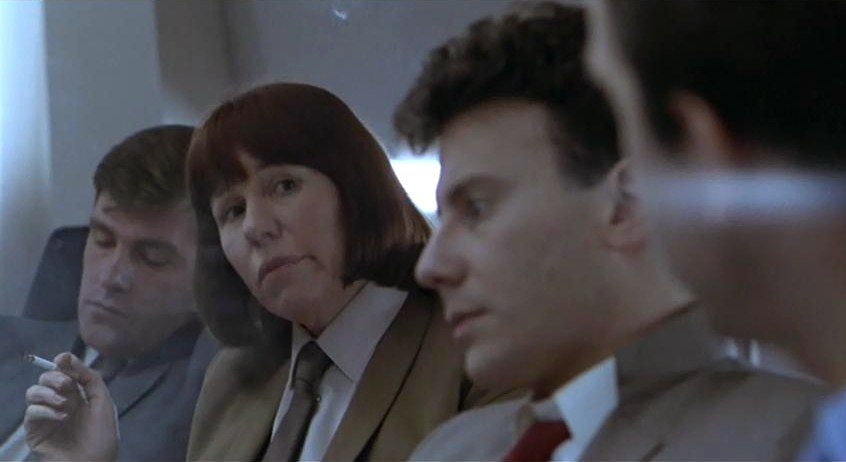
In an early scene set in a smoky board room (replete with coffee cups, fancy business suits and clouds of cigarette smoke...) we watch as the Company Board stages an inquisition at Ripley's expense. The Board arrives at the pre-ordained conclusion that Ripley is a liar, and focuses simply on the bottom line. Ripley admits to having destroyed the Nostromo, a "very expensive piece of hardware" and is summarily dismissed for her negative contribution to the bottom line.
Appropriately, Ripley terms the concerns of the Company "bullshit" and walks away from it, but the Yuppies aren't done with her yet.
In fact, the colonists on LV-426 face horrible death because an executive, Carter Burke, sent them out to the very coordinates Ripley specified on one of her reports: the location of the alien derelict ship where thousands of eggs were located.
Notably, Burke does so without warning the colonists of what they might find. Why? He wants to save the lion's share of the profits from the aliens for himself. This is how he rationalizes his behavior: "What if that ship didn't even exist? Did you ever think about that, I didn't know! So, now, if I went and made a major security situation out of it, everybody steps in; Administration steps in, and there's no exclusive rights for anybody, nobody wins! So I made a decision, and it was... wrong. It was a bad call, Ripley. It was a bad call."
Notice the terminology there: "bad call."
It explicitly refers to Wall Street jargon (namely "call options"), but more importantly, Burke's comments share the attitudes of many "players" on Wall Street. For a living, they gamble with the retirement and pension funds of investors, and don't necessarily act responsibly in light of such responsibility. In essence, Burke does the exact same thing in Aliens, playing with the lives of the colonists on the chance that he could win "exclusive rights" to what he perceives as a treasure trove: the rights to alien biology and "bio-weapons" created from it.
Aliens' most trenchant and memorable observation about yuppies and 1980s yuppie values comes from Ripley. She compares the Aliens -- a hive mind working for the common good of their race -- with Burke's brand of selfish "humanity:" "You know, Burke, I don't know which species is worse. You don't see them fucking each other over for a goddamn percentage." She's right. As hideous and monstrous as the Aliens appear and act, they move as one; they don't betray and sabotage one another so one drone can get ahead.
Although Aliens arrived before the stock market crash of 1987, it certainly suggests the fall of the Yuppies, because of this self-absorbed attitude. Had Burke worked to protect Ripley, Newt and the Marines, they would have certainly reciprocated and worked to save him when push came to shove. Instead, Burke is left alone, and therefore without the support he needs to survive in an arena overrun by aliens. His very philosophy of life -- me first! me second! and me third! -- dooms him. Of course, he's too short-sighted to see it.
Clearly, Burke is the most despicable character in the film. He's a liar, a turncoat and a murderer. But what makes him so sick is that all of his sins came about from a desire simply to be rich. Again, the Aliens act according to their nature, not out of extraordinary malice. They kill, certainly, but do so not to acquire personal wealth, but to assure the continuance of their species. This is a very sharp counterpoint to human behavior in the Reagan/Yuppie Era, and one not lost on audiences.
There's so much more to discuss here regarding Aliens, yet this review has certainly gone on long enough.
So, if you'll forgive me, I'll close with a few bullet points to think about while you watch the film:
1. Cameron shows a real preference for movement within the foreground of the frame, especially during action sequences. In the climactic battle between Ripley (in a power suit) and the Alien Queen, for instance, one hydraulic arm moves up and down in the frame repeatedly, obscuring our view, occasionally, of the close-quarters, mother-against-mother combat. This movement not only takes our eyes away from any deficiencies in terms of special effects; it adds to our desire to "see" the action and makes the action seem all the more urgent. Cameron would utilize the same approach (with a swinging light panel in the foreground of the frame) during the knife-fight in The Abyss.
2. Aliens reads as a "faithful" continuation of Alien despite deliberate alterations in the alien life-cycle in large part because Cameron has, like Scott before him, targeted a particularly colorful class of people, namely blue collar people, as main characters. In Alien, the crew of the Nostromo was famously termed "space truckers," and Brett and Parker constantly complained about their contracts, shares and responsibilities in the Company. In Aliens, Cameron lands us into battle with blue collar "grunts," and their flamboyant and gritty language also seems real, and often very funny. In particular, the character of Hudson is a source of continuous humor with his colorful observations ("Game over, man! Why don't you put her in charge? You want some of this?!). But the tenor of the characters from Alien to Aliens is surprisingly consistent. Both films pit the average joe -- of stalwart heart -- against faceless and callous white collar-types: business executives and military higher-ups.
3. Aliens has often been termed the ultimate battle of the Moms: Ripley vs. The Alien Queen. That dynamic is definitely present here, and it is interesting to contrast these two matriarchs. Ripley suffers from guilt because she was not "there" to raise her biological daughter, and so goes to extreme lengths to protect Newt from danger. She won't make the same mistake twice. The uber-protective mother resurfaces in Cameron films such as Terminator 2: Judgment Day (1991), but here is contrasted with a mother of a very different and inhuman perspective.
Specifically, the continuance of the Alien race rests with the Queen and her survival, whereas the continuance of the human race rests with the child, the heir to our lineage. The Alien Queen ultimately fights to the death for her own survival then (so she may lay more eggs), whereas there is an emotional, personal connection and component to Ripley's love for Newt. She would never consciously choose her own survival over the child's. This is the difference, perhaps, between the mentality of an insect, and the mentality of a mammal.
4. The last half-hour of Aliens is a virtual replay of the finale of Alien, only with more combat, and bigger, more elaborate sets. Once more, Ripley is required to don protective gear (a power suit rather than a space suit) so as to eject an alien life-form from a spaceship, via the airlock. Only in this case, Ripley is fighting for more than her own survival (or the survival of a cat). Here, she has an android, another adult, and a child to safeguard. The higher stakes in this battle render the "rerun" ending incredibly effective and it hardly seems like a regurgitation of what Scott accomplished. But at least from an objective standpoint, the film's final act is the only part of the film that slavishly mirrors the dynamics of its predecessor.
5. I always find it interesting how the Alien films treat non-humans and non-aliens. In Scott's Alien, Jones the Cat was just as much a survivor as Ripley, and operating as much by its unique nature as were the humans and the alien. In Aliens, another non-human, Bishop, plays a critical role in the action. And he too lives up to his unique nature (or programming, in his case.) Ripley's eventual rapprochement with Bishop is a good example of the fact that humans need not be obsessed with jingoistic hatred or malice for "the other." In a series obsessed with violence, and with aliens and humans at war, this is a nice bit of business to throw in. Humans still have the capacity to empathize with other creatures even if they are different, like Bishop, who comes across as a complete innocent. There can be little doubt here that Bishop is the model for Star Trek: The Next Generation's Lt. Data.
In so many ways large and small, Aliens is almost a perfect time capsule of the 1980s. It shares that decade's obsession with the Vietnam War, and with the emerging Yuppie culture. As a sequel, it is bigger and more elaborate than its progenitor, and it features state-of-the-art special effects sequences. But what makes Aliens resonate beyond the original context is its overwhelming sense of heart. The bonds between Ripley and Newt, and even the bond between the Marines are strong evidence that man is the superior species in this war with an aggressive species, and will ultimately prevail.
James Cameron makes big, expressive, emotional action films, and Aliens is one of the best of that category ever made. The performances are uniformly strong, and Sigourney Weaver was nominated for a Best Actress Oscar. But most importantly, Aliens cogently reminds the viewer of a critical and powerful human truth.
If you are fighting for a just cause -- for your family, for instance -- you truly feel like can slay dragons.

 Posts