Subscribe To JKM


 Posts
All Comments
Posts
All Comments
Showing posts with label 1983. Show all posts
Showing posts with label 1983. Show all posts
Wednesday, April 24, 2019
Theme Song of the Week: Dungeons and Dragons (1983)

 award-winning creator of the web series Abnormal Fixation (2024), the audio drama Enter the House Between (2023) and author of 35 books including Horror Films FAQ (2013), Horror Films of the 1990s (2011), Horror Films of the 1980s (2007), TV Year (2007), The Rock and Roll Film Encyclopedia (2007), Mercy in Her Eyes: The Films of Mira Nair (2006),, Best in Show: The Films of Christopher Guest and Company (2004), The Unseen Force: The Films of Sam Raimi (2004), An Askew View: The Films of Kevin Smith (2002), The Encyclopedia of Superheroes on Film & Television (2004), Exploring Space:1999 (1997), An Analytical Guide to TV's Battlestar Galactica (1998), Terror Television (2001), Space:1999 - The Forsaken (2003) and Horror Films of the 1970s (2002).
Monday, February 06, 2017
Cult-Movie Review: Blue Thunder (1983)

John Badham had a banner year in 1983 as the director of two blockbuster techno-thrillers: War Games and Blue Thunder.
Both
films involve the bugaboo of advanced computer technology, which was, generally
speaking, the broad theme of many genre films in 1983. Films from Superman III and Never
Say Never Again to the anthology Nightmares circled around the
frightening notion that our technology might run amok, or at the very least
fall into the wrong hands.
Blue
Thunder is
among the most entertaining of this 1983 techno-bunch, and it pushes the pedal
hard on action and spectacular fireworks. Although some of the character
dialogue is undeniably clunky, the movie nonetheless accurately forecasts the
rise of the modern surveillance state, one fact that makes the film relevant in
2012. Today, however, the helicopter
prototype’s spying capability looks positively quaint.
Certainly,
Blue
Thunder owes some creative debt to 1982’s Firefox, another film concerning
a deadly hi-tech aircraft and a protagonist battling PTSD following the Vietnam
War. Yet the action here is so rousing
that it is easy to gloss over the film’s occasionally contrived plot mechanisms
or its transparent debt to other cinematic thrillers.
In
fact, Blue Thunder was so well-received by audiences of the day that
it spawned a TV spin-off (also titled Blue Thunder), a terrific TV
knock-off (Airwolf), and a model kit of the titular vehicle, which I owned,
built…and cherished. Wish I still had it…
Although
this film is over thirty years old, Blue Thunder’s visceral obsession with
state-of-the-art aerial combat (over a modern American city, Los Angeles, no
less), permits it to hold up much better than WarGames. Also, the film remains relevant in part
because of the strongly enunciated social commentary about man and his machines.
In
short, machines don’t yet boast the capacity for morality, and so man must decide how to use his new toys. In Frank Murphy -- a veteran who witnessed immorality among men in Vietnam -- the audience
gets a hero who represents mankind’s inherent struggle against entrenched
power, and power unconcerned with the good of the many, but rather the riches
of a few. Yet despite being outnumbered
and outgunned, Murphy won’t let the machine take over, even if that outcome is precisely
what big government and big business apparently desire.
In
gazing intently at conspiracy and corruption (not to mention the nexus of
government and big business government contractors), Blue Thunder in some
fashion feels like a product of the 1970s, the great age of conspiracy
movies. But the strong focus on
computers and technology also gives it the Video Game Age sheen of the early
1980s.
In
whatever way one chooses to parse the film, Blue Thunder remains a
hell of a lot of fun.
“I love morals, and the
moral of this story is: If you're walkin' on eggs, don't hop.”

Cop Frank Murphy (Roy Scheider) and his rookie co-pilot Lymangood (Daniel Stern) of Los Angeles Air Support test fly a new urban pacification helicopter nicknamed “Blue Thunder,” over the city streets, and while on surveillance or “whisper” mode, learn of a wide-ranging conspiracy involving corruption and murder.
The
makers of Blue Thunder prototype have been making trouble in L.A.’s barrio so
the city will requisition more copters to manage the crime problem before the
upcoming 1984 Olympics. This top secret
project to create urban mayhem is called Project T.H.O.R. (Tactical Helicopter
Offensive Response). Worse, Murphy’s old
nemesis from the Vietnam War, Colonel Cochrane (Malcolm McDowell) is one of the
key conspirators behind the scenes.
Murphy
and Lymangood -- or JAFO (Just Another F’ing Observer) -- secretly videotape a
conversation about T.H.O.R. from the cockpit of Blue Thunder but soon become
fugitives from the police and City Hall.
When Lymangood is murdered by Cochrane’s goons, Murphy steals Blue
Thunder and asks his girlfriend, Kate (Candy Clark) to deliver the incriminating
videotape to a local news station.
While
Kate eludes the police on the ground, Blue Thunder and Murphy are called upon
to battle police helicopters, state-of-the-art Air force jets (armed with
heat-seeking missiles), and Cochrane’s gun ship…
“You're really riding with
the angels, sweetheart.”

The Blue Thunder screenplay by the late Dan O’Bannon and Don Jakoby certainly sets up some amazing action sequences, but it’s also clumsy and contrived at crucial points.
For
instance, McDowell utters his character’s catchphrase -- “Catch you later!” -- a whopping three times in the first forty
five minutes of the film, thus paving the way for a triumphant turnaround from
Murphy at the denouement. When Murphy
blows up Cochrane’s gunship, he says, inevitably, “Catch you later!” The laborious
repetition of the phrase is so contrived and stupid that it’s easy to see the
punch line coming. That established, the
audience I saw the film with in the theater in 1983 absolutely loved it, so who
am I to complain?
Similarly,
there’s a weird scene early in the film wherein Kate, Murphy’s girlfriend, takes
a wrong turn on the way to a Sunday family outing with Frank and her son. She recklessly drives her car into oncoming
traffic to get back on course, and, well, let’s just say it’s an egregiously
hazardous act, especially with a child on board. But, of course, Kate’s slightly-crazy nature
(not to mention demolition-derby driving skills…) are important ingredients in
the film’s climax, so again, we’re seeing a laborious and somewhat clumsy
set-up.
You
could probably make the same point about all the exposition regarding Murphy’s
aerodynamically-impossible “loop” in a chopper.
It gets brought up so many times before the film’s end that we just know
there’s going to be a “pay off.”
Certainly,
Blue
Thunder is not alone in harvesting seeds like this early in the film,
for cropping at the climax. It’s just that the set-ups here are so brazenly transparent.
Yet
here’s the thing. You absolutely will not care.
The
film’s final thirty minutes feature jaw-dropping stunt after jaw-dropping
stunt, both on the ground and in the air.
And Blue Thunder vets this material with almost no fakery, which is
incredible. As an adrenaline ride, then,
Blue
Thunder succeeds wildly. This
film also made me realize just how long it’s been since we’ve seen an action
movie like this one; one that doesn’t rely, to some unhealthy extent, on digital
effects. The car chase, in particular,
is riveting.
It
may not be politically-correct to write this, but there’s a thrill that comes
from knowing that movie stuntmen and stunt pilots really performed the actions
in question. Here, some of the
helicopter stunts near the ground, and weaving in and around a sewer and bridge
system, are downright stunning (and terrifying). As a result, you leave a viewing of the movie
feeling exhilarated.
 |
| Blue Thunder in action. |
 |
| And again... |
To
its credit, Blue Thunder also finds a perfect metaphor for the relationship
between man and machine. Murphy wears a clunky-looking wrist-watch that can
count up to a minute, or sixty seconds.
As it does so, it displays a very 1980s-style, spiro-graph-looking graphic of a
circle moving towards completion. Murphy utilizes this stop-watch function to
test his sanity….several times-a-day. If
he can still tell time, or possess a “feeling” about the reality of time, he’s
sure he isn’t going insane.
In
terms of psychology, this timed “sanity test” might be considered a little bit
hokey. In terms of metaphor, it’s
actually pretty good. The watch, like
Blue Thunder itself, is a machine that humans can control…if they choose to do
so.
Technology too is a test, then, to
be mastered, not something that should be allowed to oppress or control
mankind. Murphy understands this fact of life.
He masters his life (represented by the watch) and uses that same
determination to master the helicopter, and, finally, make an ethical final decision
about it. If he can master terrifying memories (represented by the Vietnam flashbacks), then certainly Murphy and others can master machines and computers.
 |
| Mastering self; mastering the machine. |
At
its heart, Blue Thunder concerns this idea, that man must rein in and
manage his machines, and not vice-versa, or humanity will pay the price. In addition, however, the film worries about
new technologies which could diminish privacy and create a Big Brother-type world
where no one’s secrets are safe.
At
one point, Murphy and Lymangood track a motorcycle cop to an assignation with a
bored housewife. They listen in on him
making love to her, and then, afterwards, erase the tape, realizing that it is
a horrible invasion of privacy. Again,
Murphy acts as the film’s moral barometer.
That motorcycle cop may be a laughing stock, and he may be engaged in a
morally-questionable act, but, as Murphy concludes, people deserve to have
their “quickies” in peace.
That’s a
silly example, perhaps, of what’s at stake in the modern surveillance society,
but like the stop-watch metaphor, it concisely makes an important point. If we are to remain free, we must have some
surveillance free zones where we can simply be….human. We must have some places to let down and simply be ourselves, without fear of being observed, or worse, blackmailed.
 |
| What happens when machines are everywhere, and they see and hear everything? |
From
an amazingly graphic scene of naked calisthenics (!) early-on to a great supporting
performance by Warren Oates as Murphy’s put-upon superior at Air Support, Blue
Thunder flies by with almost no wasted energy, and a surfeit of good
humor, intrigue and action. If I had to
select one film today, I’d probably choose Blue Thunder over WarGames,
in terms of Badham’s oeuvre, in part because of the performances, in part
because of the rousing action, and in part because of that gorgeous helicopter,
which even today looks like absolute poetry in motion.

The film’s final scene, which sees Murphy pulp Blue Thunder in a final act of defiance to City Hall, makes perfect sense in terms of the film’s theme and story line. But I still hate to see the old girl go up in a fireball.
Of course, It’s the right climactic move for a movie about
conspiracies and about concerns over privacy.
But the thirteen year old kid who first saw Blue Thunder just knew there should have been further
adventures, with Murphy again mastering the (wonderful) machine.
award-winning creator of the web series Abnormal Fixation (2024), the audio drama Enter the House Between (2023) and author of 35 books including Horror Films FAQ (2013), Horror Films of the 1990s (2011), Horror Films of the 1980s (2007), TV Year (2007), The Rock and Roll Film Encyclopedia (2007), Mercy in Her Eyes: The Films of Mira Nair (2006),, Best in Show: The Films of Christopher Guest and Company (2004), The Unseen Force: The Films of Sam Raimi (2004), An Askew View: The Films of Kevin Smith (2002), The Encyclopedia of Superheroes on Film & Television (2004), Exploring Space:1999 (1997), An Analytical Guide to TV's Battlestar Galactica (1998), Terror Television (2001), Space:1999 - The Forsaken (2003) and Horror Films of the 1970s (2002).
Friday, January 27, 2017
Movie Trailer: Starflight One: the Plane That Couldn't Land
award-winning creator of the web series Abnormal Fixation (2024), the audio drama Enter the House Between (2023) and author of 35 books including Horror Films FAQ (2013), Horror Films of the 1990s (2011), Horror Films of the 1980s (2007), TV Year (2007), The Rock and Roll Film Encyclopedia (2007), Mercy in Her Eyes: The Films of Mira Nair (2006),, Best in Show: The Films of Christopher Guest and Company (2004), The Unseen Force: The Films of Sam Raimi (2004), An Askew View: The Films of Kevin Smith (2002), The Encyclopedia of Superheroes on Film & Television (2004), Exploring Space:1999 (1997), An Analytical Guide to TV's Battlestar Galactica (1998), Terror Television (2001), Space:1999 - The Forsaken (2003) and Horror Films of the 1970s (2002).
Wednesday, November 02, 2016
Theme Song of the Week: Dragon's Lair (1983)
award-winning creator of the web series Abnormal Fixation (2024), the audio drama Enter the House Between (2023) and author of 35 books including Horror Films FAQ (2013), Horror Films of the 1990s (2011), Horror Films of the 1980s (2007), TV Year (2007), The Rock and Roll Film Encyclopedia (2007), Mercy in Her Eyes: The Films of Mira Nair (2006),, Best in Show: The Films of Christopher Guest and Company (2004), The Unseen Force: The Films of Sam Raimi (2004), An Askew View: The Films of Kevin Smith (2002), The Encyclopedia of Superheroes on Film & Television (2004), Exploring Space:1999 (1997), An Analytical Guide to TV's Battlestar Galactica (1998), Terror Television (2001), Space:1999 - The Forsaken (2003) and Horror Films of the 1970s (2002).
Tuesday, January 05, 2016
Cult-TV Movie Review: Starflight One: The Plane that Couldn't Land (1983)

Gazing
back upon 1983’s TV-movie, Starflight One: The Plane that Couldn’t
Land, the most significant question it raises involves timing.
How
-- years after the theatrical releases of spoofs such as Airplane (1980) and Airplane
II: The Sequel (1982) -- did filmmakers believe they could produce a
serious version of the same tired premise that had informed films such as Airport
(1970), Airport’ 75 (1975), Airport ’77 (1977) and Concorde:
Airport ’79 (1979)?
You remember that premise of the Airport (and Airplane) franchise right? A group of diverse passengers and a stalwart plane crew, including a heroic pilot, are jeopardized mid-flight, by some kind of disaster, whether a terrorist bomb, a design flaw, or a ground attack.
Worse,
by 1983, the year of Starflight One's premiere, the disaster film in general had pretty much run its course thanks to theatrical misfires
such as Irwin Allen’s The Swarm (1978). Airport
’79 had also proven a giant flop at the box office, failing to earn back,
even, its production budget.
Unfortunately, Starflight
One: The Plane that Couldn’t Land slavishly resurrects all the tired
old character clichés of the Airport films (which were based on the 1968 best seller by
Arthur Hailey).
There’s
a love-affair going on between a pilot and a passenger (here Lee Majors and
Lauren Hutton); there’s an elderly woman on her first plane flight (though not
Helen Hayes), and an untrustworthy passenger whose actions jeopardize the survival
of the plane (Terry Kiser).


Meanwhile,
resourceful personnel on the ground and in the air (here including Hal Linden -- in
both places!) struggle to pull a rabbit out of a hat and save the imperiled
plane from fiery disaster.
Such roles, through their sheer repetition in the disaster genre, are largely thankless here, and the cast can't do much to make them memorable.

So,
who thought Starflight One could have been a good idea, coming along in
1983, at the end of the
Airport and disaster film cycle?
Well,
historically speaking, the TV-movie’s premiere in February of 1983 on ABC followed-up
on another ABC event of great importance.
Nine months earlier -- in May of 1982 -- ABC had broadcast an extended,
three-hour version of Concorde: Airport 79 for sweeps, and
it earned big ratings, regardless of its earlier failure at the box office. It ranked in tenth place the week of its airing.
So,
to accountants at ABC no doubt, Starflight One seemed like it could plausibly repeat the same magic in the Nielsen ratings.
Add to the mix the special
effects creations of Star Wars (1977) guru, John Dykstra,
and Starflight
One must have seemed like a slam dunk right?
Well, not exactly. The movie finished second in its time-slot, but it was victorious, at least over one of its prime-time competitors: Cocaine: One Man's Seduction (1983).

And artistically? How does Starflight One rank?
Well,
to my surprise, there are indeed aspects of this film -- about an hour or so in -- that
succeed far better than I expected they would have.
There
are, for example two extremely creative and tense “rescue” scenes set in space
during the TV-movie's second act. These moments in Starflight One are
far more effective than they should be, especially given that so much of the film
seems to run on auto-pilot and on tired, stock situations and characters.
These
scenes succeed, and more than that, actually qualify as nail-biting. It’s just a shame that the rest of the movie can’t
sustain the pace and interest of these inventive sequences.
Instead, one leaves a viewing of Starflight
One considering how much, truly, the filmmakers get wrong, particularly about
the workings and capabilities of the space shuttle Columbia.

“The
eyes of the world will be on Starflight One.”
The world's first hypersonic plane -- Thornwell’s Starflight One -- is scheduled for its
historic maiden flight from the U.S. to Australia, with pilot Cody Briggs (Lee
Majors) at the controls.
Also
aboard for the flight are the plane’s designer, Josh Gilliam (Hal Linden), who would prefer the
flight be delayed while he irons out some final details, and Brody’s mistress,
Erica Hansen (Lauren Hutton).
Other passengers include a man, Freddie Barrett
(Terry Kiser), who is attempting to get a new satellite into orbit, and rushing
the rocket launch in Australia.
Once Starflight One is in the air, Barrett’s rocket explodes, and debris from it
strikes the hypersonic plane. A rocket engine on Starflight One continues to burn, out-of-control -- its instrumentation short-circuited -- and it ascends to orbit…to space itself.
Now,
Josh Gilliam must find a way to get the craft back down to Earth.
The problem
is that the hypersonic plane possesses no heat shields, and will burn up in re-entry. The shuttle
Columbia joins Starflight One in space and makes a handful of dedicated
attempts to transfer passengers from the damaged craft to the shuttle.
Meanwhile,
Starflight One’s orbit is decaying, and the clock is ticking down towards death
and destruction...

“They’re
talking. But they’re not saying much.”
Starflight
One is mostly slow
and rote, with sleepy performances from the likes of Lee Majors and Hal Linden. But in its superior second act, the TV-movie unexpectedly turns riveting for about a
half-hour.
Here’s
the situation: NASA needs Josh Gilliam
(Linden) -- the hypersonic plane’s architect -- on the ground. But he is aboard the
plane and must be transferred to the shuttle. Fortunately, the plane is carrying the body of a recently-deceased Australian
ambassador in its cargo hold. The bright idea is struck upon that the shuttle
astronauts can transfer Gilliam from the plane to the shuttle in the ambassador’s
coffin!
As
Josh settles into the casket, it is checked for any signs of air leaks and then
closed…with him inside.
We see a view of the nervous Josh, inside the sealed coffin, as the transfer across several hundred meters -- in orbit -- is broached. Josh’s fear and discomfort are palpable, and the
special effects, which have often been criticized by critics as sub-par, do a good job of
revealing the risky and vulnerable nature of this transfer.
Suspense ratchets
up to a high-point when Josh detects an air-leak in the coffin, his mode of transport, and realizes
that unless he does something soon, he will run out of air before the transfer is
complete.
There's a commendable if ghoulish kind of gallows humor about this sequence, especially since it follows another involving the death of a co-pilot in the airlock. One realizes that Josh's transport, his coffin, is an appropriate final resting place, should the mission fail.


The
second suspenseful scene in the film is even more disturbing.
With Josh safely
on the ground, the decision is made to transfer twenty of the stranded
passengers from the hypersonic plane to the space shuttle.
A thin, wobbly “air tube” is connected
between the vessels’ airlocks, and five passengers traverse the long,
unsteady tunnel at a time. The film
shows the audience every step of that long, arduous trip, as the first five
passengers make their way successfully across the passageway. Their progress is recorded with a torturous, methodical camera. Again, the desired effect of suspense is achieved.
Then,
the second five passengers -- including Kiser’s character and the kindly old lady -- begin
making their transfer.
The sparking,
damaged hull of Starflight One, however, impacts with the travel tube, and
fiery, horrible disaster ensues.
Again,
I can give the film no higher compliment than to suggest that it has reached a
Poseidon Adventure (1972) threshold of suspense and horror at this juncture. Had I caught this film on TV in '83, when I was thirteen, I would have no doubt been riveted, and the space scenes (and death scenes set in that venue) are not only imaginative, but the stuff of nightmares.


Alas,
the last act of Starflight One, including the climactic re-entry scene, fails entirely to live
up to the early moments of nail-biting drama and suspense. And, knowing what we do
of the space shuttle’s capabilities, the film loses much of its sense of plausibility
in the last hour too.
In
Starflight One, for instance, the space shuttle launches, meets the hypersonic plane in
flight, and brings Josh back to terra firma. Within a 17 hour window, it then re-launches, vets the aforementioned
passenger tube debacle, and lands with its five rescued passengers. Then, in the same window of time, it launches
a third time, picks-up all remaining passengers inside an empty fuel container, and
lands again.
In
real life, it would take a shuttle a minimum of two weeks between launches. Here, it makes three journeys in less than a
day’s time.
Then,
at the end of the film, and quite miraculously, a second shuttle (also bafflingly named Columbia) --
the XU-5 -- appears, already in orbit, and guides Starflight One through
safe re-entry.
Basically this second
shuttle, of which the audience had no prior knowledge, acts as the heat shield
that brings the hypersonic flight home.

Okay,
I will buy all that.
But, all the going
back and forth with Columbia (on the ground and in space) -- not to mention the
death of five passengers and one crew-member -- could have been prevented since
the XU-5 was already in orbit.
And since it was already in orbit, why not come up with this safe re-entry gambit right out the gate, five hours
earlier?
Many lives (and much rocket fuel...) would have been spared.
Poetic
license, I suppose.
Yet when Starflight
One was over, I felt that it had all been for
nothing. The moments that hooked me were
powerful and well-vetted, but buried and suffocated by many routine elements.
Which
brings me back to my original point.
It’s really, really difficult to tell this
particular story in a serious way, after the likes of Airplane or Airplane
II: The Sequel.
Those films are so perfect, so relentless in their
chiseling away at the tropes of the disaster/Airport formula, that it’s nearly
impossible to take the idea seriously again in their aftermath.
The
saddest thing about Starflight One, however, is that, in the moments I described in my review above,
the TV-movie actually comes close to climbing that seemingly insurmountable
mountain.
In the final analysis, however Starflight One: The Plane that
Couldn’t Land is the movie that just couldn’t stick its landing.
award-winning creator of the web series Abnormal Fixation (2024), the audio drama Enter the House Between (2023) and author of 35 books including Horror Films FAQ (2013), Horror Films of the 1990s (2011), Horror Films of the 1980s (2007), TV Year (2007), The Rock and Roll Film Encyclopedia (2007), Mercy in Her Eyes: The Films of Mira Nair (2006),, Best in Show: The Films of Christopher Guest and Company (2004), The Unseen Force: The Films of Sam Raimi (2004), An Askew View: The Films of Kevin Smith (2002), The Encyclopedia of Superheroes on Film & Television (2004), Exploring Space:1999 (1997), An Analytical Guide to TV's Battlestar Galactica (1998), Terror Television (2001), Space:1999 - The Forsaken (2003) and Horror Films of the 1970s (2002).
Sunday, October 25, 2015
At Flashbak: Sci-Fi TV: 1983

For my second Flashbak article this week, I jumped a decade from 1973 to look at the genre offerings of 1983.
This was the season in which (late) producer Glen A. Larson gave the world two unusual TV superheroes in Automan and Manimal.
Of the two efforts, I prefer Automan, although I'll admit I watched both series through their entire brief runs. But Automan had a great sense of humor about itself, whereas Manimal was often unintentionally funny.
Speaking of funny, Wizards and Warriors, another short-lived series of 1983, also premiered, and gave the dungeons and dragons milieu a kind of campy make-over.
award-winning creator of the web series Abnormal Fixation (2024), the audio drama Enter the House Between (2023) and author of 35 books including Horror Films FAQ (2013), Horror Films of the 1990s (2011), Horror Films of the 1980s (2007), TV Year (2007), The Rock and Roll Film Encyclopedia (2007), Mercy in Her Eyes: The Films of Mira Nair (2006),, Best in Show: The Films of Christopher Guest and Company (2004), The Unseen Force: The Films of Sam Raimi (2004), An Askew View: The Films of Kevin Smith (2002), The Encyclopedia of Superheroes on Film & Television (2004), Exploring Space:1999 (1997), An Analytical Guide to TV's Battlestar Galactica (1998), Terror Television (2001), Space:1999 - The Forsaken (2003) and Horror Films of the 1970s (2002).
Tuesday, October 16, 2012
The Films of 1983: Blue Thunder
John Badham had a banner year in 1983 as the director of two blockbuster techno-thrillers: War Games and Blue Thunder.
Both
films involve the bugaboo of advanced computer technology, which was, generally
speaking, the broad theme of many genre films in 1983. Films from Superman III and Never
Say Never Again to the anthology Nightmares circled around the
frightening notion that our technology might run amok, or at the very least
fall into the wrong hands.
Blue
Thunder is
among the most entertaining of this 1983 techno-bunch, and it pushes the pedal
hard on action and spectacular fireworks. Although some of the character
dialogue is undeniably clunky, the movie nonetheless accurately forecasts the
rise of the modern surveillance state, one fact that makes the film relevant in
2012. Today, however, the helicopter
prototype’s spying capability looks positively quaint.
Certainly,
Blue
Thunder owes some creative debt to 1982’s Firefox, another film concerning
a deadly hi-tech aircraft and a protagonist battling PTSD following the Vietnam
War. Yet the action here is so rousing
that it is easy to gloss over the film’s occasionally contrived plot mechanisms
or its transparent debt to other cinematic thrillers.
In
fact, Blue Thunder was so well-received by audiences of the day that
it spawned a TV spin-off (also titled Blue Thunder), a terrific TV
knock-off (Airwolf), and a model kit of the titular vehicle, which I owned,
built…and cherished. Wish I still had it…
Although
this film is nearly thirty years old, Blue Thunder’s visceral obsession with
state-of-the-art aerial combat (over a modern American city, Los Angeles, no
less), permits it to hold up much better than WarGames. Also, the film remains relevant in part
because of the strongly enunciated social commentary about man and his machines.
In
short, machines don’t yet boast the capacity for morality, and so man must decide how to use his new toys. In Frank Murphy -- a veteran who witnessed immorality among men in Vietnam -- the audience
gets a hero who represents mankind’s inherent struggle against entrenched
power, and power unconcerned with the good of the many, but rather the riches
of a few. Yet despite being outnumbered
and outgunned, Murphy won’t let the machine take over, even if that outcome is precisely
what big government and big business apparently desire.
In
gazing intently at conspiracy and corruption (not to mention the nexus of
government and big business government contractors), Blue Thunder in some
fashion feels like a product of the 1970s, the great age of conspiracy
movies. But the strong focus on
computers and technology also gives it the Video Game Age sheen of the early
1980s.
In
whatever way one chooses to parse the film, Blue Thunder remains a
hell of a lot of fun.
“I love morals, and the
moral of this story is: If you're walkin' on eggs, don't hop.”
Cop Frank Murphy (Roy Scheider) and his rookie co-pilot Lymangood (Daniel Stern) of Los Angeles Air Support test fly a new urban pacification helicopter nicknamed “Blue Thunder,” over the city streets, and while on surveillance or “whisper” mode, learn of a wide-ranging conspiracy involving corruption and murder.
The
makers of Blue Thunder prototype have been making trouble in L.A.’s barrio so
the city will requisition more copters to manage the crime problem before the
upcoming 1984 Olympics. This top secret
project to create urban mayhem is called Project T.H.O.R. (Tactical Helicopter
Offensive Response). Worse, Murphy’s old
nemesis from the Vietnam War, Colonel Cochrane (Malcolm McDowell) is one of the
key conspirators behind the scenes.
Murphy
and Lymangood -- or JAFO (Just Another F’ing Observer) -- secretly videotape a
conversation about T.H.O.R. from the cockpit of Blue Thunder but soon become
fugitives from the police and City Hall.
When Lymangood is murdered by Cochrane’s goons, Murphy steals Blue
Thunder and asks his girlfriend, Kate (Candy Clark) to deliver the incriminating
videotape to a local news station.
While
Kate eludes the police on the ground, Blue Thunder and Murphy are called upon
to battle police helicopters, state-of-the-art Air force jets (armed with
heat-seeking missiles), and Cochrane’s gun ship…
“You're really riding with
the angels, sweetheart.”
The Blue Thunder screenplay by the late Dan O’Bannon and Don Jakoby certainly sets up some amazing action sequences, but it’s also clumsy and contrived at crucial points.
For
instance, McDowell utters his character’s catchphrase -- “Catch you later!” -- a whopping three times in the first forty
five minutes of the film, thus paving the way for a triumphant turnaround from
Murphy at the denouement. When Murphy
blows up Cochrane’s gunship, he says, inevitably, “Catch you later!” The laborious
repetition of the phrase is so contrived and stupid that it’s easy to see the
punch line coming. That established, the
audience I saw the film with in the theater in 1983 absolutely loved it, so who
am I to complain?
Similarly,
there’s a weird scene early in the film wherein Kate, Murphy’s girlfriend, takes
a wrong turn on the way to a Sunday family outing with Frank and her son. She recklessly drives her car into oncoming
traffic to get back on course, and, well, let’s just say it’s an egregiously
hazardous act, especially with a child on board. But, of course, Kate’s slightly-crazy nature
(not to mention demolition-derby driving skills…) are important ingredients in
the film’s climax, so again, we’re seeing a laborious and somewhat clumsy
set-up.
You
could probably make the same point about all the exposition regarding Murphy’s
aerodynamically-impossible “loop” in a chopper.
It gets brought up so many times before the film’s end that we just know
there’s going to be a “pay off.”
Certainly,
Blue
Thunder is not alone in harvesting seeds like this early in the film,
for cropping at the climax. It’s just that the set-ups here are so brazenly transparent.
Yet
here’s the thing. You absolutely will not care.
The
film’s final thirty minutes feature jaw-dropping stunt after jaw-dropping
stunt, both on the ground and in the air.
And Blue Thunder vets this material with almost no fakery, which is
incredible. As an adrenaline ride, then,
Blue
Thunder succeeds wildly. This
film also made me realize just how long it’s been since we’ve seen an action
movie like this one; one that doesn’t rely, to some unhealthy extent, on digital
effects. The car chase, in particular,
is riveting.
It
may not be politically-correct to write this, but there’s a thrill that comes
from knowing that movie stuntmen and stunt pilots really performed the actions
in question. Here, some of the
helicopter stunts near the ground, and weaving in and around a sewer and bridge
system, are downright stunning (and terrifying). As a result, you leave a viewing of the movie
feeling exhilarated.
|
| Blue Thunder in action. |
|
| And again... |
To
its credit, Blue Thunder also finds a perfect metaphor for the relationship
between man and machine. Murphy wears a clunky-looking wrist-watch that can
count up to a minute, or sixty seconds.
As it does so, it displays a very 1980s-style, spiro-graph-looking graphic of a
circle moving towards completion. Murphy utilizes this stop-watch function to
test his sanity….several times-a-day. If
he can still tell time, or possess a “feeling” about the reality of time, he’s
sure he isn’t going insane.
In
terms of psychology, this timed “sanity test” might be considered a little bit
hokey. In terms of metaphor, it’s
actually pretty good. The watch, like
Blue Thunder itself, is a machine that humans can control…if they choose to do
so.
Technology too is a test, then, to
be mastered, not something that should be allowed to oppress or control
mankind. Murphy understands this fact of life.
He masters his life (represented by the watch) and uses that same
determination to master the helicopter, and, finally, make an ethical final decision
about it. If he can master terrifying memories (represented by the Vietnam flashbacks), then certainly Murphy and others can master machines and computers.
|
| Mastering self; mastering the machine. |
At
its heart, Blue Thunder concerns this idea, that man must rein in and
manage his machines, and not vice-versa, or humanity will pay the price. In addition, however, the film worries about
new technologies which could diminish privacy and create a Big Brother-type world
where no one’s secrets are safe.
At
one point, Murphy and Lymangood track a motorcycle cop to an assignation with a
bored housewife. They listen in on him
making love to her, and then, afterwards, erase the tape, realizing that it is
a horrible invasion of privacy. Again,
Murphy acts as the film’s moral barometer.
That motorcycle cop may be a laughing stock, and he may be engaged in a
morally-questionable act, but, as Murphy concludes, people deserve to have
their “quickies” in peace.
That’s a
silly example, perhaps, of what’s at stake in the modern surveillance society,
but like the stop-watch metaphor, it concisely makes an important point. If we are to remain free, we must have some
surveillance free zones where we can simply be….human. We must have some places to let down and simply be ourselves, without fear of being observed, or worse, blackmailed.
|
| What happens when machines are everywhere, and they see and hear everything? |
From
an amazingly graphic scene of naked calisthenics (!) early-on to a great supporting
performance by Warren Oates as Murphy’s put-upon superior at Air Support, Blue
Thunder flies by with almost no wasted energy, and a surfeit of good
humor, intrigue and action. If I had to
select one film today, I’d probably choose Blue Thunder over WarGames,
in terms of Badham’s oeuvre, in part because of the performances, in part
because of the rousing action, and in part because of that gorgeous helicopter,
which even today looks like absolute poetry in motion.
The film’s final scene, which sees Murphy pulp Blue Thunder in a final act of defiance to City Hall, makes perfect sense in terms of the film’s theme and story line. But I still hate to see the old girl go up in a fireball.
Of course, It’s the right climactic move for a movie about
conspiracies and about concerns over privacy.
But the thirteen year old kid who first saw Blue Thunder just knew there should have been further
adventures, with Murphy again mastering the (wonderful) machine.
award-winning creator of the web series Abnormal Fixation (2024), the audio drama Enter the House Between (2023) and author of 35 books including Horror Films FAQ (2013), Horror Films of the 1990s (2011), Horror Films of the 1980s (2007), TV Year (2007), The Rock and Roll Film Encyclopedia (2007), Mercy in Her Eyes: The Films of Mira Nair (2006),, Best in Show: The Films of Christopher Guest and Company (2004), The Unseen Force: The Films of Sam Raimi (2004), An Askew View: The Films of Kevin Smith (2002), The Encyclopedia of Superheroes on Film & Television (2004), Exploring Space:1999 (1997), An Analytical Guide to TV's Battlestar Galactica (1998), Terror Television (2001), Space:1999 - The Forsaken (2003) and Horror Films of the 1970s (2002).
Friday, October 12, 2012
The Films of 1983: Twilight Zone: The Movie

Submitted
for your approval… a genre movie from the year 1983 which confirms the old
adage, “you can’t go home again.”
Case
in point: Twilight Zone: The Movie, a big-budget anthology directed by the
best of the Brat Generation Hollywood directors: John Landis (An
American Werewolf in London [1981]), Steven Spielberg (E.T.
[1982]), Joe Dante (The Howling [1981]) and George Miller (The Road Warrior [1982]).
All
these talented directors grew up with tremendous affection for Rod Serling’s
landmark fantasy/horror anthology, which aired on CBS TV from 1959-1964. That these directors were well-intentioned is
unquestioned. But the cinematic results are
perhaps not quite what audiences hoped for.
I
n
part, of course, the film’s reputation has been sullied by a terrible accident.
During
filming of the movie’s first segment, directed by John Landis, lead actor Vic
Morrow and two child actors were killed in a tragic helicopter accident. The filmmakers were then tried for negligence
and eventually exonerated in a very well-publicized trial. But the bottom line is that Twilight
Zone: The Movie -- and especially that first tale -- are simply not enterprises
worth dying over. That two of the deaths
involved children makes the matter even more gruesome and sickening.
Outside
of the unforeseen circumstances of the notorious and fatal accident, Twilight
Zone: The Movie suffers from a crucial strategic mistake. It
remakes three very strong episodes from the television series, and in doing
so fails to improve on them. Now, some
people might insist that a movie and television series are surely apples and
oranges, so why compare? The answer is that
one quality of good criticism is, indeed, the ability to meaningfully compare
and contrast works of art. In this case,
the movie rewrites of the three original TV teleplays are simply inferior to
the originals. This is the case in terms
of writing, characterization, and heart, if not in terms of monetary resources.
This
is not to state that all the remakes are utter failures. “Kick the Can” is a dramatic
failure along with the first story, “Time Out,” but “It’s a Good Life” and “Nightmare
at 20,000 Feet” are entertaining and intriguing efforts…just not up to the
(admittedly-high) standard set by the TV series.
The
underlying question here is this: Why would three inventive directors remake
(and not faithfully, either) three stories already told and so well-known, veritably
inviting such invidious comparisons?
Why
didn’t these directors at least attempt to offer something new and fresh? In 1983, Twilight Zone fans had already seen
more than enough reruns, after all. And
it’s hard to see the appeal of reruns that -- though boasting bigger budgets --
don’t tell the stories as ably.
Featuring
two very weak stories, and two decent ones -- with an excellent wraparound
narrative device, featuring Albert Brooks and Dan Aykroyd also thrown into the
equation) -- Twilight Zone: The Movie is a mixed bag indeed, and one that
demonstrate, if nothing else, just how remarkable Rod Serling’s original series
truly was. The movie never feels like
much more than a Cliffnotes version of the Twilight Zone, read aloud, as it
were, by some very ingenious directors.
“Wanna
see something really scary?”

In
the realm called the Twilight Zone -- a land of shadow and substance, of things
and ideas -- four fantastic stories unfold.
In
the first, Bill (Vic Morrow) is a bigot who gets a taste of his own hateful
medicine when he becomes a Jew in Nazi Germany, an African American at a KKK
rally in the South of the 1950s, and a “gook” under attack by American armed forces
during the Vietnam War. In the end, he
is carted off to a concentration camp, with no hope for reprieve…
In
the second story, kindly old Mr. Bloom (Scatman Crothers) brings vitality and
joy to the residents of Sunnyvale Retirement home with a magical game of Kick
the Can. The old folks are transformed
into children, but then Mr. Bloom cajoles them into returning to their older
bodies.
During
the third story, “It’s a Good Life,” teacher Helen Foley (Kathleen Quinlan)
meets an unusual child named Anthony (Jeremy Licht), who can re-shape reality
to his will. But all he wants is a
family that really loves him. Helen,
realizing that Anthony needs a loving but strong influence in his life, takes
him under wing.
And
finally, a nervous flyer named John Valentine (John Lithgow) spots a terrifying
creature – a hideous gremlin-- on the wing of the airliner while in flight (and
during a storm to boot).
“Time Out”

First
and foremost, Twilight Zone: The Movie may serve as a reminder that a big
budget and big name directors don’t necessarily ensure superior quality. The fact of the matter is that the three
remakes feared here, while of variable quality, are universally less-successful
than the episodes on which they are based.
But
the original story, “Time Out” is an unmitigated disaster. I write that, by the way, as an affirmed
admirer of John Landis’s great An American Werewolf in London.
But
“Time Out” is a mindless runaround filled with explosions, chases and battles,
but little humanity and little understanding
of humanity. Worse, it boasts no sense
of proportion and no sense of the Twilight Zone’s essentially just
nature.
Here,
William Connor is a man with “a chip the
size of the national debt” on his shoulder, a man who seems to possess a
blind hatred for all non-whites. In the
story, he goes to a bar, meets some friends, and immediately rails (loudly…) against
Jews, Arabs, and African-Americans.
There’s no doubt he’s a big mouth, and an unlikeable fellow. As I wrote in Horror Films of the 1980s,
once you meet William Connor, you want to shut him up with a punch to the
mouth.
But
had this story been vetted by someone like Rod Serling, however, Connor might have
faced a different excursion to the Zone.
Perhaps he would have awakened one morning to find himself in the body
of an African-American. Throughout his day, he would have then been confronted
head-on with racist behavior of all forms, both overt and subtle. By experiencing the reality of racism -- by living in the shoes of another human
being -- Connor would have learn something about human nature, and perhaps have
come to see the error of his ways.
But
none of that happens here. Instead,
Connor gets carted off to Nazi Germany, where he is chased. Then he ends up in 1950s Alabama, at a rally
for the Klan…and is chased. And then he
ends up in the swamps of Vietnam…and is chased again, until an explosion
somehow blows him back to Nazi Germany and he is captured.
Then,
he ends up in a death train, bound for a concentration camp. The story ends with no hope, no rescue, and,
importantly, no learning on his part
about what he did wrong.
Not
only is the accent on action and explosions absolutely wrong for The
Twilight Zone, but the punishment doesn’t fit the crime. Connor talks a big show, but he never sets
out to physically harm anyone in the story.
He’s a bully and a loud mouth, certainly, but does he deserve to die in
the concentration camps because he is a big-mouth bigot?
Death
camps were wrong on any and every level imaginable -- a testament to our
cruelty as a species -- and the people who died in them didn’t deserve such a
fate, either. But as thinking and moral human beings, we can recognize that
nobody, not even a bigot, should die in one simply because he used ugly words.
It’s
a very severe punishment for diarrhea of the mouth. I submit Bill could have been better taught a
lesson about his racist views in a more pro-human, social way. As it stands, what’s the moral upshot of the
climax?
Well, that’s one
less bigot in the world! Woo-hoo!
Basically,
everything that could be wrong with this particular story is wrong. Connor goes to his death over speaking
(loathsome) racial slurs, and is thus denied the opportunity to learn why he
was wrong to use them. On TV, The
Twilight Zone rarely seemed
this draconian. There, the punishment
would largely fit the crime, which is something you can’t say of this empty
action tale.
If
you look back at Twilight Zone stories such as “The Encounter,” you can see how
Serling took on racism in a less two-dimensional style. In that particular tale, a young Japanese man
(George Takei) and an American World War II veteran viewed each other with
distrust and dislike because of the war experience, for instance. “I am the Night, Color Me Black,” also looked
at institutionalized racism in the South, and how it is an affront not just to
the law, but to God.
Both
of those stories reveal more depth and heart than “Time Out.”
“Kick in the Can”
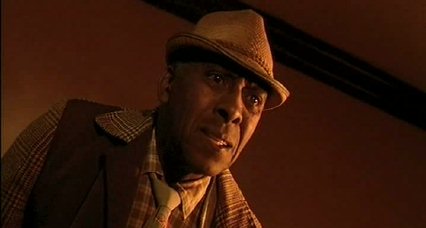
Alas,
Steven Spielberg’s sentimental “Kick the Can” is not much better than “Time Out.”
Here,
a group of cuddly old people -- virtually
all of them Jewish stereotypes -- are magically granted the opportunity to
be children again when a kindly stranger brings a night of magic to their
dreary nursing home.
In
the original episode that aired on television, one of the old folks at the home
came up with the idea himself that he
had grown old because he had stopped
playing. To play, he insisted, was
to be young.
Thus
in the TV version, the magic arose from
within the residents of the home themselves as they re-
connected with their
inner children. It was a beautiful and
heart-wrenching tale about how growing old isn’t just a quality of the body, a
physical thing, but a mental thing too.
And it’s never too late to recapture that youth; to play. You just have to find the child within. You just have to remember what it is to be
young.
Such
noble and affirming ideas are lost in Twilight Zone: The Movie because
Scatman Crothers plays a wandering magician who generously bestows youth on others, whether they ask for it or not. Suddenly, the quality of youth is not an
internal one, a quality that can be “activated” by one and all. Instead, it is the magic pixie dust of a
wandering Peter Pan, doled out like candy, and then taken back.
Indeed,
Mr. Bloom’s whole modus operandi is
extremely bizarre. He urges the old
folks to play kick the can and experience youth, and then, once they are
transformed into children again, urges them to go back to their old
bodies. In other words, he’s forces them
to dance to his tune, to learn what he wants them to, and, then, even draw the
same conclusion he has drawn.
These
poor old folk really get jerked around, but the important thing is that the
discovery process of “being young at heart” is lost. These old folks are denied the learning they
were afforded in the TV program, and so the message gets lost, or at least
muddled.
Frankly,
it’s a mystery why the original TV script wasn’t deployed here, instead of an
inferior knock-off that misses the point.
In terms of visualization, the story looks muddy, a mélange of browns
and gold -- no doubt to suggest the
autumn of life. And the camera work features
an unfortunate, claustrophobic quality that is never relieved, even when the
senior citizens are made young again.
“It’s a Good Life”

Joe
Dante’s installment, “It’s a Good Life” is a huge step-up in terms of quality,
yet it also can’t quite stand-up to the powerful memory of the TV episode,
which featured Bill Mumy as an over-indulged, super-powerful kid who could wish
people “into the cornfield.”
There,
in that TV version, the horror dwelt in the suggestion of what horrible
things Anthony might do. A man who dared to challenge the boy was
turned into a springing jack-in-the-box, for instance, but it was seen only in
creepy, imagination-provoking silhouette.
Here,
director Joe Dante goes full-throttle into cartoon mayhem, creating Looney
Tunes-styled nightmares to threaten teacher Helen Foley (Kathleen Quinlan) and
Anthony’s family. But where the TV story
concerned an indulged child who thrived because people refused to draw limits,
the movie version is a special effects freak show about a lonely kid who
creates monsters – wait for it -- to be loved.
Two
problems with this approach: First, Anthony’s family is depicted as being
bad…as though it is somehow at fault for being afraid of him and his monstrous creations.
And secondly, Anthony does horrible things (like disintegrating one sister’s
mouth, and consigning another to cartoon hell…) and we are supposed to forgive
him -- feel sorry for him -- because
he is so lonely and unloved.
He
may indeed be lonely and unloved and therefore deserving of sympathy, but that
doesn’t excuse the way he tortures his family.
And
the story’s ending is pure sentimentality and fantasy land: Anthony and his new
“Mom,” Helen, drive off into the metaphorical sunset as sweet, fantasy flowers
suddenly bloom, dotting the landscape.
Just wait until that
kid is a teenager, Helen, and then let’s see how you do with little Anthony…
Like
“Kick the Can,” “It’s a Good Life” loses the emotional and narrative meat of
the televised story, and replaces that meat with lesser…confections. The special effects are great, for instance,
and the cartoon world absolutely unnerving, not to mention original. As a fan of Heckyl and Jeckyl, I love how
Dante uses that old series’ episode “The Power of Thought” to reflect Anthony’s
ability to recreate the world, as if it too is a cartoon.
There’s
good stuff here, absolutely, and the visuals are dazzling enough to gloss over
the narrative and character deficits.
But those deficits do exist, and occasionally come through.
For
instance, we are never quite sure what Helen is thinking when she agrees to
take over parental responsibilities for Anthony. Does she see his powers as a tool she can
wield? Or is she pure of heart, and
wishing only to help a lonely child?
Helen remains such an undeveloped character that her motives stay opaque
.
“Nightmare at 20,000 Feet.”

“Nightmare
at 20,000 Feet” ends the movie on fine horror footing. Here, a twitchy,
over-the-top John Lithgow battles a fierce gremlin on the wing of a plane in
flight.
Director
George Miller adopts claustrophobic framing and cockeyed-angles so as to make
us feel the breadth of Lithgow’s panic. He
succeeds well in making the jet feel more like a flying coffin than you average-every
day conveyance. In presentation and form,
this episode is truly scary, even a tour de force in terms of style. A perfect ending story, it is dominated by
electric jolts and a strong sense of menace.
But
again, the original version’s subtlety is missed. The episode, directed by Richard Donner,
involved a man, played by William Shatner, recovering from a nervous breakdown. Because of the man’s history, there was a
tension in the episode between what people expected of him, and how he reported
what he saw.
In
other words, he was a man desperately trying to hold onto his dignity at the
same time that he battled an impossible creature from the Twilight Zone.
In
the movie, that tension is gone, because Valentine just happens to be a very
nervous flyer. Nobody knows him, and he
has no history of crying wolf, so-to-speak.
Clearly,
this is the best segment in the film, and it gets by largely on directorial
legerdemain. And that gremlin is scary
as hell, a notable improvement on the fluffy gremlin of the TV series.
A
crucial part of my 1983 summer of fan discontent – along with Return
of the Jedi and Superman III -- Twilight Zone: The Movie
is slicker and more manipulative than any tale Rod Serling ever imagined, yet
also less clever, less soulful, and less terrifying too.
This
Twilight
Zone movie is more “shadow” and less “substance” than the TV series
provided on a weekly basis for five years.
award-winning creator of the web series Abnormal Fixation (2024), the audio drama Enter the House Between (2023) and author of 35 books including Horror Films FAQ (2013), Horror Films of the 1990s (2011), Horror Films of the 1980s (2007), TV Year (2007), The Rock and Roll Film Encyclopedia (2007), Mercy in Her Eyes: The Films of Mira Nair (2006),, Best in Show: The Films of Christopher Guest and Company (2004), The Unseen Force: The Films of Sam Raimi (2004), An Askew View: The Films of Kevin Smith (2002), The Encyclopedia of Superheroes on Film & Television (2004), Exploring Space:1999 (1997), An Analytical Guide to TV's Battlestar Galactica (1998), Terror Television (2001), Space:1999 - The Forsaken (2003) and Horror Films of the 1970s (2002).
Subscribe to:
Posts (Atom)

-
 It is quite difficult to believe, but in 2024, Ridley Scott’s Alien (1979) turns 45 years old. Perhaps the most amazing thing about Alie...
 -
 It is an indisputable fact that fan service and good drama don’t always go hand-in-hand in the cinema. In fact, sometimes these factors div...