Showing posts with label Buck Rogers Day. Show all posts

Thursday, September 20, 2012

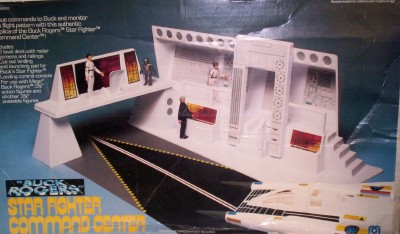
Buck Rogers Day: Buck Rogers Star Fighter Command Center (Mego; 1979)


In 1979, Mego released a whole line of very cool Buck Rogers spaceships and toys, including the Directorate Starfighter (my favorite ship from the show), the Draconian Marauder (known as a Hatchet fighter on the series...), a Land Rover, and a Laserscope Fighter (not a design from the series). So it only makes sense that the same company would market a place to dock these ships, the Buck Rogers Star Fighter Command Center.

Christmas 1980 was the holiday of Buck Rogers for me. I'll never forget going over to my aunt and uncle's house in Summit, New Jersey and opening toy after toy -- all Buck Rogers models and action figures (though, as I recall, this was also the Christmas of The Empire Strikes Back and my giant AT-AT. But that's another story...).

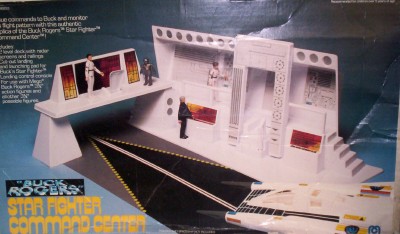
Here, the toy box suggests: "Issue commands to Buck and monitor his flight pattern with this authentic replica of the Buck Rogers Star Fighter Command Center!"

The toy also includes "2 level deck with radar screens and railings," "Cut-out landing and launch pad for Buck's Star Fighter," and "landing control console for use with Mego Buck Rogers 3 3/4 action figures and all other poseable 3 3/4 action figures."

What remains most interesting about this toy is that what you see displayed on the box is not necessarily the toy you get inside. On the box, for instance, the upper deck of the landing pad shows a chair from Star Trek's U.S.S. Enterprise bridge. In the actual toy, a different style chair is molded to the deck.

Also, the 
decals on the box and the decals of the actual set are completely different. I know now that Mego was juggling a number of "space opera" licenses at the time, including Star Trek, Buck Rogers and The Black Hole, so there may have been some franchise confusion. Just a guess.

This just goes to show you that back in the 1970s and 1980s, even great toy companies like Mego weren't necessarily paying close attention to the exact details of their (admittedly wonderful and now incredibly collectible) products. This isn't really an "authentic replica" of the landing bay on the series.

But that's okay, it's still a fun toy.  And as you can see from the photos, Buck's Starfighter Command Center today holds a cherished spot in my home office, even today.

Buck Rogers Day: Galactic Playset (HG Toys; 1979)


By the time Buck Rogers in the 25th Century (1979 - 1981) aired on NBC, I suppose you could state I was primed to love the show.  I had "grown up" through Star Wars (1977) and Battlestar Galactica (1978-1979) and had seen The Black Hole (1979), Star Trek: The Motion Picture (1979) and Moonraker (1979).  

But the nice thing about Buck Rogers was that the series, unlike many of those other titles, didn't take itself too seriously.  The program, starring Gil Gerard and Erin Gray, boasted a great sense of humor, at least during the first season.

Mego released a good-sized line of Buck Rogers toys and vehicles back in the day, but HG Toys also got into the act, recycling and retro-fitting a pre-existing play set as the Buck Rogers in the 25th Century Galactic Play Set.  It came complete with "over 35 pieces" and a nice diorama/backdrop.  

This HG Toy set included a "space station with movable ladder, 2 Draconian marauders, 2 starfighters, 8 space commandos, 10 aliens," and "fully detailed figures of Buck Rogers, Wilma Deering, Killer Kane, Dr. Huer, Tigerman, Draco, Twiki and Princess Ardala."

Also present: "a colorful diorama set-up and assembly instructions."

I have fond memories of playing with this particular play set, because I took it on a cross-country vacation with me.  My family traveled (in our new Ford van) from New Jersey to California and back over the span of six weeks.  Space was tight since we were traveling for such a duration and this one of the few toys I was allowed to bring along.  I set it up in camp sites from Lake Michigan to Lake Tahoe.   On days where we seemed to be endlessly driving through desert terrain, I also set up the Galactic Play Set in the back of the van and played with it, though the bumps in the road could occasionally wreak havoc.


Buck Rogers Day: Laserscope Fighter (Mego; 1979)


In 1979, the post-Star Wars, Glen Larson version of Buck Rogers took the sci-fi world by storm.  I was nine year old at the time, and both the feature film and the follow-up TV series on NBC were right up my alley.  

The franchise starred Gil Gerard as Buck, Erin Gray as Colonel Wilma Deering, and Pamela Hensley as Princess Ardala.  The tone of the enterprise was cheeky and knowing, and the special effects, for their day, were absolutely stellar.  Down to the sexy opening credits, the film version played like James Bond in the future, or in space, perhaps.

Accordingly, I was thrilled when I began to see toys from Mego lining the shelves at Toys R Us.  Among the first of these was a spaceship toy with a design you never saw featured on-screen: the “Laserscope fighter.” 

This sharp-nosed space fighter “with simulated lasers and explosions” featured a cockpit for the 3.5 inch Buck Rogers figures.  But more interestingly, it possessed a rear-mounted view screen through which you could track, target, and incinerate enemies.

The box explains: “Look through the view-screen and line up your target, press the switches – see and hear the lasers fire – the target will appear to explode right before your very eyes!”

Also according to the box legend, this Buck Rogers Laserscope fighter featured:
·         Laserscope viewscreen
·         Twin stub wing handles
·         Telescopic focus control
·         Realistic laser sounds
·         Swing-open cockpit
·         Fits any Buck Rogers figure.

Of course, I must confess that when I was generously given the Laserscope fighter as a gift, I was a bit disappointed because I really wanted the Buck Rogers star fighter, a craft which was featured on the show and boasted an infinitely cooler design aesthetic. 

But once I actually got the star fighter for the Christmas of 1980, I could enjoy the Laserscope fighter as a kind of “alternate” ship for the intrepid Buck.  The fighter sort of fit with the universe of the TV series, because Buck often ended up going undercover for the Earth Directorate, flying ships of various designs.  So it was kind of cool to be able to play out that scenario with a ship other than an “official” one.

Also, if I understand my toy history right, the “Laserscope fighter” was also released in Europe, but as a toy from a different Mego license: The Black Hole (1979).  

Of course, the design of the ship doesn’t fit that particular franchise any more than it resembles something you saw on Buck Rogers

Buck Rogers Day: "The Satyr"


"There are strange viruses here on this planet."

- Cyra (Anne E. Curry) warns Buck about the dangers of Arcanus in "The Satyr."

One of the real bright spots of Buck Rogers' abbreviated second season in 1981 remains the episode titled "The Satyr" written by Paul and Margaret Schneider and directed by Victor French.

On first glance, however, this development seems unexpected since the episode's storyline stems from a long-standing and ubiquitous sci-fi TV trope: "the single mother in jeopardy."

In this all-too-familiar genre TV chestnut, a series protagonist encounters a lovely single mother and her child (usually a son) who are being menaced by some malevolent outside force.  The series hero then becomes a stand-in husband/father to the duo, defeats the menace, and -- in a heartbreaking moment -- must say farewell to his new family so that he may continue his episodic adventures romantically unimpeded. 

Examples of the "single mother in jeopardy" convention can be found on the original Battlestar Galactica (1978 - 1979) in "The Lost Warrior," where the convention is played well as a variation on Shane (1953) and as a commentary on gun control, in V: The Series as "The Wildcats" (wherein Marc Singer's Mike Donovan steps in to save a Mom and her daughter from the Visitors), and on MacGyver, "To Be a Man," which featured the late Persis Khambatta as Zia, the single mother in jeopardy from Russian military forces.

In Buck Rogers': "The Satyr," Captain Buck Rogers (Gil Gerard) explores the planet Arcanus, the site of a failed Earth colony while the star ship Searcher is away for ten days on a mission to "sweep" an asteroid belt.

On the planet surface, Buck soon meets Cyra (Anne E. Curry) and her son, Delph (Bobby Lane), the only two settlers who have remained behind on the planet.  Buck soon discovers that the duo is regularly harassed by Pangor (Dave Cass), a half-man/half-goat or "satyr" who seems obsessed with them.  Buck steps in to battle the violent Pangor, but is bitten by the satyr.

Over a period of days, Buck begins to transform into a satyr himself, a creature obsessed with women and wine...and little else.

After being bitten, Buck learns that Pangor is actually Jason Samos, the founder of the Arcanus colony and Cyra's much-mourned husband.  She has been unable to leave the planet behind because she still feels attached to him, despite Jason's transformation into a rampaging monster.

As I've noted above, the "single mother in jeopardy" cliche has been depicted on television many times, but "The Satyr" illustrates nicely how a science fiction program can explore contemporary issues that "regular" dramatic programs either cannot,  or if they do seems too on the nose, like an Afterschool Special.

As my friend and the exemplary blogger Uncle Lancifer of Kindertrauma noted here on a previous Buck Rogers retrospective (for "Time of the Hawk,") this episode of the series sub textually concerns alcoholism; and the effect of alcoholism upon the entire family unit.  This subtext and social commentary actually elevates "The Satyr" above its familiar and cliched premise and makes it one of Buck Rogers' finest hours.
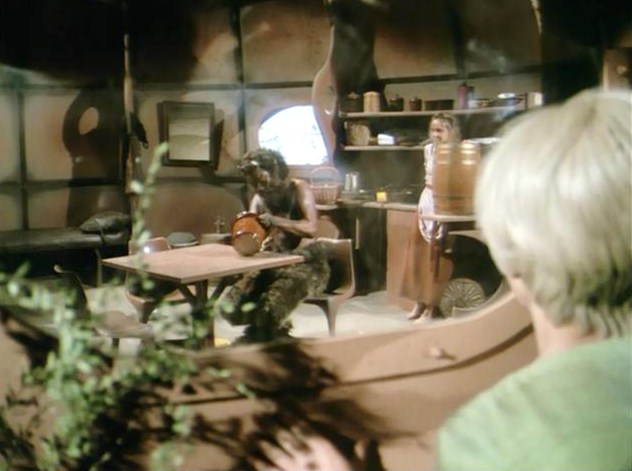
In "The Satyr," Cyra and Delph live a relatively happy life, until Dad -- Pangor -- shows up at their home, demanding wine and violently threatening Mom. 

In one well-staged scene, we watch with Delph through an exterior window as, inside the home, Pangor pushes Cyra onto her back (behind the kitchen table), and threatens physical violence.  He wants more wine, you see, even though, as Cyra tells him, "he drank it all the last time."  The subtext here isn't just violence, but sexual violence, at least in terms of the staging/blocking.

What we get in "The Satyr," particularly in this camera view from the outside-in, is the notion of a child dwelling in a terrifying household of alcoholism and domestic violence, and seeing/experiencing things that no child should.  Worse, the P.O.V. suggests isolation and helplessness.

At several points during the episode, Delph is also policed by his mother not to be too conspicuous, so as not to gain the attention of the alcoholic/Satyr.  At one point, Delph plays "flute grass" and at another point he calls out innocently for his Mom.  In both instances he is quickly "hushed" -- "Don't shout!" --  lest the angry man of the household focus his violent attention upon him.  Half the battle is staying off Pangor's radar as he pursues his vices.

Additionally, the boy, Delph, soon sees himself as his mother's defender, eventually fighting the angry Pangor and telling the beast to "leave my mother alone."   In the homes of many alcoholics, it is indeed the child who eventually becomes the protector of the Mom,or other siblings, and who stands-up to the offending drinker.

As for Cyra, she's dramatized in this episode as the traumatized, exhausted victim of sustained domestic abuse.  She hides bruises on her neck from Buck, and, quite understandably, doesn't like "to be touched."  She also has much trouble letting go of the "good man" who was once her husband, clinging to old photo albums which reveal happier, more romantic days.  Much of the blocking depicts Cyra cowering or retreating.  She is someone who is used to being terrorized and fears being struck.

Cyra also maintains the family home on Arcanus -- despite the danger to herself and her son -- in the misguided belief that somehow Pangor can change.  In fact, Cyra spends her life appeasing the violent satyr.  "If he's supplied with enough [wine]," she informs Buck, "he's content" and leaves the family alone.

At the same time that she must handle Pangor, Cyra worries that the "virus" that affected her husband -- a metaphor for alcoholism -- could affect her son too "when he's a man."  In other words, the cycle of abuse and violence could continue to the next generation.  Yet by keeping Delph on Arcanus, in a terrorized home, Cyra makes it more likely that this will happen to Delph.

This social commentary in "The Satyr" is intriguing by itself, but the episode gains some real unexpected juice and power when Buck actually grows sick with "the virus "and quickly loses his status as the white knight.
Buck sets up house with Cyra and Delph (even teaching the boy to fly his shuttle craft) and then -- just when things are good -- succumbs to the same "virus' and begins to show signs of physical violence like Cyra's previous husband.   In one sequence, Buck tries to hide evidence of his transformation from Delph, ashamed to show his true nature as a "monster" to the boy he clearly cherishes.

Here, the subtext isn't about alcoholism so much as the nature of (some) men in general, and how some women seem to attract these monsters, one after the other. It's something in their individual nature and lack of self-esteem perhaps, and part of a deadly symbiosis involving abuser and victim. "The Satyr" tries to make viewers understand why Cyra stays on Arcanus, imperiled by one satyr after the other, and gives us some insight into the mentality of a perpetual victim.  In this case, Cyra just can't let go of the past and the (vain) dream that Pangor could again become the husband she once loved.

course, Buck -- as our stalwart series hero -- is able to kick the virus and save the day. Still,  it was pretty daring in terms of 1981-era television to create a metaphor for alcoholism and then see the likable series protagonist succumb to that  "disease."  In visual terms, Buck's horns literally start to come out, as he transforms from man to beast.

I am old enough to remember the promotional materials and interviews for the second season of Buck Rogers in the 25th Century.  The overall promise by the producers was that Buck would become more recognizably and fallibly human, and less the quipping, boogeying, Burt Reynolds-in-space figure of the first season.  Whether or not that promise was fulfilled entirely is up for debate, but certainly "The Satyr" showcases Buck at his most human and interesting.  He exhibits real remorse when he believes he is responsible for the death of Cyra's husband, Jason, and then must battle his growing "dark side" as the satyr virus takes hold. 

This episode is also intriguing for the way it ties the myth of the Satyr (a wine loving man/goat) to the alcoholism/domestic violence symbolism, and for the implicit "reason" behind alcoholism provided by the show.  Jason had the "pioneer spirit," you see, and had hoped to turn Arcanus into a "garden of Eden."  When that dream failed, he couldn't handle it...and that's when he first acquired "the virus."  Again, this idea fits our contemporary world well.  What leads people to drink?  Failure?  Tragedy?  Loss?  Desperation? 

All of my commentary on this episode no doubt suggests that "The Satyr" is some labored "message" show about an "important" life lesson (see: Star Trek: The Next Generation: "Symbiosis.")  But that's not actually the case at all.

Like the best social commentary in science fiction television (from The Twilight Zone to Star Trek to The X-Files to Buffy), this is an episode that plays ably on two levels.  You can watch it just as a gripping, good adventure, or as a story with a bit more relevance and meaning in our own world.  In other words, the metaphor for alcoholism holds powerfully (right down to the blocking of the actors), but you aren't hit over the head with a "lesson."

At the very least, "The Satyr" adds some much-needed depth to an old TV trope.  In this Buck Rogers episode, the single mother was again in dire jeopardy, but it's the nature of  that jeopardy and the source of the jeopardy that make this installment meaningful and unique, even after three decades.

Buck Rogers Day: "The Guardians"


The second season of Buck Rogers in the 25th Century is not generally high-regarded among fans. In its sophomore sortie, the Glen Larson series eliminated the characters of Dr. Huer, Dr. Theopolis and the Draconians, downplayed Buck’s (Gil Gerard) strong sense of fish-out-of-water humor, and moved Buck from sexy secret agent work on Earth to a deep space assignment aboard the Earth ship Searcher. These format changes cast the new Buck Rogers rather firmly in the mold of Star Trek or Space: 1999 with the new series acting as a vehicle for “civilization of the week” stories. 

In that particular format, success or failure rests largely on how well interesting and likable main characters interact with intriguing or convincing alien cultures. The Fantastic Journey (1977), for example, got the former aspect of that alchemy right (the likable main characters), but had a difficult time coming up with good stories, and original alien cultures to explore. In broad terms, this was the very problem with the second season of Buck Rogers. Episodes that involved mischievous dwarves, (“Shgoratchx!), or backwards-aging men spray-painted gold (“The Golden Man”) failed to impress or persuade either mainstream audiences or die-hard sci-fi fans. Some second season episodes were better, including the dynamic “The Satyr” (reviewed here), a show that pinpointed a great “alien” metaphor for alcoholism and its impact on families. 

The subject of this cult-tv flashback, “The Guardians” may not work as effectively as “The Satyr” on a metaphorical level, but I still estimate it’s one of the best episodes of Buck Rogers’ second season, in part because it deploys a tried-and-true Star Trek technique for better developing the dramatis personae.

On Star Trek, an alien disease or weapon was often utilized to examine emotional aspects of the characters that they normally keep hidden. “The Naked Time” or “The Naked Now” are two such notable examples.  In those episodes, a disease that mimicked alcohol intoxication “exposed” the underneath characteristics of our favorite Starfleet officers. The character revelations were sometimes funny, sometimes extremely moving. 

That general idea informs “The Guardians,” only an alien artifact is the catalyst for the character reveals.

Here, Buck and his new friend Hawk (Thom Christopher) investigate a “Terra Class satellite.” Although the exploration of the planet is supposedly “strictly routine,” Buck and Hawk soon hear a distant bell ringing over the wind's howl. They follow the noise and discover that the bell tolls for Janovus XXVI, an old man now on his death bed. This ancient “Guardian” informs Buck that he has been waiting for Captain Rogers for over five hundred years. Now, he must pass on to Buck – “The Chosen One,” an ancient green Pandora’s Box. This jade artifact must be transported to the old man’s unnamed successor and only a person of both “the past and the present” (like Buck) can get it to its destination successfully. 

That night, Buck sleeps in proximity to the jade box and dreams of his life on Earth. In particular, he experiences a vision of his mother, one from the eve of his disastrous mission on Ranger 3. After the box is brought back to the Searcher, it begins to have strangely deleterious effects on the ship and crew. The ship inexplicably goes off course and makes a setting for the edge of the galaxy.

 This trajectory especially concerns Lt. Devlin (Paul Carr), since he is due to be married on Lambda Colony in only a few days. 

When Admiral Asimov (Jay Garner) is exposed to the box, he imagines his crew…starving to death on the long journey in the void from the edge of the galaxy to Lambda. When Wilma (Erin Gray) is affected by the box, she sees herself as a hopeless blind woman wandering the corridors of Searcher alone. Then, in a matter of an hour, Wilma is blinded in real life, and realizes her vision was prophetic. Even Hawk is affected, and he experiences an emotional moment with his dead mate, Koori (Barbara Luna). 

As the Searcher reaches the edge of the galaxy, Buck realizes the box must be passed on to a Guardian, a “saintly figure” seen throughout many cultures and on many worlds. When a Guardian does not possess the box, chaos ensues, and that sense of chaos explains a lot of Earth’s violent history. Buck realizes that the Time Guardian is the very one that they now must seek… 

By and large, Buck Rogers is a pretty light show, a fact which distinguishes it from the original Battlestar Galactica or Space: 1999. There’s often a great deal of humor on Buck, and a tremendous amount of physical action too. In some sense, “The Guardian” showcases how the series could have approached more serious sci-fi storytelling.

 This episode is not without flaws (and the ending looks cheap...), but the crew member visions of people starving to death and going blind are authentically disturbing. I remember watching the program for the first time in 1981 and feeling pretty jolted by Asimov’s vision of a crew dying from hunger…and looking like zombies.  This moment resonates, and is probably the strongest in the show, despite the fact that Gil Gerard, in the vision, hardly looks emaciated...

"The Guardian" also delves into some pretty dark territory regarding erstwhile Lt. Devlin. While Searcher is lost and heading to the edge of the galaxy, he learns that his fiancé on Lambda Colony has died.  She was killed while out searching for him and his lost ship. Again, this bit of drama is just a bit darker than the typical Buck Rogers show, and here it all works well.  A sense of panic and anxiety builds up as "The Guardian" reaches it final act.  

Frankly, the writing for the main characters here is also amongst the best in the series' second season. We learn how heavily Asimov carries the burden of command (imagining a future of starvation, in which he is incapable of helping his crew…), we come to understand Wilma’s fear of appearing vulnerable or being pitied. And we are reminded once more of Hawk’s utter isolation and alone-ness. 

Of all the phantasms featured in "The Guardians," Buck’s may be the least effective. It’s great to meet a Rogers family member, since we know very little of the astronaut’s family history, and yet Buck doesn’t really do or say anything important in this dream.  You’d think Buck might want to warn his Mom about the coming nuclear holocaust…tell her to go into hiding, or something. Instead, she’s the one worried about his mission. 

Buck’s dream is a bit off tonally, though it’s fun to see the special effects from “Awakening” recycled as a callback to the Buck Rogers pilot.   In toto, I would have preferred to see a dream in which Buck revealed some personal flaw, foible or fear.  Like the fact that he was afraid of never again making a meaningful connection with the world around him.  I don't know.  But something other than an idyllic dream of lemonade and small-town Americana.  This dream tells us where he came from, but in a sense, we already know that.  Better to explore how he feels about where he was, or where he is, or where he might be headed.

Like many cult-tv programs, “The Guardians” also imagines an external force as being the guarantor of peace or war in the galaxy. On the original Twilight Zone, the great (and incredibly atmospheric) episode “The Howling Man” postulated that man would experience peace only during those intervals during which he held the Devil captive. Whenever the Devil escaped captivity, world war would occur.  

Likewise, in Star Trek’s “The Day of the Dove,” an alien monster that thrived on “hate” was believed responsible for the violent, war-like aspects of humankind’s long history. 

Here, the Guardians preserve galactic peace, but during the uncertain periods of succession, elements of the space-time continuum “jump” their tracks, and chaos is the result.  In all these situations, "fate" is determined specifically by some agency outside of man's dominion and yet he can  still struggle to rein the situation back in during each crisis.  

Probably the best aspect of “The Guardians” is simply the fact that the episode creates a sense of terror (especially in the scene wherein the box is jettisoned from the ship…but then re-appears aboard her…) without ever focusing on a humanoid villain. There are no bad guys to be found here, at all, only a strange alien artifact that the crew of Searcher, including Buck, doesn’t quite understand. 

This conceit was very much of the Space:1999 playbook: terror is forged because man doesn’t have all the answers, and his curiosity or other emotions only create more danger. It’s nice to see Buck Rogers operate on that more intellectual, spine-tingling level, at least for a short duration. Had later episodes followed this relatively intelligent formula, the second season might today be much better perceived.

I don’t often return to the second season of Buck Rogers today because of some of the really dreadful episodes, but “Time of the Hawk,” “The Satyr” and yes, “The Guardians” reveal how the changes from season one to season two could have truly created an interesting space opera and interesting, early 1980s alternative to Star Trek.   I don't know if the second series was too rushed, it was difficult to find good writers, or there were problems elsewhere that needed to be addressed first, but at least for "The Guardians" everything seems to come together for Buck.    

In this case "opening up Pandora's Box" gave the sci-fi series a pretty visceral and intriguing hour.

Buck Rogers Day: "Time of the Hawk"


"Time of the Hawk" by Norman Hudis and directed by Vincent McEveety is the premiere episode of Buck Rogers in the 25th Century's hotly-debated second season. 

The two-hour episode aired on NBC, January 15, 1981, following a lengthy writer's strike, and eventually earned an Emmy nomination for "Outstanding Cinematography in a Series" for director of photography Ben Colman.

Loyal viewers of Buck Rogers' first season were in for a shock with the opening moments of Season Two. Dr. Huer (Tim O'Connor) and Dr. Theopolis had been erased from the format (along with the Earth Defense Directorate), and were never mentioned again. The Draconians were also gone.

Instead, Buck Rogers (Gil Gerard), Wilma Deering (Erin Gray) and Twiki -- now voiced by Bob Elyea -- were officers ensconced aboard a starship called "The Searcher," heading out on a space mission in search of the "lost tribes of Earth." They hoped to find humans who had fled Earth following the nuclear holocaust... and re-establish contact.

New characters on the series included the gruff, temperamental commanding officer of the Searcher, Admiral Asimov (Jay Garner), a dotty, scatter-brained professor, Dr. Goodfellow (Wilfrid-Hyde White) and an officious robot called Crichton, who refused to believe that humans had actually constructed him. Dennis Haysbert -- later President David Palmer on 24 -- had an early, recurring role as a "communications probe officer."

"Time of the Hawk" introduces the second season's most prominent new character, a noble bird-man called "Hawk" (Thom Christopher).

As the two-parter commences, Hawk and his mate Koori (Barbara Luna) return home to their peaceful village on the distant planet Throm in the Argus Sector, only to find that drunken humans have murdered all of their people, including Koori's family. Hawk swears vengeance on the human race and begins to launch lightning raids against human-owned starships from the cockpit of his deadly fighter, the war hawk.

"The Galactic Council" orders The Searcher to stop this "devil" called Hawk, and Buck tracks the bird-man down to the City-State of Neutralis on Throm, where Hawk's ship is often serviced by local engineers who are -- you guessed it -- "neutral" in matters of conflict.


"Forget the hatreds of the past," Buck urges Hawk, "help us discover the future..."

The first thing you may notice about this particular narrative is the overt western genre structure.

A decent lawman (Buck Rogers) on a frontier of sorts (the West/Space) needs to bring in a terrible criminal from a different or "alien" culture (think of Hawk as a native-American, a wronged Apache-Chief...), but it is mankind's (America's...) difficult history actually put on trial, particularly for the crime of genocide.

Indeed, this structure was absolutely intentional. New Buck Rogers producer John Mantley had also overseen a decade's worth of Gunsmoke (1955-1975) stories, and had re-vamped a script from that long-running series to open Buck Rogers's sophomore sortie

Mantley told Starlog Magazine's Karen E. Willson (#39, October 1980, page 18) that "something can be said for the fact that Matt Dillon and Buck Rogers are the same man, six or seven hundred years apart. They're 'both' superheroes -- the difference is that up to now, Buck has not been very real. In the first show that Matt Dillon was in, the 'heavy' blew him down. He didn't outshoot the heavy. He even hanged the wrong man once. That made him very human. In the first show of this year, Buck is going to be soundly whipped in the air by a character named Hawk..."

In theory this may have sounded like a strong and intriguing idea -- to allow Buck to finally meet his match after a season of handily dispatching space tyrants -- but Mantley's concept was also, plainly, a western re-tread, a rerun.

Author Norman Hudis explained to CFQ's Steve A. Simak (CFQ: "Back to the Future," February/March 2005, page 46) that Mantley and fellow producer Calvin Clements Jr. had "used the story at least twice before when they worked on Gunsmoke. The idea was very vaguely about somebody who was wanted either by the police or by some authority but he was safely hiding somewhere. The only way they could entice him out was to flaunt his girlfriend or romantic interest and [then] he took the chance of coming out of hiding..They both giggled about it and said 'We've used the story twice before in the Old West and now we're going to use it in outer space.'"

Basing a high-profile re-vamp of an already popular show on a decade's-old rerun may not have been the best or most creative way to countenance a futuristic series going into a critical time period, but nonetheless, Hudis's version of the familiar tale is emotionally affecting at points. "Time of the Hawk" proves a fine introduction for Hawk, at the very least.

Buck Rogers in the 25th Century's second season faced additional concerns too. The shooting schedule per hour-long episode was cut an entire day from what it had been the year before. And the budget per episode of the series was drastically reduced, to approximately half-a-million dollars a show. This meant that props and miniatures largely had to be re-used from older episodes (and other Glen Larson series...), a fact which gave the new season a kind of bizarre, on-the-cheap visual aura. The Searcher, for example, -- the starship Enterprise of this new season, essentially -- was simply a redressed version of a vessel seen in "Cruise Ship to the Stars" in the first season. Had this fact simply been mentioned in the screenplay -- that a civilian ship had been retrofitted for the mission -- the re-use of a familiar miniature might not have been so disappointing.

And Buck is also seen in "Time of the Hawk" tooling around in a Colonial shuttle craft from the original Battlestar Galactica (1978-1979). These two space vessels don't appear to be products of the same technology, history or culture...and that's part and parcel of the problem. In visual terms, the new Buck Rogers just looked scatter shot...like a spaceship and prop vault at Universal had been raided.

The same criticism applies to Searcher's bridge: it looks like a hodgepodge of spare parts from the first season of Buck Rogers. It's crowded, ugly -- and again -- cheap-looking. And don't get me started on the fishbowl space helmets Buck and Wilma adorn early in the show. Suddenly, we're back on Rod Brown and the Rocket Rangers.

 
The criticism of slipshod production values does not affect however, anything Hawk-related in this premiere episode. Hawk is introduced with great flourish, and actor Thom Christopher remains a powerful presence as the stoic, dangerous bird man. The actor brings tremendous gravitas and dignity to the role, and his "war hawk" fighter is one of the coolest, most sinister-looking miniatures ever featured on Buck Rogers, replete with retractable claws that can tear apart enemy ships.


At least this introductory episode, with its western storyline, boasts the sense to present Hawk as an authentic menace (right down to his ship...), and as a character who seems believable in terms of the genre. Some people have complained about Hawk's costume, but I submit that the overall look of the character works just fine, especially given Christopher's serious, intense interpretation of the part.


The central idea governing Mantley's re-vamp of Buck Rogers was that characters and ideas would now take prominence over space battles and action scenes. Hawk is a good step in that direction: an "outsider" with his own world perspective, and a serious counterpart for the more impish Buck.

Yet, after "Time of the Hawk," Hawk (like Maya before him on Moonbase Alpha and the Maquis after him on Voyager...) is far too easily and quickly assimilated/integrated into an existing crew structure. There's not much sense in presenting an "alien" character who quickly fits in with human buddies. You lose the chance to mine drama from that conflict. Hawk should have always had a different way of doing things, and always chafed at his proximity to humans. Thom Christopher always maintained his dignity, and the character's "outsider" traits, but often with precious little assistance from the story lines that followed "Time of the Hawk."

This was not the only problem with the "new" approach of the second season. Wilma has very little of substance to do in "Time of the Hawk," and soon becomes a console jockey in the series, flying the Searcher and pushing buttons. In Season One, Deering was a sexy, independent, operative for the Directorate. Here she's almost invisible, as if Buck Rogers had also adopted a Western-style aesthetic about the role of women.

In space, in the distant future, this is nothing short of absurd.


"Time of the Hawk" also presents Crichton and Asimov, two dreadfully-cartoonish, cardboard characters who hurl insults at each other ("ridiculous lamp post!" "kettle belly!") and, if anything, evoke only memories of Dr. Smith and the Robot on Lost in Space.

Where is the so-called "serious" drama in this relationship? Bickering is not a substitute for mature storytelling, just because Star Trek did it (and did it well...) with Spock/McCoy.

Most disturbing of all, perhaps, Buck and Wilma are now forced to endure playful romantic banter that, in contest, just seems ridiculous.

In their first scene of the season, they engage in a mock argument, flirt a little bit, and then reconcile...but it's all over nothing at all. It's strictly canned characterization. Everyone is too jovial, too emotional, and trying too hard to be likable and "human." This was also my problem with some of Space: 1999 Year Two: everybody was trying so hard to laugh and smile that it actually became painful to watch. Gil Gerard and Erin Gray are enormously likable performers, and one just wishes they had better material to work with here. In Buck Rogers' first year, Buck and Wilma had great chemistry and shared a kind of tongue-in-cheek relationship. The stories may not have been overtly serious, but the characters seemed real and human, and not forced, like grins had been plastered to their faces at gunpoint.

In terms of story lines, one can argue that the new season of Buck Rogers tried sincerely to make a statement about conformity, and the way that people fear or kill that which they don't understand. "Time of the Hawk," "Journey to Oasis," "The Golden Man," and "The Dorian Secret" all -- at least tangentially -- revolve around the idea of prejudice against those who are deemed different. This is a commendable and consistent theme. The best enunciation of it -- for all its flaws -- is likely in "Time of the Hawk," which condemns man for his predilection to render other species extinct because differences are perceived as threats. "The history of your race is written in its own blood," Hawk tells Buck at one juncture, and the point is made.

Looking back, I enjoyed (and still enjoy...) several episodes of Buck Rogers' second season, mainly "Time of the Hawk," "The Guardians," "The Satyr," and "Testimony of a Traitor," but the second season changes -- excluding Hawk -- by and large did not improve the series. Today, the first season is generally regarded more highly. Still, I can't help but wish that the second season had been granted a full renewal instead of just thirteen episodes. Maybe those last dozen or so episodes that were never produced would have been the very ones that revealed just how well the second season format might have worked. We'll never know.

Lastly, I'll say this. At age 11...what I wouldn't have done to get my hands on a war hawk model kit...


Buck Rogers Day: "Space Vampire"


When I was eleven years old, the Buck Rogers in the 25th Century (1979 - 1981) episode about a monster called a "Vorvon," was probably the scariest thing I had yet seen on network television.

That episode, titled simply "Space Vampire," aired on January 3, 1980 on NBC, and the Kathleen Barnes and David Wise teleplay concerned Captain Buck Rogers' (Gil Gerard) chilling encounter on Theta Space Station with a cosmic Nosferatu or "Undead," a soul stealer known as a "Vorvon."

Although Buck Rogers might rightly be accused of exploiting the popularity of Dracula in the pop culture in 1979 -- a year which saw the release of John Badham's Dracula, Werner Herzog's Nosferatu and even Love at First Bite -- the "Space Vampire" episode of the first season nonetheless remains one of the series highlights: unnervingly creepy, uncharacteristically somber, and wholly dread-filled. This is true even if by adult standards we today judge the program to border on camp.

On the other hand, I watched the episode again recently with a friend's ten year old son and it thoroughly freaked him out. So there's definitely something frightening there; at least to impressionable young minds.

In "Space Vampire" a "space age vampire stalks a lonely space station," according to the teaser, and that summary pretty much nails the whole story. Buck and Wilma drop-off Twiki for repairs at Theta Station but instead of getting away for their vacation on Genesia, they witness a starship (the Gemonese Freighter from Battlestar Galactica actually...) plunge through Stargate Nine and collide with the station.

The inner atmosphere of Theta is contaminated, and the logs of the derelict -- the I.S. Demeter -- suggest the crew and passengers were suffering from hallucinations and "mental deterioration" brought on by the Denebian virus EL7.

After the station's Dr Ecbar (Lincoln Kilpatrick) reveals to Buck that the crew of Demeter is not dead, but rather drained of "spirit," Buck suspects a being, not a disease, is the culprit.

He's right. The evil Vorvon (Nicholas Hormann) creates undead minions out of the station crew (who appear replete with two discolorations on their neck...). He then prepares to make the uncharacteristically terrified Wilma Deering (Erin Gray) his immortal bride.

One aspect of "Space Vampire" I rather enjoy is the deliberate homage to the epistolary nature of Bram Stoker's 1897 novel. As you'll recall, the literary Dracula was crafted in the form of various collected letters and communiques. The whole story was conjured through the filter of newspaper clippings, Mina's Diary, Seward's phonograph recordings, and Jonathan Harker's journal.

For all its disco-decade glitz, cheap sets and callow characterization, Buck Rogers actually pinpoints a decent "space age" corollary to Stoker's literary approach, permitting the stalwart Buck to assemble the story (and history) of the Vorvon from various 25th century media sources, though all visual in nature: the captain's log from the Demeter, the servo drone recordings of a Demeter passenger (and bounty hunter) from "New London" named Helson (Van Helsing), and even helpful communiques from Dr. Huer and Dr. Theopolis on Earth.

The other parallels to Dracula are much more obvious. The only thing to ward off the Vorvon is called an "ancient power lock," the "25th century equivalent of a cross," in Buck's own words.

What's funny (and silly...) about this "ancient power lock" is that it is really just Commander Adama's collar medallion from Battlestar Galactica. And ironically, Adama was played by Lorne Greene, a man who had recently portrayed Dracula himself in an episode of The Hardy Boys/Nancy Drew Mysteries in 1977! Yep, it's Six Degrees of Cult-TV Dracula...

The Vorvon can also mesmerize his victims and change forms at will, another recognizable trait. Just as Dracula could turn to mist, wolf, bat or other form, the Vorvon here often takes the shape of a red, pulsating energy blob that hovers overhead. This non-corporeal form gives the makers of the episode license to provide some examples of crimson-hued, P.O.V. shots. Call it "Vorvon Vision," all rendered from dramatic and doom-laden high-angles as Wilma is stalked by the Monster.

Obviously, the name of the derelict ship, the Demeter, itself originates from Stoker's novel and serves the same purpose in both texts: carrying the "disease" (Dracula or Vorvon) to civilization.

Even the uni-browed, long-fingered physical appearance of the Vorvon is similar to Stoker's written description of the vampire.

From almost a century of vampire cinema, the episode appropriates the idea that the Vorvon cannot survive in sunlight, and in an interesting final twist, Buck destroys the soul sucker by flying it into a star itself.


There are actually some pretty solid horror compositions featured in this episode too. A slow, steady pan ominously marks the Vorvon's first appearance as a humanoid. We pan across the Theta Station Lounge (where an arcade video game unit, circa 1979 is plainly visible...) and see Buck ordering drinks at the bar. When the camera pans back (all in one shot), the Vorvon is suddenly seated at a previously empty table...staring at Wilma with malevolent eyes.

There's also a great shot (pictured above), in which the undead Dr. Ecbar is struck down and collapses directly in front of a flashlight, his ghoulish pallor suddenly illuminated in the relative darkness. Together, a few clever compositions like these examples economically enhance Wilma's stated fear of "death as a tangible presence."

And finally, you haven't truly lived until you've seen Erin Gray -- in a skin-tight spandex cat-suit -- playing the soulless, avaricious, seductive bride of the Vorvon. But seriously, what makes "Space Vampire" resonate, I think, is Wilma's pervasive fear of the Vorvon, and the fact that nobody seems to believe that it is hunting her. Wilma just knows she can't escape it...and she almost doesn't. There's a feeling of powerlessness here; and a sweeping inevitability in the narrative. It may not be Shakespeare -- or Stoker -- but it works pretty well.

"Space Vampire" may not be the best episode of Buck Rogers (I'm rather fond of "The Plot to Kill a City"), but it is certainly the installment that most people of my generation seem to remember most fondly. 

Buck Rogers Day: "The Plot to Kill a City"


Buck Rogers vs. The Legion of Death.
This exciting Buck Rogers two-parter aired on October 11 and October 18, 1979, and was written by the talented Alan Brennert.  Dick Lowry directs.

"The Plot to Kill a City's story opens in media res, with Buck Rogers (Gil Gerard) on a mission to take out and replace a legendary criminal named Raphael Argus.  Argus, you see, is a member of "The Legion of Death," a terrorist group planning to deliver "final retribution" on New Chicago (a city of 10 million people...) for the death of one of  its comrades.

Because Buck hails from the 20th century, there's no record of his existence anywhere in the data-heavy, computerized 25th Century, and so Dr. Huer (Tim O'Connor) at the Earth Defense Directorate sends Buck to infiltrate the Legion and learn its secret plan.  Since the Legion of Death members rarely gather -- and don't know each other by sight -- this seems a perfect plan.

Not so fast, however, as Buck is soon pitted against a team of James Bond-worthy villains. 

A soldier villain? Varek (Anthony James)
Leading the Legion of Death is a brilliant scientist from Rigel IV, Selon Kellogg (Frank Gorshin). 

He's the mastermind and formidable "general" villain of the organization.  Kellogg is cruel and merciless, willing to visit death upon innocent millions for a personal slight. 

If you've watched Batman, you may recall that Gorshin is expert at portraying exaggerated, larger-than-life villainy, but his Kellogg is a different breed from the Riddler all-together: a deadly serious, deadly somber threat; a real (and utterly horrible...) person.

At Kellogg's side stand several incredibly powerful and memorable "soldier" villains and minions.  Their numbers include Quince (John Quade), an assassin from a heavy gravity planet armed with telekinetic powers, Sherese (Nancy DeCarl), an empath who picks up "vibrations" and who is "pathologically suspicious," and Markos, a martial arts expert who has "partially severed" his nerve endings to reduce his ability to feel pain (and yes, we saw a villain much like Markos in The World is Not Enough [1999], didn't we?). 

Finally, there's the hulking Varek (Anthony James), a masked mutant and Kellogg's personal bodyguard.  He boasts the ability to "alter his molecular density."   In other words, Varek can walk through walls.

During the course of the story's two-parts, Buck must infiltrate the Legion and stay ahead of these powerful villains.   This task is made more difficult by his entanglement with a betrayer named Barney (James Sloyan), after the comic strip's "Black Barney."  Buck must also evade galactic police, who believe he really is the notorious Raphael Argus.

As Buck soon learns, the Legion of Death plans to destroy a matter/anti-matter power generator outside of New Chicago. The Legion forces an employee at the power station to help them evade security by threatening the lives of his children. 

"Show me a family man who can afford to be a hero..." Kellogg quips.

With time running out, Buck finds an unexpected ally in Varek...

The space port on Aldebaron (later re-used in ST: TNG: "Coming of Age").
It seems to me that --  especially in the case of Buck Rogers in the 25th Century -- one must judge the quality or worth of the series' installments within the boundaries of its action-oriented format and particular historical context. 

In this case, the Glen Larson TV series was broadcast post-Star Wars.   That says a lot.

That historical context means audiences  must expect a cute robot (Twiki), plenty of flashy laser beam fire, space dogfights, and a heightened sense of romantic action/adventure.  

In broad terms, the series format basically makes Buck and Wilma futuristic "secret agents" working for Dr. Huer's Directorate, putting cosmic bad guys out of business while acting "undercover."   Not particularly deep; but the stories are often immensely engaging, and almost universally entertaining.

Many weeks, it's James Bond in space, all right, and as is the case with the best Bond films, the best Buck Rogers episodes are often those which feature the most interesting villains

"The Plot to Kill a City" serves up a literal "legion" of such nemeses, plus an appealing Bond girl (Buck girl?)  in Markie Post's cute-as-a-button Joella Cameron.  The threat is also grave enough to hold the attention: the destruction of New Chicago and 10 million people at the hands of the terrorist villains.

If you choose to look at Huer as "M" or "Q" while he gives Buck his gadgets of the week (black light bombs...) the comparison to the Bond franchise is complete.

Within the parameters established above -- Buck as Bondian secret agent, bracing space adventure -- the truly rewarding Buck Rogers episodes remain those that  are able -- through clever writing and execution -- to often find a sort of unexpected "sweet spot" in this superficial Bond formula:  a spot where story and character ingredients work on a deeper-than-surface level. 

Markie Post is a futuristic Bond Girl.
Where was that sweet spot located?  Well, it often became apparent when Buck's humanity and fish-out-of-water predicament played an important role in the narrative, and when good, solid science fiction concepts ably supported the front-and-center action. 

Even better, it occurred when those solid science fiction concepts were ones that had something relevant and important to say about American life during the late 1970s or early 1980s.

With the "The Plot to Kill a City,"  you can put checks in all those boxes.  

Make no mistake, Buck Rogers is not Star Trek, which by and large remains a meditative vehicle on human morality, but this  comparison doesn't mean Buck couldn't tell meaningful, dimensional tales, either.  

Most importantly, the superficial good guys vs. bad guys nature of the "Plot to Kill a City" is supported ably by a surprising, welcome and very human character subplot.  In this case, Varek -- the masked body guard -- originates from a planet that survived a "winnable" nuclear war, only to face a future of terrible genetic deformity.  Varek hides his misshapen face behind a golden mask so as not to reveal his hideous visage.

Late in the first segment, Varek tells Buck Rogers that he deserves to be Kellogg's servant, a slave essentially. 

"I deserve no better," he declares with self-loathing.  "My people were a proud race...too proud.  It wasn't enough that we had tamed our planet, built a great culture, reached out into space.  We had to have other worlds too.  We abused our freedom and we lost it, and deservedly so."

Later, when Varek realizes that Kellogg plans to visit a similar apocalypse upon Earth's innocent children, he gets over his self-pity and hatred and actively joins Buck's cause.  "You can't imagine life on my planet," he explains.  "Children afraid to look at their own reflections.  Children with the touch of death."

The needs of the many outweigh the needs of the few?
In the end, Varek saves the day by facing his own death.  Eyes wide open, he walks straight into a radioactive anti-matter chamber to stabilize the reactor. 

Inside, Varek re-aligns the power system, and saves the generator...and all of New Chicago.

And yes, this heroic incident -- with a character bravely and knowingly facing extinction before the eyes of his comrades in a sealed compartment -- oddly foreshadows the specifics of Spock's death in the engine room in The Wrath of Khan.

More to the point, however, Valek is no ordinary "guest star of the week," but rather a character who is well-developed, and undergoes an arc of learning and development during the story.  He changes sides not on a writer's whim, not because the story demands it, but based on his difficult life experience, and that idea comes through pretty powerfully without being overtly preachy.

Also, it's important to recall that America was locked in a Cold War with the Soviet Union in late 1979, when this episode aired.  The specter of nuclear annihilation was always present -- every day -- like a shroud, hanging over all of us.   This episode of Buck Rogers expresses the terrible horror of nuclear Armageddon, with children paying the consequences for an "international" disagreement over political ideology.  Even more so, it suggests that those who use such weapons to conquer others deserve themselves to be subjugated and enslaved.  Not a tame statement in the year leading up to Russia's invasion of Afghanistan, and the American boycott of the 1980 summer Olympics.

Again, this "apocalypse mentality," this expression of fear around a nuclear war, lends a commendable gravity to this episode that not all Buck Rogers episodes abundantly possess.  Although the Earth itself is a victim of nuclear holocaust in the series, the writers of the program never returned Buck to Anarchia to face the savagery of his time period, and the ideological passions that led to such global horror.  "The Plot to Kill a City" gets at the idea in a different way, and in a way that resonates well.  Other episodes of the series would certainly try --"Olympiad" was about a defector from an oppressive planetary regime -- but none truly got to the stark horror of nuclear brinkmanship in the way that "The Plot to Kill a City" does.

Kellogg's starfighter.
When I discuss solid science fiction concepts in terms of this two-part episode, I'm talking about the way the episode creates deadly and unique "assassins" out of other-worldly environments. 

It imagines a world of heavy gravity where the inhabitants develop the power of their minds (telekinesis) so as to control their environs.  It imagines Varek's world of nuclear apocalypse; a world that took a dark path which, fortunately, our Earth has not. It features an "empath" as a deadly conspirator and interrogator, and much more.

With the exception of Varek and his milieu, these concepts are not explored in great depth, merely touched upon, but then again we must return to the concept of Buck Rogers as an action series.  The natures and backgrounds of Quince, Sherese, Markos and the others are imaginative and believable enough to make the story fly (and to suggest a larger world), and that's what's important.

I still remember watching this compelling two-parter when I was nine years old, and being absolutely glued to the television as those terrible words -- "To Be Continued" -- popped up.  There was the feeling then that Buck Rogers -- for all its swashbuckling fun -- was hitting on all creative thrusters too.

"A Plot to Kill a City" serves up a number of great villains, and one tragic character too.  Because it consists of two parts and has roughly ninety minutes to tell its tale, the story is fast-paced but also takes the time to get the small touches right.  For all of the series' sense of fun and humor, there was always the impression here that the danger presented by Kellogg was real and grave, and that matters of great consequence were occurring.  Simply put, this is one of the best "Bucks."