Showing posts with label The Immortal. Show all posts

Thursday, April 19, 2018

Cult-TV Blogging: The Immortal: "Brother's Keeper" (January 14, 1971)


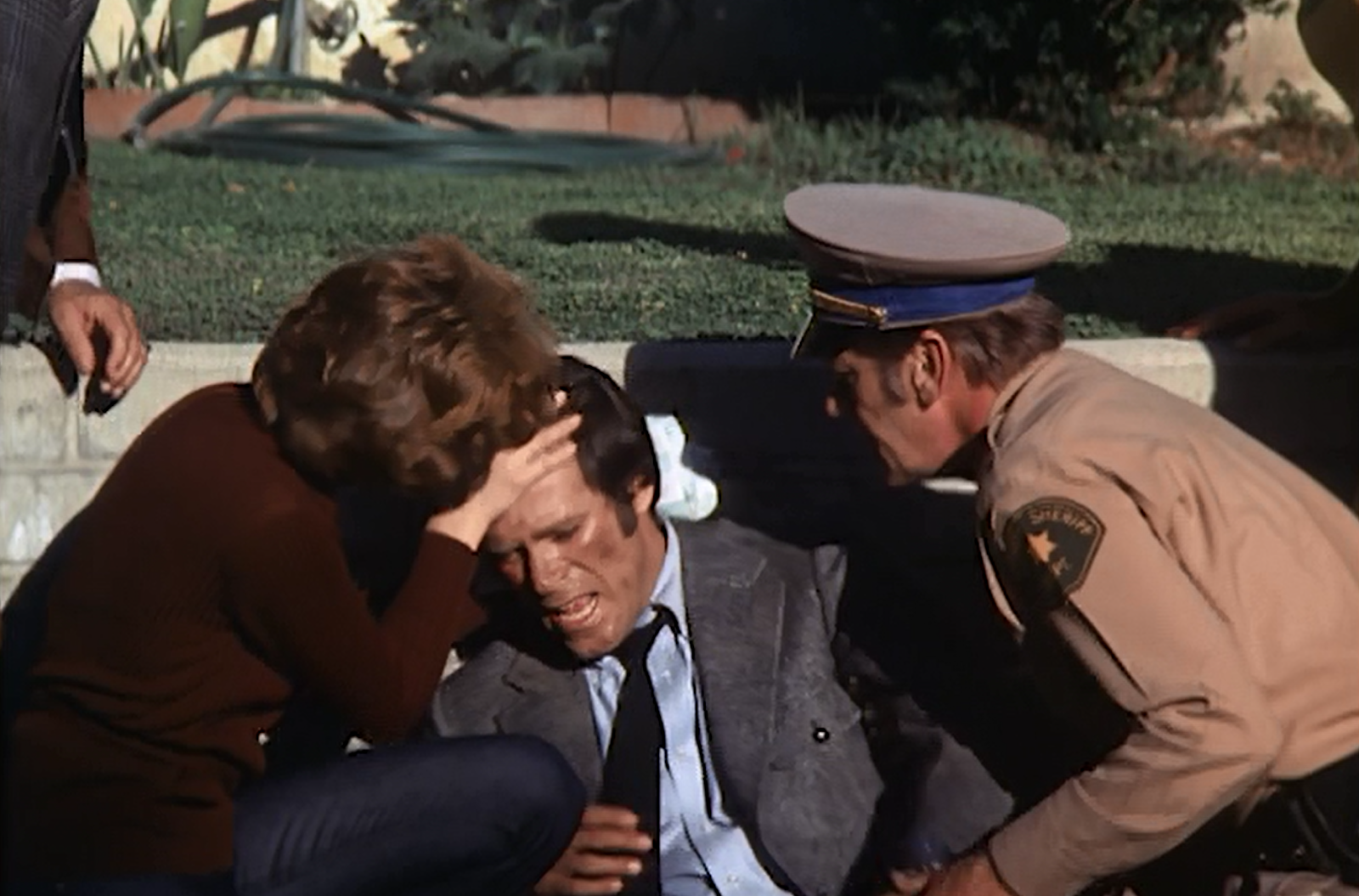
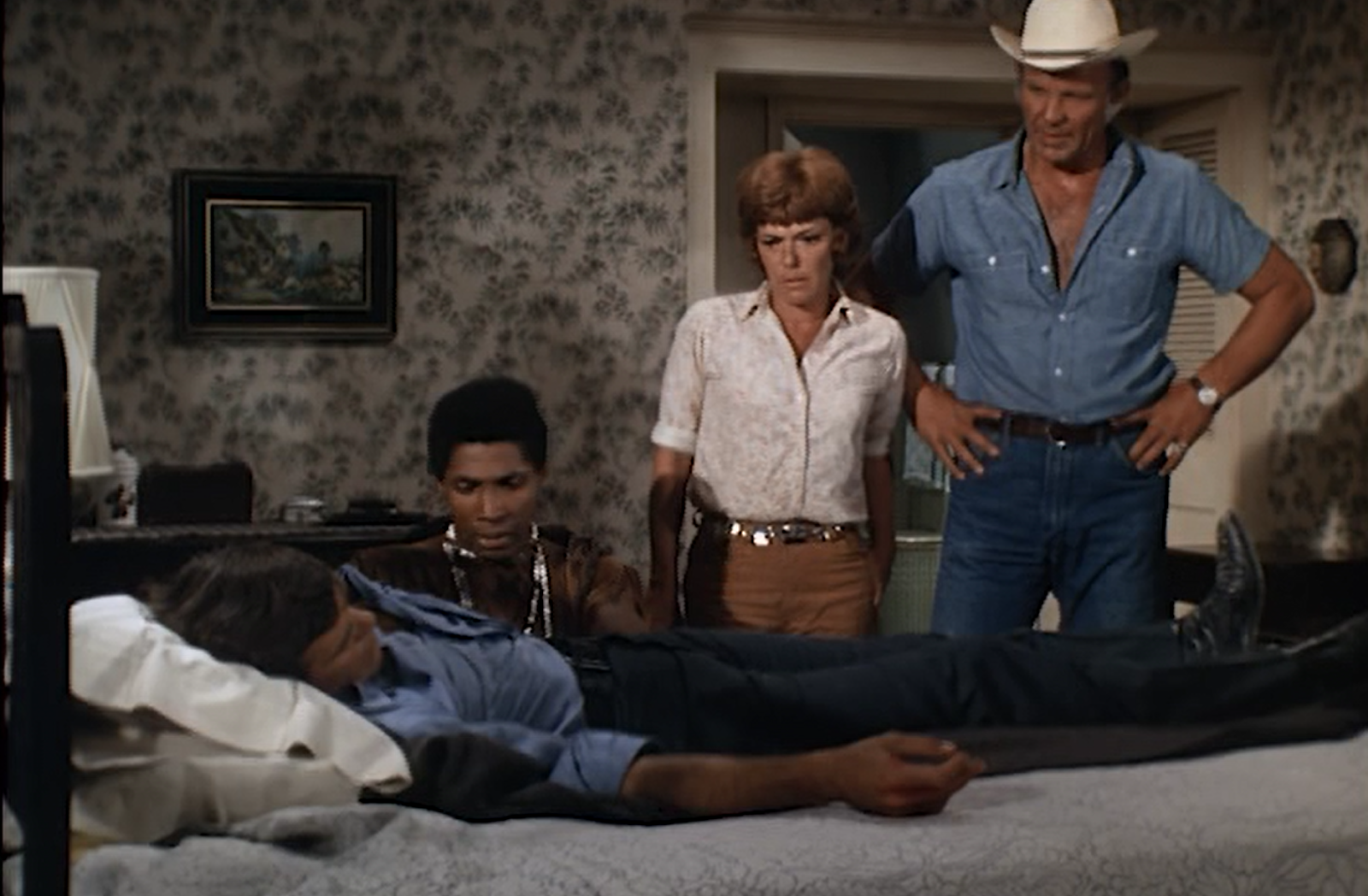
In “Brother’s Keeper,” Ben Richards (Christopher George) tracks down a man who could be his brother, Jason (Michael Strong). Unfortunately, Jason was in an accident some years earlier, and doesn’t recall if he is Ben’s brother, or not. This fact complicates their reunion.

Although Jason’s wife (Marj Dusay) is suspicious of the newcomer at first, Ben attempts to get the couple to leave their home and flee, before Fletcher (Don Knight) can locate them.

Unfortunately, Fletcher has already tracked Jason down via the orphanage where he and Ben were raised, and he offers Jason and his wife a deal to return to Maitland’s lab. Suffering under crippling debt, Jason agrees to Fletcher’s terms. 

Ben rescues Jason and his wife from captivity, but Fletcher is soon in hot pursuit.  During a scuffle, Jason is injured, and Ben realizes that Jason does not share the same special blood as his brother. 

Ben continues on his lonely journey…


“Brother’s Keeper” -- the final episode of the short-lived 1969-1971 series The Immortal -- is largely a bust. 

First of all, the episode was apparently aired out of sequential order by its network, and so not a legitimate “final” episode. The specific details of this narrative suggest that this tale occurs in the series continuity before “The Return.” 

In that episode, Fletcher notes that he and Ben have both visited the orphanage where he was raised for a time, and this episode shows those events. This episode also notes that Ben has not yet been “home,” to the family that raised him in his teenage years.  Those events are seen in “The Return.”

Even leaving aside the out-of-order airdate, “Brother’s Keeper” is a bit confusing. “The Return” suggests that Jason and Ben were raised by Joe, together, when they were both teenagers.  Yet here Ben doesn’t recognize Jason as the brother he was raised with.  This personal detail makes absolutely zero sense.  At most, it’s been fifteen years since Ben has seen Jason.  Jason may have amnesia at this point and not recognize Ben, but Ben would certainly recognize Jason!


Also, the episode brings absolutely no closure to the series’ themes or narrative, much in keeping with TV shows of the age.  Jason, we find out, may or may not be Ben’s brother.  However, he definitely does not bear the same type of “immortal” blood. So, we get no real answers about the “real” Jason, and this is just another episode (like “The Return” or “Paradise Bay”) where Ben encounters someone named Jason Richards, whom he believes, for a time, to be his sibling.  But again, there’s no certainty.

The episode also strains credibility at points. Jason and his wife are taken back to Maitland’s National Research Institute -- the belly of the beast, and Fletcher’s HQ -- and Ben effortlessly breaks in, rescues the couple, and breaks out.  Moment like these render the Fletcher character little more than the cliché of the “hapless pursuer.” His prey comes to him, faces incredible odds at his HQ, and gets away.  This is the point, obviously, where Maitland should fire Fletcher and get someone more competent to do the job.  The series has, overall, avoided having Ben engage in such crazy, suicidal heroic campaigns.

So The Immortal ends with a whimper rather than a bang, and yet I will admit it: it was totally worth it to watch this forty-five year old series. The production values were often outstanding, and some episodes (“The Queen’s Gambit,” “Man on a Punched Card,” “To the Gods Alone”) were great treasures.  I often cover series here on the blog, or in my books, that have survived the test of time.  They have endured beyond their original context and emerged as multi-generational favorites. Pretty clearly, The Immortal is not in this cherished camp, and remains an obscure, though intriguing series.  Apparently the culture has room for one “touchstone” of the man-on-the-run format, and that series is The Fugitive.  If I’m wrong, and it isn’t The Fugitive, it may be The Invaders, instead.  But it’s not The Immortal.

Despite the good episodes, The Immortal never manages to really overcome its formulaic nature, despite the occasional bright spots. As I wrote above, however, it was a treat to actually see the series for the first time, and to see some fine work on the part of choreographers, composers, writers, and directors, and the (late) Christopher George, and Don Knight.

It would be fascinating, I believe, to go back to James Gunn’s original book, The Immortal, and adapt that dystopian story utilizing modern special effects and sensibilities.

Next week, I move to a retrospective of another one season wonder: Kolchak: The Night Stalker (1974).

Thursday, April 12, 2018

Cult-TV Blogging: The Immortal: "Sanctuary" (January 7, 1971)


Fletcher (Don Knight) chases Ben Richards (Christopher George) onto a Native American reservation in the desert.

Richards’ dune buggy breaks down in that territory, and he is unexpectedly aided by the land’s rebellious youth, and its leader, Tsinnajinni (Sal Mineo).  He befriends Tsinnajinni, who has a bad impression of the white man, and his culture.

Meanwhile, Fletcher plans a full-scale assault on the reservation to attain his quarry. On the reservation, Richards attempts to repair his vehicle.


For my money, “The Sanctuary” is the least interesting episode of The Immortal (1969-1971) in the entire series run of sixteen episodes. The narratives trades in old clichés about Native Americans, fails to cast Native Americans in the central roles, and adds nothing to the series’ mythology…or even Ben Richards’ character.  The episode attempts to be progressive, I suppose, in some ways, but just ends up looking and sounding clichéd.  Time has done it no favors.

The episode begins with the non-Native American playing a Native American Sal Mineo making critical observations about white men and white society. “You’re always fighting a war for a cause,” he says with dissdain. This is not a small matter in the age of the Vietnam War. By episode’s end, however, we’re in straight-up “White Man’s Burden” territory as Richards lectures the young man about life in the city. He turns patronizing and asks him “Are you ready for it?” Who is he to decide, really? Is he ready for it? What has been his experience, based on what we’ve seen?

Also, the episode ends in hackneyed format with the leader of the Native American tribe offering to say a “chant” for Richards, as he continues his journey. It’s all clichéd, and condescending at the same time.


The worst part of the episode, however, is that it just plays as dull. We know Richards is going to win over Tsinnajinni, get his dune buggy working, and be on his way.  At this point, the almost-weekly love interest would have been welcome!

For me, the most unique aspect of the episode finds Fletcher bribing one of Richards’ white friends at a local auto repair shop for the use of a vehicle, so he can launch a full-scale attack on the reservation.  In this episode, Fletcher basically wages war, with vehicles, soldiers, and explosives against the Native Americans on the reservation.  This subplot actually does have some cultural currency for 1971.  Not only is it a callback to a grim chapter in American history, with westerners attempting to take the land of Native Americans, but it works as a metaphor, of sorts, for Vietnam, with soldiers bringing their advanced war technology to another culture, without really understanding the “enemy” or the terrain. 

But this idea, like most in “The Sanctuary” is not very well-explored.

Next week: the final episode of The Immortal: “Brother’s Keeper.”

Thursday, March 29, 2018

Cult-TV Blogging: The Immortal: "To the Gods Alone" (December 31st, 1970).


In “To the Gods Alone,” Ben Richards (Christopher George) is trapped in a wintry log cabin with his pursuer, Fletcher (Don Knight), about to be delivered to Maitland.

In close proximity to each other for a sustained period -- for the very first time -- Richards shares the story of Jordan Braddock’s (Barry Sullivan) last days.

Early in his “run,” Richards had been captured, and then found himself forced to help the aging millionaire, and CEO of Braddock Industries.  Dying of old age, and fearing senility and dementia, Braddock begged for help, seeking to know Richards’ price for helping him.

Then -- as now – Richards proved that he had no price. He couldn’t be bough. But what he did have was a sense of decency. After first leaving Braddock in the custody of two dangerous rednecks, he returned to save his tormentor, and even went so far as to give Braddock the blood transfusion he so desperately needed.

In the end, however, Braddock did not survive, and Fletcher was forced to find a new employer in Maitland.


One of the things I cherish most about The Immortal (1969-1971), is its occasional ability -- despite a rusty and repetitive premise -- to totally surprise (and thus impress…) the audience. 

This episode, “To the Gods Alone” was veritably thrown away by the network with an airing on New Year’s Eve of 1970, when no one would have been watching TV.  And yet it is, in so many ways, “To the Gods Alone” is one of the best episodes of the series.

“To the Gods Alone” has one foot in TV’s past, and one in its future. In terms of the past, the episode is nearly a “my enemy/my ally” tale, with Fletcher and Richards trapped together in a snow-bound cabin. Similarly, the story proceeds via flashback, a tried-and-true TV technique.

But in terms of the future, the episode remembers that this series has a history, and a continuity. Specifically, Braddock is the man who hunted Richards in the original, highly-rated pilot movie. In the series, he is replaced with (the less-interesting) Maitland. All we really need to know to understand the series is that Braddock is dead, and Maitland is his replacement.

But “To the Gods Alone” goes further than that, and explains what happened to Braddock, in his final days. Most of the episode is spent with Braddock and Richards together in a rural area, attempting to survive, and see which of them can gain the upper hand. Their dynamic is best dramatized in the back-and-forth dialogue between the two stubborn men. Braddock states “I want to live.” Richards replies “I want to be free.”  Between those two extremes, the audience wonders if compromise is possible, beneficial, or necessary.

Ultimately, the episode humanizes Braddock. He is a selfish, greedy man who wants more life, and our first instinct might be to conclude that he has done nothing to make us feel he deserves to go on living.  This episode, however, makes us feel sympathy for the man. When sick and dying, Braddock calls out for Miriam, his dead sister, and the only person who genuinely loved him, or cared for him.  Braddock possesses all the material riches of the world, but none of the emotional ones.  Perhaps he wants more life because, as he suggests, there is some part of his life that is still empty. He has lived so many years, and accumulated so many things, and still his time on this mortal coil feels incomplete to him.

It’s fascinating too, the way that Braddock talks about selfishness in this episode.  There’s nothing wrong with selfishness,” he tells Richards. Rather, he claims, it is the very thing that drives men towards “achievement.”  In this episode, we are able to see that the viewpoints of both men -- Braddock and Richards – come from a place of selfishness.

Braddock wants more life, at all costs. Richards wants to be free at all costs, even when his blood could save people.

Neither man is a saint.

Perhaps that is why, in the final scenes, Richards relents and agrees to a transfusion for Braddock.  He has started to understand where his need for freedom ends and his selfishness begins.  Compassion is an insidious thing,” Braddock says, and yet Richards proves here his compassion, even for his enemy, on two occasions.  First, he saves Braddock from the rednecks, secondly, he attempts to transfuse him (before tragedy strikes).

The truly great thing about this episode is that when it ends, we have a better and deeper understanding of these two important characters, both Braddock and Richards. Richards realizes that he can’t hold onto hate and selfishness. And Braddock realizes how much he has missed in life, and yet must face his greatest fear: death.

Fletcher gets a meatier part here than usual, but doesn’t reveal any great depths, alas. He’s a gun for hire, a man hired to do a job, and that’s about it. His commitment is to the man (or woman) paying him at the moment.  For Fletcher, selfishness has eclipsed compassion totally in his psychological gestalt.


“To the Gods Alone” is a story that The Immortal might not have told -- and strictly speaking, probably didn’t need to tell -- but I’m glad it did. It fills in an important gap in Richards’ narrative and history, and brings closure to one of the most memorable and important characters featured in the property.


And on top of these virtues, the great Bruce Dern guests here as a surly, avaricious redneck. What more could anyone want?

Next up: “Sanctuary.”

Thursday, March 22, 2018

Cult-TV Blogging: The Immortal:"The Return" (December 17, 1970)


In “The Return,” Ben Richards (Christopher George) returns home to the small town where he and his brother, Jason, were raised after leaving an orphanage.

Their adoptive father is Joe Carver (Richard Ward), an African-American man who owns a gas-station and auto-shop. Joe is happy to see Ben again, but has no information on Jason’s current whereabouts. He is also hurt that Ben has not visited him for six long years.

Soon, Joe is accused of assaulting a white boy, Steve -- the son of his best friend, Roy Adkins (Harry Townes).  The boy will not survive his injuries, according to Dr. Arliss (Ted Knight), unless Ben can transfuse him with his special blood. Joe refuses to talk about the incident, or defend himself from legal jeopardy. But he is not a violent man by nature or inclination.

Ben stays in town to learn more and help Joe, but Fletcher (Don Knight) and his newly hired mercenaries know where he is. Fletcher insists that “emotions are every man’s worst enemy,” and proceeds to capture Ben.

Ben escapes from custody after shrugging off the effects of a tranquilizer dart, and learns the truth from his adoptive father. The boy, Steve Adkins, wants to marry Joe’s daughter -- Ben’s adoptive sister --Carol (Marlene Clark), and their discussion about it grew heated. Steve fell and injured his head in the accident, so Joe is innocent of assault charges. 

The Adkins and Carver families reconcile as Steve recovers, and Ben must head on his way with a final gift from Joe: a car to drive on his cross-country travels.


On one hand, it is rewarding that Ben Richards’ youth and background is examined in “The Return.”  It is also refreshing that the episode takes such a progressive view of family relationships, and reveals that Ben is the adopted son of a black man.  On the other hand, however, this installment still feels a bit like the formula, with Ben showing up in a town, saving a life, solving a problem, and the story raising a social issue.

Still, credit where credit is due: it was a courageous choice in 1970 to have the lead protagonist of a series be from an interracial family. Today, I hope we don’t look twice at an arrangement like this, but such family relationships were not the norm at the start of the disco decade. Consider, this episode aired years before All in the Family premiered, and brought discussions of race (and racism) part of the national conversation.


The social currents in the episode are fascinating to watch, by today’s standards. Joe has spent his life as a crusader for African-American equality and civil rights, and he experiences a burst of anger when Steve calls him an “Uncle Tom.”  We get this story from Joe, but sadly, the episode doesn’t have the courage to show us that scene.  In fact, the interracial lovers -- Steve and Carol -- don’t have a single scene of dialogue together. He’s comatose in the hospital, throughout.

So, the story gets credit for tackling an issue -- interracial tensions and family dynamics in 1970 America -- but the way it tackles that issue isn’t always great.  I will say this, the episode offers a strong depiction of Joe Carver, as a man of integrity and morality, who finds himself navigating unexpected and surprising territory in his family.

Outside the central story, Fletcher gets a larger-role than usual in “The Return.” The episode begins with him briefing his mercenaries about Richards, and about the belief that he will return to his childhood home, because he is hobble by emotions. Later, he and Richards interact more here than they have since the very first episode of the series, following the pilot, “Sylvia.”   At one point, Fletcher dons a blue jacket, and with his short 1970 haircut looks a bit like Ed Straker from Gerry Anderson’s UFO.


But back on point, Fletcher discusses how emotions hobble Ben, and make him easy prey. His theory is proven true, as Richards risks everything to help the man he considers his Dad. This material all works fairly well, since Ben isn’t always emotionally invested in the encounters of the week.  On the other hand, it is odd that Fletcher doesn’t appear in the latter half of the episode, to continue his pursuit of Richards. He captures Richards. Richards escape. And then Fletcher disappears, even though he knows exactly where Richards is headed (back to Joe).

At least there’s no romance shoe-horned in this week.  Finally, I wonder if this episode was produced early, and held back to be aired later in the season. Some of the chase scene in this episode is excerpted in the opening credits each week.

Next week: “To the Gods Alone.”

Thursday, March 15, 2018

Cult-TV Blogging: The Immortal: "Paradise Bay" (December 10, 1970)


Ben Richards (Christopher George) visits a strange coastal ghost town called Paradise Bay, where his brother -- or a man with his brother’s name -- Jason Richards, was last seen.

Once in the ghost town, however, Ben encounters a group of strange, secretive and unfriendly individuals, including Arthur Cameron (Howard Duff): an industrialist who claims to own the town. Cameron claims that Jason Richards died in a scuba diving accident. And Cameron also controls the local sheriff, who takes an instant dislike to Ben.

Ben also meets beautiful twins Nancy and Julie Dudley (Tisha Sterling) in Paradise Bay.  Nancy owns a local motel, and seems stable, but Julie is a free-spirited, slightly unstable sort, one who was in love with Jason.

Ben digs to discover the truth about Paradise Bay, wondering if Jason, working for Amity Development, learned that the bay had been contaminated by Cameron’s chemical factories. 

When Ben finally learns the truth about Jason’s fate, however, it is somewhat different than what he expected.


“Paradise Bay” opens with a surfeit of atmosphere or mood. Ben Richards arrives alone in a scene ghost town (motto: “A Happy Place to Live”), and it quickly proves far from welcoming. The local sheriff is threatening, and Ben even finds his (apparent) brother’s tombstone in the local cemetery.  

Soon, the audience meets twins, and a gang of violent surfers, who want to do Ben harm.  The near empty nature of the town makes for a creepy and effective backdrop to the narrative.

Overall,”Paradise Bay’s” opening act is weird and unusual, and therefore promising, in terms of The Immortal’s repetitive nature. For a while, it looks like the series is actually going to address the mystery of Ben’s brother, and more.

But it’s all a (not-so-clever) misdirect, and a lead-up to disappointment. 

This Jason Richards is not Ben’s long-lost brother, rather but an “only child.” And the mystery behind Paradise Bay is a lot less interesting than the ghost town environs first suggest. 

Without giving too much away, all the material about Cameron dumping chemicals in the bay and poisoning it is but a red-herring.  The solution to the week’s mystery is grounded in the twins, and a very 1970’s interpretation of mental illness.

The remaining townspeople, including Nancy, you see, are protecting Julie. Apparently, she did love Jason, but she also killed Jason. The schizophrenic Julie hit him on the head with a rock during a game of hide and seek on the beach. Ben susses this information out of her by pretending to be Jason in the final act, and the whole reveal is largely underwhelming, even though set against the picturesque beach.

By being loose and free spirited, apparently, Julie is actually expressing some serious type of mental illness. She doesn’t seem sick or disturbed, actually just, well, young, uninhibited and a bit naïve.  The townspeople are aware of Julie’s crime, and are protecting her. That is the grand conspiracy of Paradise Bay. Rather than give up the money they would receive by selling the town, they decide to keep Julie’s condition (and murderous behavior) a secret.  As Ben points out, she badly needs “professional help.”


Then, out of the blue, “Paradise Bay” ends with Ben Richards bedding Nancy at her motel. Literally a girl in every port! Every single week! 

I suppose it could have been worse. He could have bedded Julie, the free-wheeling, free-spirited schizophrenic.

So, “Paradise Bay” opens in high style, and feels unlike any other The Immortal episode thus far.  It closes, however, in un-inventive and familiar fashion.

Next week: Ben Richards goes home in “The Return.”

Thursday, March 08, 2018

Cult-TV Blogging: The Immortal: "Dead Man, Dead Man" (December 3, 1970)


Continuing his flight from Fletcher and captivity, Ben Richards (Christopher George) gets a lift in the desert from a police detective from Philadelphia named Tom McWade (John Garwood). 

After a terrible car accident on a winding road, McWade is killed, but Richards is thrown from the car and survives.

Richards wakens in the nearby town of Vernal Park, where the local sheriff (Byron Keith) has mistaken the fugitive for the police detective. With Fletcher hot on his heels, Ben goes along with the case of mistaken identity, pretending to be McWade until he can escape from town.

However, matters get complicated when Richards learns why McWade was headed to Vernal Park in the first place: to arrest the town doctor, Dr. Kinneson (Henry Beckman). 

Kinneson has been practicing medicine without a license, only pretending to be a qualified M.D.  The townspeople, however, love their doctor dearly, and are out to get McWade for arresting him.

Now, Richards’ plan to masquerade as McWade could have fatal consequences for him.


“Dead Man, Dead Man” is a clever episode of The Immortal (1969-1971), though it is another story that focuses on strangers instead of the lead character, Ben Richards.  However, in some sense, this story is actually about Ben Richards; or at least the life that Ben Richards has selected for himself.

Specifically, Ben Richards in “Dead Man, Dead Man,” pretends to be someone he is not, so that he can survive, and “live free” as he chooses.

He encounters a man, Dr. Kinneson, who has done precisely the same thing. Kinneson wants to heal people, but taught himself how to be a doctor.  He is not, however, a real physician, and only pretends to be one.

In both cases, the pretender must hide, or run, or otherwise escape from a judgmental society.  In this story, Ben starts to feel like a hypocrite for his behavior, pretending to be a cop tracking down an innocent man. He knows what it is like to be an innocent man on the run, after all.  At one point, Kinneson tells Richards that his whole life has just been a “series of roles,” and this is certainly a comment that Ben can identify with.


In choosing to “live free,” and run, ironically, both men have actually selected lives in which they are trapped, unable to find peace or respite.

During the moments when “Dead Man, Dead Man,” draws parallels between Kinneson and Richards, it is a successful and dramatic installment of this short-lived series. Kinneson’s plight gives us a new insight on Richards’ plight, without Richards having to lament it himself.  At the end of the story, Kinneson tells Richards “there are so few of us free souls left,” and it’s a fascinating point to make.   I’m not certain it is accurate, however.

Are Kinneson and Richards really free at all?

Some elements in “Dead Man, Dead Man” don’t work as well as the comparison between characters. For instance, the whole town is against Richards, thinking he is a police officer. A town nutcase, Van Ryerson, even tries to kill him. This seems a bit over the top.


Even someone who likes and appreciates the good doctor (and whose son was saved by the doctor) is not likely to become homicidal, and attempt to kill a police officer.

Finally, we get yet another romance this week.

The sheriff’s sister, Helen (Joan Hotchkis), is a widower, and let’s just say that she has not had, well, the comforts of a husband for some time. Though Ben reminds Helen that he is “just passing through,” he nonetheless goes to bed with her, after initially resisting the impulse to do so. 


The episode is surprisingly straightforward and frank about this relationship and what’s involved. There’s no talk of love, or staying together, or the long term.  The relationship is very....transactional, I suppose one might conclude. Helen needs a man, and Richards is ready and willing.  Still, this seems the most knowingly casual hook-up for Richards on the series thus far.

Next week: “Paradise Bay.”

Thursday, March 01, 2018

Cult-TV Blogging: The Immortal: "By Gift of Chance" (November 19, 1970)


In Mexico, Ben Richards (Christopher George) is attacked and shot in an alley.

The badly wounded immortal is aided by Garland Colley (Herbert Jefferson Jr.), a drifter who offers to help him get across the border to America using an ‘underground railroad’ of sorts for illegal immigrants.

Once across the U.S. border, however, Ben and Colley are quickly sold into servitude at a tomato ranch, where a draconian task masker, Loomis (Michael Conrad) works his field-hands to death, even exposing them to a toxic pesticide. Loomis’s prized crop is under attack from pin-worms, and the workers, who have no rights because of their illegal status, have no voice in the matter.  They can work, and die. Or they can refuse to work, and also die.

As Ben recovers from his injuries, he learns he is at the Henderson Ranch, and that Loomis is just as brutal to the owner of this “hard-scrabble farmland” as he is to the workers: Alpha Henderson (Jacqueline Scott).   

After Colley dies, saving Richards’ life a second time, Ben and Alpha work together to stop Loomis from his continued exploitation. They burn down the tomato crop, destroying Loomis’s ability to harm any others so he can make a profit.


Well, after last week’s compelling episode “The Queen’s Gambit,” it’s back to business as usual on The Immortal (1969-1971) in “By Gift of Chance.”

Once more, the audience finds Ben Richards in an adventure that has absolutely nothing to do with his unique blood, or unusual situation.  Instead, he’s just the generic man on the run, encountering people, this time immigrants, who need his help.

As we have come to expect, there’s also a romance (or pseudo-romance, this week), with the female guest star of the installment, and a touch of social commentary too. In regards to the latter quality, “By Gift of Chance” is certainly timely, since it involves illegal immigration, and exploitation of immigrants, once they have arrived in the United States. Because of their illegal status, they are easily manipulated and mistreated by unscrupulous business interests

“By Gift of Chance” is enlivened, largely, by the presence of a sci-fi cult-TV favorite, Herbert Jefferson Jr., who played Boomer on the original Battlestar Galactica (1978-1979), and is this week’s sacrificial lamb character. 


The sacrificial lamb, in case you are wondering, is the character in series such as this one whose decency and friendship -- and then untimely death -- lead the rugged man-on-the-run to act affirmatively for the defense of others. 

We had a sacrificial lamb type named Charley a few weeks backed in “The Rainbow Butcher.”

At this point, all the story and character elements: man on the run, hapless pursuer, female love interest, and sacrificial lamb are so firmly ensconced in the formula that episodes of The Immortal seem to write themselves. That’s the greatest disappointment of this series, no doubt: the utter reliance on an old formula.

Sooner or later, that mortgage payment comes due” one character laments in “By Gift of Chance,” and I can apply that statement to The Immortal, as well. The series relies so heavily on a tired formula that many weeks the episodes are just time-wasters.  We learn nothing about Ben. We learn nothing about his condition. We learn nothing about his future, either. 

But here’s the thing that really vexes me when I think about the series: are episodes like “Man on a Punched Card” or “The Queen’s Gambit” only so strong because of the fact that most other episodes are run-of-the-mill man-on-the-run tropes like “By Gift of Chance?”


Would the good episodes even register as such without all the formulaic ones?

I don’t know for sure, but this week, while watching, I thought of how imaginative The Immortal could have been. Each episode could have jumped ahead a decade or so since Ben Richards could have been the same age, in each decade, and there would have been no need to use old-age make-up on Christopher George.

It would really be fascinating to catch up with him twenty, or thirty years, into his fugitive run.  Of course, Fletcher would have aged at a much faster rate.


Next week: “Dead Man, Dead Man.”

Thursday, February 22, 2018

Cult-TV Blogging: The Immortal: "The Queen's Gambit" (November 12, 1970)


A beautiful and duplicitous double agent, Sigrid Bergen (Lee Meriwether), captures Ben Richards (Christopher George) and then stages his death, so that Fletcher (Don Knight) will call off the hunt for the immortal,

Then, Sigrid flies Ben via helicopter to the remote estate of millionaire Simon Brent (Nico Minardos), who wishes to study Ben’s blood, and produce medicine that will cure the world of disease, and perhaps even old age.

As Ben soon discovers, escape seems impossible as the estate is heavily patrolled, and geographically isolated. Ben attempts to get a message out via a visiting doctor, but fails.

Sigrid, however, begins to develop an affection for her former prey, and teams with Richards to help him escape.


“The Queen’s Gambit” is likely my favorite of all The Immortal (1969-1971) episodes produced since the pilot. It features a terrific central performance from Lee Meriwether as a mercenary who, for a considerable time, outsmarts Ben Richards, Fletcher, and even her employer, Brent. 

Meriwether is a beloved cult-TV actress (Time Tunnel [1966]; Batman: The Movie [1966], Star Trek: “That Which Survives”) but I’ll go on record as stating that The Immortal gives the actress an opportunity to deliver her most dynamic (and sexiest) performance in this medium. 


Although Sigrid eventually succumbs to Ben’s charms -- as every single woman on the series must, at some point -- she is otherwise depicted as a brilliant tactician and expert in her field. Sigrid is one of the most imposing antagonists Ben has yet faced, even if that antagonism gives way, eventually to sexual attraction.  

On that front, I will merely note that Meriwether and George boast good romantic chemistry here, and that such chemistry hasn’t always been the case for the romance-of-the-week.

“The Queen’s Gambit” is such a strong episode, no doubt, because it isn’t some random story about Ben Richards arbitrarily walking into a ranching conflict, or randomly encountering a corrupt sheriff. It’s a story actually about Ben, his predicament, and his life choices. There is some excellent dialogue in this episode about the fact that, from a certain perspective, it is selfish of Richards to continue to run rather than making a pro-social use of his unusual blood.

At first Ben says “I’d like to be free to decide what I want to do with my life,” but it’s clear that the arguments for helping the human race have an impact on him.His stubbornness is reinforced, ultimately, by the fact that Brent -- like Maitland -- is more concerned about himself than humanitarian causes.  Brent isn’t so much concerned that everyone “share” Richards’ blood, so much as he is concerned that he reap the rewards.

There's even a discussion of immortality in this episode -- what it means, how it could change things -- and if you have watched The Immortal you know this subject almost never comes up.


“The Queen’s Gambit” succeeds, as well, because of its twisting narrative. The episode starts with Ben encountering Sigrid seemingly at random. Then the audience sees her attempting to cash in, with Fletcher, for the reward.  This too, however, is a carefully set-up ruse to throw Fletcher off Richards’ scent.  Basically, Sigrid is a version of Fletcher, only a competent (and better looking) one.  I should add that, unlike Fletcher, she has a conscience and comes to regret imprisoning a man for what could be an eternity. Then, there's another twist, Sigrid's change of allegiance, and the final whammy: Brent's estate isn't on another continent after all, by outside Los Angeles!

So many The Immortal episodes are just re-heated versions of tales already featured on The Fugitive (1963-1967).  “The Queen’s Gambit” is a high point in the catalog because it feels individual to the series, because Meriwether's performance drives the drama, and because surprises drive each plot twist.

Next week, we’re back to random adventuring in “By Gift of Chance.”